Grade 11 Chemistry Revision
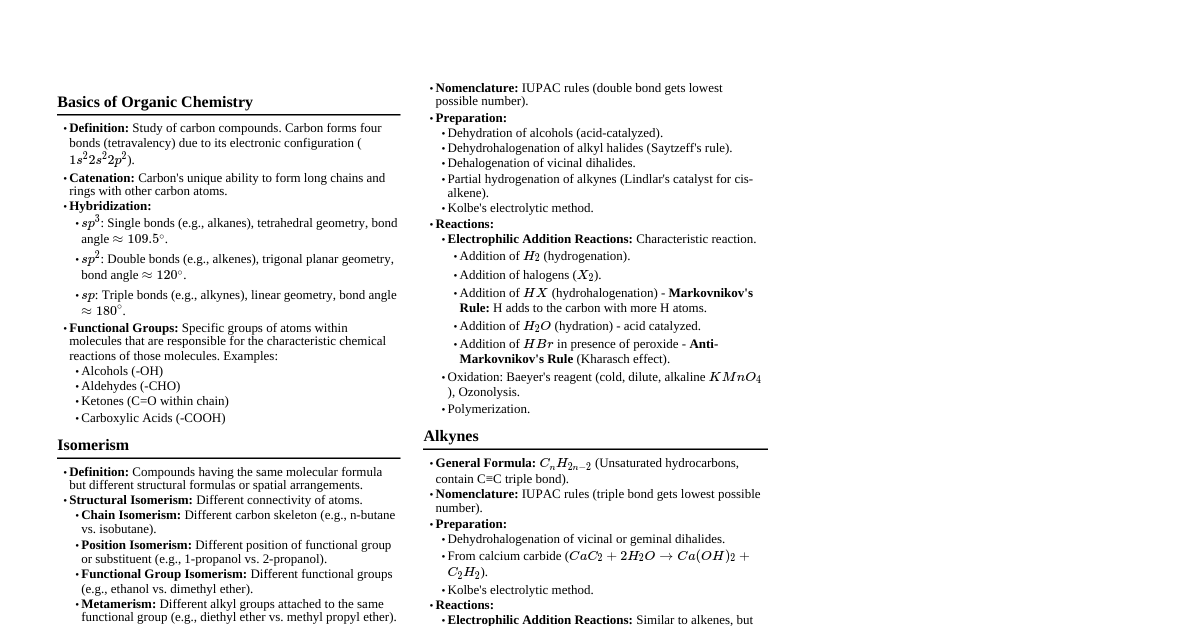
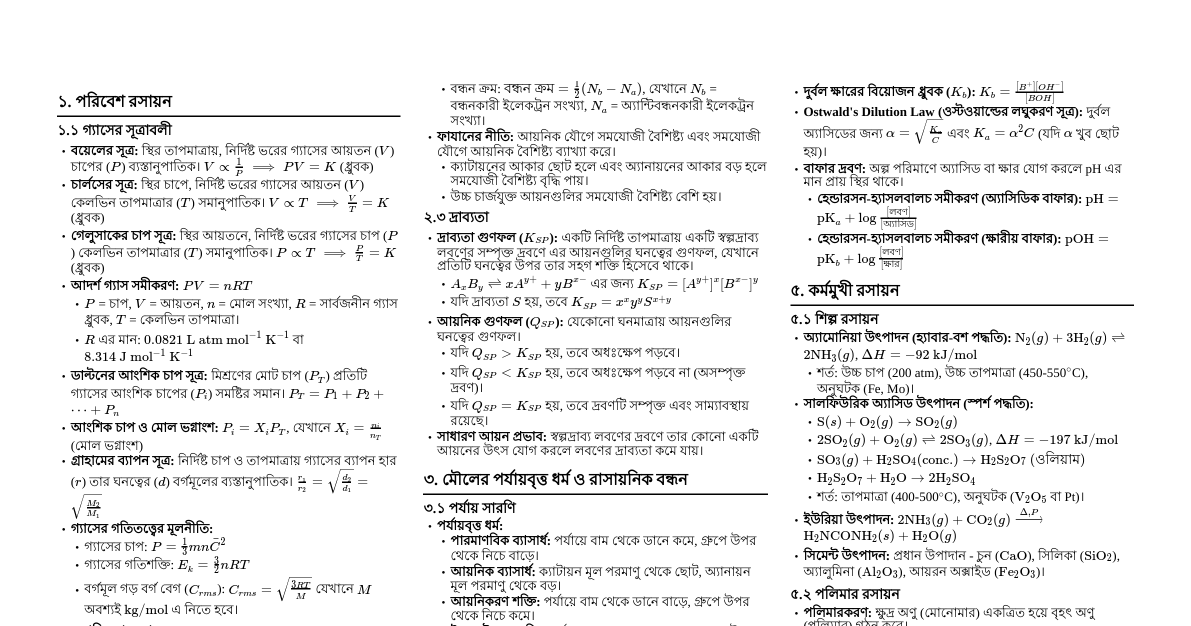
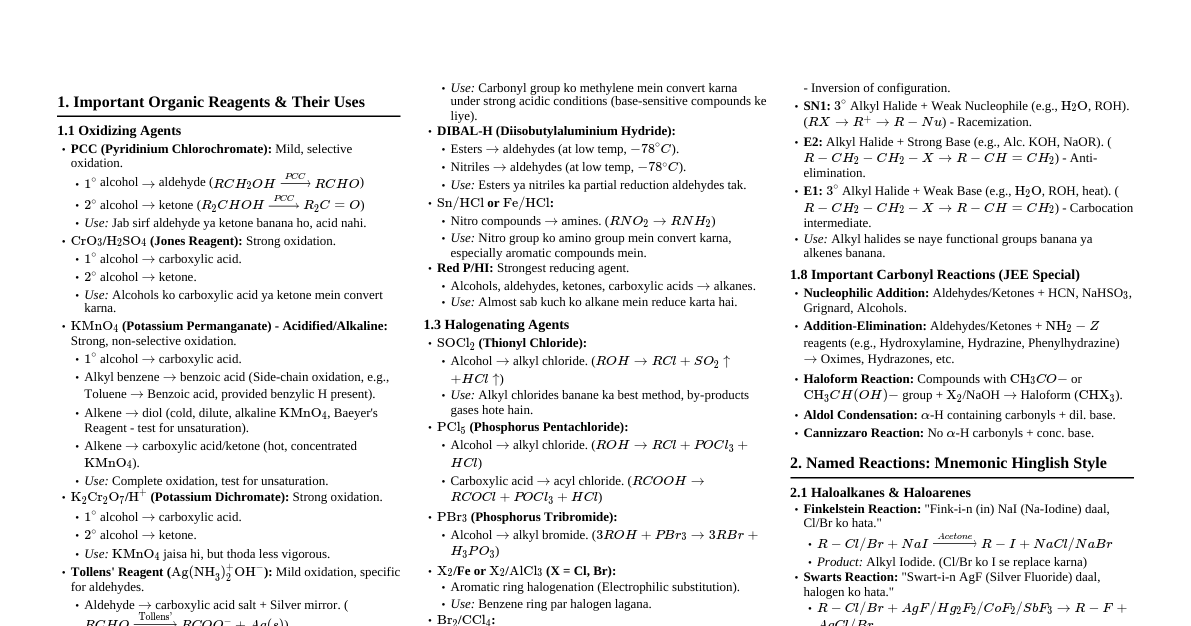
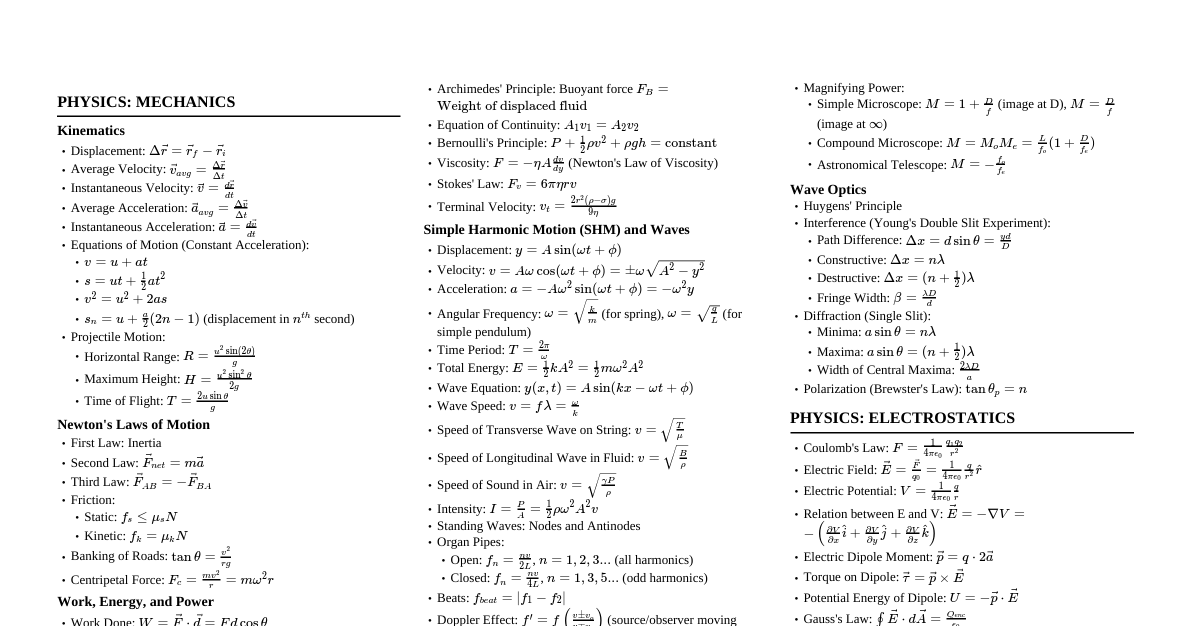
Cheatsheet Content
# Chemistry Revision Guide — Grade 11 ## Table of Contents 1. **Syllabus Overview** * Chapter List & Weightage * Prioritization Guide * Estimated Revision Time 2. **Chapter-by-Chapter Notes** * [Chapter 1: Basic Concepts of Chemistry](#chapter-basic-concepts) * [Chapter 2: Chemical Stoichiometry](#chapter-stoichiometry) * [Chapter 3: Atomic Structure](#chapter-atomic-structure) * [Chapter 4: Chemical Bonding and Molecular Structure](#chapter-chemical-bonding) * [Chapter 5: States of Matter](#chapter-states-of-matter) * [Chapter 6: Chemical Energetics](#chapter-chemical-energetics) * [Chapter 7: Chemical Equilibrium](#chapter-chemical-equilibrium) * [Chapter 8: Acid, Base and Salt](#chapter-acid-base-salt) * [Chapter 9: Redox Reactions](#chapter-redox-reactions) * [Chapter 10: Hydrogen](#chapter-hydrogen) * [Chapter 11: s-Block Elements](#chapter-s-block) * [Chapter 12: p-Block Elements](#chapter-p-block) * [Chapter 13: Organic Chemistry: Basic Principles](#chapter-organic-basic) * [Chapter 14: Hydrocarbons](#chapter-hydrocarbons) * [Chapter 15: Environmental Chemistry](#chapter-environmental) 3. **Important Questions Bank** 4. **Formula & Fact Sheet** 5. **Mind Maps & Summaries** 6. **Past Exam Trend Analysis** 7. **Practice Test** 8. **Exam Day Strategy** ### SECTION 1 — SYLLABUS OVERVIEW Welcome, future Chemistry ace! This section will give you a bird's-eye view of your Grade 11 NEB Chemistry syllabus, helping you strategize your revision effectively. #### 1.1 Full Chapter/Unit List with Weightage (Marks Distribution) Understanding the **marks distribution** is crucial for smart preparation. Focus more on chapters with higher weightage, but don't neglect the smaller ones! | S.N. | Chapter | Marks Distribution (Approx.) | | :--- | :---------------------------------------- | :--------------------------- | | 1 | Basic Concepts of Chemistry | 4-6 | | 2 | Chemical Stoichiometry | 6-8 | | 3 | Atomic Structure | 6-8 | | 4 | Chemical Bonding and Molecular Structure | 8-10 | | 5 | States of Matter | 6-8 | | 6 | Chemical Energetics | 6-8 | | 7 | Chemical Equilibrium | 6-8 | | 8 | Acid, Base and Salt | 8-10 | | 9 | Redox Reactions | 4-6 | | 10 | Hydrogen | 4-6 | | 11 | s-Block Elements | 6-8 | | 12 | p-Block Elements | 8-10 | | 13 | Organic Chemistry: Basic Principles | 8-10 | | 14 | Hydrocarbons | 8-10 | | 15 | Environmental Chemistry | 4-6 | | | **Total** | **100** | #### 1.2 A "What to Prioritize" Guide Based on Exam Frequency ⭐ **High Priority Chapters (High Marks, Frequent Questions):** * **Chemical Bonding and Molecular Structure:** Fundamental, often combined with other topics. * **Acid, Base and Salt:** Core concepts, calculations, and reactions are frequently tested. * **Organic Chemistry: Basic Principles & Hydrocarbons:** Forms the foundation of organic chemistry, always has significant questions. * **Chemical Stoichiometry:** Numerical problems are a staple. * **Atomic Structure:** Theoretical questions and quantum numbers are common. * **p-Block Elements:** Detailed study of important elements and compounds. 🔁 **Medium Priority Chapters (Moderate Marks, Regular Questions):** * **Chemical Energetics:** Enthalpy changes, Hess's Law calculations. * **Chemical Equilibrium:** Le Chatelier's Principle, Kp/Kc calculations. * **States of Matter:** Gas laws, intermolecular forces. * **s-Block Elements:** Properties and reactions of alkali and alkaline earth metals. 💡 **Lower Priority Chapters (Fewer Marks, but Essential Basics):** * **Basic Concepts of Chemistry:** Foundational, but direct questions might be less frequent. * **Redox Reactions:** Balancing equations, oxidation states. * **Hydrogen:** Preparation, properties, uses. * **Environmental Chemistry:** Important for general knowledge, direct questions are usually theory-based. #### 1.3 Estimated Revision Time Per Chapter This is a general guide. Adjust based on your comfort level with each topic. | S.N. | Chapter | Estimated Revision Time (Hours) | | :--- | :---------------------------------------- | :------------------------------ | | 1 | Basic Concepts of Chemistry | 3-4 | | 2 | Chemical Stoichiometry | 5-6 | | 3 | Atomic Structure | 5-6 | | 4 | Chemical Bonding and Molecular Structure | 6-8 | | 5 | States of Matter | 4-5 | | 6 | Chemical Energetics | 5-6 | | 7 | Chemical Equilibrium | 5-6 | | 8 | Acid, Base and Salt | 6-8 | | 9 | Redox Reactions | 3-4 | | 10 | Hydrogen | 3-4 | | 11 | s-Block Elements | 4-5 | | 12 | p-Block Elements | 6-8 | | 13 | Organic Chemistry: Basic Principles | 6-8 | | 14 | Hydrocarbons | 6-8 | | 15 | Environmental Chemistry | 3-4 | | | **Total Estimated Revision Time** | **~75-95 Hours** | **💡 Tip:** Break down your revision into smaller, manageable chunks. Use the Pomodoro technique (25 min study, 5 min break) for optimal focus! ### SECTION 2 — CHAPTER-BY-CHAPTER NOTES This section provides detailed notes for each chapter, designed to cover all crucial aspects for your exam. #### Chapter 1: Basic Concepts of Chemistry ##### a) Key Concepts & Definitions * **Chemistry:** The branch of science that deals with the composition, structure, properties, and reactions of matter. * **Matter:** Anything that has mass and occupies space. Classified as mixtures (homogeneous/heterogeneous) or pure substances (elements/compounds). * **Element:** A pure substance consisting only of atoms that all have the same numbers of protons in their atomic nuclei. * **Compound:** A pure substance composed of two or more different elements chemically bonded together in a fixed ratio. * **Atom:** The smallest unit of an element that retains the chemical identity of that element. * **Mole:** The SI unit for amount of substance. One **mole** contains **Avogadro's number** ($6.022 \times 10^{23}$) of particles (atoms, molecules, ions, etc.). * **Molar Mass (M):** The mass of one mole of a substance, expressed in grams per mole (g/mol). Numerically equal to the atomic/molecular mass in amu. * **Percentage Composition:** The percentage by mass of each element in a compound. * **Empirical Formula:** The simplest whole-number ratio of atoms in a compound. * **Molecular Formula:** The actual number of atoms of each element in a molecule of the compound. ##### b) Important Formulas / Laws / Rules 1. **Mole Calculation:** * Number of moles ($n$) = $\frac{\text{Mass (g)}}{\text{Molar Mass (g/mol)}}$ * Number of moles ($n$) = $\frac{\text{Number of particles}}{\text{Avogadro's Number (N_A)}}$ * Number of moles ($n$) = $\frac{\text{Volume of gas (L) at STP}}{22.4 \text{ L/mol}}$ (for ideal gases) 2. **Percentage Composition:** * $\% \text{ of element} = \frac{\text{Mass of element in compound}}{\text{Molar mass of compound}} \times 100\%$ 3. **Relationship between Empirical and Molecular Formula:** * Molecular Formula = $(Empirical \text{ Formula})_n$ * $n = \frac{\text{Molecular Mass}}{\text{Empirical Formula Mass}}$ ##### c) Step-by-step Solved Examples **Example 1: Mole Calculation** Calculate the number of moles in 49 g of $\text{H}_2\text{SO}_4$. (Atomic masses: H=1, S=32, O=16) **Solution:** 1. **Calculate Molar Mass of $\text{H}_2\text{SO}_4$**: * Molar mass = $(2 \times 1) + (1 \times 32) + (4 \times 16) = 2 + 32 + 64 = 98 \text{ g/mol}$ 2. **Apply Mole Formula**: * Number of moles ($n$) = $\frac{\text{Mass}}{\text{Molar Mass}} = \frac{49 \text{ g}}{98 \text{ g/mol}} = 0.5 \text{ moles}$ * **Answer:** There are 0.5 moles in 49 g of $\text{H}_2\text{SO}_4$. **Example 2: Empirical and Molecular Formula** A compound contains 40.0% carbon, 6.7% hydrogen, and 53.3% oxygen by mass. Its molecular mass is 60 g/mol. Determine its empirical and molecular formulas. (Atomic masses: C=12, H=1, O=16) **Solution:** 1. **Convert % to grams (assume 100 g sample):** * C = 40.0 g, H = 6.7 g, O = 53.3 g 2. **Convert grams to moles:** * Moles of C = $40.0 / 12 = 3.33$ * Moles of H = $6.7 / 1 = 6.7$ * Moles of O = $53.3 / 16 = 3.33$ 3. **Divide by the smallest number of moles to get mole ratio:** * C: $3.33 / 3.33 = 1$ * H: $6.7 / 3.33 \approx 2$ * O: $3.33 / 3.33 = 1$ * **Empirical Formula:** $\text{CH}_2\text{O}$ 4. **Calculate Empirical Formula Mass:** * Empirical Formula Mass = $(1 \times 12) + (2 \times 1) + (1 \times 16) = 12 + 2 + 16 = 30 \text{ g/mol}$ 5. **Calculate 'n' factor:** * $n = \frac{\text{Molecular Mass}}{\text{Empirical Formula Mass}} = \frac{60 \text{ g/mol}}{30 \text{ g/mol}} = 2$ 6. **Determine Molecular Formula:** * Molecular Formula = $(\text{CH}_2\text{O})_2 = \text{C}_2\text{H}_4\text{O}_2$ * **Answer:** Empirical Formula is $\text{CH}_2\text{O}$, Molecular Formula is $\text{C}_2\text{H}_4\text{O}_2$. ##### d) Common Mistakes to Avoid * ⚠ Forgetting units in calculations (e.g., g, mol, L). * ⚠ Incorrectly calculating molar mass, especially for polyatomic ions. * ⚠ Not dividing by the smallest mole value when finding empirical formulas, leading to incorrect ratios. * ⚠ Confusing empirical and molecular formulas. Remember: empirical is the simplest ratio, molecular is the actual. ##### e) Quick Memory Tips / Mnemonics * **"Moles are a Count, Mass is a Weight, Volume is a Space"**: Helps remember what each quantity represents. * **"EMF = (MM / EFM) x EF"**: For calculating molecular formula from empirical formula. EMF = Empirical Molecular Formula (just a mnemonic), MM = Molecular Mass, EFM = Empirical Formula Mass, EF = Empirical Formula. #### Chapter 2: Chemical Stoichiometry ##### a) Key Concepts & Definitions * **Stoichiometry:** The quantitative relationship between reactants and products in a balanced chemical reaction. * **Balanced Chemical Equation:** Represents a chemical reaction where the number of atoms of each element is the same on both reactant and product sides, obeying the **Law of Conservation of Mass**. * **Limiting Reactant (or Limiting Reagent):** The reactant that is completely consumed in a chemical reaction and thus determines the maximum amount of product that can be formed. * **Excess Reactant:** The reactant that is not completely used up in a chemical reaction. * **Theoretical Yield:** The maximum amount of product that can be formed from a given amount of reactants, calculated from the balanced chemical equation. * **Actual Yield:** The amount of product actually obtained from a chemical reaction, which is usually less than the theoretical yield. * **Percentage Yield:** A measure of the efficiency of a reaction, calculated as $\frac{\text{Actual Yield}}{\text{Theoretical Yield}} \times 100\%$. * **Concentration:** The amount of solute present in a given amount of solution or solvent. * **Molarity (M):** Moles of solute per liter of solution ($\text{mol/L}$). * **Molality (m):** Moles of solute per kilogram of solvent ($\text{mol/kg}$). * **Normality (N):** Gram equivalents of solute per liter of solution ($\text{eq/L}$). (Less common now, but good to know.) * **Mass Percentage:** $\frac{\text{Mass of solute}}{\text{Mass of solution}} \times 100\%$. * **Volume Percentage:** $\frac{\text{Volume of solute}}{\text{Volume of solution}} \times 100\%$. * **Parts Per Million (ppm):** $\frac{\text{Mass of solute}}{\text{Mass of solution}} \times 10^6$. ##### b) Important Formulas / Laws / Rules 1. **Percentage Yield:** * $\% \text{ Yield} = \frac{\text{Actual Yield}}{\text{Theoretical Yield}} \times 100\%$ 2. **Molarity (M):** * $M = \frac{\text{Moles of solute}}{\text{Volume of solution (L)}}$ 3. **Dilution Formula:** * $M_1V_1 = M_2V_2$ (where 1 is initial, 2 is final) 4. **Relationship between Molarity and Normality (for acids/bases):** * Normality = Molarity $\times$ Basicity (for acids) or Acidity (for bases) * (Basicity is the number of $\text{H}^+$ ions an acid can donate; Acidity is the number of $\text{OH}^-$ ions a base can donate) ##### c) Step-by-step Solved Examples **Example 1: Limiting Reactant and Theoretical Yield** When 2.0 moles of $\text{H}_2$ react with 1.5 moles of $\text{O}_2$ to produce water, which is the limiting reactant? How many moles of $\text{H}_2\text{O}$ are formed? Balanced equation: $2\text{H}_2(g) + \text{O}_2(g) \rightarrow 2\text{H}_2\text{O}(l)$ **Solution:** 1. **Determine moles of product from each reactant:** * From $\text{H}_2$: $2.0 \text{ mol } \text{H}_2 \times \frac{2 \text{ mol } \text{H}_2\text{O}}{2 \text{ mol } \text{H}_2} = 2.0 \text{ mol } \text{H}_2\text{O}$ * From $\text{O}_2$: $1.5 \text{ mol } \text{O}_2 \times \frac{2 \text{ mol } \text{H}_2\text{O}}{1 \text{ mol } \text{O}_2} = 3.0 \text{ mol } \text{H}_2\text{O}$ 2. **Identify Limiting Reactant:** The reactant that produces less product is the limiting reactant. * $\text{H}_2$ produces 2.0 moles of $\text{H}_2\text{O}$, while $\text{O}_2$ produces 3.0 moles of $\text{H}_2\text{O}$. * Therefore, **$\text{H}_2$ is the limiting reactant.** 3. **Determine Theoretical Yield:** The amount of product formed is determined by the limiting reactant. * **Answer:** 2.0 moles of $\text{H}_2\text{O}$ are formed. **Example 2: Molarity Calculation** Calculate the molarity of a solution prepared by dissolving 9.8 g of $\text{H}_2\text{SO}_4$ in enough water to make 250 mL of solution. (Atomic masses: H=1, S=32, O=16) **Solution:** 1. **Calculate Molar Mass of $\text{H}_2\text{SO}_4$**: * Molar mass = $(2 \times 1) + (1 \times 32) + (4 \times 16) = 98 \text{ g/mol}$ 2. **Calculate Moles of Solute ($\text{H}_2\text{SO}_4$)**: * Moles = $\frac{\text{Mass}}{\text{Molar Mass}} = \frac{9.8 \text{ g}}{98 \text{ g/mol}} = 0.1 \text{ moles}$ 3. **Convert Volume to Liters**: * Volume = $250 \text{ mL} = 0.250 \text{ L}$ 4. **Apply Molarity Formula**: * Molarity ($M$) = $\frac{\text{Moles of solute}}{\text{Volume of solution (L)}} = \frac{0.1 \text{ mol}}{0.250 \text{ L}} = 0.4 \text{ M}$ * **Answer:** The molarity of the solution is 0.4 M. ##### d) Common Mistakes to Avoid * ⚠ **Not balancing the chemical equation first:** All stoichiometric calculations rely on a correctly balanced equation. * ⚠ Incorrectly identifying the limiting reactant. Always calculate product yield from EACH reactant. * ⚠ Forgetting to convert volume to liters for molarity calculations. * ⚠ Using mass of solvent instead of mass of solution for mass percentage, or vice versa. * ⚠ Misinterpreting ppm; it's a ratio, often used for very dilute solutions. ##### e) Quick Memory Tips / Mnemonics * **"LR is the 'Boss'":** The **Limiting Reactant** dictates how much product can be made, just like a boss dictates the output. * **"Molarity is Moles per Liter"**: The 'L' in Molarity reminds you to use Liters for volume. * **"Stoichiometry is the Recipe"**: A balanced chemical equation is like a recipe telling you the exact proportions of ingredients (reactants) and how much food (products) you'll get. #### Chapter 3: Atomic Structure ##### a) Key Concepts & Definitions * **Atom:** Smallest unit of an element. Composed of subatomic particles: **protons**, **neutrons**, and **electrons**. * **Protons:** Positively charged particles ($+1e$), located in the nucleus. Mass $\approx 1 \text{ amu}$. * **Neutrons:** Neutrally charged particles (0), located in the nucleus. Mass $\approx 1 \text{ amu}$. * **Electrons:** Negatively charged particles ($-1e$), orbit the nucleus in specific energy levels. Mass is negligible ($\approx 1/1836$ amu). * **Atomic Number (Z):** Number of protons in the nucleus. Defines the element. (For a neutral atom, Z = number of electrons). * **Mass Number (A):** Total number of protons and neutrons in the nucleus ($A = Z + N$). * **Isotopes:** Atoms of the same element (same Z) but with different numbers of neutrons (different A). E.g., $^{12}\text{C}$, $^{13}\text{C}$, $^{14}\text{C}$. * **Isobars:** Atoms with the same mass number (A) but different atomic numbers (Z). E.g., $^{40}\text{Ar}$, $^{40}\text{K}$, $^{40}\text{Ca}$. * **Isotones:** Atoms with the same number of neutrons (N) but different atomic and mass numbers. E.g., $^{39}\text{K}$ (N=20), $^{40}\text{Ca}$ (N=20). * **Dual Nature of Matter:** **De Broglie's Hypothesis** states that particles (like electrons) can exhibit both wave-like and particle-like properties. * **Heisenberg's Uncertainty Principle:** It is impossible to simultaneously determine with perfect accuracy both the position and momentum of a particle. * **Quantum Numbers:** A set of four numbers that describe the unique state of an electron in an atom. 1. **Principal Quantum Number (n):** Defines the electron's energy level and distance from the nucleus (shell). $n = 1, 2, 3, ...$ 2. **Azimuthal (Angular Momentum) Quantum Number (l):** Defines the shape of the orbital (subshell). $l = 0, 1, 2, ..., (n-1)$. * $l=0 \rightarrow s \text{ orbital (spherical)}$ * $l=1 \rightarrow p \text{ orbital (dumbbell)}$ * $l=2 \rightarrow d \text{ orbital (complex)}$ * $l=3 \rightarrow f \text{ orbital (more complex)}$ 3. **Magnetic Quantum Number ($m_l$):** Defines the orientation of the orbital in space. $m_l = -l, ..., 0, ..., +l$. 4. **Spin Quantum Number ($m_s$):** Defines the intrinsic angular momentum (spin) of the electron. $m_s = +1/2$ or $-1/2$. * **Aufbau Principle:** Electrons fill atomic orbitals of the lowest available energy levels before occupying higher energy levels. * **Pauli Exclusion Principle:** No two electrons in an atom can have the same set of four quantum numbers. This means an orbital can hold a maximum of two electrons, and they must have opposite spins. * **Hund's Rule of Maximum Multiplicity:** For degenerate orbitals (orbitals of the same energy), electrons will fill each orbital singly with parallel spins before pairing up. * **Electron Configuration:** The distribution of electrons of an atom or molecule (or other physical structure) in atomic or molecular orbitals. ##### b) Important Formulas / Laws / Rules 1. **De Broglie Wavelength:** * $\lambda = \frac{h}{mv}$ (where $h$ is Planck's constant, $m$ is mass, $v$ is velocity) 2. **Heisenberg's Uncertainty Principle:** * $\Delta x \cdot \Delta p \geq \frac{h}{4\pi}$ (where $\Delta x$ is uncertainty in position, $\Delta p$ is uncertainty in momentum) 3. **Maximum electrons in a shell:** $2n^2$ 4. **Maximum orbitals in a shell:** $n^2$ 5. **Maximum orbitals in a subshell:** $2l+1$ ##### c) Step-by-step Solved Examples **Example 1: Quantum Numbers** Write all possible sets of quantum numbers for an electron in a 3p orbital. **Solution:** 1. **Principal Quantum Number (n):** From "3p", $n = 3$. 2. **Azimuthal Quantum Number (l):** For a 'p' orbital, $l = 1$. 3. **Magnetic Quantum Number ($m_l$):** For $l=1$, $m_l$ can be $-1, 0, +1$. These represent the $p_x, p_y, p_z$ orbitals. 4. **Spin Quantum Number ($m_s$):** For each $m_l$ value, there can be two electrons with opposite spins: $+1/2$ or $-1/2$. * **Possible sets:** * $(3, 1, -1, +1/2)$ * $(3, 1, -1, -1/2)$ * $(3, 1, 0, +1/2)$ * $(3, 1, 0, -1/2)$ * $(3, 1, +1, +1/2)$ * $(3, 1, +1, -1/2)$ * **Answer:** There are 6 possible sets of quantum numbers for electrons in a 3p orbital. This makes sense as a p-subshell has 3 orbitals, each holding 2 electrons. **Example 2: Electron Configuration** Write the ground state electron configuration for Chromium (Cr, Z=24) and explain why it's an exception. **Solution:** 1. **Expected Configuration (following Aufbau):** * $1s^2 2s^2 2p^6 3s^2 3p^6 4s^2 3d^4$ 2. **Actual Configuration:** * $1s^2 2s^2 2p^6 3s^2 3p^6 4s^1 3d^5$ 3. **Explanation for Exception:** * This is an exception due to the extra stability associated with half-filled and completely filled subshells. * In the expected configuration, the 3d subshell is $3d^4$ (4 electrons), which is not half-filled or full. The 4s subshell is $4s^2$ (full). * By shifting one electron from the 4s orbital to the 3d orbital, the configuration becomes $4s^1 3d^5$. * Now, both the 4s subshell is half-filled ($4s^1$) and the 3d subshell is half-filled ($3d^5$), which provides greater stability to the atom. * **Answer:** The electron configuration for Cr is $[Ar] 4s^1 3d^5$. It is an exception because a half-filled d-subshell ($3d^5$) along with a half-filled s-subshell ($4s^1$) provides extra stability compared to $4s^2 3d^4$. ##### d) Common Mistakes to Avoid * ⚠ Confusing atomic number (Z) with mass number (A). * ⚠ Incorrectly applying Aufbau, Pauli, or Hund's rules, especially for exceptions like Cr and Cu. * ⚠ Mixing up the values or significance of the four quantum numbers. * ⚠ Forgetting that $m_l$ depends on $l$, and $l$ depends on $n$. * ⚠ Not drawing orbital diagrams correctly (e.g., pairing electrons before singly filling degenerate orbitals). ##### e) Quick Memory Tips / Mnemonics * **"AP H"**: **A**ufbau, **P**auli, **H**und's - The order of rules for filling electrons. * **"SPDF - Shapes"**: **S**pherical, **P**ear-shaped (dumbbell), **D**ouble dumbbell, **F**ancy (complex). * **"N L M S"**: **N**ame (shell), **L**egend (shape), **M**ap (orientation), **S**pin (direction). #### Chapter 4: Chemical Bonding and Molecular Structure ##### a) Key Concepts & Definitions * **Chemical Bond:** An attractive force that holds two or more atoms together in a molecule or crystal. Formed to achieve stability (usually by attaining a noble gas configuration). * **Octet Rule:** Atoms tend to gain, lose, or share electrons to achieve eight electrons in their outermost electron shell. (Exceptions exist, e.g., H, He, Li, Be, B, PCl$_5$, SF$_6$). * **Ionic Bond:** Formed by the complete **transfer** of electrons from a metal (low ionization energy) to a non-metal (high electron affinity), resulting in electrostatic attraction between oppositely charged ions. * **Covalent Bond:** Formed by the **sharing** of electrons between two non-metal atoms. * **Nonpolar Covalent Bond:** Equal sharing of electrons (e.g., $\text{H}_2, \text{O}_2$). Occurs between identical atoms or atoms with very similar electronegativity. * **Polar Covalent Bond:** Unequal sharing of electrons, leading to partial positive ($\delta^+$) and partial negative ($\delta^-$) charges on atoms. Occurs between atoms with different electronegativities. * **Electronegativity:** The ability of an atom in a molecule to attract shared electrons towards itself. (Pauling scale is commonly used). * **Dipole Moment ($\mu$):** A measure of the polarity of a bond or molecule. $\mu = q \times d$ (charge $\times$ distance). A non-zero dipole moment indicates a polar molecule. * **Coordinate (Dative) Bond:** A type of covalent bond where both shared electrons are contributed by only one of the participating atoms. * **Hydrogen Bond:** A special type of dipole-dipole interaction between a hydrogen atom (covalently bonded to a highly electronegative atom like F, O, or N) and an electronegative atom in another molecule or the same molecule. * **Valence Shell Electron Pair Repulsion (VSEPR) Theory:** Predicts the geometry of molecules based on minimizing repulsion between electron pairs (both bonding and non-bonding) in the valence shell of the central atom. * **Hybridization:** The concept of mixing atomic orbitals to form new hybrid orbitals with different energies, shapes, etc., than the component atomic orbitals, suitable for the pairing of electrons to form chemical bonds. * $sp^3$: 4 hybrid orbitals, tetrahedral geometry (e.g., $\text{CH}_4, \text{NH}_3, \text{H}_2\text{O}$) * $sp^2$: 3 hybrid orbitals, trigonal planar geometry (e.g., $\text{C}_2\text{H}_4, \text{BF}_3$) * $sp$: 2 hybrid orbitals, linear geometry (e.g., $\text{C}_2\text{H}_2, \text{BeCl}_2$) * **Sigma ($\sigma$) Bond:** Formed by head-on (axial) overlap of atomic orbitals. Stronger, always present in single bonds. * **Pi ($\pi$) Bond:** Formed by sideways (lateral) overlap of unhybridized p-orbitals. Weaker, present in double (1 $\sigma$, 1 $\pi$) and triple (1 $\sigma$, 2 $\pi$) bonds. * **Molecular Orbital Theory (MOT):** Describes bonding as the combination of atomic orbitals to form molecular orbitals that extend over the entire molecule. Explains paramagnetism/diamagnetism. ##### b) Important Formulas / Laws / Rules 1. **Bond Order (from MOT):** * Bond Order = $\frac{1}{2} (\text{Number of electrons in bonding MOs} - \text{Number of electrons in anti-bonding MOs})$ 2. **Formal Charge:** * Formal Charge = (Valence electrons) - (Non-bonding electrons) - $\frac{1}{2}$ (Bonding electrons) 3. **VSEPR Theory General Rule:** Electron pairs arrange themselves to minimize repulsion. Order of repulsion: Lone pair-Lone pair > Lone pair-Bond pair > Bond pair-Bond pair. ##### c) Step-by-step Solved Examples **Example 1: VSEPR Theory - Predict Geometry and Hybridization** Determine the geometry and hybridization of the central atom in $\text{NH}_3$ (Ammonia). **Solution:** 1. **Identify Central Atom:** Nitrogen (N). 2. **Count Valence Electrons of Central Atom:** N is in Group 15, so 5 valence electrons. 3. **Count Electrons from Bonding Atoms:** Each H contributes 1 electron. 3 H atoms, so $3 \times 1 = 3$ electrons. 4. **Total Electron Pairs:** $(5 + 3) / 2 = 8 / 2 = 4$ electron pairs. 5. **Determine Bonding Pairs and Lone Pairs:** * N forms 3 single bonds with 3 H atoms, so 3 bonding pairs. * Lone pairs = Total pairs - Bonding pairs = $4 - 3 = 1$ lone pair. 6. **Apply VSEPR:** 3 bonding pairs + 1 lone pair = 4 electron domains. * The electron geometry (arrangement of electron domains) is **tetrahedral**. * The molecular geometry (arrangement of atoms) is **trigonal pyramidal** due to the repulsion from the lone pair. 7. **Determine Hybridization:** Since there are 4 electron domains, the hybridization is **$sp^3$**. * **Answer:** $\text{NH}_3$ has $sp^3$ hybridization and a trigonal pyramidal molecular geometry. **Example 2: Bond Order (MOT)** Calculate the bond order for the $\text{N}_2$ molecule and determine if it is diamagnetic or paramagnetic. **Solution:** 1. **Total Electrons:** Nitrogen (N) has 7 electrons. So, $\text{N}_2$ has $2 \times 7 = 14$ electrons. 2. **Fill Molecular Orbitals (MOs) according to Aufbau principle:** * The MO configuration for $\text{N}_2$ (up to 14 electrons) is: $(\sigma 1s)^2 (\sigma^* 1s)^2 (\sigma 2s)^2 (\sigma^* 2s)^2 (\pi 2p_x)^2 (\pi 2p_y)^2 (\sigma 2p_z)^2$ (Note: For $\text{N}_2$, $\sigma 2p_z$ is higher in energy than $\pi 2p_x, \pi 2p_y$. For $\text{O}_2, \text{F}_2$, it's the other way around. Be careful!) 3. **Count Bonding and Anti-bonding Electrons:** * Bonding electrons ($N_b$) = 2 (from $\sigma 1s$) + 2 (from $\sigma 2s$) + 2 (from $\pi 2p_x$) + 2 (from $\pi 2p_y$) + 2 (from $\sigma 2p_z$) = 10 electrons. * Anti-bonding electrons ($N_a$) = 2 (from $\sigma^* 1s$) + 2 (from $\sigma^* 2s$) = 4 electrons. 4. **Calculate Bond Order:** * Bond Order = $\frac{1}{2} (N_b - N_a) = \frac{1}{2} (10 - 4) = \frac{1}{2} (6) = 3$ 5. **Determine Magnetic Property:** * All electrons in the MO configuration are paired. * **Answer:** The bond order for $\text{N}_2$ is 3 (a triple bond). Since all electrons are paired, $\text{N}_2$ is **diamagnetic**. ##### d) Common Mistakes to Avoid * ⚠ Confusing electron geometry with molecular geometry, especially when lone pairs are present. * ⚠ Incorrectly predicting hybridization. Remember, hybridization involves the number of electron domains (bonding pairs + lone pairs). * ⚠ Forgetting to account for lone pair repulsion in VSEPR, which distorts bond angles. * ⚠ Incorrectly applying MOT rules, especially the energy order of $\sigma 2p_z$ vs $\pi 2p_x, \pi 2p_y$ for different molecules. * ⚠ Assuming all molecules with polar bonds are polar overall. Molecular symmetry can cancel out bond dipoles (e.g., $\text{CO}_2, \text{CCl}_4$). ##### e) Quick Memory Tips / Mnemonics * **VSEPR: "Valence Shell Electrons Repel Each Other"**: The name itself is the rule. * **"LPLP > LPBP > BPBP"**: Order of repulsion for electron pairs. * **Hybridization:** Count the number of "things" around the central atom (single bonds, double bonds, triple bonds, lone pairs) -> this count gives you the hybridization. * 2 things = $sp$ * 3 things = $sp^2$ * 4 things = $sp^3$ * **"FON"**: The three highly electronegative atoms that participate in strong **H**ydrogen bonding: **F**luorine, **O**xygen, **N**itrogen. #### Chapter 5: States of Matter ##### a) Key Concepts & Definitions * **States of Matter:** Solid, Liquid, Gas, Plasma (and Bose-Einstein Condensate, Fermionic Condensate). This chapter focuses on Gas and Liquid. * **Intermolecular Forces (IMFs):** Attractive forces between molecules. Weaker than intramolecular (covalent/ionic) bonds. * **Dispersion Forces (London Dispersion Forces, LDF):** Present in all molecules, weakest IMF. Arise from temporary, instantaneous dipoles due to electron movement. Strength increases with molecular size/number of electrons. * **Dipole-Dipole Forces:** Present in polar molecules. Attractive forces between permanent dipoles of adjacent molecules. Stronger than LDF. * **Hydrogen Bonding:** Strongest type of dipole-dipole interaction. Occurs when H is bonded to F, O, or N. * **Gases:** * Particles are far apart, high kinetic energy, negligible attractive forces. * Indefinite shape and volume, highly compressible, low density. * **Liquids:** * Particles are close together but can move past each other. Moderate kinetic energy, significant attractive forces. * Indefinite shape, definite volume, slightly compressible, moderate density. * **Vapor Pressure:** The pressure exerted by the vapor in equilibrium with its liquid phase at a given temperature. Increases with temperature. * **Boiling Point:** The temperature at which the vapor pressure of a liquid equals the external atmospheric pressure. * **Viscosity:** A liquid's resistance to flow. Decreases with increasing temperature. * **Surface Tension:** The force per unit length existing at the surface of a liquid, arising from the unbalanced inward pull of molecules at the surface. * **Ideal Gas:** A hypothetical gas whose molecules occupy negligible space and have no intermolecular forces. Obeys gas laws perfectly. * **Real Gas:** Actual gases that deviate from ideal behavior, especially at high pressure and low temperature. * **Critical Temperature ($T_c$):** The temperature above which a gas cannot be liquefied, no matter how high the pressure. * **Critical Pressure ($P_c$):** The minimum pressure required to liquefy a gas at its critical temperature. ##### b) Important Formulas / Laws / Rules **Gas Laws:** 1. **Boyle's Law:** At constant temperature and number of moles, $P \propto \frac{1}{V}$ or $P_1V_1 = P_2V_2$. 2. **Charles's Law:** At constant pressure and number of moles, $V \propto T$ or $\frac{V_1}{T_1} = \frac{V_2}{T_2}$ (T in Kelvin). 3. **Gay-Lussac's Law:** At constant volume and number of moles, $P \propto T$ or $\frac{P_1}{T_1} = \frac{P_2}{T_2}$ (T in Kelvin). 4. **Avogadro's Law:** At constant temperature and pressure, $V \propto n$ or $\frac{V_1}{n_1} = \frac{V_2}{n_2}$. 5. **Combined Gas Law:** $\frac{P_1V_1}{T_1} = \frac{P_2V_2}{T_2}$ (T in Kelvin). 6. **Ideal Gas Equation:** $PV = nRT$ * $P$: Pressure (atm, kPa, Pa) * $V$: Volume (L, $\text{m}^3$) * $n$: Number of moles * $R$: Ideal Gas Constant ($0.0821 \text{ L atm mol}^{-1} \text{ K}^{-1}$ or $8.314 \text{ J mol}^{-1} \text{ K}^{-1}$) * $T$: Temperature (Kelvin) 7. **Dalton's Law of Partial Pressures:** For a mixture of non-reacting gases, the total pressure is the sum of the partial pressures of the individual gases. * $P_{total} = P_1 + P_2 + P_3 + ...$ * Partial pressure of a gas ($P_i$) = Mole fraction of gas ($X_i$) $\times P_{total}$ 8. **Graham's Law of Diffusion/Effusion:** The rate of diffusion/effusion of a gas is inversely proportional to the square root of its molar mass. * $\frac{Rate_1}{Rate_2} = \sqrt{\frac{M_2}{M_1}}$ 9. **Van der Waals Equation (for Real Gases):** * $(P + \frac{an^2}{V^2})(V - nb) = nRT$ * $a$: correction for intermolecular forces * $b$: correction for finite volume of gas molecules ##### c) Step-by-step Solved Examples **Example 1: Ideal Gas Law** A sample of gas has a volume of 5.0 L at 25°C and 1.5 atm pressure. How many moles of gas are present? ($R = 0.0821 \text{ L atm mol}^{-1} \text{ K}^{-1}$) **Solution:** 1. **List knowns and unknowns:** * $V = 5.0 \text{ L}$ * $P = 1.5 \text{ atm}$ * $T = 25^\circ\text{C} = 25 + 273.15 = 298.15 \text{ K}$ * $R = 0.0821 \text{ L atm mol}^{-1} \text{ K}^{-1}$ * $n = ?$ 2. **Rearrange Ideal Gas Law for n:** * $PV = nRT \Rightarrow n = \frac{PV}{RT}$ 3. **Substitute values and solve:** * $n = \frac{(1.5 \text{ atm})(5.0 \text{ L})}{(0.0821 \text{ L atm mol}^{-1} \text{ K}^{-1})(298.15 \text{ K})}$ * $n = \frac{7.5}{24.47} \approx 0.306 \text{ moles}$ * **Answer:** Approximately 0.306 moles of gas are present. **Example 2: Combined Gas Law** A gas occupies 100 mL at 27°C and 740 mmHg pressure. What will be its volume at STP (Standard Temperature and Pressure: 0°C and 760 mmHg)? **Solution:** 1. **List initial (1) and final (2) conditions:** * $V_1 = 100 \text{ mL}$ * $T_1 = 27^\circ\text{C} = 27 + 273 = 300 \text{ K}$ * $P_1 = 740 \text{ mmHg}$ * $V_2 = ?$ * $T_2 = 0^\circ\text{C} = 0 + 273 = 273 \text{ K}$ * $P_2 = 760 \text{ mmHg}$ 2. **Apply Combined Gas Law:** * $\frac{P_1V_1}{T_1} = \frac{P_2V_2}{T_2}$ 3. **Rearrange for $V_2$:** * $V_2 = \frac{P_1V_1T_2}{P_2T_1}$ 4. **Substitute values and solve:** * $V_2 = \frac{(740 \text{ mmHg})(100 \text{ mL})(273 \text{ K})}{(760 \text{ mmHg})(300 \text{ K})}$ * $V_2 = \frac{20172000}{228000} \approx 88.47 \text{ mL}$ * **Answer:** The volume of the gas at STP will be approximately 88.47 mL. ##### d) Common Mistakes to Avoid * ⚠ **Not converting temperature to Kelvin (K)** for all gas law calculations. This is a very common error! * ⚠ Using incorrect units for the gas constant R, or mismatching units (e.g., using L atm for R but kPa for pressure). * ⚠ Confusing Boyle's, Charles', and Gay-Lussac's laws. * ⚠ Forgetting that real gases deviate significantly from ideal behavior under high pressure and low temperature conditions. * ⚠ Misinterpreting intermolecular forces; hydrogen bonding is a *type* of dipole-dipole interaction, not a separate primary bond. ##### e) Quick Memory Tips / Mnemonics * **"PV=nRT"**: The Ideal Gas Law. Remember the variables and their units. * **"Hot Air Rises" (Charles' Law)**: As temperature increases, volume increases (at constant P). * **"Pressure cooker" (Gay-Lussac's Law)**: As temperature increases, pressure increases (at constant V). * **IMFs strength:** "LDF #### Chapter 6: Chemical Energetics ##### a) Key Concepts & Definitions * **Chemical Energetics (Thermochemistry):** The study of energy changes that accompany chemical reactions and physical transformations. * **System:** The part of the universe being studied (e.g., reactants and products in a beaker). * **Surroundings:** Everything else in the universe outside the system. * **Universe:** System + Surroundings. * **Open System:** Exchanges both matter and energy with surroundings. * **Closed System:** Exchanges only energy, not matter, with surroundings. * **Isolated System:** Exchanges neither matter nor energy with surroundings. * **Endothermic Reaction:** A reaction that **absorbs** heat from the surroundings. $\Delta H$ is positive ($+ve$). * **Exothermic Reaction:** A reaction that **releases** heat to the surroundings. $\Delta H$ is negative ($-ve$). * **Enthalpy (H):** A measure of the total heat content of a system. Change in enthalpy ($\Delta H$) is the heat absorbed or released at constant pressure. * **Standard Enthalpy of Formation ($\Delta H_f^\circ$):** The enthalpy change when one mole of a compound is formed from its elements in their standard states (298 K, 1 atm, most stable form). $\Delta H_f^\circ$ for elements in their standard states is zero. * **Standard Enthalpy of Reaction ($\Delta H_{rxn}^\circ$):** The enthalpy change for a reaction under standard conditions. * **Hess's Law of Constant Heat Summation:** If a reaction can be expressed as the sum of a series of steps, then the enthalpy change for the overall reaction is the sum of the enthalpy changes for each step. * **Bond Enthalpy (Bond Energy):** The average amount of energy required to break one mole of a specific type of bond in the gaseous state. Breaking bonds is endothermic (+ve), forming bonds is exothermic (-ve). * **Heat Capacity (C):** The amount of heat required to raise the temperature of a substance by $1^\circ\text{C}$ (or 1 K). * **Specific Heat Capacity ($c$):** Heat capacity per unit mass ($J g^{-1} K^{-1}$). * **Molar Heat Capacity ($C_m$):** Heat capacity per unit mole ($J mol^{-1} K^{-1}$). * **First Law of Thermodynamics:** Energy cannot be created or destroyed, only transferred or transformed. Mathematically: $\Delta U = q + w$ (Change in internal energy = heat + work). * **Spontaneous Process:** A process that occurs without continuous external intervention. (Does not mean fast). * **Entropy (S):** A measure of the disorder or randomness of a system. * **Gibbs Free Energy (G):** A thermodynamic potential that measures the "useful" or process-initiating work obtainable from an isothermal, isobaric thermodynamic system. * $\Delta G 0$: Non-spontaneous * $\Delta G = 0$: At equilibrium ##### b) Important Formulas / Laws / Rules 1. **Heat Change (q):** * $q = mc\Delta T$ (for a substance, where $m$ is mass, $c$ is specific heat, $\Delta T$ is temperature change) * $q = nC_m\Delta T$ (for moles) 2. **Standard Enthalpy of Reaction from Enthalpies of Formation:** * $\Delta H_{rxn}^\circ = \sum n \Delta H_f^\circ (products) - \sum m \Delta H_f^\circ (reactants)$ * ($n, m$ are stoichiometric coefficients) 3. **Standard Enthalpy of Reaction from Bond Energies:** * $\Delta H_{rxn}^\circ = \sum \text{Bond energies (reactants, bonds broken)} - \sum \text{Bond energies (products, bonds formed)}$ * (Energy required to break bonds - Energy released upon forming bonds) 4. **First Law of Thermodynamics:** * $\Delta U = q + w$ * Work done by system ($w$) = $-P\Delta V$ (at constant pressure) 5. **Gibbs Free Energy Equation:** * $\Delta G = \Delta H - T\Delta S$ (at constant temperature) 6. **Relationship between $\Delta G^\circ$ and Equilibrium Constant (K):** * $\Delta G^\circ = -RT \ln K$ ##### c) Step-by-step Solved Examples **Example 1: Hess's Law** Given the following reactions: 1. $\text{C}(s) + \text{O}_2(g) \rightarrow \text{CO}_2(g)$ ; $\Delta H_1 = -393.5 \text{ kJ}$ 2. $\text{H}_2(g) + \frac{1}{2}\text{O}_2(g) \rightarrow \text{H}_2\text{O}(l)$ ; $\Delta H_2 = -285.8 \text{ kJ}$ 3. $\text{C}_2\text{H}_6(g) + \frac{7}{2}\text{O}_2(g) \rightarrow 2\text{CO}_2(g) + 3\text{H}_2\text{O}(l)$ ; $\Delta H_3 = -1560 \text{ kJ}$ Calculate the standard enthalpy of formation of ethane ($\text{C}_2\text{H}_6(g)$), i.e., $\Delta H_f^\circ$ for $2\text{C}(s) + 3\text{H}_2(g) \rightarrow \text{C}_2\text{H}_6(g)$. **Solution:** 1. **Target Equation:** $2\text{C}(s) + 3\text{H}_2(g) \rightarrow \text{C}_2\text{H}_6(g)$ 2. **Manipulate given equations:** * We need 2 moles of $\text{C}(s)$, so multiply equation (1) by 2: $2\text{C}(s) + 2\text{O}_2(g) \rightarrow 2\text{CO}_2(g)$ ; $\Delta H = 2 \times (-393.5) = -787.0 \text{ kJ}$ * We need 3 moles of $\text{H}_2(g)$, so multiply equation (2) by 3: $3\text{H}_2(g) + \frac{3}{2}\text{O}_2(g) \rightarrow 3\text{H}_2\text{O}(l)$ ; $\Delta H = 3 \times (-285.8) = -857.4 \text{ kJ}$ * We need $\text{C}_2\text{H}_6(g)$ as a product. In equation (3), it's a reactant. So, reverse equation (3): $2\text{CO}_2(g) + 3\text{H}_2\text{O}(l) \rightarrow \text{C}_2\text{H}_6(g) + \frac{7}{2}\text{O}_2(g)$ ; $\Delta H = +1560 \text{ kJ}$ 3. **Add the manipulated equations and their $\Delta H$ values:** $(2\text{C}(s) + 2\text{O}_2(g) \rightarrow 2\text{CO}_2(g))$ $(3\text{H}_2(g) + \frac{3}{2}\text{O}_2(g) \rightarrow 3\text{H}_2\text{O}(l))$ $(2\text{CO}_2(g) + 3\text{H}_2\text{O}(l) \rightarrow \text{C}_2\text{H}_6(g) + \frac{7}{2}\text{O}_2(g))$ ----------------------------------------------------------------------------------------------------------------- $2\text{C}(s) + 3\text{H}_2(g) \rightarrow \text{C}_2\text{H}_6(g)$ (After canceling $\text{CO}_2$, $\text{H}_2\text{O}$, and $\text{O}_2$ ($2 + 1.5 = 3.5 \text{ O}_2$ on reactant side, $3.5 \text{ O}_2$ on product side)) 4. **Sum the $\Delta H$ values:** $\Delta H_f^\circ (\text{C}_2\text{H}_6) = (-787.0) + (-857.4) + (+1560) = -84.4 \text{ kJ}$ * **Answer:** The standard enthalpy of formation of ethane is -84.4 kJ/mol. **Example 2: Gibbs Free Energy** For a certain reaction at 298 K, $\Delta H = -100 \text{ kJ}$ and $\Delta S = -200 \text{ J/K}$. Is the reaction spontaneous at this temperature? **Solution:** 1. **List knowns:** * $\Delta H = -100 \text{ kJ} = -100,000 \text{ J}$ (convert to Joules for consistency with $\Delta S$) * $\Delta S = -200 \text{ J/K}$ * $T = 298 \text{ K}$ 2. **Apply Gibbs Free Energy Equation:** * $\Delta G = \Delta H - T\Delta S$ 3. **Substitute values and solve:** * $\Delta G = (-100,000 \text{ J}) - (298 \text{ K})(-200 \text{ J/K})$ * $\Delta G = -100,000 \text{ J} + 59,600 \text{ J}$ * $\Delta G = -40,400 \text{ J} = -40.4 \text{ kJ}$ 4. **Interpret $\Delta G$ value:** * Since $\Delta G$ is negative ($-40.4 \text{ kJ} 0$). * ⚠ Using bond *formation* energies instead of bond *breaking* energies for reactants in bond enthalpy calculations (or vice versa). Remember: breaking bonds requires energy (+ve), forming bonds releases energy (-ve). * ⚠ Assuming spontaneity means fast. Thermodynamics tells us *if* a reaction will occur, not *how fast* (kinetics). ##### e) Quick Memory Tips / Mnemonics * **"Hess's Law: Follow the Path, Sum the Energy"**: No matter the steps, the total enthalpy change is the same. * **"Exo-EXIT, Endo-ENTER"**: Exothermic reactions release heat (heat exits), Endothermic reactions absorb heat (heat enters). * **"Gibbs Free Energy: G for GO!"**: If $\Delta G$ is negative, the reaction will "go" spontaneously. * **"H and S are Friends, but T is the Third Wheel"**: $\Delta G = \Delta H - T\Delta S$. * **"B(ond) R(eaking) E(nds) U(p) P(ositive)"**: Bond breaking is endothermic, so positive $\Delta H$. Bond forming is exothermic, so negative $\Delta H$. #### Chapter 7: Chemical Equilibrium ##### a) Key Concepts & Definitions * **Chemical Equilibrium:** A state in a reversible reaction where the rate of the forward reaction equals the rate of the reverse reaction, and the concentrations of reactants and products remain constant. * **Reversible Reaction:** A reaction that can proceed in both forward and reverse directions. * **Equilibrium Constant ($K_c$):** Expressed in terms of molar concentrations of reactants and products at equilibrium. * **Equilibrium Constant ($K_p$):** Expressed in terms of partial pressures of gaseous reactants and products at equilibrium. * **Law of Mass Action:** For a general reversible reaction $aA + bB \rightleftharpoons cC + dD$, the equilibrium constant $K_c = \frac{[C]^c[D]^d}{[A]^a[B]^b}$. * **Reaction Quotient (Q):** Similar expression to K, but uses non-equilibrium concentrations/pressures. * If $Q K$: Reaction proceeds reverse to reach equilibrium. * If $Q = K$: System is at equilibrium. * **Le Chatelier's Principle:** If a change of condition (temperature, pressure, concentration) is applied to a system in equilibrium, the system will shift in a direction that relieves the stress. * **Concentration:** Adding reactant shifts right; adding product shifts left. * **Pressure/Volume (for gases):** Increasing pressure (decreasing volume) shifts to the side with fewer moles of gas. Decreasing pressure (increasing volume) shifts to the side with more moles of gas. * **Temperature:** For endothermic reactions ($\Delta H > 0$), increasing temperature shifts right. For exothermic reactions ($\Delta H #### Chapter 8: Acid, Base and Salt ##### a) Key Concepts & Definitions * **Acids:** * **Arrhenius Acid:** Produces $\text{H}^+$ ions in aqueous solution. * **Brønsted-Lowry Acid:** A proton ($\text{H}^+$) donor. * **Lewis Acid:** An electron pair acceptor. * **Bases:** * **Arrhenius Base:** Produces $\text{OH}^-$ ions in aqueous solution. * **Brønsted-Lowry Base:** A proton ($\text{H}^+$) acceptor. * **Lewis Base:** An electron pair donor. * **Conjugate Acid-Base Pair:** Two species that differ by the presence of a proton ($\text{H}^+$). When an acid loses a proton, it forms its **conjugate base**. When a base gains a proton, it forms its **conjugate acid**. * **Amphoteric Substance:** A substance that can act as both an acid and a base (e.g., water, $\text{HCO}_3^-$). * **Strong Acid/Base:** Completely ionizes/dissociates in aqueous solution. (e.g., $\text{HCl}, \text{NaOH}$) * **Weak Acid/Base:** Partially ionizes/dissociates in aqueous solution. (e.g., $\text{CH}_3\text{COOH}, \text{NH}_3$) * **Ionization Constant of Water ($K_w$):** Product of $\text{H}^+$ and $\text{OH}^-$ concentrations in water. At 25°C, $K_w = [\text{H}^+][\text{OH}^-] = 1.0 \times 10^{-14}$. * **pH Scale:** A measure of the acidity or basicity of a solution. * $\text{pH} = -\log[\text{H}^+]$ * $\text{pOH} = -\log[\text{OH}^-]$ * $\text{pH} + \text{pOH} = 14$ (at 25°C) * $\text{pH} 7$: Basic; $\text{pH} = 7$: Neutral. * **Acid Dissociation Constant ($K_a$):** For a weak acid $\text{HA} \rightleftharpoons \text{H}^+ + \text{A}^-$, $K_a = \frac{[\text{H}^+][\text{A}^-]}{[\text{HA}]}$. Larger $K_a$ means stronger acid. * **Base Dissociation Constant ($K_b$):** For a weak base $\text{B} + \text{H}_2\text{O} \rightleftharpoons \text{BH}^+ + \text{OH}^-$, $K_b = \frac{[\text{BH}^+][\text{OH}^-]}{[\text{B}]}$. Larger $K_b$ means stronger base. * **Relationship between $K_a$ and $K_b$ for a conjugate pair:** $K_a \times K_b = K_w$. * **Hydrolysis of Salts:** When a salt dissolves in water, its ions can react with water to produce $\text{H}^+$ or $\text{OH}^-$, affecting the solution's pH. * Salt of Strong Acid + Strong Base: Neutral solution (e.g., NaCl) * Salt of Strong Acid + Weak Base: Acidic solution (e.g., $\text{NH}_4\text{Cl}$) * Salt of Weak Acid + Strong Base: Basic solution (e.g., $\text{CH}_3\text{COONa}$) * Salt of Weak Acid + Weak Base: pH depends on relative $K_a$ and $K_b$. * **Buffer Solution:** A solution that resists changes in pH upon addition of small amounts of acid or base. Typically consists of a weak acid and its conjugate base, or a weak base and its conjugate acid. * **Henderson-Hasselbalch Equation:** Used to calculate the pH of a buffer solution. * $\text{pH} = \text{p}K_a + \log \frac{[\text{Conjugate Base}]}{[\text{Weak Acid}]}$ * $\text{pOH} = \text{p}K_b + \log \frac{[\text{Conjugate Acid}]}{[\text{Weak Base}]}$ * **Titration:** A quantitative chemical analysis method used to determine the concentration of an identified analyte. In acid-base titrations, an acid of known concentration (titrant) is added gradually to a base of unknown concentration (analyte) or vice versa until the equivalence point is reached. * **Equivalence Point:** The point in a titration where the moles of acid exactly equal the moles of base. * **End Point:** The point in a titration where the indicator changes color. Ideally, it should be very close to the equivalence point. * **Indicator:** A substance that changes color over a specific pH range. ##### b) Important Formulas / Laws / Rules 1. **Ionization of Water:** * $[\text{H}^+][\text{OH}^-] = K_w = 1.0 \times 10^{-14}$ (at 25°C) 2. **pH and pOH:** * $\text{pH} = -\log[\text{H}^+]$ * $\text{pOH} = -\log[\text{OH}^-]$ * $\text{pH} + \text{pOH} = 14$ 3. **For Weak Acids:** * $[\text{H}^+] = \sqrt{K_a \times [\text{HA}]}$ (approximation for weak acids) * $\text{p}K_a = -\log K_a$ 4. **For Weak Bases:** * $[\text{OH}^-] = \sqrt{K_b \times [\text{B}]}$ (approximation for weak bases) * $\text{p}K_b = -\log K_b$ 5. **Relationship $K_a, K_b, K_w$:** * $K_a \times K_b = K_w$ 6. **Henderson-Hasselbalch Equation:** * $\text{pH} = \text{p}K_a + \log \frac{[\text{Salt}]}{[\text{Acid}]}$ (for acid buffer) * $\text{pOH} = \text{p}K_b + \log \frac{[\text{Salt}]}{[\text{Base}]}$ (for base buffer) 7. **Titration (at equivalence point for strong acid/strong base):** * $M_aV_a = M_bV_b$ (where $M$ is molarity, $V$ is volume, $a$ for acid, $b$ for base) ##### c) Step-by-step Solved Examples **Example 1: pH of a Weak Acid** Calculate the pH of a 0.10 M solution of acetic acid ($\text{CH}_3\text{COOH}$) if its $K_a = 1.8 \times 10^{-5}$. **Solution:** 1. **Write dissociation equilibrium:** * $\text{CH}_3\text{COOH}(aq) \rightleftharpoons \text{H}^+(aq) + \text{CH}_3\text{COO}^-(aq)$ 2. **Set up ICE table (or use approximation):** * Initial: $[\text{CH}_3\text{COOH}] = 0.10 \text{ M}$, $[\text{H}^+] = 0$, $[\text{CH}_3\text{COO}^-] = 0$ * Change: $-x$, $+x$, $+x$ * Equilibrium: $0.10-x$, $x$, $x$ 3. **Write $K_a$ expression and substitute:** * $K_a = \frac{[\text{H}^+][\text{CH}_3\text{COO}^-]}{[\text{CH}_3\text{COOH}]} = \frac{x^2}{0.10-x}$ 4. **Apply approximation (if $K_a$ is small and initial concentration is large):** * Assume $0.10 - x \approx 0.10$ * $1.8 \times 10^{-5} = \frac{x^2}{0.10}$ * $x^2 = 1.8 \times 10^{-6}$ * $x = \sqrt{1.8 \times 10^{-6}} = 1.34 \times 10^{-3} \text{ M}$ 5. **Check approximation:** $(1.34 \times 10^{-3} / 0.10) \times 100\% = 1.34\% 5% of initial concentration). * ⚠ **Confusing $\text{p}K_a$ with $K_a$** and vice versa. * ⚠ Selecting the wrong indicator for a titration; the indicator's pH range must match the equivalence point pH. ##### e) Quick Memory Tips / Mnemonics * **"B-L: B for Base, L for Loser (of H+)"**: Brønsted-Lowry Base accepts H+, B-L Acid donates H+. * **"Lewis: L-EA"**: Lewis Acid **E**lectron **A**cceptor. (Lewis Base is electron donor). * **"pH + pOH = 14"**: Always true for aqueous solutions at 25°C. * **"Strong Acids: HCl, HBr, HI, HNO3, H2SO4, HClO4"**: Memorize these common strong acids. * **"Henderson-Hasselbalch is for Buffers"**: Only use this equation for buffer solutions. * **"Titration: MAVA = MBVB"**: Good for strong acid/strong base titrations at the equivalence point. #### Chapter 9: Redox Reactions ##### a) Key Concepts & Definitions * **Redox Reaction:** A chemical reaction involving the transfer of electrons. It is a combination of a reduction process and an oxidation process. * **Oxidation:** * Loss of electrons. * Increase in oxidation number. * Addition of oxygen. * Removal of hydrogen. * **Reduction:** * Gain of electrons. * Decrease in oxidation number. * Removal of oxygen. * Addition of hydrogen. * **Oxidizing Agent (Oxidant):** A substance that causes oxidation by accepting electrons. It gets reduced itself. * **Reducing Agent (Reductant):** A substance that causes reduction by donating electrons. It gets oxidized itself. * **Oxidation Number (or Oxidation State):** A number assigned to an element in a compound that represents the number of electrons lost or gained by an atom of that element in the compound. * **Rules for Assigning Oxidation Numbers:** 1. Elements in their free state: 0 (e.g., $\text{O}_2, \text{Na}, \text{S}_8$) 2. Monoatomic ions: Equal to their charge (e.g., $\text{Na}^+ = +1, \text{Cl}^- = -1$) 3. Oxygen: Usually -2 (except in peroxides ($\text{O}_2^{2-}$) where it's -1, and superoxides ($\text{O}_2^-$) where it's -1/2, and with F where it's +2 in $\text{OF}_2$). 4. Hydrogen: +1 with non-metals, -1 with metals (hydrides). 5. Group 1 metals: +1 6. Group 2 metals: +2 7. Fluorine: Always -1 8. Sum of oxidation numbers in a neutral compound = 0. 9. Sum of oxidation numbers in a polyatomic ion = charge of the ion. * **Balancing Redox Reactions:** Can be done using: * **Oxidation Number Method:** Focuses on the change in oxidation numbers. * **Ion-Electron Method (Half-Reaction Method):** Separates the reaction into oxidation and reduction half-reactions, balances them, and then combines them. ##### b) Important Formulas / Laws / Rules 1. **Balancing Steps (Ion-Electron Method - Acidic Medium):** a. Separate into half-reactions. b. Balance atoms other than O and H. c. Balance O atoms by adding $\text{H}_2\text{O}$. d. Balance H atoms by adding $\text{H}^+$. e. Balance charge by adding electrons ($e^-$). f. Multiply half-reactions to equalize electrons. g. Add half-reactions and cancel common terms. 2. **Balancing Steps (Ion-Electron Method - Basic Medium):** a. Follow steps a-e for acidic medium. b. For every $\text{H}^+$ added, add an equal number of $\text{OH}^-$ to *both* sides of the equation. c. Combine $\text{H}^+$ and $\text{OH}^-$ to form $\text{H}_2\text{O}$. d. Cancel common $\text{H}_2\text{O}$ molecules. e. Verify atoms and charge are balanced. ##### c) Step-by-step Solved Examples **Example 1: Assigning Oxidation Numbers** Assign oxidation numbers to each atom in the following compounds/ions: a) $\text{KMnO}_4$ b) $\text{Cr}_2\text{O}_7^{2-}$ **Solution:** a) **$\text{KMnO}_4$** * K is a Group 1 metal, so its oxidation number is +1. * Oxygen is usually -2. There are 4 oxygen atoms, so $4 \times (-2) = -8$. * The compound is neutral, so sum of oxidation numbers is 0. * $+1 (\text{K}) + x (\text{Mn}) + (-8 (\text{O}_4)) = 0$ * $x - 7 = 0 \Rightarrow x = +7$ * **Answer:** K = +1, Mn = +7, O = -2. b) **$\text{Cr}_2\text{O}_7^{2-}$** * Oxygen is usually -2. There are 7 oxygen atoms, so $7 \times (-2) = -14$. * The ion has a charge of -2, so sum of oxidation numbers is -2. * $2x (\text{Cr}_2) + (-14 (\text{O}_7)) = -2$ * $2x - 14 = -2$ * $2x = 12 \Rightarrow x = +6$ * **Answer:** Cr = +6, O = -2. **Example 2: Balancing Redox Reaction (Acidic Medium)** Balance the following reaction in acidic medium: $\text{MnO}_4^-(aq) + \text{Fe}^{2+}(aq) \rightarrow \text{Mn}^{2+}(aq) + \text{Fe}^{3+}(aq)$ **Solution:** 1. **Separate into half-reactions:** * Oxidation: $\text{Fe}^{2+} \rightarrow \text{Fe}^{3+}$ * Reduction: $\text{MnO}_4^- \rightarrow \text{Mn}^{2+}$ 2. **Balance Oxidation Half-Reaction:** * $\text{Fe}^{2+} \rightarrow \text{Fe}^{3+} + e^-$ (Fe atoms balanced, charge balanced by one electron) 3. **Balance Reduction Half-Reaction:** * $\text{MnO}_4^- \rightarrow \text{Mn}^{2+}$ (Mn atoms balanced) * $\text{MnO}_4^- \rightarrow \text{Mn}^{2+} + 4\text{H}_2\text{O}$ (Balance O with $\text{H}_2\text{O}$) * $\text{MnO}_4^- + 8\text{H}^+ \rightarrow \text{Mn}^{2+} + 4\text{H}_2\text{O}$ (Balance H with $\text{H}^+$) * Charge on left: $-1 + 8 = +7$. Charge on right: $+2$. Add electrons to balance charge: $\text{MnO}_4^- + 8\text{H}^+ + 5e^- \rightarrow \text{Mn}^{2+} + 4\text{H}_2\text{O}$ 4. **Equalize electrons:** * Multiply oxidation half-reaction by 5: $5\text{Fe}^{2+} \rightarrow 5\text{Fe}^{3+} + 5e^-$ * Reduction half-reaction remains: $\text{MnO}_4^- + 8\text{H}^+ + 5e^- \rightarrow \text{Mn}^{2+} + 4\text{H}_2\text{O}$ 5. **Add half-reactions:** * $5\text{Fe}^{2+} + \text{MnO}_4^- + 8\text{H}^+ + 5e^- \rightarrow 5\text{Fe}^{3+} + 5e^- + \text{Mn}^{2+} + 4\text{H}_2\text{O}$ 6. **Cancel common terms ($5e^-$):** * **Answer:** $5\text{Fe}^{2+}(aq) + \text{MnO}_4^-(aq) + 8\text{H}^+(aq) \rightarrow 5\text{Fe}^{3+}(aq) + \text{Mn}^{2+}(aq) + 4\text{H}_2\text{O}(l)$ ##### d) Common Mistakes to Avoid * ⚠ **Incorrectly assigning oxidation numbers**, especially for elements with variable oxidation states or in complex ions. Review the rules carefully. * ⚠ **Forgetting to balance O with $\text{H}_2\text{O}$ and H with $\text{H}^+$ (or $\text{OH}^-$ in basic medium).** * ⚠ **Not ensuring that the number of electrons lost in oxidation equals the number gained in reduction.** * ⚠ **Confusing oxidizing agent with the substance that *gets oxidized*** (it's the opposite!). Oxidizing agent *causes* oxidation (by getting reduced). * ⚠ Not checking both atom balance and charge balance at the end of balancing. ##### e) Quick Memory Tips / Mnemonics * **"OIL RIG"**: **O**xidation **I**s **L**oss (of electrons), **R**eduction **I**s **G**ain (of electrons). * **"LEO the lion says GER"**: **L**ose **E**lectrons **O**xidation, **G**ain **E**lectrons **R**eduction. * **"Oxidizing Agent Gets Reduced"**: The agent does the opposite to itself. * **Balancing in Basic Medium:** "Add $\text{H}^+$ first, then neutralize with $\text{OH}^-$ on both sides." #### Chapter 10: Hydrogen ##### a) Key Concepts & Definitions * **Position of Hydrogen in Periodic Table:** Unique element, sometimes placed in Group 1 (alkali metals) due to $1s^1$ configuration and ability to lose an electron, and sometimes in Group 17 (halogens) due to its tendency to gain an electron to form $\text{H}^-$ or share electrons. No fixed position due to its dual nature. * **Isotopes of Hydrogen:** * **Protium ($^1\text{H}$):** Most common (99.98%), 1 proton, 0 neutrons. * **Deuterium ($^2\text{H}$ or D):** Heavy hydrogen, 1 proton, 1 neutron. Used in heavy water ($\text{D}_2\text{O}$). * **Tritium ($^3\text{H}$ or T):** Radioactive, 1 proton, 2 neutrons. * **Preparation of Dihydrogen ($\text{H}_2$):** * **Laboratory:** * From active metals (Zn, Mg, Fe) with dilute acids: $\text{Zn} + 2\text{HCl} \rightarrow \text{ZnCl}_2 + \text{H}_2$ * From active metals with alkalis: $\text{2Al} + 2\text{NaOH} + 2\text{H}_2\text{O} \rightarrow 2\text{NaAlO}_2 + 3\text{H}_2$ * **Industrial:** * **Electrolysis of acidulated water:** $2\text{H}_2\text{O}(l) \xrightarrow{\text{electricity}} 2\text{H}_2(g) + \text{O}_2(g)$ * **Bosch Process:** From steam and red hot coke. $\text{C}(s) + \text{H}_2\text{O}(g) \xrightarrow{1000^\circ\text{C}} \text{CO}(g) + \text{H}_2(g)$ (Water gas) * Then shift reaction: $\text{CO}(g) + \text{H}_2\text{O}(g) \xrightarrow{\text{Fe}_2\text{O}_3, \text{Cr}_2\text{O}_3} \text{CO}_2(g) + \text{H}_2(g)$ * **From hydrocarbons (steam reforming):** $\text{CH}_4(g) + \text{H}_2\text{O}(g) \xrightarrow{\text{Ni catalyst}} \text{CO}(g) + 3\text{H}_2(g)$ (Syngas) * **Properties of Dihydrogen:** * Colorless, odorless, tasteless gas. * Non-polar, very low boiling/melting points. * Highly flammable. * Lightest known substance. * **Chemical Properties:** * **Reducing Agent:** Reduces metal oxides to metals (e.g., $\text{CuO} + \text{H}_2 \rightarrow \text{Cu} + \text{H}_2\text{O}$). * Reacts with halogens: $\text{H}_2 + \text{Cl}_2 \xrightarrow{\text{sunlight}} 2\text{HCl}$. * Reacts with active metals to form hydrides (e.g., $2\text{Na} + \text{H}_2 \rightarrow 2\text{NaH}$). * Reacts with nitrogen (Haber process): $\text{N}_2 + 3\text{H}_2 \rightleftharpoons 2\text{NH}_3$. * **Hydrides:** Compounds of hydrogen with other elements. * **Ionic (Saline) Hydrides:** Formed with s-block elements. Crystalline, non-volatile solids (e.g., $\text{NaH}, \text{CaH}_2$). * **Covalent (Molecular) Hydrides:** Formed with p-block elements. Volatile liquids or gases (e.g., $\text{CH}_4, \text{NH}_3, \text{H}_2\text{O}, \text{HCl}$). Can be electron-deficient, electron-precise, or electron-rich. * **Metallic (Interstitial) Hydrides:** Formed with d- and f-block elements. Non-stoichiometric, metallic conductivity (e.g., $\text{TiH}_{1.5-1.8}$). * **Water:** * **Structure:** Bent, polar molecule due to two lone pairs on oxygen and high electronegativity difference. * **Hydrogen Bonding:** Extensive hydrogen bonding leads to high boiling point, specific heat, and latent heat of vaporization. * **Hard Water:** Contains dissolved mineral salts (calcium, magnesium) which prevent lather formation with soap. * **Temporary Hardness:** Due to bicarbonates ($\text{Ca}(\text{HCO}_3)_2, \text{Mg}(\text{HCO}_3)_2$). Removed by boiling. * **Permanent Hardness:** Due to chlorides and sulfates ($\text{CaCl}_2, \text{MgSO}_4$). Removed by chemical methods (washing soda, ion-exchange, Calgon method). * **Heavy Water ($\text{D}_2\text{O}$):** Used as a moderator in nuclear reactors and as a tracer in chemical reactions. * **Hydrogen Peroxide ($\text{H}_2\text{O}_2$):** * **Preparation:** * From barium peroxide: $\text{BaO}_2 \cdot 8\text{H}_2\text{O}(s) + \text{H}_2\text{SO}_4(aq) \rightarrow \text{BaSO}_4(s) + \text{H}_2\text{O}_2(aq) + 8\text{H}_2\text{O}(l)$ * Electrolytic method: Electrolysis of 50% $\text{H}_2\text{SO}_4$. * **Properties:** Unstable, decomposes to $\text{H}_2\text{O}$ and $\text{O}_2$. * **Oxidizing and Reducing Agent:** Can act as both depending on the reactant and medium. * Oxidizing: $2\text{Fe}^{2+} + \text{H}_2\text{O}_2 + 2\text{H}^+ \rightarrow 2\text{Fe}^{3+} + 2\text{H}_2\text{O}$ * Reducing: $\text{MnO}_4^- + \text{H}_2\text{O}_2 \rightarrow \text{Mn}^{2+} + \text{O}_2 + \text{H}_2\text{O}$ * **Uses:** Bleaching agent, antiseptic, rocket fuel. * **Hydrogen as Fuel:** High calorific value, non-polluting (produces only water). Challenges: storage, transportation. ##### b) Important Formulas / Laws / Rules 1. **Reactions for preparation of $\text{H}_2$ (see definitions).** 2. **Reactions for removal of water hardness (see definitions).** 3. **Decomposition of $\text{H}_2\text{O}_2$:** * $2\text{H}_2\text{O}_2(l) \rightarrow 2\text{H}_2\text{O}(l) + \text{O}_2(g)$ 4. **Volume strength of $\text{H}_2\text{O}_2$:** The volume of $\text{O}_2$ (at STP) produced by the decomposition of 1 volume of $\text{H}_2\text{O}_2$ solution. * A 'V' volume $\text{H}_2\text{O}_2$ solution means 1 L of $\text{H}_2\text{O}_2$ gives V L of $\text{O}_2$ at STP. * Molarity of $\text{H}_2\text{O}_2 = \frac{\text{Volume strength}}{11.2}$ ##### c) Step-by-step Solved Examples **Example 1: Removal of Temporary Hardness** Write the chemical equation for the removal of temporary hardness of water by boiling. **Solution:** 1. **Identify cause of temporary hardness:** Presence of bicarbonates of calcium or magnesium. Let's use calcium bicarbonate. * $\text{Ca}(\text{HCO}_3)_2(aq)$ 2. **Effect of boiling:** Heating causes the soluble bicarbonates to decompose into insoluble carbonates, which precipitate out. * $\text{Ca}(\text{HCO}_3)_2(aq) \xrightarrow{\text{Heat}} \text{CaCO}_3(s) \downarrow + \text{H}_2\text{O}(l) + \text{CO}_2(g)$ * Similarly for magnesium: $\text{Mg}(\text{HCO}_3)_2(aq) \xrightarrow{\text{Heat}} \text{MgCO}_3(s) \downarrow + \text{H}_2\text{O}(l) + \text{CO}_2(g)$ * (Note: $\text{MgCO}_3$ is slightly soluble and may further hydrolyze to $\text{Mg}(\text{OH})_2$ which is insoluble.) * **Answer:** $\text{Ca}(\text{HCO}_3)_2(aq) \xrightarrow{\text{Heat}} \text{CaCO}_3(s) + \text{H}_2\text{O}(l) + \text{CO}_2(g)$ **Example 2: Volume Strength of $\text{H}_2\text{O}_2$** A sample of $\text{H}_2\text{O}_2$ is labeled as "10 volume". Calculate its molarity. **Solution:** 1. **Understand "10 volume" strength:** This means 1 L of the $\text{H}_2\text{O}_2$ solution will produce 10 L of $\text{O}_2$ gas at STP. 2. **Recall the decomposition reaction:** * $2\text{H}_2\text{O}_2(l) \rightarrow 2\text{H}_2\text{O}(l) + \text{O}_2(g)$ 3. **Stoichiometric relationship:** From the balanced equation, 2 moles of $\text{H}_2\text{O}_2$ produce 1 mole of $\text{O}_2$. * At STP, 1 mole of $\text{O}_2$ occupies 22.4 L. * So, 2 moles of $\text{H}_2\text{O}_2$ produce 22.4 L of $\text{O}_2$. * Therefore, 1 mole of $\text{H}_2\text{O}_2$ produces $22.4/2 = 11.2$ L of $\text{O}_2$. 4. **Calculate Molarity:** * Molarity = $\frac{\text{Volume strength}}{11.2}$ * Molarity = $\frac{10}{11.2} \approx 0.893 \text{ M}$ * **Answer:** The molarity of the "10 volume" $\text{H}_2\text{O}_2$ solution is approximately 0.893 M. ##### d) Common Mistakes to Avoid * ⚠ **Confusing isotopes** (protium, deuterium, tritium). * ⚠ **Mixing up preparations** (lab vs. industrial) and their specific conditions. * ⚠ **Incorrectly identifying types of hydrides** and their properties. * ⚠ **Forgetting the role of hydrogen bonding** in water's unique properties. * ⚠ **Confusing temporary and permanent hardness** and their respective removal methods. * ⚠ **Incorrectly applying the volume strength formula** for $\text{H}_2\text{O}_2$. ##### e) Quick Memory Tips / Mnemonics * **"Hydrogen: H is for Helper (reducing agent), H is for Heat (fuel)"**. * **"D for Deuterium, D for D_2O (heavy water)"**. * **"FON for H-Bonding"**: F, O, N are the elements that form strong hydrogen bonds. * **"Temporary = Bicarbonates = Boiling"**: Simple way to remember temporary hardness removal. * **"Permanent = Sulfates/Chlorides = Chemical"**: Needs chemical treatment. * **"H2O2: Oxidizer and Reducer"**: It's a versatile molecule. #### Chapter 11: s-Block Elements ##### a) Key Concepts & Definitions * **s-Block Elements:** Elements in which the last electron enters the outermost s-orbital. Includes Group 1 (Alkali Metals) and Group 2 (Alkaline Earth Metals). * **General Electronic Configuration:** * Group 1 (Alkali Metals): $[Noble Gas] ns^1$ * Group 2 (Alkaline Earth Metals): $[Noble Gas] ns^2$ * **Common Properties (General Trends):** * **Atomic/Ionic Radii:** Increase down the group. Group 2 elements are smaller than Group 1 elements in the same period due to higher nuclear charge. * **Ionization Enthalpy:** Decreases down the group. Group 2 elements have higher first ionization enthalpy than Group 1 (due to smaller size, higher nuclear charge), but lower second ionization enthalpy than Group 1 (due to stable $ns^0$ configuration). * **Electronegativity:** Decreases down the group. Low values, highly electropositive (metallic). * **Metallic Character:** Increases down the group. Good conductors of heat and electricity. * **Oxidation State:** Group 1: +1; Group 2: +2. * **Melting/Boiling Points:** Relatively low, decrease down the group. Group 2 elements have higher MPs/BPs than Group 1 due to stronger metallic bonding (2 valence electrons). * **Flame Coloration:** Characteristic colors when heated in a flame (Li-crimson red, Na-golden yellow, K-lilac, Rb-red violet, Cs-sky blue; Ca-brick red, Sr-crimson red, Ba-apple green). Used for identification. * **Reactivity:** Highly reactive. React with water, air, halogens, etc. Reactivity increases down the group. * **Reducing Nature:** Strong reducing agents (easily lose electrons). Reducing power increases down the group. * **Formation of Ions:** Readily form ionic compounds. * **Group 1: Alkali Metals (Li, Na, K, Rb, Cs, Fr)** * Soft, silvery-white metals. * Highly reactive, stored under kerosene (except Li, stored in paraffin wax). * Form basic oxides and hydroxides. * React vigorously with water to produce $\text{H}_2$ gas and metal hydroxide. * **Anomalous behavior of Lithium:** Smallest size, high polarizing power. Forms covalent compounds, less reactive, forms monoxide ($\text{Li}_2\text{O}$), reacts slowly with water, forms nitride ($\text{Li}_3\text{N}$). Shows diagonal relationship with Magnesium (Mg). * **Group 2: Alkaline Earth Metals (Be, Mg, Ca, Sr, Ba, Ra)** * Harder, denser, higher MPs than alkali metals. * Less reactive than alkali metals. * Form basic oxides and hydroxides (except BeO which is amphoteric). * React with water (Be and Mg slowly, Ca, Sr, Ba vigorously). * **Anomalous behavior of Beryllium:** Smallest size, high polarizing power. Forms covalent compounds, amphoteric oxide/hydroxide, forms carbide ($\text{Be}_2\text{C}$). Shows diagonal relationship with Aluminium (Al). * **Important Compounds:** * **Sodium Carbonate ($\text{Na}_2\text{CO}_3 \cdot 10\text{H}_2\text{O}$ - Washing Soda):** * **Solvay Process (Ammonia-Soda Process):** $\text{NH}_3 + \text{H}_2\text{O} + \text{CO}_2 \rightarrow \text{NH}_4\text{HCO}_3$. Then $\text{NaCl} + \text{NH}_4\text{HCO}_3 \rightarrow \text{NaHCO}_3(s) + \text{NH}_4\text{Cl}$. $\text{NaHCO}_3$ is heated to get $\text{Na}_2\text{CO}_3$. * Uses: Glass, soap, paper, textile industries. * **Sodium Hydroxide ($\text{NaOH}$ - Caustic Soda):** * **Castner-Kellner Process:** Electrolysis of brine solution. * Uses: Soap, paper, artificial silk, petroleum refining. * **Calcium Oxide ($\text{CaO}$ - Quicklime):** * Prepared by heating limestone ($\text{CaCO}_3$). * Uses: Cement, glass, sugar refining. * **Calcium Hydroxide ($\text{Ca}(\text{OH})_2$ - Slaked Lime):** * Prepared by adding water to quicklime. * Uses: Bleaching powder, mortar, white wash. * **Calcium Carbonate ($\text{CaCO}_3$ - Limestone, Marble, Chalk):** * Uses: Building material, cement, flux in metallurgy. * **Plaster of Paris ($\text{CaSO}_4 \cdot \frac{1}{2}\text{H}_2\text{O}$):** * Prepared by heating gypsum ($\text{CaSO}_4 \cdot 2\text{H}_2\text{O}$) to $120^\circ\text{C}$. * Uses: Plaster for bones, casts, dental fillings. ##### b) Important Formulas / Laws / Rules 1. **General reactions of Alkali Metals (M):** * With air/oxygen: $4\text{M} + \text{O}_2 \rightarrow 2\text{M}_2\text{O}$ (monoxide, Li) * $2\text{Na} + \text{O}_2 \rightarrow \text{Na}_2\text{O}_2$ (peroxide, Na) * $\text{K} + \text{O}_2 \rightarrow \text{KO}_2$ (superoxide, K, Rb, Cs) * With water: $2\text{M} + 2\text{H}_2\text{O} \rightarrow 2\text{MOH} + \text{H}_2$ * With halogens: $2\text{M} + \text{X}_2 \rightarrow 2\text{MX}$ 2. **General reactions of Alkaline Earth Metals (M'):** * With air/oxygen: $2\text{M}' + \text{O}_2 \rightarrow 2\text{M}'\text{O}$ * With water: $\text{M}' + 2\text{H}_2\text{O} \rightarrow \text{M}'(\text{OH})_2 + \text{H}_2$ (reactivity varies) * With halogens: $\text{M}' + \text{X}_2 \rightarrow \text{M}'\text{X}_2$ 3. **Solvay Process equations (see definitions for steps).** 4. **Preparation of Plaster of Paris:** * $\text{CaSO}_4 \cdot 2\text{H}_2\text{O} \xrightarrow{393 \text{ K}} \text{CaSO}_4 \cdot \frac{1}{2}\text{H}_2\text{O} + 1\frac{1}{2}\text{H}_2\text{O}$ ##### c) Step-by-step Solved Examples **Example 1: Solvay Process** Explain the main reactions involved in the Solvay process for the manufacture of sodium carbonate. **Solution:** The Solvay process produces sodium carbonate using common raw materials: brine ($\text{NaCl}$), limestone ($\text{CaCO}_3$), and ammonia ($\text{NH}_3$). 1. **Preparation of Ammoniated Brine:** Ammonia is dissolved in brine, and then carbon dioxide is passed through it. * $\text{NH}_3(g) + \text{H}_2\text{O}(l) + \text{CO}_2(g) \rightarrow \text{NH}_4\text{HCO}_3(aq)$ (Ammonium bicarbonate) 2. **Precipitation of Sodium Bicarbonate:** The ammonium bicarbonate reacts with sodium chloride to form sodium bicarbonate, which is sparingly soluble and precipitates out. * $\text{NaCl}(aq) + \text{NH}_4\text{HCO}_3(aq) \rightarrow \text{NaHCO}_3(s) \downarrow + \text{NH}_4\text{Cl}(aq)$ 3. **Formation of Sodium Carbonate:** Sodium bicarbonate is then heated to produce sodium carbonate, water, and carbon dioxide. * $2\text{NaHCO}_3(s) \xrightarrow{\text{Heat}} \text{Na}_2\text{CO}_3(s) + \text{H}_2\text{O}(l) + \text{CO}_2(g)$ * **Answer:** The key reactions involve forming ammonium bicarbonate, which then reacts with NaCl to precipitate $\text{NaHCO}_3$, and finally, heating $\text{NaHCO}_3$ to yield $\text{Na}_2\text{CO}_3$. The $\text{CO}_2$ and $\text{NH}_3$ are largely recycled. **Example 2: Anomalous Behavior of Lithium** Explain why Lithium exhibits anomalous behavior compared to other alkali metals. **Solution:** Lithium, being the first member of Group 1, shows distinct differences from the rest of the alkali metals. This anomalous behavior is primarily due to: 1. **Small Atomic and Ionic Size:** Lithium has the smallest atomic and ionic radii in its group. This leads to a high charge density. 2. **High Ionization Enthalpy:** Due to its small size and strong attraction of the nucleus for the valence electron. 3. **High Electronegativity:** Compared to other alkali metals. 4. **Strong Polarizing Power:** The small $\text{Li}^+$ ion can distort the electron cloud of an anion significantly, leading to a greater degree of covalent character in its compounds (e.g., $\text{LiCl}$ is more covalent than $\text{NaCl}$). * **Specific consequences:** * It forms monoxide ($\text{Li}_2\text{O}$) while others form peroxides/superoxides. * It forms nitride ($\text{Li}_3\text{N}$) directly with nitrogen, unlike other alkali metals. * Its salts are often less soluble and more covalent. * It shows a diagonal relationship with Magnesium, having similar properties. * **Answer:** Lithium's anomalous behavior stems from its exceptionally small size, high ionization enthalpy, and high polarizing power, which results in more covalent character in its compounds and unique reactivity patterns compared to other alkali metals. ##### d) Common Mistakes to Avoid * ⚠ **Mixing up Group 1 and Group 2 properties/trends.** * ⚠ **Forgetting the anomalous behavior of Li and Be** and their diagonal relationships. * ⚠ **Incorrectly recalling specific flame colors** for identification. * ⚠ **Not knowing the key processes** (Solvay, Castner-Kellner) and their balanced equations. * ⚠ **Confusing quicklime, slaked lime, and limestone.** * ⚠ **Incorrect conditions for preparation of Plaster of Paris** (overheating gypsum leads to dead burnt plaster). ##### e) Quick Memory Tips / Mnemonics * **"Alkali Metals: Li, Na, K, Rb, Cs, Fr"**: "LiNa Kills Rabbits, Causes Failure" (or similar). * **"Alkaline Earth: Be, Mg, Ca, Sr, Ba, Ra"**: "Be Magnanimous, CaSeR BaRa" (or similar). * **"Li-Mg, Be-Al"**: Diagonal relationships. * **"Solvay Process: Brine, Ammonia, CO2 = Baking Soda = Washing Soda"**: Key ingredients and products. * **"Quicklime = CaO (Quick to react with water), Slaked Lime = Ca(OH)2 (Slaked the thirst of quicklime)"**. * **"Gypsum = 2 water, Plaster of Paris = half water"**: Helps remember the hydration states. #### Chapter 12: p-Block Elements ##### a) Key Concepts & Definitions * **p-Block Elements:** Elements in which the last electron enters the outermost p-orbital. Groups 13 to 18. They include metals, non-metals, and metalloids. * **General Electronic Configuration:** $[Noble Gas] ns^2 np^{1-6}$ * **Trends in Properties:** * **Atomic Radius:** Generally decreases across a period, increases down a group. * **Ionization Enthalpy:** Generally increases across a period, decreases down a group. * **Electronegativity:** Generally increases across a period, decreases down a group. * **Metallic Character:** Non-metallic character increases across a period, metallic character increases down a group. * **Oxidation States:** Exhibit various oxidation states, often showing inert pair effect (tendency of $ns^2$ electrons to remain paired and not participate in bonding) in heavier elements, leading to lower oxidation states being more stable (e.g., +1 for Tl, +2 for Pb). * **Group 13 Elements (Boron Family): B, Al, Ga, In, Tl** * Electronic configuration: $ns^2 np^1$. * Common oxidation state: +3. Heavier elements (Ga, In, Tl) also show +1 due to inert pair effect. * Boron is a non-metal, rest are metals. * **Anomalous behavior of Boron:** Smallest size, high ionization energy, forms covalent compounds, exists as non-metal. Shows diagonal relationship with Silicon (Si). * **Aluminium:** Amphoteric oxide ($\text{Al}_2\text{O}_3$), reacts with both acids and bases. * **Group 14 Elements (Carbon Family): C, Si, Ge, Sn, Pb** * Electronic configuration: $ns^2 np^2$. * Common oxidation states: +4, +2. Stability of +2 increases down the group (inert pair effect). * Carbon is a non-metal, Si/Ge are metalloids, Sn/Pb are metals. * **Catenation:** Ability of atoms to form long chains or rings with themselves (strongest in Carbon). * **Allotropes of Carbon:** Diamond, Graphite, Fullerenes. * **Silicon:** Forms silicates, silicones. * **Group 15 Elements (Nitrogen Family): N, P, As, Sb, Bi** * Electronic configuration: $ns^2 np^3$. * Common oxidation states: -3, +3, +5. Stability of +3 increases down the group. * Nitrogen/Phosphorus are non-metals, As/Sb are metalloids, Bi is a metal. * **Nitrogen:** Exists as diatomic gas ($\text{N}_2$), forms very stable triple bond. * **Ammonia ($\text{NH}_3$):** * **Haber Process:** $\text{N}_2(g) + 3\text{H}_2(g) \rightleftharpoons 2\text{NH}_3(g)$ ($\Delta H #### Chapter 13: Organic Chemistry: Basic Principles ##### a) Key Concepts & Definitions * **Organic Chemistry:** The branch of chemistry that deals with the study of hydrocarbons and their derivatives. * **Catenation:** The unique ability of carbon atoms to link with each other to form long chains, branched chains, and rings. This is the primary reason for the vast number of organic compounds. * **Tetravalency of Carbon:** Carbon has four valence electrons and forms four bonds. Its electronic configuration ($1s^2 2s^2 2p^2$) allows for $sp^3, sp^2, sp$ hybridization. * **Hybridization:** * **$sp^3$ (Tetrahedral):** Carbon forms four single bonds, bond angle $\approx 109.5^\circ$. (e.g., alkanes) * **$sp^2$ (Trigonal Planar):** Carbon forms one double bond and two single bonds, bond angle $\approx 120^\circ$. (e.g., alkenes) * **$sp$ (Linear):** Carbon forms one triple bond and one single bond, or two double bonds, bond angle $\approx 180^\circ$. (e.g., alkynes, $\text{CO}_2$) * **Classification of Organic Compounds:** * **Acyclic (Open Chain):** Alkanes, alkenes, alkynes. * **Alicyclic (Closed Chain/Ring):** Cycloalkanes, cycloalkenes. * **Aromatic:** Compounds containing benzene ring or similar aromatic systems. * **Heterocyclic:** Cyclic compounds containing at least one heteroatom (O, N, S) in the ring. * **Functional Group:** An atom or a group of atoms responsible for the characteristic chemical properties of an organic compound. (e.g., -OH for alcohols, -COOH for carboxylic acids). * **Homologous Series:** A series of organic compounds in which all members have the same functional group, similar chemical properties, and can be represented by a general formula. Each successive member differs by a $\text{CH}_2$ unit. * **Isomerism:** The phenomenon where two or more compounds have the same molecular formula but different structural formulas and/or spatial arrangements of atoms. * **Structural Isomerism:** Same molecular formula, different connectivity of atoms. * **Chain Isomerism:** Different carbon chain arrangements (straight vs. branched). * **Position Isomerism:** Different position of functional group or substituent. * **Functional Group Isomerism:** Different functional groups. * **Metamerism:** Different alkyl groups attached to the same functional group (e.g., ethers, ketones). * **Tautomerism:** Dynamic equilibrium between two structural isomers (e.g., keto-enol tautomerism). * **Stereoisomerism:** Same molecular formula and connectivity, different spatial arrangement of atoms. * **Geometrical (cis-trans) Isomerism:** Due to restricted rotation around a double bond or in a ring. * **Optical Isomerism:** Due to the presence of a chiral center (asymmetric carbon atom) leading to non-superimposable mirror images (enantiomers). * **Nomenclature (IUPAC Rules):** 1. Longest continuous carbon chain (parent chain). 2. Number the chain to give the functional group or substituent the lowest possible number. 3. Identify and name substituents. 4. Alphabetize substituents. 5. Use prefixes (di-, tri-, tetra-) for multiple identical substituents. 6. Functional group suffix (e.g., -ol for alcohol, -al for aldehyde). * **Bond Fission:** * **Homolytic Fission:** Symmetrical breaking of a covalent bond, each atom takes one electron, forming **free radicals**. Favored by high temperature, UV light, non-polar solvents. * **Heterolytic Fission:** Unsymmetrical breaking of a covalent bond, one atom takes both bonding electrons, forming a **carbocation** (positive charge on carbon) and a **carbanion** (negative charge on carbon). Favored by polar solvents. * **Reaction Intermediates:** * **Free Radicals:** Highly reactive species with an unpaired electron. * **Carbocations:** Positively charged carbon atom, $sp^2$ hybridized, trigonal planar. Stability: $3^\circ > 2^\circ > 1^\circ > \text{methyl}$. * **Carbanions:** Negatively charged carbon atom, $sp^3$ hybridized, pyramidal. Stability: $\text{methyl} > 1^\circ > 2^\circ > 3^\circ$. * **Electrophile:** Electron-deficient species, seeks electrons (Lewis acid). (e.g., $\text{H}^+, \text{NO}_2^+, \text{BF}_3$) * **Nucleophile:** Electron-rich species, seeks positive center (Lewis base). (e.g., $\text{OH}^-, \text{NH}_3, \text{R-O}^-$) * **Types of Organic Reactions:** * **Substitution:** One atom/group replaced by another. (e.g., halogenation of alkanes, electrophilic substitution in benzene). * **Addition:** Atoms/groups add across a multiple bond (double or triple bond). (e.g., hydrogenation of alkenes). * **Elimination:** Atoms/groups are removed from adjacent carbons, forming a multiple bond. (e.g., dehydrohalogenation). * **Rearrangement:** Atoms/groups rearrange within the molecule. ##### b) Important Formulas / Laws / Rules 1. **General formulas for homologous series:** * Alkanes: $\text{C}_n\text{H}_{2n+2}$ * Alkenes: $\text{C}_n\text{H}_{2n}$ * Alkynes: $\text{C}_n\text{H}_{2n-2}$ * Cycloalkanes: $\text{C}_n\text{H}_{2n}$ * Alcohols/Ethers: $\text{C}_n\text{H}_{2n+2}\text{O}$ * Aldehydes/Ketones: $\text{C}_n\text{H}_{2n}\text{O}$ * Carboxylic Acids/Esters: $\text{C}_n\text{H}_{2n}\text{O}_2$ 2. **Stability of Carbocations:** $3^\circ > 2^\circ > 1^\circ > \text{methyl}$ (explained by inductive effect and hyperconjugation). 3. **Stability of Carbanions:** $\text{methyl} > 1^\circ > 2^\circ > 3^\circ$ (opposite to carbocations). 4. **Markovnikov's Rule:** In the addition of an unsymmetrical reagent to an unsymmetrical alkene, the negative part of the reagent adds to the carbon atom of the double bond that has fewer hydrogen atoms. 5. **Anti-Markovnikov's Rule (Peroxide effect):** In the presence of peroxides, the addition of HBr to an unsymmetrical alkene occurs contrary to Markovnikov's rule (negative part adds to carbon with more hydrogen atoms). Only for HBr. ##### c) Step-by-step Solved Examples **Example 1: IUPAC Nomenclature** Name the following organic compound using IUPAC rules: $\text{CH}_3 - \text{CH}(\text{CH}_3) - \text{CH}_2 - \text{CH}_2 - \text{OH}$ **Solution:** 1. **Identify the longest carbon chain containing the functional group:** * The -OH (alcohol) functional group is present. * The longest chain including -OH is 4 carbons long. 2. **Number the chain:** Start numbering from the end closest to the functional group to give it the lowest possible number. * $\text{CH}_3 - \text{CH}(\text{CH}_3) - \text{CH}_2 - \text{CH}_2 - \text{OH}$ * 1 - 2 - 3 - 4 (numbering from right to left gives -OH at C1) 3. **Identify substituents:** There is a methyl group ($\text{CH}_3$) at carbon 3. 4. **Combine name:** * Parent chain: Butan-1-ol (or 1-butanol) * Substituent: 3-methyl * **Answer:** 3-Methylbutan-1-ol **Example 2: Isomerism** Draw all possible structural isomers for a compound with molecular formula $\text{C}_4\text{H}_{10}\text{O}$ that are alcohols. **Solution:** The general formula for alcohols is $\text{C}_n\text{H}_{2n+2}\text{O}$. For $n=4$, it is $\text{C}_4\text{H}_{10}\text{O}$, so this is indeed the formula for saturated alcohols with 4 carbons. 1. **Straight chain alcohols:** * **Butan-1-ol (1-butanol):** $\text{CH}_3-\text{CH}_2-\text{CH}_2-\text{CH}_2-\text{OH}$ (Primary alcohol) * **Butan-2-ol (2-butanol):** $\text{CH}_3-\text{CH}_2-\text{CH}(\text{OH})-\text{CH}_3$ (Secondary alcohol) 2. **Branched chain alcohols:** * **2-Methylpropan-1-ol (Isobutyl alcohol):** $\text{CH}_3-\text{CH}(\text{CH}_3)-\text{CH}_2-\text{OH}$ (Primary alcohol) * **2-Methylpropan-2-ol (tert-Butyl alcohol):** $(\text{CH}_3)_3\text{C}-\text{OH}$ (Tertiary alcohol) * **Answer:** There are four structural isomers of alcohols for $\text{C}_4\text{H}_{10}\text{O}$: Butan-1-ol, Butan-2-ol, 2-Methylpropan-1-ol, and 2-Methylpropan-2-ol. ##### d) Common Mistakes to Avoid * ⚠ **Incorrectly identifying the longest carbon chain** or the functional group. * ⚠ **Incorrect numbering** of the carbon chain (always give functional groups the lowest number). * ⚠ **Confusing different types of isomerism**, especially structural vs. stereoisomerism. * ⚠ **Misinterpreting bond fission types** (homolytic vs. heterolytic) and the intermediates they form. * ⚠ **Mixing up electrophiles and nucleophiles.** * ⚠ **Forgetting Markovnikov's Rule** or its anti-Markovnikov exception for HBr in the presence of peroxides. * **Incorrectly assigning hybridization** to carbon atoms in double or triple bonds. ##### e) Quick Memory Tips / Mnemonics * **"Catenation is Carbon's superpower"**: Explains why organic chemistry is so vast. * **"SP3 - Single, SP2 - Double, SP - Triple"**: Easy way to remember hybridization. * **"Functional Groups: The personality of the molecule"**: Determines chemical properties. * **"Isomers: Same formula, different structure"**: The core idea. * **"Lions Eat Grass" (LEO-GER)**: For oxidation/reduction, but also remember **"OIL RIG"**. * **"Markovnikov: Hydrogen loves Hydrogen"**: The hydrogen of the reagent goes to the carbon with more hydrogens. * **"Anti-Markovnikov: Peroxide is the Rebel"**: Only for HBr with peroxides. #### Chapter 14: Hydrocarbons ##### a) Key Concepts & Definitions * **Hydrocarbons:** Organic compounds composed solely of carbon and hydrogen atoms. * **Classification:** * **Saturated:** Alkanes (contain only C-C single bonds). * **Unsaturated:** Alkenes (contain at least one C=C double bond), Alkynes (contain at least one C≡C triple bond). * **Aromatic:** Contain benzene ring. * **Alkanes:** * General formula: $\text{C}_n\text{H}_{2n+2}$. * **Structure:** Tetrahedral geometry around each carbon ($sp^3$ hybridized). * **Nomenclature:** Suffix "-ane". * **Isomerism:** Chain isomerism. * **Preparation:** * **Wurtz Reaction:** $2\text{RX} + 2\text{Na} \xrightarrow{\text{Dry Ether}} \text{R-R} + 2\text{NaX}$ (for symmetrical alkanes). * **Decarboxylation of Carboxylic Acids:** $\text{RCOONa} + \text{NaOH} \xrightarrow{\text{CaO}, \text{Heat}} \text{RH} + \text{Na}_2\text{CO}_3$. * **Hydrogenation of Unsaturated Hydrocarbons:** $\text{Alkene/Alkyne} + \text{H}_2 \xrightarrow{\text{Ni/Pt/Pd}} \text{Alkane}$. * **Chemical Properties:** * **Substitution Reactions (Free Radical Halogenation):** $\text{CH}_4 + \text{Cl}_2 \xrightarrow{\text{UV light}} \text{CH}_3\text{Cl} + \text{HCl}$. (Chain mechanism: initiation, propagation, termination). * **Combustion:** $\text{CH}_4 + 2\text{O}_2 \rightarrow \text{CO}_2 + 2\text{H}_2\text{O} + \text{Energy}$. * **Pyrolysis/Cracking:** Decomposition at high temperature. * **Alkenes:** * General formula: $\text{C}_n\text{H}_{2n}$. * **Structure:** Planar geometry around double bond ($sp^2$ hybridized), bond angle $\approx 120^\circ$. Contains one $\sigma$ and one $\pi$ bond. * **Nomenclature:** Suffix "-ene". * **Isomerism:** Chain, position, and geometrical (cis-trans) isomerism. * **Preparation:** * **Dehydration of Alcohols:** $\text{R-CH}_2-\text{CH}_2-\text{OH} \xrightarrow{\text{Conc. } \text{H}_2\text{SO}_4, \text{Heat}} \text{R-CH}=\text{CH}_2 + \text{H}_2\text{O}$. (Saytzeff's Rule: more substituted alkene is major product). * **Dehydrohalogenation of Alkyl Halides:** $\text{R-CH}_2-\text{CH}_2-\text{X} + \text{KOH(alc.)} \xrightarrow{\text{Heat}} \text{R-CH}=\text{CH}_2 + \text{KX} + \text{H}_2\text{O}$. * **Dehalogenation of Vicinal Dihalides:** $\text{R-CHX-CHX-R} + \text{Zn} \rightarrow \text{R-CH}=\text{CH-R} + \text{ZnX}_2$. * **Chemical Properties (Electrophilic Addition Reactions):** Due to $\pi$ electrons. * **Hydrogenation:** $\text{Alkene} + \text{H}_2 \xrightarrow{\text{Ni/Pt/Pd}} \text{Alkane}$. * **Halogenation:** $\text{Alkene} + \text{Br}_2 \rightarrow \text{Dibromoalkane}$ (test for unsaturation, reddish-brown $\text{Br}_2$ decolorizes). * **Hydrohalogenation:** $\text{Alkene} + \text{HX} \rightarrow \text{Alkyl Halide}$ (Markovnikov's Rule; Anti-Markovnikov's for HBr + peroxides). * **Hydration:** $\text{Alkene} + \text{H}_2\text{O} \xrightarrow{\text{H}^+} \text{Alcohol}$ (Markovnikov's Rule). * **Oxidation:** * **Baeyer's Reagent (Cold, dilute, alkaline $\text{KMnO}_4$):** Forms diols (vicinal glycols). Decolorizes Baeyer's reagent (test for unsaturation). * **Hot, acidic $\text{KMnO}_4$ or ozonolysis:** Cleavage of double bond, forms carboxylic acids, ketones, $\text{CO}_2$. * **Alkynes:** * General formula: $\text{C}_n\text{H}_{2n-2}$. * **Structure:** Linear geometry around triple bond ($sp$ hybridized), bond angle $\approx 180^\circ$. Contains one $\sigma$ and two $\pi$ bonds. * **Nomenclature:** Suffix "-yne". * **Isomerism:** Chain, position, and functional group (with dienes). * **Preparation:** * **From Calcium Carbide ($\text{CaC}_2$):** $\text{CaC}_2 + 2\text{H}_2\text{O} \rightarrow \text{Ca}(\text{OH})_2 + \text{C}_2\text{H}_2$ (Ethyne/Acetylene). * **Dehydrohalogenation of Vicinal/Geminal Dihalides:** Requires strong base (e.g., $\text{NaNH}_2$). * **Chemical Properties:** * **Addition Reactions:** Similar to alkenes but twice. * Hydrogenation: Forms alkene, then alkane. * Halogenation: Forms tetrahaloalkane. * Hydrohalogenation: Forms geminal dihalides (Markovnikov's). * Hydration: Forms enol, which tautomerizes to aldehyde/ketone (e.g., $\text{C}_2\text{H}_2 \xrightarrow{\text{HgSO}_4/\text{H}_2\text{SO}_4} \text{CH}_3\text{CHO}$). * **Acidity of Terminal Alkynes:** Terminal alkynes have acidic hydrogen (due to $sp$ hybridized carbon's high electronegativity), can react with strong bases or active metals to form metal acetylides. (e.g., $\text{CH} \equiv \text{CH} + \text{NaNH}_2 \rightarrow \text{CH} \equiv \text{C}^-\text{Na}^+ + \text{NH}_3$). * **Polymerization:** Linear polymerization forms polyacetylene. Cyclic polymerization (red hot iron tube) forms benzene. * **Benzene ($\text{C}_6\text{H}_6$):** * **Aromaticity:** Cyclic, planar, conjugated system with $(4n+2)\pi$ electrons (Hückel's Rule). * **Structure:** Planar hexagonal ring, all C-C bond lengths are equal (intermediate between single and double). Delocalized $\pi$ electron system. * **Preparation:** * **Cyclic Polymerization of Ethyne:** $3\text{C}_2\text{H}_2 \xrightarrow{\text{Red hot Fe tube}, 873 \text{ K}} \text{C}_6\text{H}_6$. * **Decarboxylation of Benzoic Acid:** $\text{C}_6\text{H}_5\text{COONa} + \text{NaOH} \xrightarrow{\text{CaO}, \text{Heat}} \text{C}_6\text{H}_6 + \text{Na}_2\text{CO}_3$. * **Chemical Properties (Electrophilic Substitution Reactions):** * **Nitration:** With conc. $\text{HNO}_3$ and conc. $\text{H}_2\text{SO}_4$, forms nitrobenzene. * **Halogenation:** With $\text{X}_2$ and Lewis acid catalyst ($\text{FeX}_3$), forms halobenzene. * **Sulfonation:** With fuming $\text{H}_2\text{SO}_4$, forms benzenesulfonic acid. * **Friedel-Crafts Alkylation:** With $\text{R-X}$ and anhydrous $\text{AlCl}_3$, forms alkylbenzene. * **Friedel-Crafts Acylation:** With $\text{RCOX}$ and anhydrous $\text{AlCl}_3$, forms acylbenzene. * **Directive Influence of Substituents:** * **Ortho-para directing, activating groups:** -OH, -NH2, -OR, -R, -X (halogens are deactivating but o,p-directing). * **Meta directing, deactivating groups:** -NO2, -COOH, -CHO, -CN. ##### b) Important Formulas / Laws / Rules 1. **Hückel's Rule for Aromaticity:** $(4n+2)\pi$ electrons (where $n = 0, 1, 2, ...$). 2. **Saytzeff's Rule (for elimination reactions):** In dehydrohalogenation or dehydration, the major product is the more highly substituted alkene (the one with fewer hydrogen atoms on the double-bonded carbons). 3. **Markovnikov's Rule (for addition to alkenes/alkynes):** The hydrogen atom of the reagent adds to the carbon atom of the double/triple bond that already has a greater number of hydrogen atoms. 4. **Anti-Markovnikov's Rule (HBr + Peroxides):** The hydrogen adds to the carbon with fewer hydrogen atoms (negative part adds to carbon with more hydrogens). ##### c) Step-by-step Solved Examples **Example 1: Wurtz Reaction** What is the product when bromoethane reacts with sodium metal in the presence of dry ether? Write the reaction. **Solution:** 1. **Identify the reaction type:** This is a Wurtz reaction, used for synthesizing symmetrical alkanes from alkyl halides. 2. **Identify reactant:** Bromoethane ($\text{CH}_3\text{CH}_2\text{Br}$). 3. **Mechanism:** Two molecules of the alkyl halide couple together, losing bromine atoms which react with sodium. * $2\text{CH}_3\text{CH}_2\text{Br} + 2\text{Na} \xrightarrow{\text{Dry Ether}} \text{CH}_3\text{CH}_2-\text{CH}_2\text{CH}_3 + 2\text{NaBr}$ 4. **Product:** The ethyl groups combine to form butane ($\text{CH}_3\text{CH}_2\text{CH}_2\text{CH}_3$). * **Answer:** When bromoethane reacts with sodium metal in the presence of dry ether, **butane** is formed. $2\text{CH}_3\text{CH}_2\text{Br} + 2\text{Na} \xrightarrow{\text{Dry Ether}} \text{CH}_3\text{CH}_2\text{CH}_2\text{CH}_3 + 2\text{NaBr}$ **Example 2: Addition to Alkene and Markovnikov's Rule** Predict the major product when propene reacts with HBr. **Solution:** 1. **Identify reactants:** Propene ($\text{CH}_3\text{CH}=\text{CH}_2$) is an unsymmetrical alkene. HBr is an unsymmetrical reagent. 2. **Identify reaction type:** This is an electrophilic addition reaction. 3. **Apply Markovnikov's Rule:** The negative part of the reagent (Br in HBr) will add to the carbon atom of the double bond that has fewer hydrogen atoms. * In propene, $\text{CH}_3-\text{CH}=\text{CH}_2$: * The first double-bonded carbon has 1 H. * The second double-bonded carbon has 2 H's. * So, Br will add to the first carbon (C-2), and H will add to the second carbon (C-1). 4. **Form the product:** * $\text{CH}_3-\text{CH}=\text{CH}_2 + \text{HBr} \rightarrow \text{CH}_3-\text{CH}(\text{Br})-\text{CH}_3$ * **Answer:** The major product is **2-Bromopropane**. ##### d) Common Mistakes to Avoid * ⚠ **Not recognizing the type of reaction** (substitution, addition, elimination) and applying the wrong rules. * ⚠ **Forgetting the conditions** for specific reactions (e.g., dry ether for Wurtz, UV light for chlorination of alkanes, catalysts for hydrogenation). * ⚠ **Incorrectly applying Markovnikov's or Saytzeff's rules.** Practice these! * ⚠ **Confusing cis-trans isomerism** with other types of isomerism. * ⚠ **Misidentifying aromatic compounds** (forgetting Hückel's rule). * ⚠ **Mixing up directing effects** of substituents on benzene rings. * **Assuming all addition reactions to alkenes follow Markovnikov's rule** (remember the HBr + peroxides exception). ##### e) Quick Memory Tips / Mnemonics * **"Alkanes: Saturated and Sleepy"**: They only do substitution reactions (slow and steady). * **"Alkenes/Alkynes: Unsaturated and Unstable"**: They love addition reactions (fast and furious). * **"Wurtz: Double the Carbon"**: Good for making longer, symmetrical alkanes. * **"Saytzeff's: The Rich Get Richer"**: The carbon with fewer hydrogens loses the $\text{H}$ to form the double bond (more substituted product). * **"Markovnikov's: The Hydrogen-Rich Get More Hydrogen"**: $\text{H}$ goes where there are already more $\text{H}$'s. * **"Benzene: The Aromatic Ring of Stability"**: Its delocalized electrons make it stable and prefer substitution over addition. * **"Ortho/Para: Activating, Meta: Deactivating"**: A general rule for directing groups on benzene. #### Chapter 15: Environmental Chemistry ##### a) Key Concepts & Definitions * **Environmental Chemistry:** The study of the origin, transport, reactions, effects, and fates of chemical species in the environment. * **Pollution:** Any undesirable change in physical, chemical, or biological characteristics of air, land, or water that may or will harm human life or other desirable species. * **Pollutant:** A substance that causes pollution. * **Atmospheric Pollution:** * **Tropospheric Pollution (Ground-level):** Occurs in the lowest layer of atmosphere (up to 10 km). * **Gaseous Pollutants:** Oxides of sulfur ($\text{SO}_2, \text{SO}_3$), oxides of nitrogen ($\text{NO}, \text{NO}_2$), carbon oxides ($\text{CO}, \text{CO}_2$), hydrocarbons. * **Particulate Pollutants:** Dust, mist, fumes, smoke, smog. * **Smog:** * **Classical Smog (London Smog):** Coal smoke + fog + $\text{SO}_2$. Reducing nature. Occurs in cool, humid climate. * **Photochemical Smog (Los Angeles Smog):** Formed by reaction of sunlight with nitrogen oxides and hydrocarbons. Oxidizing nature. Occurs in warm, dry, sunny climate. Components: Ozone ($\text{O}_3$), PAN (Peroxyacetyl Nitrate), acrolein, formaldehyde. * **Acid Rain:** Rainwater with pH less than 5.6. Caused by $\text{SO}_2$ and $\text{NO}_x$ reacting with water to form $\text{H}_2\text{SO}_4$ and $\text{HNO}_3$. * **Greenhouse Effect:** Trapping of heat by certain gases ($\text{CO}_2, \text{CH}_4, \text{N}_2\text{O}$, CFCs, water vapor) in the atmosphere, leading to global warming. * **Stratospheric Pollution (High-altitude):** Occurs in the stratosphere (10-50 km). * **Ozone Layer Depletion:** Caused by CFCs (Chlorofluorocarbons). CFCs release Cl radicals which catalytically destroy ozone. * $\text{CF}_2\text{Cl}_2(g) \xrightarrow{\text{UV}} \cdot \text{CF}_2\text{Cl} + \cdot \text{Cl}$ * $\cdot \text{Cl} + \text{O}_3 \rightarrow \text{ClO}\cdot + \text{O}_2$ * $\text{ClO}\cdot + \text{O} \rightarrow \cdot \text{Cl} + \text{O}_2$ (net reaction: $\text{O}_3 + \text{O} \rightarrow 2\text{O}_2$) * **Water Pollution:** * **Sources:** Domestic sewage, industrial effluents, agricultural runoff (pesticides, fertilizers). * **Eutrophication:** Excessive growth of algae due to nutrient enrichment (phosphates, nitrates) in water bodies, leading to depletion of dissolved oxygen and death of aquatic life. * **BOD (Biochemical Oxygen Demand):** The amount of oxygen required by bacteria to break down organic matter in a certain volume of water over a period (usually 5 days at 20°C). High BOD indicates high organic pollution. * **COD (Chemical Oxygen Demand):** The amount of oxygen required to oxidize all organic and inorganic compounds in a water sample. * **Heavy Metal Pollution:** Leads to various health problems (e.g., Minamata disease from mercury, Itai-Itai disease from cadmium). * **Soil Pollution:** * **Sources:** Pesticides, fertilizers, industrial waste, plastic waste. * **Pesticides:** DDT, BHC, Aldrin (non-biodegradable). * **Industrial Waste:** Acidic/alkaline waste, heavy metals. * **Green Chemistry:** A philosophy of chemical research and engineering that encourages the design of products and processes that minimize the use and generation of hazardous substances. * **Principles:** Prevention, atom economy, less hazardous chemical syntheses, designing safer chemicals, safer solvents and auxiliaries, design for energy efficiency, use of renewable feedstocks, reduce derivatives, catalysis, design for degradation, real-time analysis for pollution prevention, inherently safer chemistry for accident prevention. ##### b) Important Formulas / Laws / Rules 1. **Reactions involved in Acid Rain formation:** * $\text{SO}_2 + \text{O}_2 \rightarrow \text{SO}_3$ * $\text{SO}_3 + \text{H}_2\text{O} \rightarrow \text{H}_2\text{SO}_4$ * $2\text{NO} + \text{O}_2 \rightarrow 2\text{NO}_2$ * $3\text{NO}_2 + \text{H}_2\text{O} \rightarrow 2\text{HNO}_3 + \text{NO}$ 2. **Reactions involved in Photochemical Smog formation:** * $\text{NO}_2 \xrightarrow{h\nu} \text{NO} + \text{O}$ * $\text{O} + \text{O}_2 \rightarrow \text{O}_3$ (Ozone) * Hydrocarbons + $\text{O}_3$ or $\text{O}$ or $\text{NO}$ radicals $\rightarrow$ Acrolein, PAN, Formaldehyde 3. **Ozone depletion mechanism (see definitions).** ##### c) Step-by-step Solved Examples **Example 1: Acid Rain Formation** Explain how the burning of fossil fuels contributes to acid rain, mentioning the key chemical reactions. **Solution:** 1. **Identification of pollutants from fossil fuels:** Fossil fuels (coal, petroleum) contain sulfur and nitrogen impurities. 2. **Formation of sulfur oxides:** When fossil fuels are burned, sulfur is oxidized to sulfur dioxide ($\text{SO}_2$). * $\text{S}(s) + \text{O}_2(g) \rightarrow \text{SO}_2(g)$ * $\text{SO}_2$ is further oxidized to sulfur trioxide ($\text{SO}_3$) in the atmosphere. * $2\text{SO}_2(g) + \text{O}_2(g) \rightarrow 2\text{SO}_3(g)$ 3. **Formation of nitrogen oxides:** At high temperatures in combustion engines, atmospheric nitrogen and oxygen react to form nitric oxide ($\text{NO}$). * $\text{N}_2(g) + \text{O}_2(g) \xrightarrow{\text{High Temp}} 2\text{NO}(g)$ * $\text{NO}$ is then rapidly oxidized to nitrogen dioxide ($\text{NO}_2$) in the air. * $2\text{NO}(g) + \text{O}_2(g) \rightarrow 2\text{NO}_2(g)$ 4. **Formation of acids:** Sulfur trioxide and nitrogen dioxide react with water vapor in the atmosphere to form sulfuric acid and nitric acid, respectively. These acids then fall as acid rain. * $\text{SO}_3(g) + \text{H}_2\text{O}(l) \rightarrow \text{H}_2\text{SO}_4(aq)$ * $3\text{NO}_2(g) + \text{H}_2\text{O}(l) \rightarrow 2\text{HNO}_3(aq) + \text{NO}(g)$ * **Answer:** Burning fossil fuels releases sulfur dioxide and nitrogen oxides. $\text{SO}_2$ oxidizes to $\text{SO}_3$, which forms $\text{H}_2\text{SO}_4$ with water. $\text{NO}_x$ forms $\text{HNO}_3$ with water. Both acids lower the pH of rainwater, leading to acid rain. **Example 2: Green Chemistry Principle** Explain the "Atom Economy" principle of Green Chemistry with an example. **Solution:** 1. **Definition of Atom Economy:** Atom economy is a measure of how efficiently a chemical reaction converts the atoms of the reactants into the desired product. It aims to maximize the incorporation of all atoms from the starting materials into the final product, thereby minimizing waste. 2. **Formula:** Atom Economy = $\frac{\text{Molecular mass of desired product}}{\text{Sum of molecular masses of all reactants}} \times 100\%$ 3. **Example:** * **Traditional synthesis of Ethanol (from ethene):** $\text{CH}_2=\text{CH}_2 + \text{H}_2\text{O} \xrightarrow{\text{H}^+} \text{CH}_3\text{CH}_2\text{OH}$ (Addition reaction) * Molecular mass of ethene ($\text{C}_2\text{H}_4$) = 28 g/mol * Molecular mass of water ($\text{H}_2\text{O}$) = 18 g/mol * Molecular mass of ethanol ($\text{C}_2\text{H}_5\text{OH}$) = 46 g/mol * Atom Economy = $\frac{46}{28+18} \times 100\% = \frac{46}{46} \times 100\% = 100\%$ * **Traditional synthesis of Nitrobenzene (from benzene):** $\text{C}_6\text{H}_6 + \text{HNO}_3 \rightarrow \text{C}_6\text{H}_5\text{NO}_2 + \text{H}_2\text{O}$ (Substitution reaction) * Molecular mass of benzene = 78 g/mol * Molecular mass of nitric acid = 63 g/mol * Molecular mass of nitrobenzene = 123 g/mol * Molecular mass of water = 18 g/mol * Atom Economy = $\frac{123}{78+63} \times 100\% = \frac{123}{141} \times 100\% \approx 87.2\%$ * In the first example, all atoms of reactants are incorporated into the product, so atom economy is 100%. In the second, water is a byproduct, reducing atom economy. * **Answer:** Atom economy is a green chemistry principle that quantifies the efficiency of a reaction in converting reactant atoms into the desired product. It is calculated as (mass of product / total mass of reactants) * 100%. Addition reactions typically have higher atom economy (e.g., 100% for ethene to ethanol) compared to substitution or elimination reactions which produce byproducts. ##### d) Common Mistakes to Avoid * ⚠ **Confusing classical smog with photochemical smog** (components, conditions, nature). * ⚠ **Misunderstanding the role of CFCs** in ozone depletion (catalytic cycle). * ⚠ **Mixing up BOD and COD** definition and significance. * ⚠ **Forgetting the major greenhouse gases** ($\text{CO}_2, \text{CH}_4, \text{N}_2\text{O}$, CFCs). * ⚠ **Not being able to provide chemical equations** for key environmental reactions (acid rain, ozone depletion). * ⚠ **Listing general environmental actions instead of specific Green Chemistry principles.** ##### e) Quick Memory Tips / Mnemonics * **"London Smog is Cold & Reducing, LA Smog is Hot & Oxidizing"**: Classical vs. Photochemical. * **"CFCs are Ozone's Arch-Nemesis"**: Chlorofluorocarbons destroy the ozone layer. * **"BOD for Bacteria"**: Biochemical Oxygen Demand relates to microbial breakdown of organic matter. * **"Green Chemistry: Reduce, Reuse, Recycle, and Redesign"**: Focus on prevention and efficiency. * **"Atom Economy: All Atoms Accounted For"**: Maximize desired product, minimize waste. ### SECTION 3 — IMPORTANT QUESTIONS BANK This section provides a selection of high-probability questions for each chapter, along with model answers, to help you practice and understand what examiners are looking for. #### Chapter 1: Basic Concepts of Chemistry ##### Short Answer Questions (5 Marks) 1. ⭐ **Define mole. Calculate the number of atoms in 4.6 g of sodium (Na).** (Atomic mass: Na = 23 g/mol, Avogadro's Number = $6.022 \times 10^{23}$) * **Model Answer:** * **Mole:** A mole is the amount of substance that contains as many elementary entities (atoms, molecules, ions, etc.) as there are atoms in exactly 12 grams of the carbon-12 isotope. This number is Avogadro's number ($6.022 \times 10^{23}$). * **Calculation:** * Molar mass of Na = 23 g/mol * Number of moles ($n$) = $\frac{\text{Mass}}{\text{Molar Mass}} = \frac{4.6 \text{ g}}{23 \text{ g/mol}} = 0.2 \text{ moles}$ * Number of atoms = Number of moles $\times$ Avogadro's Number * Number of atoms = $0.2 \times 6.022 \times 10^{23} = 1.2044 \times 10^{23}$ atoms. 2. 🔁 **Distinguish between empirical formula and molecular formula. Give one example.** * **Model Answer:** * **Empirical Formula:** Represents the simplest whole-number ratio of the atoms of different elements present in a compound. It does not necessarily represent the actual number of atoms. * **Molecular Formula:** Represents the actual number of atoms of each element present in a molecule of the compound. It is a multiple of the empirical formula. * **Example:** For glucose, the empirical formula is $\text{CH}_2\text{O}$ (simplest ratio 1:2:1), while the molecular formula is $\text{C}_6\text{H}_{12}\text{O}_6$ (actual number of atoms). 3. ⭐ **State and explain the Law of Conservation of Mass with an example.** * **Model Answer:** * **Law of Conservation of Mass:** This law states that in any closed system, the mass of the reactants consumed must be equal to the mass of the products formed during a chemical reaction. In other words, matter cannot be created or destroyed in a chemical reaction. * **Explanation & Example:** When 12 g of carbon reacts completely with 32 g of oxygen, 44 g of carbon dioxide is formed. * $\text{C}(s) + \text{O}_2(g) \rightarrow \text{CO}_2(g)$ * $12 \text{ g } + 32 \text{ g } \rightarrow 44 \text{ g}$ * Here, the total mass of reactants (12+32=44 g) is equal to the total mass of the product (44 g), thus demonstrating the conservation of mass. 4. ⭐ **Calculate the percentage composition of carbon in methane ($\text{CH}_4$).** (Atomic masses: C=12, H=1) * **Model Answer:** * Molar mass of $\text{CH}_4 = 1 \times 12 (\text{C}) + 4 \times 1 (\text{H}) = 12 + 4 = 16 \text{ g/mol}$ * Mass of carbon in one mole of $\text{CH}_4 = 12 \text{ g}$ * Percentage of Carbon = $\frac{\text{Mass of Carbon}}{\text{Molar Mass of } \text{CH}_4} \times 100\%$ * Percentage of Carbon = $\frac{12}{16} \times 100\% = 75\%$ * **Answer:** The percentage composition of carbon in methane is 75%. 5. 🔁 **Define limiting reactant. Why is it important in chemical reactions?** * **Model Answer:** * **Limiting Reactant:** The limiting reactant (or limiting reagent) is the reactant that is completely consumed first in a chemical reaction. Its amount determines the maximum amount of product that can be formed. * **Importance:** It is important because it dictates the theoretical yield of a reaction. Once the limiting reactant is used up, the reaction stops, regardless of the amount of other reactants (excess reactants) present. Understanding the limiting reactant is crucial for optimizing reaction conditions and predicting product quantities in industrial and laboratory settings. ##### Long Answer Questions (3 Marks) 1. ⭐ **A compound has the following percentage composition: C = 54.5%, H = 9.1%, O = 36.4%. Its vapor density is 44. Determine its empirical and molecular formulas.** (Atomic masses: C=12, H=1, O=16) * **Model Answer:** * **1. Find moles of each element:** * C: $54.5 / 12 = 4.54$ * H: $9.1 / 1 = 9.1$ * O: $36.4 / 16 = 2.275$ * **2. Find the simplest mole ratio (divide by smallest, 2.275):** * C: $4.54 / 2.275 \approx 2$ * H: $9.1 / 2.275 \approx 4$ * O: $2.275 / 2.275 = 1$ * **Empirical Formula:** $\text{C}_2\text{H}_4\text{O}$ * **3. Calculate Empirical Formula Mass (EFM):** * EFM = $(2 \times 12) + (4 \times 1) + (1 \times 16) = 24 + 4 + 16 = 44 \text{ g/mol}$ * **4. Calculate Molecular Mass (MM) from Vapor Density (VD):** * MM = $2 \times \text{VD} = 2 \times 44 = 88 \text{ g/mol}$ * **5. Calculate 'n' factor:** * $n = \frac{\text{Molecular Mass}}{\text{Empirical Formula Mass}} = \frac{88}{44} = 2$ * **6. Determine Molecular Formula:** * Molecular Formula = $(\text{C}_2\text{H}_4\text{O})_2 = \text{C}_4\text{H}_8\text{O}_2$ * **Answer:** Empirical Formula is $\text{C}_2\text{H}_4\text{O}$, Molecular Formula is $\text{C}_4\text{H}_8\text{O}_2$. 2. 🔁 **How many grams of $\text{CO}_2$ will be produced when 24 g of carbon reacts with 64 g of oxygen? Which reactant is limiting?** (Atomic masses: C=12, O=16) * **Model Answer:** * **1. Balanced Reaction:** $\text{C}(s) + \text{O}_2(g) \rightarrow \text{CO}_2(g)$ * **2. Molar masses:** C=12 g/mol, $\text{O}_2$=32 g/mol, $\text{CO}_2$=44 g/mol * **3. Moles of reactants:** * Moles of C = $24 \text{ g} / 12 \text{ g/mol} = 2 \text{ mol}$ * Moles of $\text{O}_2$ = $64 \text{ g} / 32 \text{ g/mol} = 2 \text{ mol}$ * **4. Determine Limiting Reactant:** * From equation, 1 mol C reacts with 1 mol $\text{O}_2$. * We have 2 mol C and 2 mol $\text{O}_2$. They are in stoichiometric ratio. * In this case, **neither is limiting; both will be completely consumed.** * **5. Calculate grams of $\text{CO}_2$ produced:** * From equation, 1 mol C produces 1 mol $\text{CO}_2$. * So, 2 mol C will produce 2 mol $\text{CO}_2$. * Mass of $\text{CO}_2$ = Moles $\times$ Molar mass = $2 \text{ mol} \times 44 \text{ g/mol} = 88 \text{ g}$ * **Answer:** 88 g of $\text{CO}_2$ will be produced. Neither reactant is limiting; they react completely. 3. ⭐ **Define molarity and calculate the molarity of a solution containing 19.6 g of $\text{H}_2\text{SO}_4$ in 500 mL of solution.** (Atomic masses: H=1, S=32, O=16) * **Model Answer:** * **Molarity (M):** Molarity is defined as the number of moles of solute dissolved per liter of solution. Its unit is moles per liter (mol/L) or M. * **Calculation:** * Molar mass of $\text{H}_2\text{SO}_4 = (2 \times 1) + (1 \times 32) + (4 \times 16) = 2 + 32 + 64 = 98 \text{ g/mol}$ * Moles of $\text{H}_2\text{SO}_4 = \frac{\text{Mass}}{\text{Molar Mass}} = \frac{19.6 \text{ g}}{98 \text{ g/mol}} = 0.2 \text{ moles}$ * Volume of solution in liters = $500 \text{ mL} / 1000 \text{ mL/L} = 0.5 \text{ L}$ * Molarity = $\frac{\text{Moles of solute}}{\text{Volume of solution (L)}} = \frac{0.2 \text{ mol}}{0.5 \text{ L}} = 0.4 \text{ M}$ * **Answer:** The molarity of the solution is 0.4 M. ##### Multiple Choice Questions (2 Marks) 1. ⭐ The number of atoms in 0.1 mole of a triatomic gas is: a) $1.806 \times 10^{22}$ b) $6.022 \times 10^{22}$ c) $1.806 \times 10^{23}$ d) $6.022 \times 10^{23}$ * **Correct Answer:** c) $1.806 \times 10^{23}$ * **Explanation:** * Number of molecules $= 0.1 \text{ mol} \times 6.022 \times 10^{23} \text{ molecules/mol} = 6.022 \times 10^{22} \text{ molecules}$. * Since it's a triatomic gas, each molecule has 3 atoms. * Number of atoms $= 3 \times 6.022 \times 10^{22} = 1.8066 \times 10^{23}$ atoms. 2. 🔁 Which of the following is the most suitable method for determining the molecular mass of a polymer? a) Vapor density method b) Osmotic pressure method c) Cryoscopic method d) Ebullioscopic method * **Correct Answer:** b) Osmotic pressure method * **Explanation:** Polymers have very high molecular masses. Colligative properties like elevation in boiling point (ebullioscopic) or depression in freezing point (cryoscopic) are inversely proportional to molar mass, so the changes are too small to measure accurately for polymers. Vapor density method is for volatile substances. Osmotic pressure is directly proportional to molar concentration, making it suitable for dilute solutions of high molar mass compounds like polymers. #### Chapter 2: Chemical Stoichiometry ##### Short Answer Questions (5 Marks) 1. ⭐ **What is percentage yield? Why is actual yield often less than theoretical yield?** * **Model Answer:** * **Percentage Yield:** It is the ratio of the actual yield (the amount of product actually obtained from a reaction) to the theoretical yield (the maximum amount of product calculated from stoichiometry), expressed as a percentage. * $\% \text{ Yield} = \frac{\text{Actual Yield}}{\text{Theoretical Yield}} \times 100\%$ * **Reasons for Actual Yield #### Chapter 3: Atomic Structure ##### Short Answer Questions (5 Marks) 1. ⭐ **State and explain Heisenberg's Uncertainty Principle. What is its significance?** * **Model Answer:** * **Heisenberg's Uncertainty Principle:** It states that it is impossible to simultaneously determine with absolute precision both the position and the momentum (or velocity) of a subatomic particle (like an electron). The more accurately one quantity is measured, the less accurately the other can be known. Mathematically, $\Delta x \cdot \Delta p \geq \frac{h}{4\pi}$. * **Significance:** 1. **Challenges classical mechanics:** It shows that classical physics, which allows for precise determination of both position and momentum, is not applicable to the microscopic world. 2. **Foundation of Quantum Mechanics:** It is a fundamental principle of quantum mechanics, emphasizing the probabilistic nature of electron behavior. 3. **Electron doesn't orbit in fixed path:** It implies that an electron cannot exist in a well-defined orbit (like planets around the sun) because that would require knowing both its exact position and momentum simultaneously. Instead, electrons exist in orbitals, which are regions of probability. 2. 🔁 **Write the electron configuration for Nitrogen (Z=7) and Iron (Z=26).** * **Model Answer:** * **Nitrogen (N, Z=7):** * Following Aufbau principle, Pauli Exclusion Principle, and Hund's Rule: * $1s^2 2s^2 2p^3$ * Orbital diagram: [↑↓] [↑↓] [↑ ][↑ ][↑ ] 1s 2s 2p * **Iron (Fe, Z=26):** * Following Aufbau principle etc.: * $1s^2 2s^2 2p^6 3s^2 3p^6 4s^2 3d^6$ * Shorthand notation: $[Ar] 4s^2 3d^6$ 3. ⭐ **Distinguish between isotopes, isobars, and isotones with suitable examples.** * **Model Answer:** * **Isotopes:** Atoms of the same element (same atomic number, Z) that have different mass numbers (A) due to a different number of neutrons. * Example: Protium ($^1\text{H}$), Deuterium ($^2\text{H}$), Tritium ($^3\text{H}$) * **Isobars:** Atoms of different elements (different atomic number, Z) that have the same mass number (A). * Example: $^{40}\text{Ar}$ (Z=18, A=40), $^{40}\text{K}$ (Z=19, A=40), $^{40}\text{Ca}$ (Z=20, A=40) * **Isotones:** Atoms of different elements (different atomic number, Z, and different mass number, A) that have the same number of neutrons (N). * Example: $^{39}\text{K}$ (Z=19, A=39, N=20), $^{40}\text{Ca}$ (Z=20, A=40, N=20) 4. ⭐ **What are the four quantum numbers? Briefly explain what each of them describes.** * **Model Answer:** * **Quantum Numbers:** A set of four numbers that completely describe the state and energy of an electron in an atom. 1. **Principal Quantum Number (n):** Describes the main energy level or shell in which the electron resides. It also indicates the average distance of the electron from the nucleus. $n = 1, 2, 3, ...$ (K, L, M shells). 2. **Azimuthal (Angular Momentum) Quantum Number (l):** Describes the shape of the electron orbital (subshell) and the angular momentum of the electron. $l = 0, 1, 2, ..., (n-1)$. * $l=0$ corresponds to s orbital (spherical) * $l=1$ corresponds to p orbital (dumbbell) * $l=2$ corresponds to d orbital (double dumbbell) 3. **Magnetic Quantum Number ($m_l$):** Describes the orientation of the orbital in space. For a given $l$, $m_l$ can take values from $-l$ to $+l$, including 0. * For $l=1$ (p orbital), $m_l = -1, 0, +1$, representing $p_x, p_y, p_z$. 4. **Spin Quantum Number ($m_s$):** Describes the intrinsic angular momentum or "spin" of the electron. It can have two values: $+1/2$ (spin up) or $-1/2$ (spin down). 5. 🔁 **State and explain Hund's Rule of Maximum Multiplicity with an example.** * **Model Answer:** * **Hund's Rule of Maximum Multiplicity:** This rule states that for degenerate orbitals (orbitals of the same energy, such as the three p orbitals or five d orbitals), electrons will first occupy each orbital singly with parallel spins before any orbital is occupied by a second electron (with opposite spin). * **Explanation & Example:** Consider the electron configuration of Nitrogen (Z=7). It has 3 electrons in the 2p subshell. * Incorrect filling: [↑↓][↑ ] [_ ] (violates Hund's rule, pairs before filling all) 2p * Correct filling: [↑ ][↑ ][↑ ] (each orbital singly occupied with parallel spins) 2p * This arrangement results in maximum multiplicity (highest number of unpaired electrons), which leads to greater stability for the atom. ##### Long Answer Questions (3 Marks) 1. ⭐ **Calculate the de Broglie wavelength of an electron moving with a velocity of $2.05 \times 10^7 \text{ m/s}$.** (Mass of electron = $9.11 \times 10^{-31} \text{ kg}$, Planck's constant $h = 6.626 \times 10^{-34} \text{ J s}$) * **Model Answer:** * **1. De Broglie Wavelength Formula:** $\lambda = \frac{h}{mv}$ * **2. Given values:** * $h = 6.626 \times 10^{-34} \text{ J s}$ * $m = 9.11 \times 10^{-31} \text{ kg}$ * $v = 2.05 \times 10^7 \text{ m/s}$ * **3. Substitute and calculate:** * $\lambda = \frac{6.626 \times 10^{-34} \text{ J s}}{(9.11 \times 10^{-31} \text{ kg})(2.05 \times 10^7 \text{ m/s})}$ * $\lambda = \frac{6.626 \times 10^{-34}}{1.86755 \times 10^{-23}}$ * $\lambda \approx 3.55 \times 10^{-11} \text{ m}$ * **Answer:** The de Broglie wavelength of the electron is approximately $3.55 \times 10^{-11} \text{ m}$. 2. ⭐ **Explain the concept of orbital shapes (s and p orbitals) based on the azimuthal quantum number.** * **Model Answer:** * The **azimuthal (angular momentum) quantum number (l)** determines the shape of an atomic orbital and the number of subshells within a principal energy level. * **s-orbital (l=0):** * When $l=0$, the orbital is called an s-orbital. * It is **spherical** in shape, meaning the probability of finding the electron is equal in all directions from the nucleus. * As 'n' increases (e.g., from 1s to 2s to 3s), the size of the spherical s-orbital increases, and it contains spherical nodes (regions of zero electron probability). * **p-orbital (l=1):** * When $l=1$, the orbitals are called p-orbitals. * There are three p-orbitals for each principal energy level (starting from n=2), corresponding to $m_l = -1, 0, +1$. These are designated as $p_x, p_y,$ and $p_z$. * Each p-orbital has a **dumbbell shape**, consisting of two lobes on opposite sides of the nucleus, separated by a nodal plane passing through the nucleus. * The three p-orbitals are oriented along the x, y, and z axes, respectively, and are degenerate (have equal energy) in the absence of an external magnetic field. 3. 🔁 **Explain why Copper (Cu, Z=29) exhibits an anomalous electron configuration. Write its actual configuration.** * **Model Answer:** * **Expected Configuration (based on Aufbau):** For Copper (Z=29), the expected electron configuration would be $[Ar] 4s^2 3d^9$. * **Actual Configuration:** However, the actual electron configuration for Copper is $[Ar] 4s^1 3d^{10}$. * **Explanation for Anomaly:** This anomaly occurs because of the extra stability associated with completely filled ($3d^{10}$) and half-filled ($3d^5$) subshells. * In the expected configuration ($4s^2 3d^9$), the 3d subshell is one electron short of being completely filled. * By promoting one electron from the 4s orbital to the 3d orbital, the configuration changes to ($4s^1 3d^{10}$). * This arrangement results in a completely filled 3d subshell and a half-filled 4s subshell, both of which are more stable than the $4s^2 3d^9$ configuration. The energy difference between the 4s and 3d orbitals is small enough to allow this electron promotion for greater overall stability. ##### Multiple Choice Questions (2 Marks) 1. ⭐ Which of the following sets of quantum numbers is NOT possible for an electron in an atom? a) n=2, l=1, $m_l$=0, $m_s$=+1/2 b) n=3, l=3, $m_l$= -1, $m_s$=+1/2 c) n=4, l=0, $m_l$=0, $m_s$=-1/2 d) n=3, l=2, $m_l$=+2, $m_s$=-1/2 * **Correct Answer:** b) n=3, l=3, $m_l$= -1, $m_s$=+1/2 * **Explanation:** The azimuthal quantum number (l) can only have integer values from 0 to (n-1). In option (b), n=3, but l=3, which is not allowed ($l$ must be less than n). 2. 🔁 The maximum number of electrons that can be accommodated in the M-shell is: a) 2 b) 8 c) 18 d) 32 * **Correct Answer:** c) 18 * **Explanation:** The M-shell corresponds to the principal quantum number n=3. The maximum number of electrons in a shell is given by the formula $2n^2$. For n=3, the maximum number of electrons is $2 \times (3)^2 = 2 \times 9 = 18$. #### Chapter 4: Chemical Bonding and Molecular Structure ##### Short Answer Questions (5 Marks) 1. ⭐ **Explain the formation of an ionic bond and a covalent bond with one example each.** * **Model Answer:** * **Ionic Bond:** An ionic bond is formed by the complete **transfer** of one or more electrons from a metal atom (which tends to lose electrons) to a non-metal atom (which tends to gain electrons). This transfer leads to the formation of oppositely charged ions (cations and anions), which are then held together by strong electrostatic forces of attraction. * **Example: Formation of NaCl:** Sodium (Na) has 1 valence electron, Chlorine (Cl) has 7. Na transfers its electron to Cl, forming $\text{Na}^+$ and $\text{Cl}^-$. These ions attract each other to form NaCl. $\text{Na} \rightarrow \text{Na}^+ + e^-$ $\text{Cl} + e^- \rightarrow \text{Cl}^-$ $\text{Na}^+ + \text{Cl}^- \rightarrow \text{NaCl}$ * **Covalent Bond:** A covalent bond is formed by the **mutual sharing** of one or more pairs of electrons between two atoms, typically between two non-metal atoms. This sharing allows both atoms to achieve a stable electron configuration (usually an octet). * **Example: Formation of $\text{H}_2$:** Each hydrogen atom has 1 valence electron. They share their electrons to form a single covalent bond, each achieving a duet configuration. $\text{H} \cdot + \cdot \text{H} \rightarrow \text{H}:\text{H}$ or $\text{H}-\text{H}$ 2. 🔁 **Using VSEPR theory, predict the geometry of $\text{H}_2\text{O}$ molecule. Explain why its bond angle is less than $109.5^\circ$.** * **Model Answer:** * **1. Central atom:** Oxygen (O). * **2. Valence electrons of O:** 6. * **3. Bonding atoms:** 2 Hydrogen atoms, forming 2 single bonds. * **4. Electron pairs:** 2 bonding pairs + $(6 - 2 \times 1)/2 = 2$ lone pairs. Total 4 electron pairs. * **5. Electron Geometry:** With 4 electron domains, the electron geometry is **tetrahedral**. * **6. Molecular Geometry:** Due to the presence of two lone pairs, the ideal tetrahedral angle of $109.5^\circ$ is distorted. Lone pair-lone pair repulsion > lone pair-bond pair repulsion > bond pair-bond pair repulsion. The two lone pairs repel the two bond pairs more strongly, compressing the bond angle. Thus, the molecular geometry is **bent (or V-shaped)**. * **7. Bond Angle:** The bond angle in water is approximately $104.5^\circ$, which is less than the ideal $109.5^\circ$ for a perfect tetrahedron due to the strong lone pair-bond pair repulsions. 3. ⭐ **What is hydrogen bonding? Explain why water has an unusually high boiling point compared to $\text{H}_2\text{S}$.** * **Model Answer:** * **Hydrogen Bonding:** It is a special type of dipole-dipole intermolecular force that occurs when a hydrogen atom, covalently bonded to a highly electronegative atom (like Fluorine, Oxygen, or Nitrogen - FON), is attracted to another highly electronegative atom in a different molecule or the same molecule. It's represented by a dotted line. * **Explanation for Water's High Boiling Point:** 1. **Electronegativity Difference:** Oxygen is much more electronegative than sulfur. In $\text{H}_2\text{O}$, the $\text{O}-\text{H}$ bond is highly polar. In $\text{H}_2\text{S}$, the $\text{S}-\text{H}$ bond is much less polar. 2. **Hydrogen Bonding in Water:** Due to the high electronegativity of oxygen and the small size of hydrogen, water molecules form extensive and strong intermolecular hydrogen bonds with each other. Each water molecule can form up to four hydrogen bonds. 3. **No Hydrogen Bonding in $\text{H}_2\text{S}$:** Sulfur is not electronegative enough to form hydrogen bonds. $\text{H}_2\text{S}$ molecules are held together only by weaker dipole-dipole forces and London dispersion forces. 4. **Energy Requirement:** A significant amount of energy is required to overcome these strong hydrogen bonds in water to convert it from liquid to gas phase. Therefore, water has an unusually high boiling point ($100^\circ\text{C}$) compared to $\text{H}_2\text{S}$ (which boils at $-60^\circ\text{C}$). 4. ⭐ **Distinguish between sigma ($\sigma$) and pi ($\pi$) bonds.** * **Model Answer:** | Feature | Sigma ($\sigma$) Bond | Pi ($\pi$) Bond | | :--------------- | :-------------------------------------------------- | :------------------------------------------------- | | **Overlap Type** | Head-on (axial) overlap of atomic orbitals. | Sideways (lateral) overlap of unhybridized p-orbitals. | | **Strength** | Stronger bond. | Weaker bond than sigma. | | **Rotation** | Free rotation about the bond axis is possible. | Rotation is restricted (leads to cis-trans isomerism). | | **Formation** | Formed by s-s, s-p, or p-p (head-on) overlap. | Formed by p-p (sideways) overlap. | | **Presence** | Always present in single bonds. One in a double bond, one in a triple bond. | Present in double (one $\pi$) and triple (two $\pi$) bonds. | | **Electron Cloud** | Symmetrical about the internuclear axis. | Above and below the internuclear axis. | 5. 🔁 **Explain the term "hybridization". Describe $sp^2$ hybridization with an example.** * **Model Answer:** * **Hybridization:** It is the concept of intermixing of atomic orbitals of slightly different energies (typically s and p orbitals of the same atom) to form a new set of equivalent hybrid orbitals with identical energy, shape, and orientation. These hybrid orbitals are then used for forming chemical bonds. * **$sp^2$ Hybridization:** * **Formation:** One s-orbital and two p-orbitals of the same atom intermix to form three new equivalent hybrid orbitals called $sp^2$ hybrid orbitals. One p-orbital remains unhybridized. * **Geometry:** These three $sp^2$ hybrid orbitals are arranged in a **trigonal planar** geometry, with a bond angle of approximately $120^\circ$. The unhybridized p-orbital lies perpendicular to this plane. * **Example: Ethene ($\text{C}_2\text{H}_4$):** * Each carbon atom in ethene undergoes $sp^2$ hybridization. * Two $sp^2$ hybrid orbitals on each carbon form $\sigma$ bonds with two hydrogen atoms. * The third $sp^2$ hybrid orbital on each carbon forms a $\sigma$ bond with the other carbon atom. * The unhybridized p-orbitals on each carbon atom overlap sideways to form a $\pi$ bond above and below the plane of the molecule. * This results in a planar molecule with a $\text{C}=\text{C}$ double bond. ##### Long Answer Questions (3 Marks) 1. ⭐ **Explain the conditions for the formation of ionic and covalent bonds based on electronegativity difference.** * **Model Answer:** * **Electronegativity:** The ability of an atom in a molecule to attract shared electrons towards itself. * **Ionic Bond Formation:** * Occurs between atoms with a **large electronegativity difference** (typically $> 1.7$ on the Pauling scale). * Usually involves a metal (low electronegativity) and a non-metal (high electronegativity). * The highly electronegative non-metal pulls the valence electron(s) completely from the less electronegative metal, leading to the formation of ions and subsequent electrostatic attraction. * Example: NaCl (Electronegativity difference: Cl=3.16, Na=0.93; difference = 2.23) * **Covalent Bond Formation:** * Occurs between atoms with a **small or zero electronegativity difference** (typically $ #### Chapter 5: States of Matter ##### Short Answer Questions (5 Marks) 1. ⭐ **State and explain Boyle's Law. How is it represented graphically?** * **Model Answer:** * **Boyle's Law:** It states that at a constant temperature and for a fixed amount of gas, the pressure of the gas is inversely proportional to its volume. * Mathematically: $P \propto \frac{1}{V}$ or $PV = \text{constant}$ (at constant T and n). * **Explanation:** If you decrease the volume of a gas, the gas molecules have less space to move, leading to more frequent collisions with the container walls, thus increasing the pressure. Conversely, increasing the volume reduces collisions and pressure. * **Graphical Representation:** 1. **P vs. V:** A hyperbola (curve) where as V increases, P decreases non-linearly. 2. **P vs. 1/V:** A straight line passing through the origin, indicating direct proportionality. 3. **PV vs. P (or V):** A straight line parallel to the x-axis, indicating that PV is constant. 2. 🔁 **Distinguish between ideal gases and real gases.** * **Model Answer:** | Feature | Ideal Gas | Real Gas | | :------------------ | :---------------------------------------------- | :------------------------------------------------------ | | **Volume of molecules** | Negligible compared to container volume. | Finite volume, not negligible at high pressure. | | **Intermolecular forces** | No attractive or repulsive forces between molecules. | Significant attractive forces (especially at low T). | | **Collision Type** | Perfectly elastic. | Not perfectly elastic. | | **Obedience to Gas Laws** | Obeys gas laws ($PV=nRT$) under all conditions. | Deviates from gas laws, especially at high P and low T. | | **Liquefaction** | Cannot be liquefied. | Can be liquefied. | 3. ⭐ **Explain the terms viscosity and surface tension of liquids.** * **Model Answer:** * **Viscosity:** It is a measure of a fluid's resistance to flow. It arises from the internal friction between different layers of a fluid as they move past each other. Liquids with strong intermolecular forces (e.g., hydrogen bonding in glycerol) have higher viscosity. Viscosity generally decreases with increasing temperature as kinetic energy overcomes intermolecular forces. * **Surface Tension:** It is the force per unit length acting perpendicular to the surface of a liquid, or the energy required to increase the surface area of a liquid by a unit amount. It arises because molecules at the surface of a liquid experience a net inward pull from the bulk molecules (due to unbalanced intermolecular forces), causing the surface to contract to the smallest possible area. This explains why liquid drops are spherical and why insects can walk on water. 4. ⭐ **A gas occupies 300 mL at 27°C and 700 mmHg pressure. What volume will it occupy at 57°C and 760 mmHg pressure?** * **Model Answer:** * **1. Convert temperatures to Kelvin:** * $T_1 = 27^\circ\text{C} + 273 = 300 \text{ K}$ * $T_2 = 57^\circ\text{C} + 273 = 330 \text{ K}$ * **2. List initial (1) and final (2) conditions:** * $V_1 = 300 \text{ mL}$ * $P_1 = 700 \text{ mmHg}$ * $V_2 = ?$ * $P_2 = 760 \text{ mmHg}$ * **3. Apply Combined Gas Law:** $\frac{P_1V_1}{T_1} = \frac{P_2V_2}{T_2}$ * **4. Rearrange for $V_2$:** $V_2 = \frac{P_1V_1T_2}{P_2T_1}$ * **5. Substitute values:** $V_2 = \frac{(700 \text{ mmHg})(300 \text{ mL})(330 \text{ K})}{(760 \text{ mmHg})(300 \text{ K})}$ * $V_2 = \frac{69300000}{228000} = 303.95 \text{ mL}$ * **Answer:** The gas will occupy approximately 303.95 mL at the new conditions. 5. 🔁 **State Graham's Law of Diffusion. How does the rate of diffusion of $\text{H}_2$ compare to $\text{O}_2$?** (Atomic masses: H=1, O=16) * **Model Answer:** * **Graham's Law of Diffusion:** It states that the rate of diffusion or effusion of a gas is inversely proportional to the square root of its molar mass (or density) at constant temperature and pressure. * Mathematically: $\frac{Rate_1}{Rate_2} = \sqrt{\frac{M_2}{M_1}}$ * **Comparison of $\text{H}_2$ and $\text{O}_2$:** * Molar mass of $\text{H}_2 (M_1) = 2 \text{ g/mol}$ * Molar mass of $\text{O}_2 (M_2) = 32 \text{ g/mol}$ * $\frac{Rate(\text{H}_2)}{Rate(\text{O}_2)} = \sqrt{\frac{M(\text{O}_2)}{M(\text{H}_2)}} = \sqrt{\frac{32}{2}} = \sqrt{16} = 4$ * **Answer:** The rate of diffusion of $\text{H}_2$ is 4 times faster than the rate of diffusion of $\text{O}_2$. ##### Long Answer Questions (3 Marks) 1. ⭐ **Derive the ideal gas equation ($PV=nRT$).** * **Model Answer:** * The Ideal Gas Equation is derived by combining the four fundamental gas laws: 1. **Boyle's Law:** $V \propto \frac{1}{P}$ (at constant n, T) 2. **Charles's Law:** $V \propto T$ (at constant n, P) 3. **Avogadro's Law:** $V \propto n$ (at constant P, T) * **Combining the laws:** * From the above proportionalities, we can write: $V \propto \frac{nT}{P}$ * To remove the proportionality sign, we introduce a constant, R, known as the Ideal Gas Constant: $V = R \frac{nT}{P}$ * Rearranging this gives the **Ideal Gas Equation:** $PV = nRT$ * **Explanation of terms:** * $P$: Pressure of the gas * $V$: Volume of the gas * $n$: Number of moles of the gas * $R$: Ideal Gas Constant * $T$: Absolute temperature of the gas (in Kelvin) 2. 🔁 **What are intermolecular forces? Discuss the different types of intermolecular forces present in liquids.** * **Model Answer:** * **Intermolecular Forces (IMFs):** These are the attractive forces that exist between molecules. They are much weaker than intramolecular forces (covalent or ionic bonds) that hold atoms together *within* a molecule. IMFs determine the physical properties of substances like boiling point, melting point, viscosity, and surface tension. * **Types of Intermolecular Forces:** 1. **London Dispersion Forces (LDFs):** * Present in ALL molecules (polar and nonpolar). * Arise from temporary, instantaneous dipoles created by the momentary unequal distribution of electron clouds in atoms/molecules. * Weakest IMFs. Strength increases with increasing molecular size, molar mass, and number of electrons (due to increased polarizability). 2. **Dipole-Dipole Forces:** * Present in **polar molecules** only. * These are attractive forces between the permanent dipoles of adjacent polar molecules (where the partially positive end of one molecule is attracted to the partially negative end of another). * Stronger than LDFs for molecules of comparable size. 3. **Hydrogen Bonding:** * A special, particularly strong type of dipole-dipole interaction. * Occurs when a hydrogen atom is covalently bonded to a highly electronegative atom (Fluorine (F), Oxygen (O), or Nitrogen (N)) and is attracted to another highly electronegative atom (F, O, or N) in a different molecule. * Strongest of the IMFs. Responsible for the unique properties of water, ammonia, and hydrogen fluoride. 3. ⭐ **A mixture of 2 moles of $\text{N}_2$ and 3 moles of $\text{O}_2$ is contained in a 10 L vessel at 27°C. Calculate the partial pressure of each gas and the total pressure.** ($R = 0.0821 \text{ L atm mol}^{-1} \text{ K}^{-1}$) * **Model Answer:** * **1. Convert temperature to Kelvin:** $T = 27^\circ\text{C} + 273 = 300 \text{ K}$ * **2. Calculate total moles of gas:** $n_{total} = n_{\text{N}_2} + n_{\text{O}_2} = 2 \text{ mol} + 3 \text{ mol} = 5 \text{ mol}$ * **3. Calculate total pressure using Ideal Gas Law ($P_{total}V = n_{total}RT$):** * $P_{total} = \frac{n_{total}RT}{V} = \frac{(5 \text{ mol})(0.0821 \text{ L atm mol}^{-1} \text{ K}^{-1})(300 \text{ K})}{10 \text{ L}}$ * $P_{total} = \frac{123.15}{10} = 12.315 \text{ atm}$ * **4. Calculate mole fraction of each gas:** * $X_{\text{N}_2} = \frac{n_{\text{N}_2}}{n_{total}} = \frac{2}{5} = 0.4$ * $X_{\text{O}_2} = \frac{n_{\text{O}_2}}{n_{total}} = \frac{3}{5} = 0.6$ * **5. Calculate partial pressure of each gas ($P_i = X_i \times P_{total}$):** * $P_{\text{N}_2} = 0.4 \times 12.315 \text{ atm} = 4.926 \text{ atm}$ * $P_{\text{O}_2} = 0.6 \times 12.315 \text{ atm} = 7.389 \text{ atm}$ * **6. Check (Dalton's Law):** $P_{\text{N}_2} + P_{\text{O}_2} = 4.926 + 7.389 = 12.315 \text{ atm}$ (Matches $P_{total}$) * **Answer:** The partial pressure of $\text{N}_2$ is 4.926 atm, the partial pressure of $\text{O}_2$ is 7.389 atm, and the total pressure is 12.315 atm. ##### Multiple Choice Questions (2 Marks) 1. ⭐ Which of the following conditions is most favorable for a real gas to behave like an ideal gas? a) High pressure, high temperature b) Low pressure, high temperature c) High pressure, low temperature d) Low pressure, low temperature * **Correct Answer:** b) Low pressure, high temperature * **Explanation:** At low pressure, gas molecules are far apart, so intermolecular forces are negligible. At high temperature, molecules have high kinetic energy, further overcoming any attractive forces and making their volume significant compared to the container. 2. 🔁 The boiling point of water is higher than that of hydrogen sulfide ($\text{H}_2\text{S}$) due to: a) Larger size of oxygen atom b) Higher electronegativity of oxygen c) Presence of hydrogen bonding in water d) Lower molecular mass of water * **Correct Answer:** c) Presence of hydrogen bonding in water * **Explanation:** Oxygen's high electronegativity (b) *leads* to hydrogen bonding (c). Hydrogen bonding is the specific strong intermolecular force in water that requires more energy to overcome, resulting in a higher boiling point compared to $\text{H}_2\text{S}$ which only has weaker dipole-dipole interactions. #### Chapter 6: Chemical Energetics ##### Short Answer Questions (5 Marks) 1. ⭐ **Distinguish between endothermic and exothermic reactions. Give one example of each.** * **Model Answer:** | Feature | Endothermic Reaction | Exothermic Reaction | | :--------------- | :-------------------------------------------------- | :-------------------------------------------------- | | **Heat Change** | Absorbs heat from the surroundings. | Releases heat to the surroundings. | | **Temperature** | Causes cooling of the surroundings. | Causes warming of the surroundings. | | **Enthalpy Change ($\Delta H$)** | Positive ($+ve$) | Negative ($-ve$) | | **Energy Profile** | Products have higher energy than reactants. | Products have lower energy than reactants. | | **Example** | Photosynthesis: $6\text{CO}_2 + 6\text{H}_2\text{O} \rightarrow \text{C}_6\text{H}_{12}\text{O}_6 + 6\text{O}_2$ | Combustion: $\text{CH}_4 + 2\text{O}_2 \rightarrow \text{CO}_2 + 2\text{H}_2\text{O}$ | 2. 🔁 **State Hess's Law of Constant Heat Summation. Explain its significance.** * **Model Answer:** * **Hess's Law of Constant Heat Summation:** This law states that if a chemical reaction can be expressed as the sum of a series of steps (individual reactions), then the enthalpy change ($\Delta H$) for the overall reaction is equal to the algebraic sum of the enthalpy changes for each individual step, regardless of the pathway taken. * **Significance:** 1. **Calculation of unknown $\Delta H$:** It allows us to calculate the enthalpy changes for reactions that are difficult or impossible to measure directly in a laboratory (e.g., very slow reactions, reactions involving unstable intermediates). 2. **Thermodynamic consistency:** It reinforces the idea that enthalpy is a state function; its change depends only on the initial and final states of the system, not on the path taken. 3. **Predicting feasibility:** By calculating $\Delta H$, we can get an indication of the energy changes involved, which is a factor in predicting the feasibility of a reaction. 3. ⭐ **Define standard enthalpy of formation ($\Delta H_f^\circ$). Why is $\Delta H_f^\circ$ of an element in its standard state zero?** * **Model Answer:** * **Standard Enthalpy of Formation ($\Delta H_f^\circ$):** It is the enthalpy change that occurs when one mole of a compound is formed from its constituent elements in their most stable physical states (standard states) under standard conditions (298 K and 1 atm pressure). * **Why $\Delta H_f^\circ$ of an element in its standard state is zero:** By convention, the standard enthalpy of formation for an element in its most stable physical state under standard conditions is defined as zero. This is because there is no chemical change involved when an element is in its standard state, and thus no energy is absorbed or released during its "formation" from itself. For example, $\Delta H_f^\circ$ for $\text{O}_2(g)$, $\text{C}(graphite)$, $\text{Na}(s)$ is zero. 4. ⭐ **Calculate the heat required to raise the temperature of 100 g of water from 20°C to 80°C. (Specific heat capacity of water = $4.18 \text{ J g}^{-1} \text{ K}^{-1}$)** * **Model Answer:** * **1. Formula for heat change:** $q = mc\Delta T$ * **2. Given values:** * Mass ($m$) = 100 g * Specific heat capacity ($c$) = $4.18 \text{ J g}^{-1} \text{ K}^{-1}$ * Change in temperature ($\Delta T$) = Final temp - Initial temp = $80^\circ\text{C} - 20^\circ\text{C} = 60^\circ\text{C}$ (or 60 K, as a temperature difference is the same in Celsius and Kelvin) * **3. Substitute and calculate:** * $q = (100 \text{ g})(4.18 \text{ J g}^{-1} \text{ K}^{-1})(60 \text{ K})$ * $q = 25080 \text{ J}$ or $25.08 \text{ kJ}$ * **Answer:** The heat required is 25080 J or 25.08 kJ. 5. 🔁 **What is a spontaneous process? Explain how $\Delta G$ predicts the spontaneity of a reaction.** * **Model Answer:** * **Spontaneous Process:** A spontaneous process is a process that occurs without continuous external intervention or input of energy, once initiated (if activation energy is required). It proceeds in a given direction under a specific set of conditions. (Note: Spontaneity does not imply speed.) * **Prediction of Spontaneity by $\Delta G$ (Gibbs Free Energy):** * The change in Gibbs free energy ($\Delta G$) is a thermodynamic potential that determines the spontaneity of a process at constant temperature and pressure. * **$\Delta G 0$ (positive):** The process is **non-spontaneous** in the forward direction. It will be spontaneous in the reverse direction. Work must be put into the system to make it occur. * **$\Delta G = 0$:** The system is at **equilibrium**, and there is no net change in either direction. ##### Long Answer Questions (3 Marks) 1. ⭐ **Calculate the standard enthalpy of reaction for the combustion of methane: $\text{CH}_4(g) + 2\text{O}_2(g) \rightarrow \text{CO}_2(g) + 2\text{H}_2\text{O}(l)$ given the standard enthalpies of formation: $\Delta H_f^\circ(\text{CH}_4) = -74.8 \text{ kJ/mol}$, $\Delta H_f^\circ(\text{CO}_2) = -393.5 \text{ kJ/mol}$, $\Delta H_f^\circ(\text{H}_2\text{O}) = -285.8 \text{ kJ/mol}$.** * **Model Answer:** * **1. Formula:** $\Delta H_{rxn}^\circ = \sum n \Delta H_f^\circ (products) - \sum m \Delta H_f^\circ (reactants)$ * **2. List $\Delta H_f^\circ$ values:** * $\Delta H_f^\circ(\text{CH}_4) = -74.8 \text{ kJ/mol}$ * $\Delta H_f^\circ(\text{O}_2) = 0 \text{ kJ/mol}$ (element in standard state) * $\Delta H_f^\circ(\text{CO}_2) = -393.5 \text{ kJ/mol}$ * $\Delta H_f^\circ(\text{H}_2\text{O}) = -285.8 \text{ kJ/mol}$ * **3. Substitute into formula:** * $\Delta H_{rxn}^\circ = [1 \times \Delta H_f^\circ(\text{CO}_2) + 2 \times \Delta H_f^\circ(\text{H}_2\text{O})] - [1 \times \Delta H_f^\circ(\text{CH}_4) + 2 \times \Delta H_f^\circ(\text{O}_2)]$ * $\Delta H_{rxn}^\circ = [1(-393.5) + 2(-285.8)] - [1(-74.8) + 2(0)]$ * $\Delta H_{rxn}^\circ = [-393.5 - 571.6] - [-74.8]$ * $\Delta H_{rxn}^\circ = [-965.1] + 74.8$ * $\Delta H_{rxn}^\circ = -890.3 \text{ kJ}$ * **Answer:** The standard enthalpy of reaction for the combustion of methane is -890.3 kJ. 2. ⭐ **For a reaction, $\Delta H = 150 \text{ kJ/mol}$ and $\Delta S = 50 \text{ J K}^{-1} \text{ mol}^{-1}$. At what temperature will the reaction become spontaneous?** * **Model Answer:** * **1. Condition for spontaneity:** For a reaction to be spontaneous, $\Delta G$ must be negative ($\Delta G T_{eq}$. * **Answer:** The reaction will become spontaneous at temperatures above 3000 K. 3. 🔁 **Given the bond energies: C-H = 413 kJ/mol, C-C = 348 kJ/mol, $\text{O}=\text{O}$ = 498 kJ/mol, $\text{C}=\text{O}$ = 799 kJ/mol, O-H = 463 kJ/mol. Calculate the enthalpy change for the combustion of propane ($\text{C}_3\text{H}_8$): $\text{C}_3\text{H}_8(g) + 5\text{O}_2(g) \rightarrow 3\text{CO}_2(g) + 4\text{H}_2\text{O}(g)$.** * **Model Answer:** * **1. Bonds broken (Reactants):** * In $\text{C}_3\text{H}_8$: 2 C-C bonds, 8 C-H bonds * Energy for C-C: $2 \times 348 = 696 \text{ kJ}$ * Energy for C-H: $8 \times 413 = 3304 \text{ kJ}$ * In $5\text{O}_2$: 5 $\text{O}=\text{O}$ bonds * Energy for $\text{O}=\text{O}$: $5 \times 498 = 2490 \text{ kJ}$ * Total energy required to break bonds = $696 + 3304 + 2490 = 6490 \text{ kJ}$ * **2. Bonds formed (Products):** * In $3\text{CO}_2$: Each $\text{CO}_2$ has 2 $\text{C}=\text{O}$ bonds, so $3 \times 2 = 6 \text{ C}=\text{O}$ bonds * Energy for $\text{C}=\text{O}$: $6 \times 799 = 4794 \text{ kJ}$ * In $4\text{H}_2\text{O}$: Each $\text{H}_2\text{O}$ has 2 O-H bonds, so $4 \times 2 = 8 \text{ O-H}$ bonds * Energy for O-H: $8 \times 463 = 3704 \text{ kJ}$ * Total energy released from forming bonds = $4794 + 3704 = 8498 \text{ kJ}$ * **3. Enthalpy Change ($\Delta H_{rxn}$):** * $\Delta H_{rxn} = \sum \text{Energy (bonds broken)} - \sum \text{Energy (bonds formed)}$ * $\Delta H_{rxn} = 6490 \text{ kJ} - 8498 \text{ kJ} = -2008 \text{ kJ}$ * **Answer:** The enthalpy change for the combustion of propane is -2008 kJ. ##### Multiple Choice Questions (2 Marks) 1. ⭐ Which of the following statements is true for an exothermic reaction? a) $\Delta H > 0$ and heat is absorbed. b) $\Delta H 0$ b) $\Delta H > 0, \Delta S 0, \Delta S > 0$ * **Correct Answer:** a) $\Delta H 0$ * **Explanation:** * $\Delta G = \Delta H - T\Delta S$. * If $\Delta H$ is negative (favorable) and $\Delta S$ is positive (favorable), then $\Delta G$ will always be negative, regardless of temperature. This makes the reaction spontaneous at all temperatures. #### Chapter 7: Chemical Equilibrium ##### Short Answer Questions (5 Marks) 1. ⭐ **Define chemical equilibrium. What are its essential characteristics?** * **Model Answer:** * **Chemical Equilibrium:** It is a state in a reversible chemical reaction where the rate of the forward reaction equals the rate of the reverse reaction, and the concentrations of reactants and products remain constant over time. It is a dynamic state where reactions continue to occur, but with no net change in concentrations. * **Essential Characteristics:** 1. **Dynamic Nature:** Equilibrium is dynamic, not static. Both forward and reverse reactions are continuously occurring at equal rates. 2. **Constant Concentrations:** At equilibrium, the concentrations of reactants and products become constant (but not necessarily equal). 3. **Attainable from Either Direction:** Equilibrium can be reached starting from either reactants or products. 4. **Catalyst Effect:** A catalyst speeds up the attainment of equilibrium but does not change the equilibrium position or the value of the equilibrium constant. 5. **Temperature Dependence:** The value of the equilibrium constant (K) is temperature-dependent. 2. 🔁 **State Le Chatelier's Principle. Explain the effect of increasing pressure on the following equilibrium:** $2\text{SO}_2(g) + \text{O}_2(g) \rightleftharpoons 2\text{SO}_3(g)$. * **Model Answer:** * **Le Chatelier's Principle:** It states that if a change of condition (such as concentration, pressure, or temperature) is applied to a system in equilibrium, the system will shift in a direction that tends to relieve the stress imposed, thereby re-establishing a new equilibrium. * **Effect of Increasing Pressure on $2\text{SO}_2(g) + \text{O}_2(g) \rightleftharpoons 2\text{SO}_3(g)$:** 1. **Count moles of gas:** * Reactant side: $2 \text{ mol } \text{SO}_2 + 1 \text{ mol } \text{O}_2 = 3 \text{ moles of gas}$ * Product side: $2 \text{ mol } \text{SO}_3 = 2 \text{ moles of gas}$ 2. **Apply principle:** Increasing the pressure on a gaseous equilibrium system favors the side of the reaction that has fewer moles of gas. 3. **Shift:** In this reaction, the product side (2 moles) has fewer moles of gas than the reactant side (3 moles). Therefore, increasing the pressure will cause the equilibrium to shift to the **right (forward direction)**, favoring the formation of $\text{SO}_3$. 3. ⭐ **Write the expression for $K_c$ and $K_p$ for the following reaction: $\text{CaCO}_3(s) \rightleftharpoons \text{CaO}(s) + \text{CO}_2(g)$. How are $K_c$ and $K_p$ related for this reaction?** * **Model Answer:** * **$K_c$ Expression:** For equilibrium expressions, pure solids and liquids are omitted because their concentrations are considered constant. * $K_c = [\text{CO}_2]$ * **$K_p$ Expression:** Only gaseous species are included. * $K_p = P_{\text{CO}_2}$ * **Relationship between $K_c$ and $K_p$:** * The general relation is $K_p = K_c(RT)^{\Delta n_g}$. * $\Delta n_g = (\text{moles of gaseous products}) - (\text{moles of gaseous reactants})$ * In this reaction: $\Delta n_g = 1 (\text{for } \text{CO}_2) - 0 (\text{for solids}) = 1$ * Therefore, for this reaction, $K_p = K_c(RT)^1$ or $K_p = K_cRT$. 4. ⭐ **For the reaction $\text{H}_2(g) + \text{I}_2(g) \rightleftharpoons 2\text{HI}(g)$, the value of $K_c$ is 54.8 at 700 K. What is the value of $K_p$ at the same temperature?** ($R = 0.0821 \text{ L atm mol}^{-1} \text{ K}^{-1}$) * **Model Answer:** * **1. Calculate $\Delta n_g$:** * $\Delta n_g = (\text{moles of gaseous products}) - (\text{moles of gaseous reactants})$ * $\Delta n_g = 2 (\text{for HI}) - (1 (\text{for H}_2) + 1 (\text{for I}_2)) = 2 - 2 = 0$ * **2. Apply relationship between $K_p$ and $K_c$:** * $K_p = K_c(RT)^{\Delta n_g}$ * Since $\Delta n_g = 0$, $(RT)^0 = 1$. * $K_p = K_c \times 1 = K_c$ * **3. Substitute value of $K_c$:** * $K_p = 54.8$ * **Answer:** The value of $K_p$ at 700 K is also 54.8. 5. 🔁 **At a certain temperature, the equilibrium constant ($K_c$) for the reaction $\text{N}_2(g) + 3\text{H}_2(g) \rightleftharpoons 2\text{NH}_3(g)$ is $0.50$. If the concentrations at a particular instant are $[\text{N}_2] = 0.1 \text{ M}$, $[\text{H}_2] = 0.2 \text{ M}$, and $[\text{NH}_3] = 0.4 \text{ M}$, is the system at equilibrium? If not, in which direction will the reaction proceed?** * **Model Answer:** * **1. Write the expression for the Reaction Quotient ($Q_c$):** * $Q_c = \frac{[\text{NH}_3]^2}{[\text{N}_2][\text{H}_2]^3}$ * **2. Substitute given concentrations:** * $Q_c = \frac{(0.4)^2}{(0.1)(0.2)^3} = \frac{0.16}{(0.1)(0.008)} = \frac{0.16}{0.0008} = 200$ * **3. Compare $Q_c$ with $K_c$:** * Given $K_c = 0.50$. * $Q_c (200) > K_c (0.50)$ * **4. Determine direction of shift:** * Since $Q_c > K_c$, the ratio of products to reactants is currently too high. To reach equilibrium, the system will shift to decrease the product concentration and increase the reactant concentration. * **Answer:** The system is **not at equilibrium**. The reaction will proceed in the **reverse direction (towards the reactants)** to reach equilibrium. ##### Long Answer Questions (3 Marks) 1. ⭐ **Explain the effect of temperature on chemical equilibrium for both endothermic and exothermic reactions, based on Le Chatelier's Principle.** * **Model Answer:** * **Le Chatelier's Principle:** If a change in temperature is applied to a system at equilibrium, the system will shift in a direction that absorbs the added heat (if temperature is increased) or produces heat (if temperature is decreased). * **1. Effect on Endothermic Reactions ($\Delta H > 0$):** * In an endothermic reaction, heat is absorbed (it can be considered as a reactant). * Example: $\text{A} + \text{B} + \text{Heat} \rightleftharpoons \text{C} + \text{D}$ * **Increasing Temperature:** Adding heat will cause the equilibrium to shift to the **right (forward direction)** to consume the added heat. This increases the formation of products, and the value of the equilibrium constant (K) increases. * **Decreasing Temperature:** Removing heat will cause the equilibrium to shift to the **left (reverse direction)** to produce more heat. This increases the formation of reactants, and the value of K decreases. * **2. Effect on Exothermic Reactions ($\Delta H #### Chapter 8: Acid, Base and Salt ##### Short Answer Questions (5 Marks) 1. ⭐ **Define Arrhenius, Brønsted-Lowry, and Lewis acids. Give an example for each.** * **Model Answer:** * **Arrhenius Acid:** A substance that produces hydrogen ions ($\text{H}^+$) or hydronium ions ($\text{H}_3\text{O}^+$) when dissolved in water. * Example: $\text{HCl}(aq) \rightarrow \text{H}^+(aq) + \text{Cl}^-(aq)$ * **Brønsted-Lowry Acid:** A species that acts as a proton ($\text{H}^+$) donor. * Example: In $\text{HCl} + \text{H}_2\text{O} \rightleftharpoons \text{H}_3\text{O}^+ + \text{Cl}^-$, $\text{HCl}$ donates a proton to $\text{H}_2\text{O}$ and is thus a Brønsted-Lowry acid. * **Lewis Acid:** A species that accepts an electron pair. * Example: $\text{BF}_3$ (Boron trifluoride) can accept an electron pair from $\text{NH}_3$ (Lewis base) to form an adduct, making $\text{BF}_3$ a Lewis acid. $\text{BF}_3 + \text{NH}_3 \rightarrow \text{F}_3\text{B} \leftarrow \text{NH}_3$ 2. 🔁 **What are conjugate acid-base pairs? Identify the conjugate acid-base pairs in the following reaction: $\text{H}_2\text{O}(l) + \text{NH}_3(aq) \rightleftharpoons \text{NH}_4^+(aq) + \text{OH}^-(aq)$.** * **Model Answer:** * **Conjugate Acid-Base Pair:** A conjugate acid-base pair consists of two species that differ from each other by the presence or absence of a single proton ($\text{H}^+$). When an acid loses a proton, it forms its conjugate base. When a base gains a proton, it forms its conjugate acid. * **Identification in reaction:** * $\text{H}_2\text{O}(l) + \text{NH}_3(aq) \rightleftharpoons \text{NH}_4^+(aq) + \text{OH}^-(aq)$ * Here, $\text{H}_2\text{O}$ donates a proton to $\text{NH}_3$, so $\text{H}_2\text{O}$ is an acid and $\text{NH}_3$ is a base. * When $\text{H}_2\text{O}$ loses a proton, it forms $\text{OH}^-$. So, $\text{H}_2\text{O}$ / $\text{OH}^-$ is a conjugate acid-base pair. * When $\text{NH}_3$ gains a proton, it forms $\text{NH}_4^+$. So, $\text{NH}_4^+$ / $\text{NH}_3$ is a conjugate acid-base pair. * **Answer:** The conjugate acid-base pairs are ($\text{H}_2\text{O}/\text{OH}^-$) and ($\text{NH}_4^+/\text{NH}_3$). 3. ⭐ **Calculate the pH of a 0.001 M $\text{HCl}$ solution.** * **Model Answer:** * **1. Identify type of acid:** $\text{HCl}$ is a strong acid, so it dissociates completely in water. * $\text{HCl}(aq) \rightarrow \text{H}^+(aq) + \text{Cl}^-(aq)$ * **2. Determine $[\text{H}^+]$ concentration:** * Since $\text{HCl}$ dissociates completely, $[\text{H}^+] = [\text{HCl}]_{initial} = 0.001 \text{ M} = 1 \times 10^{-3} \text{ M}$. * **3. Apply pH formula:** $\text{pH} = -\log[\text{H}^+]$ * $\text{pH} = -\log(1 \times 10^{-3})$ * $\text{pH} = 3$ * **Answer:** The pH of the 0.001 M $\text{HCl}$ solution is 3. 4. ⭐ **What is a buffer solution? Give an example and explain its function.** * **Model Answer:** * **Buffer Solution:** A buffer solution is an aqueous solution that resists significant changes in pH upon the addition of small amounts of an acid or a base. * **Composition:** It typically consists of a mixture of a weak acid and its conjugate base (e.g., acetic acid and sodium acetate) OR a weak base and its conjugate acid (e.g., ammonia and ammonium chloride). * **Example:** A solution containing $\text{CH}_3\text{COOH}$ (weak acid) and $\text{CH}_3\text{COONa}$ (source of conjugate base $\text{CH}_3\text{COO}^-$). * **Function (Explanation):** * When a small amount of strong acid ($\text{H}^+$) is added, the conjugate base ($\text{CH}_3\text{COO}^-$) reacts with it to form the weak acid ($\text{CH}_3\text{COOH}$), thereby consuming the added $\text{H}^+$ and preventing a sharp drop in pH. * $\text{CH}_3\text{COO}^-(aq) + \text{H}^+(aq) \rightarrow \text{CH}_3\text{COOH}(aq)$ * When a small amount of strong base ($\text{OH}^-$) is added, the weak acid ($\text{CH}_3\text{COOH}$) reacts with it to form water and the conjugate base, thereby consuming the added $\text{OH}^-$ and preventing a sharp increase in pH. * $\text{CH}_3\text{COOH}(aq) + \text{OH}^-(aq) \rightarrow \text{CH}_3\text{COO}^-(aq) + \text{H}_2\text{O}(l)$ * Thus, the buffer components neutralize added acid or base, maintaining a relatively stable pH. 5. 🔁 **Define hydrolysis of salts. Predict the nature of an aqueous solution of ammonium chloride ($\text{NH}_4\text{Cl}$).** * **Model Answer:** * **Hydrolysis of Salts:** It is a reaction in which the cation or anion (or both) of a salt reacts with water to produce $\text{H}^+$ or $\text{OH}^-$ ions, thereby changing the pH of the solution. * **Nature of $\text{NH}_4\text{Cl}$ solution:** * $\text{NH}_4\text{Cl}$ is a salt formed from a **weak base** ($\text{NH}_3$) and a **strong acid** ($\text{HCl}$). * When $\text{NH}_4\text{Cl}$ dissolves in water, it dissociates into $\text{NH}_4^+$ and $\text{Cl}^-$ ions. * $\text{NH}_4\text{Cl}(aq) \rightarrow \text{NH}_4^+(aq) + \text{Cl}^-(aq)$ * The $\text{Cl}^-$ ion (conjugate base of a strong acid) is a very weak base and does not hydrolyze. * The $\text{NH}_4^+$ ion (conjugate acid of a weak base) reacts with water (hydrolyzes) to produce $\text{H}^+$ ions: * $\text{NH}_4^+(aq) + \text{H}_2\text{O}(l) \rightleftharpoons \text{NH}_3(aq) + \text{H}_3\text{O}^+(aq)$ * The production of $\text{H}_3\text{O}^+$ ions makes the solution **acidic**. * **Answer:** An aqueous solution of ammonium chloride ($\text{NH}_4\text{Cl}$) will be **acidic** due to the hydrolysis of the $\text{NH}_4^+$ ion. ##### Long Answer Questions (3 Marks) 1. ⭐ **Calculate the pH and pOH of a 0.05 M $\text{Ba}(\text{OH})_2$ solution.** * **Model Answer:** * **1. Identify type of base:** $\text{Ba}(\text{OH})_2$ is a strong base and dissociates completely in water. * $\text{Ba}(\text{OH})_2(aq) \rightarrow \text{Ba}^{2+}(aq) + 2\text{OH}^-(aq)$ * **2. Determine $[\text{OH}^-]$ concentration:** * Since 1 mole of $\text{Ba}(\text{OH})_2$ produces 2 moles of $\text{OH}^-$, * $[\text{OH}^-] = 2 \times [\text{Ba}(\text{OH})_2]_{initial} = 2 \times 0.05 \text{ M} = 0.10 \text{ M} = 1 \times 10^{-1} \text{ M}$. * **3. Apply pOH formula:** $\text{pOH} = -\log[\text{OH}^-]$ * $\text{pOH} = -\log(1 \times 10^{-1}) = 1$ * **4. Calculate pH:** $\text{pH} + \text{pOH} = 14$ * $\text{pH} = 14 - \text{pOH} = 14 - 1 = 13$ * **Answer:** The pOH of the solution is 1, and the pH is 13. 2. ⭐ **Explain the choice of indicators in acid-base titrations. Which indicator would be suitable for titrating a strong acid with a strong base?** * **Model Answer:** * **Choice of Indicators:** An acid-base indicator is a weak organic acid or base that changes color over a specific pH range. The choice of indicator for a titration depends on the pH at the equivalence point of the titration. The indicator should be chosen such that its color change interval (pH range) falls within the steep portion (vertical rise) of the titration curve, which corresponds to the equivalence point pH. * **Indicator for Strong Acid-Strong Base Titration:** * When a strong acid is titrated with a strong base, the equivalence point occurs at **pH 7 (neutral)**. * Therefore, an indicator that changes color around pH 7 should be chosen. * **Suitable Indicators:** **Phenolphthalein** (pH range 8.2-10.0, changes from colorless to pink) or **Methyl Orange** (pH range 3.1-4.4, changes from red to yellow) are both suitable. Although their ranges are not exactly 7, the steep rise in the titration curve for strong acid-strong base is very sharp, covering a wide pH range (approx. 3 to 11). Both phenolphthalein (end point slightly basic) and methyl orange (end point slightly acidic) would give a distinct color change very close to the equivalence point. * **Answer:** For a strong acid-strong base titration, the equivalence point is at pH 7. Both Phenolphthalein and Methyl Orange are suitable indicators, as their color change ranges fall within the sharp pH change region of the titration curve. 3. 🔁 **Using the Henderson-Hasselbalch equation, calculate the pH of a buffer solution prepared by mixing 0.1 M $\text{CH}_3\text{COOH}$ and 0.1 M $\text{CH}_3\text{COONa}$. ($K_a$ for $\text{CH}_3\text{COOH} = 1.8 \times 10^{-5}$)** * **Model Answer:** * **1. Identify acid and conjugate base concentrations:** * $[\text{Acid}] = [\text{CH}_3\text{COOH}] = 0.1 \text{ M}$ * $[\text{Conjugate Base}] = [\text{CH}_3\text{COO}^-] (\text{from } \text{CH}_3\text{COONa}) = 0.1 \text{ M}$ * **2. Calculate $\text{p}K_a$:** * $\text{p}K_a = -\log K_a = -\log(1.8 \times 10^{-5})$ * $\text{p}K_a = 4.74$ * **3. Apply Henderson-Hasselbalch Equation:** * $\text{pH} = \text{p}K_a + \log \frac{[\text{Conjugate Base}]}{[\text{Weak Acid}]}$ * $\text{pH} = 4.74 + \log \frac{0.1}{0.1}$ * $\text{pH} = 4.74 + \log(1)$ * $\text{pH} = 4.74 + 0$ * $\text{pH} = 4.74$ * **Answer:** The pH of the buffer solution is 4.74. ##### Multiple Choice Questions (2 Marks) 1. ⭐ Which of the following is a Lewis acid? a) $\text{NH}_3$ b) $\text{BF}_3$ c) $\text{H}_2\text{O}$ d) $\text{OH}^-$ * **Correct Answer:** b) $\text{BF}_3$ * **Explanation:** A Lewis acid is an electron pair acceptor. $\text{BF}_3$ has an incomplete octet on Boron and can accept an electron pair. $\text{NH}_3$, $\text{H}_2\text{O}$, and $\text{OH}^-$ are all electron pair donors (Lewis bases). 2. 🔁 A solution has a pH of 9. What is its $[\text{OH}^-]$ concentration? a) $1 \times 10^{-9} \text{ M}$ b) $1 \times 10^{-5} \text{ M}$ c) $1 \times 10^{-7} \text{ M}$ d) $1 \times 10^{-14} \text{ M}$ * **Correct Answer:** b) $1 \times 10^{-5} \text{ M}$ * **Explanation:** * $\text{