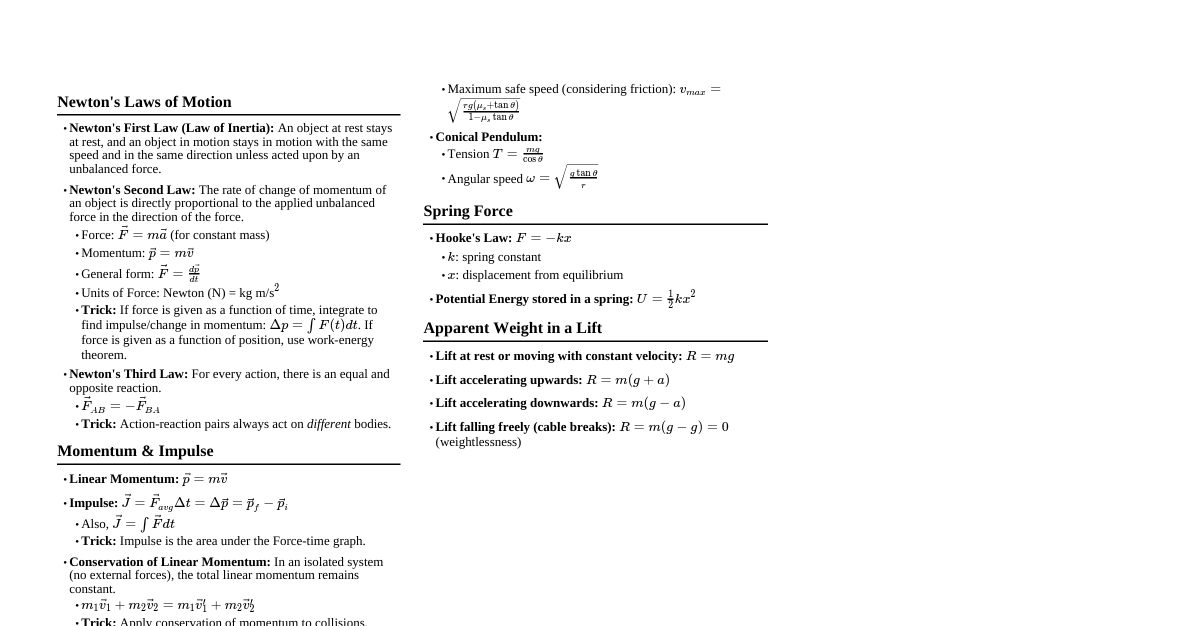
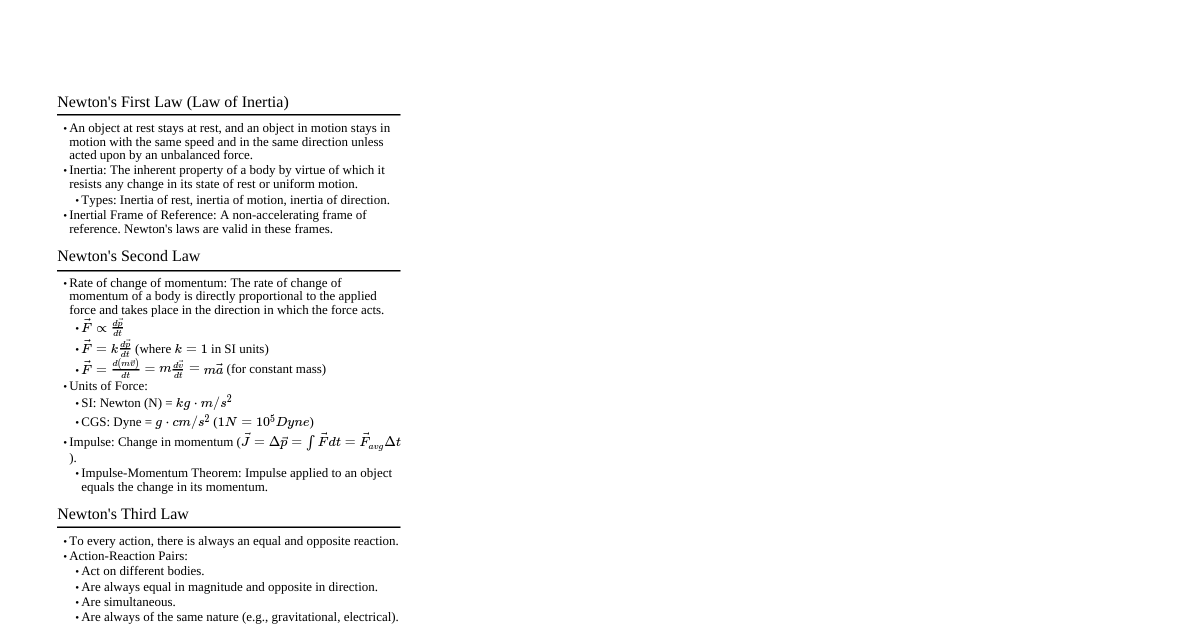
Motion & Laws of Motion
Shared 3/1/2026•135 views
### Motion in a Straight Line #### Multiple Choice Questions (MCQs) **Q.1** Among the four graphs shown in the figure, there is only one graph for which average velocity over the time interval (0, T) can vanish for a suitably chosen T. Which one is it? X (a) t (c) X t XA (b) → t X (d) → t **Thinking Process** In this problem, we have to locate the graph which has the same displacement for two timings. When there are two timings for the same displacement, the corresponding velocities will be in opposite directions. **Ans. (b)** In graph (b), for one value of displacement, there are two different points in time. Hence, for one time, the average velocity is positive, and for other time, it is equivalently negative. As there are opposite velocities in the interval 0 to T, the average velocity can vanish in (b). This can be seen in the figure below: X A B T t Here, OA = BT (same displacement) for two different points of time. **Q.2** A lift is coming from the 8th floor and is just about to reach the 4th floor. Taking the ground floor as the origin and the positive direction upwards for all quantities, which one of the following is correct? (a) x 0 (b) x > 0, v 0, v 0 (d) x > 0, v > 0, a 0. As displacement is in the negative direction, velocity will also be negative, i.e., v **Q.3** In one-dimensional motion, instantaneous speed v satisfies 0 ≤ v **Q.4** A vehicle travels half the distance L with speed $v_1$ and the other half with speed $v_2$, then its average speed is (a) $\frac{v_1 + v_2}{2}$ (b) $\frac{2 v_1 + v_2}{v_1 + v_2}$ (c) $\frac{2 v_1 v_2}{v_1 + v_2}$ (d) $\frac{L(v_1 + v_2)}{v_1 v_2}$ **Thinking Process** To calculate average speed, we will calculate the total distance covered and divide it by the total time taken. **Ans. (c)** Time taken to travel the first half distance $t_1 = \frac{L/2}{v_1} = \frac{L}{2v_1}$. Time taken to travel the second half distance $t_2 = \frac{L/2}{v_2} = \frac{L}{2v_2}$. Total time = $t_1 + t_2 = \frac{L}{2v_1} + \frac{L}{2v_2} = \frac{L}{2} \left[ \frac{1}{v_1} + \frac{1}{v_2} \right]$. We know that, $V_{avg} = \text{Average speed} = \frac{\text{total distance}}{\text{total time}} = \frac{L}{\frac{L}{2} \left[ \frac{1}{v_1} + \frac{1}{v_2} \right]} = \frac{2}{\frac{v_1 + v_2}{v_1 v_2}} = \frac{2v_1 v_2}{v_1 + v_2}$. **Q.5** The displacement of a particle is given by $x = (t − 2)^2$ where x is in metre and t in second. The distance covered by the particle in the first 4 seconds is (a) 4 m (b) 8 m (c) 12 m (d) 16 m **Thinking Process** In such type of problems, we have to see whether the motion is accelerating or retarding. During retarding journey, the particle will stop in between. **Ans. (b)** Given, $x = (t − 2)^2$. Velocity, $v = \frac{dx}{dt} = \frac{d}{dt} (t-2)^2 = 2(t − 2)$ m/s. Acceleration, $a = \frac{dv}{dt} = \frac{d}{dt} [2(t − 2)] = 2[1 - 0] = 2$ m/s$^2$. When, t = 0; v = − 4 m/s t = 2s; v = 0 m/s t = 4s; v = 4 m/s The v-t graph is shown in the adjacent diagram. Distance travelled = area of the graph $= \frac{1}{2} \times 2 \times 4 + \frac{1}{2} \times 2 \times 4 = 8$ m. **Q.6** At a metro station, a girl walks up a stationary escalator in time $t_1$. If she remains stationary on the escalator, then the escalator takes her up in time $t_2$. The time taken by her to walk up on the moving escalator will be (a) $(t_1 + t_2)/2$ (b) $t_1 t_2/(t_2 - t_1)$ (c) $t_1 t_2 / (t_2 + t_1)$ (d) $t_1 - t_2$ **Ans. (c)** In this question, we have to find the net velocity with respect to the Earth that will be equal to the velocity of the girl plus the velocity of the escalator. Let the displacement be L, then velocity of girl $v_g = \frac{L}{t_1}$. velocity of escalator $v_e = \frac{L}{t_2}$. Net velocity of the girl = $v_g + v_e = \frac{L}{t_1} + \frac{L}{t_2}$. If t is the total time taken in covering distance L, then $\frac{L}{t} = \frac{L}{t_1} + \frac{L}{t_2} \Rightarrow \frac{1}{t} = \frac{t_1 + t_2}{t_1 t_2} \Rightarrow t = \frac{t_1 t_2}{t_1 + t_2}$. **Q.7** The variation of quantity A with quantity B, plotted in figure, describes the motion of a particle in a straight line. (A-B graph) **Ans. (a, c, d)** When we are calculating the velocity of a displacement-time graph, we have to take the slope. Similarly, we have to take the slope of a velocity-time graph to calculate acceleration. When the slope is constant, motion will be uniform. When we are representing motion by a graph, it may be displacement-time, velocity-time, or acceleration-time; hence, B may represent time. For uniform motion, the velocity-time graph should be a straight line parallel to the time axis. For uniform motion, velocity is constant; hence, the slope will be positive. Hence, quantity A is displacement. For uniformly accelerated motion, the slope will be positive, and A will represent velocity. **Q.8** A graph of x versus t is shown in figure. Choose the correct alternatives given below. (x-t graph with points A, B, C, D, E) (a) The particle was released from rest at t = 0 (b) At B, the acceleration a > 0 (c) Average velocity for the motion between A and D is positive (d) The speed at D exceeds that at E **Ans. (a, c, d)** As per the diagram, at point A, the graph is parallel to the time axis; hence, $v = \frac{dx}{dt} = 0$. As the starting point is A, we can say that the particle is starting from rest. At C, the graph changes slope; hence, velocity also changes. As the graph at C is almost parallel to the time axis, we can say that velocity vanishes. As the direction of acceleration changes, we can say that it may be zero in between. From the graph, it is clear that $| \text{slope at D} | > | \text{slope at E} |$. Hence, speed at D will be more than at E. **Note** We should be very clear about the magnitude of the slope. A negative slope does not mean a lesser value. It represents a change in the direction of velocity. **Q.9** For the one-dimensional motion described by $x = t - \sin t$. (a) $x(t) > 0$ for all $t > 0$ (b) $v(t) > 0$ for all $t > 0$ (c) $a(t) > 0$ for all $t > 0$ (d) $v(t)$ lies between 0 and 2 **Ans. (a, d)** Given, $x = t - \sin t$. Velocity, $v = \frac{dx}{dt} = \frac{d}{dt} [t - \sin t] = 1 - \cos t$. Acceleration, $a = \frac{dv}{dt} = \frac{d}{dt} [1 - \cos t] = \sin t$. As acceleration, $a > 0$ for all $t > 0$. Hence, $x(t) > 0$ for all $t > 0$. Velocity $v = 1 - \cos t$. When, $\cos t = 1$, velocity $v = 0$. $V_{max} = 1 - (\cos t)_{min} = 1 - (-1) = 2$. $V_{min} = 1 - (\cos t)_{max} = 1 - 1 = 0$. Hence, v lies between 0 and 2. **Note** (i) When a sinusoidal function is involved in an expression, we should be careful about sine and cosine functions. (ii) We should be very careful when calculating maximum and minimum values of velocity because it involves an inverse relation with cost in the given expression. **Q.10** A spring with one end attached to a mass and the other to a rigid support is stretched and released. (a) Magnitude of acceleration, when just released is maximum (b) Magnitude of acceleration, when at equilibrium position, is maximum (c) Speed is maximum when mass is at equilibrium position (d) Magnitude of displacement is always maximum whenever speed is minimum **Ans. (a, c)** When the spring is stretched by x, the restoring force will be $F = -kx$. The potential energy of the stretched spring = $PE = \frac{1}{2} kx^2$. The restoring force is central; hence, when the particle is released, it will execute SHM about the equilibrium position. Acceleration will be $a = \frac{F}{m} = \frac{-kx}{m}$. At equilibrium position, $x = 0 \Rightarrow a = 0$. Hence, when just released, $x = x_{max}$. Hence, acceleration is maximum. Thus, option (a) is correct. At equilibrium, the whole PE will be converted to KE; hence, KE will be maximum, and thus, speed will be maximum. **Q.11** A ball is bouncing elastically with a speed 1 m/s between walls of a railway compartment of size 10 m in a direction perpendicular to walls. The train is moving at a constant velocity of 10 m/s parallel to the direction of motion of the ball. As seen from the ground. (a) The direction of motion of the ball changes every 10 s. (b) Speed of ball changes every 10 s. (c) Average speed of ball over any 20 s interval is fixed. (d) The acceleration of ball is the same as from the train. **Ans. (b, c, d)** In this problem, we have to keep in mind the frame of the observer. Here, we must be clear that we are considering the motion from the ground. Compared to the velocity of the train (10 m/s), the speed of the ball is less (1 m/s). The speed of the ball before collision with the side of the train is 10 + 1 = 11 m/s. The speed after collision with the side of the train = 10 - 1 = 9 m/s. As speed is changing after traveling 10 m, and speed is 1 m/s; hence, the time duration of changing speed is 10 s. Since the collision of the ball is perfectly elastic, there is no dissipation of energy; hence, total momentum and kinetic energy are conserved. Since the train is moving with constant velocity, it will act as an inertial frame of reference, like the Earth, and acceleration will be the same in both frames. We should not confuse with non-inertial and inertial frames of reference. A frame of reference that is not accelerating will be inertial. #### Very Short Answer Type Questions **Q.12** Refer to the graph in figure. Match the following. (Graphs (a), (b), (c), (d) showing x-t or v-t variations) **Ans.** We have to analyze the slope of each curve, i.e., $\frac{dx}{dt}$. For peak points, $\frac{dx}{dt}$ will be zero as x is maximum at peak points. For graph (a), there is a point (B) for which displacement is zero. So, (a) matches with (iii) "has a point with zero displacement for t > 0". In graph (b), x is positive (> 0) throughout, and at point B₁, $v = \frac{dx}{dt} = 0$. Since, at point of curvature, a changes = 0. So (b) matches with (ii) "has x > 0 throughout and has a point with v = 0 and a point with a = 0". In graph (c), slope $V = \frac{dx}{dt}$ is negative; hence, velocity will be negative. So (c) matches with (iv) "has v 0". In graph (d), as slope $V = \frac{dx}{dt}$ is positive; hence, $V > 0$. Hence, (d) matches with (i) "has v > 0 and a **Q.13** A uniformly moving cricket ball is turned back by hitting it with a bat for a very short time interval. Show the variation of its acceleration with time (Take acceleration in the backward direction as positive). **Ans.** If gravity effect is neglected, then the ball moving uniformly turns back with the same speed when a bat hits it. The acceleration of the ball is zero just before it strikes the bat. When the ball strikes the bat, it gets accelerated due to the applied impulsive force by the bat. (Graph showing acceleration vs time, with a sharp spike during the impact time) **Q.14** Give examples of a one-dimensional motion where: (a) the particle moving along positive x-direction comes to rest periodically and moves forward. (b) the particle moving along positive x-direction comes to rest periodically and moves backward. **Ans.** When we are writing an equation belonging to a periodic nature, it will involve sine or cosine functions. (a) The particle will be moving along the positive x-direction only if $t > \sin t$. Hence, $x(t) = t - \sin t$. Velocity $v(t) = \frac{dx(t)}{dt} = 1 - \cos t$. Acceleration $a(t) = \frac{dv}{dt} = \sin t$. When $t = 0; x(t) = 0$. When $t = \pi; x(t) = \pi > 0$. When $t = 2\pi; x(t) = 2\pi > 0$. (b) Equation can be represented by $x(t) = \sin t$. $V = \frac{d}{dt} x(t) = \cos t$. As displacement and velocity involve $\sin t$ and $\cos t$, these equations represent periodic motion. **Q.15** Give an example of a motion where $x > 0, v 0$ at a particular instant. **Ans.** Let the motion be represented by $x(t) = A + Be^{-\gamma t}$. Let $A > B$ and $\gamma > 0$. Now velocity $\frac{dx}{dt} = -\gamma B e^{-\gamma t}$. Acceleration $\frac{d^2x}{dt^2} = \gamma^2 B e^{-\gamma t}$. Suppose we are considering any instant t, then from Eq. (i), we can say that $x(t) > 0; v(t) 0$. **Q.16** An object falling through a fluid is observed to have acceleration given by $a = g - bv$ where $g$ = gravitational acceleration and b is constant. After a long time of release, it is observed to fall with constant speed. What must be the value of constant speed? **Ans.** When speed becomes constant, acceleration $a = \frac{dv}{dt} = 0$. Given acceleration $a = g - bv$. Clearly, from the above equation, as speed increases, acceleration will decrease. At a certain speed, say $v_0$, acceleration will be zero, and speed will remain constant. Hence, $a = g - bv_0 = 0 \Rightarrow v_0 = g/b$. **Q.17** A ball is dropped, and its displacement versus time graph is as shown (Displacement x from ground and all quantities are positive upwards). (x-t graph of a bouncing ball) (a) Plot qualitatively velocity versus time graph. (b) Plot qualitatively acceleration versus time graph. **Thinking Process** To calculate velocity, we will find the slope $\frac{dx}{dt}$ for the displacement-time curve, and to find acceleration, we will find the slope $\frac{dV}{dt}$ of the velocity-time curve. **Ans.** It is clear from the graph that displacement x is positive throughout. The ball is dropped from a height, and its velocity increases in the downward direction due to gravity's pull. In this condition, v is negative, but the acceleration of the ball is equal to acceleration due to gravity, i.e., $a = -g$. When the ball rebounds in the upward direction, its velocity is positive, but acceleration is $a = -g$. (a) The velocity-time graph of the ball is shown in fig. (i). (b) The acceleration-time graph of the ball is shown in fig. (ii). **Q.18** A particle executes the motion described by $x(t) = x_0 (1-e^{-\gamma t}); t \ge 0, x_0 > 0$. (a) Where does the particle start and with what velocity? (b) Find maximum and minimum values of $x(t), v(t), a(t)$. Show that $x(t)$ and $a(t)$ increase with time, and $v(t)$ decreases with time. **Thinking Process** First, we have to calculate velocity and acceleration, and then we can determine the maximum or minimum value accordingly. **Ans.** Given, $x(t) = x_0 (1-e^{-\gamma t})$. $v(t) = \frac{dx(t)}{dt} = x_0 \gamma e^{-\gamma t}$. $a(t) = \frac{dv(t)}{dt} = -x_0 \gamma^2 e^{-\gamma t}$. (a) When $t = 0; x(t) = x_0 (1 - e^0) = x_0 (1 - 1) = 0$. $v(t=0) = x_0 \gamma e^0 = x_0 \gamma (1) = x_0 \gamma$. (b) $x(t)$ is maximum when $t = \infty \Rightarrow [x(t)]_{max} = x_0$. $x(t)$ is minimum when $t = 0 \Rightarrow [x(t)]_{min} = 0$. $v(t)$ is maximum when $t = 0; v(0) = x_0 \gamma$. $v(t)$ is minimum when $t = \infty; v(\infty) = 0$. $a(t)$ is maximum when $t = \infty; a(\infty) = 0$. $a(t)$ is minimum when $t = 0; a(0) = -x_0 \gamma^2$. **Note** We should be careful about the nature of variation of the curve, and maximum and minimum values will be decided accordingly. **Q.19** A bird is tossing (flying to and fro) between two cars moving towards each other on a straight road. One car has a speed of 18 km/h while the other has the speed of 27 km/h. The bird starts moving from the first car towards the other and is moving with the speed of 36 km/h, and when the two cars were separated by 36 km. What is the total distance covered by the bird? **Thinking Process** In this problem, we have to use the concept of relative velocity. It will be subtracted for velocities in the same direction and added for velocities in opposite directions. **Ans.** Given, speed of the first car = 18 km/h. Speed of the second car = 27 km/h. Relative speed of each car w.r.t. each other = 18 + 27 = 45 km/h. Distance between the cars = 36 km. Time of meeting the cars $(t) = \frac{\text{Distance between the cars}}{\text{Relative speed of cars}} = \frac{36}{45} \text{ h} = \frac{4}{5} \text{ h} = 0.8 \text{ h}$. Speed of the bird $(v_b) = 36 \text{ km/h}$. Distance covered by the bird $= v_b \times t = 36 \times 0.8 = 28.8 \text{ km}$. #### Long Answer Type Questions **Q.20** A man runs across the roof, top of a tall building and jumps horizontally with the hope of landing on the roof of the next building which is at a lower height than the first. If his speed is 9 m/s, the (horizontal) distance between the two buildings is 10 m and the height difference is 9 m, will he be able to land on the next building? (Take g = 10 m/s$^2$) **Thinking Process** When the man runs on the roof-top, the velocity will be horizontal. Then, acceleration will be vertically downward (taken as g), and equations of kinematics will be applied. **Ans.** Given, horizontal speed of the man $(u_x) = 9 \text{ m/s}$. Horizontal distance between the two buildings = 10 m. Height difference between the two buildings = 9 m. And $g = 10 \text{ m/s}^2$. Let the man jump from point A and land on the roof of the next building at point B. Taking motion in the vertical direction, $y = ut + \frac{1}{2} at^2$. $9 = 0 \times t + \frac{1}{2} \times 10 \times t^2$. $9 = 5t^2 \Rightarrow t^2 = \frac{9}{5} \Rightarrow t = \frac{3}{\sqrt{5}}$ s. Horizontal distance traveled $= u_x \times t = 9 \times \frac{3}{\sqrt{5}} = \frac{27}{\sqrt{5}} \approx 12$ m. The horizontal distance traveled by the man is greater than 10 m; therefore, he will land on the next building. **Q.21** A ball is dropped from a building of height 45 m. Simultaneously, another ball is thrown up with a speed of 40 m/s. Calculate the relative speed of the balls as a function of time. **Thinking Process** In this problem, as the ball is dropped, the initial velocity will be taken as zero. We will apply equations involving one-dimensional motion. **Ans.** For the ball dropped from the building, $u_1 = 0, u_2 = 40 \text{ m/s}$. Velocity of the dropped ball after time t, $V_1 = u_1 + gt = gt$ (downward). For the ball thrown up, $u_2 = 40 \text{ m/s}$. Velocity of the ball after time t, $V_2 = u_2 - gt = (40 - gt)$ (upward). Relative velocity of one ball w.r.t. another ball $= V_1 - (-V_2)$ (since they are moving in opposite directions). $= gt - [-(40 - gt)] = gt + 40 - gt = 40 \text{ m/s}$. **Note** When we are applying equations for rectilinear motion, we should carefully put up the signs for the physical quantities. **Q.22** The velocity-displacement graph of a particle is shown in figure. (v-x graph) (a) Write the relation between v and x. (b) Obtain the relation between acceleration and displacement and plot it. **Thinking Process** In this problem, we will use the concept of slope. Suppose the slope is m; then the equation will come out to be y = mx + c. **Ans.** Given, initial velocity = $V_0$. Let the distance traveled in time t = $x_0$. For the graph, $\tan \theta = \frac{V_0 - V}{x_0 - x} = \frac{V_0}{x_0}$. Where, v is velocity, and x is displacement at any instant of time t. From Eq. (i), $\frac{V_0 - V}{x_0 - x} = \frac{V_0}{x_0} \Rightarrow V_0 x_0 - V x_0 = V_0 x - V_0 x_0 \Rightarrow V = V_0 - \frac{V_0}{x_0} x$. This is a linear relation between v and x. Acceleration $a = v \frac{dv}{dx} = \left( V_0 - \frac{V_0}{x_0} x \right) \left( -\frac{V_0}{x_0} \right) = -\frac{V_0^2}{x_0} + \frac{V_0^2}{x_0^2} x$. This is a linear relation between acceleration and displacement. (Graph of a vs x, showing a linear increase) **Q.23** It is a common observation that rain clouds can be at about a kilometer altitude above the ground. (a) If a rain drop falls from such a height freely under gravity, what will be its speed? Also, calculate in km/h ($g = 10 \text{ m/s}^2$). (b) A typical rain drop is about 4 mm in diameter. Momentum is mass $\times$ speed in magnitude. Estimate its momentum when it hits the ground. (c) Estimate the time required to flatten the drop. (d) Rate of change of momentum is force. Estimate how much force such a drop would exert on you. (e) Estimate the order of magnitude of force on an umbrella. Typical lateral separation between two rain drops is 5 cm. (Assume that the umbrella is circular and has a diameter of 1 m, and the cloth is not pierced through.) **Thinking Process** In this problem, the equation of motion and Newton's second law, $F_{ext} = \frac{dp}{dt}$, will be used, where dp is the change in momentum over time dt. **Ans.** Given, height $(h) = 1 \text{ km} = 1000 \text{ m}$. $g = 10 \text{ m/s}^2$. (a) Velocity attained by the rain drop in freely falling through a height h. $v = \sqrt{2gh} = \sqrt{2 \times 10 \times 1000} = \sqrt{20000} = 100\sqrt{2} \text{ m/s}$. In km/h, $v = 100\sqrt{2} \times \frac{3600}{1000} = 360\sqrt{2} \text{ km/h} \approx 510 \text{ km/h}$. (b) Diameter of the drop $(d) = 2r = 4 \text{ mm}$. Radius of the drop $(r) = 2 \text{ mm} = 2 \times 10^{-3} \text{ m}$. Mass of a rain drop $(m) = V \times \rho = \frac{4}{3} \pi r^3 \rho$. $m = \frac{4}{3} \times \frac{22}{7} \times (2 \times 10^{-3})^3 \times 10^3 = 3.4 \times 10^{-5} \text{ kg}$. Momentum of the rain drop $(p) = mv = (3.4 \times 10^{-5}) \times (100\sqrt{2}) = 4.7 \times 10^{-3} \text{ kg-m/s} \approx 5 \times 10^{-3} \text{ kg-m/s}$. (c) Time required to flatten the drop = time taken by the drop to travel a distance equal to its diameter near the ground. $t = \frac{d}{v} = \frac{4 \times 10^{-3}}{100\sqrt{2}} = 2.8 \times 10^{-5} \text{ s} \approx 30 \mu \text{s}$. (d) Force exerted by a rain drop $F = \frac{\text{Change in momentum}}{\text{Time}} = \frac{p - 0}{t} = \frac{4.7 \times 10^{-3}}{2.8 \times 10^{-5}} \approx 168 \text{ N}$. (e) Radius of the umbrella $(R) = \frac{1}{2} \text{ m}$. Area of the umbrella $(A) = \pi R^2 = \pi (\frac{1}{2})^2 = \frac{\pi}{4} \approx 0.8 \text{ m}^2$. Number of drops striking the umbrella simultaneously with an average separation of 5 cm $= 5 \times 10^{-2} \text{ m}$. Number of drops $= \frac{0.8}{(5 \times 10^{-2})^2} = \frac{0.8}{25 \times 10^{-4}} = \frac{0.8}{0.0025} = 320$. Net force exerted on umbrella $= 320 \times 168 = 53760 \text{ N} \approx 54000 \text{ N}$. **Note** In practice, the velocity of the drops decreases due to air friction. **Q.24** A motor car moving at a speed of 72 km/h cannot come to a stop in less than 3.0 s, while for a truck, this time interval is 5.0 s. On a highway, the car is behind the truck, both moving at 72 km/h. The truck gives a signal that it is going to stop at an emergency. At what distance should the car be from the truck so that it does not bump into (collide with) the truck? Human response time is 0.5 s. **Ans.** In this problem, equations related to one-dimensional motion will be applied. For acceleration, a positive sign will be used, and for retardation, a negative sign will be used. Given, speed of car as well as truck $= 72 \text{ km/h} = 72 \times \frac{5}{18} \text{ m/s} = 20 \text{ m/s}$. Retarded motion for the car: $v = u + at \Rightarrow 0 = 20 + a \times 3 \Rightarrow a_c = -\frac{20}{3} \text{ m/s}^2$. Retarded motion for the truck: $v = u + at \Rightarrow 0 = 20 + a \times 5 \Rightarrow a_t = -4 \text{ m/s}^2$. Let the car be at a distance x from the truck when the truck gives the signal, and t be the time taken to cover this distance. As human response time is 0.5 s, the time of retarded motion of the car is $(t - 0.5)$ s. Velocity of car after time t, $V_c = 20 - \frac{20}{3} (t - 0.5)$. Velocity of truck after time t, $V_t = 20 - 4t$. To avoid the car bumping onto the truck, $V_c = V_t$. $20 - \frac{20}{3} (t - 0.5) = 20 - 4t$. $\frac{20}{3} (t - 0.5) = 4t \Rightarrow 20t - 10 = 12t \Rightarrow 8t = 10 \Rightarrow t = \frac{10}{8} = \frac{5}{4} \text{ s}$. Distance traveled by the truck in time t: $S_t = u_t t + \frac{1}{2} a_t t^2 = 20 \times \frac{5}{4} + \frac{1}{2} (-4) \times (\frac{5}{4})^2 = 25 - 2 \times \frac{25}{16} = 25 - \frac{25}{8} = \frac{175}{8} = 21.875 \text{ m}$. Distance traveled by the car in time t: $S_c = (\text{Distance traveled by car in 0.5 s (without retardation)}) + (\text{Distance traveled by car in (t - 0.5) s (with retardation)})$. $S_c = (20 \times 0.5) + \left( 20 \times (t - 0.5) + \frac{1}{2} (-\frac{20}{3}) (t - 0.5)^2 \right)$. $S_c = 10 + \left( 20 \times (\frac{5}{4} - 0.5) - \frac{10}{3} (\frac{5}{4} - 0.5)^2 \right) = 10 + \left( 20 \times \frac{3}{4} - \frac{10}{3} (\frac{3}{4})^2 \right)$. $S_c = 10 + \left( 15 - \frac{10}{3} \times \frac{9}{16} \right) = 10 + 15 - \frac{30}{16} = 25 - 1.875 = 23.125 \text{ m}$. Required distance $= S_c - S_t = 23.125 - 21.875 = 1.250 \text{ m}$. Therefore, to avoid bumping onto the truck, the car must maintain a distance from the truck of more than 1.250 m. ### Motion in a Plane #### Multiple Choice Questions (MCQs) **Q.1** The angle between $\vec{A} = \hat{i} + \hat{j}$ and $\vec{B} = \hat{i} - \hat{j}$ is (a) 45° (b) 90° (c) – 45° (d) 180° **Thinking Process** To solve such types of questions, we have to use the formula for dot product or cross product. **Ans. (b)** Given, $\vec{A} = \hat{i} + \hat{j}$ and $\vec{B} = \hat{i} - \hat{j}$. We know that $\vec{A} \cdot \vec{B} = |\vec{A}| |\vec{B}| \cos \theta$. $(\hat{i} + \hat{j}) \cdot (\hat{i} - \hat{j}) = \sqrt{1^2 + 1^2} \sqrt{1^2 + (-1)^2} \cos \theta$. $1 - 1 = \sqrt{2} \sqrt{2} \cos \theta$. $0 = 2 \cos \theta \Rightarrow \cos \theta = 0 \Rightarrow \theta = 90^\circ$. #### Very Short Answer Type Questions **Q.16** A cyclist starts from centre O of a circular park of radius 1 km and moves along the path OPRQO as shown in figure. If he maintains a constant speed of 10 m/s, what is his acceleration at point R in magnitude and direction? (Diagram of a circular path OPRQO) **Ans.** As shown in the adjacent figure, the cyclist covers the path OPRQO. As we know, whenever an object performs circular motion, acceleration is called centripetal acceleration and is always directed towards the centre. Hence, acceleration at R is $a = \frac{v^2}{r}$. $a = \frac{(10)^2}{1 \text{ km}} = \frac{100}{1000} = 0.1 \text{ m/s}^2$ along RO. #### Long Answer Type Questions **Q.20** A man runs across the roof, top of a tall building and jumps horizontally with the hope of landing on the roof of the next building which is at a lower height than the first. If his speed is 9 m/s, the (horizontal) distance between the two buildings is 10 m and the height difference is 9 m, will he be able to land on the next building? (Take g = 10 m/s$^2$) **Thinking Process** When the man runs on the roof-top, the velocity will be horizontal. Then, acceleration will be vertically downward (taken as g), and equations of kinematics will be applied. **Ans.** Given, horizontal speed of the man $(u_x) = 9 \text{ m/s}$. Horizontal distance between the two buildings = 10 m. Height difference between the two buildings = 9 m. And $g = 10 \text{ m/s}^2$. Let the man jump from point A and land on the roof of the next building at point B. Taking motion in the vertical direction, $y = ut + \frac{1}{2} at^2$. $9 = 0 \times t + \frac{1}{2} \times 10 \times t^2$. $9 = 5t^2 \Rightarrow t^2 = \frac{9}{5} \Rightarrow t = \frac{3}{\sqrt{5}}$ s. Horizontal distance traveled $= u_x \times t = 9 \times \frac{3}{\sqrt{5}} = \frac{27}{\sqrt{5}} \approx 12$ m. The horizontal distance traveled by the man is greater than 10 m; therefore, he will land on the next building. **Q.22** A boy traveling in an open car moving on a leveled road with constant speed tosses a ball vertically up in the air and catches it back. Sketch the motion of the ball as observed by a boy standing on the footpath. Give an explanation to support your diagram. **Ans.** The path of the ball observed by a boy standing on the footpath is parabolic. The horizontal speed of the ball is the same as that of the car; therefore, the ball as well as the car travels an equal horizontal distance. Due to its vertical speed, the ball follows a parabolic path. (Diagram showing a parabolic trajectory of the ball as seen from the ground) **Note** We must be very clear that we are working with respect to the ground. When we observe with respect to the car, motion will be along the vertical direction only. **Q.23** A bird is tossing (flying to and fro) between two cars moving towards each other on a straight road. One car has a speed of 18 km/h while the other has the speed of 27 km/h. The bird starts moving from the first car towards the other and is moving with the speed of 36 km/h, and when the two cars were separated by 36 km. What is the total distance covered by the bird? **Thinking Process** In this problem, we have to use the concept of relative velocity. It will be subtracted for velocities in the same direction and added for velocities in opposite directions. **Ans.** Given, speed of the first car = 18 km/h. Speed of the second car = 27 km/h. Relative speed of each car w.r.t. each other = 18 + 27 = 45 km/h. Distance between the cars = 36 km. Time of meeting the cars $(t) = \frac{\text{Distance between the cars}}{\text{Relative speed of cars}} = \frac{36}{45} \text{ h} = \frac{4}{5} \text{ h} = 0.8 \text{ h}$. Speed of the bird $(v_b) = 36 \text{ km/h}$. Distance covered by the bird $= v_b \times t = 36 \times 0.8 = 28.8 \text{ km}$. **Q.24** A fighter plane is flying horizontally at an altitude of 1.5 km with a speed of 720 km/h. At what angle of sight (w.r.t. horizontal) when the target is seen, should the pilot drop the bomb in order to attack the target? **Thinking Process** When the bomb is dropped from the plane, the bomb will have the same velocity as that of the plane. **Ans.** Consider the adjacent diagram. Let a fighter plane, when it is at position P, drops a bomb to hit a target T. Let $\angle P'PT = \theta$. Speed of the plane $= 720 \text{ km/h} = 720 \times \frac{5}{18} \text{ m/s} = 200 \text{ m/s}$. Altitude of the plane $(P'T) = 1.5 \text{ km} = 1500 \text{ m}$. If the bomb hits the target after time t, then the horizontal distance traveled by the bomb, $PP' = u \times t = 200t$. Vertical distance traveled by the bomb, $P'T = \frac{1}{2} gt^2$. $1500 = \frac{1}{2} \times 9.8 t^2 \Rightarrow t^2 = \frac{3000}{9.8} \Rightarrow t = \sqrt{\frac{3000}{9.8}} \approx 17.49 \text{ s}$. Using the value of t in Eq. (i), $PP' = 200 \times 17.49 \text{ m}$. Now, $\tan \theta = \frac{P'T}{PP'} = \frac{1500}{200 \times 17.49} \approx 0.49287$. $\theta = \tan^{-1}(0.49287) \approx 23^\circ 12'$. **Note** The angle is with respect to the target. As seen by an observer in the plane motion, the bomb will be vertically downward below the plane. **Q.33** A girl riding a bicycle with a speed of 5 m/s towards the north direction observes rain falling vertically down. If she increases her speed to 10 m/s, rain appears to meet her at 45° to the vertical. What is the speed of the rain? In what direction does rain fall as observed by a ground-based observer? **Thinking Process** Draw the vector diagram for the information given and find a and b. We may draw all vectors in the reference frame of a ground-based observer. **Ans.** Assume north to be the $\hat{i}$ direction and vertically downward to be $-\hat{j}$. Let the rain velocity $\vec{v}_r$ be $a\hat{i} + b\hat{j}$. Case I: Given velocity of girl $\vec{v}_g = (5 \text{ m/s})\hat{i}$. Let $\vec{v}_{rg}$ = Velocity of rain w.r.t. girl $= \vec{v}_r - \vec{v}_g = (a\hat{i} + b\hat{j}) - 5\hat{i} = (a - 5)\hat{i} + b\hat{j}$. According to the question, rain appears to fall vertically downward. Hence, $a - 5 = 0 \Rightarrow a = 5$. Case II: Given velocity of the girl $\vec{v}_g = (10 \text{ m/s})\hat{i}$. $\vec{v}_{rg} = \vec{v}_r - \vec{v}_g = (a\hat{i} + b\hat{j}) - 10\hat{i} = (a - 10)\hat{i} + b\hat{j}$. According to the question, rain appears to fall at 45° to the vertical. Hence, $\tan 45^\circ = \frac{b}{a - 10} = 1 \Rightarrow b = a - 10$. Since $a = 5$, $b = 5 - 10 = -5$. Hence, velocity of rain $\vec{v}_r = 5\hat{i} - 5\hat{j}$. Speed of rain $= |\vec{v}_r| = \sqrt{5^2 + (-5)^2} = \sqrt{50} = 5\sqrt{2} \text{ m/s}$. ### Laws of Motion #### Multiple Choice Questions (MCQs) **Q.3** A cricket ball of mass 150 g has an initial velocity $\vec{u} = (3\hat{i} + 4\hat{j}) \text{ ms}^{-1}$ and a final velocity $\vec{v} = -(3\hat{i} + 4\hat{j}) \text{ ms}^{-1}$, after being hit. The change in momentum (final momentum – initial momentum) is (in kgms$^{-1}$) (a) zero (b) $-(0.45\hat{i} + 0.6\hat{j})$ (c) $-(0.9\hat{i} + 1.2\hat{j})$ (d) $-5(\hat{i} + \hat{j})$ **Ans. (c)** Given, $\vec{u} = (3\hat{i} + 4\hat{j}) \text{ m/s}$ $\vec{v} = -(3\hat{i} + 4\hat{j}) \text{ m/s}$ Mass of the ball = 150 g = 0.15 kg. $\Delta \vec{p} = \text{Change in momentum} = \text{Final momentum} - \text{Initial momentum} = m\vec{v} - m\vec{u} = m(\vec{v} - \vec{u})$. $\Delta \vec{p} = 0.15 [-(3\hat{i} + 4\hat{j}) - (3\hat{i} + 4\hat{j})] = 0.15 [-6\hat{i} - 8\hat{j}] = -[0.15 \times 6\hat{i} + 0.15 \times 8\hat{j}] = -[0.9\hat{i} + 1.2\hat{j}] \text{ kg-m/s}$. **Q.4** In the previous problem (3), the magnitude of the momentum transferred during the hit is (a) zero (b) $0.75 \text{ kg-m s}^{-1}$ (c) $1.5 \text{ kg-m s}^{-1}$ (d) $1.4 \text{ kg-m s}^{-1}$ **Ans. (c)** By previous solution, $\Delta \vec{p} = -(0.9\hat{i} + 1.2\hat{j})$. Magnitude $= |\Delta \vec{p}| = \sqrt{(-0.9)^2 + (-1.2)^2} = \sqrt{0.81 + 1.44} = \sqrt{2.25} = 1.5 \text{ kg-m s}^{-1}$. **Q.6** A hockey player is moving northward and suddenly turns westward with the same speed to avoid an opponent. The force that acts on the player is (a) frictional force along westward (b) muscle force along southward (c) frictional force along south-West (d) muscle force along south-West **Ans. (c)** Consider the adjacent diagram. Let $\vec{P}_1$ = Initial momentum of player northward. Let $\vec{P}_2$ = Final momentum of player towards west. Change in momentum $\Delta \vec{P} = \vec{P}_2 - \vec{P}_1 = \vec{P}_2 + (-\vec{P}_1)$. Clearly, the resultant $\Delta \vec{P}$ will be along south-west. Therefore, the force that acts on the player will be along south-west. **Q.8** A body with mass 5 kg is acted upon by a force $\vec{F} = (-3\hat{i} + 4\hat{j}) \text{ N}$. If its initial velocity at $t = 0$ is $\vec{v} = (6\hat{i} – 12\hat{j})\text{ms}^{-1}$, the time at which it will just have a velocity along the Y-axis is (a) never (b) 10 s (c) 2 s (d) 15 s **Ans. (b)** Given, mass = $m = 5 \text{ kg}$. Acting force $\vec{F} = (-3\hat{i} + 4\hat{j}) \text{ N}$. Initial velocity at $t = 0$, $\vec{u} = (6\hat{i} – 12\hat{j}) \text{ m/s}$. Acceleration, $\vec{a} = \frac{\vec{F}}{m} = \frac{(-3\hat{i} + 4\hat{j})}{5} = (-\frac{3}{5}\hat{i} + \frac{4}{5}\hat{j}) \text{ m/s}^2$. As the final velocity is along the Y-axis only, its x-component must be zero. From $\vec{v} = \vec{u} + \vec{a}t$, for the X-component only, $0 = 6 - \frac{3}{5}t$. $6 = \frac{3}{5}t \Rightarrow t = \frac{30}{3} = 10 \text{ s}$. #### Very Short Answer Type Questions **Q.16** A girl riding a bicycle along a straight road with a speed of 5 m/s throws a stone of mass 0.5 kg which has a speed of 15 m/s with respect to the ground along her direction of motion. The mass of the girl and bicycle is 50 kg. Does the speed of the bicycle change after the stone is thrown? What is the change in speed, if so? **Thinking Process** In this problem, we have to apply the conservation of linear momentum. **Ans.** Given, total mass of girl, bicycle, and stone = $m_1 = (50 + 0.5) \text{ kg} = 50.5 \text{ kg}$. Velocity of bicycle $u_1 = 5 \text{ m/s}$. Mass of stone $m_2 = 0.5 \text{ kg}$. Velocity of stone $u_2 = 15 \text{ m/s}$. Mass of girl and bicycle $m = 50 \text{ kg}$. Yes, the speed of the bicycle changes after the stone is thrown. Let the speed of the bicycle be v m/s after throwing the stone. According to the law of conservation of linear momentum, $m_1 u_1 = m_2 u_2 + mv$. $50.5 \times 5 = 0.5 \times 15 + 50 \times v$. $252.5 = 7.5 + 50v$. $50v = 245 \Rightarrow v = \frac{245}{50} = 4.9 \text{ m/s}$. Change in speed $= 5 - 4.9 = 0.1 \text{ m/s}$. **Q.21** A block placed on a rough horizontal surface is pulled by a horizontal force F. Let f be the force applied by the rough surface on the block. Plot a graph of f versus F. **Ans.** The approximate graph is shown in the diagram. (Graph showing force of friction f vs applied force F, with static and kinetic regions) The frictional force f is shown on the vertical axis, and the applied force F is shown on the horizontal axis. The portion OA of the graph represents static friction, which is self-adjusting. In this portion, f = F. The point B corresponds to the force of limiting friction, which is the maximum value of static friction. CD || OX represents kinetic friction when the body actually starts moving. The force of kinetic friction does not increase with applied force and is slightly less than limiting friction. **Q.22** Why are porcelain objects wrapped in paper or straw before packing for transportation? **Ans.** Porcelain objects are wrapped in paper or straw before packing to reduce the chances of damage during transportation. During transportation, sudden jerks or even falls take place. The force takes a longer time to reach the porcelain objects through paper or straw for the same change in momentum, as $F = \frac{\Delta p}{\Delta t}$; therefore, a lesser force acts on the object. **Q.25** Why are mountain roads generally made winding upwards rather than going straight up? **Ans.** While going up a mountain, the force of friction acting on a vehicle of mass m is $f = \mu R = \mu mg \cos \theta$, where $\theta$ is the angle of slope of the road with the horizontal. To avoid skidding, the force of friction (f) should be large, and therefore, $\cos \theta$ should be large, and hence, $\theta$ should be small. That's why mountain roads are generally made winding upwards rather than going straight up to avoid skidding. **Q.26** A mass of 2 kg is suspended with thread AB (figure). Thread CD of the same type is attached to the other end of the 2 kg mass. The lower thread is pulled gradually, harder and harder in the downward direction, so as to apply force on AB. Which of the threads will break and why? (Diagram showing a mass suspended by two threads AB and CD) **Ans.** The thread AB will break earlier than the thread CD. This is because the force acting on thread CD = applied force, and the force acting on thread AB = (applied force + weight of 2 kg mass). Hence, the force acting on thread AB is larger than the force acting on thread CD. **Q.27** In the above given problem, if the lower thread is pulled with a jerk, what happens? **Ans.** When the lower thread CD is pulled with a jerk, the thread CD itself breaks. This is because the pull on thread CD is not transmitted to thread AB instantly. **Q.30** A block of mass M is held against a rough vertical wall by pressing it with a finger. If the coefficient of friction between the block and the wall is $\mu$ and the acceleration due to gravity is g, calculate the minimum force required to be applied by the finger to hold the block against the wall. **Ans.** Given, mass of the block = M. Coefficient of friction between the block and the wall = $\mu$. Let a force F be applied on the block to hold the block against the wall. The normal reaction of mass be N, and the force of friction acting upward be f. In equilibrium, vertical and horizontal forces should be balanced separately. $f = Mg$ ...(i) $F = N$ ...(ii) But force of friction $(f) = \mu N$ ...(iii) From Eqs. (i) and (iii), $Mg = \mu N$. Substituting N from Eq. (ii), $Mg = \mu F$. Therefore, $F = \frac{Mg}{\mu}$. **Q.33** A person in an elevator accelerating upwards with an acceleration of 2 ms$^{-2}$, tosses a coin vertically upwards with a speed of 20 ms$^{-1}$. After how much time will the coin fall back into his hand? ($g = 10 \text{ ms}^{-2}$) **Ans.** Here, initial speed of the coin $(u) = 20 \text{ m/s}$. Acceleration of the elevator $(a) = 2 \text{ m/s}^2$. Acceleration due to gravity $(g) = 10 \text{ m/s}^2$. Effective acceleration $a' = g + a = 10 + 2 = 12 \text{ m/s}^2$ (upwards, relative to the elevator). If the time of ascent of the coin is $t$, then $v = u + a't$. $0 = 20 + (-12)t \Rightarrow t = \frac{20}{12} = \frac{5}{3} \text{ s}$. Time of ascent = Time of descent. Total time after which the coin falls back into hand $= \frac{5}{3} + \frac{5}{3} = \frac{10}{3} \text{ s} \approx 3.33 \text{ s}$. **Note** While calculating net acceleration, we should be aware that if the lift is going upward, the net acceleration is $(g + a)$, and for downward, the net acceleration is $(g - a)$. **Q.42** A helicopter of mass 2000 kg rises with a vertical acceleration of 15 ms$^{-2}$. The total mass of the crew and passengers is 500 kg. Give the magnitude and direction of the ($g = 10 \text{ ms}^{-2}$) (a) force on the floor of the helicopter by the crew and passengers. (b) action of the rotor of the helicopter on the surrounding air. (c) force on the helicopter due to the surrounding air. **Ans.** Given, mass of helicopter $(m_1) = 2000 \text{ kg}$. Mass of the crew and passengers $(m_2) = 500 \text{ kg}$. Acceleration in the vertical direction $(a) = 15 \text{ m/s}^2$ (upwards), and $g = 10 \text{ m/s}^2$ (downwards). (a) Force on the floor of the helicopter by the crew and passengers = $m_2 (g + a) = 500 (10 + 15) \text{ N} = 500 \times 25 \text{ N} = 12500 \text{ N}$. (b) Action of the rotor of the helicopter on the surrounding air = $(m_1 + m_2) (g + a) = (2000 + 500) (10 + 15) \text{ N} = 2500 \times 25 \text{ N} = 62500 \text{ N}$ (downward). (c) Force on the helicopter due to the surrounding air = reaction of the force applied by the helicopter = $62500 \text{ N}$ (upward). **Note** We should be very clear when we are balancing action and reaction forces. We must know which part is action and which part is reaction due to the action.