Quadratic Equations (JEE)
Cheatsheet Content
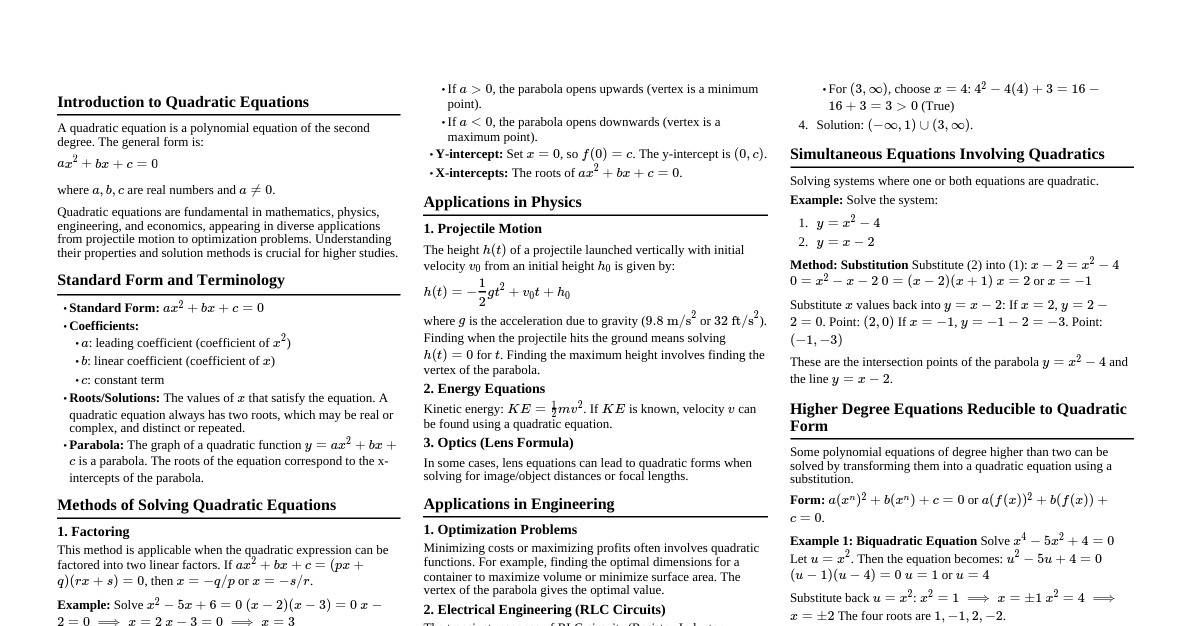
### Basics of Quadratic Equations A quadratic equation in a single variable $x$ is an equation of the form $ax^2 + bx + c = 0$, where $a, b, c$ are real numbers and $a \neq 0$. - **Standard Form:** $ax^2 + bx + c = 0$ - **Roots/Solutions:** The values of $x$ that satisfy the equation. - **Degree:** The highest power of the variable is 2. #### Methods to Solve Quadratic Equations 1. **Factorization Method:** - Express the quadratic polynomial as a product of two linear factors. - Example: $x^2 - 5x + 6 = 0 \Rightarrow (x-2)(x-3) = 0 \Rightarrow x=2, x=3$. 2. **Completing the Square Method:** - Transform $ax^2 + bx + c = 0$ into $(x+k)^2 = d$ form. - Example: $x^2 + 4x + 1 = 0 \Rightarrow (x^2 + 4x + 4) - 4 + 1 = 0 \Rightarrow (x+2)^2 = 3 \Rightarrow x+2 = \pm\sqrt{3} \Rightarrow x = -2 \pm\sqrt{3}$. 3. **Quadratic Formula:** - The roots of $ax^2 + bx + c = 0$ are given by $x = \frac{-b \pm \sqrt{b^2 - 4ac}}{2a}$. This formula is derived by completing the square. ### Nature of Roots The discriminant, denoted by $\Delta$ or $D$, is given by $\Delta = b^2 - 4ac$. It determines the nature of the roots: 1. **$\Delta > 0$:** Roots are real and distinct (unequal). - If $\Delta$ is a perfect square, roots are rational and distinct. - If $\Delta$ is not a perfect square, roots are irrational and distinct (conjugate surds: $p \pm \sqrt{q}$). 2. **$\Delta = 0$:** Roots are real and equal (coincident). $x = -b/(2a)$. 3. **$\Delta ### Relation Between Roots and Coefficients For a quadratic equation $ax^2 + bx + c = 0$ with roots $\alpha$ and $\beta$: - **Sum of roots:** $\alpha + \beta = -\frac{b}{a}$ - **Product of roots:** $\alpha \beta = \frac{c}{a}$ #### Formation of Quadratic Equation If $\alpha$ and $\beta$ are the roots, the equation can be written as: $x^2 - (\alpha + \beta)x + \alpha\beta = 0$ or $x^2 - (\text{Sum of roots})x + (\text{Product of roots}) = 0$. #### Symmetric Functions of Roots - $\alpha^2 + \beta^2 = (\alpha+\beta)^2 - 2\alpha\beta = \left(-\frac{b}{a}\right)^2 - 2\left(\frac{c}{a}\right)$ - $\alpha^3 + \beta^3 = (\alpha+\beta)^3 - 3\alpha\beta(\alpha+\beta)$ - $|\alpha - \beta| = \frac{\sqrt{\Delta}}{|a|}$ ### Common Roots Consider two quadratic equations: $a_1x^2 + b_1x + c_1 = 0$ $a_2x^2 + b_2x + c_2 = 0$ 1. **One Common Root:** Let $\alpha$ be the common root. $a_1\alpha^2 + b_1\alpha + c_1 = 0$ $a_2\alpha^2 + b_2\alpha + c_2 = 0$ Solving these two equations for $\alpha^2$ and $\alpha$ using cross-multiplication: $\frac{\alpha^2}{b_1c_2 - b_2c_1} = \frac{\alpha}{c_1a_2 - c_2a_1} = \frac{1}{a_1b_2 - a_2b_1}$ From this, $\alpha = \frac{c_1a_2 - c_2a_1}{a_1b_2 - a_2b_1}$. For a common root to exist, we must have $(c_1a_2 - c_2a_1)^2 = (b_1c_2 - b_2c_1)(a_1b_2 - a_2b_1)$. 2. **Both Roots Common:** If both roots are common, then the equations are identical (or one is a multiple of the other). $\frac{a_1}{a_2} = \frac{b_1}{b_2} = \frac{c_1}{c_2}$ ### Graph of a Quadratic Expression The graph of a quadratic expression $y = ax^2 + bx + c$ is a parabola. - **Opening:** - If $a > 0$, the parabola opens upwards (concave up). - If $a 0$: Parabola intersects the x-axis at two distinct points. - $\Delta = 0$: Parabola touches the x-axis at one point (vertex is on x-axis). - $\Delta ### Sign of Quadratic Expression ($ax^2 + bx + c$) Let $f(x) = ax^2 + bx + c$. 1. **$a > 0$ (Parabola opens upwards):** - If $\Delta 0$ for all $x \in \mathbb{R}$. (Always positive) - If $\Delta = 0$: $f(x) \ge 0$ for all $x \in \mathbb{R}$. ($f(x)=0$ at $x = -b/2a$, otherwise positive) - If $\Delta > 0$: Let roots be $\alpha, \beta$ with $\alpha 0$ for $x \in (-\infty, \alpha) \cup (\beta, \infty)$. - $f(x) 0$: Let roots be $\alpha, \beta$ with $\alpha 0$ for $x \in (\alpha, \beta)$. #### Summary Table for Sign of $ax^2 + bx + c$ | Condition | $a > 0$ | $a 0$ for all $x$ | $ax^2+bx+c 0$ | $ax^2+bx+c > 0$ for $x \notin [\alpha, \beta]$ | $ax^2+bx+c 0$ for $x \in (\alpha, \beta)$ | ### Location of Roots & Wavy Curve Method #### Location of Roots (JEE Advanced Concept) To determine the conditions for roots of $ax^2 + bx + c = 0$ to lie in a certain interval $(k_1, k_2)$ or relative to a specific number $k$: Let $f(x) = ax^2 + bx + c$. **Case 1: Both roots greater than $k$ ($\alpha, \beta > k$)** Conditions: 1. $\Delta \ge 0$ (roots are real) 2. $a \cdot f(k) > 0$ (value of function at $k$ has same sign as $a$) 3. $-\frac{b}{2a} > k$ (vertex is to the right of $k$) **Case 2: Both roots less than $k$ ($\alpha, \beta 0$ 3. $-\frac{b}{2a} 0$) **Case 4: Both roots lie in an interval $(k_1, k_2)$** Conditions: 1. $\Delta \ge 0$ 2. $a \cdot f(k_1) > 0$ 3. $a \cdot f(k_2) > 0$ 4. $k_1 0$) **Case 6: Both $k_1$ and $k_2$ lie between the roots** Condition: 1. $a \cdot f(k_1) 0$ and the parabola opens towards the interval $(k_1, k_2)$ from below if $a>0$, or above if $a 0$, $\ge 0$, $ $ or $ ### Maximum and Minimum Values For $f(x) = ax^2 + bx + c$: - If $a > 0$, minimum value is $-\frac{\Delta}{4a}$ at $x = -\frac{b}{2a}$. (No maximum value) - If $a 0$, min value is $f(x_v)$, max value is $\max(f(k_1), f(k_2))$. - If $a ### Equations Reducible to Quadratic Form Sometimes, non-quadratic equations can be transformed into quadratic equations by a suitable substitution. 1. **Type 1:** $ax^{2n} + bx^n + c = 0$ - Substitute $y = x^n$. Equation becomes $ay^2 + by + c = 0$. - Solve for $y$, then substitute back to find $x$. - Example: $x^4 - 5x^2 + 4 = 0$. Let $y = x^2$. $y^2 - 5y + 4 = 0 \Rightarrow (y-1)(y-4) = 0 \Rightarrow y=1, y=4$. - So, $x^2=1 \Rightarrow x=\pm 1$ and $x^2=4 \Rightarrow x=\pm 2$. 2. **Type 2:** Reciprocal equations (symmetric coefficients) - $ax^4 + bx^3 + cx^2 + bx + a = 0$ - Divide by $x^2$ (assuming $x \neq 0$). - $a(x^2 + \frac{1}{x^2}) + b(x + \frac{1}{x}) + c = 0$ - Substitute $y = x + \frac{1}{x}$. Then $y^2 = x^2 + \frac{1}{x^2} + 2 \Rightarrow x^2 + \frac{1}{x^2} = y^2 - 2$. - Equation becomes $a(y^2-2) + by + c = 0$, which is quadratic in $y$. 3. **Type 3:** Equations involving square roots - $\sqrt{Ax+B} = Cx+D$ or $\sqrt{Ax+B} + \sqrt{Cx+D} = E$ - Isolate the square root term(s) and square both sides. This may introduce extraneous roots, so always check solutions in the original equation. ### Advanced Problems for JEE #### Conditional Roots If one root is $k$ times the other: $\beta = k\alpha$. $\alpha + k\alpha = -\frac{b}{a} \Rightarrow \alpha(1+k) = -\frac{b}{a}$ $\alpha \cdot k\alpha = \frac{c}{a} \Rightarrow k\alpha^2 = \frac{c}{a}$ Substitute $\alpha = -\frac{b}{a(1+k)}$ into the second equation: $k \left(-\frac{b}{a(1+k)}\right)^2 = \frac{c}{a} \Rightarrow k \frac{b^2}{a^2(1+k)^2} = \frac{c}{a} \Rightarrow kb^2 = ac(1+k)^2$. #### Transformation of Equations If $\alpha, \beta$ are the roots of $ax^2 + bx + c = 0$, find the equation whose roots are $f(\alpha), f(\beta)$. 1. Let $y = f(x)$. 2. Express $x$ in terms of $y$. 3. Substitute this expression for $x$ back into the original equation $ax^2 + bx + c = 0$. - Example: Roots are $\alpha, \beta$. Find equation with roots $\alpha+2, \beta+2$. - Let $y = x+2 \Rightarrow x = y-2$. - Substitute into $a(y-2)^2 + b(y-2) + c = 0$. Expand to get the new quadratic equation in $y$. #### Rolle's Theorem and Lagrange's Mean Value Theorem (Applications to Polynomials) While not directly quadratic equation topics, these are useful for analyzing root existence and properties. - **Rolle's Theorem:** If $f(x)$ is continuous on $[a,b]$ and differentiable on $(a,b)$, and $f(a)=f(b)$, then there exists at least one $c \in (a,b)$ such that $f'(c)=0$. - For a quadratic $f(x)=ax^2+bx+c$, $f'(x)=2ax+b$. If $f(x)$ has two real roots, then $f(x_1)=f(x_2)=0$. By Rolle's theorem, $f'(c)=0$ for some $c$ between $x_1$ and $x_2$. $2ac+b=0 \Rightarrow c = -b/(2a)$, which is the vertex. #### Integral Root Theorem (for integer coefficients) If $a, b, c$ are integers and $ax^2 + bx + c = 0$ has rational roots, then these roots must be of the form $p/q$, where $p$ is a divisor of $c$ and $q$ is a divisor of $a$. If the roots are integers, they must be divisors of $c$. #### Newton's Sums For a quadratic equation $ax^2 + bx + c = 0$ with roots $\alpha, \beta$, let $S_n = \alpha^n + \beta^n$. Then $aS_n + bS_{n-1} + cS_{n-2} = 0$ for $n \ge 2$. - $S_0 = \alpha^0 + \beta^0 = 1+1=2$ (if $\alpha, \beta \neq 0$) - $S_1 = \alpha + \beta = -b/a$ - $S_2 = \alpha^2 + \beta^2 = (\alpha+\beta)^2 - 2\alpha\beta = (-b/a)^2 - 2(c/a)$ This recurrence relation can be used to find sums of higher powers of roots without directly calculating the roots. #### Cauchy-Schwarz Inequality (in context of quadratic forms) For real numbers $x_i, y_i$: $(\sum_{i=1}^n x_i y_i)^2 \le (\sum_{i=1}^n x_i^2)(\sum_{i=1}^n y_i^2)$ Equality holds if $x_i = \lambda y_i$ for some constant $\lambda$. This inequality can be used to find min/max values of expressions involving quadratic forms. Example: Find the minimum value of $x^2+y^2$ given $3x+4y=5$. By Cauchy-Schwarz: $(3x+4y)^2 \le (3^2+4^2)(x^2+y^2)$ $5^2 \le (9+16)(x^2+y^2)$ $25 \le 25(x^2+y^2) \Rightarrow x^2+y^2 \ge 1$. The minimum value is 1.