Differential Equations Cheatsheet
Cheatsheet Content
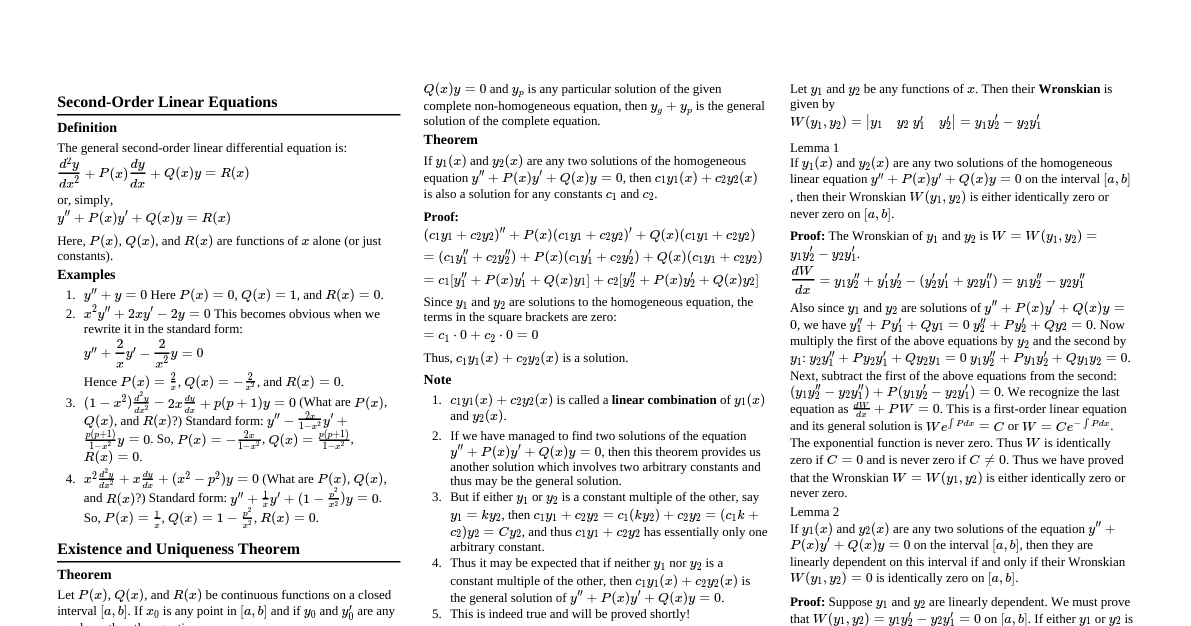
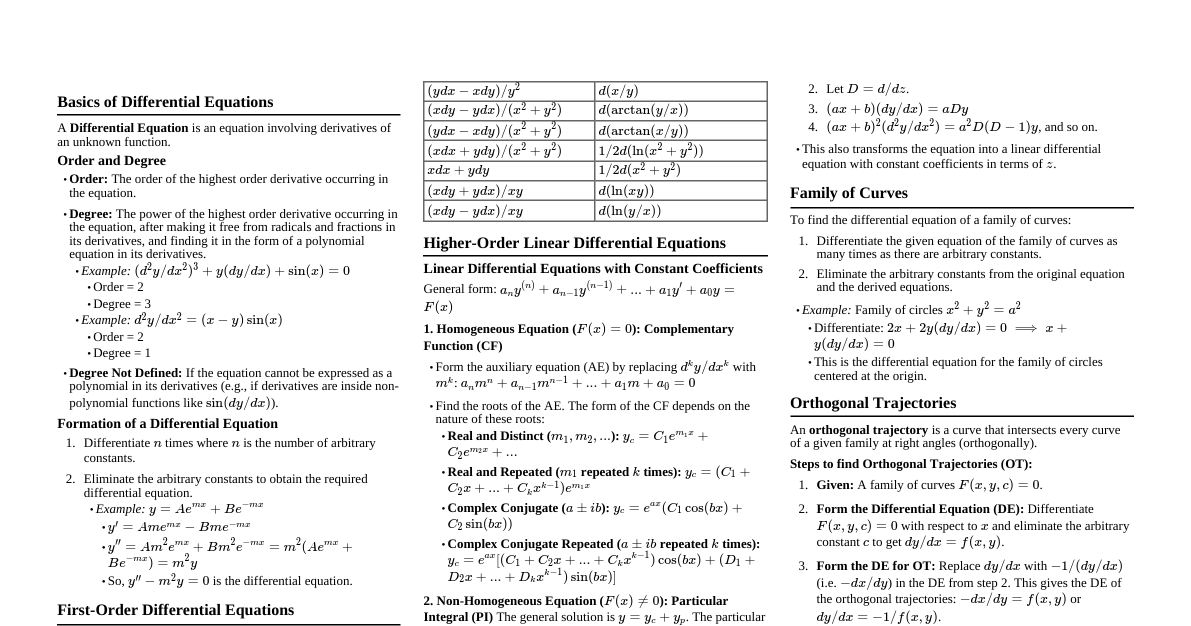
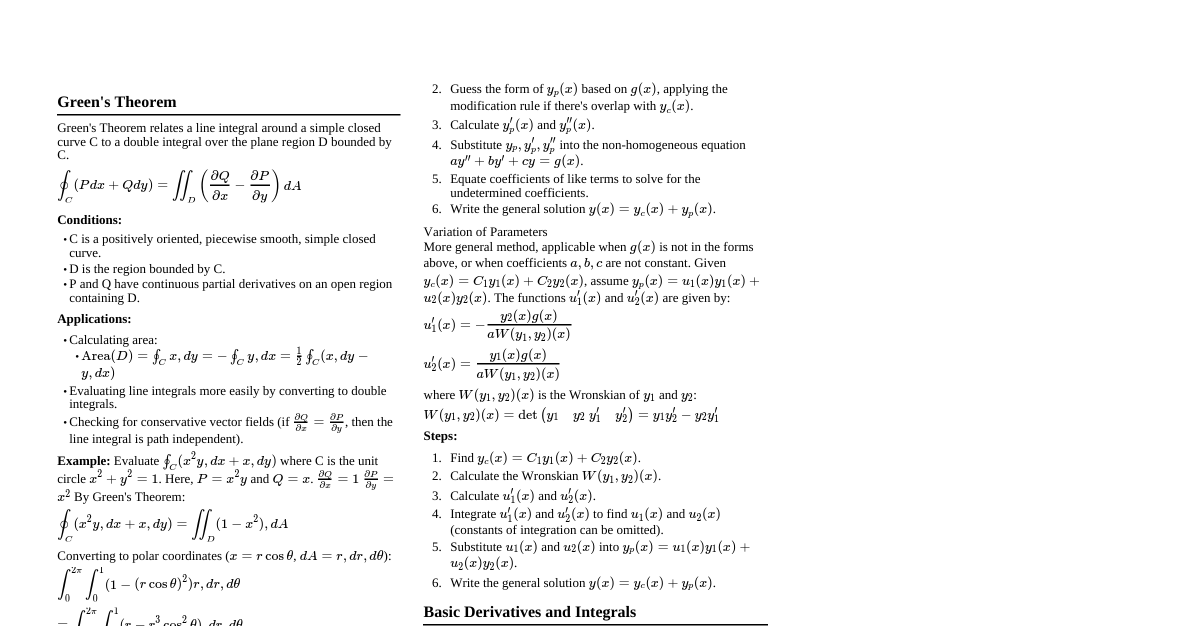
Differential Equations: Basic Concepts Definition: An equation involving an unknown function and its derivatives. Ordinary Differential Equation (ODE): Involves derivatives with respect to a single independent variable. Example: $y' + 2y = \sin(x)$ Partial Differential Equation (PDE): Involves partial derivatives with respect to two or more independent variables. Example: $\frac{\partial u}{\partial t} = k \frac{\partial^2 u}{\partial x^2}$ Order of a DE: The order of the highest derivative present in the equation. Example: $y''' + (y'')^2 + y = x$ is a 3rd order ODE. Degree of a DE: The power of the highest order derivative, once the equation is rationalized and cleared of fractions with respect to derivatives. Example: $(y'')^3 + (y')^2 + y = x$ has degree 3. Linear DE: A differential equation is linear if it is linear in the unknown function and its derivatives. General form for ODE: $a_n(x) \frac{d^n y}{dx^n} + \dots + a_1(x) \frac{dy}{dx} + a_0(x) y = f(x)$ Features: The dependent variable $y$ and its derivatives appear only to the first power. No products of $y$ or its derivatives. No transcendental functions of $y$ or its derivatives (e.g., $\sin(y)$, $e^y$). Non-Linear DE: Any differential equation that is not linear. Homogeneous DE (for linear ODEs): If $f(x)=0$. Otherwise, it's non-homogeneous. Solution of a DE: A function that satisfies the differential equation. General Solution: A solution containing arbitrary constants, equal in number to the order of the differential equation. Particular Solution: A solution obtained from the general solution by assigning specific values to the arbitrary constants, often using initial or boundary conditions. First Order Differential Equations General Form: $\frac{dy}{dx} = f(x,y)$ or $M(x,y)dx + N(x,y)dy = 0$ 1. Variables Separable Method If $f(x,y)$ can be written as $g(x)h(y)$, i.e., $\frac{dy}{dx} = g(x)h(y)$. Separate variables: $\frac{dy}{h(y)} = g(x)dx$ Integrate both sides: $\int \frac{dy}{h(y)} = \int g(x)dx + C$ 2. Homogeneous Equations If $f(x,y)$ is a homogeneous function of degree zero, i.e., $f(tx, ty) = t^0 f(x,y) = f(x,y)$. Substitution: $y = vx \implies \frac{dy}{dx} = v + x \frac{dv}{dx}$ The equation transforms into a separable form in $v$ and $x$. 3. Equations Reducible to Homogeneous Form Equations of the form $\frac{dy}{dx} = \frac{ax+by+c}{Ax+By+C}$ Case 1: If $aB - Ab \neq 0$, substitute $x = X+h$, $y = Y+k$ to eliminate $c$ and $C$. Solve $ah+bk+c=0$ and $Ah+Bk+C=0$ for $h, k$. Case 2: If $aB - Ab = 0$ (i.e., $Ax+By = k(ax+by)$), substitute $z = ax+by$. 4. Exact Differential Equations Form: $M(x,y)dx + N(x,y)dy = 0$ Condition for exactness: $\frac{\partial M}{\partial y} = \frac{\partial N}{\partial x}$ Solution: $\int M(x,y)dx + \int (\text{terms in } N \text{ not containing } x)dy = C$ Alternatively: $\int N(x,y)dy + \int (\text{terms in } M \text{ not containing } y)dx = C$ 5. Integrating Factor (IF) If $Mdx + Ndy = 0$ is not exact, an integrating factor $\mu(x,y)$ exists such that $\mu M dx + \mu N dy = 0$ is exact. Rules for finding IF: If $\frac{1}{N} \left( \frac{\partial M}{\partial y} - \frac{\partial N}{\partial x} \right) = f(x)$ (a function of $x$ only), then $IF = e^{\int f(x)dx}$. If $\frac{1}{M} \left( \frac{\partial N}{\partial x} - \frac{\partial M}{\partial y} \right) = g(y)$ (a function of $y$ only), then $IF = e^{\int g(y)dy}$. If $Mdx + Ndy = 0$ is homogeneous and $Mx+Ny \neq 0$, then $IF = \frac{1}{Mx+Ny}$. If $Mdx + Ndy = 0$ is of the form $f_1(xy)ydx + f_2(xy)xdy = 0$ and $Mx-Ny \neq 0$, then $IF = \frac{1}{Mx-Ny}$. 6. Linear First Order ODEs Form: $\frac{dy}{dx} + P(x)y = Q(x)$ Integrating Factor: $IF = e^{\int P(x)dx}$ Solution: $y \cdot (IF) = \int Q(x) \cdot (IF) dx + C$ 7. Bernoulli's Equation Form: $\frac{dy}{dx} + P(x)y = Q(x)y^n$ (where $n \neq 0, 1$) Substitution: $z = y^{1-n} \implies \frac{dz}{dx} = (1-n)y^{-n}\frac{dy}{dx}$ Transforms into a linear first-order ODE in $z$. 8. Clairaut's Equation Form: $y = xp + f(p)$, where $p = \frac{dy}{dx}$ General Solution: $y = cx + f(c)$ (by replacing $p$ with constant $c$). Singular Solution: Obtained by eliminating $p$ from $y = xp + f(p)$ and $x + f'(p) = 0$. 9. Lagrange's Equation Form: $y = xg(p) + f(p)$, where $p = \frac{dy}{dx}$ Differentiate with respect to $x$: $p = g(p) + xg'(p)\frac{dp}{dx} + f'(p)\frac{dp}{dx}$ Rearrange: $(p - g(p)) \frac{dx}{dp} - xg'(p) = f'(p)$ (Linear in $x$ and $\frac{dx}{dp}$) Higher-Order Linear Homogeneous DEs with Constant Coefficients General Form: $a_n y^{(n)} + a_{n-1} y^{(n-1)} + \dots + a_1 y' + a_0 y = 0$ Auxiliary Equation (Characteristic Equation): $a_n m^n + a_{n-1} m^{n-1} + \dots + a_1 m + a_0 = 0$ Finding the General Solution based on roots of Auxiliary Equation: Real and Distinct Roots ($m_1, m_2, \dots, m_n$): $y_c = C_1 e^{m_1 x} + C_2 e^{m_2 x} + \dots + C_n e^{m_n x}$ Real and Repeated Roots ($m$ repeated $k$ times): $y_c = (C_1 + C_2 x + \dots + C_k x^{k-1}) e^{mx}$ Complex Conjugate Roots ($\alpha \pm i\beta$): For a pair: $y_c = e^{\alpha x} (C_1 \cos(\beta x) + C_2 \sin(\beta x))$ Repeated Complex Conjugate Roots ($\alpha \pm i\beta$ repeated $k$ times): $y_c = e^{\alpha x} [(C_1 + C_2 x + \dots + C_k x^{k-1}) \cos(\beta x) + (D_1 + D_2 x + \dots + D_k x^{k-1}) \sin(\beta x)]$ Higher-Order Linear Non-Homogeneous DEs with Constant Coefficients General Form: $a_n y^{(n)} + \dots + a_0 y = F(x)$ General Solution: $y = y_c + y_p$ $y_c$: Complementary function (solution to the homogeneous equation, $F(x)=0$). $y_p$: Particular integral (any specific solution to the non-homogeneous equation). Method of Undetermined Coefficients Used when $F(x)$ is a combination of polynomials, exponentials, sines, and cosines. Rule: Guess the form of $y_p$ based on $F(x)$ and its derivatives. $F(x)$ Form of $y_p$ (initial guess) $P_n(x) = a_n x^n + \dots + a_0$ $A_n x^n + \dots + A_0$ $Ce^{ax}$ $Ae^{ax}$ $C \cos(bx)$ or $C \sin(bx)$ $A \cos(bx) + B \sin(bx)$ $P_n(x)e^{ax}$ $(A_n x^n + \dots + A_0)e^{ax}$ $P_n(x) \cos(bx)$ or $P_n(x) \sin(bx)$ $(A_n x^n + \dots + A_0)\cos(bx) + (B_n x^n + \dots + B_0)\sin(bx)$ Modification Rule: If any term in the initial guess for $y_p$ is also a term in $y_c$, multiply the entire guess by $x^s$, where $s$ is the smallest positive integer that eliminates the duplication. Method of Variation of Parameters Used when $F(x)$ is not of a suitable form for undetermined coefficients or when coefficients are not constant. For a second-order equation $y'' + P(x)y' + Q(x)y = F(x)$: Let $y_c = C_1 y_1(x) + C_2 y_2(x)$ be the complementary solution. Assume $y_p = u_1(x) y_1(x) + u_2(x) y_2(x)$. $u_1'(x) = -\frac{y_2(x)F(x)}{W(y_1, y_2)}$ $u_2'(x) = \frac{y_1(x)F(x)}{W(y_1, y_2)}$ Where $W(y_1, y_2) = y_1 y_2' - y_2 y_1'$ is the Wronskian. Integrate $u_1'$ and $u_2'$ to find $u_1$ and $u_2$. Cauchy-Euler Equations (Equidimensional Equations) Form: $a_n x^n y^{(n)} + a_{n-1} x^{n-1} y^{(n-1)} + \dots + a_1 x y' + a_0 y = F(x)$ Substitution: $x = e^t$ or $t = \ln x$. $xy' = \frac{dy}{dt}$ $x^2 y'' = \frac{d^2 y}{dt^2} - \frac{dy}{dt} = D(D-1)y$ (where $D = \frac{d}{dt}$) $x^3 y''' = D(D-1)(D-2)y$ Transforms into a linear ODE with constant coefficients in terms of $t$. System of Linear Differential Equations Matrix Form: $\mathbf{x}' = A\mathbf{x} + \mathbf{f}(t)$ Homogeneous System: $\mathbf{x}' = A\mathbf{x}$ Solution for Constant Matrix A: Assume $\mathbf{x} = \mathbf{v}e^{\lambda t}$. Characteristic Equation: $\det(A - \lambda I) = 0$. Solve for eigenvalues $\lambda$. For each $\lambda$, find eigenvectors $\mathbf{v}$ by solving $(A - \lambda I)\mathbf{v} = \mathbf{0}$. Case 1: Distinct Real Eigenvalues $\lambda_1, \dots, \lambda_n$: $\mathbf{x}(t) = C_1 \mathbf{v}_1 e^{\lambda_1 t} + \dots + C_n \mathbf{v}_n e^{\lambda_n t}$ Case 2: Complex Conjugate Eigenvalues $\lambda = \alpha \pm i\beta$: If $\mathbf{v}$ is an eigenvector for $\lambda = \alpha + i\beta$, then $\mathbf{\bar{v}}$ is an eigenvector for $\bar{\lambda} = \alpha - i\beta$. Solutions are $\mathbf{z}_1 = \mathbf{v}e^{(\alpha+i\beta)t}$ and $\mathbf{z}_2 = \mathbf{\bar{v}}e^{(\alpha-i\beta)t}$. Real solutions: $\mathbf{x}_1 = \text{Re}(\mathbf{z}_1)$ and $\mathbf{x}_2 = \text{Im}(\mathbf{z}_1)$. Case 3: Repeated Eigenvalues: Requires generalized eigenvectors or matrix exponentials. (More advanced) Partial Differential Equation: Introduction Definition: An equation involving an unknown function of multiple independent variables and its partial derivatives. Order: The order of the highest partial derivative. Degree: The power of the highest order partial derivative (after rationalization). Linear PDE: Linear in the unknown function and its partial derivatives. Example: $\frac{\partial^2 u}{\partial x^2} + \frac{\partial^2 u}{\partial y^2} = 0$ (Laplace Equation) Homogeneous PDE: If every term contains the dependent variable or one of its derivatives. Superposition Principle (for linear homogeneous PDEs): If $u_1, u_2, \dots, u_k$ are solutions, then $C_1 u_1 + \dots + C_k u_k$ is also a solution. Formation of PDEs: By elimination of arbitrary constants. By elimination of arbitrary functions. First Order Partial Differential Equations General Form: $F(x, y, u, p, q) = 0$, where $p = \frac{\partial u}{\partial x}$ and $q = \frac{\partial u}{\partial y}$. Linear First Order PDE (Lagrange's Linear Equation) Form: $Pp + Qq = R$, where $P, Q, R$ are functions of $x, y, u$. Auxiliary Equations: $\frac{dx}{P} = \frac{dy}{Q} = \frac{du}{R}$ If $c_1 = \phi_1(x,y,u)$ and $c_2 = \phi_2(x,y,u)$ are independent solutions to the auxiliary equations, the general solution is $\Phi(c_1, c_2) = 0$ or $c_1 = f(c_2)$. Non-Linear First Order PDE Charpit's Method: For $F(x, y, u, p, q) = 0$. Auxiliary equations: $\frac{dp}{\frac{\partial F}{\partial x} + p\frac{\partial F}{\partial u}} = \frac{dq}{\frac{\partial F}{\partial y} + q\frac{\partial F}{\partial u}} = \frac{du}{-p\frac{\partial F}{\partial p} - q\frac{\partial F}{\partial q}} = \frac{dx}{-\frac{\partial F}{\partial p}} = \frac{dy}{-\frac{\partial F}{\partial q}}$ Find a relation between $p, q$ and some variables (e.g., $p = f(x,y,u,a)$) from Charpit's equations. Substitute this back into $F(x,y,u,p,q)=0$ to find $q$. Substitute $p$ and $q$ into $du = pdx + qdy$ and integrate to find the complete integral. Standard Forms: $F(p,q) = 0$: Solution $u = ax+by+c$ where $F(a,b)=0$. $F(u,p,q) = 0$: Substitution $t = x+ay$, then $p = \frac{du}{dt}$, $q = a\frac{du}{dt}$. Reduces to ODE. $F(x,p) = G(y,q)$: Separate variables, $F(x,p) = G(y,q) = a$. Solve for $p$ and $q$, then integrate $du=pd+qdy$. Clairaut's Form: $u = px + qy + f(p,q)$. General solution: $u = ax + by + f(a,b)$. Second Order Partial Differential Equations General Form (Linear, second order, two independent variables): $A \frac{\partial^2 u}{\partial x^2} + B \frac{\partial^2 u}{\partial x \partial y} + C \frac{\partial^2 u}{\partial y^2} + D \frac{\partial u}{\partial x} + E \frac{\partial u}{\partial y} + F u = G(x,y)$ where $A, B, C, D, E, F$ are functions of $x, y$. Classification (based on $B^2 - 4AC$): Elliptic: If $B^2 - 4AC Parabolic: If $B^2 - 4AC = 0$. (e.g., Heat equation: $\frac{\partial u}{\partial t} = k \frac{\partial^2 u}{\partial x^2}$) Hyperbolic: If $B^2 - 4AC > 0$. (e.g., Wave equation: $\frac{\partial^2 u}{\partial t^2} = c^2 \frac{\partial^2 u}{\partial x^2}$) Homogeneous Linear PDEs with Constant Coefficients Form: $f(D, D')u = 0$, where $D = \frac{\partial}{\partial x}$, $D' = \frac{\partial}{\partial y}$. Auxiliary Equation: Replace $D$ with $m$ and $D'$ with $1$. Solve $f(m, 1) = 0$ for $m$. Roots $m_1, m_2, \dots, m_n$: Distinct real roots: $u(x,y) = \phi_1(y+m_1 x) + \phi_2(y+m_2 x) + \dots$ Repeated root $m$ ($k$ times): $u(x,y) = \phi_1(y+mx) + x\phi_2(y+mx) + \dots + x^{k-1}\phi_k(y+mx)$ Non-Homogeneous Linear PDEs with Constant Coefficients Form: $f(D, D')u = G(x,y)$ General Solution: $u = u_c + u_p$ $u_c$: Complementary function (solution to $f(D, D')u = 0$). $u_p$: Particular integral. If $G(x,y) = e^{ax+by}$, then $u_p = \frac{1}{f(a,b)}e^{ax+by}$, provided $f(a,b) \neq 0$. If $f(a,b)=0$, multiply by $x$ (or $y$) and differentiate the denominator with respect to $D$ (or $D'$). If $G(x,y) = \sin(ax+by)$ or $\cos(ax+by)$, then replace $D^2$ with $-a^2$, $D'^2$ with $-b^2$, $DD'$ with $-ab$. If $G(x,y) = x^m y^n$, then $u_p = \frac{1}{f(D,D')} x^m y^n = [f(D,D')]^{-1} x^m y^n$. Expand $[f(D,D')]^{-1}$ using binomial theorem.