Differential Equations
Cheatsheet Content
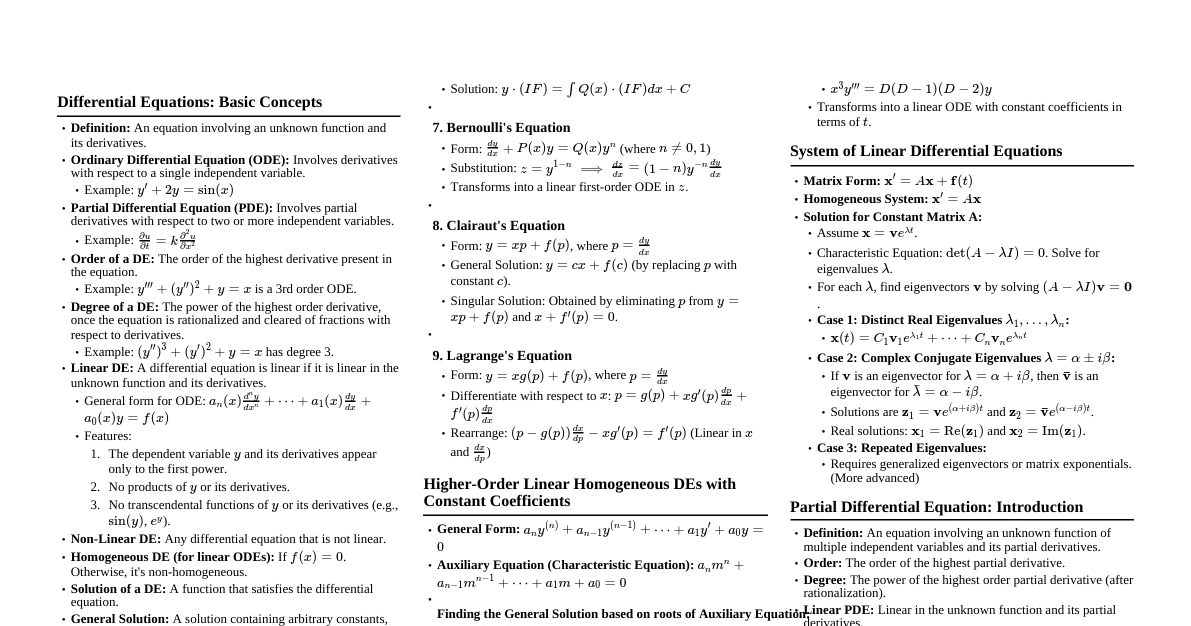
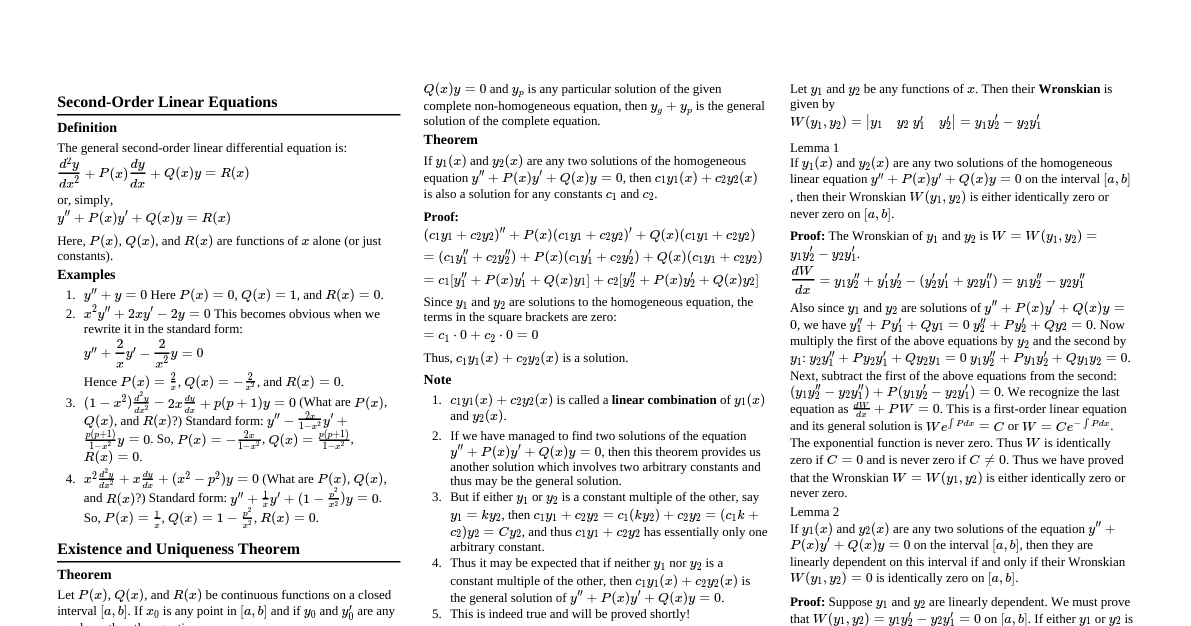
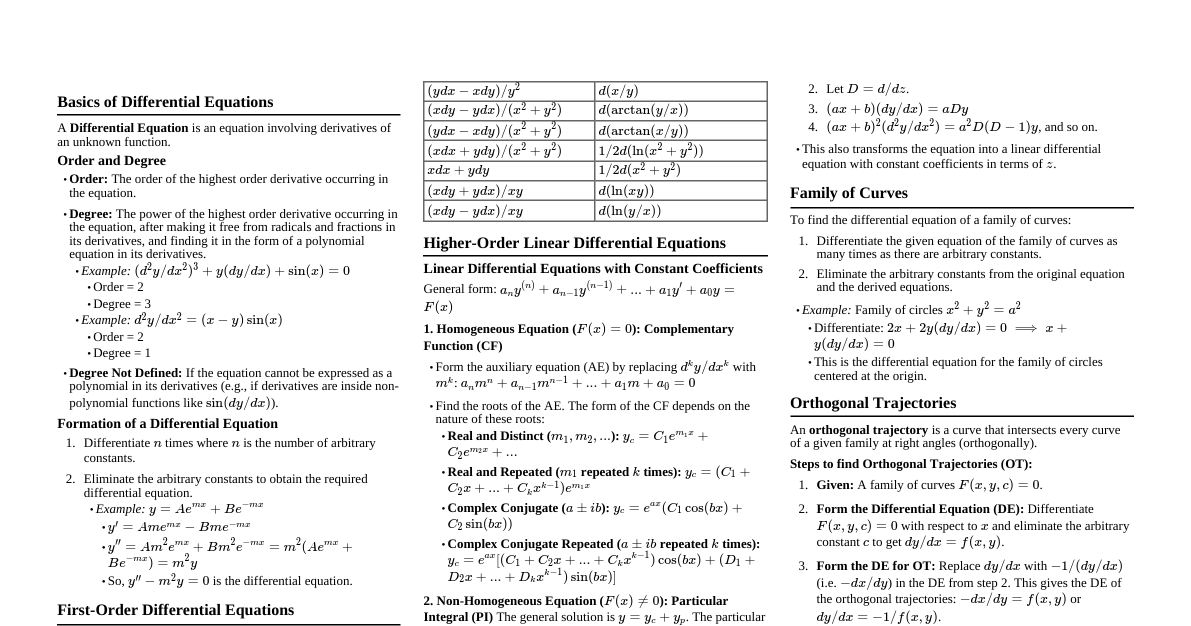
### Differential Equation Definition - **Ordinary Differential Equation (ODE):** An equation where all differential coefficients refer to a single independent variable. - **Order:** The order of the highest derivative in the equation. - **Degree:** The degree of the highest derivative after the equation is free from radicals and fractions (as far as derivatives are concerned). - **Linear Differential Equation:** Dependent variable and its derivatives occur only in the first degree and are not multiplied together. - General form of nth order: $$\frac{d^n y}{dx^n} + P_1 \frac{d^{n-1} y}{dx^{n-1}} + P_2 \frac{d^{n-2} y}{dx^{n-2}} + \dots + P_n y = X$$ Where $P_1, P_2, \dots, P_n$ and $X$ are functions of $x$ only. - **Linear Differential Equations with Constant Coefficients:** - Form: $$\frac{d^n y}{dx^n} + k_1 \frac{d^{n-1} y}{dx^{n-1}} + k_2 \frac{d^{n-2} y}{dx^{n-2}} + \dots + k_n y = X$$ Where $k_1, k_2, \dots, k_n$ are constants. Important for electro-mechanical vibrations. - **Complete Solution:** $y = \text{C.F} + \text{P.I}$ - **C.F:** Complementary Function - **P.I:** Particular Integral ### The Operator D - Denoting $\frac{d}{dx}$ by $D$, $\frac{d^2}{dx^2}$ by $D^2$, etc. - $\frac{dy}{dx} = Dy$ - $\frac{d^2y}{dx^2} = D^2y$ - $\frac{d^3y}{dx^3} = D^3y$ - Symbolic form of an nth order linear differential equation with constant coefficients: $$(D^n + k_1 D^{n-1} + \dots + k_n)y = X \quad \text{or} \quad f(D)y = X$$ Where $f(D)$ is a polynomial in $D$. - `D` can be treated as an algebraic quantity for factorization. - Example: $\frac{d^2y}{dx^2} + 2\frac{dy}{dx} - 3y = (D^2 + 2D - 3)y = (D+3)(D-1)y$. ### Rules to find C.F - the Complementary Function To solve $f(D)y = X$ where $k$'s are constants: 1. Write $f(D) = 0$ (Auxiliary Equation - A.E.). 2. Replace $D$ with $m$ and solve the A.E. for roots $m_1, m_2, \dots$. #### Case 1: Real Roots - **Distinct Roots ($m_1, m_2$):** $\text{C.F} = c_1 e^{m_1 x} + c_2 e^{m_2 x}$ - **Same Roots ($m_1 = m_2 = m$):** $\text{C.F} = (c_1 x + c_2) e^{m x}$ #### Case 2: Complex Roots - **Complex Conjugate Roots ($\alpha \pm i\beta$):** $\text{C.F} = e^{\alpha x} (c_1 \cos \beta x + c_2 \sin \beta x)$ ### Rules to find P.I - Particular Integral Symbolic form: $f(D)y = X$. Then $\text{P.I} = \frac{1}{f(D)}X$, provided $f(D) \neq 0$. #### Case 1: $X = e^{ax}$ - Replace $D$ by $a$ in $f(D)$: $\text{P.I} = \frac{1}{f(a)}e^{ax}$ #### Case 2: $X = \sin(ax+b)$ or $\cos(ax+b)$ - Replace $D^2$ (only) by $-a^2$ in $f(D)$. #### Case 3: $X = x^m$ - $\text{P.I} = \frac{1}{f(D)}x^m = [f(D)]^{-1}x^m$. - Expand $f(D)$ in ascending powers of $D$ and operate on $x^m$. #### Case of Failure: $f(D) = 0$ - If $f(D) = 0$ for Case 1 or 2, multiply the numerator by $x$ and differentiate the denominator once, then apply the rule. - Example: If $X=e^{ax}$ and $f(a)=0$, then $\text{P.I} = x \frac{1}{f'(a)}e^{ax}$. ### Problems: Solving Differential Equations 1. **Pitch Angle Response:** - Given: $\frac{d^2x}{dt^2} + 5\frac{dx}{dt} + 6x = 0$, with $x(0) = 0$, $\frac{dx}{dt}(0) = 15$. - Symbolic form: $(D^2 + 5D + 6)x = 0$. - A.E.: $D^2 + 5D + 6 = 0 \implies (D+2)(D+3) = 0 \implies D = -2, -3$. - C.S.: $x = c_1 e^{-2t} + c_2 e^{-3t}$. - $\frac{dx}{dt} = -2c_1 e^{-2t} - 3c_2 e^{-3t}$. - Apply initial conditions: - $x(0) = 0 \implies 0 = c_1 + c_2$. - $\frac{dx}{dt}(0) = 15 \implies 15 = -2c_1 - 3c_2$. - Solving for $c_1, c_2$: $c_1 = 15, c_2 = -15$. - Solution: $x = 15(e^{-2t} - e^{-3t})$. 2. **Spacecraft Attitude Stabilization:** - Given: $\frac{d^2x}{dt^2} + 6\frac{dx}{dt} + 9x = 0$. - Symbolic form: $(D^2 + 6D + 9)x = 0$. - A.E.: $(D+3)^2 = 0 \implies D = -3, -3$. - C.S.: $x = (c_1 + c_2 t)e^{-3t}$. 3. **Aircraft Wing Tip Vibration:** - Given: $(D^3 + D^2 + 4D + 4)y = 0$. - A.E.: $(D^2 + 4)(D + 1) = 0 \implies D = -1, \pm 2i$. - C.S.: $y = c_1 e^{-x} + e^{0x}(c_2 \cos 2x + c_3 \sin 2x) = c_1 e^{-x} + c_2 \cos 2x + c_3 \sin 2x$. 4. **Missile Longitudinal Motion:** - Given: $(D^2 + 5D + 6)y = e^x$. - C.F. A.E.: $m^2 + 5m + 6 = 0 \implies (m+2)(m+3) = 0 \implies m = -2, -3$. - C.F.: $c_1 e^{-2x} + c_2 e^{-3x}$. - P.I.: $\frac{1}{D^2+5D+6}e^x = \frac{1}{1^2+5(1)+6}e^x = \frac{1}{12}e^x$. - Complete Solution: $y = c_1 e^{-2x} + c_2 e^{-3x} + \frac{1}{12}e^x$. 5. **Rocket Body Structural Vibration:** - Given: $(D+2)(D-1)^2 y = e^{-2x} + 2\sinh x$. - C.F. A.E.: $(m+2)(m-1)^2 = 0 \implies m = -2, 1, 1$. - C.F.: $c_1 e^{-2x} + (c_2 x + c_3)e^x$. - P.I. for $e^{-2x}$: $\text{P.I}_1 = \frac{1}{(D+2)(D-1)^2}e^{-2x}$. Since $D=-2$ makes $(D+2)=0$, use case of failure. - $\text{P.I}_1 = x \frac{1}{(1-2)^2 + (-2+2)(1-2)}e^{-2x} = x \frac{1}{(-2-1)^2}e^{-2x} = x \frac{1}{9}e^{-2x}$. (Correction from OCR: The failure rule is $x \frac{1}{f'(-2)} e^{-2x}$) - Let $f(D) = (D+2)(D-1)^2$. $f'(D) = (D-1)^2 + (D+2)2(D-1) = (D-1)(D-1+2D+4) = (D-1)(3D+3)$. - $f'(-2) = (-2-1)(3(-2)+3) = (-3)(-3) = 9$. - So, $\text{P.I}_1 = x \frac{1}{9}e^{-2x}$. - P.I. for $2\sinh x = e^x - e^{-x}$: - $\text{P.I}_2 = \frac{1}{(D+2)(D-1)^2}e^x$. Since $D=1$ makes $(D-1)^2=0$, use case of failure. - Let $g(D) = (D+2)(D-1)^2$. $g'(D) = (D-1)^2 + (D+2)2(D-1)$. - $g'(1) = (1-1)^2 + (1+2)2(1-1) = 0$. This is a repeated root, so $g''(D)$ is needed. - $g''(D) = 2(D-1) + 2(D-1) + 2(D+2)2 = 4(D-1) + 4(D+2)$. - $g''(1) = 4(1-1) + 4(1+2) = 12$. - So, $\text{P.I}_2 \text{ part for } e^x = x^2 \frac{1}{12}e^x$. - $\text{P.I}_3 \text{ part for } -e^{-x} = \frac{1}{(-1+2)(-1-1)^2}(-e^{-x}) = \frac{1}{(1)(-2)^2}(-e^{-x}) = -\frac{1}{4}e^{-x}$. - Total P.I. = $\frac{x}{9}e^{-2x} + \frac{x^2}{12}e^x - \frac{1}{4}e^{-x}$. ### Method of Variation of Parameters - For equations of the form $y'' + py' + qy = X$, where $p, q, X$ are functions of $x$. - If $\text{C.F.} = c_1 y_1 + c_2 y_2$, then $\text{P.I.} = -y_1 \int \frac{y_2 X}{W} dx + y_2 \int \frac{y_1 X}{W} dx$. - **Wronskian:** $W = \begin{vmatrix} y_1 & y_2 \\ y_1' & y_2' \end{vmatrix} = y_1 y_2' - y_2 y_1'$. #### Problems: Variation of Parameters 1. **Aircraft Lateral Oscillation:** - Given: $\frac{d^2y}{dx^2} + 4y = \tan 2x$. - (i) C.F. A.E.: $D^2 + 4 = 0 \implies D = \pm 2i$. - C.F.: $y = c_1 \cos 2x + c_2 \sin 2x$. - (ii) P.I. Here $y_1 = \cos 2x$, $y_2 = \sin 2x$, $X = \tan 2x$. - $W = \begin{vmatrix} \cos 2x & \sin 2x \\ -2\sin 2x & 2\cos 2x \end{vmatrix} = 2\cos^2 2x + 2\sin^2 2x = 2$. - $\int \frac{y_2 X}{W} dx = \int \frac{\sin 2x \tan 2x}{2} dx = \frac{1}{2} \int \frac{\sin^2 2x}{\cos 2x} dx = \frac{1}{2} \int \frac{1-\cos^2 2x}{\cos 2x} dx = \frac{1}{2} \int (\sec 2x - \cos 2x) dx$ $= \frac{1}{2} \left[ \frac{1}{2}\log|\sec 2x + \tan 2x| - \frac{1}{2}\sin 2x \right]$. - $\int \frac{y_1 X}{W} dx = \int \frac{\cos 2x \tan 2x}{2} dx = \frac{1}{2} \int \sin 2x dx = -\frac{1}{4}\cos 2x$. - $\text{P.I.} = -\cos 2x \left[ \frac{1}{4}\log|\sec 2x + \tan 2x| - \frac{1}{4}\sin 2x \right] + \sin 2x \left[ -\frac{1}{4}\cos 2x \right]$ $= -\frac{1}{4}\cos 2x \log|\sec 2x + \tan 2x| + \frac{1}{4}\sin 2x \cos 2x - \frac{1}{4}\sin 2x \cos 2x$ $= -\frac{1}{4}\cos 2x \log|\sec 2x + \tan 2x|$. - Complete Solution: $y = c_1 \cos 2x + c_2 \sin 2x - \frac{1}{4}\cos 2x \log|\sec 2x + \tan 2x|$. ### Cauchy's Homogeneous Linear Equation - Form: $x^n \frac{d^n y}{dx^n} + k_1 x^{n-1} \frac{d^{n-1} y}{dx^{n-1}} + \dots + k_{n-1} x \frac{dy}{dx} + k_n y = X$. - Reduced to linear DE with constant coefficients by substituting $x = e^t$ or $t = \log x$. - Then: - $x\frac{dy}{dx} = Dy$ - $x^2\frac{d^2y}{dx^2} = D(D-1)y$ - $x^3\frac{d^3y}{dx^3} = D(D-1)(D-2)y$ - And so on, where $D = \frac{d}{dt}$. #### Problems: Cauchy-Euler Equations 1. **Rocket Nozzle Pressure Variation:** - Given: $x^2 \frac{d^2y}{dx^2} - x \frac{dy}{dx} + y = \log x$. - Substitute: $x=e^t$, $x\frac{dy}{dx}=Dy$, $x^2\frac{d^2y}{dx^2}=D(D-1)y$. - Equation becomes: $D(D-1)y - Dy + y = t \implies (D^2 - D - D + 1)y = t \implies (D^2 - 2D + 1)y = t \implies (D-1)^2 y = t$. - A.E.: $(m-1)^2 = 0 \implies m=1,1$. - C.F.: $(c_1 t + c_2)e^t$. - P.I.: $\frac{1}{(D-1)^2}t = (1-D)^{-2}t = (1+2D+3D^2+\dots)t = t+2$. - Solution: $y = (c_1 t + c_2)e^t + t+2$. - Substitute back $t = \log x$, $e^t = x$: $y = (c_1 \log x + c_2)x + \log x + 2$. ### Special Functions in Aerospace Engineering Special functions are crucial when governing equations become non-trivial. #### (a) Bessel Functions - Used for problems involving **cylindrical geometry**. - **Applications:** - Vibration of aircraft fuselage - Pressure waves in jet engines - Heat conduction in rocket motors - Acoustics of engine noise #### (b) Fourier Series and Fourier Transforms - Used for **periodic and transient phenomena**. - **Applications:** - Aircraft vibration analysis - Gust load modeling - Signal processing in radar and avionics - Aeroelastic flutter analysis #### (c) Laplace Transforms - Used to solve **initial-value problems**. - **Applications:** - Aircraft control systems - Autopilot design - Missile guidance laws - Dynamic response of flight systems #### (d) Legendre, Chebyshev, Hermite Polynomials - Used in: - Spectral methods for CFD - High-accuracy numerical simulations - Optimal control and trajectory optimization - Legendre polynomials and special functions enable analytical and numerical solutions of complex aerospace problems involving aerodynamics, vibrations, heat transfer, orbital mechanics, and control systems. - Legendre polynomials are used in solving axisymmetric aerodynamic and gravitational field problems in aerospace engineering. - Special functions are essential in modeling vibrations, heat transfer, wave propagation, and control systems in aerospace vehicles. #### (e) Gamma and Error Functions - Used in: - Statistical modeling of atmospheric turbulence - Reliability analysis of aerospace components - Probabilistic flight mechanics ### Applications of Legendre Polynomials in Aerospace Engineering Legendre polynomials naturally arise in problems with **spherical or axisymmetric geometry**. #### (a) Potential Flow Around Axisymmetric Bodies - Used to solve Laplace's equation in spherical coordinates. - **Applications:** - Flow around spheres - Missile noses - Radomes - Simplified fuselage shapes - Pressure and velocity potentials are expanded using Legendre polynomials. #### (b) Aerodynamic Pressure Distribution - Pressure variation over aircraft or missile surfaces can be expanded in Legendre series. - Useful for: - Estimating lift and drag - Computing aerodynamic moments #### (c) Gravitational and Magnetic Field Modeling - Earth's gravitational potential is expanded using Legendre polynomials. - Used in: - Satellite orbit determination - Spacecraft navigation - Attitude dynamics #### (d) Boundary-Value Problems in Heat Transfer - Temperature distribution over spherical or axisymmetric aerospace components. - **Examples:** - Rocket nose cones - Thermal protection systems #### (e) Stability and Control Analysis - Solutions to linearized equations of motion may involve Legendre-type expansions when symmetry exists. - Helps in modeling angular motion and stability derivatives. ### Power Series & Legendre's Polynomial - **Power Series Definition:** A series of the form $a_0 + a_1 x + a_2 x^2 + \dots + a_n x^n + \dots$, where $a_i$ are independent of $x$. - **Legendre's Equation:** $(1-x^2)\frac{d^2y}{dx^2} - 2x\frac{dy}{dx} + n(n+1)y = 0$, where $n$ is a real number. - **Legendre's Polynomial $P_n(x)$:** - $P_n(x) = \sum_{r=0}^{\lfloor n/2 \rfloor} (-1)^r \frac{(2n-2r)!}{2^n r!(n-r)!(n-2r)!} x^{n-2r}$. - $P_n(x)$ is a solution of Legendre's equation. - **Recurrence Formulae for $P_n(x)$:** 1. $(n+1)P_{n+1}(x) = (2n+1)xP_n(x) - nP_{n-1}(x)$ 2. $nP_n(x) = xP_n'(x) - P_{n-1}'(x)$ 3. $(2n+1)P_n(x) = P_{n+1}'(x) - P_{n-1}'(x)$ 4. $P_n'(x) = xP_{n-1}'(x) + nP_{n-1}(x)$ 5. $(1-x^2)P_n'(x) = n[P_{n-1}(x) - xP_n(x)]$ #### Results (First few Legendre Polynomials) - $P_0(x) = 1$ - $P_1(x) = x$ - $P_2(x) = \frac{1}{2}(3x^2-1)$ - $P_3(x) = \frac{1}{2}(5x^3-3x)$ - $P_4(x) = \frac{1}{8}(35x^4-30x^2+3)$ - $P_5(x) = \frac{1}{8}(63x^5-70x^3+15x)$ #### Expressing Powers of x in terms of Legendre Polynomials - $1 = P_0(x)$ - $x = P_1(x)$ - $x^2 = \frac{2}{3}P_2(x) + \frac{1}{3}P_0(x)$ - $x^3 = \frac{2}{5}P_3(x) + \frac{3}{5}P_1(x)$ - $x^4 = \frac{8}{35}P_4(x) + \frac{12}{35}P_2(x) + \frac{3}{35}P_0(x)$ #### Problems: Expressing Functions in terms of Legendre Polynomials 1. **Aerodynamic Potential Function:** - Given: $f(x) = x^4 + 2x^2 - x - 3$. - Substitute powers of $x$ with Legendre polynomials: $f(x) = \left(\frac{8}{35}P_4(x) + \frac{12}{35}P_2(x) + \frac{3}{35}P_0(x)\right) + 2\left(\frac{2}{3}P_2(x) + \frac{1}{3}P_0(x)\right) - P_1(x) - 3P_0(x)$ $f(x) = \frac{8}{35}P_4(x) + \left(\frac{12}{35} + \frac{4}{3}\right)P_2(x) - P_1(x) + \left(\frac{3}{35} + \frac{2}{3} - 3\right)P_0(x)$ $f(x) = \frac{8}{35}P_4(x) + \frac{152}{105}P_2(x) - P_1(x) - \frac{224}{105}P_0(x)$. 2. **Pressure Distribution over Spherical Radome:** - Given: $f(x) = 4x^3 + 6x^2 + 7x + 2$. - Substitute powers of $x$: $f(x) = 4\left(\frac{2}{5}P_3(x) + \frac{3}{5}P_1(x)\right) + 6\left(\frac{2}{3}P_2(x) + \frac{1}{3}P_0(x)\right) + 7P_1(x) + 2P_0(x)$ $f(x) = \frac{8}{5}P_3(x) + 4P_2(x) + \left(\frac{12}{5} + 7\right)P_1(x) + \left(2 + \frac{6}{3}\right)P_0(x)$ $f(x) = \frac{8}{5}P_3(x) + 4P_2(x) + \frac{47}{5}P_1(x) + 4P_0(x)$. 3. **Velocity Potential Distribution:** - Given: $f(x) = 4x^3 - 2x^2 - 3x + 8$. - Substitute powers of $x$: $f(x) = 4\left(\frac{2}{5}P_3(x) + \frac{3}{5}P_1(x)\right) - 2\left(\frac{2}{3}P_2(x) + \frac{1}{3}P_0(x)\right) - 3P_1(x) + 8P_0(x)$ $f(x) = \frac{8}{5}P_3(x) - \frac{4}{3}P_2(x) + \left(\frac{12}{5} - 3\right)P_1(x) + \left(-\frac{2}{3} + 8\right)P_0(x)$ $f(x) = \frac{8}{5}P_3(x) - \frac{4}{3}P_2(x) - \frac{3}{5}P_1(x) + \frac{22}{3}P_0(x)$.