Physical Education Class 12
Cheatsheet Content
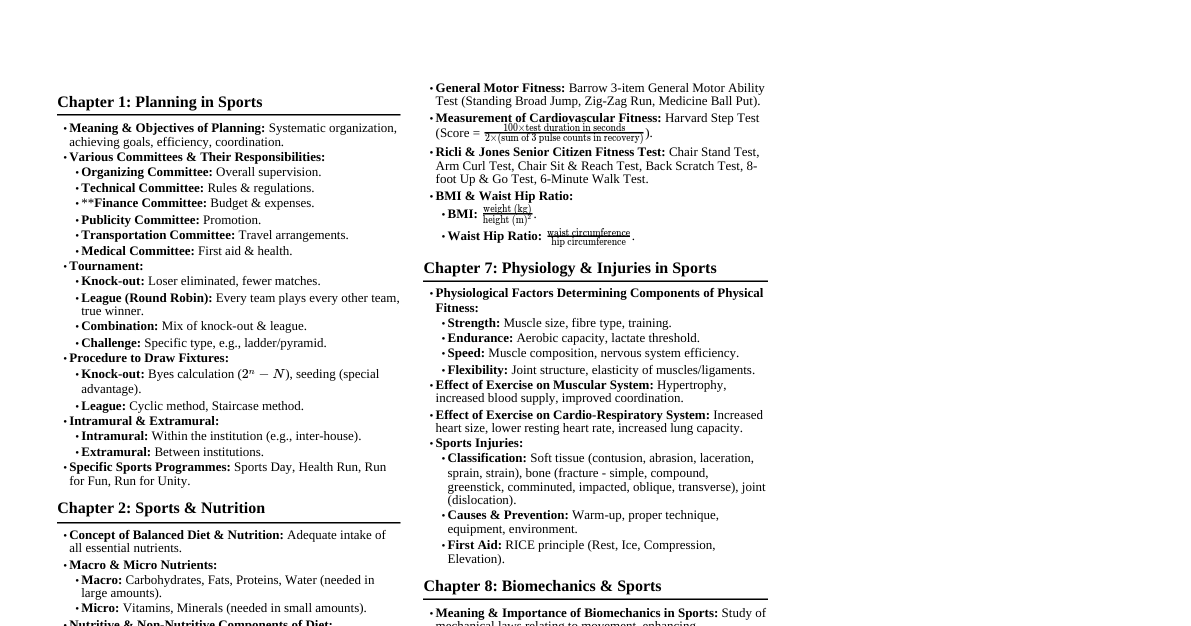
### Planning in Sports - **Definition:** A systematic process to achieve specific goals in sports. - **Objectives:** - Reduce chances of error. - Efficient utilization of resources. - Improve performance. - Maintain good control over activities. - **Types of Tournaments:** - **Knock-out:** Loser is eliminated immediately. - *Advantages:* Less time, less expensive. - *Disadvantages:* Strong teams might get eliminated early. - **League (Round Robin):** Every team plays every other team. - *Advantages:* True winner, maximum matches. - *Disadvantages:* More time, more expensive. - **Combination:** Mix of knock-out and league (e.g., league-cum-knockout). - **Challenge:** Players challenge each other. - **Fixtures:** Drawing up the schedule for matches. - *Methods:* Staircase method, Cyclic method. - **Committees & Their Responsibilities:** - *Pre-tournament:* Marketing, finance, ground/equipment. - *During-tournament:* Accommodation, transport, refreshment, medical. - *Post-tournament:* Prize distribution, records, press release. - **Intramural & Extramural:** - **Intramural:** Activities within the institution (e.g., inter-house). - **Extramural:** Activities outside the institution (e.g., inter-school). - **Specific Sports Programmes:** - *Health Runs:* Promote health & fitness. - *Fun & Run:* Recreational, non-competitive. - *Run for Unity:* Promote national integration. - *Run for Cause:* Raise awareness for social issues. ### Sports and Nutrition - **Balanced Diet:** Contains all essential nutrients in correct proportions for growth, maintenance, and energy. - *Components:* Carbohydrates, Proteins, Fats, Vitamins, Minerals, Water. - **Macronutrients:** - **Carbohydrates:** Primary energy source (e.g., grains, fruits). - *Types:* Simple (sugars), Complex (starches). - **Proteins:** Bodybuilding, repair of tissues (e.g., pulses, meat). - **Fats:** Concentrated energy source, vitamin absorption (e.g., oils, nuts). - **Micronutrients:** - **Vitamins:** Regulate body processes (A, B, C, D, E, K). - **Minerals:** Bone formation, nerve function (Calcium, Iron, Sodium, Potassium). - **Water:** Essential for all bodily functions, temperature regulation. - **Healthy Weight:** - **BMI (Body Mass Index):** Weight (kg) / [Height (m)]^2 - *Underweight:* = 30.0 - **Factors for Healthy Weight:** Diet, Physical Activity, Lifestyle. - **Food Intolerances & Myths:** - **Food Intolerance:** Difficulty digesting certain foods (e.g., lactose intolerance). - **Food Myths:** Misconceptions about food (e.g., "fat-free means healthy," "eating less is best for weight loss"). - **Eating Disorders:** - **Anorexia Nervosa:** Self-starvation, extreme fear of gaining weight. - **Bulimia Nervosa:** Binge eating followed by purging. - **Binge Eating Disorder:** Recurrent episodes of eating large quantities of food, often quickly and to the point of discomfort. ### Yoga and Lifestyle - **Yoga:** An ancient Indian practice involving physical postures (asanas), breathing techniques (pranayama), and meditation. - **Asanas as Preventive Measure:** - **Obesity:** Tadasana, Katichakrasana, Pavanmuktasana, Ardhachakrasana. - **Diabetes:** Bhujangasana, Paschimottanasana, Ardha Matsyendrasana, Mandukasana. - **Asthma:** Sukhasana, Chakrasana, Gomukhasana, Parvatasana, Bhujangasana, Paschimottanasana, Matsyasana. - **Hypertension (High BP):** Tadasana, Katichakrasana, Pavanmuktasana, Ardhachakrasana, Bhujangasana, Paschimottanasana, Ardha Matsyendrasana, Mandukasana, Shavasana. - **Back Pain:** Tadasana, Katichakrasana, Ardhachakrasana, Bhujangasana, Shalabhasana. - **Benefits of Yoga:** - Improves flexibility, strength, balance. - Reduces stress and anxiety. - Boosts immunity. - Enhances concentration. - Improves posture. - **Common Lifestyle Diseases:** Obesity, Diabetes, Asthma, Hypertension, Back Pain. Yoga helps manage and prevent these conditions. ### Physical Education and Sports for CWSN (Children with Special Needs) - **Concepts of Disability & Disorder:** - **Disability:** A condition or function judged to be significantly impaired relative to the usual standard of an individual or group. - **Disorder:** A disturbance in physical or mental health or functions. - **Types of Disabilities:** - *Cognitive Disability:* Difficulty with mental tasks (e.g., dyslexia, ADHD). - *Physical Disability:* Impairment of body structure or function (e.g., cerebral palsy, paraplegia). - *Sensory Disability:* Impairment of one of the senses (e.g., blindness, deafness). - **Causes of Disabilities:** Genetic, environmental, accidents, diseases. - **Types of Disorders:** - **ADHD (Attention Deficit Hyperactivity Disorder):** Difficulty paying attention, hyperactivity, impulsivity. - **SPD (Sensory Processing Disorder):** Difficulty processing sensory information. - **ASD (Autism Spectrum Disorder):** Challenges with social skills, repetitive behaviors, speech, nonverbal communication. - **ODD (Oppositional Defiant Disorder):** Pattern of disobedient, hostile, and defiant behavior. - **OCD (Obsessive Compulsive Disorder):** Unwanted thoughts (obsessions) and repetitive behaviors (compulsions). - **Strategies to Make Physical Activities Accessible:** - **Inclusive Environment:** Adapt facilities, equipment. - **Modified Rules:** Simplify game rules, allow assistance. - **Variety of Activities:** Offer diverse options to suit different abilities. - **Sensory Considerations:** Reduce distractions, use visual aids. - **Peer Support:** Encourage interaction and help among students. - **Specific Teaching Strategies:** Task analysis, backward chaining, positive reinforcement. ### Children and Women in Sports - **Motor Development in Children:** - **Gross Motor Skills:** Large muscle movements (e.g., running, jumping). - **Fine Motor Skills:** Small muscle movements (e.g., writing, tying shoes). - **Factors Affecting Motor Development:** Heredity, environment, nutrition, opportunity. - **Common Postural Deformities:** - **Kyphosis:** Exaggerated outward curve of the thoracic spine (hunchback). - **Lordosis:** Exaggerated inward curve of the lumbar spine (swayback). - **Scoliosis:** Sideways curvature of the spine. - **Knock-Knees (Genu Valgum):** Knees touch when feet are apart. - **Bow Legs (Genu Varum):** Legs curve outward at the knees. - **Flat Foot (Pes Planus):** Absence of arch in the foot. - **Round Shoulders:** Shoulders pulled forward. - *Corrective Measures:* Specific exercises, yoga asanas, proper posture habits. - **Women's Participation in Sports:** - **Reasons for Less Participation:** Social barriers, lack of safety, limited access to facilities, cultural norms, lack of role models. - **Special Considerations for Women Athletes:** - **Menstrual Dysfunction:** Amenorrhea (absence of menstruation), oligomenorrhea (infrequent menstruation). - **Osteoporosis:** Decreased bone density, increased fracture risk. - **Eating Disorders:** Anorexia, bulimia (more prevalent in aesthetic sports). - **Female Athlete Triad:** Interrelationship of energy availability, menstrual function, and bone mineral density. - **Ergogenic Aids:** Substances or methods used to enhance athletic performance (e.g., caffeine, creatine). - *Ethical concerns & health risks involved.* ### Test and Measurement in Sports - **Definition:** - **Test:** A tool or technique used to obtain data about specific characteristics. - **Measurement:** The process of collecting data on performance or ability. - **Evaluation:** Interpreting the collected data to make judgments or decisions. - **Importance:** - Assess fitness level. - Identify strengths and weaknesses. - Motivate participants. - Set goals. - Evaluate training programs. - **Fitness Tests:** - **SAI Khelo India Fitness Test:** - *Age 5-8 years (Class 1-3):* BMI, Flamingo Balance Test, Plate Tapping Test. - *Age 9-18 years (Class 4-12):* BMI, 50m Standing Start, 600m Run/Walk, Sit & Reach Flexibility, Strength (Partial Curl-up, Push-ups for Boys, Modified Push-ups for Girls). - **General Motor Fitness Test (Barrow Motor Ability Test):** - Standing Broad Jump. - Zig-Zag Run. - Medicine Ball Put (for boys), Basketball Throw (for girls). - **Specific Tests:** - **Harvard Step Test:** Cardiovascular fitness. - **Rikli & Jones Senior Citizen Fitness Test:** - Chair Stand Test (lower body strength). - Arm Curl Test (upper body strength). - Chair Sit & Reach Test (lower body flexibility). - Back Scratch Test (upper body flexibility). - 8-Foot Up-and-Go Test (agility/dynamic balance). - 6-Minute Walk Test (aerobic endurance). ### Physiology and Injuries in Sports - **Physiological Factors Determining Fitness Components:** - **Strength:** Muscle size, fiber composition (fast/slow twitch), neuromuscular coordination. - **Endurance:** Aerobic capacity, lactate threshold, oxygen uptake. - **Speed:** Muscle fiber type, nervous system efficiency, flexibility. - **Flexibility:** Joint structure, muscle elasticity, age, gender. - **Coordination:** Nervous system efficiency, balance, proprioception. - **Effect of Exercise on Systems:** - **Cardiovascular System:** Increased heart size, stroke volume, cardiac output, decreased resting heart rate, improved blood circulation. - **Respiratory System:** Increased lung capacity, tidal volume, vital capacity, improved oxygen utilization. - **Muscular System:** Muscle hypertrophy, increased strength, endurance, flexibility, improved coordination. - **Sports Injuries:** - **Classification:** - **Soft Tissue Injuries:** Sprain (ligament), Strain (muscle/tendon), Contusion (bruise), Abrasion (graze), Laceration (cut), Incision (clean cut). - **Bone Injuries:** Fracture (simple, compound, greenstick, comminuted, impacted, oblique, transverse). - **Joint Injuries:** Dislocation (complete displacement), Subluxation (partial displacement). - **Causes:** Improper training, inadequate warm-up, poor technique, faulty equipment, lack of fitness. - **Prevention:** Proper warm-up/cool-down, appropriate equipment, correct technique, balanced training, adequate rest. - **First Aid (PRICE/RICE Principle):** - **P**rotection: Protect the injured area. - **R**est: Avoid using the injured part. - **I**ce: Apply ice to reduce swelling. - **C**ompression: Apply bandage to limit swelling. - **E**levation: Raise the injured part above heart level. ### Biomechanics and Sports - **Biomechanics:** Study of mechanical laws relating to movement or structure of living organisms. - **Importance:** - Improve performance. - Prevent injuries. - Improve technique. - Design better equipment. - **Newton's Laws of Motion & Their Application in Sports:** - **1st Law (Inertia):** A body at rest stays at rest, and a body in motion stays in motion with the same speed and in the same direction unless acted upon by an unbalanced force. - *Application:* A cricket ball at rest on the pitch, a shot-putter maintaining balance before throw. - **2nd Law (Acceleration):** The acceleration of an object is directly proportional to the net force acting on it and inversely proportional to its mass ($F=ma$). - *Application:* Kicking a football (harder kick = more acceleration), throwing a lighter javelin farther. - **3rd Law (Action-Reaction):** For every action, there is an equal and opposite reaction. - *Application:* Pushing off the starting block in swimming, jumping (pushing ground down, ground pushes body up). - **Types of Levers:** - **First Class:** Fulcrum between effort and resistance (e.g., seesaw, nodding head - triceps extending elbow). - **Second Class:** Resistance between fulcrum and effort (e.g., wheelbarrow, standing on toes - gastrocnemius). - **Third Class:** Effort between fulcrum and resistance (e.g., fishing rod, bicep curl - most common in human body). - **Equilibrium:** State of balance. - **Static Equilibrium:** Body at rest (e.g., standing still). - **Dynamic Equilibrium:** Body in motion but balanced (e.g., walking, cycling). - *Factors Affecting Equilibrium:* Base of support, center of gravity, line of gravity. - **Friction:** Force resisting motion between surfaces. - *Advantages:* Helps grip (shoes on ground), stops motion. - *Disadvantages:* Reduces speed (swimming), causes wear and tear. - **Projectile in Sports:** An object thrown or projected into the air, subject only to the force of gravity and air resistance. - *Factors Affecting Projectile Trajectory:* Angle of projection, initial velocity, height of release, spin, air resistance. ### Psychology and Sports - **Personality:** Unique combination of characteristics that make an individual. - *Types (Jung):* Introvert, Extrovert, Ambivert. - *Dimensions:* Traits (e.g., aggression, conscientiousness), States (temporary emotional conditions). - **Motivation:** Internal or external force that energizes, directs, and sustains behavior. - **Intrinsic Motivation:** From within (enjoyment, satisfaction). - **Extrinsic Motivation:** From outside (rewards, praise, fear of punishment). - **Aggression in Sports:** - **Instrumental Aggression:** Goal-oriented, not intended to cause harm (e.g., hard tackle to win ball). - **Hostile Aggression:** Intention to cause harm or injury (e.g., punching an opponent). - **Psychological Attributes for Sports Performance:** - **Self-Esteem:** Belief in one's own worth. - **Mental Imagery:** Visualizing success, practicing skills mentally. - **Goal Setting:** Specific, Measurable, Achievable, Relevant, Time-bound (SMART goals). - **Self-Talk:** Internal monologue used to motivate or regulate performance. - **Emotional Regulation:** Managing emotions effectively during competition. - **Stress, Anxiety & Coping Strategies:** - **Stress:** Body's reaction to demands or threats. - **Anxiety:** Feeling of worry, nervousness, or unease. - *Cognitive Anxiety:* Negative thoughts. - *Somatic Anxiety:* Physical symptoms (e.g., increased heart rate). - **Coping Strategies:** Relaxation techniques, positive self-talk, imagery, deep breathing, pre-performance routines. ### Training in Sports - **Concept of Training:** Systematic process of preparation for optimal performance. - **Principles of Training:** - **Overload:** Training load must be greater than normal. - **Specificity:** Training must be specific to the sport/muscle groups. - **Progression:** Gradually increase training load. - **Individual Differences:** Training must be tailored to individual needs. - **Adaptation:** Body adapts to training stimuli. - **Variety:** Change exercises to prevent boredom and stimulate different muscles. - **Rest & Recovery:** Essential for muscle repair and growth. - **Reversibility:** Fitness gains are lost if training stops. - **Methods to Develop Fitness Components:** - **Strength:** - *Isotonic:* Muscle length changes (e.g., weightlifting). - *Isometric:* Muscle length doesn't change (e.g., pushing against a wall). - *Isokinetic:* Muscle contracts at a constant speed (specialized machines). - **Endurance:** - *Continuous Training:* Long duration, moderate intensity (e.g., jogging). - *Interval Training:* Alternating high intensity with rest periods. - *Fartlek Training:* "Speed play," unstructured varying intensity. - **Speed:** - *Acceleration Runs:* Short bursts to maximum speed. - *Pace Runs:* Running at a set pace. - *Interval Training.* - **Flexibility:** - *Static Stretching:* Holding a stretch. - *Dynamic Stretching:* Controlled movements through range of motion. - *Ballistic Stretching:* Bouncing movements (less recommended). - *PNF (Proprioceptive Neuromuscular Facilitation):* Advanced stretching involving contraction and relaxation. - **Coordination/Agility:** - *Obstacle courses, ladders, shuttle runs, drills specific to sport.* - **Circuit Training:** Series of exercises performed one after another with short rests, targeting different muscle groups. - **Talent Identification & Development:** - Identifying individuals with potential and providing systematic training to nurture their abilities. - *Process:* Observation, testing, coaching, long-term development plans.