Physical Education Essentials
Cheatsheet Content
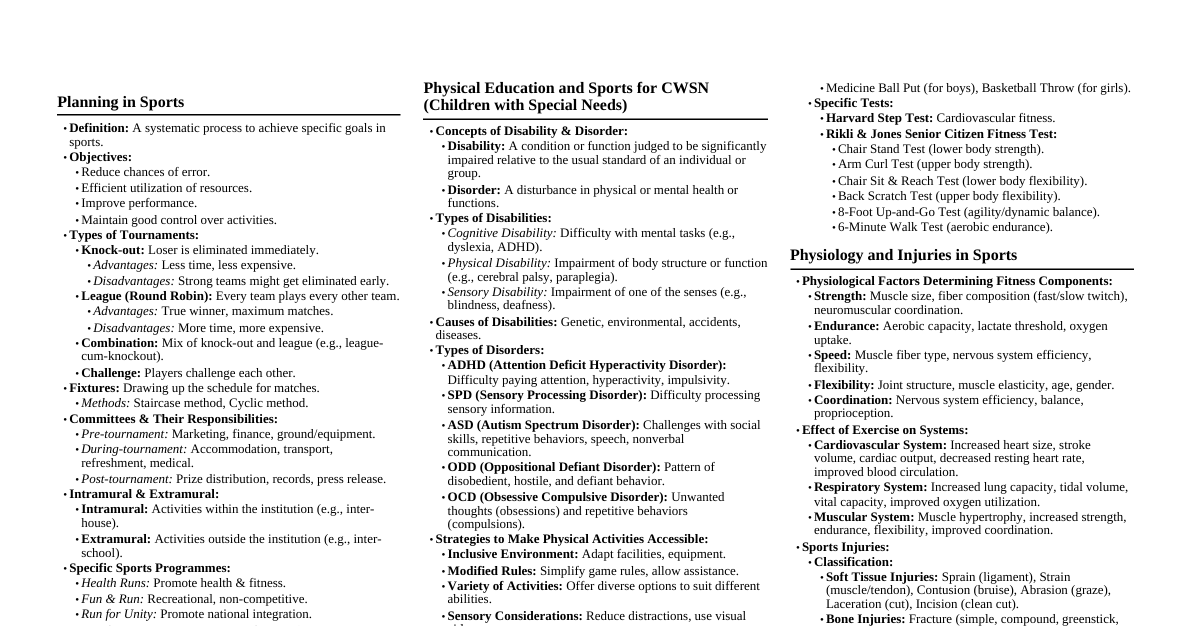
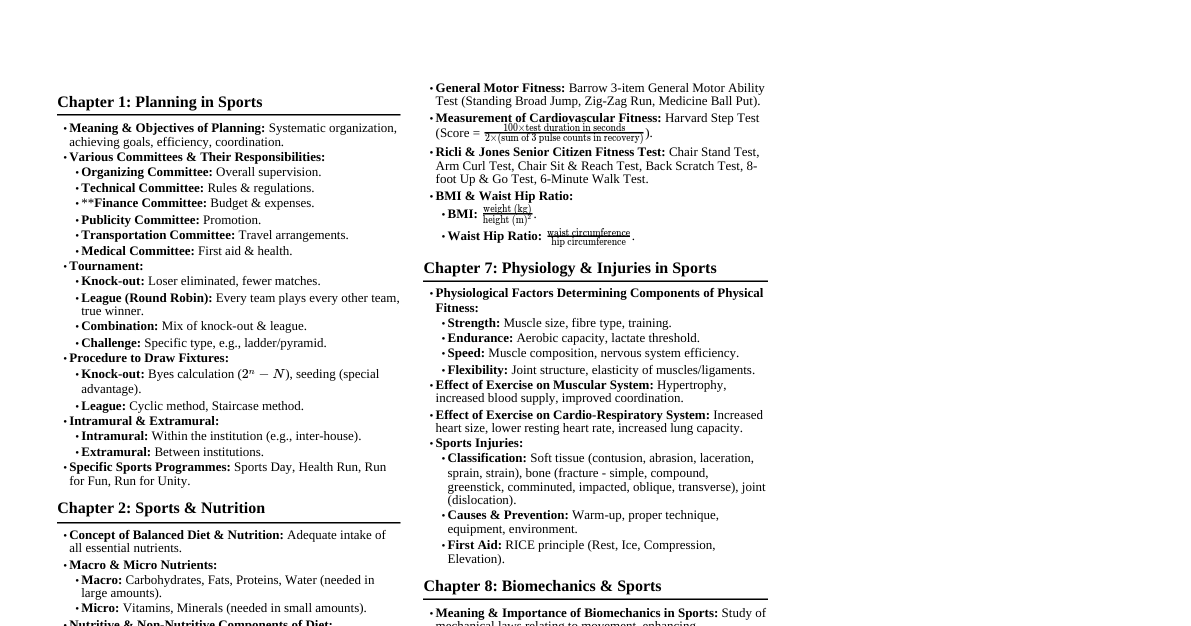
CHAPTER 1: SOCIOLOGICAL ASPECTS OF PHYSICAL EDUCATION Sociology: Scientific study of society and relationships between its components. Focuses on social behavior, patterns, interaction, and culture. Sports Sociology: Studies sports as a social phenomenon. Culture: Way of life of a group, including behaviors, beliefs, values, and symbols, passed through generations. Cultural Heritage: Transfer of customs, traditions, values with modifications to future generations. Sports in Early Human Beings: Running, jumping, throwing, wrestling, boxing, chariot racing initially for survival, later developed into sports. Contribution of Countries to Sports Greece: Founder of organized sporting events (Ancient Olympics in 776 BCE). Rome: Sports restricted for slaves and military. England: "Home of Outdoor Sports," founder of ball games, invented cricket, hammer throw, pole vault. USA: Popularized games through YMCA/YWCA, introduced basketball and tennis. Sweden: Leading contributor to modern gymnastics. Japan: Introduced Sumo, Judo, Taekwondo, Fencing. Denmark: Franz Nachtegall introduced modern physical education in schools (1884). India: Introduced Malkhamb, Kabaddi, Yoga, Kho-Kho. Individual Development Through Sports Physical Development: Physical fitness. Social Development: Social adjustment. Mental Development: Mental alertness. Emotional Development: Emotional balance. Role in Promoting National Integration Good Effects: Promotes brotherhood, fraternity, national, and international cooperation. Bad Effects: Promotes regionalism, personal vanity, quarrels, rivalry. (e.g., Jesse Owens and racial discrimination at Berlin Olympics). Role in Personality Development Develops: Attitude, patience, helpfulness, friendship, team spirit, discipline, unity, self-confidence, tolerance. CHAPTER 2: TRAINING METHODS Topic-1: Sports Training: Meaning, Importance and Methods Training: Process to prepare for an activity or task. Sports Training: Special preparation process for sportspersons based on scientific principles to improve and maintain performance capacity. Includes strength, corrective, restorative, conditioning, cardiovascular, mental, psychological training, and nutritional advice. Importance of Sports Training Improves physical fitness. Skill development. Prevents injuries. Aligns posture. Improves balance. Develops reflexes. Reduces fat and waste. Develops concentration. Helps in gaining knowledge about the sport. Methods of Training Interval Training Method: Developed by Woldemar Gerschler and Dr. Hans Reindell. Alternates short bursts of intense activity with active recovery. Interval (rest period) is crucial. Advantages: Increased workout in less time, easy performance measurement, develops patience, beneficial for respiratory/circulatory systems. Disadvantages: More injury chances, heart problems, overtraining risk, pain. Repetition Method: Similar to interval training but with increased interval and less recovery. Focuses on repeatedly performing competition-like exercises. Advantages: Muscle development, improves anaerobic capacity, nervous/skeletal/muscular coordination, glycolytic process. Disadvantages: Heart problems, increased fatigue, injury chances, overtraining risk. Continuous Method: Introduced by Dr. Ernst van Aaken. Athlete practices for a long duration without rest. Advantages: Increases heart/lung efficiency, improves willpower, induces self-discipline, good for aerobic fitness. Disadvantages: Boring, not good for anaerobic fitness (e.g., football/hockey), increases body strain. Fartlek Training Method: Swedish for "speed play." Combines interval and continuous training. Varied exercises (jogging, sprints, uphill runs) to relax athletes during continuous exercise. Advantages: Develops cardiovascular performance, rigid yet flexible, adapts athletes to different situations, good for both aerobic/anaerobic fitness. Disadvantages: Difficult to judge performance, more accidents, less check on trainees, demotivation. Topic-2: Warming–up, Conditioning and Cooling/Limbering Warming up: Series of preparatory exercises before training or competition. Types of Warming up: Passive: Increases body temperature by external means (heavy uniform, steam, massage). Active: Increases body temperature through physical activities (jogging, stretching). Types of Active Warming up: General: Common to all sports (jogging, stretching, jumping). Specific: Specific to a particular sport (e.g., catching/bowling in cricket). Methods of Warming up: Raising body temperature (warm water, massage, hot drinks, sunbathing/steam), general methods (jogging, simple exercises, stretching), water (shower, swimming), massage (wrestling), hot drinks (tea, coffee). Advantages of Warming up: Increases body temperature, decreases muscle viscosity/increases speed, increases nerve impulses/metabolism, reduces anxiety, improves skills, reduces injury chances, increases reflex/decreases reaction time, increases strength. Conditioning: Modifying body for an activity through regular practice. Advantages: Increases blood circulation, improves reaction time/nerve-muscle coordination, increases weight, reduces injury chances, improves glycogen/creatine storage. Cooling Down / Limbering Down / Warming Down: Process of returning body to normal state after training/competition. Exercises: Short jogging, walking, stretching (quads, hamstrings, back, calves, hip flexors, groin, triceps, glutes, chest). Advantages: Proper waste removal, regularizes body temperature, restores muscles, reduces adrenaline, normalizes heartbeat. Topic-3: Types of Exercises and Training Isometric Exercises: Contractions of muscles without noticeable change in length or joint movement. Helps maintain strength, but not effectively build it. Isotonic Exercises: Muscle movement against resistance over a range of motion, causing length change. Concentric: Muscle shortens (e.g., lifting dumbbell). Eccentric: Muscle lengthens (e.g., lowering dumbbell). Advantages: Protein growth in muscle cells, beneficial for physiotherapy/rehabilitation, strengthens muscles/bones, maintains body weight, improves metabolism. Isokinetic Exercises: Strength training using specialized machines that produce constant speed with fluctuating resistance. Circuit Training: Endurance, resistance, high-intensity aerobics performed in a circuit. Targets strength-building and muscular endurance. Advantages: Good results quickly, easy to learn, appropriate for most sports, indoor/outdoor, involves all body parts. Disadvantages: Needs facilities/space, time-consuming setup, specialized equipment, limited trainees at once. Weight Training: Exercises to strengthen specific body parts using weights (plates, dumbbells, barbells). Advantages: Focused implementation, less time-consuming, appropriate for most sports. Disadvantages: Tedious, more injury chances, unsafe alone. CHAPTER 3: CAREER ASPECTS IN PHYSICAL EDUCATION Career Options Traditional Careers: Teaching: Elementary, middle, high, senior secondary school, college. Coaching: Institutions, academies, professional coaches for national/state teams. Emerging Careers: Health-related: Health clubs, weight control, athletic trainers, fitness centers. Administrative: Sports departments (universities, colleges), facilities management, industrial recreation. Performing: Players, officials. Media reporting: Sports journalist, broadcaster, photographer, writer, publisher. Marketing: Salesperson, marketing head for sports goods/equipment. Clothing: Manufacturer, supplier of sportswear/gear. Software engineering: Designer of sports games. Important Institutions of Physical Education in India Netaji Subhas National Institute of Sports (NSNIS): Constituted: 1961 Aims: Raise technical standard of coaches, prepare specialized coaches, organize competitions, search for talent, grant scholarships, offer orientation courses, help research, publish journals. Sports Authority of India (SAI): Constituted: 1984 Aims: Grant scholarships, search for talent, organize National Sports Talent Competition, run National Physical Health Scheme, create awareness about nutrition, encourage indigenous games. Indian Olympic Association (IOA): Constituted: 1927 Aims: Promote Olympic games, official organization for related matters in India, administer Indian teams, take disciplinary action, enforce IOC rules, create academies, enforce WADA rules, promote physical/moral development. YMCA College of Physical Education: Constituted: 1920 Aims: Develop physical education teachers/instructors, identify talent, provide theoretical/practical knowledge, extend scientific training, overall development of players. International Olympic Committee (IOC): Founder: Baron Pierre de Coubertin (Father of Modern Olympic Games). Constituted: 1894 Aims: Organize Summer/Winter Olympics every four years, decide venues, promote sports ethics, strengthen international unity, fight doping, oppose abuse of sportspersons. Lakshmibai National University of Physical Education, Gwalior (LNUPE): Constituted: 1957 Aims: Prepare qualified leaders, provide training, serve as center of excellence, promote research, provide professional/academic leadership, offer vocational guidance/placement. Lucknow Christian College of Physical Education (LCCPE): Constituted: 1862 (College of PE established 1932) Oldest physical education institution in North India. CHAPTER 4: COMPETITIONS AND TOURNAMENTS Topic-1: Tournaments and Types of Tournaments Tournament: Series of sports activities where one team wins and others lose. Importance of Tournaments: Popularize sport, develop participant skills, promote national/regional integration, help select players, develop social qualities (cooperation, team spirit, tolerance), good recreation. Types of Tournaments: Knock-out (single elimination) League / Round Robin Challenge Combination Knock-out Tournament: Team eliminated after one defeat. Merits: Improves sports standard, less time-consuming, minimum administrative setup, less expensive. Demerits: Weak teams may reach final, strong teams eliminated early, less interesting. Fixture: Arranging teams systematically for competition. Seeding: Arranging strong teams to avoid early competition. Bye: Privilege exempting a team from playing the first round. Number of Matches: $N - 1$ (for Knock-out). Number of Byes: Next highest power of two (2) from number of teams - number of teams. Consolation Tournament: Optional tournament for defeated teams in knock-out (first type: only first-round losers; second type: all defeated teams). League Tournament / Round Robin Tournament / Burger System: Each team plays every other team once (single league) or twice (double league). Number of Matches (Single League): $n(n-1)/2$ Number of Matches (Double League): $n(n-1)$ Merits: Maximum opportunity for every team, strong/consistent team wins, more popular, players improve. Demerits: Time-consuming, expensive, more administrative setup, psychological depression for losing teams. Cyclic Method (League): Teams ranked, Rank-1 fixed, others rotated clockwise. Staircase Method (League): Teams arranged in a staircase pattern. Tabular Method (League): Teams arranged in a matrix table. Topic-2: Intramurals, Extramurals and Bodies Controlling Various Tournaments, Professional and Amateur Players Intramural: "Within walls." Tournaments played within the same institute/school (e.g., inter-house). Objectives: Develop leadership, new sportspersons, mass participation, cooperation, opportunities for all, overall personality. Extramural: "Outside walls." Tournaments played between different institutes/schools (e.g., inter-school). Objectives: More exposure/competition, develop sportsmanship, widen sports base, provide experience, improve sports standard. Bodies Controlling Various Tournaments Cricket: ICC, BCCI, Women’s Cricket Association of India, State/District Cricket Associations, England and Wales Cricket Board, West Indies Cricket Board, Asian Cricket Council, Sri Lanka Cricket Board. Football: FIFA, All India Football Federation, Women’s Football Association, Asian Football Federation, African Football Federation, French Football Federation, United European Football Association. Hockey: International Hockey Federation, Oceania Hockey Federation, African Hockey Federation, Asian Hockey Federation, Hockey India, Inter University Sports Board of India, Indian Olympic Association. Basketball: International Basketball Federation, Basketball Federation of India, Asian Basketball Association, State/District Basketball Association, English Basketball Association. Volleyball: Volleyball Federation of India, International Federation of Volleyball, Asian Volleyball Federation, Australian Volleyball Federation, Japan Volleyball Association, Czech Volleyball Federation, School Games Federation of India. Badminton: Badminton World Federation, Badminton Europe, Badminton Association of India, Badminton Pan Am, Badminton Oceania, Badminton Asia Confederation, School Games Federation of India. Swimming: International Swimming Federation, Argentina/Australian/UAE/European/Asia Swimming Federation, Swimming Federation of India, School Games Federation of India. Athletics: International Olympic Committee, Commonwealth Games Federation, European/Asian Athletic Association, International Amateur Athletic Federation, Amateur Athletics Federation of India, School Games Federation of India, Inter Universities Sports Board of India. Players Amateur Players: Play for enjoyment, not paid. Professional Players: Play as a full-time job, get paid. CHAPTER 5: HEALTH EDUCATION AND HEALTH PROBLEMS Health: State of complete physical, mental, and social well-being, not just absence of disease. Health Education: Experiences influencing habits, attitudes, knowledge related to individual, community, and social health. Objectives of Health Education Develop healthy habits. Prevent diseases. Impart health/hygiene knowledge. Improve living conditions. Awareness about first aid. Importance of Health Education Discover physical defects. Maintain good health. Improve human relations. Encourage health/hygiene. Part of Safety Education. Prevalent Health Problems Air/noise/water pollution, communicable diseases, epidemics, occupational hazards, drug addiction, diabetes, malnutrition, obesity, depression. Communicable diseases: Spread by germs/pests from infected to healthy person. Modes of spread: Air, food, drinks, parents, direct/indirect contact, clothes, genital organs, dirty hands. Epidemics: Outbreak of disease infecting many people in an area. Drug Addiction: Habitual dependence on drugs. Role of Health Education in Solving Health Problems Creating health awareness. Dumping of wastes. Enforcing pollution control legislation. Creating silence zones. Discouraging deforestation. Following a balanced diet. Personal hygiene and cleanliness. Following an overall healthy lifestyle. CHAPTER 6: DISABILITY AND REHABILITATION Disability: Restriction or lack of ability to perform an activity normally, due to impairment. Factors Causing Disability Genetic, physical, occupational, mental factors. Malnutrition, accidents, drug abuse, inadequate education. Types of Disability Cognitive, Intellectual, Physical. Vision impairment, deaf/hard of hearing, mental health conditions, acquired brain injury, autism spectrum disorder. Methods (Principles) to Prevent Disability Precautions to avoid accidents. Exercise. Rule implementation. Emotional control. Corrective actions early. Staying away from drugs. Developing a healthy environment. Rehabilitation Combined/coordinated use of medical, social, educational, vocational measures for training/retraining individuals to highest possible functional ability. Scope: Rehabilitation in practice/policy, assessment procedures, education/training, medical check-up, artificial limbs, crutches, surgery, nerve therapy, hospitalization, psychiatric analysis, occupational rehabilitation. Organizations Doing Rehabilitation Indian Red Cross Society, Bharat Sewak Samaj, Tuberculosis Association of India, Artificial Limbs Manufacturing Corporation, All India Blind Relief Society, Indian Institute of Technology, Indian Medical Association, Hindu Kushth Niwaran Sangh, Asha Niketan Rehabilitation Centre. CHAPTER 7: POSTURE Topic-1: Posture: Meaning, Importance of Correct Posture (Standing, Sitting and Walking) Posture: How an individual carries oneself (sitting, standing, walking, lying down). Static posture. Dynamic posture. Correct Posture / Good Posture: Mechanically favorable position for body weight transmission, normal muscle tone, mechanical freedom, coordination, neuromuscular control, reflexes. Importance of Correct Posture: Reduces strain/pain in joints, reduces postural deformities, helps best physical performance, improves health, better metabolism, develops skills. Correct Standing Posture: Balanced, free from strain, gravity line straight (abdomen in, chest high, spine untwisted, shoulders erect). Weight equally distributed between ball of foot and heel. Correct Sitting Posture: Head, shoulders, hip aligned. Weight supported over large area for equal pressure distribution. Correct Walking Posture: Feet parallel to direction, heels touch ground first, weight transfers to toes. Advantages of Correct Posture: Increases energy level, flexibility, positive vibrations, coordinative ability, reduces reaction time/stress, increases intelligence/concentration. Bad Posture: Tightening/shortening of some muscles while others lengthen/weaken, often from daily activities. Causes of Bad Posture: Bad habit/faulty position, overstraining muscles, excessive body weight, accident/disease, lack of exercise, weak bones/muscles, congenital, improper diet. Topic-2: Common Postural Deformities Kyphosis (Round Upper Back): Exaggerated backward curve or decreased forward curve of spine. Causes: Reading in dim light, carrying heavy loads, light/shapeless clothes, habit of bending. Exercises: Swimming, bench press, push-ups; corner exercises, lying on narrow bench with ring weight, towel/stick overhead; yoga (Bhujangasana, Adho Mukha Svanasana, Tadasana). Lordosis (Inward Curvature of Spine): Increased forward curve in lumbar region. Causes: Habitual overeating, improper environment, lack of exercise, diseases affecting vertebrae, improper muscle development. Exercises: Lunge forward with knee on mat, sitting with shoulders between knees reaching for floor, prone position pushing torso up, sitting bending forward to touch toes; yoga (Makarasana, Halasana). Scoliosis (Lateral Curve of Spine): One large lateral curve or two curves. Causes: Short leg, one side flat foot, heredity, one-side paralysis of spinal muscles. Exercises: Breaststroke swimming, hanging from horizontal bar, swinging body on bar, bending exercise opposite to 'C' curve; yoga (Ardhachakrasana, Trikonasana). Knock Knees: Knees touch or overlap in normal standing. Causes: Weak ligaments/muscles, overweight, lack of balanced diet, lack of Vitamin D. Exercises: Walking calipers, horse riding, pillow between knees standing erect, Padmasana, Gomukhasana, seated quadriceps contraction, hamstring curls; yoga (Vrikshasana, Padmasana). Bow Legs: Wide gap between knees. Causes: Extra weight on leg muscles, lack of balanced diet, lack of calcium/phosphorus, improper walking, forcing babies to walk early. Exercises: Walking with toes inwards, walking on inner edge of feet; yoga (Ardhmatsyendrasana, Garudasana). Flat Foot: No arch in foot. Causes: Heaviness of body, standing long, faulty posture, poor footwear. Exercises: Rising on toes, climbing stairs, cycling, flexion of foot/ankle, grasping pencil with toes; special shoes with arch support. Round Shoulders: Shoulders drawn forward, head extended, chin forward. Causes: Poor posture at work (desk job), faulty furniture, heavy loads, wrong sitting/standing habits. Exercises: Finger tips on shoulders circling elbows, holding horizontal bar, Chakrasana, Dhanurasana. Hunch Back / Hump Back: Convex curvature in upper spine. Causes: Congenital, muscular dystrophy, osteoporosis, degenerative spine disease, connective tissue disorders, developmental problems. Exercises: Surgical procedures, pain relievers, bracing; yoga (Dhanurasana, Bhujangasana). CHAPTER 8: PERSONAL HYGIENE AND SLEEP REQUIREMENTS Personal Hygiene: Taking care of one's own body. Personal Cleanliness Tips: Skin: Good soap, fresh/lukewarm bath, clean towel, regularly clean genital/anal areas. Hair: Regular combing, good shampoo, amlas for washing, eggs for black color. Ears: Clean wax regularly, no sharp objects, glycerine/soft cloth. Nails: Neat/clean, cut regularly, avoid biting. Eyes: Cold water/clean cloth, exercise, Vitamins A/C, sunglasses, watch/read from distance, proper light. Nose: Regular cleaning, Jal Neti Kriya, Kapal Bhati, Pranayam, avoid picking. Hands: Wash with soap/water before/after meals, after toilet; thorough rinsing, clean towel dry. Feet: Scrubber, cotton socks, alternate shoes, powder feet, regular pedicure. Teeth: Interdental brush, daily flossing, brush twice daily, gentle gum massage. Tongue: Clean regularly with tongue cleaner, gentle cleaning after meals. Clothing: Fresh/washed inner clothes daily, iron clothes to destroy lice/nits. Importance of Personal Hygiene Promotes personal/community health. Prevents/controls communicable diseases. Promotes social value. Reduces health expenditure. Helps personality development. Removes low feelings, enhances self-confidence. Helps feel secure. Helps lead a good professional life. Foot Care Improves overall personality, blood circulation, reduces tension/pain. Effects of Poor Foot Care: Affects walking, exercising, comfort; can affect knee, hip, lower back. Common Feet Problems: Corns (thickening due to wrong footwear), broken nails (tight footwear), ringworm (fungus), athlete’s foot (redness/itching from wet areas/shoes). Ways to Care for Feet: Wash daily, pumice stone, massage with oil/lotion/jelly before sleep, immediate action for cuts/wounds/sores, comfortable footwear, check for blisters/corns, cut toe nails, wear heels/pointed shoes only for special cases. Factors Determining Sleep Requirements Age, Genetic, Exercise. Age-based Standard Sleep Requirements: Age Group Hours of sleep per day 0-3 months 14-17 4-11 months 12-15 1-2 years 11-14 3-5 years 10-13 6-13 years 9-11 14-17 years 8-10 18-25 years 7-9 26-64 years 7-9 65+ years 7-8 Benefits of Proper Sleep: Healthy heart, reduced tension/stress, proper cell/tissue repair, reduces weight, improves immunity/memory, proper hormonal growth, improves nervous system. Effects of Insufficient Sleep: Risk of road accidents, pessimistic approach, depression, increased body weight, heart problems, skin darkening, poor memory, hypertension. How to Enjoy Sound Sleep: Comfortable bed, absence of noise, room temperature $\approx 20^\circ C$, fixed sleep time, light night dress, proper ventilation, avoid tea/coffee before bed, do not cover face. CHAPTER 9: SUBSTANCE ABUSE Effects of Alcohol Consumption on Individual Muscular System: Weak muscles, reduced force, irregular extension/contraction, reduced cardiac muscle strength. Excretory System: Organs lose control/efficiency, waste deposition, kidney failure/damage. Nervous System: Weakening of brain, impulsive, poor nerve control, decreased response time/concentration. Digestive System: Low digestive juice production, fattening of organ membranes, incomplete digestion, loss of appetite. Other Effects: Suicidal tendencies, decreased decision-making. Effects of Alcohol Consumption on Society Family disputes, non-satisfaction of family needs, low social standards, burden on families/society, loss of etiquette/social values, increased crimes. Harms of Smoking Nicotine is deadly. Over 15 chemicals cause cancer. Arsenic produced is poisonous. Effects of Smoking on Individual Circulatory System: Rise in BP/pulse, fall in blood flow/body temperature, causes angina/heart attack. Respiratory System: Organ inflammation, throat irritation, cough, bronchitis, tuberculosis, oral/lung cancer. Nervous System: Weakening of nerves, brain damage, depression, paralysis, suicidal tendencies. Digestive System: Loss of appetite, stomach ulcers, heartburn, food pipe cancer. Prospective Life: Each cigarette reduces life by $\approx 4$ minutes. Effect of Smoking on Society Air pollution, threat to family/non-smokers, generally leads to alcohol habit, sterility, family disputes. Drugs and Doping Drug: Chemical substance changing emotions, mood, state of nerves, consciousness. Doping: Use of banned substances in competitive sports (Performance Enhancing Drugs - PEDs). Types of Drugs: Legal: Alcohol, tobacco, caffeine. Illegal: Cocaine, heroin, ecstasy, cannabis, ketamine. Drug Abuse: Use of non-prescribed drugs in huge amounts, affecting life, leading to addiction, health deterioration, suicidal tendencies. WADA (World Anti-Doping Agency) & NADA (National Anti-Doping Agency): Maintain, regularize, enforce, and enlist banned substances in sports. Drugs Prohibited at All Times Beta-2-agonists: (e.g., weightlifters) Improve respiration. Side Effects: Trembling, headache, strokes. Peptide hormones: (HCG, ACTH, HGH) Improve muscle growth, RBC count. Side Effects: Blood clots, strokes, increased sweating, dehydration, joint pain, weakness, brain damage, death. Anabolic steroids: (THG, Methenolone) Improve performance, nerves, endurance. Side Effects: High BP, cardiac arrest, death, impotency, baldness, abnormal menstrual cycle, premature puberty, cancer, jaundice, depression, mood swings. Diuretics: (Probenecid, Dextran) Hide drug detection. Side Effects: Dehydration, low BP, reduced muscle strength. Drugs Prohibited During Competition Narcotics, Cannabinoids, Stimulants, Glucocorticosteroids. Stimulants Side Effects: Increased BP/pulse/heartbeat, dehydration, loss of brain control, heart failure. Narcotics Side Effects: Imbalance, loss of concentration, vomiting, constipation, coma, death. Glucocorticoids Side Effects: Sodium deposits, weight gain, torn muscles, increased blood glucose, weak circulatory system. Cannabinoids Side Effects: Reduced concentration, respiratory metabolism, lung cancer, cardiac problems. Practices Prohibited at All Times Blood doping: Increasing RBC count. Gene doping: Improving muscles/skeletal system via genetic changes. CHAPTER 10: SPORTS INJURIES AND FIRST AID Topic-1: Sports Related Injuries Soft Tissue Injuries: Contusion, strains, sprains, abrasions, bruises. Contusion: Muscle injury from hit/kick. Swelling, stiffness, reddening. Prevention: Protective equipment, adequate warm-up, smooth/clean sports area, alertness, game knowledge. Strains: Muscle/tendon injury from pulling/twisting. Prevention: Proper conditioning, adequate warm-up, smooth/clean area, alertness, game knowledge, discontinue if fatigued. Sprains: Ligament injury from falling/twisting. Prevention: Proper conditioning, adequate warm-up, smooth/clean area, alertness, game knowledge, discontinue if fatigued, balanced diet, proper footwear. Abrasion: Rubbing off skin due to friction (falling/sliding). Bleeding, pain. Prevention: Protective equipment, adequate warm-up, smooth/clean area, alertness, game knowledge, minimal skin exposure, discontinue if fatigued. Bruises: Damage to inner tissues/blood vessels, outer skin intact. Darkening, pain, tenderness. Prevention: Protective equipment, adequate warm-up, smooth/clean area, alertness, discontinue if fatigued, no rash play. Bone Injuries / Hard Tissue Injuries: Simple fracture: Bone break at one place, no skin/muscle effect. Comminuted fracture: Bone break at multiple places, no skin/muscle effect. Compound fracture: Bone break with skin/muscle damage. Impacted fracture: Bone break, one end into another bone. Complicated fracture: Bone break, damaging internal organs. Green Stick fracture: Breaking/bending of children's delicate bones due to stress. Causes of fractures: Unnatural movements, sudden heavy impact, sudden fall, direct hit, osteoporosis, excessive running/walking. Prevention of fracture: Adequate warm-up, smooth/clean area, alertness, game knowledge, balanced diet, proper footwear, no rash play. Dislocation of Joints: Displacement of part/bone from normal position. (Shoulder, hip, wrist, jaw). Causes: Sudden fall/jerk (shoulder), sudden strength efforts/excessive walking (hip), sudden fall/twisting/miscalculated move (wrist), hitting chin/excessive mouth opening (jaw). Prevention: Adequate warm-up, smooth/clean area, alertness, game knowledge, balanced diet, proper footwear, no rash play. Topic-2: Role of Individuals in Prevention of Sports Related Accidents and First-Aid Factors that cause accidents: Intrinsic: Gender, age, body structure, muscular strength, intelligence, fitness. Extrinsic: Climate, sports equipment, coaching, errors, facilities. Role of individuals in preventing sports accidents: Use protective gear, ensure player fitness, proper coaching, regular inspection of equipment/facilities, preventive measures for climate, avoid fatigue/overtraining, follow rules, adequate warm-up/cool-down. First Aid: Immediate/temporary help to wounded person before medical help. First Aid for Cuts: Wash/dry hands, clean wound with tap water (no antiseptic), dry, apply dressing/plaster, painkiller if needed, consult doctor for severe cuts. First Aid for Grazes/Scraps: Wash/dry hands, wash affected area with soap/water. If dirt removed, leave uncovered. If not, cover with non-adhesive dressing and consult doctor. First Aid for Strain: Make comfortable, wash with cold water (15-30 min), apply ice (wrapped), painkiller if needed, apply warm water after 5 days, rest for $\ge 1$ week. First Aid for Nose Bleeding: Sit person with head backward, hands upwards. Cold/wet cloth on back of neck. Breathe through mouth. Consult doctor if continuous. First Aid for Abrasion: Clean with fresh water, dry with cotton, anti-fungal/bacterial ointment, cotton dressing, tetanus injection. First Aid for Sprain: PRICE: Protect, Rest, Ice, Compression, Elevation (first 48 hours). MICE: Mobilisation, Ice, Compression, Elevation (after 48 hours). First Aid for Cramps: Soft massage, drink water, multivitamin, First Aid for Blisters: If not painful, keep intact. If punctured, drain fluid. Wash hands/area, apply iodine, sterilize needle for more punctures if needed, antibiotic, bandage. First Aid for Bruises: Apply ice (24 hrs), rest, elevate, painkiller if severe. First Aid for Fracture: Rest, stop bleeding, apply splints, apply ice, consult doctor immediately. First Aid for Contusion: Apply ice ($\approx 1$ hour), medicine for swelling, consult doctor, regular exercise. First Aid for Dislocation of Joints: CPR if needed, do not move more than necessary, splint, rush to doctor on stretcher. First Aid in case of Drowning: Mouth-to-Mouth Artificial Respiration: Blow air into mouth, nostrils closed. Cardiopulmonary-Resuscitation (CPR): Combination of mouth-to-mouth and chest compressions. Start immediately. Give chest compression on shore. Check heartbeat/pulse. Continue CPR till normal. Warm person. Call doctor. Section B: Cricket and Football CRICKET Topic-1: Game–History and Terminology History: Invented in Saxon/Norman times in Weald, England. First reference as adult sport: 1611. Village cricket by mid-17th C, first "county teams" in second half. First known county game: 1709. Popular in London/SE England by early 18th C. Women's cricket: 1745. First Laws of Cricket: 1744 (amended 1774 for LBW, 3rd stump, bat width). MCC (Marylebone Cricket Club) founded: 1787, became custodian of Laws. Bowlers started pitching ball after 1760; straight bat replaced "hockey-stick." Cricket introduced to North America (17th C), West Indies/India (18th C), Australia (1788), NZ/South Africa (early 19th C). Mentioned in 'Wisden' in 1300 A.D. Word 'cricket' first in Florida dictionary. First match: London vs. Kent. Cambridge/Oxford played from 1710/1729. Hambleton Club (1760), MCC (1787). Lord's held first match June 27, 1788. First official test match: 1877, Australia vs. England (Australia won). Imperial Cricket Conference (ICC) formed: 1909 (England, Australia, South Africa). India, West Indies, NZ joined 1926; Pakistan 1952. Renamed International Cricket Conference 1956. Now 12 full members, 92 associate. Cricket: Two teams of 11 players. 2 batsmen from one team, 11 fielders/bowlers from other. Captain handles team. Coin toss decides batting/fielding. Strategy and Tactics of Cricket Toss winner considers pitch condition (best for batting initially, wears out). Moist pitch helps fast bowlers. Day/night matches: Bat first to avoid floodlights. Moist later day makes scoring/fielding difficult. Captain decides bowler based on: Time, ball age (new ball helps fast), bowler's style/skill, pitch state (dry/crumbled helps spin), game strategy (wickets vs. preventing runs), weather. Six balls of over thrown tactically. Field set by captain based on bowling tactics (attacking for wickets, defensive for runs). Batting order initially best to poor, but can be changed tactically. Batsman decides shot (front foot/back foot). Captain can decide on follow-on/declaration of innings. Improving Performance Preplan practice, seek help from seniors/coaches. Decrease weaknesses, focus on strengths. Be confident, self-motivated. Play different shots/strokes, deliver balls differently/tactically. Set achievable targets, gradually increase. Guess bowl to adjust timing. Learn strategies by watching matches. Play with joy, cool mind. Build innings: good grip (V-shape), standing positions, take runs, increase muscle strength for boundaries/sixes. Watch bowler, ball direction, follow teammates' fielding directions. Terminologies Batting: Back-foot: Batsman's foot nearer stumps. Back-foot shot: Shot with body weight on back-foot. Bat: Rectangular wood equipment. Cut: Offside shot with horizontal bat, perpendicular to bowler. Duck: Score of zero. Boundary/Four: Ball reaches fence with at least one bounce. Half Century: Score $\ge 50$. Century: Score $\ge 100$. Off Drive: Offside shot, $45^\circ$ to bowler. Sixer: Ball reaches fence without bounce. Run: Safe running between wickets after hitting. Runner: Assistant for injured batsman. Striker: Batsman facing bowler. Non-Striker: Batsman at bowler's end. Stroke/Shot: Hitting ball with bat. Sweep: Leg-side shot with sweeping bat, behind wickets. Bowling: Back-foot: Bowler's foot behind other at release. Ball: Spherical equipment. Ball tampering/gouging: Illegal changing of ball condition. Bodyline: Bowling at batsman's body. Bump-ball: Ball touches ground near shot, bounces as catch. Dead-ball: No runs/out for various reasons. Golden/Diamond-duck: Dismissal on first ball/without facing. Dot-ball: No runs scored. Extra run: Run not to individual, but team (bye, leg-bye, no-ball, wide). Pace: Fast bowling ($\ge 140$ km/h). Full toss: Ball reaches batsman without bounce. Googly: Ball spins unexpectedly. Hat-trick: 3 batsmen dismissed in 3 consecutive deliveries by one bowler. Leg-break: Ball turns towards batsman's body after bounce. Maiden over: No runs scored. No ball: Not delivered per rules. Over: 6 consecutive valid deliveries. Spin: Slower ball turned with fingertips. Yorker: Ball bounces very close to batsman's feet. Over-pitch: Ball bounced far up wicket for easy hit. Seam: Stitches on ball for spin. Bouncer: Short-pitched pace ball, bounces above batsman's height. Fielding: Appeal: Pleading umpire for out decision. Stump: Cylindrical wooden equipment (3 per side). Bails: Two small pieces of wood on stumps. Direct hit: Fielder hits stumps without being caught. Leg/On side: Half field on side/back of batsman's legs. Off side: Half field on side/front of batsman's legs. Wicket-keeper: Fielder behind wicket. Miscellaneous: Scoreboard: Displays scores, stats. Sightscreen: Large screen behind bowler for batsman clarity. Flood light: High power lights for night/bad light. Sledging: Distracting opponents verbally. Forfeiture: Captain forfeits innings. Match-fixing: Outcome decided in advance by violating rules. Topic-2: Rules and Laws of the Game Innings: Collective play of all batsmen or max bowling overs. 1 inning per team (T20/ODI), 2 innings per team (Test). Number of overs: 20 (T20), 50 (ODI). Single bowler cannot bowl 2 consecutive overs. 6 valid balls per over. Bowling: End changes after every over. Batsmen do not change sides, umpires change position. Team: 5-6 specialist batsmen, 4-5 specialist bowlers, 1-2 all-rounders. Wicket-keeper usually specialist batsman. Fielding: Wicket-keeper wears special gloves/pads. Captain places field with bowler. Injured fielder can be replaced by substitute (cannot bowl/wicket-keep/captain). Batting: Only 2 batsmen on pitch. Batting order by captain. Injured batsman returning is not-out, cannot be replaced but can resume. Runs: Manual run when both batsmen exchange sides/cross crease. Boundary adds 4, Sixer adds 6. No-ball/wide-ball add 1 run (not valid delivery). Overthrow runs possible. Extras: Runs from no-ball, wide-ball, byes, leg-byes. Not added to individual score, only team. Duckworth-Lewis (D/L) rule: Applied for weather/light interruptions. Calculates target score for 2nd batting team in limited overs. Methods to dismiss a batsman: Bowled: Ball hits stumps, dislodges bails. Caught: Ball touches bat, caught by fielder without bounce. LBW (Leg Before Wicket): Ball going to hit stumps, stopped by batsman's body. Run Out: Fielder hits stumps while batsman out of crease. Stumped: Batsman misses ball, steps out of crease, wicket-keeper hits stumps. Hit-wicket: Batsman dislodges bails with bat/clothes/body. Double-hit: Batsman hits ball twice (other than to protect stumps). Handling the ball: Batsman intentionally uses hand to prevent ball hitting stumps. Obstructing the field: Batsman intentionally gets in way of fielder. Time-out: Next batsman not on ground within 3 mins. Dismissal restrictions: Cannot be out Bowled, Caught, LBW, Stumped, Hit-wicket on a no-ball. Cannot be out Bowled, Caught, LBW, Double-hit on a wide-ball. Only one batsman dismissed per delivery. Completion of innings: Batting team all-out (10 batsmen dismissed). Only one player left, not-out batsmen injured/retired. Maximum overs bowled. Batting team reaches winning score. Captain declares innings closed (Test matches only). Results: If 2nd batting team doesn't reach target, 1st team wins "by __ runs." If 2nd team reaches target, wins "by __ wickets." Follow-on: 1st batting team leading by $>200$ runs in Test can ask opponent to bat again. Tie-breaker (T20): If scores tied, Super-Over. Each team nominates 3 batsmen/1 bowler. Team scoring more in Super-Over wins. Penalization: 5 penalty runs to batting team if: Shot obstructed by fielder's helmet, ball touched by injured fielder returning without informing umpire, fielder stops ball with cap/clothes/jersey, ball tampering, distracting batsman/running. 5 penalty runs to fielding team if batsmen: Take short runs, waste time, ruin pitch, distract fielders. Topic-3: Dimensions of Play Area and Game Equipment Players per team: 11 + 5 (Extras) Umpires: 2 (On field) + 1 (Third Umpire) Scorers: 2 Bat Length: 38” Bat Width (at center): 4.25” Ball Weight: 156 g Ball Color: Red (Test), White (ODI/T20) Ball Circumference: 8”-9” Pitch Width: 4’ 4” Pitch Length: 792”-22 yards Wickets Width: 9 inches Wicket Height from ground: 28 inches Distance of Stumps from each side: 792”-22 yards Time for changing players: 2 minutes Time for changing innings: 10 minutes Radius of inner circle in field: 1078”-30 yards Radius of Boundary: 2700” and above – 6858 mts Length of Crease from stumps: 4’ 4” or 1.22 m Topic-4: Game Techniques and Skills Batting Techniques and Skills: Block: Defensive shot with vertical bat, towards ground in front of wicket. (Forward defensive, backward defensive). Drive: Attacking shot with sweeping bat, in line of ball. (On-drive, cover drive, straight drive). Glance: Shot towards slip area with minor bat touch. French-cut: Cut shot, ball touches bottom edge, hit towards square leg. Bowling Techniques and Skills: Swing: Pace bowling, ball moves away from or towards batsman. Spin: Ball pitched outside wickets, turns towards wickets. Wicket-keeping Techniques and Skills: Position depends on batsman/bowler type. Keep eye on ball from bowler's run, rise/fall with ball. Ready to dive to collect/prevent runs. Topic-5: Duties and Responsibilities of Officials Match Referee: Administers match from outside field. No decision on result. Can fine players/teams (monetary, suspension). On-Field Umpire: Position for clear view. Change ends after innings. Ensures rules/equipment application. Ensures proper playing conditions (ground, pitch, light). Regular ball inspection. Consults other umpire/third umpire. If doubt continues, decision favors batsman. Decision is final. Third Umpire: Watches TV replay for decisions when consulted by on-field umpires. Red light for out, green for not out. Scorers: Two per team. Watch umpire signals. Record match details (overs, runs, dismissals). Coach: Gives player list to umpire. Ensures play per rules. Motivates players. Teaches/improves techniques. Checks health/fitness. Topic-6: Associations and Tournaments Associations: ICC, MCC, ACC, BCCI, WCAI, SCA, CSA, SLC, PCB, CA, EWCB, BCB, CI, WICB, NZC, ZC, FICA. Tournaments: Irani Trophy, Ranji Trophy, Vijay Merchant Trophy, Rani Jhansi Trophy, Indira Priyadarshini Trophy, Vijay Hazare Trophy, Ashes cup, ICC Trophy, Champions Trophy, Sharjah Cup, Benson and Hedges Cup, Hero Cup, Reliance Cup, Pepsi Cup, World Legends Cup, World Cup Twenty-20, Coca Cola Trophy. FOOTBALL Topic-1: Game–History and Terminology History: Started in Egypt as 'Harpaston'. Developed in China as 'Tsuchu' (300-500 BCE). Spread from Egypt to Rome, England, then worldwide. First competition: 1867. First international match: 1872, England vs. Scotland. FIFA constituted: 1904. UEFA constituted: 1906. Included in Olympics: 1908. First Women's World Cup: 1991. Football: Timed game, two teams of 11 players. Two goalposts, spherical ball. Score by throwing ball into opponent's goalpost. Players use feet, head, torso. Goalkeeper can use hands/arms within penalty area. Strategy and Tactics of Football Strategy decided after toss. Toss winner generally chooses goalpost to defend (against wind direction). Other team starts with kick-off. Preplan game strategy (formations, positions). Can change during play. Short passing style, move forward in triangles. Offensive or defensive strategy based on player skill. Improving Performance in Football Balance football-specific skills, athletic skills, body strength. Use coach's drills for specific skills. Use drills, decrease body fat for athletic skills. Weight training and dieting for muscular strength. Terminologies Kick-off: Kicking ball from center at start or after goal. Ball-in: Ball inside play area. Ball-out: Ball crosses boundary lines or match stopped. Dropped Ball: Match restarted after un-defined stop. Off-side: Player in opponent's half near goal line with Topic-2: Rules and Laws of the Game Play Field: Longer lines: touch lines; shorter lines: goal lines. Halfway line divides center circle. Flag posts at 4 corners. Goals: At center of goal line. Goal posts attached to nets. Can be wood/metal. White color. Football can be replaced if pressure reduced, bursts, or defective. Start of play: Toss winner chooses goalpost or kick-off. Penalty kick: Awarded if defending team commits offense in penalty area while ball in play. Ball on penalty mark. Goalkeeper on goal line. Kicker from other team. Other players outside penalty area. Goal kick: Awarded if ball crosses goal line outside goalposts after being kicked by attacking team. Kicked from defending team's goal area. Attacking players outside penalty area. Kicker cannot touch ball again until touched by another player. Corner kick: Awarded if ball crosses goal line outside goalposts after being kicked by defending team. Kicked from nearest corner flag post. Defending players $\ge 10$ yards away. Kicker cannot touch ball again until touched by another player. Throw-in: Awarded if ball crosses touch line. Player uses both hands, throws ball over head into field. Feet outside/on touch line. Kicker cannot touch ball again until touched by another player. Direct free kick: Awarded for kicking, tripping, pushing, jumping at, spitting at opponent, or intentional handball (not goalkeeper). Indirect free kick: Awarded if goalkeeper holds ball $>6$ seconds, handles ball after releasing/before being touched, or plays dangerously. Score: Goal when ball crosses goal line between goalposts, under crossbar. Result: Team with more goals wins. If tied, 15-min extra time. If still tied, penalty kicks. Topic-3: Dimensions of Play Area and Game Equipment Players per team: 11 + 7 (extras); FIFA: 11 + 12 (extras) Substitutions: 3 per match. Officials: 4 (1 table official, 1 match referee, 2 linesmen) Match Time: 2 halves of 45 minutes each. Interval: 5 to 10 minutes. Playground Shape: Rectangle. Playground Length: 100 to 130 yards (90 m to 120 m). Playground Breadth: 50 to 100 yards (45 m to 90 m). Football Circumference: 27” to 28” (68.5 cm to 71 cm). Football Weight: 14 to 16 ounces (396 g to 454 g). Football Pressure: 0.6 to 1.1 atm (600 to 1100 g/cm$^2$). Corner Flag Height: 5’ (1.5 m). Goalpost Height: 8’ (2.44 m). Goalpost Length: 24’ (7.3 m). Goal area Length: 60’ (18.3 m). Goal area Width: 18’ (5.5 m). Center circle Radius: 30’ (9.1 m). Penalty Area Length: 54’ (16.5 m). Topic-4: Game Techniques and Skills Kicking skills: Toe kick: For long distance, with toe. In step kick: For medium distance, non-striking foot in line, kick with inside of striking foot's toe. Out step kick: For short distance/passes, non-striking foot in line, kick with outside of striking foot's toe. Drop kick: Executed when ball bounces after another kick. Accurate bounce point and perfect timing needed. Inside foot pass. The push. Dribbling techniques: Light strokes, move ball away from opponent, towards opponent's goal. Run in sync with ball speed/direction. Heading skill: Hitting ball with head. Accurate height/direction, perfect timing, excellent sense of direction (towards opponent's goal or away from own). Topic-5: Duties and Responsibilities of Officials Match referee: Ensures rules followed, ball/goalpost specs met, keeps time record. Suspends/terminates match for irregularities. Punishes players for intentional injury. Takes opinions of assistant referees. Assistant referees: Ensure player substitution, penalization, game stops when ball out of play. Decides entitlement to penalty kick, goal kick, corner kick, throw-in. Fourth official: Ensures proper match administration. Replaces other officials. Point of contact between officials/spectators/non-players. Assesses players. Ensures substitute entry/exit. Topic-6: Associations and Tournaments Associations: FIFA, UEFA, USSA, AIFF, WFA, AFA, AFF, SFA, DFA. Tournaments: FIFA Cup, UEFA Cup, Asia Cup, International Nehru Cup, Women Federation Cup, Durand Cup, Begum Hajrat Mahal Cup, Santosh Trophy, Rajiv Gandhi Gold Cup, Pacific cup, Euro Cup, Colombo Cup, Subroto Cup. Other Football Tournaments: FIFA World Cup: Quadrennial global men's football championship. UEFA European Championship (Euro Cup): Quadrennial men's European football championship. Copa América: South American men's football championship. Africa Cup of Nations (AFCON): African men's football championship. AFC Asian Cup: Asian men's football championship. Olympic Football Tournament: Part of the Summer Olympics. UEFA Champions League: Annual club football competition for top European clubs. Copa Libertadores: Annual club football competition for top South American clubs. English Premier League: Top English football league. La Liga: Top Spanish football league. Serie A: Top Italian football league. Bundesliga: Top German football league. Ligue 1: Top French football league. Indian Super League (ISL): Top Indian football league.