AGEN 231: Engineering & Farm Basics
Cheatsheet Content
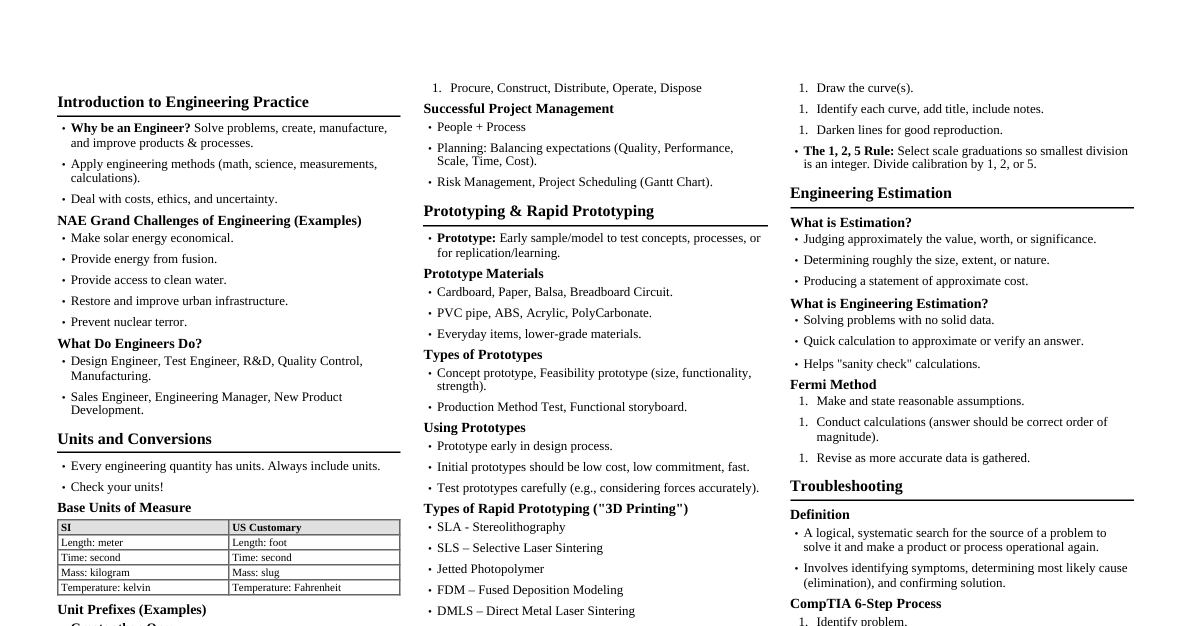
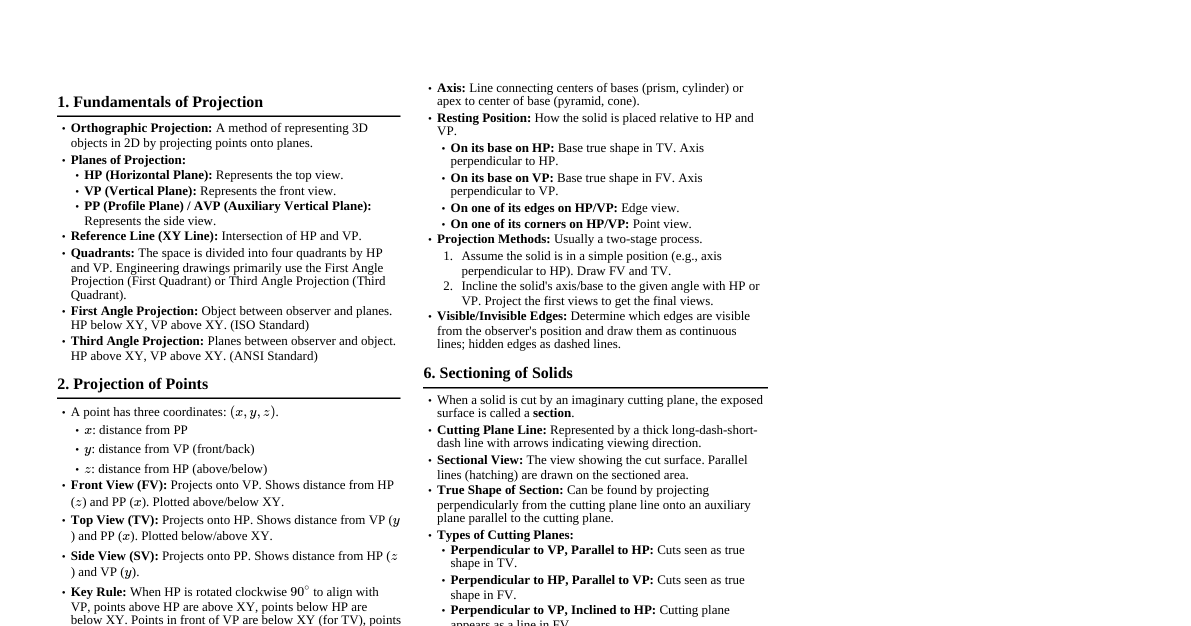
1. Basic Engineering Drawing 1.1 Drawing Instruments & Use Pencils: H (hard), HB (medium), B (soft) for different line weights. Rulers/Set Squares: For straight lines, angles ($30^\circ, 45^\circ, 60^\circ, 90^\circ$). Compasses: For circles and arcs. Protractors: For measuring and drawing angles. Drawing Board/T-square: For parallel lines and stable drawing surface. Erasers: For corrections. 1.2 Engineering Mensuration & Dimensioning Mensuration: Measurement of lengths, areas, volumes. Dimensioning: Adding measurements to drawings. Units: Millimeters (mm), centimeters (cm), meters (m). Placement: Dimensions should be clear, readable, and not redundant. Types: Linear, angular, radial, diameter. 1.3 Scaling & Lettering Scaling: Representing large objects on smaller paper or vice-versa. Ratio: e.g., 1:100 (1 unit on drawing = 100 units in real life). Types: Reduction scale (1:X), Enlargement scale (X:1), Full scale (1:1). Lettering: Standardized, legible text on drawings. Style: Vertical or inclined (e.g., $75^\circ$). Height: Consistent, typically 3-5 mm for general text, larger for titles. 1.4 Simple Projection Drawing Orthographic Projection: Showing multiple 2D views (Front, Top, Side) of a 3D object. First Angle Projection: Object between viewer and projection plane (common in Europe/Asia). Third Angle Projection: Projection plane between viewer and object (common in North America). Isometric Drawing: A type of axonometric projection where all three dimensions are shown at true scale along axes $120^\circ$ apart, giving a 3D view. 1.5 Estimation of Quantities Calculating material needs (e.g., concrete, wood, steel) from drawings for structures like piggery, poultry houses, feeders. Example: Volume of concrete for a foundation = length $\times$ width $\times$ depth. 1.6 Drawing of Plane Geometrical Figures Constructing basic shapes: Lines, angles, perpendiculars, parallel lines. Triangles, squares, rectangles, circles, polygons. Tangents, ellipses. 2. Land Clearing & Field Survey 2.1 Types of Land Clearing Manual Clearing: Tools: Cutlass, hoe, axe, rake. Methods: Slashing, weeding, uprooting small plants, burning (controlled). Advantages: Low cost, minimal soil disturbance. Disadvantages: Labor-intensive, slow. Mechanical Clearing: Equipment: Tractors, bulldozers, excavators, root plows, tree pushers. Methods: Tree felling, stump removal, windrowing, harrowing. Advantages: Fast, efficient for large areas. Disadvantages: High cost, potential for soil compaction/erosion, environmental impact. 2.2 Use of Surveying Equipment Chain Surveying: Measuring distances using chains or tapes. Principle: Triangulation. Equipment: Chain/tape, arrows, ranging rods, offset rod. Compass Surveying: Measuring bearings (angles) using a compass and distances using a chain/tape. Equipment: Prismatic compass, surveyor's compass. Errors: Local attraction, magnetic declination. Leveling: Determining relative heights (elevations) of points. Equipment: Dumpy level, automatic level, staff, tripod. Methods: Differential leveling, profile leveling. Contouring: Drawing lines of equal elevation on a map (contour lines) to represent topography. 2.3 Laying Out Garden/Farm using 3-4-5 Method Purpose: To establish a perfect $90^\circ$ (right) angle. Method: Mark a point A. From A, measure 3 units along a baseline to point B. From A, swing an arc with a radius of 4 units. From B, swing an arc with a radius of 5 units. The intersection of the two arcs is point C. The angle at A (BAC) is $90^\circ$. 3. Basic Farm Tools & Irrigation 3.1 SI Units System Système International d'Unités: The modern form of the metric system. Base Units: Length: meter (m) Mass: kilogram (kg) Time: second (s) Electric Current: ampere (A) Temperature: kelvin (K) Amount of Substance: mole (mol) Luminous Intensity: candela (cd) 3.2 Unit Conversion Converting between different units (e.g., feet to meters, acres to hectares). Conversion Factor: A ratio used to change one unit to another (e.g., $1 \text{ inch} = 2.54 \text{ cm}$). Example: Convert 5 acres to hectares ($1 \text{ acre} \approx 0.4047 \text{ ha}$). $$ 5 \text{ acres} \times \frac{0.4047 \text{ ha}}{1 \text{ acre}} = 2.0235 \text{ ha} $$ 3.3 Area, Volume, Pressure, Flow Rates Calculation Area: Rectangle: $A = l \times w$ Triangle: $A = \frac{1}{2}bh$ Circle: $A = \pi r^2$ Volume: Cube/Cuboid: $V = l \times w \times h$ Cylinder: $V = \pi r^2 h$ Pressure ($P$): Force ($F$) per unit Area ($A$). $$ P = \frac{F}{A} \quad (\text{Units: Pascal (Pa) or N/m}^2) $$ Flow Rate ($Q$): Volume ($V$) of fluid passing a point per unit Time ($t$). $$ Q = \frac{V}{t} \quad (\text{Units: m}^3/\text{s or L/s}) $$ Also, $Q = A \times v$ (Area $\times$ velocity). 3.4 Methods of Irrigation Surface Irrigation: Water flows over the land surface. Furrow: Water flows in small ditches between crop rows. Border: Water flows down a strip of land guided by small earth levees. Basin: Small, level plots enclosed by dikes, completely flooded. Sprinkler Irrigation: Water sprayed through pipes and nozzles. Types: Center pivot, lateral move, solid set, portable. Advantages: High efficiency, suitable for various terrains. Disadvantages: High initial cost, affected by wind. Drip (Trickle) Irrigation: Water applied directly to the root zone of plants. Advantages: Very high water efficiency, reduced weed growth, precise nutrient delivery. Disadvantages: High initial cost, clogging issues. Subsurface Irrigation: Water applied below the soil surface directly to the root zone. 3.5 Swamp Development Reclamation: Converting swampy or waterlogged land into arable land. Techniques: Drainage: Constructing canals, ditches, or using subsurface pipes to remove excess water. Diking/Levee Construction: Building embankments to prevent water intrusion. Filling: Adding soil or other materials to raise the land level. Pumping: Using pumps to remove water from low-lying areas. Considerations: Soil fertility, acidity (e.g., acid sulfate soils), environmental impact, water management.