Best Claude Science Alternative in 2026: TikZ Figures, RDKit, and STEM Research Beyond the Biology Stack
Jul 8, 2026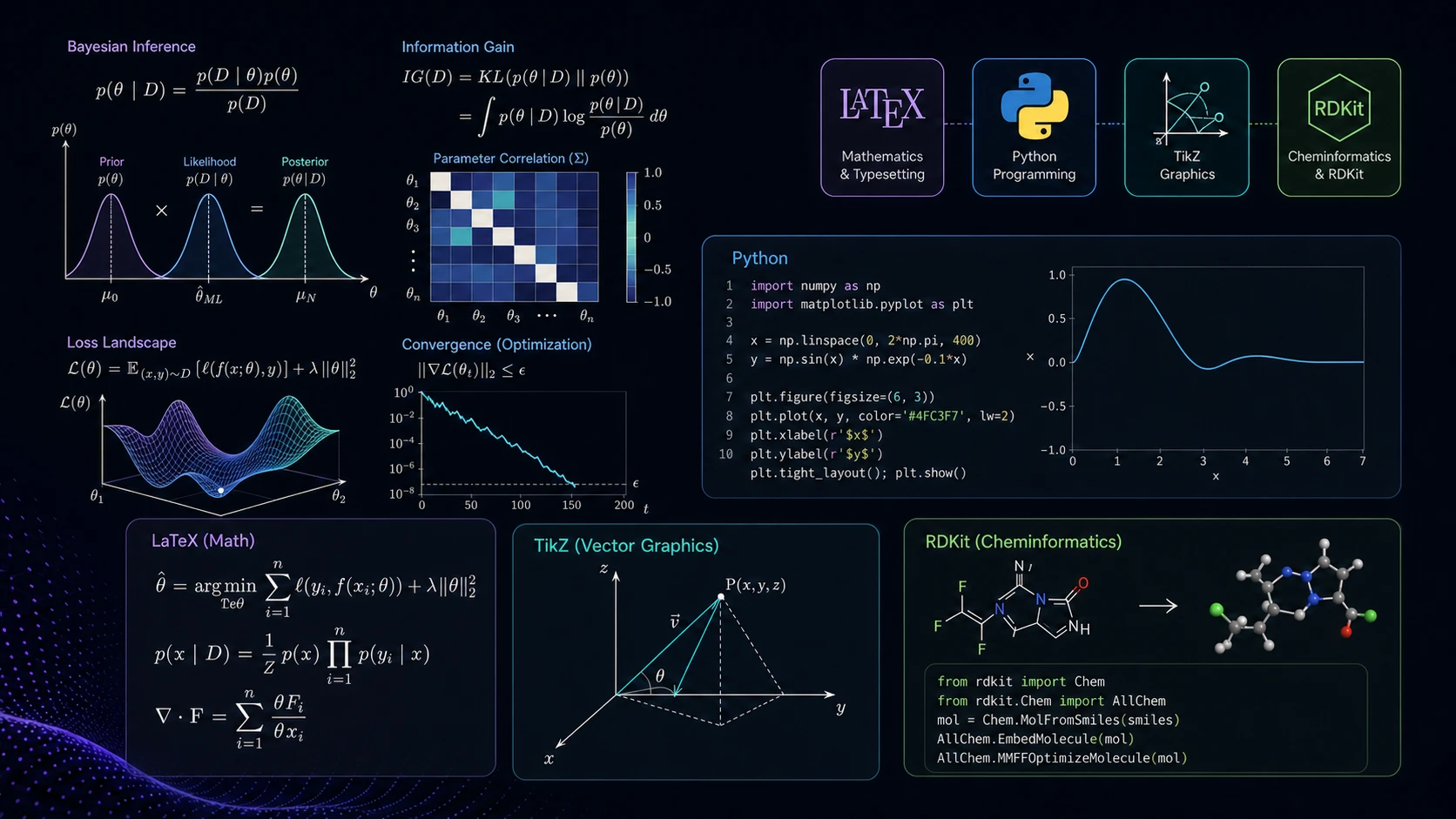
Key Points
Claude Science (launched June 30, 2026) is built around computational biology and drug development — its databases, agents, and compute integrations are calibrated for genomics, proteomics, and molecular medicine.
Researchers in physics, mathematics, chemistry, and engineering who need LaTeX-native TikZ figures, RDKit-verified reaction mechanisms, or STEM calculation verification are working with tools built for those specific tasks.
This post covers the best Claude Science alternatives in 2026 based on research domain, output format, and precision requirements.
Claude Science launched on June 30, 2026, and it is a genuinely strong product for what it does: integrating scientific databases, managing HPC compute, and tracking reproducibility across research workflows in computational biology and drug discovery. MIT Technology Review covered it as Anthropic's newest flagship product.
The researchers searching for Claude Science alternatives are not looking for something better. They are looking for something different — tools designed for research tasks and domains that Claude Science wasn't built to cover. This post covers what those alternatives are, and when each one is the right choice.
Why Researchers Look for Claude Science Alternatives
Claude Science's strengths are specific. Its 60+ pre-configured databases cover genomics, proteomics, structural biology, and cheminformatics. Its NVIDIA BioNeMo integrations (Evo 2, Boltz-2, OpenFold3) target biological structure prediction. Its launch event demonstrated autonomous drug candidate identification. These are life sciences capabilities.
Researchers who need something different typically fall into one of three categories:
Researchers in physics, mathematics, or engineering. Claude Science generates figures as web-based artifacts — Python or R code that renders in a browser. For researchers writing papers in LaTeX (the standard in physics, mathematics, and engineering), this output format creates friction: imported figures have different fonts, different scale behavior, and different vector properties from the LaTeX document they go into. There is no TikZ output in Claude Science.
Chemists who draw reaction mechanisms. Claude Science can retrieve and display chemical structures from databases. Drawing a multi-step organic reaction mechanism — with electron-pushing arrows, transition metal oxidation states, and ACS publication-standard formatting — is a different task that requires deterministic computation, not database retrieval.
Researchers who need multi-model verification. Claude Science's reviewer agent checks whether numbers in a manuscript match their cited sources. Researchers who need to verify that a calculation is mathematically correct — not just cited correctly — need a different kind of check.
The Best Claude Science Alternatives by Use Case
Best Alternative for LaTeX-Native Figure Generation: GPAI Visuals (TikZ Engine)
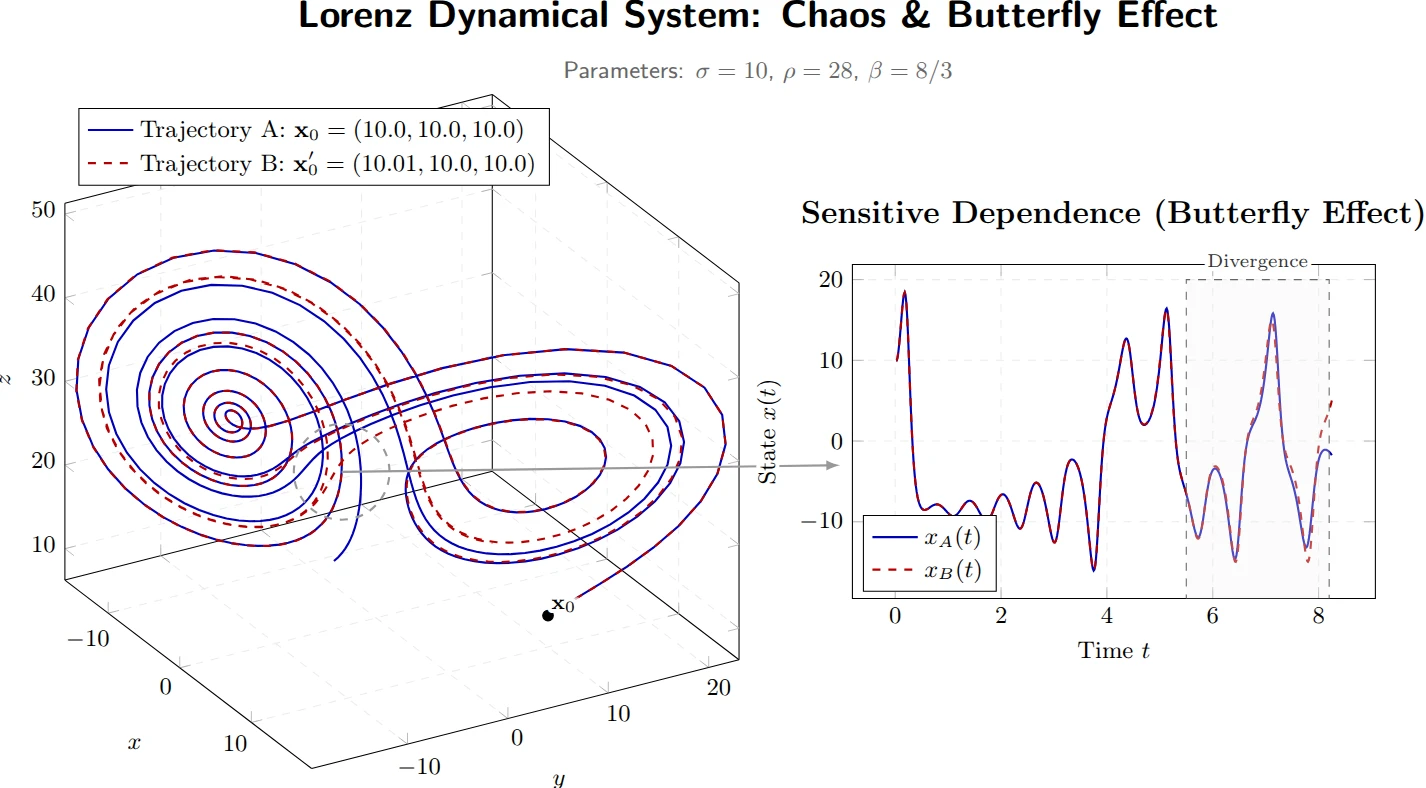
For researchers writing papers in LaTeX, the most important figure-related question is not what the figure shows — it is what format it comes out in. A PNG imported from matplotlib has different typography from the surrounding LaTeX text. A TikZ figure, by contrast, is generated within LaTeX's own language: it uses the document's fonts automatically, scales without resolution loss, and inserts directly into the manuscript as source code.
GPAI's Visuals mode handles TikZ figure generation through a four-stage pipeline:
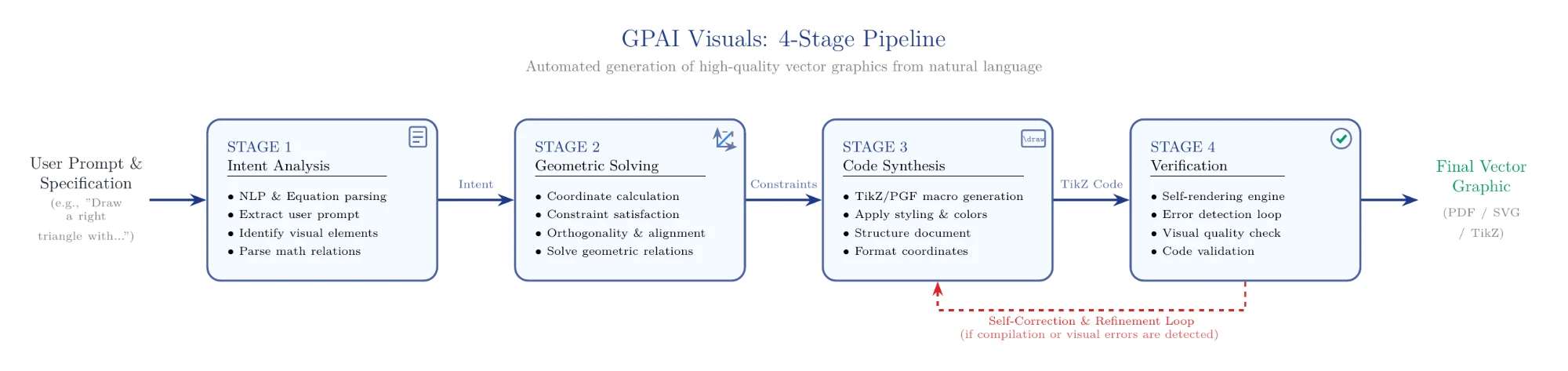
Phase | Core Task | Rigor Check |
|---|---|---|
1. Intent Analysis | Natural language and equation parsing | Infers geometric constraints the user didn't specify (orthogonality, symmetry) |
2. Geometric Solving | Coordinate and parameter calculation | Formalizes variable dependencies to ensure coordinate consistency |
3. Code Synthesis | TikZ/PGF macro generation | Produces structured code with LaTeX font matching |
4. Verification | Self-rendering and error correction | Checks for overlapping lines/labels; recalculates on geometric logic errors |
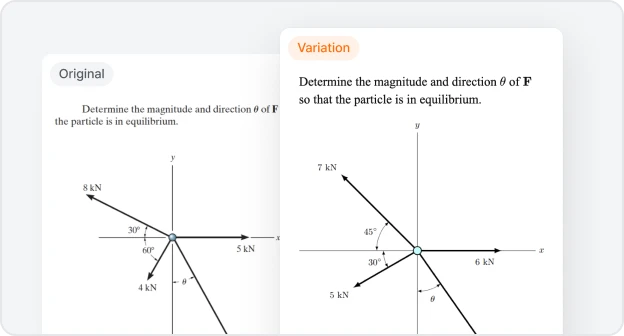
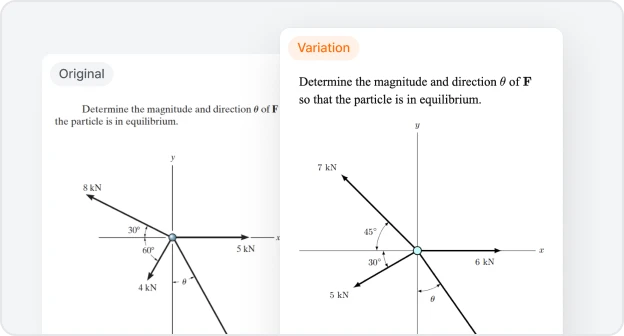
The researcher describes what they need — a phase portrait, a Feynman diagram, a control system block diagram, a vector field — and receives a rendered preview alongside .tex source code. Refinements happen conversationally without leaving GPAI.
Best for: Physicists, mathematicians, engineers, and anyone submitting LaTeX manuscripts who needs publication-ready figures without format conversion.
Best Alternative for Reaction Mechanism Drawing: GPAI Visuals (Chemistry Engine)
Claude Science is designed for retrieving and analyzing biological and chemical data from databases. It is not designed for drawing the step-by-step mechanism of a reaction that doesn't exist in any database yet.
GPAI Visuals' Chemistry engine combines LLM chemical reasoning with RDKit's deterministic computation through a self-correction loop. RDKit calculates bond lengths, valency, stereochemistry, and 2D/3D coordinates from chemical graph theory — not statistical inference. If a generated intermediate fails valency checks, the agent corrects it automatically before the figure is shown.
What this produces that Claude Science does not:
Electron-pushing arrow mechanisms drawn according to the actual electronic structure of each intermediate
Oxidation states tracked through every step of a transition metal catalytic cycle
Stereochemistry with correct wedge/dash bonds and absolute configuration labels
Output formatted to ACS publication standards
Best for: Synthetic chemists, organic chemistry researchers, and anyone who needs to draw multi-step reaction mechanisms for journal submission.
Best Alternative for STEM Calculation Verification: GPAI Problems
Claude Science addresses reproducibility at the pipeline level: its reviewer agent verifies that numbers trace to their sources, that figures match the code that generated them, and that the pipeline's own outputs are internally consistent. The question it answers is can this analysis be reproduced?
The question of whether the underlying mathematics is logically correct is a different one. GPAI Problems addresses this by running the same calculation through multiple independent AI systems simultaneously — not checking a single model's output against a source, but checking whether independent reasoners reach the same conclusion. GPAI Problems does this: it runs the same calculation through GPT, Claude, and Gemini in parallel and compares outputs. When all three agree, the result is meaningfully more reliable than any single model can guarantee. When they diverge, the discrepancy identifies exactly where to look more carefully.
For multi-step STEM derivations — where a sign error in step two propagates silently through steps three through twelve — this is not a redundancy check. It is how errors get caught before submission.
Best for: Physicists, mathematicians, engineers, and quantitative researchers working through multi-step derivations where a single propagated error changes the conclusion.
Best Alternative for STEM Research Outside Biology: GPAI Broadly
Claude Science's pre-configured database integrations, built-in agents, and compute models are calibrated for life sciences research. A graduate student in condensed matter physics, a materials engineer running DFT calculations, a control systems engineer designing transfer functions, or a pure mathematician working through a proof does not need a genomics database connector or OpenFold3 integration.
GPAI covers STEM broadly — physics, mathematics, chemistry, engineering, and biology — through three integrated modes:
Visuals: TikZ figures, chemical structure and reaction mechanism rendering
Problems: Calculation verification, numerical analysis, symbolic mathematics, cross-model checking
Chat: Cross-disciplinary literature analysis, deep paper comprehension across all STEM fields
There is no life-sciences-specific framing, and no mismatch for researchers whose primary domain is outside biology.
Best for: Any STEM researcher whose work is not primarily in computational biology or drug development.
Claude Science vs. GPAI: Side-by-Side Comparison
Capability | Claude Science | GPAI |
|---|---|---|
Life sciences database connectivity (60+ databases) | ✓ | — |
HPC compute management (SLURM, SSH, Modal) | ✓ | — |
Protein structure prediction (OpenFold3, Boltz-2, BioNeMo) | ✓ | — |
Full reproducibility tracking and provenance artifacts | ✓ | — |
Literature synthesis and analysis | ✓ Life sciences focus | ✓ All STEM fields |
Data analysis and code execution | ✓ Large-scale pipelines | ✓ Quantitative reasoning |
Figure output format | Web-based artifacts (JS/React) | LaTeX-native TikZ source (.tex) |
LaTeX-native TikZ figure generation | — | ✓ GPAI Visuals |
Reaction mechanism drawing (ACS standard, RDKit-verified) | — | ✓ GPAI Visuals |
Multi-model cross-verification for calculations | — | ✓ GPAI Problems |
Physics, mathematics, engineering research support | — | ✓ GPAI |
STEM breadth outside biology | — | ✓ GPAI |
Other Claude Science Alternatives Worth Knowing
Claude Code. Anthropic's coding-focused agent. For researchers who primarily need to write and debug scientific code (Python, R, Julia) rather than manage a full research workflow, Claude Code remains a strong choice and is not biology-specific.
Jupyter AI. For researchers already working in Jupyter notebooks, Jupyter AI integrates AI assistance directly into the notebook environment. Less infrastructure than Claude Science; no database connectivity; useful for exploratory analysis.
Elicit. Literature review and research synthesis tool. Covers all academic fields, not just life sciences. Strong for systematic reviews and evidence synthesis. Does not generate figures or verify calculations.
Wolfram Alpha / Mathematica. For pure mathematical computation and symbolic algebra. Deterministic, not AI-based. Strong for symbolic mathematics; no figure generation in LaTeX context; no chemical structure drawing.
BioRender. For biological figure creation specifically — cell diagrams, pathway illustrations, scientific illustrations. Life sciences specific; not for LaTeX-native figure generation or reaction mechanisms.
How to Choose the Right Claude Science Alternative
Use this decision framework:
Is your research domain primarily computational biology or drug development? → Claude Science may be exactly right. Its database integrations and BioNeMo compute are purpose-built for this.
Do you write papers in LaTeX and need publication-ready figures? → GPAI Visuals (TikZ engine). Claude Science outputs web artifacts; GPAI outputs .tex source code.
Do you draw organic or organometallic reaction mechanisms? → GPAI Visuals (Chemistry engine). RDKit-computed, valency-verified, ACS-standard.
Do you need to verify that a multi-step calculation is correct, not just cited? → GPAI Problems. Multi-model cross-verification across GPT, Claude, and Gemini.
Is your primary field physics, mathematics, or engineering? → GPAI. Claude Science's tooling is calibrated for biology; GPAI covers STEM broadly without domain restriction.
Do you primarily need coding assistance for scientific work? → Claude Code. Still Anthropic's best tool for code-heavy workflows that don't require biology-specific infrastructure.
Frequently Asked Questions
What is the best Claude Science alternative in 2026?
The best alternative depends on your research domain and output needs. For researchers in physics, mathematics, and engineering who write LaTeX manuscripts and need publication-ready TikZ figures, GPAI is the most direct alternative. For chemists who draw reaction mechanisms, GPAI's Chemistry engine (RDKit-based, ACS standard) addresses what Claude Science doesn't. For pure literature synthesis across all fields, Elicit is worth considering. Claude Science itself is the right choice if your work is primarily in computational biology or drug development.
Can GPAI be used as a Claude Science alternative for biology research?
GPAI covers biology as part of its STEM scope — cross-disciplinary literature analysis, chemical structure visualization, and calculation verification all apply to biological research. However, GPAI does not replicate Claude Science's life sciences database integrations (UniProt, PDB, GEO, Ensembl, etc.) or HPC compute management. For researchers whose workflow depends on those databases, Claude Science is the stronger tool. For biologists who also need LaTeX figures, reaction mechanism drawing, or calculation verification, GPAI and Claude Science complement each other.
Does Claude Science generate TikZ figures?
No. Claude Science generates figures as web-based scientific artifacts — Python or R code that renders in a browser or notebook. For LaTeX-native TikZ figures that use the document's fonts and insert directly as .tex source code, GPAI Visuals is the current option.
Does Claude Science draw reaction mechanisms?
Claude Science can retrieve and display chemical structures from databases like ChEMBL and PDB. It is not designed for generating multi-step organic or organometallic reaction mechanisms with electron-pushing arrows, oxidation state tracking, and ACS publication formatting. GPAI's Chemistry engine handles this through RDKit-based deterministic computation with a self-correction loop for valency verification.
Is GPAI free?
GPAI offers a free tier with access to core features. Full access to Visuals (TikZ and Chemistry engines), Problems (multi-model verification), and Chat requires a paid subscription. Claude Science is currently in beta for paid Claude subscribers on Pro, Max, Team, and Enterprise plans.
What does Claude Science cost?
Claude Science is included in Anthropic's paid Claude plans — Pro, Max, Team, and Enterprise — and is currently in beta. Anthropic has not announced a separate Claude Science pricing tier. GPAI's pricing is available at gpai.app.
GPAI is an all-in-one STEM workspace — Visuals, Problems, and Chat in one subscription. For researchers who need LaTeX-native TikZ figures, RDKit-verified reaction mechanisms, and multi-model calculation verification across physics, chemistry, mathematics, and engineering.