AI for Teachers in 2026: Claude for Teachers, GPAI, and What Each One Is Built For
Jul 20, 2026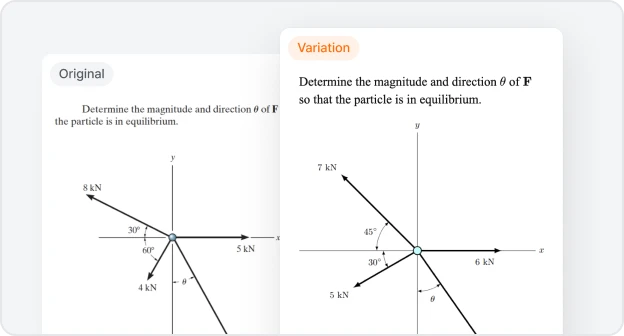
Key Points
Claude for Teachers (launched July 14, 2026) is a general-purpose K-12 teaching assistant for verified US educators — lesson planning and differentiation across every subject, aligned to academic standards in all 50 states, free through June 30, 2027.
GPAI is a STEM-specialized workspace available worldwide in multiple languages — problem authoring, technical figure generation, and parallel problem variation for physics, chemistry, mathematics, and engineering.
One works on the teaching — planning it, adapting it, tracking how students are doing. The other works on the content — authoring the problem, drawing the figure, checking the math. STEM educators increasingly run both rather than choosing between them.
2026 has been a fast year for AI in education. Anthropic launched Claude for Teachers on July 14, giving verified US K-12 educators free access to premium Claude with standards-aligned teaching skills. A week earlier, GPAI released its Parallel Problem Generator, which turns one STEM problem into a structurally equivalent variation with the figure redrawn to match.
These two launches are easy to file under the same heading — "AI for teachers" — and they are not the same kind of tool at all. They are also not competitors. Because they cover different parts of a teaching week, a STEM educator can reasonably use both, and many will.
This guide covers what each tool does, and how they fit together in practice.
What Claude for Teachers Is
Claude for Teachers is Anthropic's free offering for verified K-12 educators in the United States. It is a general-purpose teaching assistant — the subject you teach does not matter.
Two core teaching skills. Anthropic names two skills, both co-developed with Learning Commons and grounded in learning science:
Lesson planning from high-quality instructional materials. Claude draws on widely used curricula mapped to your state's standards, plus the fine-grained learning components beneath them, and drafts a plan with student-facing materials.
Differentiation for every learner. Claude adapts materials for students at different readiness levels and builds a differentiation plan with personalized materials for each proficiency band.
Standards connection. Through Learning Commons, Claude has access to academic standards across all 50 US states — and, beneath each standard, the smaller learning competencies it's built from and the order students typically learn them. This is what makes lesson planning precise rather than generic.
Curricular resources. Claude for Teachers connects to trusted curricula including OpenSciEd (science) and IM v.360 from Illustrative Mathematics.
Ecosystem integrations. Nine K-12 platforms connect at launch: ASSISTments, Brisk Teaching, Canva Education, Coteach, Diffit, Eedi, MagicSchool, Snorkl, and TeachFX. These extend what Claude can reach — for example, ASSISTments provides auto-scored, standards-aligned math practice problems, and Coteach provides K-12 math diagrams.
Claude Code and Cowork included. Teachers can hand over a folder of roster data, diagnostics, and notes and get back a picture of where each student stands. Recurring work can be scheduled — reviewing exit tickets each day at 4pm, for example.
Privacy. Data is not used for model training. Student information is covered by a K-12 Data Processing Addendum written to comply with FERPA, with terms developed alongside the American Federation of Teachers.
Access. Free for verified US K-12 educators. Sign up by June 30, 2027 for a full year.
If you teach K-12 in the US, this is a genuinely strong offering and there is no reason not to sign up.
What GPAI Is
GPAI is a STEM-specialized AI workspace. Where Claude for Teachers spans every subject in K-12, GPAI covers one domain — physics, chemistry, mathematics, and engineering — and goes deep into the tasks specific to it.
It is organized around three modes:
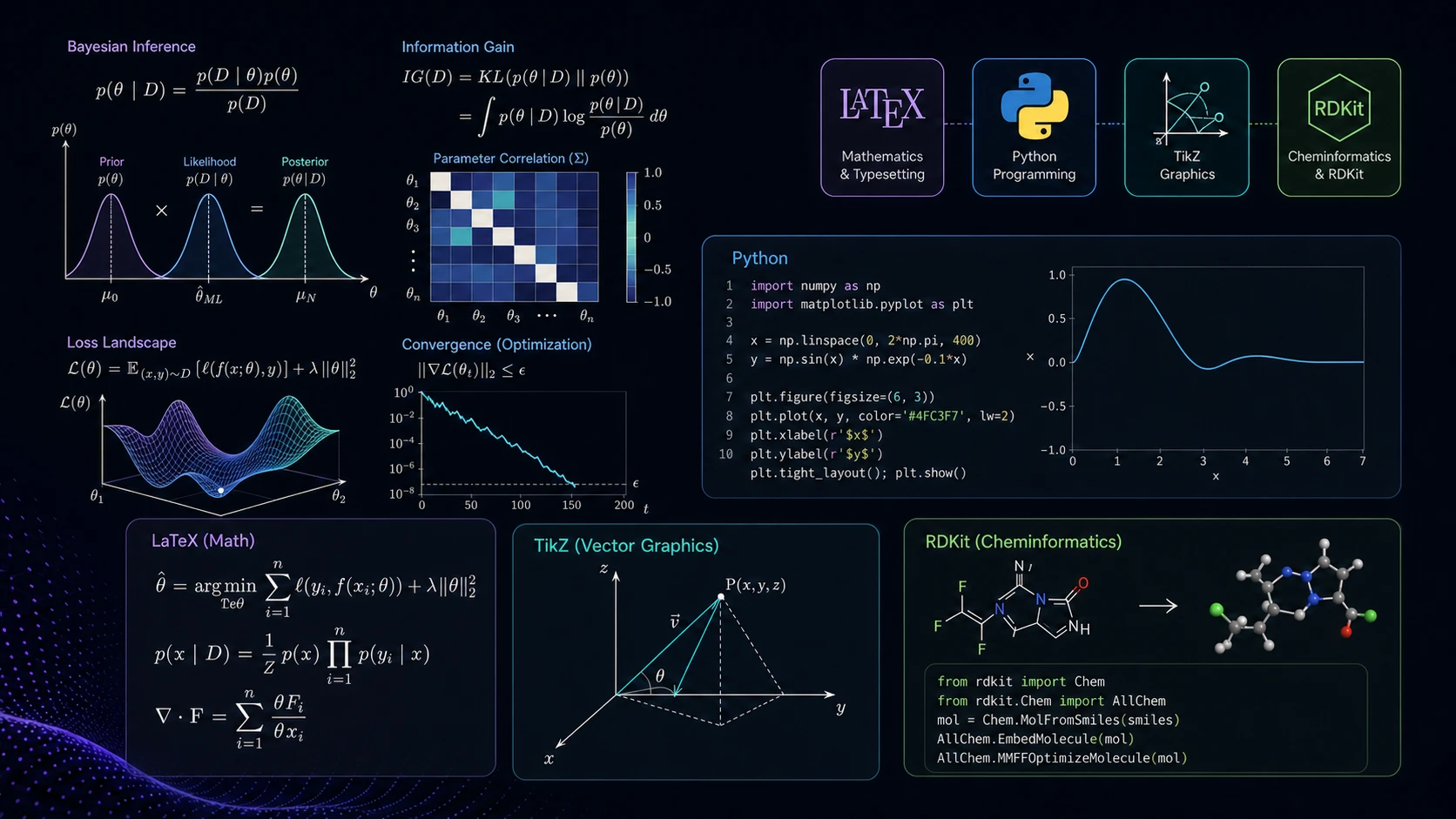
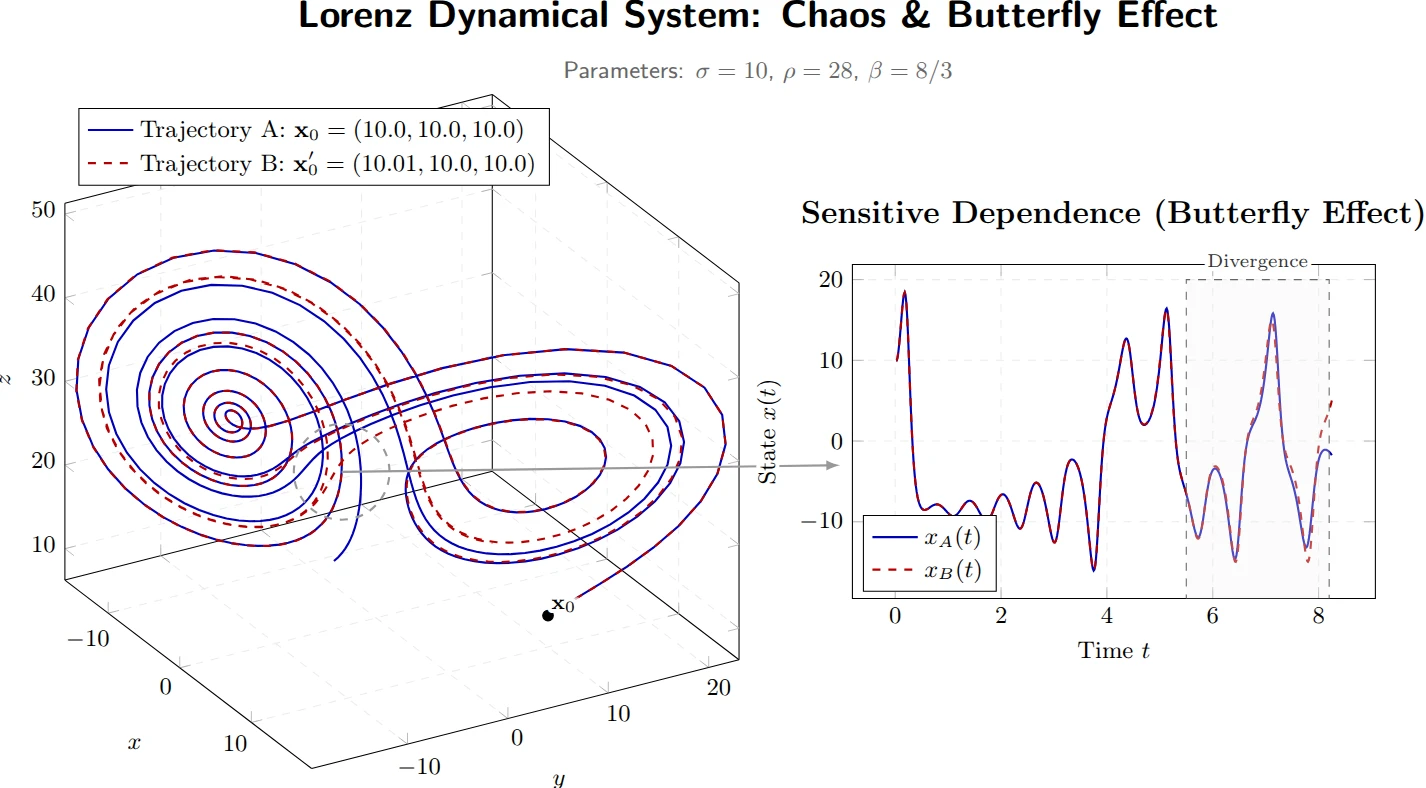
Visuals. Technical figure generation through two engines. The TikZ engine produces LaTeX-native diagrams — phase portraits, Feynman diagrams, control system block diagrams, circuit diagrams, vector fields — as both a rendered preview and .tex source code that inserts directly into a manuscript or exam. The Chemistry engine combines chemical reasoning with RDKit computation to draw molecular structures and multi-step reaction mechanisms with electron-pushing arrows, verified against chemical rules before rendering.
Problems. Calculation verification, numerical analysis, and symbolic mathematics, including cross-model verification that runs the same calculation through multiple independent AI systems and compares results. The Parallel Problem Generator lives here.
Chat. Cross-disciplinary research and literature work across STEM fields, and generation of lecture and explanatory materials.
GPAI is available worldwide and works in multiple languages, including Korean and English.
The Teaching vs. The Content
The simplest way to tell these two apart is to ask what they actually operate on.
Claude for Teachers works on the teaching. Planning the lesson, adapting it for different readiness levels, tracking how the class is doing, handling the recurring administrative work. This applies to any subject — an English teacher, a history teacher, and a chemistry teacher all get the same skills applied to their own material. Its precision comes from the standards framework underneath it.
GPAI works on the content. Not how you teach the material, but the material itself: authoring a problem whose values resolve cleanly, drawing a reaction mechanism that is chemically correct, producing a figure in LaTeX so it matches the document it goes into. It doesn't plan your week or analyze your roster.
Because they operate on different things, they rarely collide. A chemistry teacher plans the unit in Claude for Teachers and draws the mechanism in GPAI, and neither tool duplicates the other.
Where Each Tool Fits in a Teaching Week
A concrete way to see the division:
Task | Tool |
|---|---|
Draft a unit plan aligned to state standards | Claude for Teachers |
Adapt a reading for three reading levels | Claude for Teachers |
Build a differentiation plan for a mixed-readiness class | Claude for Teachers |
Analyze diagnostic data across a roster | Claude for Teachers |
Schedule a daily exit-ticket review | Claude for Teachers |
Generate standards-aligned math practice (K-12) | Claude for Teachers, via ASSISTments |
Author an original multi-step STEM problem | GPAI |
Create eight exam versions with distinct figures | GPAI |
Draw an organic reaction mechanism to ACS standard | GPAI |
Produce a phase portrait or Bode plot as | GPAI |
Verify a multi-step derivation is mathematically correct | GPAI |
A STEM teacher's week runs down both columns. Neither is a substitute for the other, and nothing in one column becomes unnecessary because of the other.
Quiz Generation vs. Problem Authoring
There is an important distinction that gets flattened when people say "AI generates problems now."
Quiz and drill generation produces items from an established template: swap the values in a linear equation, generate twenty of them, auto-score the answers. This is well-suited to K-12 practice, where the goal is repetition on a defined skill and immediate feedback matters more than novelty. ASSISTments — a nonprofit platform out of Worcester Polytechnic Institute with real efficacy research behind it — does this well, and its integration brings that capability into Claude for Teachers.
Problem authoring is a different task. Writing a problem on a transition metal catalytic cycle, or the frequency response of a second-order system, means choosing values so that a multi-step derivation resolves cleanly, the intermediate steps are instructive, and the answer isn't trivially obvious or computationally ugly. There is no template to draw from. And it comes with a figure that has to be correct for those specific values.
These are not the same job, and the second one has stayed manual almost everywhere.
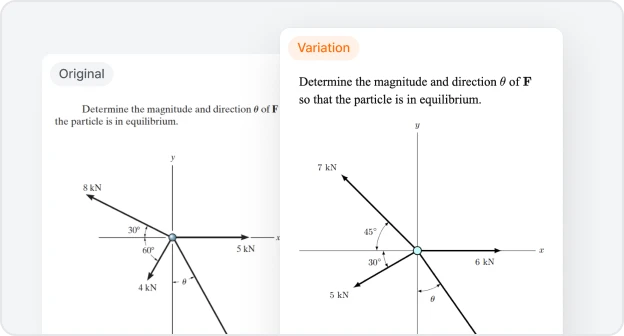
GPAI's Parallel Problem Generator addresses the second one. You upload a problem — a photo from your own materials, a textbook, a previous exam — choose how you want it varied, and receive a new problem whose values are chosen so the solution resolves, with the figure redrawn to match, a verified step-by-step solution, and a side-by-side comparison of what changed.
Equivalent-Structure Preservation
What makes a variation a genuine parallel problem rather than a reskin is that the solution path is preserved.
If the original problem is P₀ = (S₀, C₀, R₀) — symbolic structure, constraint set, solution recipe — then the parallel P₁ = (S₁, C₁, R₁) must satisfy R₁ ≅ R₀: the solution paths are isomorphic. The same method is required, applied the same way. The values, the figure, and the answer all differ.
Original: ∫₀¹ x eˣ dx Parallel: ∫₀² (x − 1) e²ˣ dx
Both require integration by parts. Neither answer helps with the other.
For assessment this is the property that matters: a student who has seen the original gains no advantage, while the problem still tests exactly the skill it was written to test.
The Figure Problem in STEM Assessment
In most subjects, generating a second version of an assessment is a text operation. In STEM, it usually isn't.
A circuit analysis problem comes with a circuit diagram. A mechanics problem comes with a free body diagram. A dynamical systems problem comes with a phase portrait. An organic chemistry problem comes with a mechanism. Change the values and the figure has to change with them — otherwise the diagram contradicts the question.
This is why STEM instructors reuse problems from previous years more than they would like: producing eight versions means solving eight problems and redrawing eight figures by hand.
The technical reason GPAI can automate this is that its figures are not images. TikZ diagrams are defined by coordinate calculations — every point, arrow, and curve specified mathematically. RDKit structures are computed from molecular graph theory: bond lengths, valency, and stereochemistry derived from first principles rather than pattern-matched. When a problem's parameters change, the inputs to those computations change, and the figure regenerates.
Figure Types That Get Regenerated
Course Area | Figure Regenerated |
|---|---|
Circuit analysis / electronics | Circuit diagrams with updated component values and topology |
Classical and analytical mechanics | Free body diagrams with corrected geometry and force vectors |
Dynamics and kinematics | Velocity-time and position-time graphs, recomputed |
Electromagnetism | Vector field diagrams, field line patterns |
Organic chemistry | Reaction mechanisms with electron-pushing arrows, ACS-standard |
Organometallic chemistry | Catalytic cycles with oxidation states tracked through every step |
Differential equations / dynamical systems | Phase portraits, bifurcation diagrams, stability diagrams |
Control systems / signals | Block diagrams, signal flow graphs |
Export Formats
Generated problems and figures come out in the formats teaching actually requires:
LaTeX /
.texsource — figures insert directly into a LaTeX exam paper or manuscript, matching the document's fonts and scalingText copy and partial export — take just the parts you need into a word processor or LMS
PDF and image download — the finished problem as a file, ready to print or upload
Availability: Region, Language, and Level
This is where the two tools separate most cleanly, and it is worth stating plainly because it determines who can use what.
Claude for Teachers is for verified K-12 educators in the United States. Its value is tied to US state academic standards, so the model of the product is inherently US-scoped. A dedicated offering for schools and districts is coming; higher education is served separately through Anthropic's other education offerings.
GPAI is available worldwide and works in multiple languages, including Korean and English. It is not tied to any national curriculum framework, which means it applies equally to a high school in Seoul, a university in Berlin, and a community college in Ohio. It also has no level ceiling — the same tools that handle introductory mechanics handle graduate-level quantum mechanics.
For the large majority of STEM educators on earth — everyone outside the US, and everyone teaching above K-12 — this is the practical difference.
What Each Tool Covers
A dash below means "outside this tool's scope," not "missing." Neither product is trying to cover the other's column — which is why the combined coverage is wider than either one alone.
Claude for Teachers | GPAI | |
|---|---|---|
Scope | All K-12 subjects | STEM (physics, chemistry, math, engineering) |
Region | United States | Worldwide |
Language | English | Multilingual (incl. Korean, English) |
Level | K-12 | Any level, including university and graduate |
Cost | Free for verified educators through June 30, 2027 | Free tier; paid plans for full access |
Standards alignment | ✓ All 50 US states via Learning Commons | — |
Lesson planning | ✓ Core skill | — |
Differentiation | ✓ Core skill | — |
Class data analysis | ✓ Via Claude Code and Cowork | — |
Scheduled recurring tasks | ✓ | — |
K-12 math practice generation | ✓ Via ASSISTments | ✓ |
Original STEM problem authoring | — | ✓ |
Parallel problem variation | — | ✓ |
Technical figure regeneration | — | ✓ |
Reaction mechanisms (RDKit-verified) | — | ✓ |
LaTeX-native figure output | — | ✓ |
Multi-model calculation verification | — | ✓ |
Lecture and explanatory material generation | ✓ | ✓ |
How Educators Combine Them
Most of these profiles involve both tools, not a choice between them.
US K-12 teacher, any subject. Claude for Teachers, without hesitation — it is free, standards-aligned, privacy-protected, and covers the parts of the week that consume the most time. If you teach a non-STEM subject, that may be all you need.
US K-12 STEM teacher. Both, on different days. Claude for Teachers for unit planning, differentiation, and class data. GPAI when the assessment work involves technical figures — an AP Chemistry mechanism, an AP Physics C circuit — that K-12 curriculum tools aren't built to produce. A chemistry teacher plans the unit in one and draws the mechanism in the other.
University STEM instructor or TA. GPAI covers the problem authoring and figure work. Anthropic's higher education offerings cover the general assistant layer — Claude for Teachers itself is K-12 scoped, but that doesn't mean choosing between an AI assistant and STEM tooling.
STEM educator outside the US. GPAI works without a national curriculum framework and in multiple languages. Claude is available broadly outside the Claude for Teachers program, so the general assistant layer is still there — it just won't carry US state standards alignment, which wouldn't apply anyway.
Large-enrollment course with multiple exam sittings. GPAI's parallel problem generator handles the version generation. Everything upstream of that — planning, materials, communication — stays wherever it already lives.
The pattern across all of these: a general assistant handles the work of teaching, and STEM-specific tooling handles the material being taught. Running both is the normal case, not a compromise.
Frequently Asked Questions
What is Claude for Teachers?
Claude for Teachers is Anthropic's free offering for verified K-12 educators in the United States, launched July 14, 2026. It provides premium Claude access with two core teaching skills — standards-aligned lesson planning and student differentiation — plus connections to academic standards in all 50 states via Learning Commons, curricular resources including OpenSciEd and Illustrative Mathematics, and integrations with nine K-12 platforms. It includes Claude Code and Cowork for class data analysis and scheduled tasks. Verified educators can sign up through June 30, 2027 for a full year free.
Is Claude for Teachers STEM-specific?
No. Claude for Teachers is a general-purpose K-12 teaching assistant. Its two core skills — lesson planning and differentiation — apply to any subject, from English language arts to history to science. It connects to STEM curricula (OpenSciEd for science, Illustrative Mathematics for math) as part of a broader curricular library, but the product is designed for all K-12 subjects rather than optimized for STEM specifically.
Is Claude for Teachers available outside the United States?
No. Claude for Teachers is currently for verified K-12 educators in the United States. Its core value comes from alignment to US state academic standards, which does not transfer to other national curricula. Educators outside the US who need STEM-specific tooling can use GPAI, which is available worldwide and supports multiple languages.
Can university professors use Claude for Teachers?
Claude for Teachers is scoped to K-12 educators. Higher education is served through Anthropic's separate education offerings. The core capabilities — alignment to state K-12 academic standards and K-12 curricular resources — are also specific to K-12 content and would not map onto upper-division university coursework.
Does Claude for Teachers generate exam problems?
Claude for Teachers itself is built around lesson planning and differentiation. Problem generation comes through its ASSISTments integration, which produces auto-scored, standards-aligned math practice problems for K-12. That is quiz and drill generation — items from a defined template with a single scoreable answer. Authoring an original multi-step STEM problem, where values must be chosen so a derivation resolves cleanly and a technical figure must accompany it, is a different task. GPAI's Parallel Problem Generator handles that class of work.
What is the difference between quiz generation and problem authoring?
Quiz generation produces items from an established template — substitute values into a known form, generate many, auto-score them. It works well for K-12 practice where repetition and immediate feedback are the goal. Problem authoring means designing a problem where the values are chosen so a multi-step solution resolves cleanly and instructively, typically accompanied by a technical figure that must be correct for those specific values. Problem authoring has no template to draw from, which is why it has stayed manual in most STEM courses.
What is ASSISTments?
ASSISTments is a free nonprofit math learning platform developed at Worcester Polytechnic Institute. Students work through problems and receive immediate feedback and hints, while teachers see data on where students are struggling. It has randomized controlled efficacy research behind it. As a Claude for Teachers integration, it lets Claude pull auto-scored, standards-aligned math problems into a teacher's workflow rather than generating them from scratch.
What is a parallel problem?
A parallel problem is a new version of an existing problem that preserves the solution structure of the original — same concept, same solution strategy, same difficulty level — while using different values and a redrawn figure. A student who has seen the original gains no advantage on the parallel, but the problem still tests exactly the skill it was written for. This is the property that makes parallel problems useful for cheat-resistant exam versions.
Can GPAI redraw figures for chemistry problems?
Yes. GPAI's Chemistry engine uses RDKit to compute molecular structures and reaction mechanisms from first principles — bond lengths, valency, stereochemistry, derived from molecular graph theory rather than pattern matching. When conditions change in a chemistry problem, the mechanism, structure, or reaction diagram is redrawn from scratch, including electron-pushing arrows, wedge/dash stereochemistry, and oxidation states tracked through catalytic cycles.
What formats can GPAI export to?
Generated problems and figures export as LaTeX .tex source (so figures insert directly into a LaTeX exam or manuscript and match the document's fonts), as text with partial selection for copying into a word processor or LMS, and as PDF or image downloads for printing or upload.
Can I use Claude for Teachers and GPAI together?
Yes, and for US K-12 STEM teachers this is often the natural combination. Claude for Teachers handles the work of teaching — lesson planning, differentiation, standards alignment, class data analysis. GPAI handles the material itself — authoring STEM problems, generating technical figures, producing exam variations where the diagram has to be redrawn for each version. The two operate on different things and rarely duplicate each other.
Is GPAI free?
GPAI offers a free tier with access to core features. Full access — including the Parallel Problem Generator with figure regeneration and verified solutions, the TikZ and Chemistry engines, and multi-model calculation verification — is available on paid plans. See pricing at gpai.app.
Getting Started
If you teach K-12 in the US, Claude for Teachers is free for verified educators through June 30, 2027. Sign up regardless of what else you use.
If your work involves authoring STEM problems, drawing technical figures, or generating exam variations — at any level, in any country — GPAI is built for that layer. The Parallel Problem Generator is the fastest place to start: upload one problem and see what comes back.
Together they cover more of a STEM teaching week than either does alone.
Try the Parallel Problem Generator →
GPAI is an AI STEM workspace — Visuals, Problems, and Chat in one subscription. Built for educators and researchers in physics, chemistry, mathematics, and engineering who need publication-grade figures, verified calculations, and complete problem variations.
Sources: Introducing Claude for Teachers — Anthropic · Claude for Teachers — claude.com