Class 9-10 Math Formulas
Shared 4/5/2026•186 views
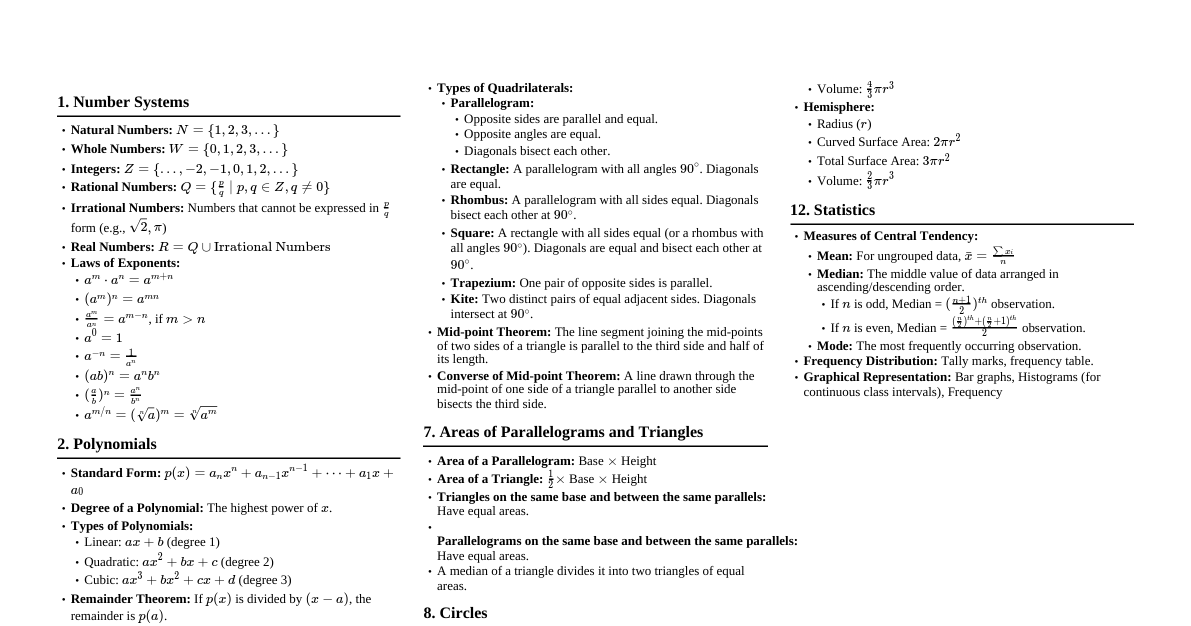
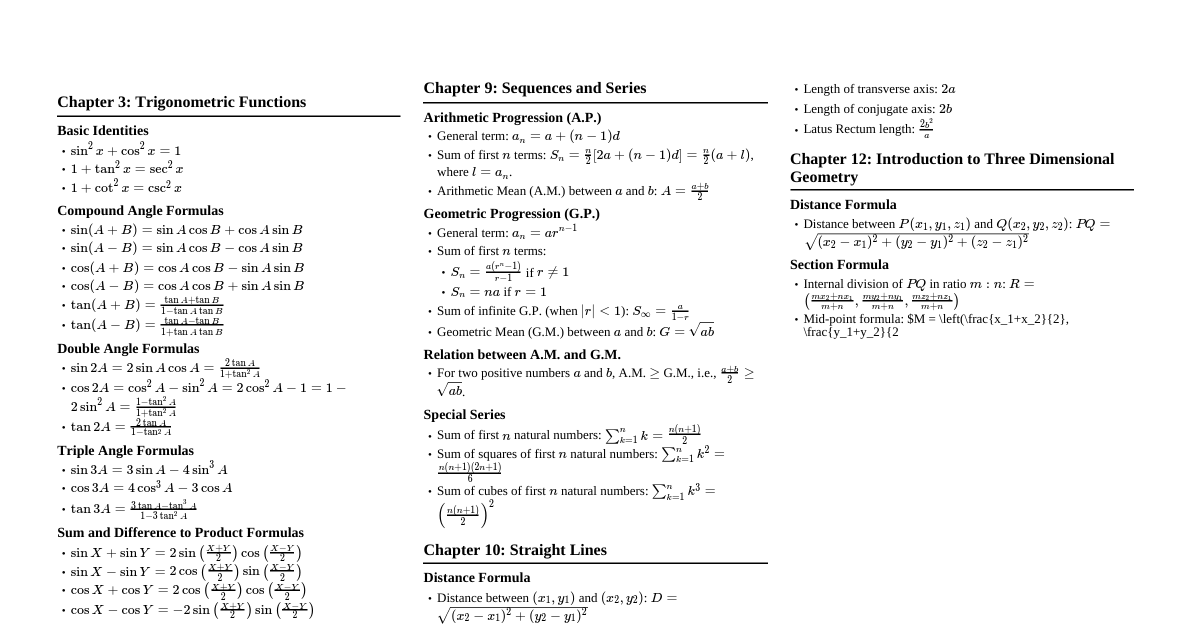
### Numbers Systems - **Natural Numbers:** $N = \{1, 2, 3, ...\}$ - **Whole Numbers:** $W = \{0, 1, 2, 3, ...\}$ - **Integers:** $Z = \{..., -2, -1, 0, 1, 2, ...\}$ - **Rational Numbers:** $Q = \{p/q \mid p, q \in Z, q \neq 0\}$ - **Irrational Numbers:** Numbers that cannot be expressed as $p/q$. E.g., $\sqrt{2}, \pi$. - **Real Numbers:** $R = Q \cup Q'$ (Rational and Irrational numbers) - **Laws of Exponents:** - $a^m \cdot a^n = a^{m+n}$ - $a^m / a^n = a^{m-n}$ - $(a^m)^n = a^{mn}$ - $(ab)^n = a^n b^n$ - $(a/b)^n = a^n / b^n$ - $a^0 = 1$ - $a^{-n} = 1/a^n$ ### Polynomials - **Degree of a polynomial:** Highest power of the variable. - **Linear Polynomial:** $ax + b$, degree 1. - **Quadratic Polynomial:** $ax^2 + bx + c$, degree 2. - **Cubic Polynomial:** $ax^3 + bx^2 + cx + d$, degree 3. - **Remainder Theorem:** If $P(x)$ is divided by $(x-a)$, the remainder is $P(a)$. - **Factor Theorem:** $(x-a)$ is a factor of $P(x)$ if $P(a) = 0$. - **Algebraic Identities:** - $(x+y)^2 = x^2 + 2xy + y^2$ - $(x-y)^2 = x^2 - 2xy + y^2$ - $x^2 - y^2 = (x-y)(x+y)$ - $(x+y+z)^2 = x^2 + y^2 + z^2 + 2xy + 2yz + 2zx$ - $(x+y)^3 = x^3 + y^3 + 3xy(x+y) = x^3 + y^3 + 3x^2y + 3xy^2$ - $(x-y)^3 = x^3 - y^3 - 3xy(x-y) = x^3 - y^3 - 3x^2y + 3xy^2$ - $x^3 + y^3 = (x+y)(x^2 - xy + y^2)$ - $x^3 - y^3 = (x-y)(x^2 + xy + y^2)$ - $x^3 + y^3 + z^3 - 3xyz = (x+y+z)(x^2 + y^2 + z^2 - xy - yz - zx)$ - If $x+y+z=0$, then $x^3+y^3+z^3=3xyz$. ### Linear Equations in Two Variables - **Standard form:** $ax + by + c = 0$, where $a, b, c$ are real numbers and $a, b \neq 0$. - **Solutions:** A pair of values $(x, y)$ that satisfies the equation. ### Quadratic Equations - **Standard form:** $ax^2 + bx + c = 0$, where $a, b, c$ are real numbers and $a \neq 0$. - **Quadratic Formula:** $x = \frac{-b \pm \sqrt{b^2 - 4ac}}{2a}$ - **Discriminant:** $D = b^2 - 4ac$ - If $D > 0$, two distinct real roots. - If $D = 0$, two equal real roots. - If $D ### Arithmetic Progressions (AP) - **General form:** $a, a+d, a+2d, ...$ - **$n^{th}$ term:** $a_n = a + (n-1)d$ - **Sum of first $n$ terms:** $S_n = \frac{n}{2}[2a + (n-1)d]$ or $S_n = \frac{n}{2}[a + a_n]$ ### Coordinate Geometry - **Distance Formula:** Between $(x_1, y_1)$ and $(x_2, y_2)$ is $\sqrt{(x_2-x_1)^2 + (y_2-y_1)^2}$. - **Section Formula:** - **Internal Division:** Point $(x, y)$ dividing line segment joining $(x_1, y_1)$ and $(x_2, y_2)$ in ratio $m:n$ is $\left(\frac{mx_2+nx_1}{m+n}, \frac{my_2+ny_1}{m+n}\right)$. - **Mid-point:** $\left(\frac{x_1+x_2}{2}, \frac{y_1+y_2}{2}\right)$. - **Area of a Triangle:** With vertices $(x_1, y_1), (x_2, y_2), (x_3, y_3)$ is $\frac{1}{2} |x_1(y_2-y_3) + x_2(y_3-y_1) + x_3(y_1-y_2)|$. ### Triangles - **Area of Triangle:** $\frac{1}{2} \times \text{base} \times \text{height}$. - **Heron's Formula:** Area $= \sqrt{s(s-a)(s-b)(s-c)}$, where $s = \frac{a+b+c}{2}$ (semi-perimeter). - **Pythagoras Theorem:** In a right-angled triangle, $h^2 = p^2 + b^2$. - **Similarity Criteria:** AAA, SSS, SAS. - **Thales Theorem (Basic Proportionality Theorem):** If a line is drawn parallel to one side of a triangle to intersect the other two sides in distinct points, the other two sides are divided in the same ratio. - **Area of similar triangles:** Ratio of areas is square of ratio of corresponding sides. ### Circles - **Circumference:** $2\pi r$ or $\pi d$. - **Area:** $\pi r^2$. - **Area of Sector:** $\frac{\theta}{360^\circ} \times \pi r^2$. - **Length of Arc:** $\frac{\theta}{360^\circ} \times 2\pi r$. - **Angle Subtended by Arc:** The angle subtended by an arc at the center is double the angle subtended by it at any point on the remaining part of the circle. - **Cyclic Quadrilateral:** Sum of opposite angles is $180^\circ$. ### Surface Areas & Volumes - **Cube:** - Volume: $a^3$ - Lateral Surface Area: $4a^2$ - Total Surface Area: $6a^2$ - **Cuboid:** - Volume: $l \times b \times h$ - Lateral Surface Area: $2h(l+b)$ - Total Surface Area: $2(lb+bh+hl)$ - **Cylinder:** - Volume: $\pi r^2 h$ - Curved Surface Area: $2\pi r h$ - Total Surface Area: $2\pi r(r+h)$ - **Cone:** - Volume: $\frac{1}{3}\pi r^2 h$ - Curved Surface Area: $\pi r l$ (where $l = \sqrt{r^2+h^2}$) - Total Surface Area: $\pi r(r+l)$ - **Sphere:** - Volume: $\frac{4}{3}\pi r^3$ - Surface Area: $4\pi r^2$ - **Hemisphere:** - Volume: $\frac{2}{3}\pi r^3$ - Curved Surface Area: $2\pi r^2$ - Total Surface Area: $3\pi r^2$ - **Frustum of a Cone (Class 10):** - Volume: $\frac{1}{3}\pi h(R^2+Rr+r^2)$ - Curved Surface Area: $\pi l(R+r)$ (where $l = \sqrt{h^2+(R-r)^2}$) - Total Surface Area: $\pi l(R+r) + \pi R^2 + \pi r^2$ ### Trigonometry - **Trigonometric Ratios:** - $\sin \theta = \text{Opposite}/\text{Hypotenuse}$ - $\cos \theta = \text{Adjacent}/\text{Hypotenuse}$ - $\tan \theta = \text{Opposite}/\text{Adjacent} = \sin \theta / \cos \theta$ - $\csc \theta = 1/\sin \theta$ - $\sec \theta = 1/\cos \theta$ - $\cot \theta = 1/\tan \theta = \cos \theta / \sin \theta$ - **Identities:** - $\sin^2 \theta + \cos^2 \theta = 1$ - $1 + \tan^2 \theta = \sec^2 \theta$ - $1 + \cot^2 \theta = \csc^2 \theta$ - **Complementary Angles:** - $\sin(90^\circ - \theta) = \cos \theta$ - $\cos(90^\circ - \theta) = \sin \theta$ - $\tan(90^\circ - \theta) = \cot \theta$ - $\cot(90^\circ - \theta) = \tan \theta$ - $\sec(90^\circ - \theta) = \csc \theta$ - $\csc(90^\circ - \theta) = \sec \theta$ - **Trigonometric Table (Common Values):** | $\theta$ | $0^\circ$ | $30^\circ$ | $45^\circ$ | $60^\circ$ | $90^\circ$ | |----------|-----------|------------|------------|------------|------------| | $\sin \theta$ | $0$ | $1/2$ | $1/\sqrt{2}$ | $\sqrt{3}/2$ | $1$ | | $\cos \theta$ | $1$ | $\sqrt{3}/2$ | $1/\sqrt{2}$ | $1/2$ | $0$ | | $\tan \theta$ | $0$ | $1/\sqrt{3}$ | $1$ | $\sqrt{3}$ | Not defined | ### Statistics - **Mean (Ungrouped Data):** $\bar{x} = \frac{\sum x_i}{n}$ - **Mean (Grouped Data):** - **Direct Method:** $\bar{x} = \frac{\sum f_i x_i}{\sum f_i}$ - **Assumed Mean Method:** $\bar{x} = A + \frac{\sum f_i d_i}{\sum f_i}$, where $d_i = x_i - A$ - **Step-deviation Method:** $\bar{x} = A + h \left(\frac{\sum f_i u_i}{\sum f_i}\right)$, where $u_i = (x_i - A)/h$ - **Median:** - **Ungrouped (odd $n$):** Middle term. - **Ungrouped (even $n$):** Average of two middle terms. - **Grouped:** $Median = L + \left(\frac{n/2 - cf}{f}\right) \times h$ - $L$: lower limit of median class - $n$: total frequency - $cf$: cumulative frequency of class preceding median class - $f$: frequency of median class - $h$: class size - **Mode:** - **Ungrouped:** Most frequent observation. - **Grouped:** $Mode = L + \left(\frac{f_1 - f_0}{2f_1 - f_0 - f_2}\right) \times h$ - $L$: lower limit of modal class - $f_1$: frequency of modal class - $f_0$: frequency of class preceding modal class - $f_2$: frequency of class succeeding modal class - $h$: class size - **Empirical Relationship:** $3 \text{ Median} = \text{Mode} + 2 \text{ Mean}$ ### Probability - **Probability of an Event E:** $P(E) = \frac{\text{Number of favorable outcomes}}{\text{Total number of possible outcomes}}$ - **Range of Probability:** $0 \le P(E) \le 1$ - **Complementary Event:** $P(E) + P(\text{not } E) = 1$ - **Impossible Event:** $P(\emptyset) = 0$ - **Sure Event:** $P(S) = 1$