Class 12 Physics Formulas
Cheatsheet Content
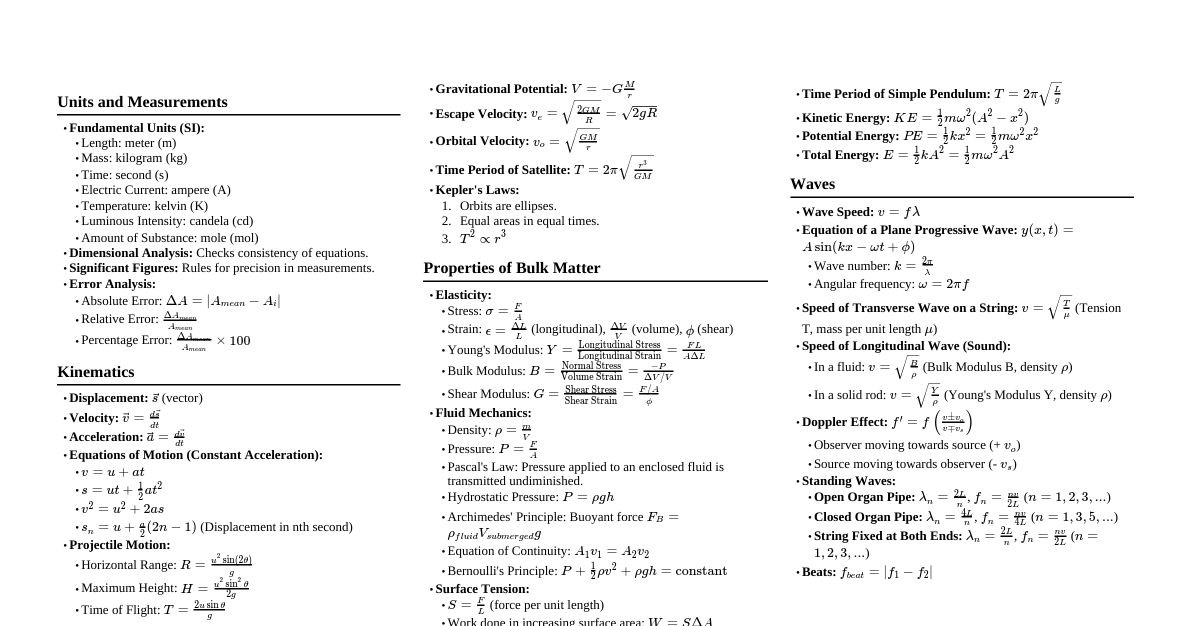
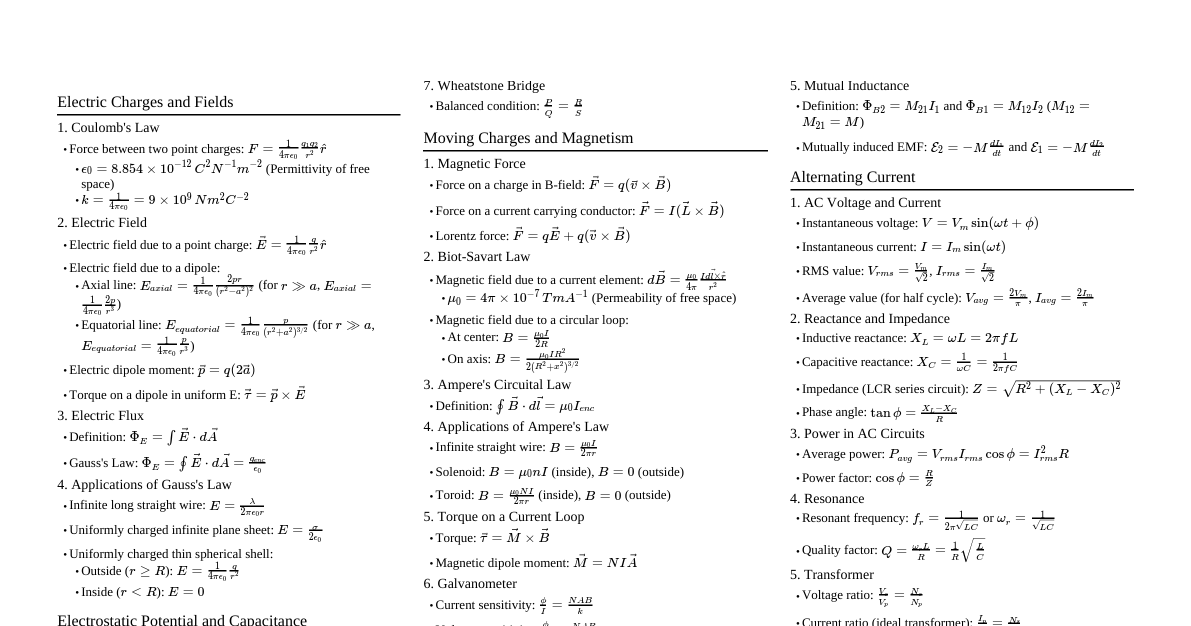
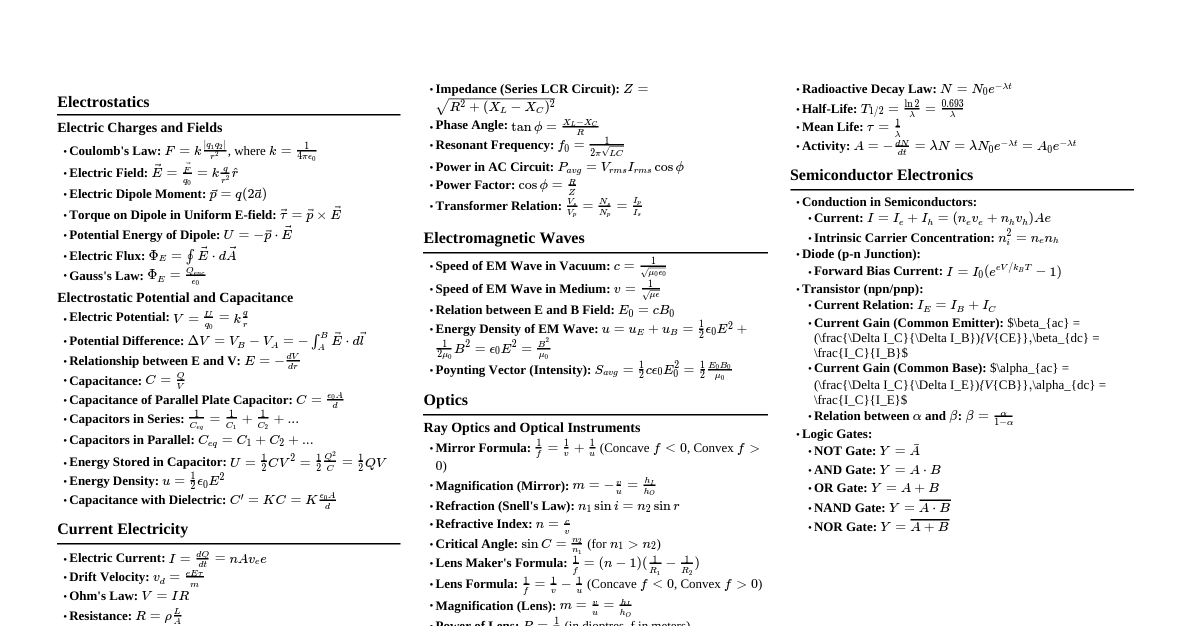
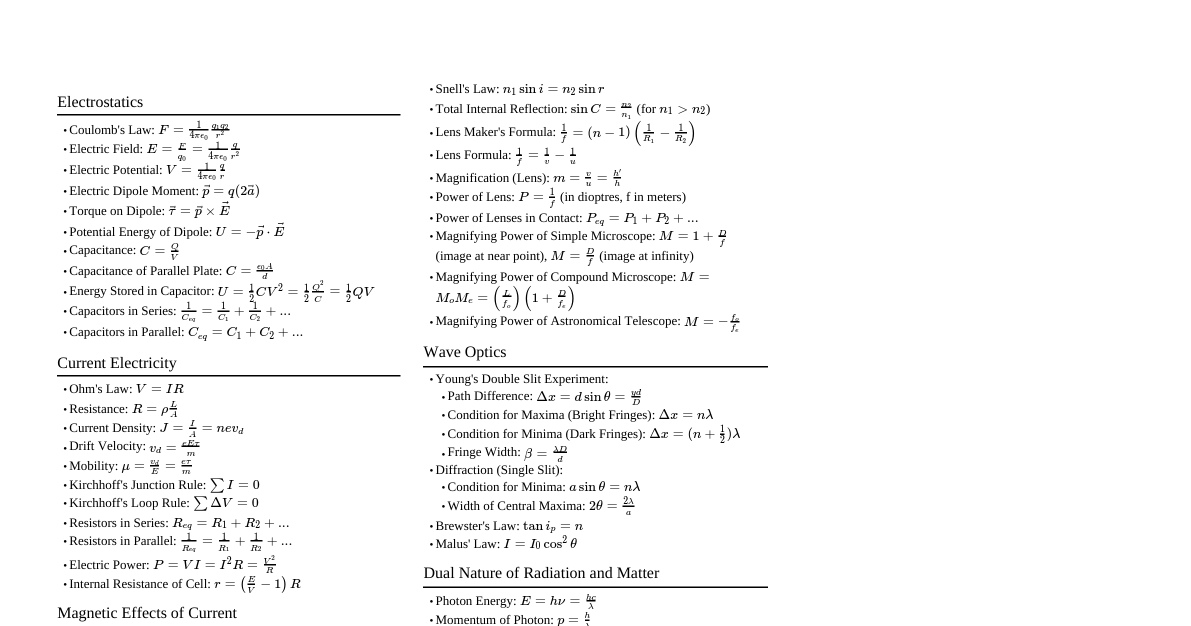
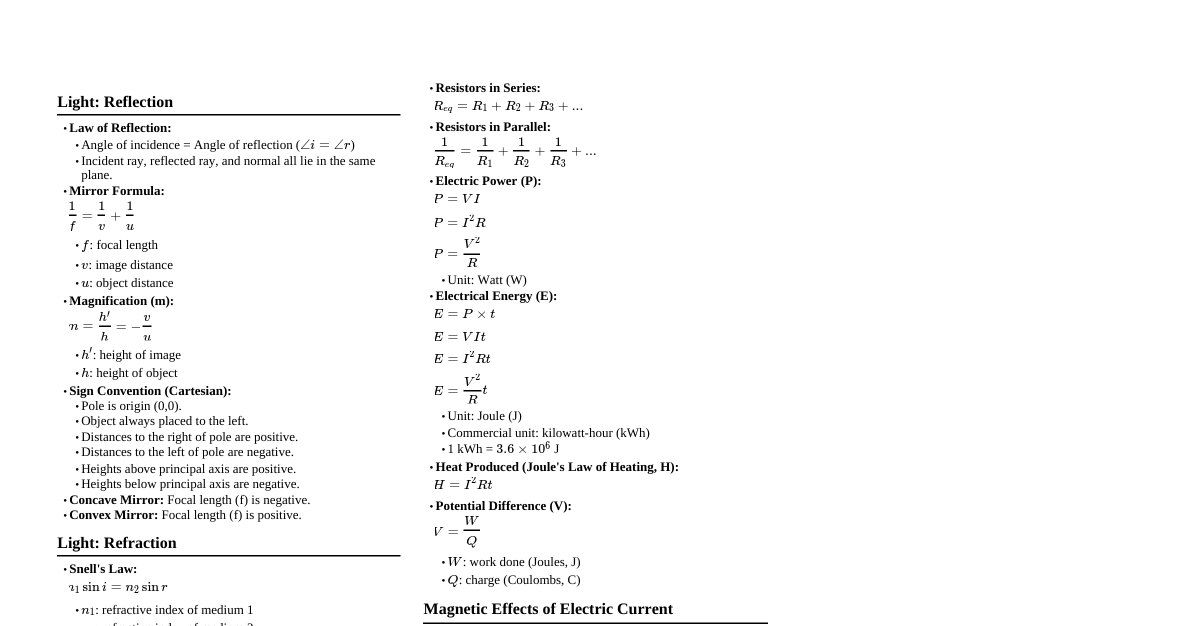
### Electrostatics - **Coulomb's Law:** $F = \frac{1}{4\pi\epsilon_0} \frac{q_1 q_2}{r^2}$ - **Electric Field:** $E = \frac{F}{q_0} = \frac{1}{4\pi\epsilon_0} \frac{q}{r^2}$ - **Electric Potential:** $V = \frac{1}{4\pi\epsilon_0} \frac{q}{r}$ - **Electric Potential Energy:** $U = \frac{1}{4\pi\epsilon_0} \frac{q_1 q_2}{r}$ - **Capacitance:** $C = \frac{Q}{V}$ - **Capacitance of Parallel Plate Capacitor:** $C = \frac{\epsilon_0 A}{d}$ - **Energy Stored in Capacitor:** $U = \frac{1}{2}CV^2 = \frac{1}{2}\frac{Q^2}{C} = \frac{1}{2}QV$ - **Series Capacitors:** $\frac{1}{C_{eq}} = \frac{1}{C_1} + \frac{1}{C_2} + ...$ - **Parallel Capacitors:** $C_{eq} = C_1 + C_2 + ...$ ### Current Electricity - **Current:** $I = \frac{dQ}{dt}$ - **Ohm's Law:** $V = IR$ - **Resistance:** $R = \rho \frac{L}{A}$ - **Series Resistors:** $R_{eq} = R_1 + R_2 + ...$ - **Parallel Resistors:** $\frac{1}{R_{eq}} = \frac{1}{R_1} + \frac{1}{R_2} + ...$ - **Kirchhoff's Junction Rule:** $\sum I = 0$ (at any junction) - **Kirchhoff's Loop Rule:** $\sum \Delta V = 0$ (around any closed loop) - **Electric Power:** $P = VI = I^2R = \frac{V^2}{R}$ - **Drift Velocity:** $v_d = \frac{eE\tau}{m}$ - **Relation between I and $v_d$:** $I = n e A v_d$ ### Magnetic Effects of Current & Magnetism - **Biot-Savart Law:** $d\vec{B} = \frac{\mu_0}{4\pi} \frac{I d\vec{l} \times \vec{r}}{r^3}$ - **Magnetic Field due to Long Straight Wire:** $B = \frac{\mu_0 I}{2\pi r}$ - **Magnetic Field at Center of Circular Loop:** $B = \frac{\mu_0 I}{2R}$ - **Magnetic Field inside Solenoid:** $B = \mu_0 n I$ - **Lorentz Force:** $\vec{F} = q(\vec{E} + \vec{v} \times \vec{B})$ - **Force on Current Carrying Conductor:** $\vec{F} = I(\vec{L} \times \vec{B})$ - **Torque on Current Loop:** $\vec{\tau} = \vec{M} \times \vec{B}$, where $\vec{M} = NI\vec{A}$ - **Magnetic Dipole Moment:** $M = NIA$ ### Electromagnetic Induction & AC - **Magnetic Flux:** $\Phi_B = \int \vec{B} \cdot d\vec{A} = BA \cos\theta$ - **Faraday's Law of EMI:** $\mathcal{E} = -\frac{d\Phi_B}{dt}$ - **Motional EMF:** $\mathcal{E} = Blv$ - **Self-Inductance:** $\Phi = LI$, $\mathcal{E} = -L\frac{dI}{dt}$ - **Mutual Inductance:** $\Phi_2 = M I_1$, $\mathcal{E}_2 = -M\frac{dI_1}{dt}$ - **Energy Stored in Inductor:** $U = \frac{1}{2}LI^2$ - **RMS Value of AC:** $V_{rms} = \frac{V_0}{\sqrt{2}}$, $I_{rms} = \frac{I_0}{\sqrt{2}}$ - **Reactance:** $X_L = \omega L$, $X_C = \frac{1}{\omega C}$ - **Impedance (LCR Series):** $Z = \sqrt{R^2 + (X_L - X_C)^2}$ - **Phase Angle:** $\tan\phi = \frac{X_L - X_C}{R}$ - **Power in AC Circuit:** $P = V_{rms} I_{rms} \cos\phi$ ### Electromagnetic Waves - **Speed of EM Wave in Vacuum:** $c = \frac{1}{\sqrt{\mu_0\epsilon_0}}$ - **Speed of EM Wave in Medium:** $v = \frac{1}{\sqrt{\mu\epsilon}}$ - **Relation between E and B:** $c = \frac{E_0}{B_0}$ - **Energy Density:** $u = u_E + u_B = \frac{1}{2}\epsilon_0 E^2 + \frac{1}{2\mu_0} B^2$ ### Optics - **Mirror Formula:** $\frac{1}{f} = \frac{1}{v} + \frac{1}{u}$ - **Magnification (Mirror):** $m = -\frac{v}{u} = \frac{h_i}{h_o}$ - **Refractive Index:** $n = \frac{c}{v}$ - **Snell's Law:** $n_1 \sin i = n_2 \sin r$ - **Lens Formula:** $\frac{1}{f} = \frac{1}{v} - \frac{1}{u}$ - **Lens Maker's Formula:** $\frac{1}{f} = (n-1)\left(\frac{1}{R_1} - \frac{1}{R_2}\right)$ - **Magnification (Lens):** $m = \frac{v}{u} = \frac{h_i}{h_o}$ - **Power of Lens:** $P = \frac{1}{f}$ (in dioptres, f in meters) - **Total Internal Reflection:** $\sin C = \frac{n_2}{n_1}$ (for $n_1 > n_2$) - **Young's Double Slit Experiment (YDSE):** - **Fringe Width:** $\beta = \frac{\lambda D}{d}$ - **Path Difference for Constructive Interference:** $n\lambda$ - **Path Difference for Destructive Interference:** $(n + \frac{1}{2})\lambda$ - **Diffraction (Single Slit):** - **Minima:** $a \sin\theta = n\lambda$ - **Angular Width of Central Maxima:** $\frac{2\lambda}{a}$ ### Dual Nature of Radiation & Matter - **Photon Energy:** $E = h\nu = \frac{hc}{\lambda}$ - **Photoelectric Equation:** $K_{max} = h\nu - \phi_0$ - **Work Function:** $\phi_0 = h\nu_0$ - **de Broglie Wavelength:** $\lambda = \frac{h}{p} = \frac{h}{mv}$ - **de Broglie Wavelength of Electron:** $\lambda = \frac{h}{\sqrt{2m_e eV}}$ ### Atoms & Nuclei - **Rutherford's Model:** $\Delta N \propto \frac{Z^2}{K^2}$ (Scattering) - **Bohr's Postulates:** - Quantized orbits: $L = mvr = n\frac{h}{2\pi}$ - Energy levels: $E_n = -\frac{13.6}{n^2}$ eV - Frequency condition: $h\nu = E_i - E_f$ - **Radius of Bohr Orbit:** $r_n = \frac{n^2 h^2 \epsilon_0}{\pi m e^2 Z} = 0.529 \frac{n^2}{Z} \mathring{A}$ - **Half-life:** $T_{1/2} = \frac{0.693}{\lambda}$ - **Mean Life:** $\tau = \frac{1}{\lambda}$ - **Radioactive Decay Law:** $N = N_0 e^{-\lambda t}$ - **Mass Defect:** $\Delta m = (Z m_p + (A-Z)m_n) - M_{nucleus}$ - **Binding Energy:** $BE = \Delta m c^2$ ### Semiconductor Electronics - **Diode Forward Bias:** Current increases exponentially - **Diode Reverse Bias:** Very small saturation current - **Transistor (Common Emitter):** - **Current Gain:** $\beta = \frac{\Delta I_C}{\Delta I_B}$ - **Voltage Gain:** $A_V = \beta \frac{R_L}{R_{in}}$ - **Power Gain:** $A_P = \beta A_V$