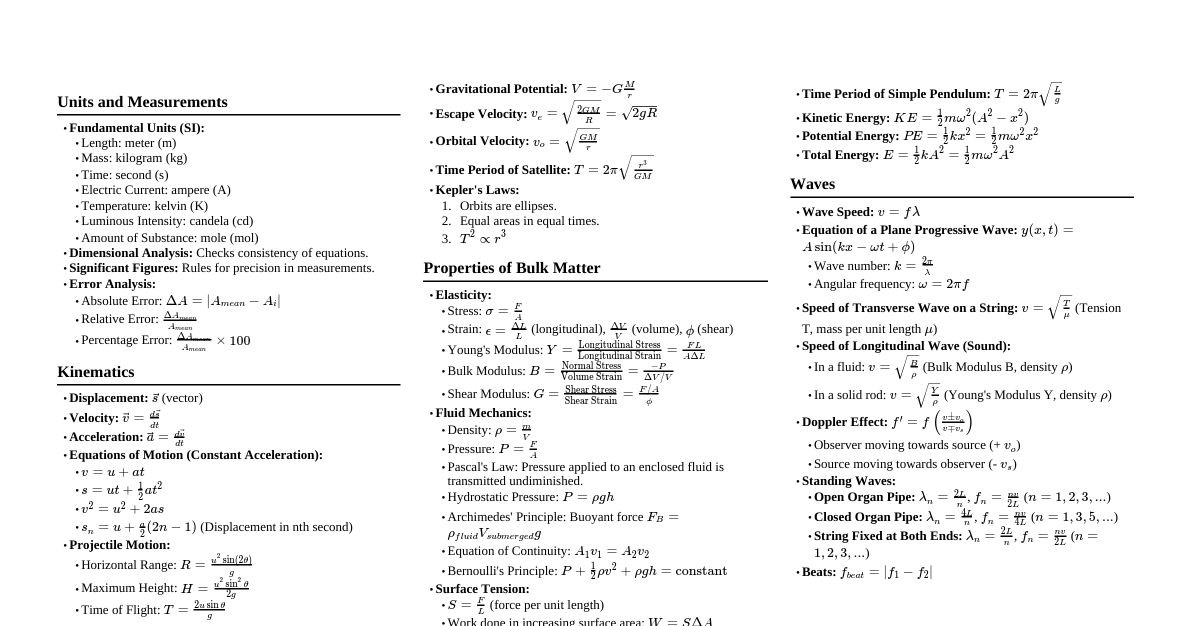
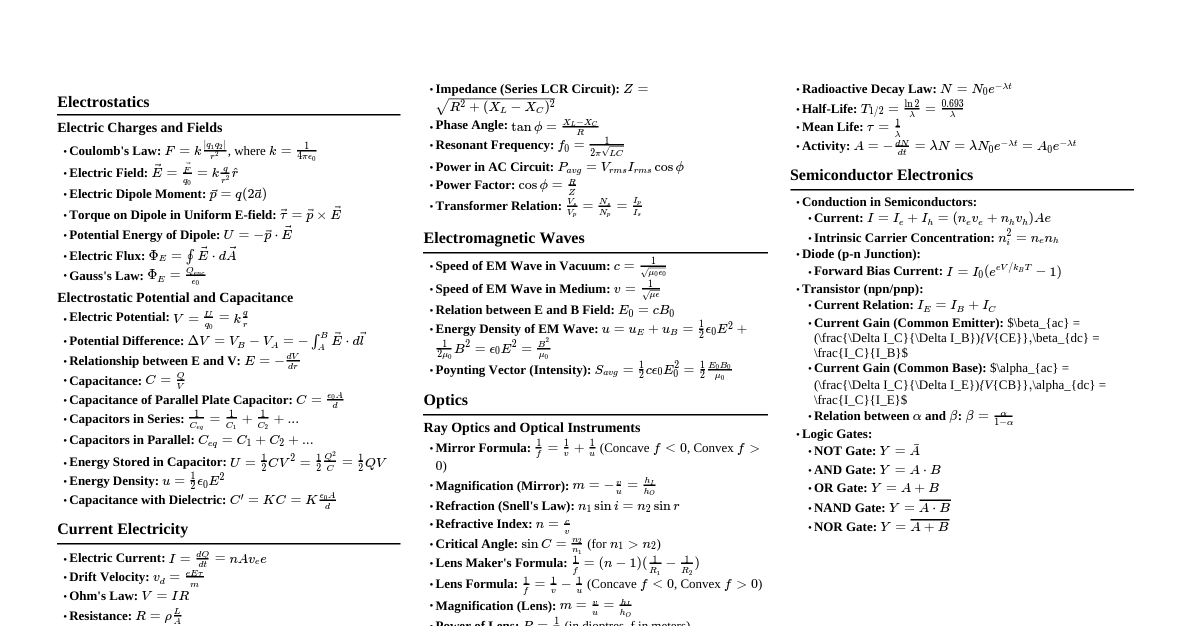
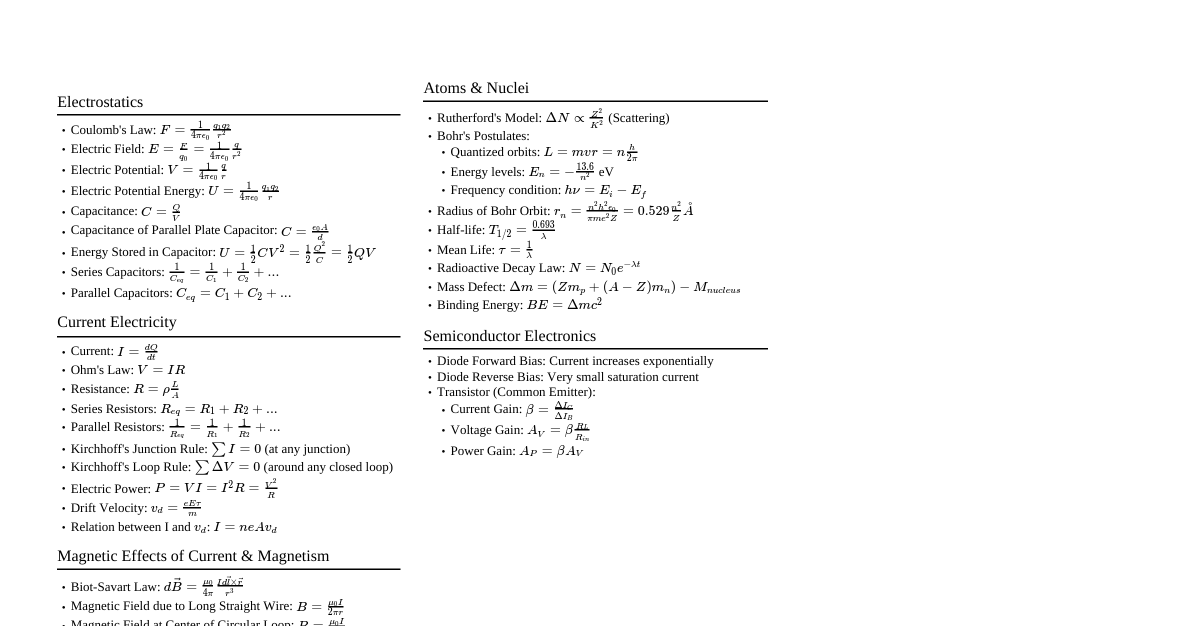
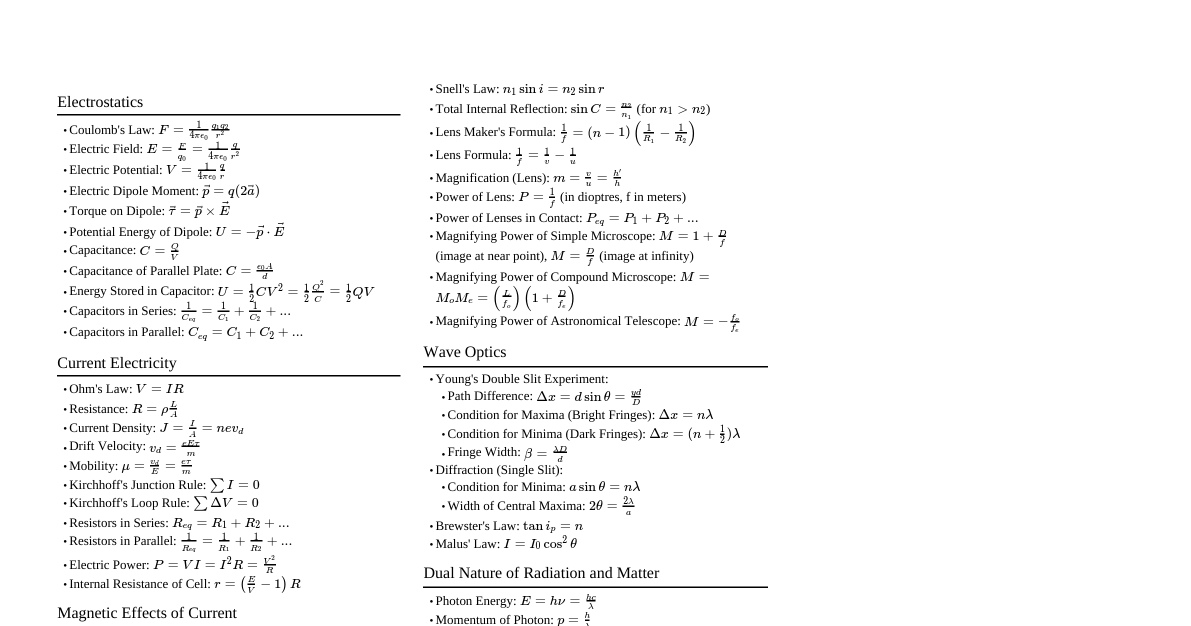
Class 12 Physics Formulas
Cheatsheet Content
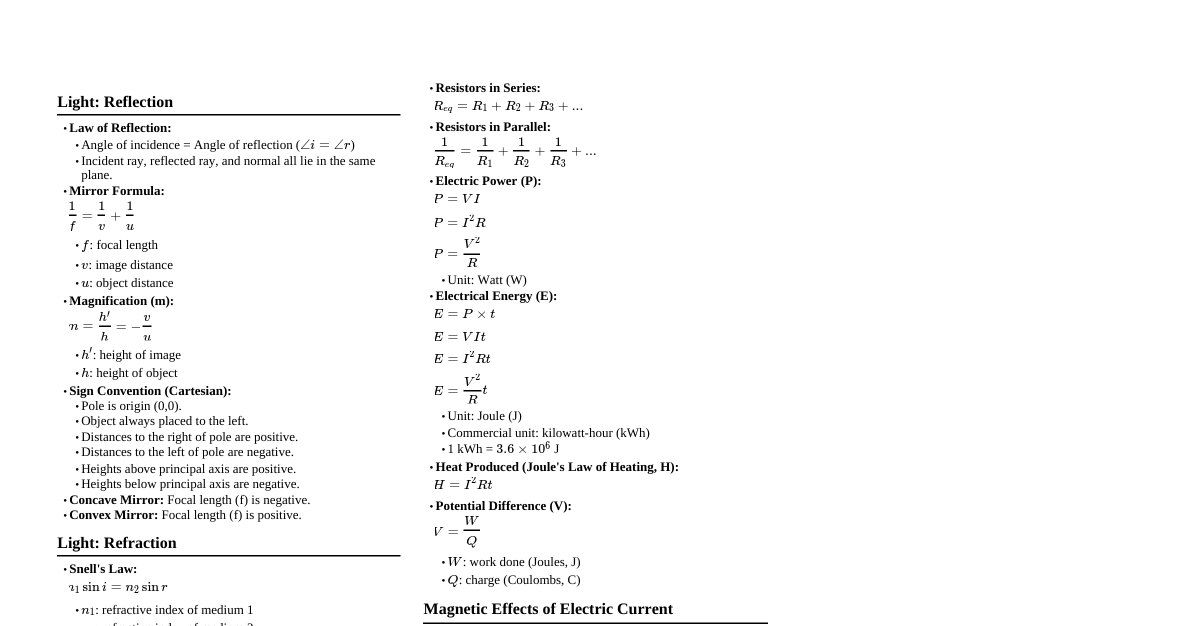
### Electric Charges and Fields #### 1. Coulomb's Law - **Force between two point charges:** $F = \frac{1}{4\pi\epsilon_0} \frac{q_1 q_2}{r^2} \hat{r}$ - $\epsilon_0 = 8.854 \times 10^{-12} \, C^2 N^{-1} m^{-2}$ (Permittivity of free space) - $k = \frac{1}{4\pi\epsilon_0} = 9 \times 10^9 \, Nm^2 C^{-2}$ #### 2. Electric Field - **Electric field due to a point charge:** $\vec{E} = \frac{1}{4\pi\epsilon_0} \frac{q}{r^2} \hat{r}$ - **Electric field due to a dipole:** - **Axial line:** $E_{axial} = \frac{1}{4\pi\epsilon_0} \frac{2pr}{(r^2 - a^2)^2}$ (for $r \gg a$, $E_{axial} = \frac{1}{4\pi\epsilon_0} \frac{2p}{r^3}$) - **Equatorial line:** $E_{equatorial} = \frac{1}{4\pi\epsilon_0} \frac{p}{(r^2 + a^2)^{3/2}}$ (for $r \gg a$, $E_{equatorial} = \frac{1}{4\pi\epsilon_0} \frac{p}{r^3}$) - **Electric dipole moment:** $\vec{p} = q(2\vec{a})$ - **Torque on a dipole in uniform E:** $\vec{\tau} = \vec{p} \times \vec{E}$ #### 3. Electric Flux - **Definition:** $\Phi_E = \int \vec{E} \cdot d\vec{A}$ - **Gauss's Law:** $\Phi_E = \oint \vec{E} \cdot d\vec{A} = \frac{q_{enc}}{\epsilon_0}$ #### 4. Applications of Gauss's Law - **Infinite long straight wire:** $E = \frac{\lambda}{2\pi\epsilon_0 r}$ - **Uniformly charged infinite plane sheet:** $E = \frac{\sigma}{2\epsilon_0}$ - **Uniformly charged thin spherical shell:** - Outside ($r \ge R$): $E = \frac{1}{4\pi\epsilon_0} \frac{q}{r^2}$ - Inside ($r ### Electrostatic Potential and Capacitance #### 1. Electric Potential - **Potential due to a point charge:** $V = \frac{1}{4\pi\epsilon_0} \frac{q}{r}$ - **Potential difference:** $V_B - V_A = -\int_A^B \vec{E} \cdot d\vec{l}$ - **Relation between E and V:** $\vec{E} = -\nabla V = -\left(\frac{\partial V}{\partial x}\hat{i} + \frac{\partial V}{\partial y}\hat{j} + \frac{\partial V}{\partial z}\hat{k}\right)$ - **Potential energy of two charges:** $U = \frac{1}{4\pi\epsilon_0} \frac{q_1 q_2}{r}$ - **Potential energy of an electric dipole in uniform E:** $U = -\vec{p} \cdot \vec{E}$ #### 2. Capacitance - **Definition:** $C = \frac{Q}{V}$ - **Parallel plate capacitor:** $C = \frac{\epsilon_0 A}{d}$ - **Capacitor with dielectric:** $C_k = k C_0 = \frac{k\epsilon_0 A}{d}$ - **Energy stored in a capacitor:** $U = \frac{1}{2}CV^2 = \frac{Q^2}{2C} = \frac{1}{2}QV$ - **Energy density:** $u_E = \frac{1}{2}\epsilon_0 E^2$ #### 3. Combination of Capacitors - **Series:** $\frac{1}{C_{eq}} = \frac{1}{C_1} + \frac{1}{C_2} + ...$ - **Parallel:** $C_{eq} = C_1 + C_2 + ...$ ### Current Electricity #### 1. Electric Current - **Definition:** $I = \frac{dQ}{dt}$ - **Drift velocity:** $v_d = \frac{eE\tau}{m}$ - **Relation between current and drift velocity:** $I = nAe v_d$ #### 2. Ohm's Law - **Definition:** $V = IR$ - **Resistance:** $R = \rho \frac{L}{A}$ - $\rho$ is resistivity, $\sigma = 1/\rho$ is conductivity - **Temperature dependence of resistance:** $R_T = R_0[1 + \alpha(T - T_0)]$ #### 3. Combination of Resistors - **Series:** $R_{eq} = R_1 + R_2 + ...$ - **Parallel:** $\frac{1}{R_{eq}} = \frac{1}{R_1} + \frac{1}{R_2} + ...$ #### 4. Kirchhoff's Laws - **Junction Rule (KCL):** $\sum I_{in} = \sum I_{out}$ - **Loop Rule (KVL):** $\sum \Delta V = 0$ #### 5. Electrical Energy and Power - **Power:** $P = VI = I^2R = \frac{V^2}{R}$ - **Energy:** $W = Pt = VIt = I^2Rt = \frac{V^2}{R}t$ #### 6. Cells and EMF - **EMF (Electromotive Force):** $\mathcal{E}$ - **Terminal voltage:** $V = \mathcal{E} - Ir$ (when current is drawn) - **Series combination of cells:** $\mathcal{E}_{eq} = \mathcal{E}_1 + \mathcal{E}_2 + ...$, $r_{eq} = r_1 + r_2 + ...$ - **Parallel combination of cells:** $\frac{1}{\mathcal{E}_{eq}} = \frac{1}{\mathcal{E}_1} + \frac{1}{\mathcal{E}_2} + ...$ (if $\mathcal{E}_1 = \mathcal{E}_2 = ... = \mathcal{E}$, then $\mathcal{E}_{eq} = \mathcal{E}$), $\frac{1}{r_{eq}} = \frac{1}{r_1} + \frac{1}{r_2} + ...$ #### 7. Wheatstone Bridge - **Balanced condition:** $\frac{P}{Q} = \frac{R}{S}$ ### Moving Charges and Magnetism #### 1. Magnetic Force - **Force on a charge in B-field:** $\vec{F} = q(\vec{v} \times \vec{B})$ - **Force on a current carrying conductor:** $\vec{F} = I(\vec{L} \times \vec{B})$ - **Lorentz force:** $\vec{F} = q\vec{E} + q(\vec{v} \times \vec{B})$ #### 2. Biot-Savart Law - **Magnetic field due to a current element:** $d\vec{B} = \frac{\mu_0}{4\pi} \frac{I d\vec{l} \times \hat{r}}{r^2}$ - $\mu_0 = 4\pi \times 10^{-7} \, T m A^{-1}$ (Permeability of free space) - **Magnetic field due to a circular loop:** - At center: $B = \frac{\mu_0 I}{2R}$ - On axis: $B = \frac{\mu_0 I R^2}{2(R^2 + x^2)^{3/2}}$ #### 3. Ampere's Circuital Law - **Definition:** $\oint \vec{B} \cdot d\vec{l} = \mu_0 I_{enc}$ #### 4. Applications of Ampere's Law - **Infinite straight wire:** $B = \frac{\mu_0 I}{2\pi r}$ - **Solenoid:** $B = \mu_0 n I$ (inside), $B=0$ (outside) - **Toroid:** $B = \frac{\mu_0 N I}{2\pi r}$ (inside), $B=0$ (outside) #### 5. Torque on a Current Loop - **Torque:** $\vec{\tau} = \vec{M} \times \vec{B}$ - **Magnetic dipole moment:** $\vec{M} = NI\vec{A}$ #### 6. Galvanometer - **Current sensitivity:** $\frac{\phi}{I} = \frac{NAB}{k}$ - **Voltage sensitivity:** $\frac{\phi}{V} = \frac{NAB}{kR}$ ### Magnetism and Matter #### 1. Bar Magnet - **Magnetic field on axial line:** $B_{axial} = \frac{\mu_0}{4\pi} \frac{2Mr}{(r^2 - L^2)^2}$ (for $r \gg L$, $B_{axial} = \frac{\mu_0}{4\pi} \frac{2M}{r^3}$) - **Magnetic field on equatorial line:** $B_{equatorial} = \frac{\mu_0}{4\pi} \frac{M}{(r^2 + L^2)^{3/2}}$ (for $r \gg L$, $B_{equatorial} = \frac{\mu_0}{4\pi} \frac{M}{r^3}$) - **Magnetic dipole moment:** $M = m(2L)$ (m is pole strength) - **Potential energy in B-field:** $U = -\vec{M} \cdot \vec{B}$ #### 2. Earth's Magnetism - **Magnetic elements:** - **Declination ($\alpha$):** Angle between geographic and magnetic meridians. - **Dip or Inclination ($\delta$):** Angle that the total magnetic field of the Earth makes with the surface of the Earth. - **Horizontal component ($B_H$):** $B_H = B \cos\delta$ - **Vertical component ($B_V$):** $B_V = B \sin\delta$ - $B = \sqrt{B_H^2 + B_V^2}$, $\tan\delta = \frac{B_V}{B_H}$ #### 3. Magnetic Properties of Materials - **Magnetic intensity:** $H = \frac{B_0}{\mu_0}$ - **Magnetization:** $M = \frac{m_{net}}{V}$ - **Magnetic susceptibility:** $\chi_m = \frac{M}{H}$ - **Magnetic permeability:** $\mu = \frac{B}{H}$ - **Relation between $\mu$, $\mu_0$, $\chi_m$:** $\mu = \mu_0(1 + \chi_m)$ - **Relative permeability:** $\mu_r = 1 + \chi_m = \frac{\mu}{\mu_0}$ #### 4. Classification of Materials - **Diamagnetic:** $\chi_m$ is small, negative. $\mu_r 1$. - **Ferromagnetic:** $\chi_m$ is large, positive. $\mu_r \gg 1$. ### Electromagnetic Induction #### 1. Magnetic Flux - **Definition:** $\Phi_B = \int \vec{B} \cdot d\vec{A} = BA \cos\theta$ #### 2. Faraday's Laws of EMI - **First Law:** Whenever magnetic flux linked with a circuit changes, an EMF is induced. - **Second Law:** Induced EMF is proportional to the rate of change of magnetic flux. - $\mathcal{E} = -\frac{d\Phi_B}{dt}$ (Lenz's Law gives the negative sign) #### 3. Motional EMF - **EMF induced in a conductor moving in B-field:** $\mathcal{E} = (Blv) \sin\theta$ (if $\vec{B}$, $\vec{l}$, $\vec{v}$ are mutually perpendicular, $\mathcal{E} = Blv$) #### 4. Self-Inductance - **Definition:** $\Phi_B = LI$ - **Self-induced EMF:** $\mathcal{E} = -L\frac{dI}{dt}$ - **Energy stored in an inductor:** $U_B = \frac{1}{2}LI^2$ - **Energy density:** $u_B = \frac{B^2}{2\mu_0}$ #### 5. Mutual Inductance - **Definition:** $\Phi_{B2} = M_{21} I_1$ and $\Phi_{B1} = M_{12} I_2$ ($M_{12} = M_{21} = M$) - **Mutually induced EMF:** $\mathcal{E}_2 = -M\frac{dI_1}{dt}$ and $\mathcal{E}_1 = -M\frac{dI_2}{dt}$ ### Alternating Current #### 1. AC Voltage and Current - **Instantaneous voltage:** $V = V_m \sin(\omega t + \phi)$ - **Instantaneous current:** $I = I_m \sin(\omega t)$ - **RMS value:** $V_{rms} = \frac{V_m}{\sqrt{2}}$, $I_{rms} = \frac{I_m}{\sqrt{2}}$ - **Average value (for half cycle):** $V_{avg} = \frac{2V_m}{\pi}$, $I_{avg} = \frac{2I_m}{\pi}$ #### 2. Reactance and Impedance - **Inductive reactance:** $X_L = \omega L = 2\pi f L$ - **Capacitive reactance:** $X_C = \frac{1}{\omega C} = \frac{1}{2\pi f C}$ - **Impedance (LCR series circuit):** $Z = \sqrt{R^2 + (X_L - X_C)^2}$ - **Phase angle:** $\tan\phi = \frac{X_L - X_C}{R}$ #### 3. Power in AC Circuits - **Average power:** $P_{avg} = V_{rms} I_{rms} \cos\phi = I_{rms}^2 R$ - **Power factor:** $\cos\phi = \frac{R}{Z}$ #### 4. Resonance - **Resonant frequency:** $f_r = \frac{1}{2\pi\sqrt{LC}}$ or $\omega_r = \frac{1}{\sqrt{LC}}$ - **Quality factor:** $Q = \frac{\omega_r L}{R} = \frac{1}{R}\sqrt{\frac{L}{C}}$ #### 5. Transformer - **Voltage ratio:** $\frac{V_s}{V_p} = \frac{N_s}{N_p}$ - **Current ratio (ideal transformer):** $\frac{I_p}{I_s} = \frac{N_s}{N_p}$ - **Efficiency:** $\eta = \frac{P_{out}}{P_{in}} = \frac{V_s I_s}{V_p I_p}$ ### Electromagnetic Waves #### 1. Basic Properties - **Speed of EM wave in vacuum:** $c = \frac{1}{\sqrt{\mu_0\epsilon_0}} = 3 \times 10^8 \, m/s$ - **Speed of EM wave in medium:** $v = \frac{1}{\sqrt{\mu\epsilon}}$ - **Relation between E and B field:** $E = cB$ - **Wavelength-frequency relation:** $c = f\lambda$ #### 2. Energy Density - **Electric energy density:** $u_E = \frac{1}{2}\epsilon_0 E^2$ - **Magnetic energy density:** $u_B = \frac{B^2}{2\mu_0}$ - **Total average energy density:** $u_{avg} = u_E + u_B = \epsilon_0 E_{rms}^2 = \frac{B_{rms}^2}{\mu_0}$ #### 3. Poynting Vector - **Definition:** $\vec{S} = \frac{1}{\mu_0}(\vec{E} \times \vec{B})$ - **Intensity:** $I = |\vec{S}|_{avg} = \frac{1}{2}c\epsilon_0 E_0^2 = \frac{1}{2}\frac{c}{\mu_0} B_0^2 = \frac{E_{rms}B_{rms}}{\mu_0}$ #### 4. Momentum Transfer - **Momentum of EM wave:** $p = \frac{U}{c}$ (total energy U) - **Radiation pressure:** $P_{rad} = \frac{I}{c}$ (for absorption), $P_{rad} = \frac{2I}{c}$ (for reflection) ### Ray Optics and Optical Instruments #### 1. Reflection - **Law of reflection:** Angle of incidence equals angle of reflection ($\angle i = \angle r$). - **Mirror formula:** $\frac{1}{f} = \frac{1}{v} + \frac{1}{u}$ - $f = R/2$ (for spherical mirrors) - **Magnification:** $m = -\frac{v}{u} = \frac{h_i}{h_o}$ #### 2. Refraction - **Snell's Law:** $\frac{\sin i}{\sin r} = \frac{n_2}{n_1}$ - **Refractive index:** $n = \frac{c}{v}$ - **Critical angle:** $\sin C = \frac{n_2}{n_1}$ (for $n_1 > n_2$) - **Lens maker's formula:** $\frac{1}{f} = (n_2 - n_1)\left(\frac{1}{R_1} - \frac{1}{R_2}\right)$ (for lens in air, $n_1 = 1$, $n_2 = n$) - $\frac{1}{f} = (n-1)\left(\frac{1}{R_1} - \frac{1}{R_2}\right)$ - **Lens formula:** $\frac{1}{f} = \frac{1}{v} - \frac{1}{u}$ - **Magnification:** $m = \frac{v}{u} = \frac{h_i}{h_o}$ - **Power of a lens:** $P = \frac{1}{f}$ (in diopters, f in meters) - **Combination of thin lenses:** $P = P_1 + P_2 + ...$, $\frac{1}{f_{eq}} = \frac{1}{f_1} + \frac{1}{f_2} + ...$ #### 3. Prism - **Angle of deviation:** $\delta = (n-1)A$ (for small angle prism) - **Relation for general prism:** $i_1 + e = A + \delta$, $r_1 + r_2 = A$ - **Minimum deviation:** $\delta_m = 2i - 2r - A$, $n = \frac{\sin((A+\delta_m)/2)}{\sin(A/2)}$ #### 4. Optical Instruments - **Simple Microscope:** - Magnifying power (image at infinity): $M = D/f$ - Magnifying power (image at D): $M = 1 + D/f$ - **Compound Microscope:** - Magnifying power: $M = m_o m_e = \left(\frac{v_o}{u_o}\right)\left(1 + \frac{D}{f_e}\right)$ (image at D) - Magnifying power: $M = \left(\frac{v_o}{u_o}\right)\left(\frac{D}{f_e}\right)$ (image at infinity) - Length of tube: $L = v_o + u_e$ - **Astronomical Telescope:** - Magnifying power (image at infinity): $M = -\frac{f_o}{f_e}$ - Length of tube: $L = f_o + f_e$ - Magnifying power (image at D): $M = -\frac{f_o}{f_e}\left(1 + \frac{f_e}{D}\right)$ ### Wave Optics #### 1. Huygens' Principle - Every point on a wavefront is a source of secondary wavelets. #### 2. Interference (Young's Double Slit Experiment - YDSE) - **Path difference:** $\Delta x = d \sin\theta = \frac{yd}{D}$ - **Condition for constructive interference (bright fringe):** $\Delta x = n\lambda$ - **Condition for destructive interference (dark fringe):** $\Delta x = (n + \frac{1}{2})\lambda$ - **Fringe width:** $\beta = \frac{\lambda D}{d}$ - **Intensity:** $I = I_1 + I_2 + 2\sqrt{I_1 I_2}\cos\phi$ (if $I_1=I_2=I_0$, then $I = 4I_0 \cos^2(\phi/2)$) - **Phase difference:** $\phi = \frac{2\pi}{\lambda}\Delta x$ #### 3. Diffraction (Single Slit) - **Condition for minima:** $a \sin\theta = n\lambda$ - **Condition for maxima:** $a \sin\theta = (n + \frac{1}{2})\lambda$ (approximate) - **Width of central maximum:** $2y = \frac{2\lambda D}{a}$ #### 4. Polarization - **Brewster's Law:** $\tan i_p = n$ - **Malus's Law:** $I = I_0 \cos^2\theta$ ### Dual Nature of Radiation and Matter #### 1. Photoelectric Effect - **Einstein's Photoelectric Equation:** $K_{max} = h\nu - \phi_0$ - $K_{max}$ is maximum kinetic energy of emitted electrons - $h\nu$ is energy of incident photon - $\phi_0 = h\nu_0$ is work function - $\nu_0$ is threshold frequency - **Stopping potential:** $eV_0 = K_{max}$ #### 2. De Broglie Wavelength - **Wavelength of matter waves:** $\lambda = \frac{h}{p} = \frac{h}{mv}$ - **For an electron accelerated through potential V:** $\lambda = \frac{h}{\sqrt{2meV}} = \frac{1.227}{\sqrt{V}} \, nm$ ### Atoms #### 1. Rutherford's Model (Alpha-particle scattering) - **Distance of closest approach:** $r_0 = \frac{1}{4\pi\epsilon_0} \frac{2Ze^2}{K}$ - **Impact parameter:** $b = \frac{Ze^2 \cot(\theta/2)}{4\pi\epsilon_0 K}$ #### 2. Bohr's Model of Hydrogen Atom - **Quantization of angular momentum:** $L = mvr = n\frac{h}{2\pi}$ - **Radius of n-th orbit:** $r_n = \frac{n^2 h^2 \epsilon_0}{\pi m e^2} = (0.529 \, \text{Å}) n^2$ - **Energy of n-th orbit:** $E_n = -\frac{me^4}{8\epsilon_0^2 h^2 n^2} = -\frac{13.6}{n^2} \, eV$ - **Frequency of emitted radiation:** $\nu = \frac{E_i - E_f}{h}$ #### 3. Hydrogen Spectrum Series - **Rydberg formula:** $\frac{1}{\lambda} = R\left(\frac{1}{n_f^2} - \frac{1}{n_i^2}\right)$ - $R = 1.097 \times 10^7 \, m^{-1}$ (Rydberg constant) - **Lyman series:** $n_f=1$, $n_i=2,3,...$ (UV region) - **Balmer series:** $n_f=2$, $n_i=3,4,...$ (Visible region) - **Paschen series:** $n_f=3$, $n_i=4,5,...$ (IR region) - **Brackett series:** $n_f=4$, $n_i=5,6,...$ (IR region) - **Pfund series:** $n_f=5$, $n_i=6,7,...$ (IR region) ### Nuclei #### 1. Nuclear Composition - **Atomic number (Z):** Number of protons - **Mass number (A):** Number of protons + neutrons - **Neutron number (N):** $N = A - Z$ - **Nuclear radius:** $R = R_0 A^{1/3}$ ($R_0 \approx 1.2 \times 10^{-15} \, m$) #### 2. Mass-Energy Equivalence - **Einstein's equation:** $E = mc^2$ - **Atomic mass unit (amu):** $1 \, u = 931.5 \, MeV/c^2$ #### 3. Mass Defect and Binding Energy - **Mass defect:** $\Delta m = [Zm_p + (A-Z)m_n - M_{nucleus}]$ - **Binding energy:** $BE = \Delta m c^2$ - **Binding energy per nucleon:** $BE/A$ #### 4. Radioactivity - **Law of radioactive decay:** $N = N_0 e^{-\lambda t}$ - **Decay constant:** $\lambda$ - **Half-life:** $T_{1/2} = \frac{\ln 2}{\lambda} = \frac{0.693}{\lambda}$ - **Mean life:** $\tau = \frac{1}{\lambda}$ - **Relation:** $T_{1/2} = 0.693 \tau$ - **Activity:** $A = \frac{dN}{dt} = \lambda N = \lambda N_0 e^{-\lambda t} = A_0 e^{-\lambda t}$ - **Units of activity:** Becquerel (Bq) = 1 decay/s, Curie (Ci) = $3.7 \times 10^{10}$ Bq ### Semiconductor Electronics: Materials, Devices and Simple Circuits #### 1. Energy Bands in Solids - **Conductor:** Overlapping valence and conduction bands. - **Insulator:** Large energy gap between valence and conduction bands ($E_g > 3 \, eV$). - **Semiconductor:** Small energy gap ($E_g \approx 1 \, eV$). #### 2. Intrinsic Semiconductors - **Number of electrons = Number of holes:** $n_e = n_h = n_i$ - **Conductivity:** $\sigma = n_i e (\mu_e + \mu_h)$ #### 3. Extrinsic Semiconductors (Doping) - **n-type:** Doped with pentavalent impurities (e.g., P, As). $n_e \gg n_h$. - **p-type:** Doped with trivalent impurities (e.g., B, Al). $n_h \gg n_e$. - **Mass action law:** $n_e n_h = n_i^2$ #### 4. p-n Junction Diode - **Forward bias:** Depletion region width decreases, low resistance. - **Reverse bias:** Depletion region width increases, high resistance. - **Diode characteristics:** - Forward current increases exponentially with voltage. - Reverse current is very small (saturation current) until breakdown voltage. #### 5. Rectifiers - **Half-wave rectifier:** Only half of AC cycle is converted to DC. - Output frequency = input frequency. - **Full-wave rectifier:** Both halves of AC cycle are converted to DC. - Output frequency = $2 \times$ input frequency. #### 6. Zener Diode - **Voltage regulator:** Operates in reverse breakdown region. Maintains constant voltage across load. #### 7. Transistor (BJT - Bipolar Junction Transistor) - **Configurations:** Common Emitter (CE), Common Base (CB), Common Collector (CC). CE is most common. - **Current gains:** - **Alpha ($\alpha$):** $\alpha = \frac{I_C}{I_E}$ (for CB configuration) - **Beta ($\beta$):** $\beta = \frac{I_C}{I_B}$ (for CE configuration) - **Relation between $\alpha$ and $\beta$:** $\beta = \frac{\alpha}{1-\alpha}$, $\alpha = \frac{\beta}{1+\beta}$ - **Transistor as an amplifier (CE configuration):** - **Voltage gain:** $A_v = \frac{\Delta V_C}{\Delta V_B} = -\beta \frac{R_C}{R_{in}}$ - **Power gain:** $A_p = A_v \times \beta$ #### 8. Logic Gates - **Basic Gates:** AND, OR, NOT - **Universal Gates:** NAND, NOR - **Boolean Algebra:** - **AND:** $Y = A \cdot B$ - **OR:** $Y = A + B$ - **NOT:** $Y = \bar{A}$ - **NAND:** $Y = \overline{A \cdot B}$ - **NOR:** $Y = \overline{A + B}$ - **XOR:** $Y = A \oplus B = A\bar{B} + \bar{A}B$ - **XNOR:** $Y = \overline{A \oplus B} = A B + \bar{A}\bar{B}$ ### Communication Systems #### 1. Basic Elements of Communication System - **Transmitter, Channel, Receiver.** #### 2. Bandwidth - **Bandwidth of Speech:** 300 Hz to 3100 Hz (approx 2800 Hz) - **Bandwidth of Music:** 20 Hz to 20 kHz - **Bandwidth of Video:** 4.2 MHz - **TV Channel:** 6 MHz #### 3. Modulation - **Need for modulation:** - Reduce antenna size. - Avoid mixing of signals. - Increase power radiated. - **Amplitude Modulation (AM):** - **Modulation index:** $m_a = \frac{A_m}{A_c}$ - **Sideband frequencies:** $(\omega_c - \omega_m)$ and $(\omega_c + \omega_m)$ - **Bandwidth:** $2f_m$ - **Power in AM wave:** $P_t = P_c \left(1 + \frac{m_a^2}{2}\right)$ #### 4. Propagation of EM Waves - **Ground wave propagation:** Up to few MHz, follows curvature of Earth. - **Sky wave propagation:** Ionospheric reflection (3-30 MHz). - **Space wave propagation:** Line-of-sight (LOS) communication (>30 MHz). - **Maximum LOS distance:** $d_M = \sqrt{2Rh_T} + \sqrt{2Rh_R}$ - **Coverage area:** $A = \pi (2Rh_T)$ (for transmitting antenna of height $h_T$)