University Physics Essentials
Cheatsheet Content
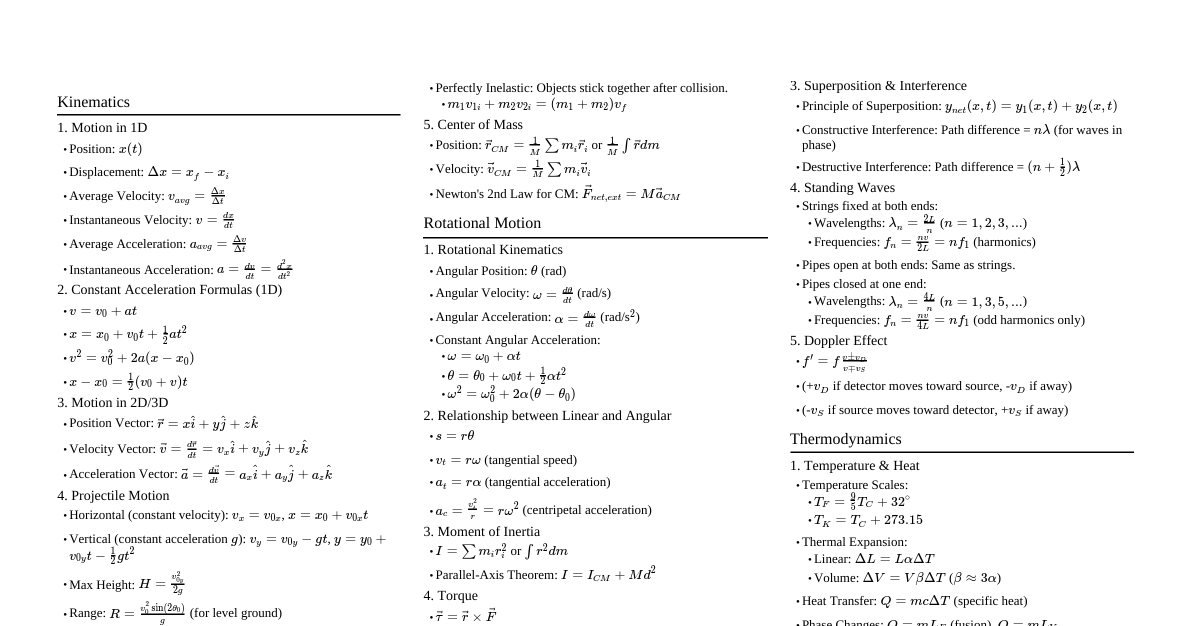
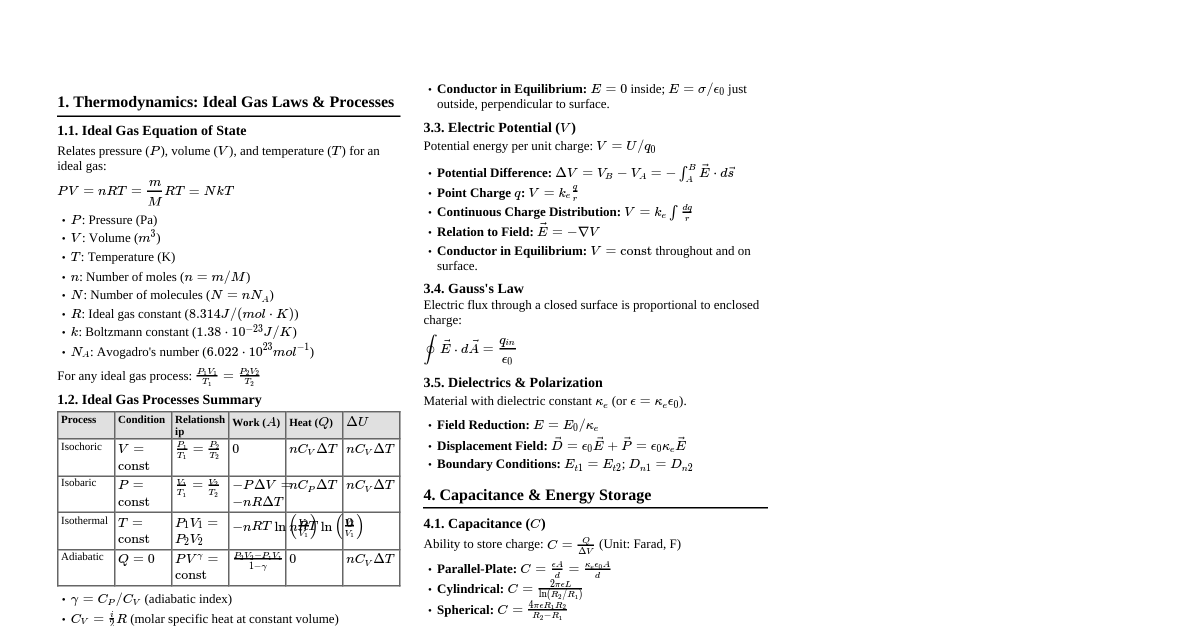
1. Units, Physical Quantities, and Vectors SI Base Units: Length: meter (m) Mass: kilogram (kg) Time: second (s) Electric Current: ampere (A) Temperature: Kelvin (K) Amount of Substance: mole (mol) Luminous Intensity: candela (cd) Unit Conversions: Treat units as algebraic quantities. Significant Figures: Reflect measurement precision. Vectors vs. Scalars: Scalar: Magnitude only (e.g., mass, temperature, speed). Vector: Magnitude and direction (e.g., displacement, velocity, force). Vector Components: For $\vec{A}$ at angle $\theta$ with x-axis: $A_x = A \cos \theta$ $A_y = A \sin \theta$ $A = \sqrt{A_x^2 + A_y^2}$ $\tan \theta = A_y / A_x$ Vector Addition (Component Method): $\vec{R} = \vec{A} + \vec{B}$ $R_x = A_x + B_x$ $R_y = A_y + B_y$ Scalar (Dot) Product: $\vec{A} \cdot \vec{B} = AB \cos \phi = A_x B_x + A_y B_y + A_z B_z$ Vector (Cross) Product: $\vec{A} \times \vec{B} = (AB \sin \phi) \hat{n}$ Magnitude: $AB \sin \phi$ Direction: Right-hand rule Components: $(A_y B_z - A_z B_y)\hat{i} + (A_z B_x - A_x B_z)\hat{j} + (A_x B_y - A_y B_x)\hat{k}$ 2. Kinematics: Motion Along a Straight Line Average Velocity: $v_{avg} = \Delta x / \Delta t$ Instantaneous Velocity: $v_x = dx/dt$ Average Acceleration: $a_{avg} = \Delta v_x / \Delta t$ Instantaneous Acceleration: $a_x = dv_x/dt = d^2x/dt^2$ Constant Acceleration Equations: $v_x = v_{0x} + a_x t$ $x = x_0 + v_{0x} t + \frac{1}{2} a_x t^2$ $v_x^2 = v_{0x}^2 + 2 a_x (x - x_0)$ $x - x_0 = \frac{1}{2} (v_{0x} + v_x) t$ Free Fall: $a_y = -g = -9.8 \text{ m/s}^2$ (downward) 3. Kinematics: Motion in Two or Three Dimensions Position Vector: $\vec{r} = x\hat{i} + y\hat{j} + z\hat{k}$ Velocity Vector: $\vec{v} = d\vec{r}/dt = v_x\hat{i} + v_y\hat{j} + v_z\hat{k}$ Acceleration Vector: $\vec{a} = d\vec{v}/dt = a_x\hat{i} + a_y\hat{j} + a_z\hat{k}$ Projectile Motion (constant $g$, no air resistance): $a_x = 0$, $a_y = -g$ $v_x = v_{0x}$ $x = x_0 + v_{0x} t$ $v_y = v_{0y} - gt$ $y = y_0 + v_{0y} t - \frac{1}{2}gt^2$ Uniform Circular Motion: Speed $v$ is constant, direction changes. Centripetal acceleration: $a_{rad} = v^2/R$, directed towards center. Period $T = 2\pi R / v$ 4. Newton's Laws of Motion Newton's First Law (Inertia): An object at rest stays at rest, an object in motion stays in motion with the same speed and in the same direction unless acted upon by an unbalanced force. Newton's Second Law: $\sum \vec{F} = m\vec{a}$ (Net force equals mass times acceleration). Newton's Third Law: If object A exerts a force on object B, then object B exerts an equal and opposite force on object A. ($\vec{F}_{A \text{ on } B} = -\vec{F}_{B \text{ on } A}$) Weight: $w = mg$ (force due to gravity) Normal Force ($n$): Perpendicular to surface. Friction: Static friction: $f_s \le \mu_s n$ Kinetic friction: $f_k = \mu_k n$ $\mu_s > \mu_k$ Free-Body Diagrams: Essential for applying Newton's laws. 5. Work and Kinetic Energy Work Done by a Constant Force: $W = Fd \cos \phi = \vec{F} \cdot \vec{d}$ Work Done by a Varying Force: $W = \int_{x_1}^{x_2} F_x dx$ Kinetic Energy: $K = \frac{1}{2}mv^2$ Work-Energy Theorem: $W_{total} = \Delta K = K_2 - K_1$ Power: Rate of doing work. Average Power: $P_{avg} = \Delta W / \Delta t$ Instantaneous Power: $P = dW/dt = \vec{F} \cdot \vec{v}$ 6. Potential Energy and Conservation of Energy Conservative Forces: Work done is independent of path (e.g., gravity, spring force). Nonconservative Forces: Work done depends on path (e.g., friction, air resistance). Gravitational Potential Energy: $U_{grav} = mgy$ Elastic Potential Energy (Spring): $U_{el} = \frac{1}{2}kx^2$ Mechanical Energy: $E = K + U$ Conservation of Mechanical Energy (Conservative Forces Only): $K_1 + U_1 = K_2 + U_2$ Conservation of Energy (General): $W_{nc} = \Delta E = \Delta K + \Delta U$ $W_{nc}$: work done by nonconservative forces. 7. Momentum, Impulse, and Collisions Momentum: $\vec{p} = m\vec{v}$ Impulse: $\vec{J} = \int_{t_1}^{t_2} \vec{F} dt = \vec{F}_{avg} \Delta t$ Impulse-Momentum Theorem: $\vec{J} = \Delta \vec{p} = \vec{p}_2 - \vec{p}_1$ Conservation of Momentum: If net external force on a system is zero, total momentum is conserved: $\sum \vec{p}_{initial} = \sum \vec{p}_{final}$ Collisions: Elastic: Both momentum and kinetic energy are conserved. Inelastic: Momentum conserved, kinetic energy is NOT conserved ($K_{final} Completely Inelastic: Objects stick together after collision. Momentum conserved, maximum $K$ loss. Center of Mass: For discrete masses: $X_{CM} = \frac{\sum m_i x_i}{\sum m_i}$, $Y_{CM} = \frac{\sum m_i y_i}{\sum m_i}$ For continuous object: $\vec{r}_{CM} = \frac{1}{M} \int \vec{r} dm$ Velocity of CM: $\vec{V}_{CM} = \frac{d\vec{r}_{CM}}{dt} = \frac{\sum m_i \vec{v}_i}{\sum m_i}$ $\sum \vec{F}_{ext} = M \vec{A}_{CM}$ 8. Rotational Dynamics Angular Position: $\theta$ (radians) Angular Velocity: $\omega = d\theta/dt$ Angular Acceleration: $\alpha = d\omega/dt$ Relating Linear and Angular Variables: (for a point at radius $r$) $s = r\theta$ $v_t = r\omega$ (tangential speed) $a_t = r\alpha$ (tangential acceleration) $a_{rad} = v_t^2/r = r\omega^2$ (radial/centripetal acceleration) Rotational Kinematics (constant $\alpha$): $\omega = \omega_0 + \alpha t$ $\theta = \theta_0 + \omega_0 t + \frac{1}{2} \alpha t^2$ $\omega^2 = \omega_0^2 + 2 \alpha (\theta - \theta_0)$ Moment of Inertia ($I$): Resistance to angular acceleration. For discrete masses: $I = \sum m_i r_i^2$ For continuous object: $I = \int r^2 dm$ Parallel-Axis Theorem: $I_P = I_{CM} + Md^2$ Torque ($\tau$): Rotational equivalent of force. $\vec{\tau} = \vec{r} \times \vec{F}$ Magnitude: $\tau = rF \sin \phi = r F_{\perp} = r_{\perp} F$ Newton's Second Law for Rotation: $\sum \tau = I\alpha$ Rotational Kinetic Energy: $K_{rot} = \frac{1}{2}I\omega^2$ Total Kinetic Energy (Rolling): $K_{total} = K_{trans} + K_{rot} = \frac{1}{2}M V_{CM}^2 + \frac{1}{2}I_{CM}\omega^2$ Angular Momentum ($\vec{L}$): For a particle: $\vec{L} = \vec{r} \times \vec{p} = \vec{r} \times (m\vec{v})$ For a rigid body: $L = I\omega$ (for rotation about a fixed axis) Conservation of Angular Momentum: If net external torque on a system is zero, total angular momentum is conserved: $I_1 \omega_1 = I_2 \omega_2$. 9. Gravitation Newton's Law of Universal Gravitation: $F = G \frac{m_1 m_2}{r^2}$ $G = 6.674 \times 10^{-11} \text{ N}\cdot\text{m}^2/\text{kg}^2$ Gravitational Potential Energy: $U = -G \frac{m_1 m_2}{r}$ (defined as zero at $r=\infty$) Escape Speed: $v_{esc} = \sqrt{\frac{2GM}{R}}$ Kepler's Laws: 1st: Orbits are ellipses with the Sun at one focus. 2nd: A line from the Sun to a planet sweeps out equal areas in equal times. (Conservation of angular momentum) 3rd: $T^2 \propto a^3$ (Orbital period squared is proportional to semimajor axis cubed). For circular orbits: $T^2 = \frac{4\pi^2}{GM}R^3$. 10. Periodic Motion Simple Harmonic Motion (SHM): Position: $x(t) = A \cos(\omega t + \phi)$ Velocity: $v_x(t) = -A\omega \sin(\omega t + \phi)$ Acceleration: $a_x(t) = -A\omega^2 \cos(\omega t + \phi) = -\omega^2 x(t)$ Angular Frequency: $\omega = \sqrt{k/m}$ (mass-spring system) Period: $T = 2\pi/\omega = 1/f$ Frequency: $f = \omega/(2\pi)$ Period of a Simple Pendulum (small angles): $T = 2\pi \sqrt{L/g}$ Period of a Physical Pendulum: $T = 2\pi \sqrt{I/(mgd)}$ Energy in SHM: $E = \frac{1}{2}kA^2 = \frac{1}{2}mv^2 + \frac{1}{2}kx^2$ 11. Mechanical Waves Wave Speed: $v = \lambda f$ Wave Function (transverse wave on a string): $y(x,t) = A \cos(kx - \omega t)$ Wave number: $k = 2\pi/\lambda$ Angular frequency: $\omega = 2\pi f$ Speed of a Transverse Wave on a String: $v = \sqrt{F_T/\mu}$ ($F_T$=tension, $\mu$=mass per unit length) Power Transmitted by a Wave: $P = \frac{1}{2} \sqrt{\mu F_T} \omega^2 A^2$ Superposition Principle: When two or more waves overlap, the resultant displacement is the algebraic sum of the individual displacements. Standing Waves on a String (fixed at both ends): Wavelengths: $\lambda_n = 2L/n$ for $n=1, 2, 3, ...$ Frequencies: $f_n = n(v/2L) = n f_1$ (harmonics) Nodes (zero displacement) and Antinodes (max displacement). 12. Sound and Hearing Speed of Sound: $v = \sqrt{B/\rho}$ (B=bulk modulus, $\rho$=density) Intensity: $I = P/A$ (Power per unit area) Intensity Level (Decibels): $\beta = (10 \text{ dB}) \log(I/I_0)$ $I_0 = 10^{-12} \text{ W/m}^2$ (threshold of hearing) Doppler Effect: Source moving towards observer: $f_L = f_S \frac{v+v_L}{v-v_S}$ Source moving away from observer: $f_L = f_S \frac{v+v_L}{v+v_S}$ Observer moving towards source: $f_L = f_S \frac{v+v_L}{v}$ Observer moving away from source: $f_L = f_S \frac{v-v_L}{v}$ General: $f_L = f_S \frac{v \pm v_L}{v \mp v_S}$ (top sign for approaching, bottom for receding) Standing Waves in Air Columns: Open at both ends: $\lambda_n = 2L/n$, $f_n = n(v/2L)$ for $n=1, 2, 3, ...$ Open at one end, closed at other: $\lambda_n = 4L/n$, $f_n = n(v/4L)$ for $n=1, 3, 5, ...$ (only odd harmonics) Beats: $f_{beat} = |f_1 - f_2|$ 13. Thermal Properties of Matter Temperature Scales: Celsius to Kelvin: $T_K = T_C + 273.15$ Fahrenheit to Celsius: $T_C = \frac{5}{9}(T_F - 32)$ Thermal Expansion: Linear: $\Delta L = \alpha L_0 \Delta T$ Volume: $\Delta V = \beta V_0 \Delta T$, where $\beta \approx 3\alpha$ Heat Capacity: $Q = mc\Delta T$ ($c$=specific heat capacity) Phase Changes (Latent Heat): $Q = mL$ ($L_f$=fusion, $L_v$=vaporization) Heat Transfer: Conduction: $H = \frac{dQ}{dt} = kA \frac{T_H - T_C}{L}$ ($k$=thermal conductivity) Convection: Involves fluid motion. Radiation: $H = A e \sigma T^4$ (Stefan-Boltzmann Law) $\sigma = 5.67 \times 10^{-8} \text{ W/(m}^2\cdot\text{K}^4)$ $e$=emissivity (0 to 1) Ideal Gas Law: $PV = nRT = NkT$ $R = 8.314 \text{ J/(mol}\cdot\text{K})$ (gas constant) $k = 1.381 \times 10^{-23} \text{ J/K}$ (Boltzmann constant) $N_A = 6.022 \times 10^{23} \text{ mol}^{-1}$ (Avogadro's number) $R = N_A k$ Kinetic Theory of Gases: Average translational KE: $K_{avg} = \frac{3}{2}kT$ RMS speed: $v_{rms} = \sqrt{\frac{3kT}{m}} = \sqrt{\frac{3RT}{M}}$ ($M$=molar mass) 14. Thermodynamics First Law of Thermodynamics: $\Delta U = Q - W$ $\Delta U$: change in internal energy $Q$: heat added to system $W$: work done BY system Work Done by a Gas: $W = \int_{V_1}^{V_2} P dV$ Thermodynamic Processes: Isochoric (constant V): $W=0$, $\Delta U = Q$ Isobaric (constant P): $W = P\Delta V$ Isothermal (constant T): $\Delta U=0$ (for ideal gas), $Q=W=nRT \ln(V_2/V_1)$ Adiabatic (no heat exchange, $Q=0$): $\Delta U = -W$, $PV^\gamma = \text{constant}$ Heat Capacities of Ideal Gases: Constant Volume: $C_V = \frac{f}{2}R$ ($f$=degrees of freedom) Constant Pressure: $C_P = C_V + R$ Ratio of heat capacities: $\gamma = C_P/C_V$ Second Law of Thermodynamics: Heat flows spontaneously from hot to cold. No process is possible whose sole result is the transfer of heat from a cooler to a hotter body. No cyclic process is possible whose sole result is the absorption of heat from a reservoir at a single temperature and the conversion of this heat completely into work. Heat Engines: Efficiency: $e = W/Q_H = 1 - Q_C/Q_H$ Carnot Efficiency (ideal): $e_{Carnot} = 1 - T_C/T_H$ Refrigerators/Heat Pumps: Coefficient of Performance (Refrigerator): $K = Q_C/W$ Coefficient of Performance (Heat Pump): $K = Q_H/W$ Carnot (ideal): $K_{Carnot, ref} = T_C/(T_H - T_C)$, $K_{Carnot, HP} = T_H/(T_H - T_C)$ Entropy: $\Delta S = \int dQ/T$ For reversible process: $\Delta S = Q/T$ Second Law (statistical): The entropy of an isolated system never decreases. $\Delta S_{total} \ge 0$. 15. Electric Charge and Electric Field Coulomb's Law: $F = \frac{1}{4\pi\epsilon_0} \frac{|q_1 q_2|}{r^2}$ $\epsilon_0 = 8.854 \times 10^{-12} \text{ C}^2/(\text{N}\cdot\text{m}^2)$ (permittivity of free space) $k = 1/(4\pi\epsilon_0) = 8.988 \times 10^9 \text{ N}\cdot\text{m}^2/\text{C}^2$ Electric Field: $\vec{E} = \vec{F}/q_0$ Electric Field of a Point Charge: $\vec{E} = \frac{1}{4\pi\epsilon_0} \frac{q}{r^2} \hat{r}$ Electric Dipole: Dipole moment: $\vec{p} = q\vec{d}$ (from - to +) Torque in E-field: $\vec{\tau} = \vec{p} \times \vec{E}$ Potential energy: $U = -\vec{p} \cdot \vec{E}$ Electric Field Lines: Originate on positive charges, terminate on negative charges. Density proportional to field strength. 16. Gauss's Law Electric Flux: $\Phi_E = \int \vec{E} \cdot d\vec{A}$ Gauss's Law: $\Phi_E = \oint \vec{E} \cdot d\vec{A} = Q_{enc}/\epsilon_0$ Useful for symmetric charge distributions. Applications: Spherical shell (outside): $E = \frac{1}{4\pi\epsilon_0} \frac{Q}{r^2}$ Infinite line of charge: $E = \frac{\lambda}{2\pi\epsilon_0 r}$ Infinite plane of charge: $E = \frac{\sigma}{2\epsilon_0}$ Conductors in Electrostatic Equilibrium: $\vec{E}=0$ inside conductor. Any net charge resides on the surface. $\vec{E}$ at surface is perpendicular to surface. $E = \sigma/\epsilon_0$ just outside surface. 17. Electric Potential Electric Potential Energy: $\Delta U = -W_{by E-field}$ Electric Potential: $V = U/q_0$ Potential Difference: $\Delta V = V_b - V_a = - \int_a^b \vec{E} \cdot d\vec{l}$ Relation between E and V: $\vec{E} = -\nabla V = -(\frac{\partial V}{\partial x}\hat{i} + \frac{\partial V}{\partial y}\hat{j} + \frac{\partial V}{\partial z}\hat{k})$ Potential of a Point Charge: $V = \frac{1}{4\pi\epsilon_0} \frac{q}{r}$ Potential of Multiple Point Charges: $V = \sum_i \frac{1}{4\pi\epsilon_0} \frac{q_i}{r_i}$ Potential of a Continuous Charge Distribution: $V = \frac{1}{4\pi\epsilon_0} \int \frac{dq}{r}$ Equipotential Surfaces: Perpendicular to electric field lines. No work done moving a charge on an equipotential surface. 18. Capacitance and Dielectrics Capacitance: $C = Q/V_{ab}$ (Charge per unit potential difference) Parallel-Plate Capacitor: $C = \epsilon_0 A/d$ Capacitors in Parallel: $C_{eq} = C_1 + C_2 + ...$ Capacitors in Series: $1/C_{eq} = 1/C_1 + 1/C_2 + ...$ Energy Stored in a Capacitor: $U = \frac{1}{2} Q V = \frac{1}{2} C V^2 = \frac{Q^2}{2C}$ Energy Density in E-field: $u = \frac{1}{2}\epsilon_0 E^2$ Dielectrics: Insulating material inserted between plates. New capacitance: $C = KC_0$ ($K$=dielectric constant, $K \ge 1$) Electric field: $E = E_0/K$ 19. Current, Resistance, and Electromotive Force Electric Current: $I = dQ/dt$ (Amperes, A) Current Density: $\vec{J} = nq\vec{v}_d$ ($n$=charge carrier density, $q$=charge, $v_d$=drift velocity) Ohm's Law: $V = IR$ Resistance: $R = \rho L/A$ ($\rho$=resistivity) Resistivity Temperature Dependence: $\rho(T) = \rho_0 [1 + \alpha (T - T_0)]$ Power Dissipation in a Resistor: $P = VI = I^2 R = V^2/R$ EMF ($\mathcal{E}$): Ideal voltage source. Actual battery has internal resistance $r$: $V_{terminal} = \mathcal{E} - Ir$. 20. Direct-Current Circuits Resistors in Series: $R_{eq} = R_1 + R_2 + ...$ Resistors in Parallel: $1/R_{eq} = 1/R_1 + 1/R_2 + ...$ Kirchhoff's Rules: Junction Rule: $\sum I_{in} = \sum I_{out}$ (conservation of charge) Loop Rule: $\sum \Delta V = 0$ around any closed loop (conservation of energy) RC Circuits: Charging: $q(t) = Q_{max}(1 - e^{-t/RC})$, $I(t) = I_{max} e^{-t/RC}$ Discharging: $q(t) = Q_0 e^{-t/RC}$, $I(t) = I_0 e^{-t/RC}$ Time constant: $\tau = RC$ 21. Magnetic Field and Magnetic Forces Magnetic Force on a Moving Charge: $\vec{F} = q\vec{v} \times \vec{B}$ Magnitude: $F = |q|vB \sin \phi$ Direction: Right-hand rule Magnetic Force on a Current-Carrying Conductor: $\vec{F} = I\vec{L} \times \vec{B}$ Torque on a Current Loop: $\vec{\tau} = \vec{\mu} \times \vec{B}$ Magnetic dipole moment: $\vec{\mu} = IA\hat{n}$ Hall Effect: $V_H = v_d Bw = (IB)/(\text{nq}t)$ ($w$=width, $t$=thickness) Cyclotron Motion: $r = mv/(|q|B)$, $f = |q|B/(2\pi m)$ 22. Sources of Magnetic Field Biot-Savart Law: $d\vec{B} = \frac{\mu_0}{4\pi} \frac{I d\vec{l} \times \hat{r}}{r^2}$ $\mu_0 = 4\pi \times 10^{-7} \text{ T}\cdot\text{m/A}$ (permeability of free space) Magnetic Field of a Long Straight Wire: $B = \frac{\mu_0 I}{2\pi r}$ Force Between Parallel Conductors: $F/L = \frac{\mu_0 I_1 I_2}{2\pi r}$ Magnetic Field at Center of a Circular Loop: $B = \frac{\mu_0 I}{2R}$ Ampere's Law: $\oint \vec{B} \cdot d\vec{l} = \mu_0 I_{enc}$ Useful for symmetric current distributions. Magnetic Field of a Solenoid: $B = \mu_0 nI$ ($n$=turns per unit length) Magnetic Field of a Toroid: $B = \frac{\mu_0 NI}{2\pi r}$ 23. Electromagnetic Induction Magnetic Flux: $\Phi_B = \int \vec{B} \cdot d\vec{A}$ Faraday's Law of Induction: $\mathcal{E} = -d\Phi_B/dt$ Lenz's Law: Induced current's magnetic field opposes the change in magnetic flux that caused it. Motional EMF: $\mathcal{E} = Blv$ (for a conductor moving perpendicular to B) Induced Electric Field: $\oint \vec{E} \cdot d\vec{l} = -d\Phi_B/dt$ Self-Inductance: $L = N\Phi_B/I$ Solenoid: $L = \mu_0 n^2 A l$ Induced EMF in inductor: $\mathcal{E} = -L dI/dt$ Energy Stored in an Inductor: $U = \frac{1}{2}LI^2$ Energy Density in B-field: $u = \frac{B^2}{2\mu_0}$ RL Circuits: Current build-up: $I(t) = ( \mathcal{E}/R )(1 - e^{-t/\tau})$ Current decay: $I(t) = I_0 e^{-t/\tau}$ Time constant: $\tau = L/R$ Mutual Inductance: $M_{21} = M_{12} = M$ 24. Alternating-Current Circuits AC Voltage/Current: $v = V \cos \omega t$, $i = I \cos \omega t$ (or $\sin$) RMS Values: $V_{rms} = V/\sqrt{2}$, $I_{rms} = I/\sqrt{2}$ Reactance: Inductive Reactance: $X_L = \omega L$ Capacitive Reactance: $X_C = 1/(\omega C)$ Impedance (RLC Series Circuit): $Z = \sqrt{R^2 + (X_L - X_C)^2}$ Phase Angle: $\tan \phi = (X_L - X_C)/R$ Ohm's Law for AC: $V = IZ$ Power in AC Circuits: $P_{avg} = V_{rms} I_{rms} \cos \phi$ ($\cos \phi$=power factor) Resonance: $X_L = X_C \implies \omega_0 = 1/\sqrt{LC}$ Transformers: $V_2/V_1 = N_2/N_1 = I_1/I_2$ (ideal) 25. Electromagnetic Waves Maxwell's Equations (integral form): Gauss's Law for E: $\oint \vec{E} \cdot d\vec{A} = Q_{enc}/\epsilon_0$ Gauss's Law for B: $\oint \vec{B} \cdot d\vec{A} = 0$ Faraday's Law: $\oint \vec{E} \cdot d\vec{l} = -d\Phi_B/dt$ Ampere-Maxwell Law: $\oint \vec{B} \cdot d\vec{l} = \mu_0 (I_C + I_D) = \mu_0 I_C + \mu_0 \epsilon_0 d\Phi_E/dt$ Displacement Current: $I_D = \epsilon_0 d\Phi_E/dt$ Speed of EM Waves in Vacuum: $c = 1/\sqrt{\mu_0 \epsilon_0} = 3.00 \times 10^8 \text{ m/s}$ Relation between E and B field strengths: $E = cB$ Energy Flow (Poynting Vector): $\vec{S} = \frac{1}{\mu_0} \vec{E} \times \vec{B}$ Magnitude: $S = EB/\mu_0$ Average Intensity: $I = S_{avg} = E_{max}B_{max}/(2\mu_0) = E_{rms}B_{rms}/\mu_0 = E_{rms}^2/(c\mu_0) = cB_{rms}^2/\mu_0$ Radiation Pressure: Absorbing surface: $P_{rad} = I/c$ Reflecting surface: $P_{rad} = 2I/c$ 26. The Nature and Propagation of Light Reflection: Angle of incidence equals angle of reflection ($\theta_a = \theta_r$). Refraction (Snell's Law): $n_a \sin \theta_a = n_b \sin \theta_b$ Index of refraction: $n = c/v$ Total Internal Reflection (TIR): Occurs when light goes from higher to lower $n$. Critical angle: $\sin \theta_{crit} = n_b/n_a$ (for $n_a > n_b$) Dispersion: $n$ depends on wavelength/color. Polarization: Malus's Law: $I = I_{max} \cos^2 \phi$ Brewster's Angle: $\tan \theta_p = n_b/n_a$ (for reflected light to be fully polarized) 27. Geometric Optics Ray Tracing Rules (Mirrors): Parallel to axis $\to$ through F (or from F). Through F $\to$ parallel to axis. Through C $\to$ back through C. Mirror Equation: $1/s + 1/s' = 1/f$ $s$: object distance (real +) $s'$: image distance (real +, virtual -) $f$: focal length (concave +, convex -) $R = 2f$ Magnification: $m = -s'/s = h'/h$ (inverted -, upright +) Ray Tracing Rules (Lenses): Parallel to axis $\to$ through F' (or from F'). Through F $\to$ parallel to axis. Through center $\to$ undeviated. Thin-Lens Equation: $1/s + 1/s' = 1/f$ $f$: focal length (converging +, diverging -) Lensmaker's Equation: $1/f = (n-1)(1/R_1 - 1/R_2)$ 28. Interference Young's Double-Slit Experiment: Constructive interference (bright fringes): $d \sin \theta = m\lambda$ ($m=0, \pm 1, \pm 2, ...$) Destructive interference (dark fringes): $d \sin \theta = (m + 1/2)\lambda$ ($m=0, \pm 1, \pm 2, ...$) Fringe spacing on screen: $y_m = L \tan \theta \approx L \sin \theta$ Phase Change on Reflection: Light reflecting from boundary with higher $n$: $\pi$ radian phase shift (1/2 wavelength). Light reflecting from boundary with lower $n$: No phase shift. Thin Films: (Consider path difference and phase shifts) Constructive: $2nt = (m+1/2)\lambda_0$ OR $2nt = m\lambda_0$ (depends on reflections) Destructive: $2nt = m\lambda_0$ OR $2nt = (m+1/2)\lambda_0$ (depends on reflections) 29. Diffraction Single-Slit Diffraction: Minima (dark fringes): $a \sin \theta = m\lambda$ ($m=\pm 1, \pm 2, ...$) Central maximum is twice as wide as other bright fringes. Diffraction Grating: Principal Maxima (bright fringes): $d \sin \theta = m\lambda$ ($m=0, \pm 1, \pm 2, ...$) X-Ray Diffraction (Bragg's Law): $2d \sin \theta = m\lambda$ ($d$=spacing between atomic planes) Circular Aperture (Rayleigh Criterion for Resolution): Angular resolution: $\theta_{res} = 1.22 \lambda/D$ ($D$=aperture diameter) 30. Relativity (Special Relativity) Postulates: The laws of physics are the same in all inertial frames of reference. The speed of light in vacuum is the same in all inertial frames, regardless of the motion of the source or observer. Lorentz Factor: $\gamma = 1/\sqrt{1 - v^2/c^2}$ Length Contraction: $L = L_0/\gamma$ (length parallel to motion) Time Dilation: $\Delta t = \gamma \Delta t_0$ (proper time $\Delta t_0$ measured in rest frame) Relativistic Momentum: $\vec{p} = \gamma m\vec{v}$ Relativistic Energy: $E = \gamma mc^2 = K + mc^2$ Rest energy: $E_0 = mc^2$ Kinetic energy: $K = (\gamma - 1)mc^2$ Energy-Momentum Relation: $E^2 = (pc)^2 + (mc^2)^2$ 31. Photons: Light Waves Behaving as Particles Photon Energy: $E = hf = hc/\lambda$ $h = 6.626 \times 10^{-34} \text{ J}\cdot\text{s}$ (Planck's constant) Photoelectric Effect: $K_{max} = hf - \Phi$ $\Phi$: work function (minimum energy to eject electron) Photon Momentum: $p = E/c = h/\lambda$ Compton Effect: $\lambda' - \lambda = \frac{h}{mc}(1 - \cos \phi)$ 32. Quantum Mechanics De Broglie Wavelength: $\lambda = h/p = h/(mv)$ Heisenberg Uncertainty Principle: Position-Momentum: $\Delta x \Delta p_x \ge \hbar/2$ Energy-Time: $\Delta E \Delta t \ge \hbar/2$ $\hbar = h/(2\pi)$ Wave Function ($\Psi$): Probability amplitude. $|\Psi|^2$ is probability density. Schrödinger Equation: (Time-independent for stationary states) $-\frac{\hbar^2}{2m} \frac{d^2\psi(x)}{dx^2} + U(x)\psi(x) = E\psi(x)$ (1D) Particle in a Box (1D): $E_n = \frac{n^2 \pi^2 \hbar^2}{2mL^2} = \frac{n^2 h^2}{8mL^2}$ ($n=1, 2, 3, ...$) Tunneling: Quantum particles can pass through potential barriers. 33. Atomic Structure Bohr Model (Hydrogen-like atoms): Quantized orbits, energy levels. Energy levels: $E_n = -13.6 \text{ eV}/n^2$ (for H) Radius of orbits: $r_n = n^2 a_0$ ($a_0 = 0.0529 \text{ nm}$ Bohr radius) Photon energy for transition: $E_{photon} = E_i - E_f$ Quantum Numbers: Principal ($n$): Energy level ($1, 2, 3, ...$) Orbital ($l$): Shape of orbital ($0, 1, ..., n-1$) (s, p, d, f) Magnetic ($m_l$): Orientation of orbital ($-l, ..., 0, ..., l$) Spin ($m_s$): Electron intrinsic angular momentum ($\pm 1/2$) Pauli Exclusion Principle: No two electrons can have the same set of four quantum numbers. X-Ray Production: Bremsstrahlung (braking radiation) and Characteristic X-rays.