Temperature and Heat
Cheatsheet Content
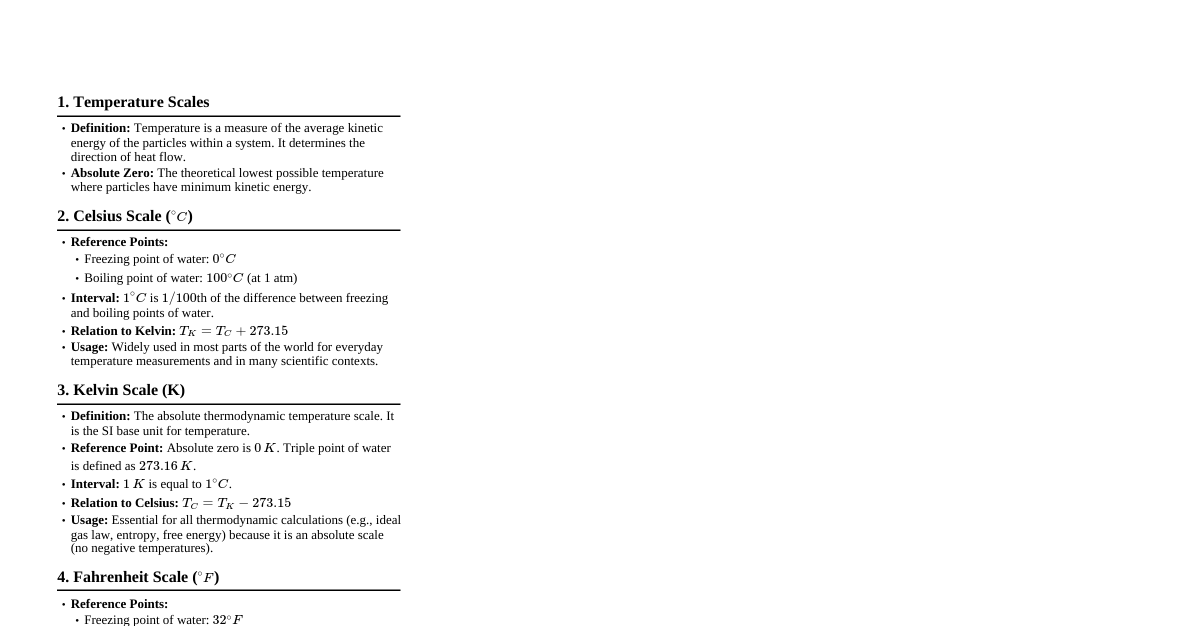
### 1. Temperature - **Definition:** A measure of the average kinetic energy of the particles within a system, determining the degree of hotness or coldness. - **Units:** - **Celsius (°C):** Water freezes at 0°C and boils at 100°C. - **Kelvin (K):** Absolute temperature scale; 0 K is absolute zero. Used in scientific calculations. - **Fahrenheit (°F):** Water freezes at 32°F and boils at 212°F. - **Measuring Instruments:** - **Mechanical (Liquid-in-Glass Thermometer):** Utilizes thermal expansion of a liquid (e.g., mercury, alcohol) to indicate temperature. - **Electrical (Thermocouple):** Measures temperature based on the voltage produced when two different metals are joined and heated (Seebeck effect). - **Radiation (Pyrometer):** Measures temperature from the thermal radiation emitted by an object, useful for very high temperatures without physical contact. - **Conversions:** - **Celsius to Kelvin:** $K = °C + 273.15$ - **Kelvin to Celsius:** $°C = K - 273.15$ - **Celsius to Fahrenheit:** $°F = (°C \times \frac{9}{5}) + 32$ - **Fahrenheit to Celsius:** $°C = (°F - 32) \times \frac{5}{9}$ ### 2. Heat - **Definition:** The transfer of thermal energy between systems or objects of different temperatures. Heat flows from hotter to colder regions. - **Units:** - **Joule (J):** Standard SI unit for energy and heat. - **Calorie (cal):** Amount of heat required to raise the temperature of 1 gram of water by 1°C. (1 cal ≈ 4.184 J). - **Heat Capacity (C):** - **Definition:** The amount of heat energy required to change the temperature of a substance by 1 unit ($J/°C$ or $J/K$). - **Formula:** $Q = C \Delta T$ - **Specific Heat Capacity (c):** - **Definition:** The amount of heat energy required to change the temperature of 1 kg of a substance by 1°C or 1 K ($J/kg°C$ or $J/kgK$). Unique for each material. - **Formula:** $Q = mc \Delta T$ (where $m$ is mass, $\Delta T$ is change in temperature) - **Specific Latent Heat (L):** - **Definition:** The amount of heat absorbed or released per unit mass during a phase change (e.g., melting, boiling) at constant temperature. - **Specific Latent Heat of Fusion ($L_f$):** For melting/freezing. - **Specific Latent Heat of Vaporization ($L_v$):** For boiling/condensation. - **Formula:** $Q = mL$ (where $m$ is mass) - **Experiments and Heat:** Principles of calorimetry, where heat lost by a hot object equals heat gained by a cold object in an isolated system, often used to determine specific heat capacities. ### 3. Heat Transfer - **Conduction:** - **Mechanism:** Transfer of heat through direct contact between particles, mainly in solids. Vibrating particles transfer energy to adjacent particles. - **Conductors:** Materials that allow heat to transfer easily (e.g., metals). - **Insulators:** Materials that resist heat transfer (e.g., wood, plastic, air). - **Convection:** - **Mechanism:** Transfer of heat through the movement of fluids (liquids or gases). Hotter, less dense fluid rises, while cooler, denser fluid sinks, creating convection currents. - **Examples:** Boiling water, ocean currents, atmospheric circulation. - **Radiation:** - **Mechanism:** Transfer of heat through electromagnetic waves (infrared radiation). Does not require a medium. - **Examples:** Heat from the sun, heat from a campfire. - **Thermal Conductors and Insulators:** - **Conductors:** High thermal conductivity, allow rapid heat transfer (e.g., copper, aluminum). - **Insulators:** Low thermal conductivity, impede heat transfer (e.g., foam, fiberglass, trapped air). ### 4. Thermal Expansion - **Definition:** The tendency of matter to change in volume in response to a change in temperature, usually increasing with increasing temperature. - **Linear Expansion:** - **Change in Length:** $\Delta L = L_0 \alpha \Delta T$ - Where: $L_0$ = original length, $\alpha$ = coefficient of linear expansion, $\Delta T$ = change in temperature. - **Superficial (Area) Expansion:** - **Change in Area:** $\Delta A = A_0 \beta \Delta T$ - Where: $A_0$ = original area, $\beta \approx 2\alpha$ = coefficient of area expansion, $\Delta T$ = change in temperature. - **Volume Expansion:** - **Change in Volume:** $\Delta V = V_0 \gamma \Delta T$ - Where: $V_0$ = original volume, $\gamma \approx 3\alpha$ = coefficient of volume expansion, $\Delta T$ = change in temperature. - **Worked Examples of the Second Law of Thermodynamics (Entropy):** The Second Law states that the total entropy (disorder) of an isolated system can only increase over time, or remain constant in ideal cases; it never decreases. Heat naturally flows from hotter to colder bodies, an irreversible process that increases overall entropy. - **Example 1:** A hot cup of coffee cooling down to room temperature. Heat flows from the coffee to the cooler surroundings. This dispersal of thermal energy increases the overall entropy of the system. - **Example 2:** An incandescent light bulb. Electrical energy is converted into light and a significant amount of heat. The heat dissipates into the surroundings, increasing entropy. It's impossible for the heat to spontaneously reconcentrate and relight the bulb. ### 5. Practical Applications - **Fire Dancing:** Utilizes the principles of heat generation and radiation; understanding flash points and heat transfer to create visual effects safely. - **Mumu (Traditional Cooking Method):** Employs efficient heat transfer (conduction and convection) using hot stones to cook food slowly and evenly in an insulated pit. - **Air Conditioning:** Works on the principle of heat transfer and phase change. It removes heat from a space (cooling effect) by evaporating a refrigerant, then condensing it outside, releasing heat. - **Refrigerators:** Similar to air conditioners, they use a refrigerant cycle to extract heat from the interior compartment and release it into the warmer surroundings, keeping food cold. - **Hot Water Systems:** Involve heat transfer to raise the temperature of water. - **Convection:** Water heated at the bottom rises, cooler water sinks, creating a circulation. - **Insulation:** Storage tanks are insulated to minimize heat loss through conduction and radiation.