Partial Differentiation
Cheatsheet Content
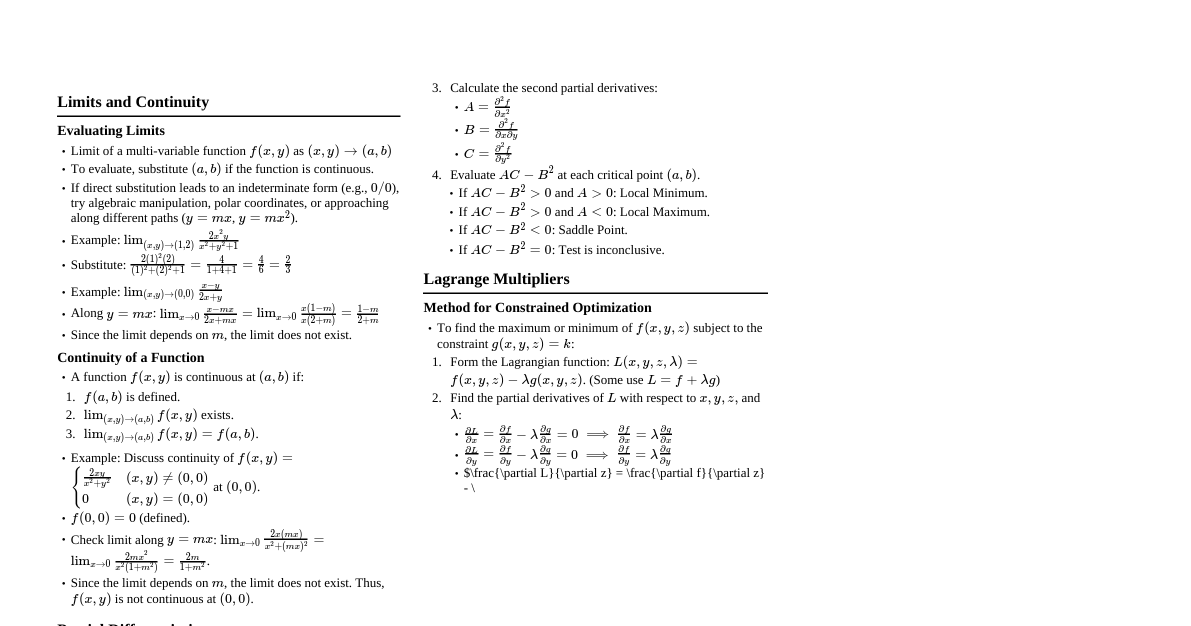
1. Introduction to Partial Derivatives Definition: For a function $f(x, y)$, the partial derivative with respect to $x$ is the derivative of $f$ with respect to $x$ while holding $y$ constant. $$ \frac{\partial f}{\partial x} = \lim_{h \to 0} \frac{f(x+h, y) - f(x, y)}{h} $$ Similarly for $y$: $$ \frac{\partial f}{\partial y} = \lim_{k \to 0} \frac{f(x, y+k) - f(x, y)}{k} $$ Notation: $\frac{\partial f}{\partial x}$, $f_x$, $\frac{\partial}{\partial x} f(x,y)$, $\partial_x f$ Geometric Interpretation: $f_x(x_0, y_0)$ is the slope of the tangent line to the curve formed by the intersection of the surface $z=f(x,y)$ and the plane $y=y_0$ at the point $(x_0, y_0, f(x_0, y_0))$. 2. Higher-Order Partial Derivatives Second-Order: $\frac{\partial^2 f}{\partial x^2} = f_{xx} = \frac{\partial}{\partial x} \left( \frac{\partial f}{\partial x} \right)$ $\frac{\partial^2 f}{\partial y^2} = f_{yy} = \frac{\partial}{\partial y} \left( \frac{\partial f}{\partial y} \right)$ Mixed Partial Derivatives: $\frac{\partial^2 f}{\partial x \partial y} = f_{yx} = \frac{\partial}{\partial x} \left( \frac{\partial f}{\partial y} \right)$ $\frac{\partial^2 f}{\partial y \partial x} = f_{xy} = \frac{\partial}{\partial y} \left( \frac{\partial f}{\partial x} \right)$ Clairaut's Theorem (Equality of Mixed Partials): If $f_{xy}$ and $f_{yx}$ are continuous on an open disk, then $f_{xy} = f_{yx}$. This often holds for most functions encountered in practice. 3. The Chain Rule for Multivariable Functions Case 1: $z = f(x, y)$, where $x = g(t)$ and $y = h(t)$. $$ \frac{dz}{dt} = \frac{\partial f}{\partial x} \frac{dx}{dt} + \frac{\partial f}{\partial y} \frac{dy}{dt} $$ Case 2: $z = f(x, y)$, where $x = g(s, t)$ and $y = h(s, t)$. $$ \frac{\partial z}{\partial s} = \frac{\partial f}{\partial x} \frac{\partial x}{\partial s} + \frac{\partial f}{\partial y} \frac{\partial y}{\partial s} $$ $$ \frac{\partial z}{\partial t} = \frac{\partial f}{\partial x} \frac{\partial x}{\partial t} + \frac{\partial f}{\partial y} \frac{\partial y}{\partial t} $$ General Case: If $u = f(x_1, \dots, x_n)$ and each $x_i = g_i(t_1, \dots, t_m)$, then $$ \frac{\partial u}{\partial t_j} = \sum_{i=1}^n \frac{\partial u}{\partial x_i} \frac{\partial x_i}{\partial t_j} $$ 4. Implicit Differentiation If $F(x, y) = 0$ defines $y$ implicitly as a function of $x$, then $$ \frac{dy}{dx} = - \frac{\partial F / \partial x}{\partial F / \partial y} = - \frac{F_x}{F_y} \quad \text{provided } F_y \ne 0 $$ If $F(x, y, z) = 0$ defines $z$ implicitly as a function of $x$ and $y$, then $$ \frac{\partial z}{\partial x} = - \frac{F_x}{F_z} \quad \text{and} \quad \frac{\partial z}{\partial y} = - \frac{F_y}{F_z} \quad \text{provided } F_z \ne 0 $$ 5. Directional Derivatives and Gradient Vector Gradient Vector: For $f(x, y)$, $\nabla f(x, y) = \left\langle \frac{\partial f}{\partial x}, \frac{\partial f}{\partial y} \right\rangle$. For $f(x, y, z)$, $\nabla f(x, y, z) = \left\langle \frac{\partial f}{\partial x}, \frac{\partial f}{\partial y}, \frac{\partial f}{\partial z} \right\rangle$. Directional Derivative: The rate of change of $f$ in the direction of a unit vector $\mathbf{u} = \langle a, b \rangle$ is $$ D_{\mathbf{u}} f(x, y) = \nabla f(x, y) \cdot \mathbf{u} = \frac{\partial f}{\partial x} a + \frac{\partial f}{\partial y} b $$ For 3D: $D_{\mathbf{u}} f(x, y, z) = \nabla f(x, y, z) \cdot \mathbf{u}$. Properties of the Gradient: The gradient $\nabla f$ points in the direction of the maximum rate of increase of $f$. The magnitude $|\nabla f|$ is the maximum rate of increase. $\nabla f$ is orthogonal to the level curves (or level surfaces) of $f$. 6. Tangent Planes and Normal Lines For a surface $z = f(x, y)$ at point $(x_0, y_0, z_0)$: Tangent Plane Equation: $$ z - z_0 = f_x(x_0, y_0)(x - x_0) + f_y(x_0, y_0)(y - y_0) $$ Normal Line Parametric Equations: $$ x = x_0 + f_x(x_0, y_0)t $$ $$ y = y_0 + f_y(x_0, y_0)t $$ $$ z = z_0 - t $$ For a level surface $F(x, y, z) = k$ at point $(x_0, y_0, z_0)$: Tangent Plane Equation: $$ F_x(x_0, y_0, z_0)(x - x_0) + F_y(x_0, y_0, z_0)(y - y_0) + F_z(x_0, y_0, z_0)(z - z_0) = 0 $$ Normal Line Parametric Equations: $$ x = x_0 + F_x(x_0, y_0, z_0)t $$ $$ y = y_0 + F_y(x_0, y_0, z_0)t $$ $$ z = z_0 + F_z(x_0, y_0, z_0)t $$ 7. Linear Approximations and Differentials Linear Approximation (Tangent Plane Approximation): For $f(x, y)$ near $(a, b)$: $$ L(x, y) = f(a, b) + f_x(a, b)(x - a) + f_y(a, b)(y - b) $$ So, $f(x, y) \approx L(x, y)$. Total Differential: For $z = f(x, y)$: $$ dz = f_x(x, y) dx + f_y(x, y) dy = \frac{\partial z}{\partial x} dx + \frac{\partial z}{\partial y} dy $$ This approximates the change in $z$, $\Delta z$, for small changes $dx = \Delta x$ and $dy = \Delta y$. 8. Maxima and Minima (Optimization) Critical Points: Points $(a, b)$ where $f_x(a, b) = 0$ and $f_y(a, b) = 0$, or where one or both partial derivatives do not exist. Second Derivative Test (for $f_{xx}, f_{yy}, f_{xy}$ continuous): Let $D(x, y) = D = f_{xx}(x, y)f_{yy}(x, y) - [f_{xy}(x, y)]^2$. At a critical point $(a, b)$: If $D > 0$ and $f_{xx}(a, b) > 0$, then $f(a, b)$ is a local minimum. If $D > 0$ and $f_{xx}(a, b) If $D If $D = 0$, the test is inconclusive. Absolute Maxima/Minima on a Closed, Bounded Region D: Find the values of $f$ at the critical points inside $D$. Find the extreme values of $f$ on the boundary of $D$. (Often requires parameterizing the boundary and using single-variable calculus or Lagrange Multipliers). The largest of these values is the absolute maximum, and the smallest is the absolute minimum. 9. Lagrange Multipliers (Constrained Optimization) To find the maximum and minimum values of $f(x, y, z)$ subject to the constraint $g(x, y, z) = k$: Solve the system of equations: $$ \nabla f(x, y, z) = \lambda \nabla g(x, y, z) $$ $$ g(x, y, z) = k $$ This expands to: $$ f_x = \lambda g_x $$ $$ f_y = \lambda g_y $$ $$ f_z = \lambda g_z $$ $$ g(x, y, z) = k $$ Evaluate $f$ at all points $(x, y, z)$ found in step 1. The largest value is the maximum, and the smallest is the minimum. For two constraints $g(x, y, z) = k$ and $h(x, y, z) = c$: $$ \nabla f = \lambda \nabla g + \mu \nabla h $$ $$ g = k $$ $$ h = c $$