JEE Advanced Differentiation
Cheatsheet Content
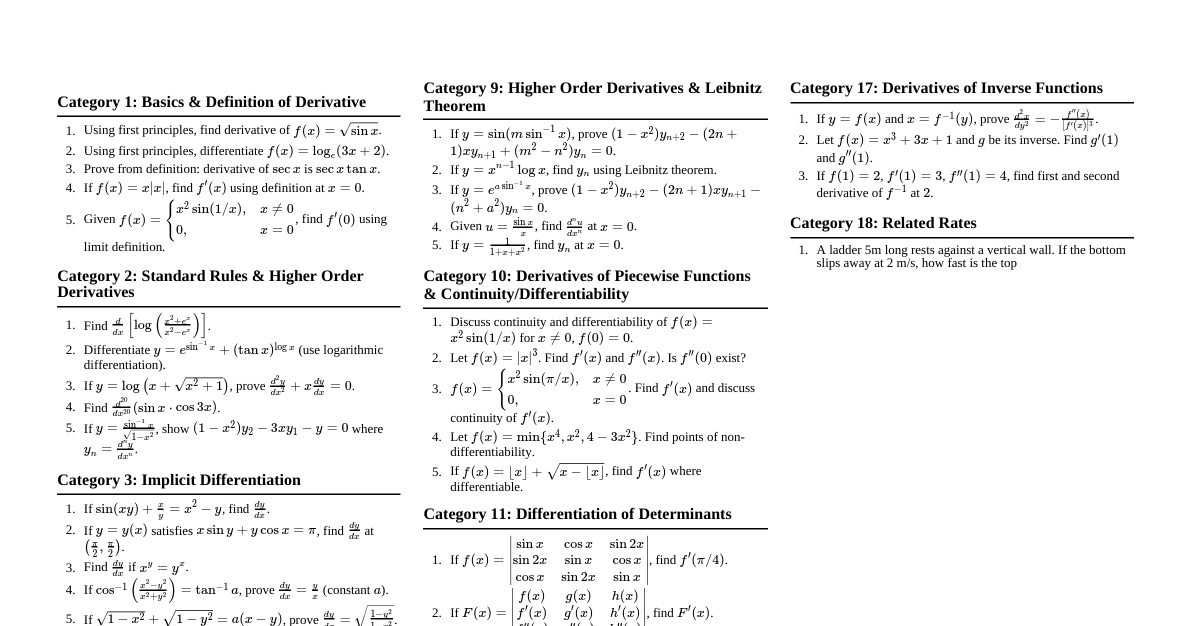
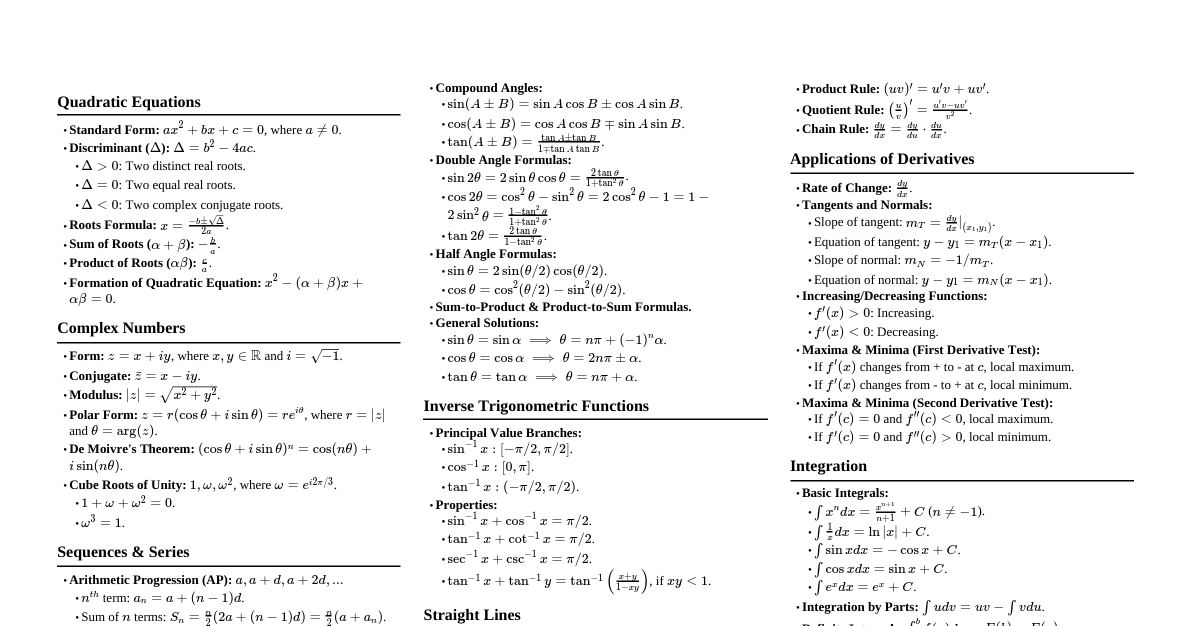
1. The Concept of Derivative 1.1 Definition and First Principles The derivative of a function $f(x)$ at a point $x = a$ is defined as: $$f'(a) = \lim_{h \to 0} \frac{f(a+h) - f(a)}{h} = \lim_{x \to a} \frac{f(x) - f(a)}{x-a}$$ Geometric Interpretation: The derivative $f'(a)$ represents the slope of the tangent to the curve $y = f(x)$ at the point $(a, f(a))$. Alternative Form (Symmetric Difference): $$f'(a) = \lim_{h \to 0} \frac{f(a+h) - f(a-h)}{2h}$$ This form is more accurate for numerical approximation and useful for proving differentiability. 1.2 Left-Hand and Right-Hand Derivatives A function $f(x)$ is differentiable at $x = a$ if and only if: Both LHD and RHD exist LHD = RHD Left-Hand Derivative (LHD): $$L f'(a) = \lim_{h \to 0^-} \frac{f(a+h) - f(a)}{h}$$ Right-Hand Derivative (RHD): $$R f'(a) = \lim_{h \to 0^+} \frac{f(a+h) - f(a)}{h}$$ 1.3 Derivative as a Function If $f$ is differentiable at every point of its domain, we define the derivative function: $$f'(x) = \lim_{h \to 0} \frac{f(x+h) - f(x)}{h}$$ Example 1: Find derivative of $f(x) = x^2$ using first principles $$f'(x) = \lim_{h \to 0} \frac{(x+h)^2 - x^2}{h} = \lim_{h \to 0} \frac{x^2 + 2xh + h^2 - x^2}{h} = \lim_{h \to 0} \frac{2xh + h^2}{h} = \lim_{h \to 0} (2x + h) = 2x$$ 1.4 Relationship Between Continuity and Differentiability Theorem: If $f$ is differentiable at $x = a$, then $f$ is continuous at $x = a$. Proof: $$\lim_{x \to a} [f(x) - f(a)] = \lim_{x \to a} \left[\frac{f(x)-f(a)}{x-a}\right] \cdot (x-a) = f'(a) \cdot 0 = 0$$ Thus $\lim_{x \to a} f(x) = f(a)$ Important Note: The converse is not true. A function can be continuous but not differentiable. Example 2: $f(x) = |x|$ is continuous at $x = 0$ but not differentiable at $x = 0$ $$L f'(0) = \lim_{h \to 0^-} \frac{|h| - 0}{h} = \lim_{h \to 0^-} \frac{-h}{h} = -1$$ $$R f'(0) = \lim_{h \to 0^+} \frac{|h| - 0}{h} = \lim_{h \to 0^+} \frac{h}{h} = 1$$ LHD $\ne$ RHD, so not differentiable. 2. Rules of Differentiation 2.1 Basic Rules Let $u(x)$ and $v(x)$ be differentiable functions, $c$ be a constant. Constant Rule: $\frac{d}{dx}[c] = 0$ Constant Multiple Rule: $\frac{d}{dx}[c \cdot f(x)] = c \cdot f'(x)$ Sum Rule: $\frac{d}{dx}[u(x) \pm v(x)] = u'(x) \pm v'(x)$ Product Rule: $\frac{d}{dx}[u(x) \cdot v(x)] = u'(x)v(x) + u(x)v'(x)$ Quotient Rule: $\frac{d}{dx}\left[\frac{u(x)}{v(x)}\right] = \frac{u'(x)v(x) - u(x)v'(x)}{[v(x)]^2}$, $v(x) \ne 0$ Chain Rule: If $y = f(u)$ and $u = g(x)$, then $\frac{dy}{dx} = \frac{dy}{du} \cdot \frac{du}{dx}$ 2.2 Extended Product Rule (for three functions) $$\frac{d}{dx}[u \cdot v \cdot w] = u'vw + uv'w + uvw'$$ 2.3 Chain Rule in Detail The chain rule can be extended to any number of functions: If $y= f(g(h(x)))$, then $$\frac{dy}{dx} = f'(g(h(x))) \cdot g'(h(x)) \cdot h'(x)$$ Example 3: Find derivative of $y = \sin(\cos(x^2))$ Let $u = x^2$, $v = \cos u$, $y = \sin v$ $$\frac{dy}{dx} = \frac{dy}{dv} \cdot \frac{dv}{du} \cdot \frac{du}{dx} = \cos v \cdot (-\sin u) \cdot 2x = \cos(\cos(x^2)) \cdot (-\sin(x^2)) \cdot 2x = -2x \sin(x^2) \cos(\cos(x^2))$$ 2.4 Derivatives of Standard Functions 2.4.1 Algebraic Functions $$\frac{d}{dx}(x^n) = n \cdot x^{n-1}$$ $$\frac{d}{dx}(\sqrt{x}) = \frac{1}{2\sqrt{x}}$$ $$\frac{d}{dx}\left(\frac{1}{x}\right) = -\frac{1}{x^2}$$ $$\frac{d}{dx}(e^x) = e^x$$ $$\frac{d}{dx}(a^x) = a^x \cdot \ln a, \quad a > 0, a \ne 1$$ 2.4.2 Trigonometric Functions $$\frac{d}{dx}(\sin x) = \cos x$$ $$\frac{d}{dx}(\cos x) = -\sin x$$ $$\frac{d}{dx}(\tan x) = \sec^2 x$$ $$\frac{d}{dx}(\cot x) = -\csc^2 x$$ $$\frac{d}{dx}(\sec x) = \sec x \tan x$$ $$\frac{d}{dx}(\csc x) = -\csc x \cot x$$ 2.4.3 Inverse Trigonometric Functions $$\frac{d}{dx}(\sin^{-1}x) = \frac{1}{\sqrt{1-x^2}}, \quad |x| 1$$ $$\frac{d}{dx}(\csc^{-1}x) = -\frac{1}{|x|\sqrt{x^2-1}}, \quad |x| > 1$$ Proof for $\sin^{-1}x$: Let $y = \sin^{-1}x \Rightarrow x = \sin y$ Differentiate implicitly: $1 = \cos y \cdot \frac{dy}{dx}$ $\frac{dy}{dx} = \frac{1}{\cos y} = \frac{1}{\sqrt{1-\sin^2y}} = \frac{1}{\sqrt{1-x^2}}$ For principal value, $\cos y \ge 0$, so positive square root. 2.4.4 Logarithmic Functions $$\frac{d}{dx}(\ln x) = \frac{1}{x}, \quad x > 0$$ $$\frac{d}{dx}(\log_a x) = \frac{1}{x \ln a}, \quad x > 0, a > 0, a \ne 1$$ 3. Special Techniques of Differentiation 3.1 Logarithmic Differentiation When to use: Functions of the form $[f(x)]^{g(x)}$ (variable exponent) Products/quotients with many factors Functions involving products of powers Method: Take natural logarithm of both sides: $\ln y = \ln[f(x)]$ Simplify using logarithm properties Differentiate implicitly with respect to $x$ Solve for $dy/dx$ Example 4: Differentiate $y = x^x$ $\ln y = x \ln x$ $\frac{1}{y} \frac{dy}{dx} = \ln x + x \cdot \frac{1}{x} = \ln x + 1$ $\frac{dy}{dx} = y(\ln x + 1) = x^x(\ln x + 1)$ Example 5: Differentiate $y = (\sin x)^{\cos x} + (\cos x)^{\sin x}$ For $u= (\sin x)^{\cos x}$: $\ln u = \cos x \cdot \ln(\sin x)$ $\frac{1}{u}\frac{du}{dx} = -\sin x \cdot \ln(\sin x) + \cos x \cdot \frac{\cos x}{\sin x}$ $\frac{du}{dx} = (\sin x)^{\cos x}[-\sin x \cdot \ln(\sin x) + \frac{\cos^2x}{\sin x}]$ Similarly for $v = (\cos x)^{\sin x}$. $\frac{dy}{dx} = \frac{du}{dx} + \frac{dv}{dx}$ 3.2 Parametric Differentiation Given: $x = f(t)$, $y = g(t)$, where $t$ is a parameter First derivative: $$\frac{dy}{dx} = \frac{dy/dt}{dx/dt} = \frac{g'(t)}{f'(t)}, \quad \text{provided } f'(t) \ne 0$$ Second derivative: $$\frac{d^2y}{dx^2} = \frac{d}{dx}\left(\frac{dy}{dx}\right) = \frac{\frac{d}{dt}\left(\frac{dy}{dx}\right)}{dx/dt}$$ $$= \frac{f'(t)g''(t) - g'(t)f''(t)}{[f'(t)]^3}$$ Proof of second derivative formula: Let $\frac{dy}{dx} = \psi(t) = \frac{g'(t)}{f'(t)}$ Then $\frac{d^2y}{dx^2} = \frac{d\psi}{dx} = \frac{d\psi/dt}{dx/dt}$ $\frac{d\psi}{dt} = \frac{f'(t)g''(t) - g'(t)f''(t)}{[f'(t)]^2}$ Thus $\frac{d^2y}{dx^2} = \frac{f'(t)g''(t) - g'(t)f''(t)}{[f'(t)]^3}$ Example 6: $x = a(\theta - \sin \theta)$, $y = a(1 - \cos \theta)$ (cycloid) $$\frac{dx}{d\theta} = a(1 - \cos \theta), \quad \frac{dy}{d\theta} = a \sin \theta$$ $$\frac{dy}{dx} = \frac{a \sin \theta}{a(1-\cos \theta)} = \frac{\sin \theta}{1-\cos \theta} = \cot(\theta/2)$$ $$\frac{d^2y}{dx^2} = \frac{\frac{d}{d\theta}(\cot(\theta/2))}{dx/d\theta} = \frac{-\frac{1}{2} \csc^2(\theta/2)}{a(1-\cos \theta)} = -\frac{1}{2a \csc^2(\theta/2) (2 \sin^2(\theta/2))} = -\frac{1}{4a \sin^4(\theta/2)}$$ 3.3 Implicit Differentiation Method: Differentiate both sides of $F(x, y) = 0$ with respect to $x$, treating $y$ as a function of $x$. Example 7: Find $dy/dx$ for $x^2 + y^2 = a^2$ Differentiate: $2x + 2y \cdot \frac{dy}{dx} = 0 \Rightarrow \frac{dy}{dx} = -\frac{x}{y}$ Example 8: Find $dy/dx$ for $\sin(xy) + x/y = x^2 - y$ Differentiate term by term: $\cos(xy) \cdot (y + x \cdot \frac{dy}{dx}) + \frac{y \cdot 1 - x \cdot \frac{dy}{dx}}{y^2} = 2x - \frac{dy}{dx}$ Collect $dy/dx$ terms and solve. Second derivative: Differentiate the expression for $dy/dx$ again. 3.4 Differentiation of Infinite Series Method: Express $y$ in closed form if possible, then differentiate. Example 9: $y = x + x^2/2 + x^3/3 + \dots$ for $|x| Example 10: $y = \sqrt{x\sqrt{x\sqrt{x...}}}$ $y = \sqrt{x \cdot y} \Rightarrow y^2 = x \cdot y \Rightarrow y(y - x) = 0$ Since $y > 0$ for $x > 0$, $y = x$. Thus $\frac{dy}{dx} = 1$. Example 11: $y = x/(1 + x/(1 + x/(1 + \dots)))$ $y = x/(1 + y) \Rightarrow y(1+y) = x \Rightarrow y^2 + y - x = 0$ $y = \frac{-1 \pm \sqrt{1+4x}}{2}$ (choose positive for $x>0$) Differentiate: $\frac{dy}{dx} = \frac{1}{2\sqrt{1+4x}} \cdot 4 = \frac{1}{\sqrt{1+4x}}$ 4. Higher Order Derivatives 4.1 Notation First derivative: $\frac{dy}{dx}, y', f'(x), Df(x)$ Second derivative: $\frac{d^2y}{dx^2}, y'', f''(x), D^2f(x)$ n-th derivative: $\frac{d^ny}{dx^n}, y^{(n)}, f^{(n)}(x), D^nf(x)$ 4.2 Standard Results 1. Exponential: If $y = e^{ax}$, then $y_n = a^n e^{ax}$ 2. Trigonometric: If $y = \sin(ax+b)$, then $y_n = a^n \sin(ax+b + n\pi/2)$ If $y = \cos(ax+b)$, then $y_n = a^n \cos(ax+b + n\pi/2)$ Proof for $\sin(ax+b)$: $y_1 = a \cos(ax+b) = a \sin(ax+b + \pi/2)$ $y_2 = a^2[-\sin(ax+b)] = a^2 \sin(ax+b + \pi)$ Assume $y_k = a^k \sin(ax+b + k\pi/2)$ Then $y_{k+1} = a^k \cdot a \cos(ax+b + k\pi/2) = a^{k+1} \sin(ax+b + k\pi/2 + \pi/2) = a^{k+1} \sin(ax+b + (k+1)\pi/2)$ By induction, formula holds. 3. Polynomial: If $y = (ax+b)^m$, then $y_n = m(m-1)...(m-n+1) a^n (ax+b)^{m-n}$ For $m 4. Logarithmic: If $y = \ln(ax+b)$, then $y_n = (-1)^{n-1} (n-1)! a^n / (ax+b)^n$ 5. Reciprocal: If $y = 1/(ax+b)$, then $y_n = (-1)^n n! a^n / (ax+b)^{n+1}$ 4.3 Leibnitz Theorem Theorem: If $u(x)$ and $v(x)$ are $n$-times differentiable functions, then $$(uv)_n = \sum_{r=0}^n \binom{n}{r} u^{(n-r)} v^{(r)}$$ where $u^{(k)} = d^ku/dx^k, v^{(k)} = d^kv/dx^k$. Proof by induction: Base case: $n=1$, $(uv)' = u'v + uv' = \binom{1}{0}u^{(1)}v^{(0)} + \binom{1}{1}u^{(0)}v^{(1)}$ Assume true for $n=k$: $(uv)_k = \sum_{r=0}^k \binom{k}{r} u^{(k-r)} v^{(r)}$ Differentiate: $(uv)_{k+1} = \sum_{r=0}^k \binom{k}{r} [u^{(k+1-r)} v^{(r)} + u^{(k-r)} v^{(r+1)}]$ $= \sum_{r=0}^k \binom{k}{r} u^{(k+1-r)} v^{(r)} + \sum_{r=0}^k \binom{k}{r} u^{(k-r)} v^{(r+1)}$ $= \sum_{r=0}^k \binom{k}{r} u^{(k+1-r)} v^{(r)} + \sum_{s=1}^{k+1} \binom{k}{s-1} u^{(k+1-s)} v^{(s)}$ (let $s = r+1$) Combine using $\binom{k}{r} + \binom{k}{r-1} = \binom{k+1}{r}$ $= \binom{k+1}{0} u^{(k+1)} v^{(0)} + \sum_{r=1}^k \binom{k+1}{r} u^{(k+1-r)} v^{(r)} + \binom{k+1}{k+1} u^{(0)} v^{(k+1)}$ $= \sum_{r=0}^{k+1} \binom{k+1}{r} u^{(k+1-r)} v^{(r)}$ Thus true for $n=k+1$. Example 12: Find n-th derivative of $x^2 \sin x$ Let $u = \sin x$, $v = x^2$ $u^{(k)} = \sin(x + k\pi/2)$ $v^{(0)} = x^2, v^{(1)} = 2x, v^{(2)} = 2, v^{(k)} = 0$ for $k \ge 3$ By Leibnitz: $y_n = \binom{n}{0} u^{(n)} v^{(0)} + \binom{n}{1} u^{(n-1)} v^{(1)} + \binom{n}{2} u^{(n-2)} v^{(2)}$ $= x^2 \sin(x + n\pi/2) + n \cdot 2x \sin(x + (n-1)\pi/2) + \frac{n(n-1)}{2} \cdot 2 \sin(x + (n-2)\pi/2)$ $= x^2 \sin(x + n\pi/2) + 2nx \sin(x + n\pi/2 - \pi/2) + n(n-1) \sin(x + n\pi/2 - \pi)$ 4.4 Successive Differentiation of Special Functions 1. $y = \sin^{-1}x$ $y_1 = 1/\sqrt{1-x^2}$ Differentiate: $y_2 = x/(1-x^2)^{3/2}$ We can show: $(1-x^2)y_2 - xy_1 = 0$ Differentiate $n$ times using Leibnitz: $$(1-x^2)y_{n+2} - (2n+1)x y_{n+1} - n^2 y_n = 0$$ 2. $y = e^{ax} \sin(bx)$ Let $y = e^{ax} \sin(bx)$ $y_1 = e^{ax}[a \sin(bx) + b \cos(bx)] = \sqrt{a^2+b^2} e^{ax} \sin(bx + \alpha)$, where $\alpha = \tan^{-1}(b/a)$ By induction: $y_n = (a^2+b^2)^{n/2} e^{ax} \sin(bx + n\alpha)$ 3. $y = \tan^{-1}x$ $y_1 = 1/(1+x^2)$ $(1+x^2)y_1 = 1$ Differentiate $n$ times using Leibnitz: $$(1+x^2)y_{n+1} + 2nx y_n + n(n-1) y_{n-1} = 0$$ 5. Differentiation of Inverse Functions 5.1 Derivative of Inverse Function If $y = f(x)$ is invertible and $f'(x) \ne 0$, then the inverse function $x = f^{-1}(y)$ satisfies: $$\frac{dx}{dy} = \frac{1}{dy/dx}$$ or $\frac{d}{dy}[f^{-1}(y)] = \frac{1}{f'(x)}$ where $x = f^{-1}(y)$ Proof: Differentiate $f(f^{-1}(y)) = y$ with respect to $y$: $f'(f^{-1}(y)) \cdot \frac{d}{dy}[f^{-1}(y)] = 1$ Thus $\frac{d}{dy}[f^{-1}(y)] = \frac{1}{f'(x)}$ where $x = f^{-1}(y)$. 5.2 Second Derivative of Inverse Function If $y = f(x)$ and $x = f^{-1}(y)$, then $$\frac{d^2x}{dy^2} = -\frac{f''(x)}{[f'(x)]^3}$$ Proof: $\frac{dx}{dy} = \frac{1}{f'(x)}$ $\frac{d^2x}{dy^2} = \frac{d}{dy}\left(\frac{1}{f'(x)}\right) = \frac{d}{dx}\left(\frac{1}{f'(x)}\right) \cdot \frac{dx}{dy}$ $= \left[-\frac{f''(x)}{(f'(x))^2}\right] \cdot \left(\frac{1}{f'(x)}\right) = -\frac{f''(x)}{[f'(x)]^3}$ Example 13: If $y = x^3 + 2x - 1$, find derivative of inverse at $y = 2$ When $y = 2$: $x^3 + 2x - 1 = 2 \Rightarrow x^3 + 2x - 3 = 0$ $x = 1$ is a root ($1+2-3=0$) $f'(x) = 3x^2 + 2$, $f'(1) = 5$ So $(f^{-1})'(2) = 1/5$. 5.3 Differentiation with Respect to Another Function To find derivative of $u(x)$ with respect to $v(x)$: $$\frac{du}{dv} = \frac{du/dx}{dv/dx} = \frac{u'(x)}{v'(x)}$$ Example 14: Differentiate $\sin^{-1}(2x/(1+x^2))$ with respect to $\tan^{-1}x$ Let $u = \sin^{-1}(2x/(1+x^2))$, $v = \tan^{-1}x$ We know $\sin^{-1}(2x/(1+x^2)) = 2 \tan^{-1}x$ for $|x| \le 1$ So $u = 2v$ Thus $\frac{du}{dv} = 2$. Alternative method: $\frac{du}{dx} = \frac{2}{1+x^2}$, $\frac{dv}{dx} = \frac{1}{1+x^2}$ So $\frac{du}{dv} = \frac{2/(1+x^2)}{1/(1+x^2)} = 2$. 6. Mean Value Theorems 6.1 Rolle's Theorem Statement: If $f(x)$ is: Continuous on $[a, b]$ Differentiable on $(a, b)$ $f(a) = f(b)$ Then $\exists c \in (a, b)$ such that $f'(c) = 0$. Geometric Meaning: There exists at least one point where tangent is horizontal. 6.2 Lagrange's Mean Value Theorem (LMVT) Statement: If $f(x)$ is: Continuous on $[a, b]$ Differentiable on $(a, b)$ Then $\exists c \in (a, b)$ such that $$f'(c) = \frac{f(b) - f(a)}{b - a}$$ Geometric Meaning: There exists at least one point where tangent is parallel to chord joining $(a, f(a))$ and $(b, f(b))$. Alternative Form: $f(b) - f(a) = f'(c)(b-a)$ Example 15: Prove that for $0 6.3 Cauchy's Mean Value Theorem Statement: If $f(x)$ and $g(x)$ are: Continuous on $[a, b]$ Differentiable on $(a, b)$ $g'(x) \ne 0$ for all $x \in (a, b)$ Then $\exists c \in (a, b)$ such that $$\frac{f(b) - f(a)}{g(b) - g(a)} = \frac{f'(c)}{g'(c)}$$ Note: LMVT is special case with $g(x) = x$. Application to L'Hôpital's Rule: If $\lim_{x \to a} f(x) = \lim_{x \to a} g(x) = 0$ and $g'(x) \ne 0$ near $a$, then $$\lim_{x \to a} \frac{f(x)}{g(x)} = \lim_{x \to a} \frac{f'(x)}{g'(x)}$$ provided the latter limit exists. 7. Applications of Derivatives 7.1 Tangents and Normals Slope of tangent: $m_t = dy/dx$ Slope of normal: $m_n = -1/(dy/dx)$ Equation of tangent at $(x_1, y_1)$: $$y - y_1 = \left(\frac{dy}{dx}\right)_{(x_1,y_1)} \cdot (x - x_1)$$ Equation of normal at $(x_1, y_1)$: $$y - y_1 = -\frac{1}{(dy/dx)_{(x_1,y_1)}} \cdot (x - x_1)$$ 7.2 Lengths of Tangents, Normals, Subtangent, Subnormal For curve $y = f(x)$ at point $P(x_1, y_1)$: Length of tangent: $PT = |y_1\sqrt{1 + (dx/dy)^2}|$ Length of normal: $PN = |y_1\sqrt{1 + (dy/dx)^2}|$ Subtangent: $ST = |y_1/(dy/dx)|$ Subnormal: $SN = |y_1 \cdot (dy/dx)|$ 7.3 Angle Between Two Curves Angle between curves $y = f_1(x)$ and $y = f_2(x)$ at intersection point is: $$\tan \theta = \left|\frac{m_1 - m_2}{1 + m_1m_2}\right|$$ where $m_1 = f_1'(x_0)$, $m_2 = f_2'(x_0)$ at intersection point $x_0$. Orthogonal curves: $m_1 \cdot m_2 = -1$ Curves touching: $m_1 = m_2$ and $f_1(x_0) = f_2(x_0)$ 7.4 Approximation and Errors Differential: $dy = f'(x)dx$ Approximation: $f(x+\Delta x) \approx f(x) + f'(x)\Delta x$ Error Analysis: If $y = f(x)$ and there's error $\Delta x$ in $x$, then approximate error in $y$ is: $$\Delta y \approx f'(x) \cdot \Delta x$$ $$\text{Percentage error} = (\Delta y/y) \times 100 \approx [f'(x) \cdot \Delta x / f(x)] \times 100$$ Example 16: Volume of sphere $V = (4/3)\pi r^3$ $\frac{dV}{dr} = 4\pi r^2$ $\Delta V \approx 4\pi r^2 \cdot \Delta r$ Percentage error in $V \approx 3 \times (\text{percentage error in } r)$ 7.5 Related Rates Method: Identify given rate and required rate Find equation relating variables Differentiate with respect to time Substitute known values Example 17: Ladder problem A 5m ladder rests against wall. Bottom slides away at 2 m/s. How fast is top sliding when bottom is 3m from wall? Let $x =$ distance from wall to bottom, $y =$ height of top $x^2 + y^2 = 25$ Differentiate: $2x \frac{dx}{dt} + 2y \frac{dy}{dt} = 0$ Given $\frac{dx}{dt} = 2$, when $x = 3$, $y = 4$ ($3^2+4^2=25$) $2 \cdot 3 \cdot 2 + 2 \cdot 4 \cdot \frac{dy}{dt} = 0$ $\frac{dy}{dt} = -12/8 = -1.5$ m/s (negative means descending) 8. Special Functions and Their Derivatives 8.1 Piecewise Defined Functions To check differentiability at join point $x = a$: Check continuity at $x = a$ Check LHD and RHD at $x = a$ Example 18: $f(x) = \begin{cases} x^2 \sin(1/x), & x \ne 0 \\ 0, & x = 0 \end{cases}$ Check differentiability at $x = 0$: $f'(0) = \lim_{h \to 0} \frac{f(0+h)-f(0)}{h} = \lim_{h \to 0} \frac{h^2 \sin(1/h)}{h} = \lim_{h \to 0} h \sin(1/h) = 0$ Thus differentiable at 0. For $x \ne 0: f'(x) = 2x \sin(1/x) - \cos(1/x)$. Note $f'(x)$ is not continuous at 0 (oscillates). 8.2 Functions Involving Greatest Integer Function For $f(x) = [x]$, where $[x] =$ greatest integer $\le x$: Discontinuous at integer points Not differentiable at integer points Example 19: $f(x) = x - [x]$ (fractional part function) Discontinuous at integers, not differentiable at integers. 8.3 Differentiation of Determinants If $F(x) = |a_{ij}(x)|$ is an $n \times n$ determinant with functions as entries, then $F'(x) =$ sum of $n$ determinants, where in the $k$-th determinant, only the $k$-th row is differentiated and other rows are as in $F(x)$. For $2 \times 2$: If $F(x) = \begin{vmatrix} a(x) & b(x) \\ c(x) & d(x) \end{vmatrix}$ then $F'(x) = \begin{vmatrix} a'(x) & b'(x) \\ c(x) & d(x) \end{vmatrix} + \begin{vmatrix} a(x) & b(x) \\ c'(x) & d'(x) \end{vmatrix}$ General Proof: Write determinant as sum of products. Differentiate each product using product rule. Collect terms where differentiation falls on each row. Example 20: $f(x) = \begin{vmatrix} \sin x & \cos x & \sin 2x \\ \sin 2x & \sin x & \cos x \\ \cos x & \sin 2x & \sin x \end{vmatrix}$ Find $f'(\pi/4)$ Differentiate each row and sum: $f'(x) = D_1 + D_2 + D_3$ where $D_1$ has first row differentiated, etc. Evaluate at $\pi/4$. 8.4 Differentiation Under Integral Sign (Leibniz Rule) For definite integral with constant limits: $$\frac{d}{dx} \int_a^b f(x,t) dt = \int_a^b \frac{\partial f}{\partial x} dt$$ For variable limits: If $F(x) = \int_{u(x)}^{v(x)} f(x,t) dt$, then $$F'(x) = f(x, v(x)) \cdot v'(x) - f(x, u(x)) \cdot u'(x) + \int_{u(x)}^{v(x)} \frac{\partial f}{\partial x} dt$$ Example 21: $F(x) = \int_0^x \frac{\sin(xt)}{t} dt$ (for $x > 0$) Let $xt = u$, then $F(x) = \int_0^{x^2} \frac{\sin u}{(u/x)} \cdot \frac{du}{x} = \int_0^{x^2} \frac{\sin u}{u} du$ $F'(x) = \frac{\sin(x^2)}{x^2} \cdot 2x = \frac{2 \sin(x^2)}{x}$ 9. Functional Equations and Differentiation 9.1 Standard Forms Type 1: $f(x+y) = f(x) + f(y)$ (Cauchy's equation) If $f$ is differentiable at one point and satisfies this, then $f(x) = kx$. Proof: Differentiate with respect to $x$: $f'(x+y) = f'(x)$. This holds for all $x,y$, so $f'$ is constant. Thus $f(x) = kx + c$. From $f(0)= f(0+0) = f(0)+f(0) \Rightarrow f(0) = 0 \Rightarrow c = 0$. Type 2: $f(x+y) = f(x)f(y)$ (Exponential type) If $f$ is differentiable and not identically zero, then $f(x) = a^x$. Proof: Differentiate w.r.t $x$: $f'(x+y) = f'(x)f(y)$. Put $x= 0$: $f'(y) = f'(0)f(y)$. Solve: $f(y) = C e^{f'(0)y}$. From $f(0)= 1 \Rightarrow C = 1$. Thus $f(x) = e^{kx}$ where $k = f'(0)$. Type 3: $f(xy) = f(x) + f(y)$ (Logarithmic type) If $f$ is differentiable and not constant, then $f(x) = k \ln x$. Proof: Differentiate w.r.t $x$: $y f'(xy) = f'(x)$. Put $x= 1$: $y f'(y) = f'(1) \Rightarrow f'(y) = k/y$. Integrate: $f(y) = k \ln y + C$. From $f(1)= 0 \Rightarrow C = 0$. Type 4: $f(x+y) = [f(x)+f(y)]/[1 - f(x)f(y)]$ (Tangent type) Solution: $f(x) = \tan(kx)$. 9.2 Method for Solving Functional Equations Find $f(0)$ by suitable substitution Find $f'(0)$ if possible Differentiate the equation with respect to one variable Solve the resulting differential equation Example 22: $f(x+y) = f(x) + f(y) + 2xy - 1$, $f'(0) = 2$ Differentiate w.r.t $x$: $f'(x+y) = f'(x) + 2y$ Put $x = 0$: $f'(y) = f'(0) + 2y = 2 + 2y$ Integrate: $f(y) = 2y + y^2 + C$ From original: $f(0) = f(0+0) = f(0)+f(0)-1 \Rightarrow f(0) = 1$ Thus $C = 1$, so $f(x) = x^2 + 2x + 1 = (x+1)^2$. 10. Polar Coordinates 10.1 Derivatives in Polar Form For curve $r = f(\theta)$: $x = r \cos \theta, y = r \sin \theta$ $\frac{dx}{d\theta} = \frac{dr}{d\theta} \cos \theta - r \sin \theta$ $\frac{dy}{d\theta} = \frac{dr}{d\theta} \sin \theta + r \cos \theta$ $$\frac{dy}{dx} = \frac{dy/d\theta}{dx/d\theta} = \frac{r' \sin \theta + r \cos \theta}{r' \cos \theta - r \sin \theta}$$ where $r' = dr/d\theta$. Angle between tangent and radius vector: $$\tan \psi = \frac{r}{dr/d\theta}$$ Perpendicular from pole to tangent: $$p = \frac{r^2}{\sqrt{r^2 + (dr/d\theta)^2}}$$ Example 23: For cardioid $r = a(1 - \cos \theta)$, find $dy/dx$ $r' = a \sin \theta$ $$\frac{dy}{dx} = \frac{a \sin \theta \cdot \sin \theta + a(1-\cos \theta)\cos \theta}{a \sin \theta \cos \theta - a(1-\cos \theta)\sin \theta}$$ Simplify numerator: $a[\sin^2\theta + \cos \theta - \cos^2\theta] = a[\cos \theta - \cos 2\theta]$ Denominator: $a[\sin \theta \cos \theta - \sin \theta + \sin \theta \cos \theta] = a[2 \sin \theta \cos \theta - \sin \theta] = a \sin \theta (2 \cos \theta - 1)$ Thus $\frac{dy}{dx} = \frac{\cos \theta - \cos 2\theta}{\sin \theta (2 \cos \theta - 1)}$. 11. Proofs and Derivations 11.1 Derivative of $x^n$ from First Principles $f(x) = x^n$ $f'(x) = \lim_{h \to 0} \frac{(x+h)^n - x^n}{h}$ Using binomial theorem: $(x+h)^n = x^n + \binom{n}{1} x^{n-1}h + \binom{n}{2} x^{n-2}h^2 + \dots + h^n$ $$= \lim_{h \to 0} \frac{nx^{n-1}h + \frac{n(n-1)}{2} x^{n-2}h^2 + \dots + h^n}{h}$$ $$= \lim_{h \to 0} [nx^{n-1} + h \cdot (\text{terms in } h)] = nx^{n-1}$$ 11.2 Derivative of $\sin x$ from First Principles $f(x) = \sin x$ $f'(x) = \lim_{h \to 0} \frac{\sin(x+h) - \sin x}{h}$ $$= \lim_{h \to 0} \frac{2 \cos(x+h/2) \sin(h/2)}{h}$$ $$= \lim_{h \to 0} \cos(x+h/2) \cdot \frac{\sin(h/2)}{h/2}$$ $$= \cos x \cdot 1 = \cos x$$ 11.3 Product Rule Proof Let $y = u(x)v(x)$ $\Delta y = u(x+\Delta x)v(x+\Delta x) - u(x)v(x)$ $= [u+\Delta u][v+\Delta v] - uv$ $= u\Delta v + v\Delta u + \Delta u\Delta v$ $\frac{\Delta y}{\Delta x} = u\frac{\Delta v}{\Delta x} + v\frac{\Delta u}{\Delta x} + \Delta u \frac{\Delta v}{\Delta x}$ As $\Delta x \to 0$: $\frac{dy}{dx} = u \frac{dv}{dx} + v \frac{du}{dx}$ 11.4 Quotient Rule Proof Let $y = u(x)/v(x)$, $v(x) \ne 0$ Consider $u = yv$ Differentiate: $\frac{du}{dx} = y \frac{dv}{dx} + v \frac{dy}{dx}$ Thus $\frac{dy}{dx} = \frac{v \frac{du}{dx} - u \frac{dv}{dx}}{v^2} = \frac{v u' - u v'}{v^2}$