Cheatsheet Content
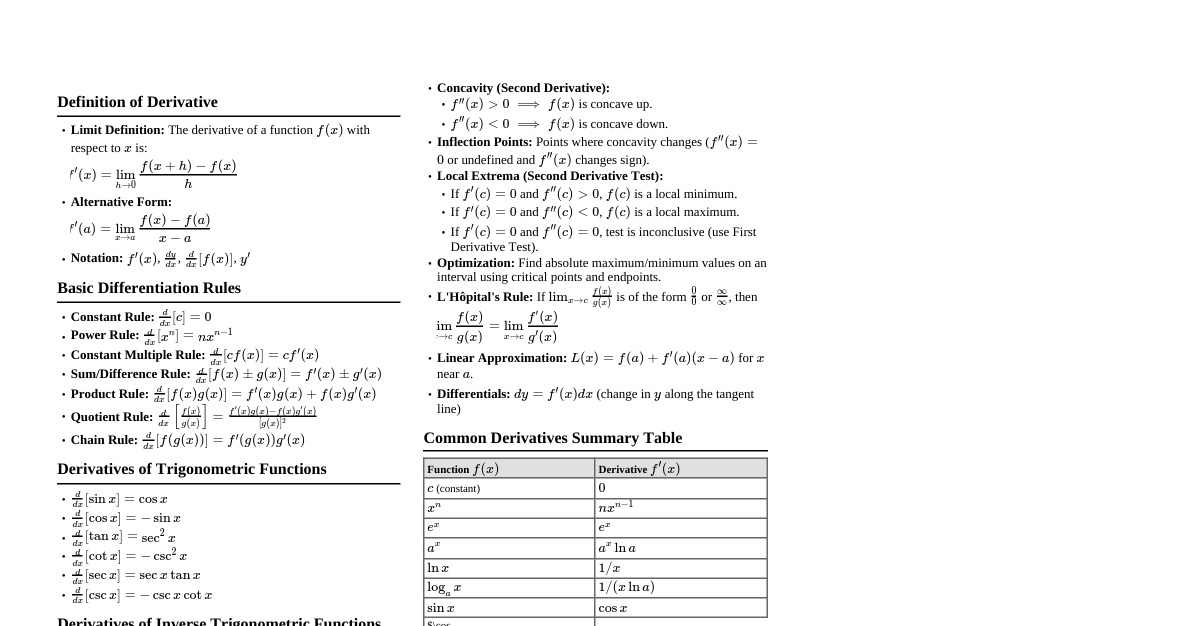
Definition of Derivative Limit Definition: The derivative of a function $f(x)$ with respect to $x$ is given by: $$f'(x) = \lim_{h \to 0} \frac{f(x+h) - f(x)}{h}$$ Alternative Form: $$f'(a) = \lim_{x \to a} \frac{f(x) - f(a)}{x-a}$$ Basic Differentiation Rules Constant Rule: If $c$ is a constant, then $\frac{d}{dx}(c) = 0$. Power Rule: If $n$ is any real number, then $\frac{d}{dx}(x^n) = nx^{n-1}$. Constant Multiple Rule: $\frac{d}{dx}(cf(x)) = c \frac{d}{dx}(f(x))$. Sum Rule: $\frac{d}{dx}(f(x) + g(x)) = \frac{d}{dx}(f(x)) + \frac{d}{dx}(g(x))$. Difference Rule: $\frac{d}{dx}(f(x) - g(x)) = \frac{d}{dx}(f(x)) - \frac{d}{dx}(g(x))$. Product Rule: $\frac{d}{dx}(f(x)g(x)) = f'(x)g(x) + f(x)g'(x)$. Quotient Rule: $\frac{d}{dx}\left(\frac{f(x)}{g(x)}\right) = \frac{f'(x)g(x) - f(x)g'(x)}{(g(x))^2}$. Chain Rule: $\frac{d}{dx}(f(g(x))) = f'(g(x))g'(x)$. Derivatives of Exponential and Logarithmic Functions $\frac{d}{dx}(e^x) = e^x$ $\frac{d}{dx}(a^x) = a^x \ln(a)$ $\frac{d}{dx}(\ln|x|) = \frac{1}{x}$ $\frac{d}{dx}(\log_a|x|) = \frac{1}{x \ln(a)}$ Derivatives of Trigonometric Functions $\frac{d}{dx}(\sin x) = \cos x$ $\frac{d}{dx}(\cos x) = -\sin x$ $\frac{d}{dx}(\tan x) = \sec^2 x$ $\frac{d}{dx}(\cot x) = -\csc^2 x$ $\frac{d}{dx}(\sec x) = \sec x \tan x$ $\frac{d}{dx}(\csc x) = -\csc x \cot x$ Derivatives of Inverse Trigonometric Functions $\frac{d}{dx}(\arcsin x) = \frac{1}{\sqrt{1-x^2}}$ $\frac{d}{dx}(\arccos x) = -\frac{1}{\sqrt{1-x^2}}$ $\frac{d}{dx}(\arctan x) = \frac{1}{1+x^2}$ $\frac{d}{dx}(\text{arccot } x) = -\frac{1}{1+x^2}$ $\frac{d}{dx}(\text{arcsec } x) = \frac{1}{|x|\sqrt{x^2-1}}$ $\frac{d}{dx}(\text{arccsc } x) = -\frac{1}{|x|\sqrt{x^2-1}}$ Higher-Order Derivatives Second Derivative: $f''(x) = \frac{d}{dx}(f'(x)) = \frac{d^2y}{dx^2}$ Third Derivative: $f'''(x) = \frac{d}{dx}(f''(x)) = \frac{d^3y}{dx^3}$ $n$-th Derivative: $f^{(n)}(x) = \frac{d^n y}{dx^n}$ Implicit Differentiation Used when $y$ is not explicitly defined as a function of $x$. Differentiate both sides of the equation with respect to $x$, treating $y$ as a function of $x$ and applying the chain rule. Example: For $x^2 + y^2 = r^2$, differentiate to get $2x + 2y \frac{dy}{dx} = 0$, so $\frac{dy}{dx} = -\frac{x}{y}$.
Create Your Own AI Cheatsheet
Generate comprehensive study cheatsheets from your notes, textbooks, or lecture materials using AI.