Amines & Diazonium Salts
Cheatsheet Content
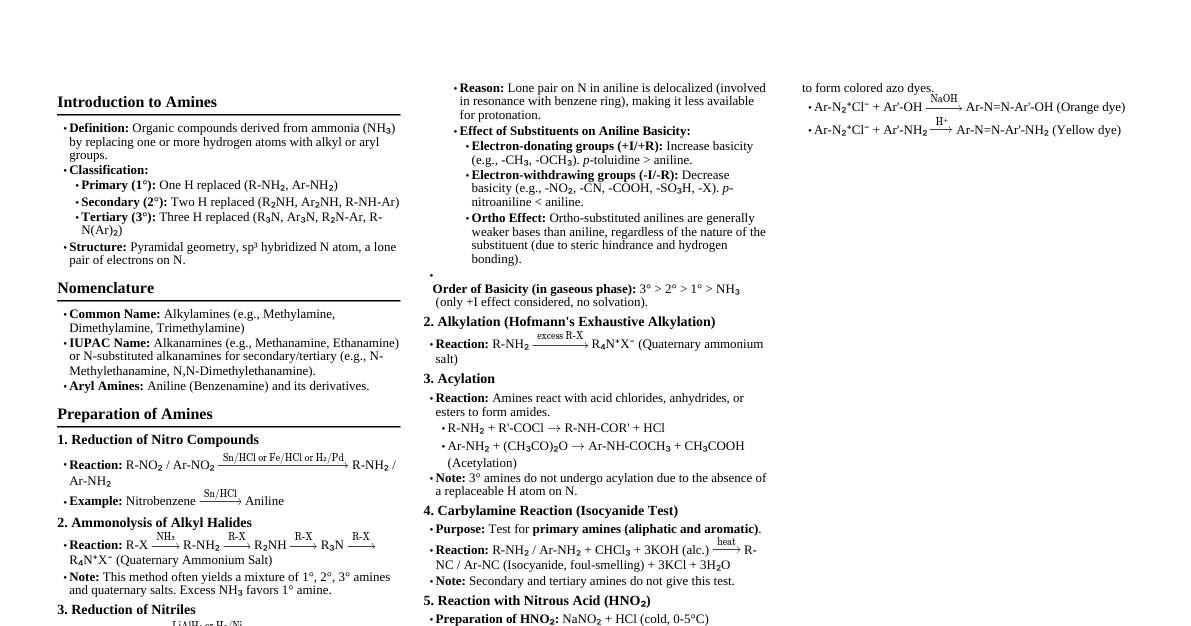
### Introduction, Biological Significance & Structure - **Definition:** Derivatives of ammonia ($NH_3$) synthesized by substituting one or more hydrogen atoms with alkyl or aryl residues. #### Biological & Synthetic Significance - Natural occurrence in proteins, vitamins, plant alkaloids, and physiological hormones. - **Adrenaline & Ephedrine:** Contain secondary amino functions; medically utilized to elevate arterial blood pressure. - **Novocain:** A synthetic local anesthetic compound. - **Benadryl:** Contains a tertiary amino backbone; highly active antihistaminic drug. #### Orbital Geometry & Bonding Constraints - The central nitrogen atom functions in an $sp^3$ hybridized state. - The dynamic arrangement is strictly pyramidal due to the non-bonding unshared lone pair of electrons localized within the fourth tetrahedral hybridization lobe. - **Bond Compression Angle:** Due to pronounced lone-pair-bond-pair orbital repulsion forces, the inner C-N-E angle (where E = C or H) contracts slightly from the ideal tetrahedral standard ($109.5^\circ$) down to $108^\circ$ (e.g., in trimethylamine). ``` [STRUCTURE MODEL: Compressed Pyramidal Geometry of Trimethylamine] (Lone Pair Orbital Cloud) N / \ / \ CH3 --- CH3 --- CH3 [C-N-C Internal Angle contracted to ~108°] ``` ### Complete Nomenclature Overview - **Common System:** Named by appending the suffix `-amine` directly to the parent alkyl root chain name (e.g., Methylamine). Symmetric secondary/tertiary classes use prefixes like `di-` or `tri-`. - **IUPAC Protocols:** Aliphatic frameworks are designated as `Alkanamines` by changing the final letter 'e' of the matching alkane with 'amine' (e.g., Methanamine). If multiple amino elements are present, position designations are added, preserving the full alkane name (e.g., Ethane-1,2-diamine). - Secondary and tertiary networks utilize a capital letter prefix `N-` to uniquely identify substitutions bound directly to the nitrogen center (e.g., N-Methylethanamine). - **Aromatic Amines:** The base core structure $C_6H_5NH_2$ is universally titled `Aniline` (which is an accepted IUPAC standard term, though systemically classified as Benzenamine). ### Exhaustive Methods of Preparation (With Detailed Mechanisms) #### 1. Hoffmann Bromamide Degradation Reaction Converts an unsubstituted primary amide into a primary amine with a net loss of exactly one carbon atom via an intramolecular shift. $R-CONH_2 + Br_2 + 4NaOH \rightarrow R-NH_2 + Na_2CO_3 + 2NaBr + 2H_2O$ ##### Complete Molecular Mechanism: 1. **Base-Driven Deprotonation:** Hydroxide removes an acidic proton from the primary amide nitrogen: $R-CO-NH_2 + OH^- \rightarrow R-CO-NH^- + H_2O$ 2. **N-Halogenation:** The resulting conjugate anion attacks molecular bromine to generate an N-bromoamide intermediate: $R-CO-NH^- + Br-Br \rightarrow R-CO-NH-Br + Br^-$ 3. **Secondary Proton Extraction:** A second equivalent of base removes the remaining proton from nitrogen, resulting in a highly unstable anion: $R-CO-NH-Br + OH^- \leftrightarrow R-CO-N^{(-)}-Br + H_2O$ 4. **Concerted Rearrangement (Isocyanate Route):** Bromide departs as a leaving group while the adjacent alkyl/aryl substituent (R) simultaneously migrates to the electron-deficient nitrogen atom, yielding an alkyl isocyanate intermediate: $[R-CO-N^{(-)}-Br] \rightarrow O=C=N-R + Br^-$ **Rate-Determining Step** 5. **Nucleophilic Cleavage (Hydrolysis):** Attack of water across the isocyanate carbonyl yields a transient carbamic acid structure, which undergoes spontaneous decarboxylation to release carbon dioxide and form the target amine: $O=C=N-R + H_2O \rightarrow [R-NH-COOH] \rightarrow R-NH_2 + CO_2$ #### 2. Gabriel Phthalimide Synthesis Used to synthesize highly pure primary aliphatic amines without contamination from secondary or tertiary amines. ##### Step-by-Step Reaction Progressions: 1. **Acidic Salt Production:** Phthalimide reacts with ethanolic $KOH$. Carbonyl systems adjacent to the nitrogen pull electron density, making the imide proton highly acidic and yielding potassium phthalimide. 2. **Nucleophilic Substitution ($SN_2$ Phase):** The powerful phthalimide nucleophilic anion attacks an unhindered primary alkyl halide (R-X), displacing the halogen to form N-alkylphthalimide: Phthalimide-$N^-K^+ + R-X \rightarrow$ Phthalimide-$N-R + KX$ 3. **Basic Hydrolysis:** Treatment with concentrated aqueous alkali (NaOH) or hydrazine ($NH_2NH_2$) liberates the clean primary aliphatic amine along with a byproduct phthalate salt. ##### Critical Boundary Limitation: Why Aryl Halides Fail: Aromatic primary amines (Aniline) cannot be synthesized by this pathway. Aryl halides (Ar-X) do not undergo standard nucleophilic substitution ($SN_2$) with the phthalimide anion because the carbon-halogen bond possesses partial double bond character due to resonance stabilization with the aromatic ring cloud. #### 3. Reduction of Nitro Compounds - Nitroalkanes or nitroarenes are converted to primary amines via catalytic hydrogenation ($H_2$ / $Pd$ in ethanol) or chemical reduction using active metals in acidic media ($Sn/HCl$ or $Fe/HCl$). - **Industrial Preference:** Production utilizing $Fe + HCl$ is preferred because the $FeCl_2$ byproduct undergoes spontaneous hydrolysis during the process, recycling and regenerating the required $HCl$. Consequently, only a small catalytic amount of acid is needed to launch the cycle. #### 4. Ammonolysis of Alkyl Halides - The nucleophilic attack of ammonia on alkyl halides forms a mixture of $1^\circ$, $2^\circ$, and $3^\circ$ amines, alongside quaternary ammonium salts ($R_4N^+X^-$). - **Halide Reactivity Profile:** $RI > RBr > RCl$ based on bond dissociation energies. - **Synthetic Control:** To isolate the primary amine as the major product, the reaction must be performed using a large excess of molecular ammonia. #### 5. Reduction of Nitriles (The Mendius Reaction) & Amides - **Mendius Reaction:** Reduction of nitriles using sodium amalgam in ethanol ($Na(Hg) / C_2H_5OH$) or $LiAlH_4$ yields primary amines. This pathway adds one extra carbon atom, enabling the ascent of a carbon chain series. $R-C \equiv N + 4[H] \rightarrow R–CH_2–NH_2$ - **Amide Reduction:** Treating an unsubstituted amide with $LiAlH_4$ followed by water yields an amine while retaining the original carbon count (unlike the Hoffmann degradation). $R-CONH_2 \rightarrow R-CH_2-NH_2$ ### Physical Properties & Correlative Matrix Data - **State & Odor Profiles:** Lower-mass aliphatic amines are gaseous species with distinct fishy odors. Intermediate analogs ($3+$ carbons) are liquid, while higher-weight networks are solid. Pure aniline is a colorless oil that darkens upon storage due to atmospheric oxidation. - **Solubility Mechanics:** Lower amines dissolve readily in water due to their ability to form hydrogen bonds with water molecules. Solubility decreases as the hydrophobic alkyl or aryl tail expands. Alcohols are more polar than amines and form stronger hydrogen bonds, resulting in higher water solubility. #### Table 1: Physical Parameter Matrix (Isomeric Mass Comparisons) | Chemical System Formula | Structural Classification Type | Molecular Weight | Normal Boiling Point (K) | Water Solubility (g/100g H2O) | | :---------------------- | :----------------------------- | :--------------- | :----------------------- | :---------------------------- | | $CH_3(CH_2)_3NH_2$ (n-Butylamine) | Primary ($1^\circ$) | 73 | 350.8 | Completely Miscible | | $(C_2H_5)_2NH$ (Diethylamine) | Secondary ($2^\circ$) | 73 | 329.3 | Highly Soluble | | $C_2H_5N(CH_3)_2$ (Ethyldimethylamine) | Tertiary ($3^\circ$) | 73 | 310.5 | Soluble | | $CH_3(CH_2)_3OH$ (n-Butanol) | Alcohol Analog | 74 | 390.8 | 7.9 | #### Physical Trend Analysis: - **Boiling Point Progression:** For structural isomers of identical weight ($73$), the boiling points decrease in the order: $1^\circ > 2^\circ > 3^\circ$. This occurs because primary and secondary amines contain polar N-H bonds that drive intermolecular hydrogen bonding, whereas tertiary amines lack hydrogen atoms on the nitrogen and cannot form these networks. - **Oxygen vs. Nitrogen Electronegativity:** Alcohols exhibit higher boiling points than comparable amines because oxygen is more electronegative than nitrogen, making the O–H...O hydrogen bonds stronger than N-H...N bonds. ### Chemical Reactions & Quantitative Basicity #### A. Comprehensive Basicity Analysis Amines function as Lewis bases due to the lone pair of electrons on the nitrogen atom. Basicity is quantified by the equilibrium values Kb or pKb = -log Kb. A smaller pKb value indicates a stronger base. ##### The Gas Phase vs. Aqueous Phase Basicity Trends (High-Yield Exams) - **Gas Phase Condition:** Regulated purely by inductive electronic displacement (+I effect). The trend follows a regular progression: $3^\circ > 2^\circ > 1^\circ > NH_3$ - **Aqueous Phase Condition:** Determined by a competitive balance between three physical factors: +I Inductive effect, Steric Hindrance, and Solvation Stabilization (hydrogen bonding between the water solvent and the protonated ammonium cation). - **Methyl Series Variant (–CH3):** $2^\circ > 1^\circ > 3^\circ > NH_3$ Actual Data: $(CH_3)_2NH (3.27) > CH_3NH_2 (3.38) > (CH_3)_3N (4.22) > NH_3 (4.75)$ - **Ethyl Series Variant (-C2H5):** $2^\circ > 3^\circ > 1^\circ > NH_3$ Actual Data: $(C_2H_5)_2NH (3.00) > (C_2H_5)_3N (3.25) > C_2H_5NH_2 (3.29) > NH_3 (4.75)$ ##### Aromatic Base Systems (Aniline Weakness) - Aniline is a weaker base than ammonia or aliphatic amines (pKb = 9.38). - **Resonance Stabilization:** The unshared lone pair on nitrogen conjugates with the benzene ring's ring cloud, delocalizing over the ring across five resonating structures and reducing its availability for protonation. ``` Aniline Resonance Path: [C6H5-NH2] [-C6H5=N+H2 (ortho)] [-C6H5=N+H2 (para)] [-C6H5=N+H2 (ortho)] ``` - The anilinium ion ($C_6H_5NH_3^+$) formed upon protonation is stabilized by only two resonance structures, making protonation less thermodynamically favored than the free base form. - **Substituent Effects on Aromatic Rings:** - **Electron Donating Groups (EDG):** (e.g., $–OCH_3, –CH_3$) enrich ring electron density $\rightarrow$ Basicity Increases. - **Electron Withdrawing Groups (EWG):** (e.g., $–NO_2, –SO_3H, –COOH, -X$) withdraw electron density $\rightarrow$ Basicity Decreases. - **The Ortho Effect:** Ortho-substituted anilines are generally weaker bases than aniline, regardless of whether the substituent is activating or deactivating, due to Steric Inhibition of Protonation (SIP). #### B. Acylation & Benzoylation (Schotten-Baumann Reaction) - Primary and secondary amines react with acid chlorides or anhydrides via nucleophilic substitution, displacing a halogen to form amides. $C_2H_5-NH_2 + CH_3COCl \rightarrow C_2H_5-NH-COCH_3 + HCl$ - **Benzoylation (Schotten-Baumann):** Reaction incorporating benzoyl chloride: $CH_3NH_2 + C_6H_5COCl \rightarrow CH_3NHCOC_6H_5 + HCl$ - **Role of Pyridine/Base Catalyst:** Adding a base stronger than the amine (such as pyridine) neutralizes the HCl byproduct as it forms, shifting the equilibrium toward the product side. ### Diagnostic Separation & Identification Testing Schemes #### Table 2: Three-Way Amine Differentiation Testing Matrix | Analytical Test Method | Primary Amine ($1^\circ$) | Secondary Amine ($2^\circ$) | Tertiary Amine ($3^\circ$) | | :----------------------------- | :---------------------------------------------------- | :--------------------------------------------------- | :--------------------------------------------- | | Carbylamine Reaction ($CHCl_3 + KOH + \Delta$) | Gives a foul, offensive odor due to Isocyanide ($R-NC$) formation. | No observable chemical reaction. | No observable chemical reaction. | | Hinsberg Reagent Test (Benzenesulphonyl chloride, $C_6H_5SO_2Cl$)| Forms N-alkylbenzenesulphonamide; Soluble in aqueous alkali (NaOH). | Forms N,N-dialkylbenzenesulphonamide; Insoluble in alkali (precipitates). | No chemical reaction occurs; remains unreacted. | | Nitrous Acid Treatment ($HNO_2$ at chilled temp) | Liberates $N_2$ gas quantitatively with alcohol formation (Aliphatic). | Produces a yellow, oily insoluble N-nitrosamine layer. | Dissolves to form a clear, water-soluble trialkylammonium nitrite salt. | ##### Hinsberg Solubility Principles: - The primary product contains a highly acidic hydrogen atom bound to nitrogen, pulled by the strongly electron-withdrawing sulphonyl group. This allows base deprotonation to form a soluble salt. - The secondary product lacks an acidic hydrogen atom on the nitrogen center and cannot react further with alkali, remaining insoluble. ### Aromatic Ring Substitution Dynamics (Aniline Activation Control) The amino group ($-NH_2$) is a strong activator and an ortho/para-director due to resonance electron donation into the aromatic ring. #### A. Uncontrolled Bromination - Aniline reacts rapidly with bromine water at room temperature, undergoing immediate substitution at all open activated positions to form a white precipitate of 2,4,6-tribromoaniline. $Aniline + 3Br_2 \rightarrow 2,4,6-Tribromoaniline$ (White Ppt) $+ 3HBr$ #### B. Controlled Monobromination via Protection - To prepare a monosubstituted product (e.g., p-bromoaniline), the activating power of the $-NH_2$ group must be temporarily decreased ("protected") by acetylation with acetic anhydride in pyridine, forming acetanilide ($-NHCOCH_3$). - The nitrogen lone pair delocalizes into the carbonyl oxygen via resonance, reducing its electron donation into the benzene ring. Subsequent bromination followed by acidic or basic amide hydrolysis yields the clean monosubstituted product, 4-bromoaniline. #### C. Nitration Anomalies - Direct nitration using a strong acid mixture ($HNO_3 + H_2SO_4$) yields a significant amount of the meta-derivative ($47\%$), along with para ($51\%$) and ortho ($2\%$) products. - **Mechanism:** In highly acidic media, aniline undergoes protonation to form the anilinium ion ($-NH_3^+$). This species is strongly electron-withdrawing and acts as a meta-director, altering the substitution profile. To obtain pure p-nitroaniline, the amino group must first be protected via acetylation prior to nitration. #### D. Sulphonation & Zwitterion Intermediates - Aniline reacts with concentrated $H_2SO_4$ to form anilinium hydrogensulphate. Heating this salt at $453-473 K$ yields p-aminobenzenesulfonic acid (Sulphanilic acid). - Sulphanilic acid undergoes internal proton transfer to exist as a stable dipolar Zwitterion ($^+H_3N–C_6H_4–SO_3^-$). - **Critical Reaction Limitation:** Aniline does not undergo Friedel-Crafts Alkylation or Acylation because the amine functions as a Lewis base, forming an unreactive salt complex with the anhydrous $AlCl_3$ Lewis acid catalyst. The positive charge on the nitrogen deactivates the aromatic ring toward electrophilic attack. ### Diazonium Salts & Synthetic Transformations (Master Mindmap Summary) - **Diazotisation:** Primary aromatic amines react with nitrous acid ($NaNO_2 + HCl$) at $273–278 K$ to form stable arenediazonium salts: $C_6H_5NH_2 + NaNO_2 + 2HCl \rightarrow C_6H_5N_2^+Cl^- + NaCl + 2H_2O$ #### Table 3: Synthetic Transformations of Benzenediazonium Salts | Reaction Title | Reagents & Conditions | Target Organic Product | | :----------------------------- | :------------------------------------------ | :------------------------------------------- | | Sandmeyer Reaction | $Cu_2Cl_2/HCl, Cu_2Br_2/HBr,$ or $CuCN/KCN$ | Chlorobenzene (ArCl), Bromobenzene (ArBr), Cyanobenzene (ArCN) | | Gatterman Reaction | Copper Metal Powder + Halogen Acid (HCl / HBr) | ArCl or ArBr (Lower yield than Sandmeyer) | | Replacement by Iodide | Warm with aqueous Potassium Iodide (KI) | Iodobenzene (ArI) | | Balz-Schiemann Reaction | Fluoroboric acid ($HBF_4$) followed by thermal decomposition | Fluorobenzene (ArF) | | Deamination (Reduction) | Hypophosphorous acid ($H_3PO_2 + H_2O$) or Ethanol ($CH_3CH_2OH$) | Benzene (ArH) | | Hydrolysis | Warm with water up to 283 K | Phenol (ArOH) | | Replacement by Nitro | Precipitate with $HBF_4$, then heat with aqueous $NaNO_2/Cu$ | Nitrobenzene (Ar$NO_2$) | #### Electrophilic Coupling Reactions (Azo Dye Formation) Diazonium cations act as weak electrophiles, reacting with highly activated aromatic systems (phenols or anilines) to form intensely colored azo compounds. ##### Azo Dye Mechanisms: - **Phenol Coupling (Weakly Alkaline Medium, pH 9-10):** Attack at the para position yields p-hydroxyazobenzene, an orange dye. - **Aniline Coupling (Weakly Acidic Medium, pH 5-6):** Attack at the para position yields p-aminoazobenzene, a yellow dye. ``` MASTER DIAZONIUM SALTS MINDMAP HIGH-YIELD ROADMAP ============================================================= BENZENEDIAZONIUM CHLORIDE --+--- /----- [Sandmeyer] Cu2Cl2 / HCl ------> CHLOROBENZENE (ArCl) | /----- [Sandmeyer] Cu2Br2 / HBr ------> BROMOBENZENE (ArBr) | /----- [Sandmeyer] CuCN / KCN --------> CYANOBENZENE (ArCN) | /------ KI Powder / Warm --------------> IODOBENZENE (ArI) | /--- [Balz-Schiemann] HBF4 & Heat ----> FLUOROBENZENE (ArF) (C6H5N2+ Cl-) |---- H2O / Heat to 283 K ------------------> PHENOL (ArOH) |---- [Deamination] H3PO2 / H2O ------------> BENZENE (ArH) \---- Phenol (pH 9-10) ---------------------> ORANGE AZO DYE \--- Aniline (pH 5-6) ---------------------> YELLOW AZO DYE ```