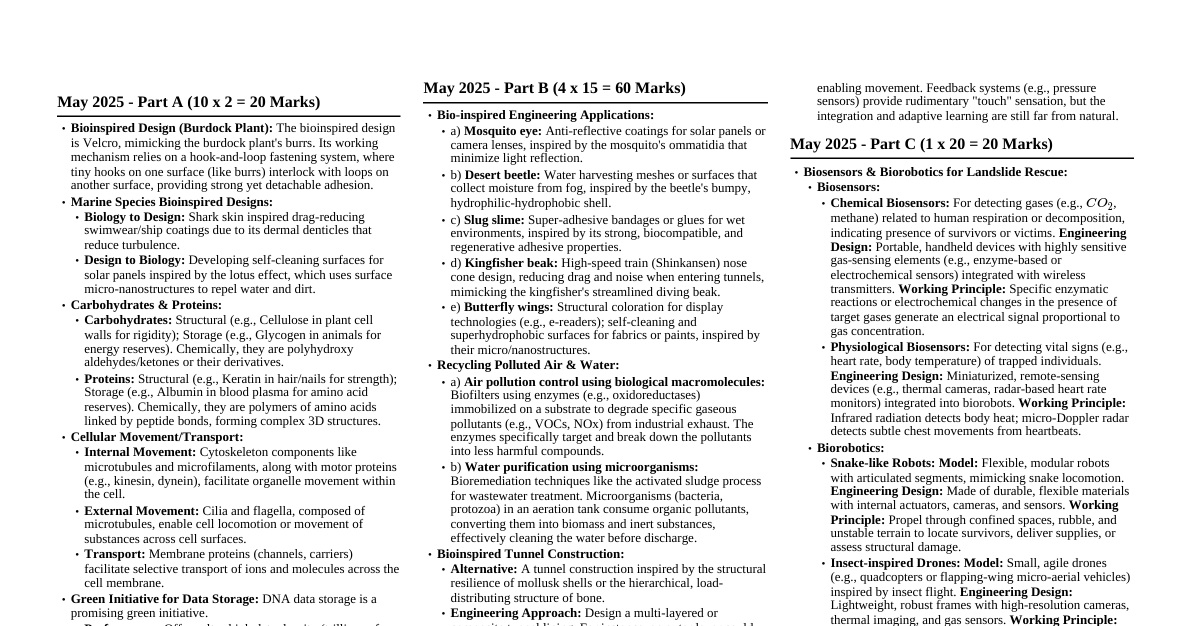
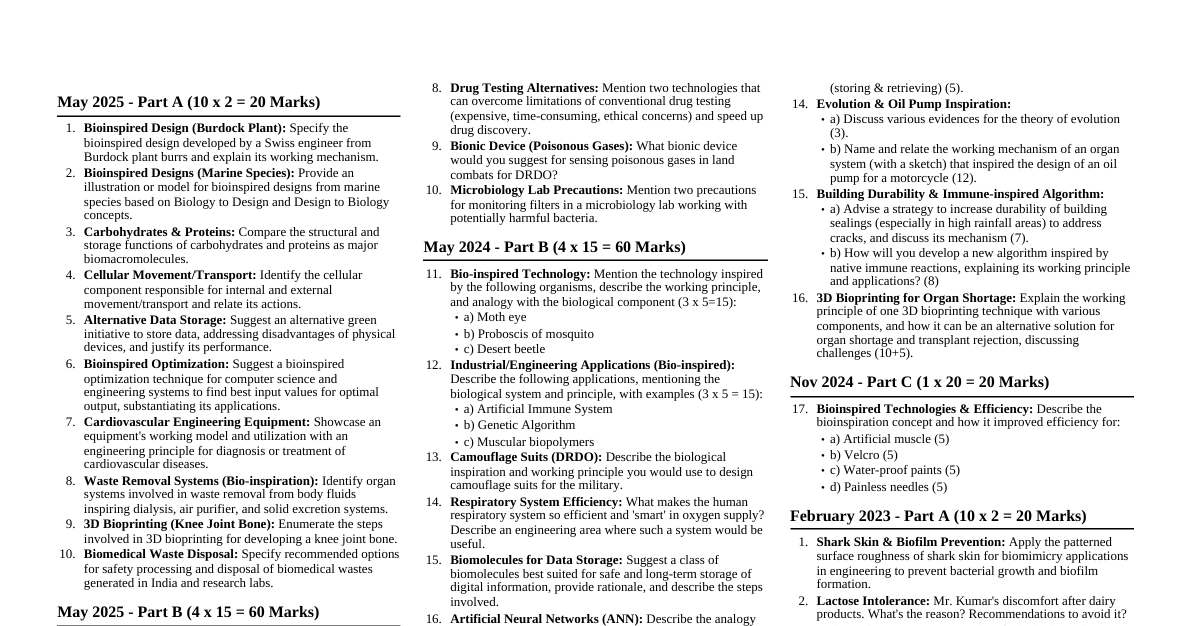
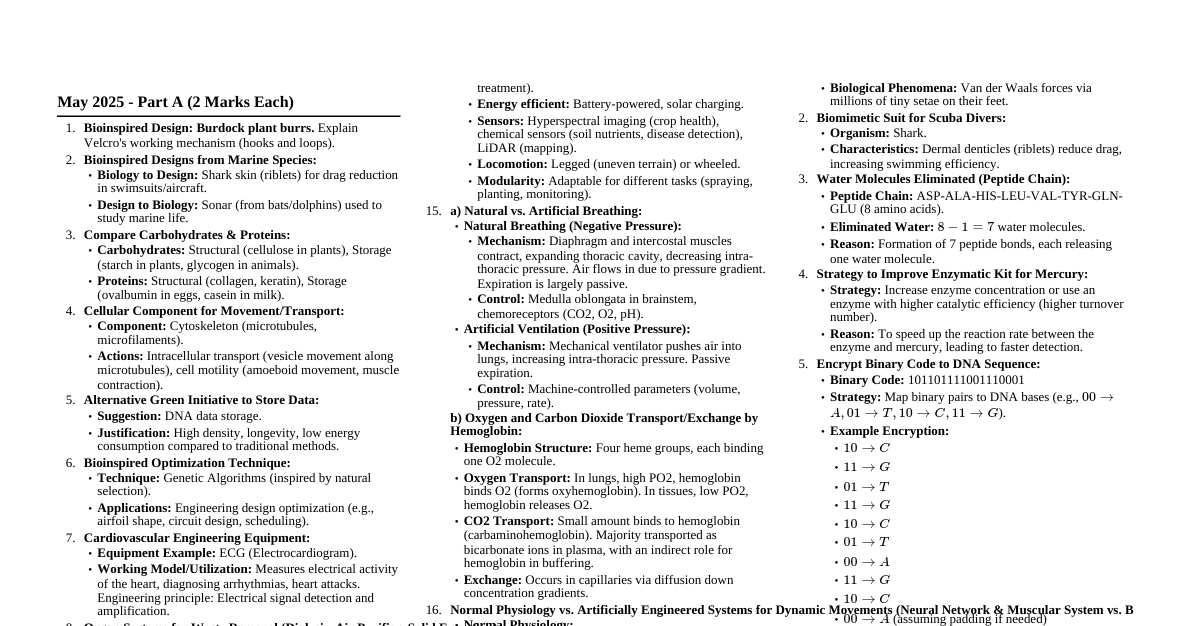
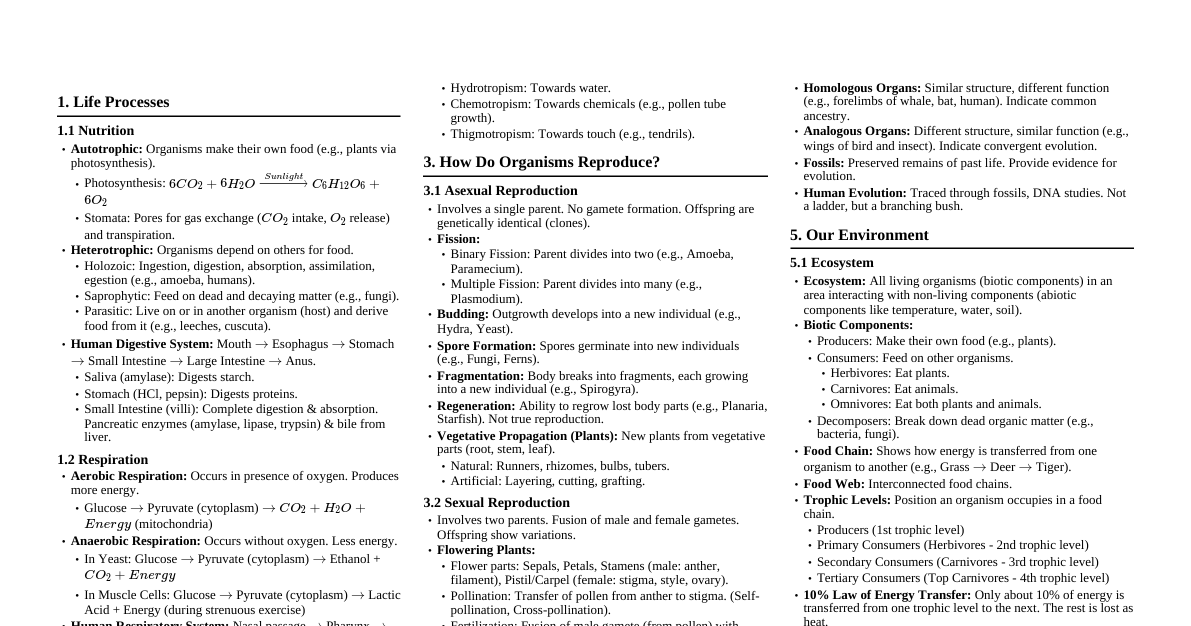
Biology for Engineers: 7-Year QPs
Cheatsheet Content
May 2025 - Part A (10 x 2 = 20 Marks) Bioinspired Design (Burdock Plant): The bioinspired design is Velcro, mimicking the burdock plant's burrs. Its working mechanism relies on a hook-and-loop fastening system, where tiny hooks on one surface (like burrs) interlock with loops on another surface, providing strong yet detachable adhesion. Marine Species Bioinspired Designs: Biology to Design: Shark skin inspired drag-reducing swimwear/ship coatings due to its dermal denticles that reduce turbulence. Design to Biology: Developing self-cleaning surfaces for solar panels inspired by the lotus effect, which uses surface micro-nanostructures to repel water and dirt. Carbohydrates & Proteins: Carbohydrates: Structural (e.g., Cellulose in plant cell walls for rigidity); Storage (e.g., Glycogen in animals for energy reserves). Chemically, they are polyhydroxy aldehydes/ketones or their derivatives. Proteins: Structural (e.g., Keratin in hair/nails for strength); Storage (e.g., Albumin in blood plasma for amino acid reserves). Chemically, they are polymers of amino acids linked by peptide bonds, forming complex 3D structures. Cellular Movement/Transport: Internal Movement: Cytoskeleton components like microtubules and microfilaments, along with motor proteins (e.g., kinesin, dynein), facilitate organelle movement within the cell. External Movement: Cilia and flagella, composed of microtubules, enable cell locomotion or movement of substances across cell surfaces. Transport: Membrane proteins (channels, carriers) facilitate selective transport of ions and molecules across the cell membrane. Green Initiative for Data Storage: DNA data storage is a promising green initiative. Performance: Offers ultra-high data density (trillions of gigabytes per gram), long-term stability (thousands of years if preserved), and potentially low energy consumption for storage once synthesized, compared to conventional electronic storage which requires continuous power and degrades over time. Bioinspired Optimization Technique: Genetic Algorithms (GA) are a bioinspired optimization technique. Applications: In engineering designs, GAs can optimize structural designs (e.g., truss structures for minimal weight and maximum strength), optimize airfoil shapes for better aerodynamic performance, or solve complex logistics and scheduling problems by mimicking natural selection, crossover, and mutation to find optimal solutions. Cardiovascular Engineering & Technology (CVET): Equipment: A pacemaker. Working Model: It's an electronic device that sends electrical impulses to the heart to regulate heart rate. It consists of a pulse generator (battery and circuitry) and leads (wires). Utilization: Used to treat bradycardia (slow heart rate) or heart block. It monitors the heart's natural rhythm and delivers impulses only when needed, ensuring the heart beats at a healthy pace. Engineering Principle: Based on electrical stimulation and feedback control systems to maintain physiological parameters. Waste Removal Organ Systems: Renal System (Kidneys): Filters blood to remove metabolic waste (urea, creatinine) and excess water, producing urine. Inspired dialysis machines. Respiratory System (Lungs): Removes gaseous waste (carbon dioxide) from the body. Can inspire air purification systems or gas exchange membranes. Digestive System (Large Intestine): Eliminates undigested food and other waste as feces. Can inspire waste processing and compacting technologies. 3D Bioprinting for Knee Joint Bone: Imaging: Obtain patient-specific anatomical data (CT/MRI) of the knee joint. CAD Model: Create a 3D computer-aided design model of the bone defect. Bioink Preparation: Formulate bioink with bone cells (osteoblasts, mesenchymal stem cells), growth factors, and biocompatible hydrogels/biomaterials (e.g., hydroxyapatite). Printing: Use a 3D bioprinter to deposit bioink layer-by-layer according to the CAD model, forming a scaffold with cells. Maturation/Bioreactor: Culture the bioprinted construct in a bioreactor under specific mechanical and biochemical stimuli to promote cell differentiation and tissue maturation into functional bone tissue. Implantation: Surgically implant the matured bone construct into the knee joint. Biomedical Waste Processing/Disposal: Segregation: Separate waste at the source into color-coded bags/containers based on type (infectious, sharps, chemical, general). Sterilization/Disinfection: Autoclaving (steam sterilization) or chemical disinfection for infectious waste to kill pathogens. Incineration: High-temperature burning for pathological waste, sharps, and pharmaceuticals to reduce volume and destroy hazardous components. Encapsulation/Inertization: For sharps and chemical waste, to prevent injury and release of toxic substances. Landfilling: Secure landfilling for treated, non-reusable waste residues. May 2025 - Part B (4 x 15 = 60 Marks) Bio-inspired Engineering Applications: a) Mosquito eye: Anti-reflective coatings for solar panels or camera lenses, inspired by the mosquito's ommatidia that minimize light reflection. b) Desert beetle: Water harvesting meshes or surfaces that collect moisture from fog, inspired by the beetle's bumpy, hydrophilic-hydrophobic shell. c) Slug slime: Super-adhesive bandages or glues for wet environments, inspired by its strong, biocompatible, and regenerative adhesive properties. d) Kingfisher beak: High-speed train (Shinkansen) nose cone design, reducing drag and noise when entering tunnels, mimicking the kingfisher's streamlined diving beak. e) Butterfly wings: Structural coloration for display technologies (e.g., e-readers); self-cleaning and superhydrophobic surfaces for fabrics or paints, inspired by their micro/nanostructures. Recycling Polluted Air & Water: a) Air pollution control using biological macromolecules: Biofilters using enzymes (e.g., oxidoreductases) immobilized on a substrate to degrade specific gaseous pollutants (e.g., VOCs, NOx) from industrial exhaust. The enzymes specifically target and break down the pollutants into less harmful compounds. b) Water purification using microorganisms: Bioremediation techniques like the activated sludge process for wastewater treatment. Microorganisms (bacteria, protozoa) in an aeration tank consume organic pollutants, converting them into biomass and inert substances, effectively cleaning the water before discharge. Bioinspired Tunnel Construction: Alternative: A tunnel construction inspired by the structural resilience of mollusk shells or the hierarchical, load-distributing structure of bone. Engineering Approach: Design a multi-layered or composite tunnel lining. For instance, an outer layer could be tough and impact-resistant (like nacre in shells), while an inner layer could be flexible and self-healing (mimicking bone's ability to repair microfractures). This could involve using fiber-reinforced composites or self-healing concrete. Pros: Increased resistance to external pressures, enhanced durability, reduced maintenance costs due to self-healing properties, and improved safety against collapse. Cons: Higher initial material costs, complex manufacturing processes, and potential challenges in scaling up bioinspired material production. Biological Concept: Biomineralization (mollusk shells) for strength and toughness, or hierarchical structure and self-repair (bone) for resilience and damage tolerance. Bio-inspired Robotics in Agriculture: Inspiration: Tiny robots inspired by insects (e.g., bees for pollination, ants for navigation, beetles for robust locomotion). Characteristic Features: Agility and Maneuverability: Small size and multi-legged/winged designs enable navigation in complex terrains or dense crop fields without damaging plants. Robustness and Durability: Miniaturized, impact-resistant designs allow them to withstand falls or collisions in outdoor environments, similar to insect exoskeletons. Advanced Sensing: Equipped with bioinspired sensors (e.g., compound eyes for vision, olfactory sensors for pest detection, tactile sensors for delicate handling) to interact with plants and soil. Energy Efficiency: Optimized locomotion mechanisms (e.g., flapping wings, efficient crawling) to maximize operational time on small power sources. Swarm Intelligence: Ability to operate collaboratively in large numbers, inspired by insect colonies, for efficient monitoring, pollination, or targeted pest control over large areas. Breathing & Oxygen Transport: a) Natural Breathing: Negative pressure breathing (diaphragm contraction creates vacuum, drawing air in). It's an active, automatic process controlled by the brainstem, adapting to metabolic needs. Artificial Breathing: Positive pressure ventilation (mechanical ventilator pushes air into lungs). It's a machine-driven process, often used when natural breathing is insufficient, and requires careful monitoring to avoid lung injury. b) Oxygen & Carbon Dioxide Transport: Hemoglobin, a protein in red blood cells, binds to oxygen in the lungs (where $pO_2$ is high) to form oxyhemoglobin, transporting it to tissues. In tissues (where $pO_2$ is low and $pCO_2$ is high), oxygen is released. Conversely, hemoglobin also facilitates $CO_2$ transport (as carbaminohemoglobin or bicarbonate ions) from tissues back to the lungs for exhalation, mediated by pH changes and enzyme carbonic anhydrase. Neural Network & Muscular System / Bionics & Prosthetics: Normal Physiology: The central nervous system (neural network) sends electrical signals via motor neurons to activate specific muscles. This coordinated action, involving sensory feedback, allows for precise and dynamic movements. The brain learns and adapts motor control based on experience. Artificially Engineered Systems (Bionics, Prosthetics): Modern bionic prosthetics aim to mimic this. Sensors (e.g., EMG electrodes) detect electrical signals from residual muscles, which are then interpreted by a control unit (microprocessor, AI algorithms mimicking neural networks). This unit sends commands to artificial actuators (motors, electroactive polymers) in the prosthetic limb, enabling movement. Feedback systems (e.g., pressure sensors) provide rudimentary "touch" sensation, but the integration and adaptive learning are still far from natural. May 2025 - Part C (1 x 20 = 20 Marks) Biosensors & Biorobotics for Landslide Rescue: Biosensors: Chemical Biosensors: For detecting gases (e.g., $CO_2$, methane) related to human respiration or decomposition, indicating presence of survivors or victims. Engineering Design: Portable, handheld devices with highly sensitive gas-sensing elements (e.g., enzyme-based or electrochemical sensors) integrated with wireless transmitters. Working Principle: Specific enzymatic reactions or electrochemical changes in the presence of target gases generate an electrical signal proportional to gas concentration. Physiological Biosensors: For detecting vital signs (e.g., heart rate, body temperature) of trapped individuals. Engineering Design: Miniaturized, remote-sensing devices (e.g., thermal cameras, radar-based heart rate monitors) integrated into biorobots. Working Principle: Infrared radiation detects body heat; micro-Doppler radar detects subtle chest movements from heartbeats. Biorobotics: Snake-like Robots: Model: Flexible, modular robots with articulated segments, mimicking snake locomotion. Engineering Design: Made of durable, flexible materials with internal actuators, cameras, and sensors. Working Principle: Propel through confined spaces, rubble, and unstable terrain to locate survivors, deliver supplies, or assess structural damage. Insect-inspired Drones: Model: Small, agile drones (e.g., quadcopters or flapping-wing micro-aerial vehicles) inspired by insect flight. Engineering Design: Lightweight, robust frames with high-resolution cameras, thermal imaging, and gas sensors. Working Principle: Rapidly survey large, inaccessible areas, map terrain, identify hotspots, and deliver communication devices to survivors. Rehabilitation: Bioinspired prosthetics (e.g., bionic limbs) and exoskeletons for injured patients, providing dynamic support and restoring mobility through neural interfaces or EMG control. May 2024 - Part A (10 x 2 = 20 Marks) Super-Adhesive Inspiration: The gecko, specifically its feet. The biological phenomenon is the high density of microscopic hair-like structures (setae) that split into even finer spatulae, creating a large contact area and enabling strong van der Waals forces with surfaces. Biomimetic Scuba Suit: The shark. The characteristics are its dermal denticles (placoid scales) which reduce drag and turbulence in water, allowing for faster and more efficient swimming. Peptide Chain Water Elimination: For ASP-ALA-HIS-LEU-VAL-TYR-GLN-GLU (which has 8 amino acids), 7 water molecules are eliminated. The reason is that one water molecule is removed for each peptide bond formed between two amino acids, and $n-1$ peptide bonds are formed for $n$ amino acids. Enzymatic Kit Improvement: Strategy: Enzyme immobilization. Reason: Immobilizing the enzyme (e.g., on a solid support) can increase its stability, reusability, and allow for a higher enzyme concentration in a smaller volume, thereby speeding up the reaction and improving response time. Optimizing pH and temperature can also enhance activity. Binary to DNA Encryption: Strategy: Map binary pairs to DNA bases (e.g., 00=A, 01=T, 10=C, 11=G). Encryption: 10|11|01|11|10|01|11|00|01 C |G |T |G |C |T |G |A |T Resulting DNA sequence: CGT GCT GAT Human Muscle Mimicry Materials: Electroactive Polymers (EAPs): Materials like dielectric elastomers or ionic polymer-metal composites that change shape or size when an electric field is applied, mimicking muscle contraction. Hydrogels: Soft, water-filled polymeric networks that can swell or contract in response to stimuli, offering compliant movement. Shape Memory Alloys (SMAs): Metals like Nitinol that can recover their original shape upon heating, useful for creating robotic actuators. Optimal Model Selection (Car Company): Technique: Genetic Algorithm (GA). Principles: GAs mimic natural selection. They start with a population of car designs (chromosomes), evaluate their fitness (e.g., fuel efficiency, safety, cost), then use operations like selection (fitter designs survive), crossover (combining features of two designs), and mutation (random changes) to evolve new, improved designs over generations. Drug Discovery Technologies: Organ-on-a-chip: Microfluidic devices that simulate human organs' physiology, allowing drug testing in a more relevant biological context than 2D cell cultures. In silico drug design: Computational methods (e.g., molecular docking, AI/machine learning) to predict drug-target interactions and optimize drug candidates, reducing the need for extensive lab experiments. Bionic Device for Poisonous Gases: A bionic nose, inspired by the highly sensitive olfactory systems of animals (e.g., dogs, insects). It would use an array of chemical sensors (e.g., polymer composites, metal oxides) that react to specific volatile organic compounds (VOCs) present in poisonous gases, converting chemical signals into electrical ones for detection and identification. Microbiology Lab Precautions: Always wear appropriate Personal Protective Equipment (PPE) including lab coat, gloves, and eye protection to prevent skin contact and inhalation of microbes. Work inside a Biological Safety Cabinet (BSC) for procedures that generate aerosols to contain airborne pathogens and protect both personnel and experiments from contamination. May 2024 - Part B (4 x 15 = 60 Marks) Technology Inspired by Organisms: a) Moth eye: Biological component: The surface of a moth's eye is covered with an array of tiny, sub-wavelength nanostructures. Working principle: These nanostructures create a gradient refractive index, which reduces light reflection and enhances light transmission, allowing the moth to see better in low light conditions. Analogy: Anti-reflective coatings for solar panels (to maximize light absorption and efficiency) or optical lenses (to minimize glare). b) Proboscis of mosquito: Biological component: The mosquito's proboscis is a complex, multi-component feeding tube that can painlessly pierce skin. It includes serrated stylets for cutting and a blunt hypodermic-like tube for blood extraction. Working principle: The serrated stylets vibrate rapidly, reducing the force required for penetration, while salivary proteins numb the area and prevent clotting. Analogy: Painless microneedles for drug delivery or blood sampling, designed with micro-serrations or vibrations to reduce patient discomfort. c) Desert beetle: Biological component: The Stenocara beetle's back has a unique surface structure with alternating hydrophilic (water-attracting) bumps and hydrophobic (water-repelling) troughs. Working principle: Fog droplets condense on the hydrophilic bumps, grow in size, and then roll down into the hydrophobic troughs, collecting at the beetle's mouth for drinking. Analogy: Water harvesting systems for arid regions, using patterned surfaces to efficiently collect atmospheric moisture; or self-cleaning surfaces that shed dirt with rolling water droplets. Industrial/Engineering Applications: a) Artificial Immune System (AIS): Biological system: The vertebrate immune system, which identifies and eliminates foreign pathogens while tolerating self-cells. Principle: Learning and memory, self-non-self discrimination, diversity, and distributed recognition. AIS algorithms (e.g., Negative Selection Algorithm, Clonal Selection Algorithm) mimic these principles. Examples: Anomaly detection in cybersecurity (identifying novel threats), fault diagnosis in complex systems, and optimization problems. b) Genetic Algorithm (GA): Biological system: Natural evolution by natural selection. Principle: Iterative optimization process involving selection, crossover (recombination), and mutation operators applied to a population of candidate solutions (chromosomes). Fitter solutions are more likely to survive and reproduce. Examples: Optimizing engineering designs (e.g., turbine blade shapes), financial modeling, logistics and scheduling, and machine learning model tuning. c) Muscular Biopolymers: Biological system: Natural muscles, composed of protein polymers (actin, myosin) that contract and relax. Principle: Conversion of chemical energy into mechanical work through conformational changes of polymer chains. Examples: Development of soft robotics (robots with compliant, deformable bodies for safe human interaction), artificial muscles using electroactive polymers or hydrogels for prosthetics, and actuators in micro-electromechanical systems (MEMS). Camouflage Suits: Biological Inspiration: Organisms like the chameleon, cuttlefish, and octopus, which exhibit dynamic camouflage by rapidly changing their skin color and texture to blend into their surroundings. Working Principle: These animals use specialized pigment-containing cells (chromatophores), light-reflecting cells (iridophores), and light-scattering cells (leucophores) controlled by their nervous system. By expanding or contracting these cells, they can alter their appearance almost instantly. Design for Camouflage Suits: A bioinspired camouflage suit could incorporate smart textiles embedded with electrochromic or thermochromic materials. These materials would change color or pattern in response to environmental stimuli (e.g., light sensors, temperature sensors) or direct user input. The suit could also integrate micro-actuators to alter surface texture, mimicking the three-dimensional blending observed in cephalopods. The aim is to create an adaptive camouflage that dynamically matches the wearer's environment, making them difficult to detect by visual or thermal sensors. Efficient Respiratory System & Engineering: Efficiency & 'Smartness' of Respiratory System: Hierarchical Branching: The extensive branching of the airways (trachea to bronchioles) and blood vessels (pulmonary artery to capillaries) maximizes surface area for gas exchange. Thin Diffusion Barrier: The extremely thin alveolar-capillary membrane ensures rapid diffusion of gases. Ventilation-Perfusion Matching: Local regulatory mechanisms ensure that airflow (ventilation) and blood flow (perfusion) are matched to optimize gas exchange across different lung regions. Automatic Control: The brainstem precisely regulates breathing rate and depth based on blood $CO_2$, $O_2$, and pH levels, ensuring metabolic demands are met. Self-Cleaning: Mucociliary escalator and macrophages remove inhaled particles and pathogens. Engineering Application: The efficiency of the respiratory system is highly useful in Heating, Ventilation, and Air Conditioning (HVAC) systems , particularly in critical environments like cleanrooms or operating theaters. Utility: Bioinspired HVAC could use hierarchical branching ductwork for more uniform air distribution, minimizing dead zones and optimizing energy usage. Advanced sensors and feedback loops, mimicking the brain's respiratory control, could dynamically adjust ventilation rates and airflow patterns based on real-time occupancy, air quality, and temperature, leading to significant energy savings and improved indoor air quality. Biomolecules for Data Storage: Class of Biomolecules: DNA (Deoxyribonucleic Acid). Rationale: High Density: DNA can store information at an incredibly high density (theoretical maximum of 2 bits per base, practically petabytes per gram), far exceeding current electronic storage. Long-Term Stability: DNA, if properly preserved (e.g., dehydrated, encapsulated), can remain stable for thousands to millions of years, making it ideal for archival storage. Low Energy: Once synthesized, DNA requires no energy to maintain the stored information, unlike electronic media. Ubiquitous Readability: DNA is the universal language of life; as long as life exists, there will be tools to read DNA. Steps Involved: Encoding: Convert digital data (binary 0s and 1s) into a DNA sequence using a specific coding scheme (e.g., 00=A, 01=T, 10=C, 11=G). Synthesis: Chemically synthesize short DNA strands corresponding to the encoded sequence. Storage: Store the synthesized DNA in a stable form (e.g., lyophilized in a tube, encapsulated in silica beads). Sequencing (Reading): When data is needed, sequence the DNA using standard next-generation sequencing technologies. Decoding: Convert the DNA sequence back into digital data using the inverse of the original encoding scheme. Artificial Neural Networks (ANN) & Nervous System: Analogy with BNN (Biological Neural Network): ANNs are computational models inspired by the structure and function of the human brain's nervous system. Neurons: In ANNs, 'nodes' or 'perceptrons' are analogous to biological neurons. Synapses: 'Weights' in ANNs represent the strength of connections between neurons, similar to synaptic strengths. Signals: Information propagates through ANNs as numerical values, akin to electrical or chemical signals in BNNs. Learning: Both systems learn by adjusting the strength of connections based on experience (synaptic plasticity in BNNs, weight adjustment in ANNs). Characteristics of ANN related to Nervous System: Learning from Experience: ANNs can learn complex patterns from data without explicit programming, mirroring the brain's ability to learn and adapt. Pattern Recognition: Excellent at recognizing patterns (e.g., images, speech), similar to how the brain processes sensory information. Fault Tolerance/Robustness: Damage to a few neurons/connections in a BNN or nodes/weights in an ANN doesn't necessarily lead to complete system failure, due to distributed processing. Examples of ANN-based devices/technologies: Facial Recognition Systems: Used in security, smartphones, and surveillance. Natural Language Processing (NLP): Powers virtual assistants (Siri, Alexa), machine translation, and spam filters. May 2024 - Part C (1 x 20 = 20 Marks) Bioinspired Building Features: a) Moisture and dirt resistant, self-cleaning walls: Bioinspiration: The Lotus effect ( Nelumbo nucifera leaf). Its surface is superhydrophobic and self-cleaning due to a hierarchical structure of microscopic papillae covered with hydrophobic wax nanocrystals. Design: Develop exterior paints or coating materials that mimic this structure, creating a rough, hydrophobic surface at the micro/nanoscale. Water droplets would roll off, picking up dirt particles, keeping the walls clean and dry. b) Ability to repair occasional cracks on its own: Bioinspiration: Bone or human skin's self-healing capabilities. Bone can repair microfractures through osteoblast activity, and skin can regenerate tissue after injury. Design: Self-healing concrete using embedded microcapsules containing healing agents (e.g., polymers, bacteria). When a crack forms, it ruptures the capsules, releasing the agents that react to seal the crack. Alternatively, bacteria embedded in the concrete can produce calcium carbonate to fill cracks when exposed to water and oxygen. c) Rooms maintained at specific temperature and humidity: Bioinspiration: Termite mounds of Macrotermes bellicosus . These mounds maintain a stable internal temperature and humidity through a complex network of tunnels that facilitates passive convection and ventilation. Design: Implement a passive ventilation system in buildings with a network of shafts and vents. Warm, stale air rises and exits through upper vents, while cooler, fresh air is drawn in through lower vents, creating a natural airflow and maintaining stable internal conditions without active cooling/heating. d) Security system to prevent entry of unauthorized personnel: Bioinspiration: The human visual system and olfactory system for recognition and detection. Design: Integrate a multi-modal biometric security system. This could combine advanced facial recognition (inspired by the brain's ability to process visual patterns) and gait analysis (recognizing walking patterns) with a 'bionic nose' (inspired by animal olfaction) to detect specific chemical signatures (e.g., explosives, drugs) associated with unauthorized entry. The system would continuously learn and adapt, similar to biological immune systems. Nov 2024 - Part A (10 x 2 = 20 Marks) Nature's Closed-Loop Systems & Circular Economy: Natural ecosystems operate on a circular economy principle where waste from one process is a resource for another (e.g., decomposition of dead organisms by microbes returns nutrients to soil). This inspires engineering to design products for reuse, recycling, and regeneration, minimizing waste and resource depletion. Water Collection from Air: The desert beetle ( Stenocara gracilipes ) with its unique hydrophilic bumps and hydrophobic troughs on its back which efficiently collect fog droplets. Another example is the cactus, which has spines that condense and channel water droplets to its base. Biomolecule for Surgical Threads: Silk fibroin (from silkworms) or collagen (from animal tissues). Justification: Both are biocompatible (non-toxic, non-immunogenic), biodegradable (resorbable by the body), and possess excellent tensile strength and flexibility, making them ideal for holding tissues together during healing. Self-Healing Concrete Components: Spore-forming bacteria (e.g., Bacillus species), a nutrient source (e.g., calcium lactate), and a protective encapsulation material (e.g., lightweight aggregates, polymer microcapsules). Darwinian Evolution & Antibiotic Resistance: Antibiotic resistance is a prime example of natural selection. Principles: Variation: A bacterial population has genetic variations, some of which confer resistance to antibiotics. Selection: When antibiotics are present, susceptible bacteria die, while resistant ones survive. Reproduction: Resistant bacteria reproduce, passing on their resistance genes. Adaptation: Over time, the population evolves to be predominantly resistant. Genetic Algorithm Examples: Aerospace Design: Optimizing the shape of aircraft wings or turbine blades for maximum lift and minimum drag. Financial Trading: Developing optimal trading strategies by evolving parameters for buy/sell rules to maximize profit. Search & Rescue Strategy: A strategy inspired by swarm intelligence, specifically Ant Colony Optimization (ACO). Explanation: Multiple small, autonomous robots (like ants) are deployed. Each robot explores the environment, leaving "virtual pheromone" trails indicating paths taken or potential findings. Robots are attracted to stronger pheromone trails, leading to efficient exploration and convergence on targets (e.g., trapped individuals). Alternative to Traditional Cell Cultures/Animal Models: Organ-on-a-chip technology: Microfluidic devices that mimic the physiological functions of human organs, allowing for more accurate drug toxicity and efficacy testing. 3D bioprinted tissue models: Creating complex 3D tissue constructs with patient-specific cells, offering a more relevant and personalized platform for disease modeling and drug screening. E-Nose Industrial Applications: Food Quality Control: Detecting spoilage, assessing freshness, or identifying adulteration in food and beverages (e.g., wine, coffee, meat). Environmental Monitoring: Detecting and quantifying atmospheric pollutants, hazardous gases, or odors in industrial emissions or public spaces. Muscular Biology Bioinspiration: Artificial Muscles: Development of actuators using electroactive polymers or shape memory alloys that mimic the contraction and relaxation of natural muscles for soft robotics and prosthetics. Bionic Prosthetics: Designing prosthetic limbs with intricate movements and sensory feedback by drawing inspiration from the neural control and biomechanics of human muscles. Nov 2024 - Part B (4 x 15 = 60 Marks) Termite Mounds & Anti-Vibration Systems: a) Termite Mound Ventilation: Key Features: The mounds have a complex network of tunnels, including a central chimney for hot air escape and peripheral tunnels for fresh air intake. The unique "convection engine" is driven by solar heating of the mound's surface, creating pressure differences that passively circulate air, maintaining stable temperature and humidity. Architectural Design: A self-ventilating building could incorporate a double-skin facade with a central atrium or chimney. The outer skin (like the mound surface) would absorb solar radiation, creating a thermal buffer. Warm air would rise through the central atrium (chimney effect) and exit via roof vents, drawing in cooler air from lower, shaded inlets, similar to the termite mound's passive convection. b) Biomimetic Anti-Vibration Innovation: Biomimetic Innovation: Shock-absorbing systems inspired by the woodpecker's head or the cat's paw. Woodpecker Inspiration: The woodpecker's head endures immense impact forces. Its brain is protected by a multi-layered structure: a strong beak, a plate-like hyoid bone wrapping around the skull, a spongy bone layer, and a small amount of cerebrospinal fluid. This acts as a superb shock absorber and energy dissipater. Car Application: Design car suspension systems or crumple zones with multi-layered, heterogeneous materials that mimic these structures. For example, using materials with varying stiffness and damping properties (e.g., composite materials with viscoelastic layers, cellular structures) to absorb and dissipate impact energy more effectively during collisions or over rough terrain. Bioinspired Catalyst & Biosensor: a) Bioinspired Catalyst for Laundry: Catalyst: Enzymes, specifically proteases (for protein stains like blood, grass), amylases (for starch stains), and lipases (for fat/oil stains). Working Mechanism: These enzymes are biological macromolecules that act as highly specific catalysts. They bind to specific stain molecules (substrates) and break them down into smaller, water-soluble components that can be easily washed away. For instance, proteases hydrolyze peptide bonds in proteins. Advantages: Effective at lower temperatures, reducing energy consumption; biodegradable, making them environmentally friendly; highly specific, minimizing damage to fabric; operate efficiently at neutral pH, gentle on clothes. b) Biosensor to Detect Genetic Disorders: Device: A DNA biosensor based on hybridization. Working Principle: Recognition Element: A single-stranded DNA probe (oligonucleotide) complementary to the target mutation or gene sequence associated with the genetic disorder is immobilized on a transducer surface. Transducer: An electrochemical transducer (e.g., gold electrode) is commonly used. Detection: When a patient's denatured DNA sample (single-stranded) is introduced, if the target sequence is present, it will hybridize (bind specifically) to the immobilized probe. This hybridization event causes a change in the electrochemical properties at the electrode surface (e.g., current, impedance), which is measured by the transducer. Sketch: (Imagine a diagram with an electrode surface, immobilized probe DNA, target DNA hybridizing, and an electrical signal output.) Justification: DNA probes offer high specificity for genetic sequences, ensuring accurate detection of specific mutations. Electrochemical transducers provide high sensitivity, rapid detection, and are amenable to miniaturization for point-of-care diagnostics. Industrial Effluent Treatment & Data Storage: a) Industrial Effluent Treatment: Method: Bioremediation using microbial consortia (e.g., specialized bacteria, fungi). Working Mechanism: (Diagram would show a bioreactor or treatment pond). Microorganisms are introduced or naturally present in the effluent. They possess enzymes and metabolic pathways to break down complex organic pollutants (e.g., hydrocarbons, pesticides, heavy metals) into simpler, less toxic, or inert compounds through processes like biodegradation, bioaccumulation, or biotransformation. Aeration might be provided to support aerobic microbes. Advantages: Cost-effective, environmentally friendly (uses natural processes), can treat large volumes, often less disruptive than chemical methods. Disadvantages: Slower reaction rates, sensitive to environmental conditions (pH, temperature), may not be effective for all pollutants, requires monitoring of microbial activity. b) Biomolecule for Efficient & Long-Lasting Data Storage: Choice: DNA. Justification: DNA's extremely high information density (petabytes per gram), inherent stability over geological timescales when preserved, and the existence of universal 'readers' (sequencing machines) make it ideal for archival data storage. Workflow: Encoding: Digital data (binary) is translated into DNA base sequences (A, T, C, G) using robust coding schemes to prevent errors. Synthesis: Custom DNA strands are chemically synthesized in a lab, corresponding to the encoded information. Storage: The synthesized DNA is stored in a stable, inert environment (e.g., dehydrated, encapsulated in silica), requiring no power. Retrieval (Sequencing): When data is needed, the DNA is rehydrated and sequenced using high-throughput DNA sequencers. Decoding: The raw sequence data is then decoded back into the original digital information using computational algorithms. Evolution & Oil Pump Inspiration: a) Evidences for Theory of Evolution: Fossil Record: Provides a historical sequence of life forms, showing transitional forms and changes over geological time. Comparative Anatomy: Homologous structures (e.g., forelimbs of mammals) suggest common ancestry, while analogous structures (e.g., bird and insect wings) show convergent evolution. Embryology: Similarities in embryonic development across different species suggest shared developmental pathways and common ancestry. Molecular Biology (DNA/Protein): Genetic similarities (e.g., DNA sequence homology, shared genes) between species directly reflect evolutionary relationships. Biogeography: Distribution of species on Earth reflects their evolutionary history and dispersal patterns. b) Oil Pump Inspiration: Organ System: The human heart and circulatory system. Working Mechanism (Heart): The heart is a muscular pump that continuously circulates blood throughout the body. It uses a rhythmic contraction-relaxation cycle (systole and diastole) and a system of one-way valves to ensure unidirectional flow and maintain pressure. Relation to Oil Pump: An oil pump is designed to move fluids (oil) efficiently and reliably through a system. The heart's principles of continuous, rhythmic pumping, one-way valving to prevent backflow, and the ability to generate sufficient pressure to overcome resistance in the circulatory system directly inspired the design of positive displacement pumps (e.g., piston pumps, gear pumps) used in oil extraction and transport. The efficiency of the heart in maintaining flow against resistance is a key design goal for industrial pumps. Sketch: (Imagine a simplified diagram of a heart with chambers and valves, next to a simplified diagram of a piston or gear pump showing inflow, outflow, and one-way action). Building Durability & Immune-Inspired Algorithms: a) Strategy for Building Durability (High Rainfall): Strategy: Implement self-healing building sealants and concrete inspired by biological healing mechanisms. Mechanism: For sealings, use polymer-based materials embedded with microcapsules containing a healing agent (e.g., a monomer and catalyst). When cracks form due to water ingress, the capsules rupture, releasing the healing agent which polymerizes and seals the crack, preventing further water penetration and degradation. For concrete, incorporate bacteria that produce calcium carbonate when exposed to water, effectively filling micro-cracks. This mimics skin's ability to heal wounds and bone's capacity to repair microfractures, increasing longevity and reducing maintenance in harsh weather. b) New Algorithm (Artificial Immune System - AIS): Development: AIS algorithms are inspired by the vertebrate immune system's ability to recognize and eliminate pathogens while tolerating self-components. Working Principle: Antigen Recognition: Data points are treated as 'antigens' (foreign entities). Antibody Population: A population of 'antibodies' (candidate solutions or detectors) is generated, representing normal system states. Self-Non-Self Discrimination: Algorithms learn to distinguish between 'self' (normal behavior) and 'non-self' (anomalous data/threats) based on training data. Clonal Selection & Memory: When an 'antigen' (threat) is detected, 'antibodies' that match it are clonally expanded and mutated to improve affinity, creating 'memory cells' for future, faster responses. Applications: Anomaly detection in network security (identifying intrusions), fault diagnosis in complex industrial systems, optimization problems (e.g., scheduling, routing), and pattern recognition. 3D Bioprinting for Organ Shortage: Working Principle (e.g., Extrusion-based Bioprinting): CAD Model: A 3D model of the desired organ/tissue is created from patient imaging data. Bioink Preparation: A 'bioink' is prepared, typically a hydrogel laden with living cells (e.g., stem cells, patient-specific cells), growth factors, and biomaterials (e.g., collagen, alginate). Printing: The bioink is loaded into a syringe and extruded layer-by-layer through a nozzle onto a build platform, following the CAD model. Support structures might be co-printed. Crosslinking/Solidification: The printed structure is immediately crosslinked (e.g., UV light, ionic solution) to maintain its shape. Maturation: The bioprinted construct is placed in a bioreactor under physiological conditions (nutrients, mechanical stimuli) to promote cell proliferation, differentiation, and tissue maturation, forming a functional organ/tissue. Solution to Organ Shortage: 3D bioprinting offers the potential to create patient-specific organs (e.g., heart, kidney, liver tissue) using the patient's own cells. This eliminates the need for organ donors, reduces transplant rejection, and provides a potentially limitless supply of organs. Solution to Animal Testing: Bioprinted human tissues and organ-on-a-chip models provide more physiologically relevant platforms for drug toxicity and efficacy testing than animal models. This reduces reliance on animal testing, which is often ethically controversial and can have limited predictive power for human responses. Nov 2024 - Part C (1 x 20 = 20 Marks) Bioinspired Technologies & Efficiency: a) Artificial muscle: Bioinspiration: Natural skeletal muscle, which contracts and relaxes in response to neural signals. Concept: Develop materials (e.g., electroactive polymers, shape memory alloys) that can undergo significant, reversible shape changes or contractions when stimulated (e.g., electrically, thermally). Efficiency Improvement: Enables more compact, lightweight, and energy-efficient actuators for robotics, prosthetics, and medical devices, replacing bulky conventional motors for more natural and fluid movements. b) Velcro: Bioinspiration: Burdock plant burrs, which have tiny, stiff hooks that readily attach to animal fur or clothing loops. Concept: George de Mestral observed burrs sticking to his dog and developed a fastening system with two components: one with stiff hooks, the other with soft loops. Efficiency Improvement: Provides a strong, reusable, and adjustable fastening mechanism that is quicker and often more secure than buttons, zippers, or laces for various applications (clothing, medical, industrial). c) Water-proof paints: Bioinspiration: The Lotus effect ( Nelumbo nucifera leaf) or bird feathers. Lotus leaves are superhydrophobic due to their hierarchical surface structure, causing water to bead up and roll off. Bird feathers are coated with waxes and structured to repel water. Concept: Engineer paints and coatings with micro-nanostructured surfaces and hydrophobic chemical compositions. Efficiency Improvement: Creates surfaces that repel water and dirt, making buildings and products self-cleaning, preventing moisture damage, reducing maintenance costs, and extending lifespan. d) Painless needles: Bioinspiration: The mosquito's proboscis. Concept: Design microneedles that mimic the mosquito's serrated stylets and vibration mechanism. The needles could be extremely thin, potentially have serrated edges, or incorporate tiny vibration elements. Efficiency Improvement: Reduces pain and discomfort during injections or blood draws, improving patient compliance, especially for frequent procedures (e.g., insulin injections), and potentially enabling self-administration. February 2023 - Part A (10 x 2 = 20 Marks) Shark Skin Biomimicry: Shark skin's patterned surface roughness (dermal denticles) reduces hydrodynamic drag and prevents biofouling. Applications include drag-reducing swimwear, ship coatings, and aircraft surfaces to improve fuel efficiency and reduce maintenance. Abdominal Discomfort from Dairy: The reason is lactose intolerance, caused by insufficient production of the enzyme lactase, which breaks down lactose (milk sugar). Recommendations include consuming lactose-free dairy products, taking lactase enzyme supplements, or choosing non-dairy alternatives. Biological Security System: System: The cell membrane. Structure: A phospholipid bilayer with embedded proteins (channels, carriers, receptors). The lipid bilayer is selectively permeable, allowing small, non-polar molecules to pass freely, while proteins regulate the passage of specific ions and larger polar molecules. This ensures the cell maintains its internal environment. Long-Term Military Data Storage: Technical advice would be DNA data storage. Its benefits include extremely high density (storing vast amounts of data in a small volume), long-term stability (data can last for centuries or millennia), and resistance to electromagnetic interference, making it ideal for secure archival of critical military information. Alpine Race Car Design: Bio-inspired Technology: Genetic Algorithms (GA) for aerodynamic optimization or biomimicry from fast-moving animals. Design Step Process: Define performance objectives (e.g., minimize drag, maximize downforce). Generate an initial population of diverse car body designs (e.g., using parametric CAD). Evaluate each design's performance using computational fluid dynamics (CFD) simulations. Apply GA operators (selection, crossover, mutation) to evolve new generations of designs, favoring those with better performance. Iterate until optimal aerodynamic shapes are found. Human Embryonic Stem Cells Ethics & Alternatives: Ethical Dilemma: The use of human embryonic stem cells (hESCs) raises ethical concerns because their derivation involves the destruction of human embryos. Alternate Sources: Induced Pluripotent Stem Cells (iPSCs), which are adult somatic cells genetically reprogrammed to an embryonic-like pluripotent state, bypassing the need for embryos. Also, adult stem cells from various tissues (e.g., bone marrow, adipose tissue) which are multipotent. Reduce Drug Testing Time: Technology: Organ-on-a-chip. Advantages: Allows for rapid screening of drug candidates, provides a more physiologically relevant environment than 2D cell cultures, reduces the need for lengthy and expensive animal trials, and can be used to study human-specific drug responses. Machines Interacting with Biological Systems: Prosthetic Limbs: An artificial limb (machine) controlled by electrical signals from residual muscles (biological system) via EMG sensors. Brain-Computer Interfaces (BCIs): Devices (machine) that directly record brain activity (biological system) and translate it into commands for external devices (e.g., moving a robotic arm, controlling a cursor). Bioink Components: Cells: Living cells (e.g., patient-specific cells, stem cells) that will form the tissue. Biomaterials (Hydrogels): A biocompatible polymer matrix (e.g., alginate, gelatin, collagen) that provides structural support and a cell-friendly environment. Growth Factors/Signaling Molecules: Biochemical cues that promote cell proliferation, differentiation, and tissue maturation. Nutrients: Essential substances for cell survival and growth. Microbiology Lab Precautions: When working with pathogenic E. coli (e.g., O157:H7), precautions include: Working in a Biological Safety Cabinet (BSC) to contain aerosols and prevent inhalation. Using sterile techniques (e.g., flaming loops, aseptic transfer) to prevent contamination of cultures and the environment. February 2023 - Part B (4 x 15 = 60 Marks) Bioinspired Technologies: a) Anti-microbial, dirt-resistant surfaces: Bioinspired Technology: The Lotus effect (from the lotus leaf) and shark skin surfaces. Explanation: The lotus leaf's superhydrophobic surface (due to micro-nanoscale roughness and wax) repels water and dirt, making it self-cleaning. Shark skin's dermal denticles create a texture that reduces bacterial adhesion and biofilm formation. Engineered surfaces can combine these features: a hierarchical rough texture created through lithography or coating, combined with hydrophobic chemical treatments, to prevent bacterial colonization and facilitate easy cleaning. b) Cooling buildings without conventional AC: Bioinspired Principle: Termite mound ventilation ( Macrotermes bellicosus ) or desert beetle water harvesting. Explanation: Termite mounds use passive convection currents, driven by solar heating and wind, to regulate internal temperature and humidity. A building can mimic this by integrating a central thermal chimney that creates an updraft, drawing hot air out and pulling in cooler air from shaded ground-level vents. Furthermore, using materials with high thermal mass (like adobe) can absorb heat during the day and release it at night, similar to how thick mound walls buffer temperature fluctuations. c) Engineering application/technology from woodpecker's head: Features: The woodpecker's head withstands high-impact forces due to its unique anatomical features: a strong, stiff beak, a hyoid bone that acts as a seatbelt for the skull, a spongy bone layer, and a small amount of cerebrospinal fluid. These components absorb and distribute impact energy. Application: Design of advanced helmets (e.g., for sports, military) or shock absorbers for vehicles. Helmets could incorporate multi-layered composite materials with varying stiffness and viscoelastic properties, mimicking the woodpecker's skull. Layers could include a rigid outer shell, a deformable spongy layer, and a fluid-filled inner layer to dissipate impact energy more effectively, reducing the risk of concussion. Self-Healing & Biomolecules: a) Mechanism of action and principle in self-healing concrete: Mechanism: Self-healing concrete typically involves embedding healing agents within the concrete matrix. When minor cracks form, these agents are released and react to seal the crack. One common approach uses bacteria (e.g., Bacillus pasteurii ) encapsulated with a nutrient source (e.g., calcium lactate). When a crack appears, water and oxygen ingress, activating the dormant bacteria. The bacteria then metabolize the nutrient, producing calcium carbonate ($CaCO_3$), which precipitates and fills the crack. Principle: Biomineralization (formation of mineral structures by living organisms) and biomimicry of biological healing processes (e.g., bone repair). b) Industrial applications of Carbohydrates & Lipids: Carbohydrates: Biofuels: Starch (from corn, sugarcane) is fermented to produce ethanol, a biofuel. Bioplastics: Polysaccharides like starch or cellulose are used to produce biodegradable plastics for packaging and disposable items. Lipids: Lubricants: Vegetable oils (lipids) are used as biodegradable lubricants in industrial machinery and engines. Emulsifiers: Lecithin (a phospholipid) is widely used as an emulsifier in food products (e.g., chocolate, mayonnaise) and cosmetics to stabilize mixtures of oil and water. Knapsack Problem: Problem Statement: Maximize survival points within a 35kg weight limit for trekking. Optimization Method: Dynamic Programming. Explanation: Dynamic programming is suitable for optimization problems that can be broken down into smaller, overlapping subproblems. Define a table $DP[i][w]$ to store the maximum survival points achievable with items up to index $i$ and maximum weight capacity $w$. Initialize $DP[0][w] = 0$ for all $w$, and $DP[i][0] = 0$ for all $i$. Iterate through each item and each possible weight capacity. For each item $i$ with weight $w_i$ and value $v_i$: If $w_i > w$, the item cannot be included: $DP[i][w] = DP[i-1][w]$. If $w_i \le w$, the item can either be included or excluded: $DP[i][w] = \max(DP[i-1][w], v_i + DP[i-1][w - w_i])$. The final answer will be $DP[N][W_{max}]$, where $N$ is the total number of items and $W_{max}$ is 35kg. Example (with hypothetical items): Item 1: Water filter (5kg, 10 points) Item 2: First-aid kit (3kg, 8 points) Item 3: Tent (10kg, 15 points) Item 4: Food rations (7kg, 12 points) ... and so on. The dynamic programming approach systematically builds up the solution by considering the best choice at each step, ensuring the overall optimal combination of items. Blood Purification Engineering: Application: Hemodialysis (the most common form of dialysis). Explanation: Hemodialysis is an engineering application that mimics the kidney's function to filter blood. Principle: It uses a dialyzer (artificial kidney) containing a semi-permeable membrane. The patient's blood is drawn and passed through one side of the membrane, while a special fluid called dialysate flows on the other side in a counter-current direction. Mechanism: Waste products (urea, creatinine, excess salts) and excess water move from the blood across the membrane into the dialysate via diffusion and ultrafiltration (driven by pressure gradients), while essential substances remain in the blood. The purified blood is then returned to the patient. Components: Blood pump, dialyzer, dialysate delivery system, and monitoring systems for blood flow, pressure, and fluid removal. This provides continuous blood purification for patients with kidney failure. Artificial Neural Networks (ANN): Technology: Artificial Neural Networks (ANNs) or Deep Learning. Inspiration: The human brain's architecture and biological neural networks. The brain consists of billions of interconnected neurons that process information in parallel and learn from experience. Operation: ANNs are composed of interconnected "neurons" (nodes) organized in layers (input, hidden, output). Each connection has a weight, representing the strength of the signal. Information flows from the input layer, through hidden layers, to the output layer. Each neuron processes input signals, applies an activation function, and passes the output to the next layer. The network "learns" by adjusting connection weights based on training data and a loss function, minimizing errors. Applications: Image Recognition: Used in self-driving cars for object detection, medical imaging for disease diagnosis, and facial recognition. Natural Language Processing (NLP): Powers chatbots, language translation software, and sentiment analysis tools. Medical Diagnosis: Assisting in diagnosing diseases (e.g., cancer, diabetic retinopathy) from medical images or patient data. Financial Forecasting: Predicting stock prices, market trends, or detecting fraudulent transactions. Robotics: Enabling robots to learn complex tasks, navigate environments, and interact with humans. Biosafety Levels & Waste Disposal: a) Precautions for Biosafety Levels (BSL): BSL-1: Basic lab practices, open bench work, no special containment (e.g., non-pathogenic E. coli ). Precautions: Standard microbiological practices, handwashing, no eating/drinking. BSL-2: BSL-1 plus limited access, biohazard signage, use of Biological Safety Cabinets (BSCs) for aerosol-generating procedures, PPE (lab coats, gloves, eye protection). (e.g., pathogenic E. coli , Salmonella). BSL-3: BSL-2 plus controlled access, directional airflow (negative pressure), self-closing double doors, respiratory protection (if needed). All work in BSCs. (e.g., Tuberculosis, SARS virus). BSL-4: BSL-3 plus maximum containment. Isolated facility, dedicated HVAC, full-body positive-pressure suits with external air supply, chemical shower upon exit, all materials decontaminated before leaving lab. (e.g., Ebola virus, Marburg virus). b) Biowaste Categorization and Discarding: Categorization: Biomedical waste is categorized based on its potential hazard: Sharps: Needles, scalpels, broken glass (yellow, puncture-proof containers). Infectious Waste: Cultures, human/animal tissues, contaminated PPE (red bags). Pathological Waste: Human anatomical waste, body parts (yellow bags). Pharmaceutical Waste: Expired or contaminated drugs (blue/white containers). Chemical Waste: Lab chemicals (specific containers based on hazard). General Waste: Non-contaminated waste (black bags). Discarding: Segregation at Source: All waste must be separated into appropriate color-coded containers immediately after generation. Treatment: Infectious waste and sharps are typically treated (e.g., autoclaved, incinerated) to neutralize pathogens before final disposal. Safe Transport: Treated waste is transported securely to designated disposal sites. Final Disposal: Incineration for hazardous waste, secure landfilling for treated non-hazardous waste, or recycling for non-contaminated materials. February 2023 - Part C (1 x 20 = 20 Marks) Bioinspired Building Features (Continued): i. Anti-reflecting glass windows: Bioinspiration: Moth eye. The compound eyes of moths have an array of sub-wavelength nanostructures that create a graded refractive index, minimizing light reflection and maximizing transmission. Design: Apply nano-patterned coatings to glass windows. These coatings create a surface texture that reduces reflections across a wide range of wavelengths and angles, similar to the moth eye. This improves light penetration, reduces glare, and enhances energy efficiency by allowing more natural light into the building. ii. Removing malodorous gases: Bioinspiration: Plant-based air purification (e.g., phytoremediation) or the human nasal cavity's ability to filter and warm air. Design: Implement a "living wall" or integrated biofilters within the building's ventilation system. The living wall, composed of various plants, would absorb volatile organic compounds (VOCs) and other pollutants. Biofilters, using microorganisms immobilized on a porous medium, would metabolize and break down specific malodorous gases from the incoming air stream, purifying the air naturally. iii. Face recognition security system: Bioinspiration: The human visual cortex and its ability to process complex facial features and recognize individuals. Design: Develop an advanced face recognition system leveraging deep learning algorithms (Artificial Neural Networks) that mimic the hierarchical processing of visual information in the brain. The system would use multiple cameras for 3D mapping and incorporate liveness detection to prevent spoofing. It would continuously learn and adapt to changes in appearance (e.g., aging, accessories) based on a vast database. iv. Stable building in high speed cross winds: Bioinspiration: Tree root systems or the flexible, yet strong, structures of tall grasses that sway with the wind. Design: Employ a deep foundation system that mimics the extensive, branching network of tree roots for enhanced stability. Additionally, the building's facade or upper sections could incorporate a degree of controlled flexibility or aerodynamic shaping (e.g., porous screens, twisted forms) that allows it to dissipate wind forces rather than rigidly resist them, similar to how tall, slender structures in nature cope with strong winds. v. Rooms maintained at specific temperature and humidity: Bioinspiration: Termite mounds (as described earlier) or the human body's thermoregulation system. Design: Implement a combination of passive and active bioinspired strategies. Utilize a double-skin facade and thermal chimneys for passive ventilation (termite mound). Integrate smart, responsive building materials (e.g., phase-change materials, responsive membranes) that can store/release heat or adjust permeability, mimicking skin's thermoregulation and sweating. Sensor networks and AI-driven control systems would constantly monitor conditions and adapt ventilation/material properties to maintain optimal temperature and humidity. Dec 2023 - Part A (10 x 2 = 20 Marks) Peptide 3D Structure: Replacement Effect: Replacing an amino acid can drastically alter a protein's 3D structure, especially if it changes polarity, size, or introduces a bend (e.g., proline). This can lead to misfolding and loss of function (e.g., sickle cell anemia due to a single amino acid change in hemoglobin). Stabilizing Bonds: Hydrogen bonds: Between backbone atoms (secondary structure) and side chains. Disulfide bridges: Covalent bonds between cysteine residues. Hydrophobic interactions: Non-polar side chains clustering in the interior. Ionic bonds/Salt bridges: Between oppositely charged side chains. Van der Waals forces: Weak interactions between all atoms. DNA vs. RNA for Storage: DNA is preferred for long-term information storage. Reasons: DNA is double-stranded, offering greater chemical stability and protection against degradation. Its sugar (deoxyribose) is less reactive than RNA's ribose. DNA also has inherent repair mechanisms, further enhancing its integrity over time. Blood Flow in Veins Against Gravity: Mechanisms: Venous Valves: One-way valves within veins prevent backflow of blood. Skeletal Muscle Pump: Contraction of surrounding skeletal muscles compresses veins, pushing blood towards the heart. Respiratory Pump: Changes in intrathoracic and intra-abdominal pressure during breathing assist venous return. Residual Cardiac Pressure: Although diminished, some pressure from the heart's pumping action still contributes. Self-Driving Vehicles Strategy: Strategy: Swarm intelligence-based traffic management, inspired by ant colony optimization (ACO) or bee colony algorithms. Working Principle: Instead of centralized control, individual self-driving vehicles (agents) communicate locally and collectively, sharing real-time traffic data (e.g., congestion, incidents). They use decentralized algorithms to make routing decisions, similar to how ants collectively find optimal paths without a central commander. This would lead to dynamic route optimization, efficient traffic flow, and rapid adaptation to changing road conditions. Transducers in Biosensors: Transducers convert a biological or biochemical signal (e.g., binding event, enzymatic reaction, change in concentration) into a measurable physical signal, typically an electrical signal (e.g., current, voltage, resistance, impedance). This allows the detection and quantification of the analyte. Match the Following: a. Largest artery. - ii. Aorta b. Mitral valve. - iv. Bicuspid valve c. Sets heart rhythm. - i. SA Node (Sinoatrial Node) d. Carries blood from heart to lungs - iii. Pulmonary artery Retinitis Pigmentosa Restoration: A viable option is a bionic eye (retinal prosthesis). This involves surgically implanting a microchip with electrodes onto or under the retina. A camera (often mounted on glasses) captures images, processes them, and wirelessly transmits signals to the implant, which then stimulates the remaining retinal cells or optic nerve, sending visual information to the brain. Self-Healing Concrete (Bacteria): Components: Spore-forming bacteria (e.g., Bacillus species) and a nutrient source (e.g., calcium lactate) encapsulated within the concrete matrix. Why Spore-Forming Bacteria: They can survive in the harsh, alkaline concrete environment for long periods in a dormant state. When cracks form, water and oxygen penetrate, activating the spores. The bacteria then metabolize the nutrient, producing calcium carbonate ($CaCO_3$), which crystallizes and fills the cracks, repairing the concrete. PPE in Biology Research: Equipment: Lab coat, safety glasses/goggles, disposable gloves, closed-toe shoes, sometimes respirators or face shields. Requirement: To protect researchers from exposure to hazardous biological agents (e.g., pathogens, toxins), chemicals, and physical hazards (e.g., splashes, spills, sharps), thereby minimizing contamination and injury. Dec 2023 - Part B (4 x 15 = 60 Marks) Anti-Biofouling Products: Technique: Fabricate surfaces inspired by shark skin or the lotus leaf. Shark Skin Inspiration: Create surfaces with microscopic riblets or denticles that disrupt the formation of biofilms and reduce the attachment of microorganisms and marine organisms (e.g., barnacles). This reduces drag and prevents the buildup of fouling. Lotus Leaf Inspiration: Develop superhydrophobic surfaces with a hierarchical micro/nanostructure. These surfaces repel water and prevent the adhesion of bacteria, algae, and other fouling organisms, as water droplets roll off, carrying contaminants with them. Three Examples: Ship Hulls: Anti-fouling coatings for marine vessels to reduce drag, improve fuel efficiency, and decrease maintenance costs. Medical Implants: Coatings for prosthetics, catheters, or surgical instruments to prevent bacterial colonization and infection. Marine Sensors/Underwater Equipment: Protecting submerged sensors and equipment from biofouling to maintain their functionality and accuracy. Bioremediation & Biodegradable Sutures: a) Novel Strategy for Metabolizing Toxic Materials: Strategy: Bioaugmentation with genetically engineered microorganisms (GEMs) for targeted bioremediation. Explanation: Introduce specific microbial strains, enhanced through genetic engineering, that possess optimized metabolic pathways to degrade recalcitrant toxic industrial pollutants (e.g., heavy metals, persistent organic pollutants like PCBs, dioxins). These GEMs would be designed for increased efficiency, faster degradation rates, and broader substrate specificity. Environmental Applications: Remediation of contaminated soil and groundwater at industrial sites, treatment of highly toxic industrial wastewater, and detoxification of hazardous waste dumps, offering a more effective and environmentally benign solution than physical or chemical methods. b) Biomolecule for Biodegradable Surgical Sutures: Biomolecule: Polylactic acid (PLA) or Polyglycolic acid (PGA) – synthetic biodegradable polymers inspired by natural processes. Alternatively, natural polymers like Collagen or Silk Fibroin. Explanation (for PLA/PGA): These are biocompatible polymers that undergo hydrolysis in the body, breaking down into natural metabolites (lactic acid, glycolic acid) which are then safely absorbed. Properties: Biocompatibility: Non-toxic and provoke minimal immune response. Biodegradability: Gradually degrade over a predictable period, eliminating the need for suture removal. Tensile Strength: Sufficient initial strength to hold tissues during the critical healing phase. Knot Security: Ability to form secure knots that do not unravel. Sterilizability: Can be sterilized without losing properties. Biosensor Detection Limits: Reason for Difference ($1 \text{ mM}$ vs. $0.001 \text{ mM}$): The difference in detection limits for histamine biosensors ($1 \text{ mM}$ vs. $0.001 \text{ mM}$ or $1 \mu \text{M}$) is primarily due to several factors: Recognition Element Affinity: The binding affinity of the biological recognition element (e.g., antibody, enzyme, aptamer) to histamine. A higher affinity leads to detection at lower concentrations. Transducer Sensitivity: The inherent sensitivity of the transducer (e.g., electrochemical, optical, mass-based) to the change in signal generated by the binding event. More sensitive transducers can detect smaller signals. Signal Amplification: The presence and efficiency of signal amplification strategies (e.g., enzymatic amplification, nanoparticles, electrochemical cycling) can significantly lower the detection limit. Interference/Noise: The level of background noise and interference in the sample matrix. Lower noise allows for detection of smaller signals. Immobilization Strategy: How the recognition element is coupled to the transducer surface can affect its activity and accessibility to the analyte. Fixing Ideal Detection Limits: Ideal detection limits are fixed based on the clinical or environmental relevance of the analyte. For histamine: Clinical Relevance: If detecting histamine for allergic reactions, a lower detection limit ($0.001 \text{ mM}$) is crucial because even low concentrations can trigger severe responses. Food Safety: For detecting histamine in spoiled fish (scrombroid poisoning), the regulatory limits determine the required detection sensitivity. The biosensor must be sensitive enough to detect histamine below the toxic threshold. The ideal limit is set to ensure the biosensor can reliably detect the analyte at concentrations that are clinically or environmentally significant, distinguishing between normal and pathological/hazardous levels. Genetic Algorithm for Optimization: How GA is Used: Genetic Algorithms (GAs) are heuristic search algorithms inspired by the process of natural selection. They are used to find approximate solutions to optimization and search problems. Initialization: A population of random candidate solutions (chromosomes) is generated. Fitness Evaluation: Each solution's 'fitness' is evaluated against a defined objective function. Selection: Fitter solutions are more likely to be selected to pass on their genetic material. Crossover (Recombination): Genetic material from two parent solutions is combined to create new offspring solutions. Mutation: Random changes are introduced into offspring solutions to maintain diversity and explore new solution spaces. Repeat: Steps 2-5 are repeated for many generations until a satisfactory solution is found or convergence occurs. Examples Demonstrating Applications: Engineering Design Optimization: GAs can optimize the design of complex structures like bridges, aircraft wings, or electronic circuits. For example, in structural engineering, a GA can evolve designs for a truss bridge to minimize material usage while maximizing load-bearing capacity, by optimizing the geometry, cross-sectional areas, and material types of its components. Logistics and Routing Problems (e.g., Traveling Salesperson Problem): GAs are used to find the shortest possible route that visits a set of cities exactly once and returns to the origin. Each 'chromosome' represents a possible tour. The fitness function measures the total distance of the tour. Through generations, the GA evolves populations of tours, gradually converging on near-optimal solutions, which is crucial for efficient delivery routes or tour planning. 3D Bioprinting for Organs & Testing: Fabricating Organs in Labs: 3D bioprinting allows for the layer-by-layer construction of complex 3D tissue and organ structures using bioinks (living cells suspended in biocompatible hydrogels). This technology can create patient-specific organs (e.g., heart patches, liver lobules, kidney tubules) by using the patient's own cells, which are then matured in bioreactors. This holds the promise of a future where organs can be "printed on demand," revolutionizing organ donation by eliminating transplant rejection and donor shortages. Revolutionizing Animal Testing: Bioprinted human tissues and organ-on-a-chip platforms provide more physiologically relevant models for drug discovery and toxicity testing than traditional animal models. These models can mimic human-specific responses to drugs, reducing the ethical concerns and extrapolation challenges associated with animal testing, leading to safer and more effective drugs reaching the market faster. Challenges in Commercialization: Vascularization: Creating complex vascular networks within bioprinted organs to supply nutrients and oxygen to all cells, especially for larger organs. Innervation: Integrating functional neural networks for proper organ control and sensation. Maturation/Functionality: Ensuring bioprinted organs achieve full physiological function and long-term stability comparable to native organs. Regulatory Hurdles: Navigating complex regulatory approval processes for personalized bioprinted organs and therapies. Cost and Scalability: High production costs and challenges in scaling up bioprinting processes for widespread clinical application. Immunogenicity (for non-autologous cells): If donor cells are used, managing immune rejection remains a challenge. Phantom Pain & Electroactive Polymers: a) Improving Phantom Pain: Phantom Pain: A chronic pain experienced in a missing body part. It's thought to be due to maladaptive reorganization in the brain's sensory cortex. Bioinspired Engineering Solutions: Targeted Muscle Reinnervation (TMR): Rerouting nerves from the amputated limb to intact muscles. When the patient tries to move the missing limb, these muscles contract, generating EMG signals that can control a prosthetic. This also provides proprioceptive feedback to the brain, potentially alleviating phantom pain by restoring a sense of limb presence. Neuroprosthetics with Sensory Feedback: Advanced prosthetic limbs integrated with sensors (e.g., pressure, temperature) that provide tactile feedback directly to the nervous system (e.g., via nerve stimulation). This "closes the loop" of sensation, helping the brain reintegrate the prosthetic as part of the body and reduce phantom pain. Virtual Reality (VR) Therapy: Using VR to create a visual representation of the missing limb, allowing the patient to "move" it. This can trick the brain into resolving the sensory mismatch, reducing pain. Working Principle (TMR): EMG signals from reinnervated muscles are captured, processed, and used to control motors in a bionic hand. The brain interprets these muscle contractions as intended movements of the missing limb, providing a more intuitive control and potentially reducing the sensory 'noise' that causes phantom pain. Disadvantages: TMR requires surgery; neuroprosthetics are complex and expensive; VR therapy may not work for all patients. b) Electroactive Polymers (EAPs) in Muscle Tissue Engineering: Description: EAPs are "smart" materials that exhibit significant changes in size or shape when stimulated by an electric field. They can mimic the contraction and relaxation of natural muscles. Applications: In muscle tissue engineering, EAPs can be used to create scaffolds or actuators that provide mechanical stimulation to developing muscle cells in vitro , promoting differentiation and maturation into functional muscle tissue. For example, a scaffold made of dielectric elastomer (a type of EAP) can be electrically stimulated to cyclically stretch and contract, precisely mimicking the mechanical environment that developing muscle cells experience in the body. This helps in growing more robust and functional artificial muscle constructs for regenerative medicine or drug testing. Dec 2023 - Part C (1 x 20 = 20 Marks) Data Storage, Swarm Intelligence, Swimsuit: a) Biomolecule for Big Digital Data Storage: Choice: DNA. Advantages: Ultra-high density (petabytes/gram), extreme longevity (thousands of years), low energy consumption for storage, and universal readability. Disadvantages: High cost and slow speed of synthesis and sequencing (write/read operations), vulnerability to errors during synthesis/sequencing, and challenges in random access or editing stored data. Methods for Encryption/Decoding: Encryption: Data is first encrypted digitally using standard cryptographic algorithms. Then, the encrypted binary data is converted into DNA sequences using a chosen encoding scheme (e.g., 00=A, 01=T, 10=C, 11=G). Further security can be added by using biological methods like enzymatic digestion at specific sites or physical encapsulation. Decoding: The DNA is sequenced, and the resulting raw sequence data is decoded back into the original encrypted binary form. This binary data is then decrypted using the corresponding cryptographic key to retrieve the original digital information. b) Technology from Hard-Working Social Animals: Inspiration: Swarm intelligence and Ant Colony Optimization (ACO), inspired by ants, bees, or bird flocks. Explanation: ACO algorithms are metaheuristics for finding optimal paths in graphs. They mimic how ants find the shortest path between their colony and a food source by depositing "pheromones" on their trails. In the algorithm, artificial "ants" explore different solutions (paths), dropping virtual pheromones on good paths. Shorter paths accumulate more pheromone faster, attracting more ants, leading to the discovery of optimal or near-optimal solutions. Applications: Network Routing: Optimizing data packet routing in telecommunication networks. Vehicle Routing: Finding the most efficient delivery routes for logistics companies. Robotics: Coordinating multiple robots for tasks like exploration or search and rescue. Job Scheduling: Optimizing task assignments and schedules in manufacturing or computing. c) Bioinspiration for Olympian Swimsuit: Bioinspiration: Shark skin for drag reduction, or penguin feathers for water repellency and streamlining. Shark Skin Concept: Design the swimsuit fabric with a texture that mimics the microscopic dermal denticles of shark skin. These riblet structures create micro-vortices in the water flow close to the surface, which reduces turbulent drag and helps the swimmer move through water more efficiently, increasing speed. Penguin Feather Concept: Design a suit that captures a thin layer of air or creates a superhydrophobic surface like penguin feathers, reducing friction between the suit and water. This would allow water to glide over the suit with minimal resistance. December 2022 - Part A (10 x 2 = 20 Marks) Bio-inspired Design vs. Biomimicry: Bio-inspired Design: A broader term where nature serves as a source of inspiration, but the solution might not strictly replicate biological principles (e.g., a helicopter inspired by a dragonfly, but not using flapping wings). Biomimicry: A more direct approach that explicitly imitates nature's designs and processes to solve human problems, adhering closely to the biological principles (e.g., Velcro strictly mimicking burdock burrs). Bionic Leaf Feasibility: The "Bionic Leaf" (integrating an artificial photosynthesis system with an engineered bacterium like Ralstonia eutropha ) aims to convert solar energy, CO2, and water into liquid fuels. Feasibility: It is scientifically plausible and shown in lab prototypes. However, scaling up faces significant challenges: low efficiency compared to natural photosynthesis, stability of the engineered biological components over time, complex integration of inorganic and organic systems, and cost-effectiveness for large-scale fuel production. It holds promise but requires substantial research and development to be commercially viable. Biomolecule for Plastic Degradation: If developing novel methods for degrading plastic wastes using Ideonella sakaiensis , the biomolecule of choice would be its PET hydrolase enzyme (PETase). Justification: PETase is specifically evolved by this bacterium to break down polyethylene terephthalate (PET) plastic into its monomer components (terephthalic acid and ethylene glycol), which the bacterium can then consume. This enzyme offers a targeted and efficient biological solution for PET plastic recycling. Microbial Decomposition for Contaminants: Yes, it is possible. Microorganisms (bacteria, fungi) possess a vast array of enzymes and metabolic pathways that allow them to degrade, transform, or sequester various environmental contaminants (e.g., hydrocarbons in oil spills, pesticides, heavy metals). This process, known as bioremediation, harnesses natural biological processes to clean up polluted environments. Artificial Immune System Algorithms: Clonal Selection Algorithm (CSA): Mimics the clonal expansion and affinity maturation of B cells. Negative Selection Algorithm (NSA): Inspired by the T-cell maturation process, where T cells that react to 'self' antigens are eliminated. Immune Network Algorithm (INA): Based on the interactions and regulation within the immune network. Dendritic Cell Algorithm (DCA): Mimics antigen presentation by dendritic cells. Electroactive Polymer Classification & Explanation: Explanation: Electroactive polymers (EAPs) are "smart" materials that exhibit significant changes in size or shape when stimulated by an electric field. They are often called "artificial muscles" due to their ability to mimic biological muscle contraction. Classification: Ionic EAPs: Rely on ion migration (e.g., Ionic Polymer-Metal Composites, Conductive Polymers, Carbon Nanotube EAPs). Electronic EAPs: Rely on electrostatic forces (e.g., Dielectric Elastomers, Electrostrictive Polymers, Liquid Crystal Elastomers). Visual Prostheses Working Principle: Visual prostheses (bionic eyes) typically work by: A miniature camera (often mounted on glasses) captures images of the surroundings. A small, wearable processor converts these images into electrical signals. These signals are wirelessly transmitted to an implanted microchip (on or in the retina, or on the optic nerve). The microchip's electrodes stimulate the remaining viable cells in the retina or the optic nerve, sending visual information (patterns of light and dark) to the brain, allowing the user to perceive forms and movement. Bio-robotics Interpretation & Applications: Interpretation: Bio-robotics is an interdisciplinary field that involves the design and construction of robots inspired by biological systems (biomimetic robots) or robots that interact directly with biological systems (biohybrid robots, medical robots). It aims to understand and replicate biological mechanisms. Applications: Prosthetics: Advanced bionic limbs that provide natural movement and sensory feedback. Surgical Robots: Minimally invasive robots inspired by insect flexibility or snake-like movement. Exploration Robots: Robots mimicking animal locomotion (e.g., legged robots, swimming robots) for navigating complex terrains. Rehabilitation Robotics: Exoskeletons and robotic aids for physical therapy. 3D Printing Advantages: Customization/Personalization: Ability to produce highly customized, patient-specific products (e.g., implants, prosthetics). Complex Geometries: Fabrication of intricate and complex shapes that are difficult or impossible with traditional manufacturing. Rapid Prototyping: Quick production of prototypes for design validation and iteration. Reduced Waste: Additive manufacturing process generates less material waste compared to subtractive methods. Distributed Manufacturing: Potential for on-demand, localized production. Anti-Fouling for Ship Hulls: Propose a shark skin-inspired coating. The idea is to apply a paint or film with a microscopic riblet texture, mimicking the dermal denticles of shark skin. This texture creates a boundary layer that reduces turbulent drag, making it harder for microorganisms and marine organisms to attach and form biofilms (biofouling), thereby keeping the hull cleaner and improving fuel efficiency. December 2022 - Part B (4 x 15 = 60 Marks) Living Cell as Cell Phone: Analogy: Cell Membrane: The "phone casing" or "screen" – controls what enters and leaves, provides protection, and mediates communication with the outside. Nucleus (DNA): The "hard drive" or "CPU" – stores all the essential information (genetic code), directs cell activities, and replicates itself. Mitochondria: The "battery" or "power supply" – generates energy (ATP) through cellular respiration. Ribosomes: The "manufacturing plant" or "app builders" – synthesize proteins based on instructions from the DNA. Endoplasmic Reticulum/Golgi Apparatus: The "assembly line" and "packaging/shipping department" – synthesize, modify, sort, and transport proteins and lipids. Receptors (on membrane): The "antenna" or "sensors" – receive external signals and messages (e.g., hormones, neurotransmitters). Cytoplasm: The "operating system" or "workspace" – where all the cellular processes occur. Biological Component for Data Storage: Component: DNA (Deoxyribonucleic Acid). Interpretation of Technology: DNA data storage involves encoding digital information (binary 0s and 1s) into the sequence of DNA bases (A, T, C, G), then chemically synthesizing these DNA strands for storage. Retrieval involves sequencing the DNA and decoding the sequence back into digital data. Merits: Ultra-high Density: Stores vastly more data per unit volume than any current electronic medium (petabytes per gram). Longevity: DNA, if properly preserved, can remain stable and readable for thousands to millions of years, ideal for archival storage. Low Energy: Requires no power to maintain stored data once synthesized. Robustness: Less susceptible to obsolescence than electronic formats. Demerits: Slow Write/Read Speeds: Chemical synthesis and sequencing are much slower than electronic data operations. High Cost: Currently very expensive for both writing (synthesis) and reading (sequencing) large amounts of data. Random Access Limitations: Difficult to quickly retrieve specific pieces of data without sequencing larger portions. Error Rates: Synthesis and sequencing processes can introduce errors, requiring robust error-correction codes. Self-Organization in Social Insects: Innovative Approach: Swarm Intelligence (SI), specifically Ant Colony Optimization (ACO) or Particle Swarm Optimization (PSO). Explanation: Self-organization in social insects (e.g., ants, bees) involves complex collective behaviors emerging from simple interactions between individuals and their environment, without central control. ACO (Ants): Individual 'ants' follow simple rules (e.g., follow pheromone, deposit pheromone). Over time, this decentralized interaction leads to the discovery of optimal paths for foraging or resource gathering. PSO (Birds/Fish): Individuals (particles) move through a search space, adjusting their trajectory based on their own best-found position and the best position found by the entire swarm. This allows the swarm to converge on optimal solutions. Advantages: Robustness/Fault Tolerance: The system can continue to function even if individual components fail, as intelligence is distributed. Scalability: Performance often improves with more agents without requiring increased complexity in individual agents. Flexibility/Adaptability: Swarms can adapt to changing environments and dynamic conditions. Emergent Behavior: Complex solutions emerge from simple rules, reducing the need for explicit programming. Disadvantages: Sub-optimality: Often finds good, but not necessarily globally optimal, solutions. Parameter Tuning: Performance is highly dependent on tuning various parameters, which can be challenging. Convergence Speed: Can sometimes be slow to converge to a solution. Lack of Memory: Simple agents may lack memory, making it hard to avoid revisiting poor solutions. Deep Learning & Human Brain: Computational Method: Deep Learning, a subfield of Artificial Neural Networks (ANNs). Interpretation: Deep learning models, particularly deep neural networks (DNNs), are inspired by the hierarchical and layered structure of the human brain's cortex. The brain processes information through multiple layers of neurons, extracting increasingly abstract features at each successive layer. Deep learning attempts to mimic this by using multiple hidden layers. Operation: DNNs automatically learn hierarchical representations of data. The initial layers might detect simple features (e.g., edges in an image), while deeper layers combine these to detect more complex features (e.g., shapes, objects, faces). This multi-layered processing allows DNNs to learn highly complex patterns and relationships in large datasets. Applications: Image and Video Recognition: Object detection, facial recognition, autonomous driving, medical image analysis. Natural Language Processing: Machine translation, sentiment analysis, speech recognition (e.g., virtual assistants). Drug Discovery: Predicting molecular properties, identifying drug candidates, understanding protein folding. Robotics: Enabling robots to learn complex motor skills, perceive their environment, and make decisions. Healthcare: Assisting in disease diagnosis, personalized medicine, and predicting patient outcomes. Heuristic Search Technique & Natural Selection: Heuristic Search Technique: Genetic Algorithms (GA). Steps reflecting Natural Selection: Initialization: A population of diverse individuals (candidate solutions) is randomly generated, akin to natural variation in a species. Fitness Evaluation: Each individual's 'fitness' (how well it solves the problem) is assessed using an objective function, mimicking natural selection's pressure for survival. Selection: Individuals with higher fitness (better solutions) are more likely to be chosen as 'parents' for the next generation, reflecting "survival of the fittest." Crossover (Recombination): Genetic material from two parents is exchanged to create new offspring, analogous to sexual reproduction and genetic recombination. This allows for exploration of the search space. Mutation: Random changes are introduced into the offspring's genetic material, mimicking natural genetic mutations. This helps maintain population diversity and prevents premature convergence to local optima. Replacement: The new generation replaces the old, and the process repeats, simulating evolution over generations. Merits: Effective for complex, high-dimensional, and non-linear optimization problems. Can find global optima even in rough search landscapes, avoiding local optima. Inherently parallelizable, suitable for parallel computing. Does not require derivative information of the objective function. Demerits: Can be computationally expensive and slow to converge for very large populations or complex problems. Requires careful tuning of parameters (e.g., population size, mutation rate, crossover rate) for optimal performance. Does not guarantee finding the absolute global optimum, only a near-optimal solution. Encoding the problem into a "chromosome" can be challenging. 3D Bioprinting for Drug Evaluation: Appraisal: 3D bioprinting offers a highly promising platform for evaluating new pharmaceutical drugs due to its ability to create complex, physiologically relevant 3D tissue and organ models. These models can mimic the true cellular microenvironment, cell-cell interactions, and tissue architecture found in the human body, providing a more accurate prediction of drug efficacy and toxicity. Advantages over Conventional Methods (e.g., animal models): Physiological Relevance: Bioprinted human tissues respond to drugs in a more human-specific way than animal models, reducing species extrapolation issues. Personalized Medicine: Potential to create patient-specific tissue models for personalized drug screening. Ethical Considerations: Reduces reliance on animal testing, addressing ethical concerns. High-Throughput Screening: Enables the creation of standardized, reproducible tissue models for automated, high-throughput drug screening. Disease Modeling: Allows for the creation of disease-specific tissue models to study pathogenesis and test targeted therapies. Disadvantages: Complexity: Difficult to accurately replicate the full complexity of entire organs, especially vascularization and innervation. Cost & Scalability: High cost of bioinks, equipment, and trained personnel; challenges in scaling up production of complex models. Maturation Time: Bioprinted tissues require time in bioreactors to mature and achieve full functionality. Standardization: Lack of universal standards for bioprinted tissue models, making comparison between studies difficult. Regulatory Approval: New regulatory frameworks are needed for these novel testing platforms. December 2022 - Part C (1 x 20 = 20 Marks) Pesticide Detection Device & Bioinspired Construction: a) Experimental Plan for Pesticide Detection Device: Bio-inspired Design: Based on the highly sensitive olfactory system of insects (e.g., moths, bees) or fish, which can detect specific chemical molecules at very low concentrations. Essential Components: Biological Recognition Element: Immobilized insect olfactory receptors (e.g., odorant binding proteins, specific enzymes that react with pesticides) or aptamers (synthetic DNA/RNA sequences) with high specificity for target pesticides. Transducer: A highly sensitive electrochemical transducer (e.g., field-effect transistor, impedimetric sensor) or an optical transducer (e.g., surface plasmon resonance sensor). Signal Processing Unit: Microcontroller to amplify, digitize, and process the transduced signal. Display/Alert System: For real-time concentration display and alerts. Working Principle: The water sample containing pesticides flows over the sensor surface. The biological recognition elements specifically bind to the pesticide molecules. This binding event causes a measurable change in the physicochemical properties (e.g., charge, mass, refractive index) at the sensor surface, which is detected by the transducer and converted into an electrical signal. The signal's magnitude correlates with the pesticide concentration, providing rapid and sensitive detection. b) Novel Approach for Construction of Large-Scale Buildings: Approach: Self-healing concrete using encapsulated bacteria and biomimetic mineralization. Blending Principles: Inspired by biological healing (e.g., bone repair, skin regeneration) and metabolic reactions (bacteria producing calcium carbonate). Explanation: The concrete would contain dormant, spore-forming bacteria encapsulated in lightweight aggregates, along with a nutrient source (e.g., calcium lactate). When micro-cracks form in the concrete due to stress or weathering, water and oxygen penetrate, activating the bacteria. The activated bacteria then metabolize the nutrient, producing calcium carbonate ($CaCO_3$ crystals) through a metabolic reaction (biomineralization). These crystals precipitate within the cracks, autonomously sealing them and preventing further structural degradation or water ingress. This extends the lifespan of the building and reduces maintenance. Limitations: Healing Capacity: Limited to micro-cracks; larger cracks may not heal effectively. Bacterial Viability: Long-term viability of bacteria in harsh concrete environments is a challenge. Cost: Higher initial material costs compared to conventional concrete. Environmental Impact: Potential concerns about introducing bacteria into the environment, although Bacillus species are generally non-pathogenic. Scalability: Challenges in uniform dispersion and long-term effectiveness in large-scale structures. May 2019 - Part A (4 x 20 = 80 Marks) Cancer Biosensor Design: a) Choice of Biosensor & Biomaterials: Biosensor: Electrochemical biosensor (e.g., amperometric or impedimetric). Biomaterials: Antibodies (e.g., anti-CEA for colorectal cancer, anti-PSA for prostate cancer) or aptamers (synthetic DNA/RNA sequences that bind specific targets). Justification: Electrochemical biosensors offer high sensitivity, rapid detection, portability, and low cost. Antibodies/aptamers provide high specificity for cancer biomarkers, minimizing false positives. Aptamers are also more stable and easier to synthesize than antibodies. b) Modification for Intracellular Analyte: If the analyte is intracellular and sensing material is impermeable to cells: Modification: Pre-treatment of the sample involving cell lysis. Explanation: Before introducing the sample to the biosensor, cells must be lysed (broken open) using physical (e.g., sonication, osmotic shock) or chemical (e.g., detergents) methods. This releases the intracellular analyte into the solution, making it accessible to the immobilized recognition element on the biosensor surface. The biosensor can then detect the released analyte. c) Biosensor for Cancer Treatment/Progression Monitoring: Target: Specific protein biomarkers whose levels correlate with tumor growth or response to therapy (e.g., HER2 protein levels for breast cancer, circulating tumor DNA (ctDNA) for various cancers). Modification: The biosensor would be designed to quantify the concentration of these specific biomarkers in patient blood or urine over time. For example, an electrochemical aptasensor could be developed where aptamers bind to specific ctDNA mutations or HER2 protein fragments. A decrease in biomarker levels post-treatment would indicate a positive response, while an increase might suggest recurrence or resistance. d) Sensor with Protein and Enzyme as Biomaterial: Prediction: If the sensor uses a protein and an enzyme, it likely functions as an enzyme-linked immunosorbent assay (ELISA)-like biosensor. How it works: The 'protein' (e.g., an antibody specific to the cancer biomarker) is immobilized on the sensor surface. The sample is added, and if the biomarker is present, it binds to the antibody. A secondary antibody, conjugated to an 'enzyme' (e.g., horseradish peroxidase), is then added. This secondary antibody binds to the captured biomarker. A substrate for the enzyme is introduced. The enzyme catalyzes a reaction that produces a detectable signal (e.g., color change, electrochemical current), which is proportional to the amount of biomarker present. Bio-inspired Robotics: a) Actuation Unit Components & Biohybrid Actuators: Actuation Unit Components: Motors (e.g., electric, pneumatic, hydraulic), gears, linkages, and power transmission elements. Other Components: Sensors (e.g., position, force, proximity), Control Unit (microcontroller, processor), Power Source (battery, power supply), End-effectors (grippers, tools). Biohybrid Actuators: Living Muscle Tissue: Using actual biological muscle cells or tissue constructs (e.g., from C2C12 cells) as actuators, controlled by electrical or optical stimulation. Electroactive Polymers (EAPs): Synthetic materials (e.g., dielectric elastomers, ionic polymer-metal composites) that deform in response to electrical stimuli, mimicking muscle contraction. b) Neural Control for Actuator: Biological Concept: The nervous system's hierarchical control of muscles. The brain sends motor commands through neural pathways to motor neurons, which innervate muscle fibers. Sensory feedback (proprioception) continuously informs the brain about limb position and force, allowing for adaptive and precise control. Engineering-Driven Solution: An Artificial Neural Network (ANN)-based controller. The ANN would be trained using data from human movements to learn the mapping between desired actions and required actuator commands. Sensors (e.g., EMG from residual muscles, joint angle sensors) would provide feedback to the ANN, allowing it to adapt actuator output in real-time, similar to biological proprioception. c) Feedback Control like Endocrine System: Endocrine-Linked Control: The endocrine system uses hormones as chemical messengers for long-range, slower, but sustained feedback control (e.g., regulation of blood glucose, stress response). It involves glands secreting hormones, target cells responding, and feedback loops regulating hormone release. Components for Robotic System: Sensory Feedback: Environmental sensors (e.g., temperature, light, chemical sensors) provide 'hormonal' input. Adaptive Control Module: An AI algorithm (e.g., fuzzy logic controller, reinforcement learning) that processes these inputs and adjusts robot behavior over longer timescales (e.g., energy conservation, long-term mission planning), analogous to hormonal regulation. 'Gland' Equivalents: Specific modules that release 'control signals' (e.g., adjusting power output, changing operational mode) based on the adaptive control module's decisions. d) Bioinspired Sensory System for Military Robot: System: Bat echolocation (active sonar) combined with insect olfactory system (chemical sensing). Explanation: Echolocation: The robot emits high-frequency sound waves and analyzes the echoes to create a detailed 3D map of its surroundings, enabling navigation in darkness, smoke, or complex terrains, and detection of hidden objects or intruders. Olfactory System: Integrate an array of highly sensitive chemical sensors (bionic nose) inspired by insect antennae. This allows the robot to detect minute traces of explosives, chemical weapons, or human presence (e.g., sweat, decomposition gases) from a distance, enhancing reconnaissance and threat detection capabilities. Stem Cells & Regenerative Medicine: a) Stem Cell Hierarchy Tree Diagram (based on potency): Totipotent (e.g., Zygote) | V Pluripotent (e.g., ESCs, iPSCs) | V Multipotent (e.g., Hematopoietic SCs, Mesenchymal SCs) | V Unipotent (e.g., Skin SCs, Muscle Satellite Cells) | V Terminally Differentiated Cells b) Strategical Approach to Arrest Cardiac Performance Decline: Approach: Direct injection of Mesenchymal Stem Cells (MSCs) or Induced Pluripotent Stem Cell-derived Cardiomyocytes (iPSC-CMs) combined with bioengineered scaffolds. Explanation: Cell Delivery: Inject MSCs (known for paracrine effects, modulating inflammation, and promoting angiogenesis) or iPSC-CMs (which can differentiate into new heart muscle cells) directly into the infarcted myocardial region. Scaffold Integration: To improve cell retention and survival, cells can be pre-seeded onto biodegradable, electrically conductive hydrogel scaffolds (bioengineered patches) that mimic the extracellular matrix of the heart. These patches are then surgically implanted onto the damaged area. Growth Factors: Co-delivery of growth factors (e.g., VEGF, bFGF) to promote angiogenesis (new blood vessel formation) and improve the integration and function of the transplanted cells. c) Engineering-Driven Solution for Diseased Heart (when other approaches fail): Solution: Total Artificial Heart (TAH) or Ventricular Assist Devices (VADs), or 3D bioprinted whole-organ heart. Explanation: For end-stage heart failure, a TAH can completely replace the diseased heart, providing mechanical pumping action. VADs assist the failing ventricles. For a more permanent solution, 3D bioprinting aims to create a whole, functional heart from patient-specific cells, eliminating rejection issues. This involves bioprinting complex cardiac tissue with integrated vascular and electrical systems, followed by maturation in a bioreactor. d) Organ-on-a-chip for Suggested Engineering Solution: Justification: The organ-on-a-chip concept, particularly a "heart-on-a-chip," provides a microphysiological system that mimics the function of cardiac tissue. Cue for Solution: It can be used to: Test Bioprinted Tissue: Evaluate the contractility, electrical activity, and drug responses of bioprinted cardiac patches or engineered heart tissues before implantation. Optimize Scaffold Design: Experiment with different scaffold materials, geometries, and mechanical stimuli to find optimal conditions for cell growth and tissue maturation in a controlled environment. Drug Screening: Test the efficacy and toxicity of drugs designed to improve cardiac function or prevent rejection of artificial organs in a human-relevant context. This helps refine the engineering design and therapeutic strategies. Water Purification & Pathogen Defense: a) Water Purifying System Inspired by Human Excretory System: Inspiration: The human kidney (renal system), which efficiently filters blood, reabsorbs essential substances, and excretes waste. Design: A multi-stage water purification system. Pre-filtration (Glomerulus analog): A coarse filter followed by a fine membrane (e.g., microfiltration or ultrafiltration membrane) to remove large particles, suspended solids, and microorganisms. This mimics the glomerulus's pressure-driven, non-selective filtration. Selective Reabsorption/Adsorption (Tubule analog): An activated carbon filter or ion-exchange resin to remove dissolved organic contaminants, heavy metals, and chlorine. This mimics the renal tubules' selective reabsorption of beneficial substances and secretion of waste. Disinfection (Bladder analog): UV disinfection or a final membrane (e.g., reverse osmosis) to eliminate any remaining pathogens. Feedback Control: Sensors monitoring water quality (pH, turbidity, conductivity) with a control unit to adjust filtration rates, resembling the kidney's homeostatic regulation. Rationale: The kidney's hierarchical filtration, selective reabsorption, and efficient waste removal provide a robust blueprint for designing comprehensive and energy-efficient water treatment plants that can handle diverse contaminants. b) How Body Avoids Pathogen Entry and Tackles Microbes: Avoiding Entry (First Line of Defense): Physical Barriers: Skin (impermeable, acidic pH), mucous membranes (traps microbes), cilia (sweep pathogens out of respiratory tract). Chemical Barriers: Stomach acid, tears (lysozyme), saliva, antimicrobial peptides. Tackling Microbes (Second & Third Lines of Defense): Innate Immunity (Non-specific): Phagocytes (macrophages, neutrophils) engulf pathogens, inflammation (localizes infection), fever (inhibits microbial growth), natural killer cells (destroy infected cells). Adaptive Immunity (Specific): Humoral Immunity: B cells produce antibodies that neutralize pathogens or mark them for destruction. Cell-mediated Immunity: T cells (e.g., cytotoxic T cells) directly kill infected cells. This system has memory, allowing faster and stronger responses to subsequent exposures. Bioinspired Electronics & Optical Phenomena: a) Modify Bionic Ear: Biological Principle: The cochlea's tonotopic organization and hair cell function. The cochlea is a spiral-shaped organ that processes different frequencies of sound at different locations along its length (tonotopy). Hair cells convert mechanical vibrations into electrical signals. Biomimicry for Sound Perception/Interpretation: A bionic ear (cochlear implant) currently bypasses damaged hair cells by directly stimulating the auditory nerve with an array of electrodes. To improve, modify the electrode array to more accurately mimic the cochlea's tonotopic map and dynamic range. Incorporate advanced signal processing algorithms (inspired by the brain's auditory cortex) that can better differentiate complex sounds (e.g., speech in noise) by selectively enhancing relevant frequency bands and reducing background noise, akin to how the brain filters auditory information. b) Inter/Intra Species Relationship & Bio-optical Phenomenon: Relationship: Predator-prey relationship (Inter-species) and courtship/mating (Intra-species). Bio-optical Phenomenon: Bioluminescence. Predator-Prey: Anglerfish use bioluminescent lures to attract prey in the deep sea. Some deep-sea organisms use a "burglar alarm" effect, emitting light when attacked to attract larger predators that might eat their attacker. Courtship/Mating: Fireflies use species-specific bioluminescent flash patterns for courtship signals to attract mates. The pattern acts as a visual communication signal within the species. c) Bionic Device Based on Redox Potential: Scenario: A bionic device (e.g., an enzymatic biosensor) measures a substance based on its redox potential. It works in solution A (pH 7) but fails in solution B (pH Reasons for Failure in Solution B (pH Enzyme Denaturation: If the bionic device uses an enzyme as its recognition element, extreme acidic pH can cause irreversible denaturation of the enzyme, altering its active site and rendering it inactive. Electrode Instability/Corrosion: Low pH can cause corrosion or degradation of the electrode material used in the transducer, leading to unstable readings or device failure. Change in Redox Potential: The redox potential of many biochemical reactions is highly pH-dependent. At very low pH, the redox couple's potential might shift significantly, falling outside the optimal operating range of the sensor or interfering with the measurement. Analyte Protonation: The analyte itself might become protonated at low pH, changing its chemical form and preventing its interaction with the recognition element or its electrochemical activity. How to Rectify: Buffer Solution: Use a strong buffer system in solution B to maintain the pH within the optimal operating range of the enzyme/sensor components. pH-Resistant Materials: Employ pH-resistant electrode materials and encapsulation for the biological components. Enzyme Engineering: Use genetically engineered enzymes that are stable and active at low pH. Alternative Recognition Element: If enzymes are too sensitive, consider using aptamers or synthetic receptors that are more robust to pH changes. Self-Healing & Defense Systems: a) Example and Potential Use of Bioinspired Self-Healing Synthetic Materials: Example: Self-healing polymers (e.g., polyurethanes, epoxies) embedded with microcapsules containing a healing agent (monomer) and a catalyst. Potential Use: Coatings for spacecraft or aircraft to autonomously repair micro-cracks caused by impact (e.g., micrometeoroids), extending structural integrity and reducing maintenance. Also for consumer electronics (e.g., phone screens, casings) to self-repair scratches. b) Autogenous Healing Concept in Concrete Crack: Concept: Autogenous healing refers to the intrinsic ability of concrete to partially self-heal cracks through further hydration of unreacted cement particles and carbonation of calcium hydroxide, especially in the presence of water. Utilization: To utilize this, concrete formulations can be optimized for delayed hydration (e.g., by adding supplementary cementitious materials) or by incorporating crystalline admixtures. These admixtures react with water entering cracks to produce calcium silicate hydrate (CSH) gels or calcium carbonate, which fill and seal the cracks over time. c) Defense System Utilized by Respiratory System & Prototype: Defense System: The mucociliary escalator. This system consists of mucus-producing goblet cells lining the airways and ciliated epithelial cells. Mucus traps inhaled particles and pathogens, and the coordinated beating of cilia propels this mucus (along with trapped debris) upwards towards the pharynx, where it can be swallowed or expelled. Design Prototype: A bioinspired air filtration/purification prototype for building HVAC systems. Design: A multi-layered filter system. The first layer would be a "mucus analog" – a sticky, porous membrane or gel that traps larger particles. The subsequent layers would incorporate "cilia analogs" – arrays of micro-vibrating fibers or an electrostatic field that continuously moves the trapped particles towards a collection zone, effectively cleaning the filter surface. Principle: Mimics the continuous, self-cleaning action of the mucociliary escalator, preventing filter clogging and maintaining high filtration efficiency without frequent manual replacement. May 2019 - Part B (1 x 20 = 20 Marks) Engineering Prototype for Societal Problems: a) Air pollution and health hazard: Bio-inspired "Living Air Purifier Wall." Problem: Urban air pollution (PM2.5, VOCs, NOx) causing respiratory and cardiovascular diseases. Bioinspiration: Plant photosynthesis (CO2 absorption, O2 release), plant leaves' ability to capture particulate matter, and the mucociliary escalator in human lungs (self-cleaning). Prototype Design: A modular, vertical "living wall" integrated into building facades or indoor spaces. Each module would consist of: Plant Micro-ecosystem: Selected plant species known for high air purification capacity (e.g., Pothos, Spider Plant) that absorb CO2 and VOCs. Root-Microbe Biofilter: The plant roots and associated rhizosphere microbes would act as a biofilter, breaking down harmful gases. Electrostatic Particle Collector (Leaf-inspired): A thin, transparent film with a micro-textured surface and a mild electrostatic charge, mimicking the sticky, rough surface of leaves that capture PM2.5. This film would be periodically self-cleaned by a gentle water spray (like rain) or a "cilia-like" vibrating mechanism, pushing accumulated particles into a collection tray. Integrated Ventilation: A silent fan system would draw ambient air through the wall system, maximizing contact with plants and filters. Impact: Reduces airborne pollutants, improves indoor/outdoor air quality, provides aesthetic value, and potentially absorbs CO2, mitigating climate change. b) Energy harvesting and saving efficiency: Bio-inspired "Smart Building Skin for Adaptive Energy Management." Problem: High energy consumption in buildings for heating, cooling, and lighting, contributing to climate change. Bioinspiration: Human skin (thermoregulation, sensing), chameleon skin (dynamic camouflage for temperature control), and moth eyes (anti-reflection for solar energy). Prototype Design: A dynamic, multi-functional building facade or "skin" that adapts to environmental conditions in real-time. Chameleon-inspired Adaptive Shading: The outer layer would consist of responsive electrochromic or thermochromic panels that can dynamically change opacity or color. In hot weather, they become opaque/reflective to block solar gain (like chameleon darkening to absorb heat, or lightening to reflect). In cold weather, they become transparent to allow passive solar heating. Human Skin-inspired Thermoregulation: An internal layer with microfluidic channels containing a phase-change material or liquid (like sweat glands). This system would actively cool or warm the facade by circulating fluid, mimicking human thermoregulation. Moth Eye-inspired Solar Harvesting: Integrated transparent solar cells or coatings on windows that mimic moth eye nanostructures to maximize light absorption for energy generation while minimizing glare. Integrated Sensors & AI Control: A network of sensors (temperature, light, wind, occupancy) would feed data to an AI-powered central control unit (inspired by the brain's homeostatic function) that optimizes the facade's properties for maximum energy efficiency and occupant comfort. Impact: Significantly reduces energy consumption for HVAC and lighting, generates clean energy, lowers operational costs, and enhances occupant comfort and well-being.