Biology for Engineers QPs
Cheatsheet Content
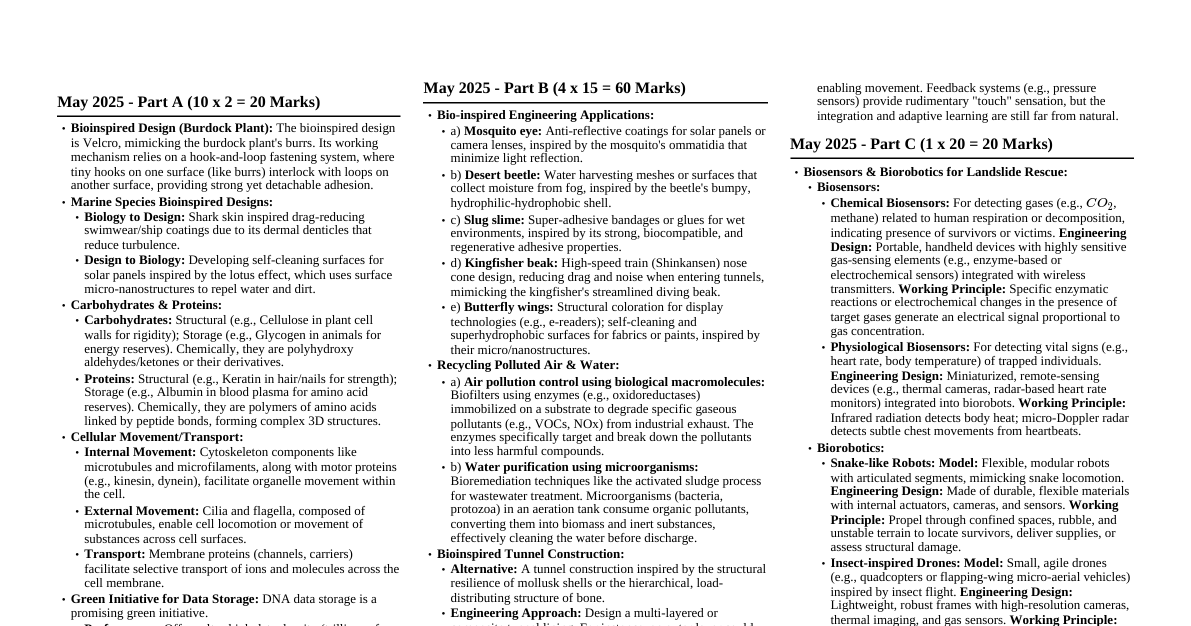
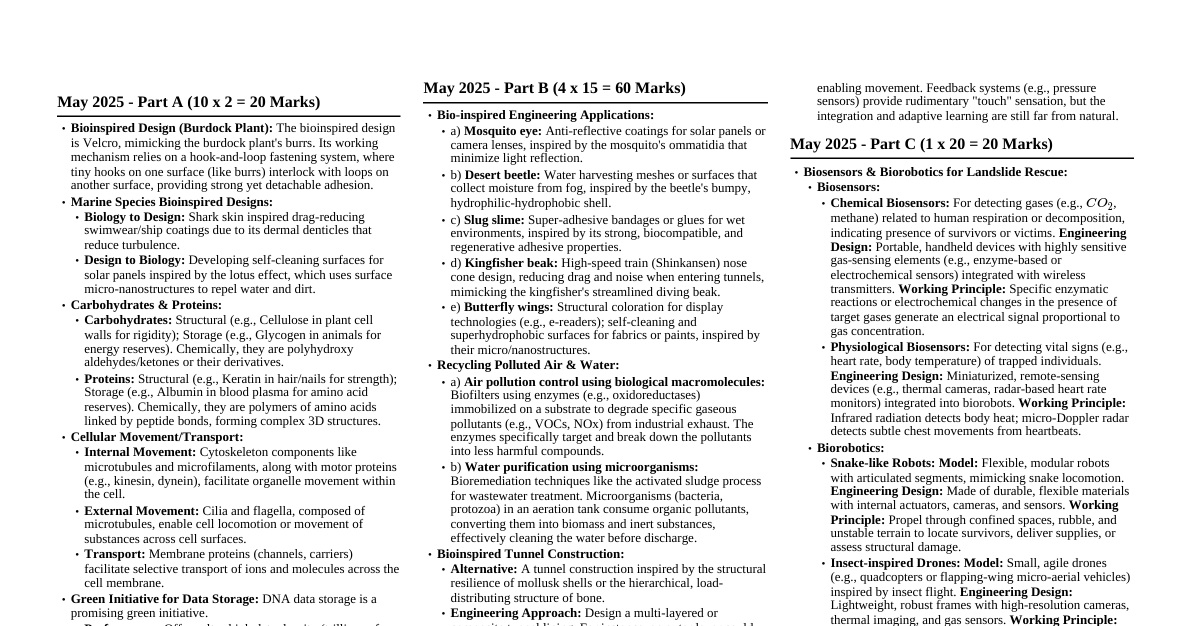
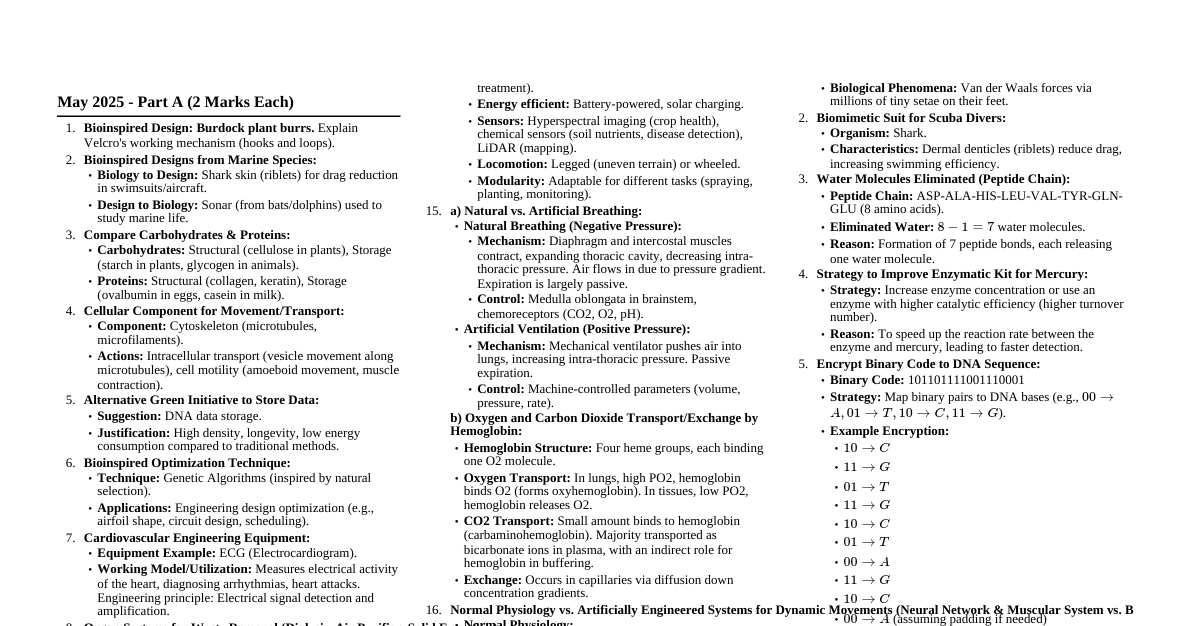
May 2025 - Part A (10 x 2 = 20 Marks) Bioinspired Design (Burdock Plant): Specify the bioinspired design developed by a Swiss engineer from Burdock plant burrs and explain its working mechanism. Bioinspired Designs (Marine Species): Provide an illustration or model for bioinspired designs from marine species based on Biology to Design and Design to Biology concepts. Carbohydrates & Proteins: Compare the structural and storage functions of carbohydrates and proteins as major biomacromolecules. Cellular Movement/Transport: Identify the cellular component responsible for internal and external movement/transport and relate its actions. Alternative Data Storage: Suggest an alternative green initiative to store data, addressing disadvantages of physical devices, and justify its performance. Bioinspired Optimization: Suggest a bioinspired optimization technique for computer science and engineering systems to find best input values for optimal output, substantiating its applications. Cardiovascular Engineering Equipment: Showcase an equipment's working model and utilization with an engineering principle for diagnosis or treatment of cardiovascular diseases. Waste Removal Systems (Bio-inspiration): Identify organ systems involved in waste removal from body fluids inspiring dialysis, air purifier, and solid excretion systems. 3D Bioprinting (Knee Joint Bone): Enumerate the steps involved in 3D bioprinting for developing a knee joint bone. Biomedical Waste Disposal: Specify recommended options for safety processing and disposal of biomedical wastes generated in India and research labs. May 2025 - Part B (4 x 15 = 60 Marks) Bio-inspired Engineering Applications: Claim bio-inspired engineering applications based on biological materials and functions of: a) Mosquito eye (3) b) Dessert beetle (3) c) Slug slime (3) d) Kingfisher beak (3) e) Butterfly wings (3) Pollution Control (Bio-inspiration): Provide suggestions from nature to recycle polluted air and water from industrial wastes: a) Air pollution control technique using biological macromolecules (7 1/2) b) Water purification technique using microorganisms (7 1/2) Tunnel Construction (Bio-inspired): Suggest an alternative tunnel construction solution for civil engineers to prevent loss of lives and materials, enumerating the engineering approach (pros/cons) and biological concept. Bio-inspired Robotics in Agriculture: Elaborate the bio-inspired inspiration behind tiny robots in agriculture for tasks like weed detection, sowing, crop monitoring, and disease detection, specifying their ideal characteristic features. Human Respiration vs. Artificial Ventilation & Oxygen Transport: a) Compare natural breathing (negative pressure) vs. artificial ventilation (positive pressure) performed by automatic control and mechanical ventilator (5+5). b) How is transport and exchange of oxygen and carbon dioxide mediated through hemoglobin across blood vessels? (5) Neural Network & Muscular System vs. Bionics & Prosthetics: Compare the working mechanism of normal physiology (neural network coordination with muscular system) and artificially engineered systems (bionics and prosthetics) for dynamic movements. May 2025 - Part C (1 x 20 = 20 Marks) Landslide Rescue (Biosensors & Biorobotics): Suggest biosensor and biorobotics models to support rescue operations and rehabilitate injured patients from a landslide, briefing their engineering designs and working models/principles (10+10). May 2024 - Part A (10 x 2 = 20 Marks) Super-Adhesive (Bio-inspired): Mention the organism and biological phenomena that led to a super-adhesive product that attaches/detaches easily without residue. Biomimetic Suits (Scuba Divers): Mention an organism and its characteristics that can inspire biomimetic suits for scuba divers. Peptide Chain Formation: How many water molecules are eliminated during the formation of the peptide chain: ASP-ALA-HIS-LEU-VAL-TYR-GLN-GLU? Give reason. Enzymatic Kit Improvement: Suggest a strategy to improve a slow enzymatic kit for mercury detection in water, giving the reason for the strategy. Binary to DNA Encryption: Encrypt the binary code 101101111001110001 to a DNA sequence using a suitable method and show the strategy. Humanoid Robot Muscles: Suggest materials that can be used to mimic human muscles for humanoid robots. Optimal Model Selection (Car Company): What technique and principles would you employ to select optimal car models for further testing from over 1000 prototypes in a short time? Drug Testing Alternatives: Mention two technologies that can overcome limitations of conventional drug testing (expensive, time-consuming, ethical concerns) and speed up drug discovery. Bionic Device (Poisonous Gases): What bionic device would you suggest for sensing poisonous gases in land combats for DRDO? Microbiology Lab Precautions: Mention two precautions for monitoring filters in a microbiology lab working with potentially harmful bacteria. May 2024 - Part B (4 x 15 = 60 Marks) Bio-inspired Technology: Mention the technology inspired by the following organisms, describe the working principle, and analogy with the biological component (3 x 5=15): a) Moth eye b) Proboscis of mosquito c) Desert beetle Industrial/Engineering Applications (Bio-inspired): Describe the following applications, mentioning the biological system and principle, with examples (3 x 5 = 15): a) Artificial Immune System b) Genetic Algorithm c) Muscular biopolymers Camouflage Suits (DRDO): Describe the biological inspiration and working principle you would use to design camouflage suits for the military. Respiratory System Efficiency: What makes the human respiratory system so efficient and 'smart' in oxygen supply? Describe an engineering area where such a system would be useful. Biomolecules for Data Storage: Suggest a class of biomolecules best suited for safe and long-term storage of digital information, provide rationale, and describe the steps involved. Artificial Neural Networks (ANN): Describe the analogy between ANN and the nervous system, mention three characteristics of ANN related to the nervous system, and give two examples of ANN-based devices/technologies (10+3+2=15). May 2024 - Part C (1 x 20 = 20 Marks) Bioinspired Building Design: Give suggestions for the following features in a multi-storied and secured building from bioinspired concepts, and discuss incorporation (4 x 5=20): a) Moisture and dirt resistant, self-cleaning walls b) Ability to repair occasional cracks on its own c) Rooms maintained at specific temperature and humidity d) Security system to prevent entry of unauthorized personnel Nov 2024 - Part A (10 x 2 = 20 Marks) Circular Economy (Nature's Example): Discuss how sustainable processes of natural ecosystems serve as an example for a circular economy. Water Collection from Air (Bioinspiration): Give a suitable bioinspiration concept to collect water from air in dry land areas for an industry. Surgical Threads (Biomolecule): Suggest a suitable biomolecule for surgical threads and justify the choice by commenting on its properties. Self-healing Concrete: What are the components present in self-healing concrete? Darwinian Evolution & Antibiotic Resistance: Comment on the principles of Darwinian evolution applicable to antibiotic resistance in bacteria. Genetic Algorithm Examples: Give two examples of genetic algorithms in solving optimization problems. Search & Rescue (Bioinspired Strategy): Suggest a strategy for search & rescue operations drawing inspiration from biological swarms (ants, bees, birds). Drug Testing Alternatives: Offer insights on alternatives for traditional cell cultures or animal models for drug testing. E-Nose Industrial Applications: Write about any two industrial applications of E-Nose. Bioinspiration from Muscular Biology: Brief on two applications of bioinspiration from muscular biology in biomedical fields. Nov 2024 - Part B (4 x 15 = 60 Marks) Termite Mounds & Automotive Design: a) Explain key features of termite mound natural ventilation, and describe architectural design for a self-ventilated building (10). b) Describe a biomimetic innovation for automotive shock-absorbing and vibration-dampening systems, inspired by nature's structural adaptations (5). Bioinspired Catalyst & Biosensor: a) Discuss a suitable bioinspired catalyst for removing grease, starch, and protein stains from laundry, explaining its working mechanism and advantages (7). b) Device a biosensor to detect genetic disorders, explaining working principle of components with a sketch and justifying choices (8). Industrial Effluent Treatment & Data Storage: a) Suggest a method to treat industrial effluents (toxic, dyes, metal ions), describe its working mechanism with a diagram, and comment on advantages/disadvantages (10). b) Choose a biomolecule for efficient, long-lasting data storage, justify choice, and explain the entire workflow (storing & retrieving) (5). Evolution & Oil Pump Inspiration: a) Discuss various evidences for the theory of evolution (3). b) Name and relate the working mechanism of an organ system (with a sketch) that inspired the design of an oil pump for a motorcycle (12). Building Durability & Immune-inspired Algorithm: a) Advise a strategy to increase durability of building sealings (especially in high rainfall areas) to address cracks, and discuss its mechanism (7). b) How will you develop a new algorithm inspired by native immune reactions, explaining its working principle and applications? (8) 3D Bioprinting for Organ Shortage: Explain the working principle of one 3D bioprinting technique with various components, and how it can be an alternative solution for organ shortage and transplant rejection, discussing challenges (10+5). Nov 2024 - Part C (1 x 20 = 20 Marks) Bioinspired Technologies & Efficiency: Describe the bioinspiration concept and how it improved efficiency for: a) Artificial muscle (5) b) Velcro (5) c) Water-proof paints (5) d) Painless needles (5) February 2023 - Part A (10 x 2 = 20 Marks) Shark Skin & Biofilm Prevention: Apply the patterned surface roughness of shark skin for biomimicry applications in engineering to prevent bacterial growth and biofilm formation. Lactose Intolerance: Mr. Kumar's discomfort after dairy products. What's the reason? Recommendations to avoid it? Biological Security System: Identify the biological system component that selectively allows passage of certain molecules, similar to airport security, and draw its structure. Military Data Storage: Technical advice for long-term storage of military secret data to provide insights for future personnel. Alpine Race Car Design: Suggest a bio-inspired technology to save time and energy in designing an Alpine race car, briefing the design step process. Embryonic Stem Cells: Comment on ethical dilemma of human embryonic stem cells and suggest alternate sources for research and therapy. Drug Testing Reduction: Mention the latest technology to reduce years of drug testing and its advantages. Machines Interacting with Biological Systems: Give two examples of machines/technology that interact with biological systems, explaining components. Bioink Components: What are the components of 'bioink' used for printing human tissues/organs? Microbiology Lab Precautions (E. coli): Mention precautions for working in a microbiology lab studying pathogenic E. coli. February 2023 - Part B (4 x 15 = 60 Marks) Bioinspired Technologies: a) Highlight the bioinspired technology behind high-performance color pigments and binder technology for UV resistance, dust, and microbial colonization (5). b) Which bioinspired principle is involved in designing buildings that eliminate heating and cooling plants for self-cooling? (5) c) Propose an engineering application/technology using all features of a woodpecker's head for shock absorption (elastic beak, CSF, spongy bone) (5). Self-Healing & Biomolecule Applications: a) Explain the mechanism and principle of a crack appearing in a building wall and repairing on its own (10). b) Mention at least two industrial applications for Carbohydrates and Lipids (2 1/2 x 2 = 5). Knapsack Problem (Survival Kit): Address the problem of carrying a maximum of 35kg with maximum survival points for a trekking survival kit, given items, weights, and survival points (15). S.No Item Weight (kg) Survival point 1. Glucose 20 17 2. Rope 10 10 3. Sleeping bag 15 15 4. Emergency light 5 8 5. Knife 2 12 6. Medicines 10 Blood Purification: Discuss the engineering application used for continuous blood purification in patients with multiple organ failure (15). Artificial Neural Networks: Discuss the technology developed and utilized for various applications, inspired by the architecture of the human brain and its biological neural networks (15). Biosafety Levels & Waste Disposal: a) Discuss precautions for entering BSL-1, BSL-2, BSL-3, and BSL-4 labs (7 1/2). b) How should biowaste be categorized and discarded according to Biological Waste Disposal Policy? (7 1/2) February 2023 - Part C (1 x 20 = 20 Marks) Bioinspired Building Features: Suggest bioinspired concepts for the following features in a multi-storied and secured building, discussing incorporation (4 marks each): i. To fix anti-reflecting glass windows ii. To remove malodorous gases in the rooms iii. Face recognition security system to prevent entry of unauthorized personnel iv. To construct more stable building in high-speed crosswinds v. Rooms maintained at specific temperature and humidity Dec 2023 - Part A (10 x 2 = 20 Marks) Peptide Modification: What happens to the 3D structure of proteins if an amino acid in peptide A (Val-His-Leu-Thr-Pro-Glu-Glu) is replaced by another (Peptide B: Val-His-Leu-Thr-Pro-Val-Glu)? Discuss chemical bonds/interactions stabilizing 3D structure. DNA vs. RNA for Storage: Which biomolecule (DNA or RNA) is preferred for long-term information storage? Give reasons. Blood Flow in Veins: What prevents deoxygenated blood from falling down when carried from foot to heart against gravity? Self-Driving Vehicles (Strategy): Device a strategy for multiple driverless vehicles to navigate safely and faultlessly, explaining the working principle. Transducers in Biosensors: Describe the role of transducers in biosensors. Match the Following: a. Largest artery. → i. SA Node b. Mitral valve. → ii. Aorta c. Sets heart rhythm. → iii. Pulmonary artery d. Carries blood from heart to lungs → iv. Bicuspid valve Retinitis Pigmentosa: As an engineer, offer a viable option to restore vision in patients with retinitis pigmentosa. Self-Healing Concrete (Bacteria): What are the components of self-healing concrete? Why are only spore-forming bacteria used? PPE in Biology Research: What personal protective equipment (PPE) is required and why for safe regulations in a biology-based research environment? Dec 2023 - Part B (4 x 15 = 60 Marks) Anti-Biofouling Products: Device a technique to fabricate anti-biofouling products inspired by nature, citing three appropriate examples of inventions. Toxic Material Metabolism & Surgical Sutures: a) Design a novel strategy with suitable environmental applications, inspired by microorganisms metabolizing toxic materials, and justify the choice (10). b) Suggest a suitable biomolecule for biodegradable surgical sutures, justifying the choice by explaining its properties (5). Biosensor Detection Limits: Discuss reasons for detection limit differences (1 mM vs. 0.001 mM) between two novel biosensors for histamine, explaining possible modifications and how ideal detection limits are fixed. Genetic Algorithm for Optimization: Discuss how genetic algorithms can be used for optimization, and write at least two examples demonstrating their applications. 3D Bioprinting (Organ Shortages & Testing): What technology can fabricate organs in labs? How will this technology revolutionize organ donations and animal testing? Discuss challenges in commercialization. Phantom Pain & Electroactive Polymers: a) How can phantom pain be improved by bioinspired engineering solutions, explaining working principle and disadvantages? (10) b) Describe applications of electroactive polymers in muscle tissue engineering with an example (5). Dec 2023 - Part C (1 x 20 = 20 Marks) Digital Data Storage, Swarm Robotics & Swimsuit Design: a) Which biomolecule is chosen for big digital data storage? Enumerate advantages/disadvantages, and discuss encryption/decoding methods (7). b) Identify and explain the inspiration behind technology from social animals (ants, bees) for robots working together, with applications (8). c) Suggest a bioinspiration concept for an Olympian swimsuit designer to enhance swimmer's speed (5). December 2022 - Part A (10 x 2 = 20 Marks) Bio-inspired Design vs. Biomimicry: Compare and contrast "bio-inspired design" and "biomimicry" with appropriate examples. Bionic Leaf Feasibility: Inspect the experimental plan and feasibility of converting solar energy into liquid fuel using a "Bionic Leaf with engineered bacterium." Plastic Degradation (Biomolecule): If developing novel methods for degrading plastic wastes (using Ideonella sakaiensis ), what biomolecule from the bacterium would be chosen? Justify. Microbial Decomposition: Is it possible to achieve biodegradation of contaminants using microbial decomposition? Infer the answer. Artificial Immune System Algorithms: List the major algorithms in Artificial Immune System. Electroactive Polymer: Classify and explain Electroactive polymer. Visual Prostheses: Demonstrate the working principle of "Visual Prostheses." Bio-robotics: Interpret "Bio-robotics" and list its most significant applications. 3D Printing Advantages: Summarize the major advantages of 3D printing. Underwater Hull Durability: Propose and explain a bio-inspired idea to enhance underwater surfaces of ships to prevent marine growth and corrosion. December 2022 - Part B (4 x 15 = 60 Marks) Cell as a Cell Phone: Interpret a living cell as a cell phone, considering nature's information processing at the cellular level. Biological Component for Data Storage: Identify the biological component that inspired engineers for information storage, and interpret that technology with its merits and demerits. Self-Organization (Social Insects): Identify and explain an innovative technology inspired by self-organization of social insects to resolve limitations of centralized control systems, with advantages and disadvantages. Deep Learning & Human Brain: Interpret the computational method that mimics human brain operations for processing inputs and executing optimized responses, summarizing its applications. Heuristic Search & Natural Selection: Recall and interpret steps in heuristic search technique reflecting natural selection theory, listing its merits and demerits. 3D Bioprinting for Drug Evaluation: Appraise the most significant application of 3D Bioprinting for evaluating new pharmaceutical drugs, explaining its advantages and disadvantages over conventional methods. December 2022 - Part C (1 x 20 = 20 Marks) Bio-inspired Design (Pesticide Detection & Self-Healing): a) Propose an ideal bio-inspired design for detecting pesticides in contaminated water, listing essential components and inferring their working principle (10). b) Identify and explain a novel technique for construction of large-scale buildings and special structures, developed by blending principles of sealing/healing organisms and microorganisms with dormant state capacity, with its limitations (10). May 2019 - Part A (4 x 20 = 80 Marks) Cancer Biosensor Design: a) Choice of biosensor type and biological materials for cancer management, with justification. b) Modification for intracellular analyte detection if sensing material is impermeable to the cell, with explanation. c) How to modify biosensor to monitor cancer treatment/progression by identifying oncogenes/tumor suppressor genes. d) Predict how a biosensor works for in vitro application using protein and enzyme as biomaterial. Bio-inspired Robotics: a) Discuss other components of a robot system besides the actuation unit, and explain options for bio-hybrid actuators. b) Summarize biological concept for neural control to an actuator, and explain engineering-driven solution. c) Provide a short note on endocrine-linked control system and identify components in robotic system for incorporation. d) Suggest bioinspired sensory systems and their working principles for a military robot. Stem Cells & Regenerative Medicine: a) Construct a tree diagram for stem cell hierarchy based on potency, taking cue from phylogenetic tree concept. b) Propose a strategical approach using stem cell therapy to arrest decline of cardiac performance after myocardial infarction. c) Suggest an engineering-driven solution for diseased heart when conventional and stem cell approaches fail. d) Justify how organ-on-chip concept can provide a cue for the engineering-driven solution suggested. Water Purification & Immunity: a) Explain features of renal filtration system utilized for a water purifying system inspired by human excretory system, with design and rationale. b) How does the body avoid pathogen entry and tackle microbes to prevent water-related diseases? Bioinspired Electronics & Senses: a) Justify biological principle and biomimicry for modifying a bionic ear based on sound perception by human ear. b) Identify different inter and intra species relationships and how they link with bio-optical phenomena. c) Cite reasons and rectification for a bionic device working effectively in solution A (pH 7) but not solution B (pH < 2) based on redox potential. Self-Healing & Defense Systems: a) Provide an example and potential use where self-healing principles have been applied in bioinspired synthetic materials. b) How can the concept of autogenous healing be utilized in healing concrete cracks? c) Name the defense system used by the respiratory system to tackle particulate matter and pathogens, and design a prototype adopting this biological principle for societal use. May 2019 - Part B (1 x 20 = 20 Marks) Bioinspired Engineering Prototype: Design an engineering prototype or model to tackle the following societal problems by adopting biological principles from nature: a) Air pollution and health hazard b) Energy harvesting and saving efficiency