Class 10 Hist Ch 1: Nationalism in Europ
Cheatsheet Content
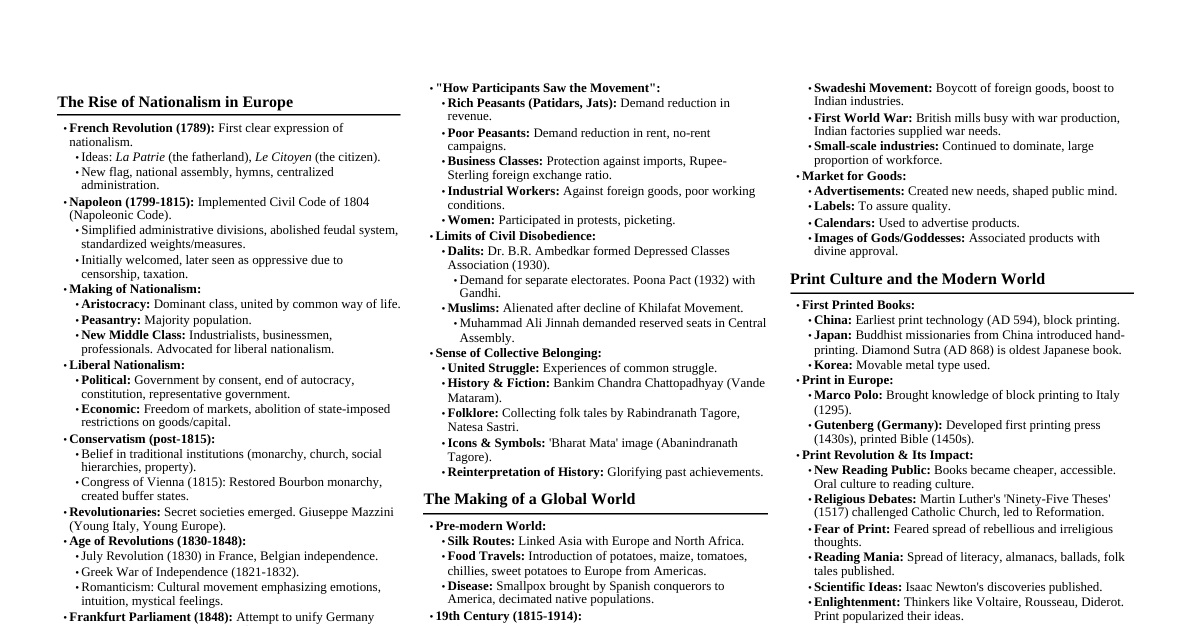
1. The French Revolution and the Idea of the Nation (1789-1799) The French Revolution marked the first clear expression of nationalism. It dismantled the absolute monarchy and transferred sovereignty from the monarch to a body of French citizens, fostering a collective identity among the people. Key Concepts Introduced: La Patrie (the fatherland) and Le Citoyen (the citizen) emphasized a united community enjoying equal rights under a constitution. A new French tricolour flag replaced the former royal standard. The Estates General was elected by active citizens and renamed the National Assembly. New hymns were composed, oaths taken, and martyrs commemorated, all in the name of the nation. A centralized administrative system was put in place, formulating uniform laws for all citizens within its territory. Internal customs duties and dues were abolished, and a uniform system of weights and measures was adopted. French, as spoken and written in Paris, became the common language of the nation, suppressing regional dialects. Napoleon Bonaparte (1769-1821): Role: Though he destroyed democracy in France (returning to monarchy), he incorporated revolutionary principles in administration to make the system more rational and efficient. Napoleonic Code (Civil Code of 1804): Abolished all privileges based on birth. Established equality before the law. Secured the right to property. Extended to regions under French control (Dutch Republic, Switzerland, Italy, Germany). Administrative Simplifications: Abolished the feudal system, freed peasants from serfdom and manorial dues. Removed guild restrictions in towns. Improved transport and communication. Initial Reception: In many places like Holland and Switzerland, and cities like Brussels, Mainz, Milan, Warsaw, French armies were initially welcomed as harbingers of liberty. Growing Hostility: This initial enthusiasm soon turned to hostility as people realized that administrative changes did not go hand-in-hand with political freedom. Increased taxation, censorship, and forced conscription into the French armies led to widespread resentment. 2. The Making of Nationalism in Europe (Early 19th Century) Before the mid-18th century, there were no 'nation-states' as we know them today. Central and Eastern Europe were under autocratic monarchies, with diverse peoples who did not share a collective identity or common culture. The Aristocracy and the New Middle Class: Aristocracy: Dominant class, united by a common way of life. Owned vast estates, spoke French for diplomacy. Smaller in number. Peasantry: Majority of the population, often tenants and serfs. Middle Class: Emerged with industrialization in the late 18th century (especially in Western and Central Europe). Comprised industrialists, businessmen, professionals (doctors, lawyers, teachers). Educated and liberal, they championed national unity and opposed aristocratic privileges. What did Liberal Nationalism Stand for? Politically: Government by consent, end of autocracy and clerical privileges, a constitution and representative government through parliament. (However, suffrage was often limited to property-owning men). Economically: Freedom of markets, abolition of state-imposed restrictions on the movement of goods and capital. Example: The German-speaking regions had numerous small states, each with its own currency, weights, and measures. This created economic obstacles. Zollverein (1834): A customs union formed at the initiative of Prussia, joined by most German states. It abolished tariff barriers and reduced the number of currencies from over thirty to two. A New Conservatism after 1815: Following Napoleon's defeat, European governments were driven by a spirit of conservatism, believing in traditional institutions (monarchy, church, social hierarchies, property, family). Treaty of Vienna (1815): Host: Austrian Chancellor Duke Metternich. Purpose: To undo most of the changes brought about by the Napoleonic wars and restore monarchies. Outcomes: Bourbon dynasty restored in France; France lost territories annexed by Napoleon; series of states set up on French boundaries to prevent future expansion (e.g., Kingdom of the Netherlands, Piedmont-Sardinia got new territories). Prussia received new territories on its western frontiers, and Austria was given control of Northern Italy. The German Confederation of 39 states (created by Napoleon) was left untouched. Repression and Censorship: Conservative regimes were autocratic, intolerant of criticism, and imposed censorship laws to control media. The Revolutionaries: Feared conservative regimes, many went underground and formed secret societies. Their aim: to train revolutionaries and spread their ideas, opposing monarchical forms, and fighting for liberty and freedom. Giuseppe Mazzini (1807-1872): "The Most Dangerous Enemy of Our Social Order" (Metternich). Early Life: Born in Genoa, member of the secret society of the Carbonari. Attempted a revolution in Liguria in 1831, exiled. Secret Societies: Founded 'Young Italy' in Marseilles and 'Young Europe' in Berne. Members were like-minded young men from Poland, France, Italy, and the German states. Vision: Believed God intended nations to be the natural units of mankind. Advocated for a united republican Italy, not a patchwork of small states. Influence: Inspired similar secret societies in Germany, France, Switzerland, and Poland. 3. The Age of Revolutions (1830-1848) The July Revolution (1830 - France): The Bourbon kings, restored by the conservatives in 1815, were overthrown by liberal revolutionaries. A constitutional monarchy was installed with Louis Philippe as its head. Metternich's comment: "When France sneezes, the rest of Europe catches cold." Sparked an uprising in Brussels, leading to Belgium breaking away from the United Kingdom of the Netherlands. The Greek War of Independence (1821 onwards): A part of the Ottoman Empire since the 15th century. Growth of revolutionary nationalism in Europe sparked a struggle for independence among Greeks. Received support from Greeks living in exile and West Europeans who admired ancient Greek culture. Lord Byron (1788-1824): English poet, organized funds and later went to fight in the war, dying of fever in 1824. Outcome: The Treaty of Constantinople of 1832 recognized Greece as an independent nation. The Role of Romanticism: A cultural movement that sought to develop a particular form of nationalist sentiment, focusing on emotions, intuition, and mystical feelings rather than science and reason. Johann Gottfried Herder (1744-1803): German philosopher. Argued that true German culture was to be discovered among the common people ( das Volk ) through folk songs, folk poetry, and folk dances ( Volksgeist - the true spirit of the nation). Language: Played a crucial role in developing nationalist feelings. Example: In Poland, after its partition by Russia, Prussia, and Austria, the Polish language was used for church gatherings and religious instruction, becoming a symbol of resistance against Russian dominance. Priests and bishops were often imprisoned or sent to Siberia for refusing to preach in Russian. Economic Hardship and Popular Revolt (1830s-1848): The 1830s were years of great economic hardship in Europe. Rapid population growth, mass migration from rural areas to overcrowded cities, and widespread unemployment. Intense competition from cheaper machine-made goods from England, especially in textile production. Bad harvests and rising food prices led to widespread pauperism. Silesian Weavers' Revolt (1845): Weavers rose in revolt against contractors who drastically reduced their payments for finished textiles. 1848 Revolution in France: Food shortages and widespread unemployment led to Parisians taking to the streets. Louis Philippe was forced to flee. The National Assembly proclaimed a Republic, granting suffrage to all adult males above 21. The 1848 Revolution of the Liberals: Alongside the revolts of the poor, a revolution led by the educated middle classes was underway. In German regions, middle-class professionals, businessmen, and prosperous artisans formed an all-German National Assembly at Frankfurt. Frankfurt Parliament (May 18, 1848): Met in the Church of St. Paul. Drafted a constitution for a German nation to be headed by a monarchy subject to a Parliament. The crown was offered to Friedrich Wilhelm IV (King of Prussia) , who rejected it. He viewed the elected assembly with contempt and joined other monarchs to oppose it. The Parliament lost support of workers and artisans because it was dominated by the middle class. When troops were called in, the assembly was forced to disband. Women's Role: Women had actively participated in liberal movements, forming political associations, founding newspapers, and taking part in political meetings and demonstrations. However, they were denied suffrage rights and admitted only as observers to the Frankfurt Parliament. 4. The Making of Germany and Italy (1848-1871) 4.1 Germany Unification After the failure of the Frankfurt Parliament, Prussia took the lead in German unification, seeing it as a way to assert its dominance. Otto von Bismarck (1815-1898): Role: Chief Minister of Prussia, known as the "architect" of German unification. Followed a policy of "blood and iron." Strategy: Carried out unification with the help of the Prussian army and bureaucracy. Wars of Unification: Over seven years, three wars were fought: Against Denmark (1864) Against Austria (Austro-Prussian War, 1866) Against France (Franco-Prussian War, 1870-1871) Outcome: Prussian victories in all these wars completed the process of German unification. Proclamation of the German Empire: In January 1871, Kaiser William I (King of Prussia) was proclaimed German Emperor in a ceremony held at the Palace of Versailles. Features of the New German Empire: The new German state placed a strong emphasis on modernizing the currency, banking, legal, and judicial systems in Germany. Prussian measures and practices often became a model for the rest of Germany. 4.2 Italy Unification Italy, like Germany, was politically fragmented into several states during the mid-19th century. Status of Italy (Mid-19th Century): Seven states, only Sardinia-Piedmont ruled by an Italian princely house. North: Under Austrian Habsburgs. Centre: Ruled by the Pope. South: Under the Bourbon Kings of Spain. Early Attempts and Key Figures: Giuseppe Mazzini (1807-1872): Role: Revolutionary who envisioned a united Italian Republic. Actions: Formed 'Young Italy'. Attempted a failed uprising in 1831. Belief: Believed unification could only be achieved through revolution and the establishment of a republic. Count Camillo de Cavour (1810-1861): Role: Chief Minister of Sardinia-Piedmont. Led the movement to unify the regions of Italy. Belief: Was neither a revolutionary nor a democrat. Spoke French much better than Italian. Strategy: Engineered a diplomatic alliance with France (1859), which helped Sardinia-Piedmont defeat the Austrian forces. Outcome: In 1859, Sardinia-Piedmont succeeded in defeating the Austrian forces, annexing Lombardy. Giuseppe Garibaldi (1807-1882): Role: Famous Italian revolutionary, known for his "Red Shirts" (Legion of volunteers). Actions: In 1860, he led a large number of armed volunteers into South Italy and the Kingdom of the Two Sicilies. With the support of local peasants, they succeeded in driving out the Spanish Bourbon rulers. Victor Emmanuel II (1820-1878): Role: King of Sardinia-Piedmont. Proclaimed King of United Italy in 1861. Challenges to Unification: A large section of the Italian population, especially the illiterate peasantry, remained unaware of liberal nationalist ideology. They had never heard of 'Italia' and believed 'La Talia' was Victor Emmanuel's wife. 5. Visualising the Nation & Nationalism and Imperialism 5.1 Visualising the Nation Artists in the 18th and 19th centuries personified nations, often using female allegories to represent abstract ideas like Liberty, Justice, or the Republic. France: Allegory: Marianne. Characteristics: Red cap (symbol of liberty), tricolour flag, and the cockade. Purpose: To remind the public of the national symbol of unity and to persuade them to identify with it. Statues were erected in public squares. Germany: Allegory: Germania. Characteristics: Wears a crown of oak leaves, as the German oak stands for heroism. Other symbols: Broken chains: Being freed. Breastplate with eagle: Strength of the German Empire. Crown of oak leaves: Heroism. Sword: Readiness to fight. Olive branch around the sword: Willingness to make peace. Black, red, and gold tricolour: Flag of the liberal-nationalists in 1848 (banned by Dukes of the German states). Rays of the rising sun: Beginning of a new era. 5.2 Nationalism and Imperialism Shift in Nationalist Ideology (Late 19th Century): Nationalism, which had initially been associated with liberal and democratic ideals, became a narrow creed with limited ends. Nationalist groups became increasingly intolerant of each other and were ready to wage war. Major European powers manipulated nationalist aspirations for their own imperialist goals. The Balkan Region: Geography: A region of geographical and ethnic variation comprising modern-day Romania, Bulgaria, Albania, Greece, Macedonia, Croatia, Bosnia-Herzegovina, Slovenia, Serbia, and Montenegro. Inhabited by Slavs. Under Ottoman Empire: A large part of the Balkans was under the control of the Ottoman Empire, which was weakening. Rise of Nationalism: As the Ottoman Empire disintegrated, its European subject nationalities broke away and declared independence. They based their claims on nationality and historical evidence of independence. Intense Rivalry: The Balkan states were fiercely jealous of each other and hoped to gain more territory at the expense of others. Great Power Rivalry: The situation became more volatile due to intense rivalry among European powers over trade, colonies, naval, and military might. Russia, Germany, England, and Austro-Hungary were all keen on extending their control over the Balkans. Consequences: This led to a series of wars in the region and ultimately, the First World War in 1914.