Equations of Motion Essentials
Cheatsheet Content
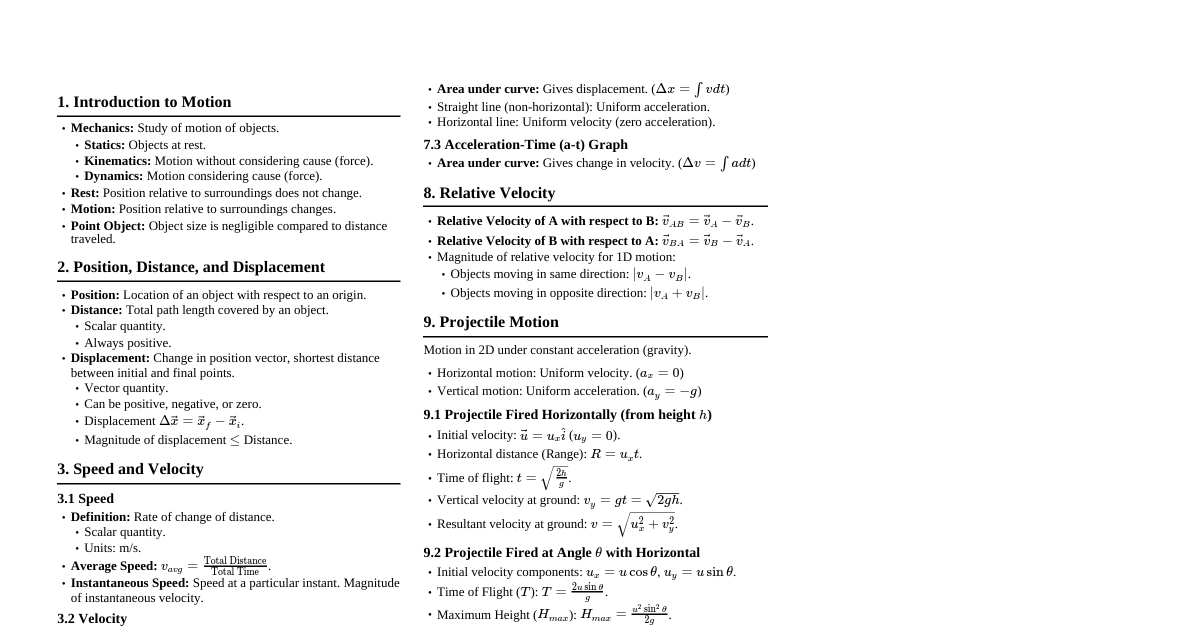
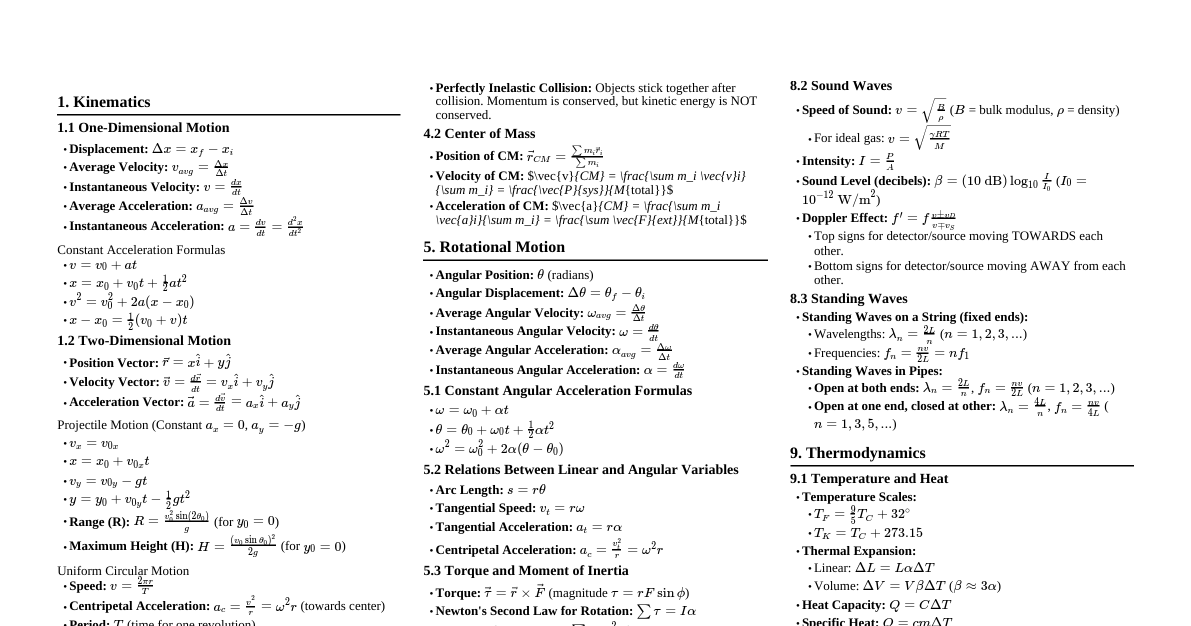
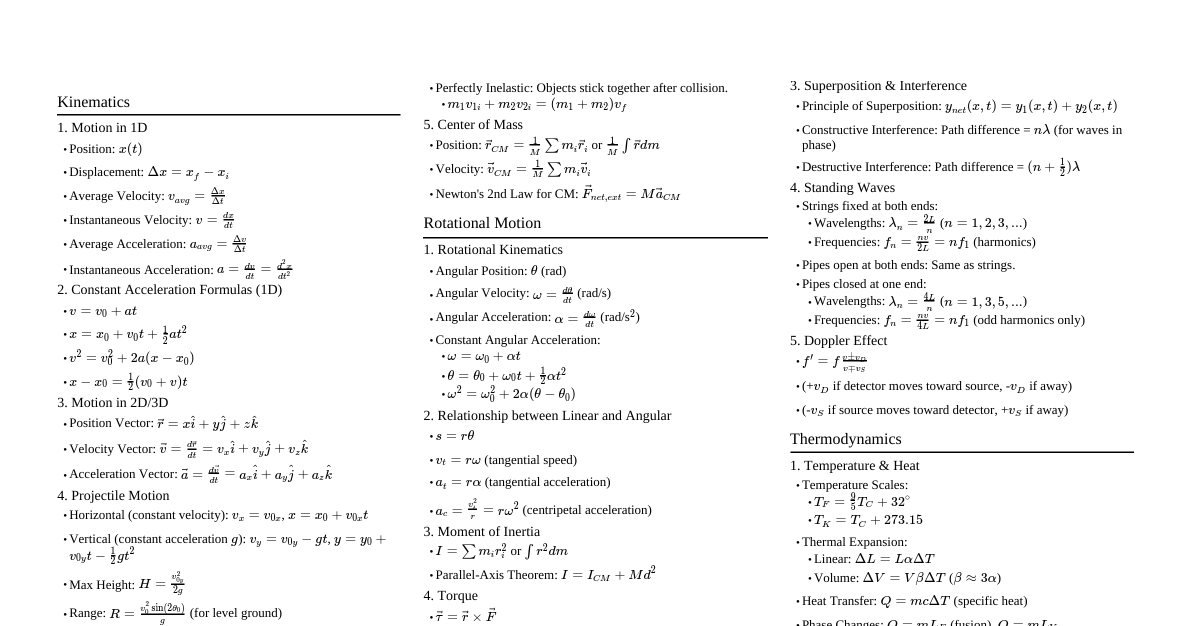
Distance and Displacement Distance: The total path length covered by an object. It is a scalar quantity. Displacement: The straight-line distance between the initial and final positions in a definite direction. It is a vector quantity, denoted by $s$. Unit: Both distance and displacement are measured in meters (m). Displacement can be zero, positive, or negative. Magnitude of displacement $\le$ Distance covered. They are equal only when an object moves along a straight line in the same direction. Scalar and Vector Quantities Scalar Quantities: Physical quantities that have only magnitude (e.g., distance, speed, time). Vector Quantities: Physical quantities that have both magnitude and direction (e.g., displacement, velocity, acceleration). Velocity Definition: The displacement of an object in unit time. It is a vector quantity. $$v = \frac{\text{Displacement}}{\text{Time}} = \frac{s}{t}$$ Unit: meters per second (m/s). The direction of velocity is the same as the direction of displacement. To calculate velocity, the total time taken to cover the actual distance should be considered. Acceleration Definition: The rate of change of velocity in unit time. It is a vector quantity. $$a = \frac{\text{Change in Velocity}}{\text{Time}} = \frac{v - u}{t}$$ where $u$ is initial velocity and $v$ is final velocity. Unit: meters per second squared (m/s$^2$). Negative Acceleration (Retardation/Deceleration): Occurs when velocity decreases over time. Types of Motion Uniform Velocity: An object moves with uniform velocity if the magnitude of the displacement is equal at equal intervals of time, and its direction remains constant. Non-uniform Velocity: Velocity changes if either its magnitude (speed) or direction (or both) changes. Uniform Acceleration: The rate of change of velocity is equal at equal intervals of time. Non-uniform Acceleration: The rate of change of velocity varies differently at equal intervals of time. Equations of Motion (for Uniform Acceleration) First Equation: Relates velocity and time. $$v = u + at$$ Second Equation: Relates displacement and time. $$s = ut + \frac{1}{2}at^2$$ Third Equation: Relates displacement and velocity. $$v^2 = u^2 + 2as$$ Where: $u$ = Initial velocity $v$ = Final velocity $a$ = Acceleration $t$ = Time $s$ = Displacement Graphical Representation of Motion Position-Time Graphs Horizontal Straight Line: Object is at rest. Inclined Straight Line: Uniform velocity. The slope of the line gives the velocity. Curved Line: Non-uniform velocity (acceleration or deceleration). Velocity-Time Graphs Horizontal Straight Line: Uniform velocity (zero acceleration). Inclined Straight Line (upwards): Uniform positive acceleration. Inclined Straight Line (downwards): Uniform negative acceleration (retardation). Curved Line: Non-uniform acceleration. The area under the velocity-time graph represents the displacement of the object. Road Safety Traffic Signs: Mandatory Signs: Must be followed (e.g., "No Parking"). Cautionary Signs: Warn about road conditions (e.g., "Hump ahead"). Informatory Signs: Provide information (e.g., "Hospital," "Police Station"). Road Markings: Indicate allowed/not allowed crossing areas and zebra crossings. Pedestrian Rules: Walk along the right side of the road. Cross only at zebra crossings, obeying traffic signals. Wear light-colored clothes in dim light for visibility.