Matrix & Linear Equations Cheatsheet
Cheatsheet Content
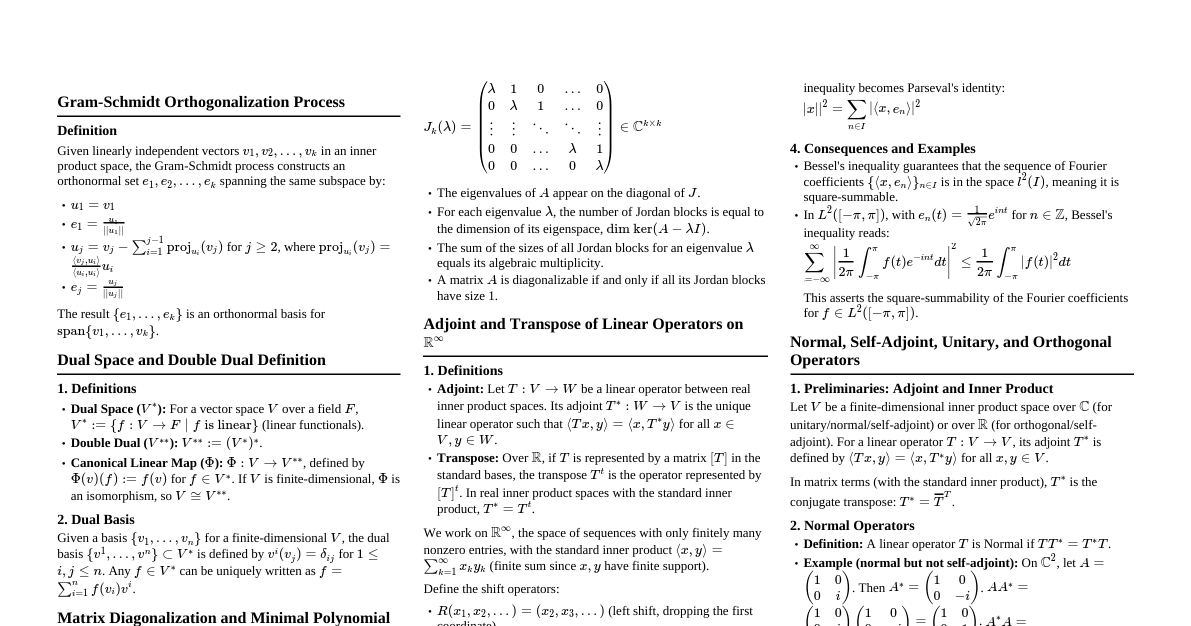
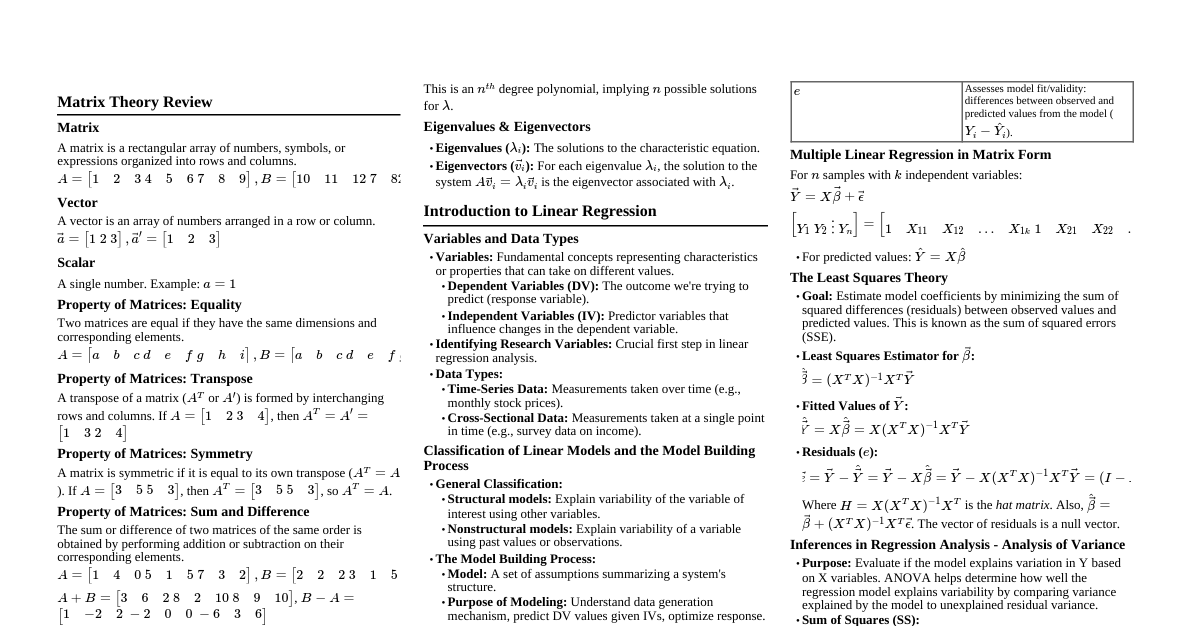
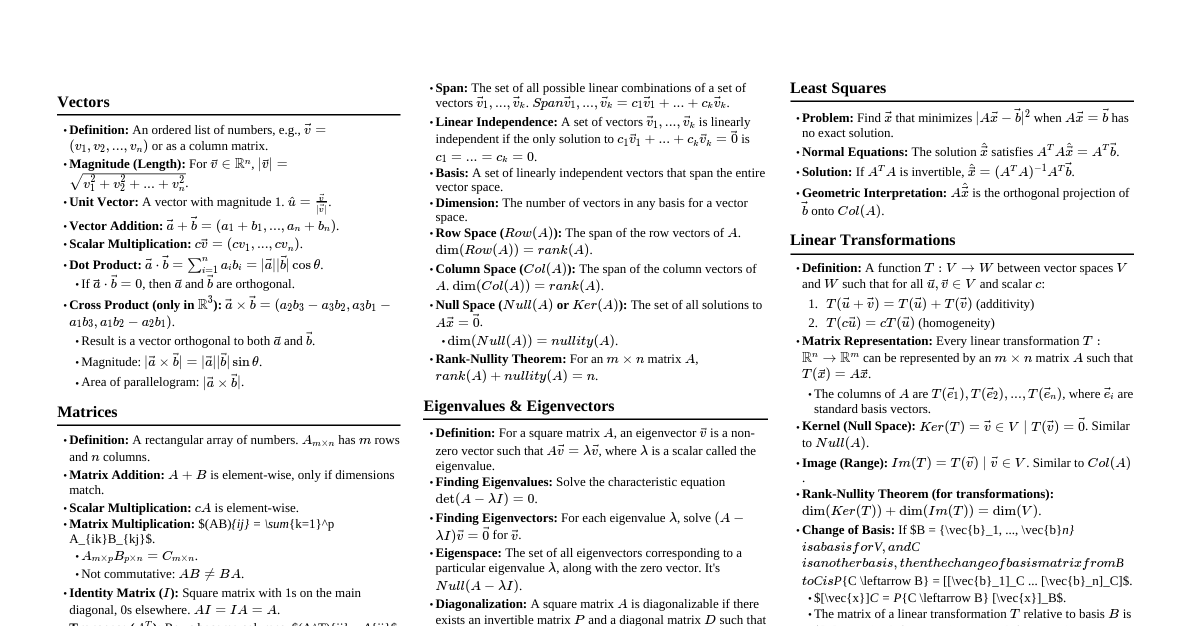
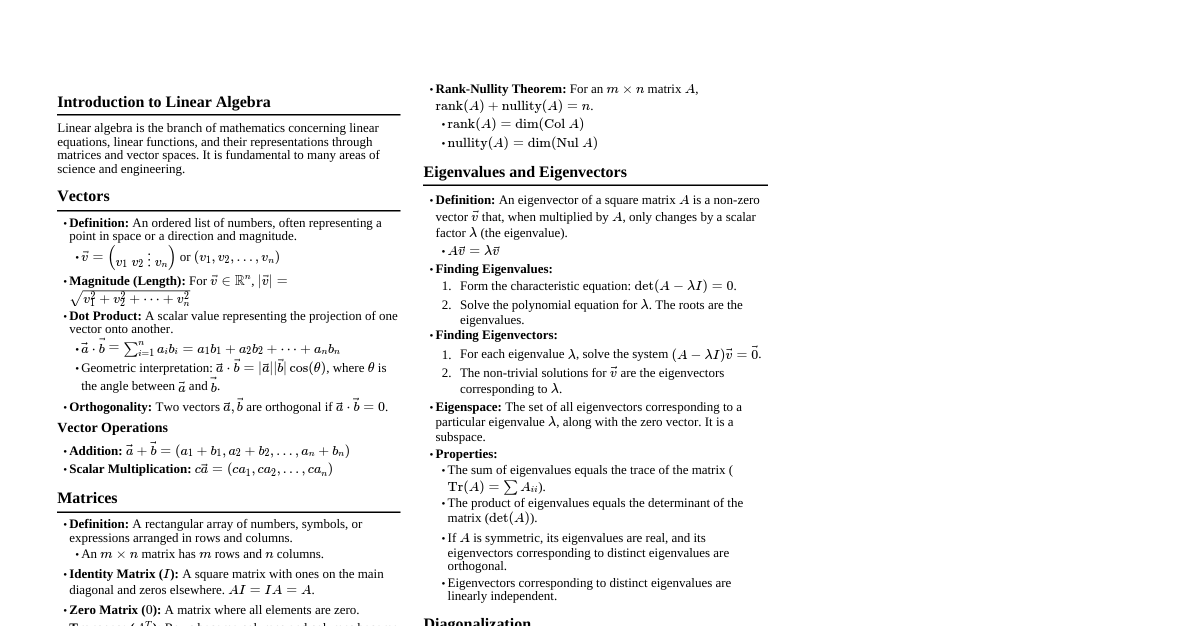
Unit Contents 3.1 The Concepts of a Matrix 3.2 Operations on Matrices 3.3 Special Types of Matrices 3.4 Elementary Row Operations on Matrices 3.5 Systems of Linear Equations with Two or Three Variables 3.6 Solutions of Systems of Linear Equations 3.7 Inverse of a Square Matrix 3.8 Applications Key Words augmented matrix column matrix consistent system diagonal matrix elementary row operations inconsistent system inverse matrix non-singular matrix reduced-echelon form row echelon form row matrix scalar matrix singular matrix skew-symmetric matrix symmetric matrix transpose of a matrix triangular matrix zero matrix Concepts of a Matrix Definition: A rectangular array of numbers, symbols, or expressions arranged in rows and columns. An $m \times n$ matrix has $m$ rows and $n$ columns. Element: $a_{ij}$ denotes the element in the $i$-th row and $j$-th column. Example: $A = \begin{pmatrix} 1 & 2 & 3 \\ 4 & 5 & 6 \end{pmatrix}$ is a $2 \times 3$ matrix. Operations on Matrices Addition/Subtraction: Matrices must have the same dimensions. $(A+B)_{ij} = a_{ij} + b_{ij}$. Scalar Multiplication: $cA = (ca_{ij})$. Matrix Multiplication: $C = AB$. For $A$ ($m \times n$) and $B$ ($n \times p$), $C$ is ($m \times p$). $(AB)_{ij} = \sum_{k=1}^n a_{ik}b_{kj}$. Condition: Number of columns in $A$ must equal number of rows in $B$. Special Types of Matrices Row Matrix: A $1 \times n$ matrix (e.g., $(1 \ 2 \ 3)$). Column Matrix: An $m \times 1$ matrix (e.g., $\begin{pmatrix} 1 \\ 2 \end{pmatrix}$). Square Matrix: Number of rows equals number of columns ($n \times n$). Diagonal Matrix: Square matrix where all non-diagonal elements are zero. $a_{ij}=0$ for $i \ne j$. Example: $\begin{pmatrix} 1 & 0 \\ 0 & 5 \end{pmatrix}$. Scalar Matrix: A diagonal matrix where all diagonal elements are equal. Example: $\begin{pmatrix} 3 & 0 \\ 0 & 3 \end{pmatrix}$. Identity Matrix ($I$): A scalar matrix with diagonal elements equal to 1. $AI = IA = A$. Example: $I_2 = \begin{pmatrix} 1 & 0 \\ 0 & 1 \end{pmatrix}$. Zero Matrix ($0$): All elements are zero. $A+0 = A$. Symmetric Matrix: $A = A^T$. $a_{ij} = a_{ji}$. Skew-Symmetric Matrix: $A = -A^T$. $a_{ij} = -a_{ji}$. Diagonal elements are zero. Triangular Matrix: Upper Triangular: All elements below the main diagonal are zero ($a_{ij}=0$ for $i > j$). Lower Triangular: All elements above the main diagonal are zero ($a_{ij}=0$ for $i Transpose of a Matrix ($A^T$): Rows become columns and columns become rows. $(A^T)_{ij} = A_{ji}$. Elementary Row Operations (EROs) 1. Swapping two rows: $R_i \leftrightarrow R_j$. 2. Multiplying a row by a non-zero scalar: $cR_i \to R_i$. 3. Adding a multiple of one row to another row: $R_i + cR_j \to R_i$. Row Echelon Form (REF) All non-zero rows are above any zero rows. The leading entry (pivot) of each non-zero row is in a column to the right of the leading entry of the row above it. All entries in a column below a leading entry are zeros. Reduced Row Echelon Form (RREF) Satisfies all conditions for REF. The leading entry in each non-zero row is 1 (called a leading 1). Each column containing a leading 1 has zeros everywhere else. Systems of Linear Equations Representation Standard Form: $a_{11}x_1 + \dots + a_{1n}x_n = b_1$ $\vdots$ $a_{m1}x_1 + \dots + a_{mn}x_n = b_m$ Matrix Form: $Ax = b$, where $A$ is the coefficient matrix, $x$ is the variable vector, and $b$ is the constant vector. Augmented Matrix: $[A | b]$. Used for solving systems with EROs. Types of Systems Consistent System: Has at least one solution (unique or infinitely many). Inconsistent System: Has no solution. Solutions of Systems of Linear Equations Gaussian Elimination Use EROs to transform the augmented matrix $[A|b]$ into REF. Then use back-substitution to find the solutions. Gauss-Jordan Elimination Use EROs to transform the augmented matrix $[A|b]$ into RREF. The solution can be read directly from the RREF. Number of Solutions Unique Solution: If RREF has a leading 1 in every variable column and no contradictory rows (e.g., $0=1$). Infinitely Many Solutions: If RREF has one or more columns without a leading 1 (free variables) and no contradictory rows. No Solution: If RREF contains a contradictory row (e.g., $0=1$). Inverse of a Square Matrix Definition: For a square matrix $A$, its inverse $A^{-1}$ satisfies $AA^{-1} = A^{-1}A = I$. Condition: An inverse exists if and only if $A$ is a non-singular matrix (i.e., $\det(A) \ne 0$). Finding $A^{-1}$ using EROs: Form the augmented matrix $[A | I]$ and use EROs to transform it into $[I | A^{-1}]$. Inverse of a $2 \times 2$ Matrix: If $A = \begin{pmatrix} a & b \\ c & d \end{pmatrix}$, then $A^{-1} = \frac{1}{ad-bc} \begin{pmatrix} d & -b \\ -c & a \end{pmatrix}$. (Provided $ad-bc \ne 0$) Properties: $(A^{-1})^{-1} = A$ $(AB)^{-1} = B^{-1}A^{-1}$ $(A^T)^{-1} = (A^{-1})^T$ Applications Solving systems of linear equations ($Ax=b \implies x=A^{-1}b$). Computer graphics (transformations like scaling, rotation, translation). Cryptography (encoding and decoding messages). Economics (input-output models). Engineering (structural analysis, circuit analysis).