Class IX Maths Quick Review
Cheatsheet Content
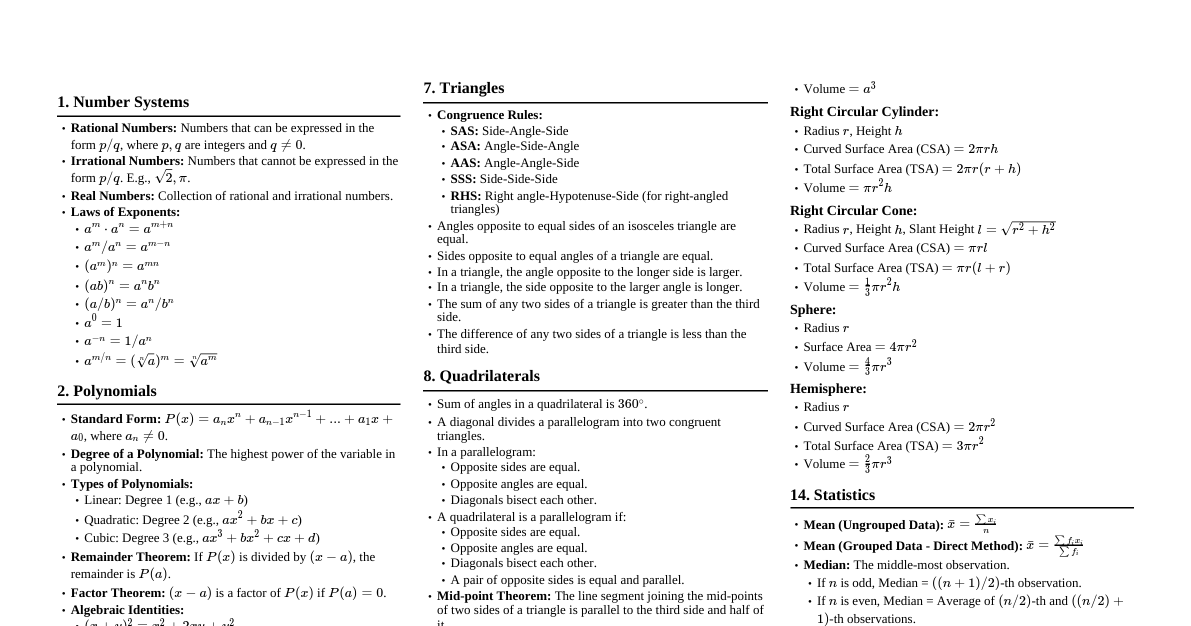
### 1. Number Systems #### 1.1 Rational Numbers - **Definition:** A number $r$ is rational if it can be expressed as $p/q$, where $p, q$ are integers and $q \neq 0$. - **Decimal Expansions:** Terminating or non-terminating recurring. #### 1.2 Irrational Numbers - **Definition:** A number $s$ is irrational if it cannot be expressed as $p/q$. - **Decimal Expansions:** Non-terminating non-recurring. - Examples: $\sqrt{2}, \sqrt{3}, \pi$. #### 1.3 Real Numbers - **Definition:** Collection of all rational and irrational numbers. - Every real number corresponds to a unique point on the number line. #### 1.4 Operations on Real Numbers - Sum/Difference of a rational and an irrational number is irrational. - Product/Quotient of a non-zero rational and an irrational number is irrational. - Sum/Difference/Product/Quotient of two irrationals can be rational or irrational. #### 1.5 Laws of Exponents for Real Numbers Let $a > 0$ be a real number and $p, q$ be rational numbers. - $a^p \cdot a^q = a^{p+q}$ - $(a^p)^q = a^{pq}$ - $a^p / a^q = a^{p-q}$ - $a^p b^p = (ab)^p$ - $a^0 = 1$ - $a^{-n} = 1/a^n$ - $\sqrt[n]{a} = a^{1/n}$ - $\sqrt[n]{ab} = \sqrt[n]{a} \cdot \sqrt[n]{b}$ - $\sqrt[n]{a/b} = \sqrt[n]{a} / \sqrt[n]{b}$ ### 2. Polynomials #### 2.1 Basic Definitions - **Polynomial:** An algebraic expression where exponents of variables are whole numbers. - **Terms:** Parts of a polynomial separated by + or -. - **Coefficient:** The numerical factor of a term. - **Monomial:** 1 term (e.g., $2x$) - **Binomial:** 2 terms (e.g., $x+1$) - **Trinomial:** 3 terms (e.g., $x^2+x+1$) - **Degree of a Polynomial:** Highest power of the variable. - Linear: degree 1 (e.g., $ax+b$) - Quadratic: degree 2 (e.g., $ax^2+bx+c$) - Cubic: degree 3 (e.g., $ax^3+bx^2+cx+d$) - **Zero Polynomial:** $0$, its degree is undefined. #### 2.2 Zeroes of a Polynomial - **Zero of $p(x)$:** A number $c$ such that $p(c) = 0$. - A linear polynomial $ax+b$ has exactly one zero: $-b/a$. #### 2.3 Remainder Theorem - If $p(x)$ is divided by $x-a$, the remainder is $p(a)$. #### 2.4 Factor Theorem - $x-a$ is a factor of $p(x)$ if and only if $p(a) = 0$. #### 2.5 Algebraic Identities - $(x+y)^2 = x^2+2xy+y^2$ - $(x-y)^2 = x^2-2xy+y^2$ - $x^2-y^2 = (x+y)(x-y)$ - $(x+a)(x+b) = x^2+(a+b)x+ab$ - $(x+y+z)^2 = x^2+y^2+z^2+2xy+2yz+2zx$ - $(x+y)^3 = x^3+y^3+3xy(x+y) = x^3+y^3+3x^2y+3xy^2$ - $(x-y)^3 = x^3-y^3-3xy(x-y) = x^3-y^3-3x^2y+3xy^2$ - $x^3+y^3+z^3-3xyz = (x+y+z)(x^2+y^2+z^2-xy-yz-zx)$ - If $x+y+z=0$, then $x^3+y^3+z^3=3xyz$. ### 3. Coordinate Geometry #### 3.1 Cartesian System - **Coordinate Axes:** Perpendicular lines (x-axis and y-axis) used to locate points in a plane. - **Origin:** Intersection of axes (0,0). - **Quadrants:** Four regions formed by the axes. - I: (+,+) - II: (-,+) - III: (-,-) - IV: (+,-) - **Coordinates of a Point (x,y):** - **Abscissa (x-coordinate):** Perpendicular distance from y-axis. - **Ordinate (y-coordinate):** Perpendicular distance from x-axis. - Point on x-axis: $(x,0)$ - Point on y-axis: $(0,y)$ - $(x,y)$ is an ordered pair, $(x,y) \ne (y,x)$ if $x \ne y$. ### 4. Linear Equations in Two Variables #### 4.1 Linear Equation in Two Variables - **Standard Form:** $ax+by+c=0$, where $a, b, c$ are real numbers, and $a, b$ are not both zero. - **Solution:** A pair of values $(x,y)$ that satisfies the equation. - A linear equation in two variables has infinitely many solutions. #### 4.2 Graph of a Linear Equation - The graph of every linear equation in two variables is a straight line. - A linear equation $y=mx$ represents a line passing through the origin. #### 4.3 Equations of Lines Parallel to Axes - **x-axis equation:** $y=0$ - **y-axis equation:** $x=0$ - **Line parallel to y-axis:** $x=a$ (vertical line) - **Line parallel to x-axis:** $y=a$ (horizontal line) ### 5. Introduction to Euclid's Geometry #### 5.1 Basic Concepts - **Undefined Terms:** Point, line, plane. - **Axioms (Common Notions):** Self-evident truths assumed without proof, used throughout mathematics. - **Postulates:** Self-evident truths specific to geometry. - **Theorems (Propositions):** Statements proved using definitions, axioms, postulates, and previously proved statements. #### 5.2 Euclid's Axioms (Examples) - Things which are equal to the same thing are equal to one another. - If equals are added to equals, the wholes are equal. - The whole is greater than the part. #### 5.3 Euclid's Postulates 1. A straight line may be drawn from any one point to any other point. - **Axiom 5.1:** Given two distinct points, there is a unique line that passes through them. 2. A terminated line can be produced indefinitely. 3. A circle can be drawn with any centre and any radius. 4. All right angles are equal to one another. 5. If a straight line falling on two straight lines makes the interior angles on the same side of it taken together less than two right angles, then the two straight lines, if produced indefinitely, meet on that side on which the sum of angles is less than two right angles. - **Playfair's Axiom (Equivalent to Postulate 5):** For every line $l$ and for every point $P$ not lying on $l$, there exists a unique line $m$ passing through $P$ and parallel to $l$. - **Theorem 5.1:** Two distinct lines cannot have more than one point in common. ### 6. Lines and Angles #### 6.1 Basic Terms and Definitions - **Line Segment:** Part of a line with two endpoints. - **Ray:** Part of a line with one endpoint. - **Collinear Points:** Points lying on the same line. - **Angle:** Formed by two rays sharing a common endpoint (vertex). - **Acute Angle:** $0^\circ ### 7. Triangles #### 7.1 Congruence of Triangles - **Congruent Figures:** Equal in all respects (same shape and size). - **CPCT:** Corresponding Parts of Congruent Triangles (are equal). #### 7.2 Criteria for Congruence - **Axiom 7.1 (SAS Congruence Rule):** Two triangles are congruent if two sides and the *included* angle of one triangle are equal to the two sides and the *included* angle of the other triangle. - **Theorem 7.1 (ASA Congruence Rule):** Two triangles are congruent if two angles and the *included* side of one triangle are equal to two angles and the *included* side of the other triangle. - **AAS Congruence Rule:** Two triangles are congruent if any two pairs of angles and one pair of *corresponding* sides (not necessarily included) are equal. - **Theorem 7.4 (SSS Congruence Rule):** If three sides of one triangle are equal to the three sides of another triangle, then the two triangles are congruent. - **Theorem 7.5 (RHS Congruence Rule):** In two right triangles, if the hypotenuse and one side of one triangle are equal to the hypotenuse and one side of the other triangle, then the two triangles are congruent. #### 7.3 Properties of a Triangle - **Theorem 7.2 (Isosceles Triangle Property):** Angles opposite to equal sides of an isosceles triangle are equal. - **Theorem 7.3 (Converse of Isosceles Triangle Property):** Sides opposite to equal angles of a triangle are equal. - Each angle of an equilateral triangle is $60^\circ$. #### 7.4 Inequalities in a Triangle - **Theorem 7.6:** If two sides of a triangle are unequal, the angle opposite to the longer side is larger (greater). - **Theorem 7.7 (Converse of Theorem 7.6):** In any triangle, the side opposite to the larger (greater) angle is longer. - **Theorem 7.8 (Triangle Inequality):** The sum of any two sides of a triangle is greater than the third side. - The perpendicular line segment from a point to a line is the shortest distance. ### 8. Quadrilaterals #### 8.1 Basic Definitions - **Quadrilateral:** A closed figure formed by joining four points, no three of which are collinear. - It has 4 sides, 4 angles, and 4 vertices. - **Diagonal:** A line segment connecting two non-adjacent vertices. #### 8.2 Angle Sum Property - The sum of the angles of a quadrilateral is $360^\circ$. #### 8.3 Types of Quadrilaterals - **Trapezium:** One pair of opposite sides is parallel. - **Parallelogram:** Both pairs of opposite sides are parallel. - **Rectangle:** A parallelogram with one angle $90^\circ$. - **Rhombus:** A parallelogram with all sides equal. - **Square:** A parallelogram with all sides equal and one angle $90^\circ$. (It is a rectangle and a rhombus). - **Kite:** Two pairs of adjacent sides are equal (not a parallelogram). #### 8.4 Properties of a Parallelogram - **Theorem 8.1:** A diagonal of a parallelogram divides it into two congruent triangles. - **Theorem 8.2:** In a parallelogram, opposite sides are equal. - **Theorem 8.3 (Converse of Theorem 8.2):** If each pair of opposite sides of a quadrilateral is equal, then it is a parallelogram. - **Theorem 8.4:** In a parallelogram, opposite angles are equal. - **Theorem 8.5 (Converse of Theorem 8.4):** If in a quadrilateral, each pair of opposite angles is equal, then it is a parallelogram. - **Theorem 8.6:** The diagonals of a parallelogram bisect each other. - **Theorem 8.7 (Converse of Theorem 8.6):** If the diagonals of a quadrilateral bisect each other, then it is a parallelogram. - A rectangle has all angles $90^\circ$. - Diagonals of a rhombus are perpendicular to each other. - **Theorem 8.8:** A quadrilateral is a parallelogram if a pair of opposite sides is equal and parallel. #### 8.5 Mid-point Theorem - **Theorem 8.9:** The line segment joining the mid-points of two sides of a triangle is parallel to the third side and is half of it. - **Formula:** $EF \parallel BC$ and $EF = \frac{1}{2} BC$. - **Theorem 8.10 (Converse of Mid-point Theorem):** The line drawn through the mid-point of one side of a triangle, parallel to another side, bisects the third side. ### 9. Areas of Parallelograms and Triangles #### 9.1 Area Concepts - **Area:** Magnitude of the planar region enclosed by a figure. - Congruent figures have equal areas. (Converse is not true) - If a planar region $T$ is made of non-overlapping regions $P$ and $Q$, then $ar(T) = ar(P) + ar(Q)$. #### 9.2 Figures on the Same Base and Between the Same Parallels - Two figures are on the same base and between the same parallels if they share a common base and the vertices opposite to the common base lie on a line parallel to the base. #### 9.3 Parallelograms on the Same Base and Between the Same Parallels - **Theorem 9.1:** Parallelograms on the same base (or equal bases) and between the same parallels are equal in area. - **Area of Parallelogram:** Base $\times$ Corresponding Altitude ($ar(ABCD) = DC \times AL$). - **Converse of Theorem 9.1:** Parallelograms on the same base (or equal bases) and having equal areas lie between the same parallels. #### 9.4 Triangles on the Same Base and Between the Same Parallels - **Theorem 9.2:** Two triangles on the same base (or equal bases) and between the same parallels are equal in area. - **Formula:** $ar(\triangle ABC) = \frac{1}{2} ar(\text{parallelogram } ABCD)$. - **Area of Triangle:** $\frac{1}{2} \times \text{Base} \times \text{Corresponding Altitude}$. - **Theorem 9.3 (Converse of Theorem 9.2):** Two triangles having the same base (or equal bases) and equal areas lie between the same parallels. - **Median Property:** A median of a triangle divides it into two triangles of equal areas. ### 10. Circles #### 10.1 Basic Terms - **Circle:** Collection of points equidistant from a fixed point (center). - **Radius (r):** Distance from center to any point on the circle. - **Chord:** Line segment connecting two points on the circle. - **Diameter (d):** Chord passing through the center ($d=2r$). Longest chord. - **Arc:** A piece of a circle. - **Minor Arc:** Shorter arc. - **Major Arc:** Longer arc. - **Semicircle:** When endpoints of an arc are ends of a diameter. - **Circumference:** Length of the complete circle ($C = 2\pi r$). - **Segment:** Region between a chord and an arc. - **Minor Segment, Major Segment.** - **Sector:** Region between an arc and two radii. - **Minor Sector, Major Sector.** #### 10.2 Chords and Angles - **Theorem 10.1:** Equal chords of a circle (or of congruent circles) subtend equal angles at the center. - **Theorem 10.2 (Converse of Theorem 10.1):** If the angles subtended by the chords of a circle at the center are equal, then the chords are equal. #### 10.3 Perpendicular from Center to Chord - **Theorem 10.3:** The perpendicular from the center of a circle to a chord bisects the chord. - **Theorem 10.4 (Converse of Theorem 10.3):** The line drawn through the center of a circle to bisect a chord is perpendicular to the chord. - **Distance of Chord from Center:** Shortest distance is the perpendicular distance. - **Theorem 10.6:** Equal chords of a circle (or of congruent circles) are equidistant from the center (or centers). - **Theorem 10.7 (Converse of Theorem 10.6):** Chords equidistant from the center of a circle are equal in length. #### 10.4 Circle through Three Points - **Theorem 10.5:** There is one and only one circle passing through three given non-collinear points. - **Circumcircle:** The circle passing through the vertices of a triangle. - **Circumcenter:** Center of the circumcircle. - **Circumradius:** Radius of the circumcircle. #### 10.5 Angles Subtended by an Arc - The angle subtended by a chord at the center is the angle subtended by the corresponding (minor) arc at the center. - **Theorem 10.8:** The angle subtended by an arc at the center is double the angle subtended by it at any point on the remaining part of the circle. - **Theorem 10.9:** Angles in the same segment of a circle are equal. - **Angle in a Semicircle:** Is a right angle ($90^\circ$). - **Theorem 10.10 (Converse of Theorem 10.9):** If a line segment joining two points subtends equal angles at two other points lying on the same side of the line containing the line segment, the four points lie on a circle (concyclic). #### 10.6 Cyclic Quadrilaterals - **Cyclic Quadrilateral:** A quadrilateral whose all four vertices lie on a circle. - **Theorem 10.11:** The sum of either pair of opposite angles of a cyclic quadrilateral is $180^\circ$. - **Theorem 10.12 (Converse of Theorem 10.11):** If the sum of a pair of opposite angles of a quadrilateral is $180^\circ$, the quadrilateral is cyclic. ### 11. Constructions #### 11.1 Basic Constructions - **Tools:** Ungraduated ruler (straight edge) and compass. - **Bisecting an Angle:** 1. Arc from vertex, intersecting arms at D, E. 2. Arcs from D, E of radius > DE/2, intersecting at F. 3. Ray from vertex through F is angle bisector. - **Perpendicular Bisector of a Line Segment:** 1. Arcs from endpoints A, B of radius > AB/2, intersecting at P, Q. 2. Line through P, Q is perpendicular bisector. - **Constructing Angles:** - $60^\circ$: Arc from A, same radius arc from intersection point. - $90^\circ$: Extend line, $60^\circ$ and $120^\circ$ arcs, then bisect the angle between them. - $30^\circ, 45^\circ, 120^\circ, 150^\circ$, etc., by bisecting or combining. #### 11.2 Construction of Triangles - **Given base, base angle, and sum of other two sides (AB+AC):** 1. Draw base BC. 2. At B, draw angle XBC equal to given base angle. 3. On ray BX, cut segment BD = AB+AC. 4. Join DC. 5. Draw perpendicular bisector of DC, intersecting BX at A. 6. Join AC. $\triangle ABC$ is required. - **Given base, base angle, and difference of other two sides (AB-AC or AC-AB):** 1. Draw base BC. 2. At B, draw angle XBC equal to given base angle. 3. On ray BX (or extended BX), cut segment BD = |AB-AC|. 4. Join DC. 5. Draw perpendicular bisector of DC, intersecting BX (or extended BX) at A. 6. Join AC. $\triangle ABC$ is required. - **Given perimeter and two base angles:** 1. Draw line segment XY = perimeter. 2. At X, draw angle LXY (half of one base angle). At Y, draw angle MYX (half of other base angle). 3. Bisect LXY and MYX. Their intersection is A. 4. Draw perpendicular bisectors of AX and AY, intersecting XY at B and C respectively. 5. Join AB and AC. $\triangle ABC$ is required. ### 12. Heron's Formula #### 12.1 Area of a Triangle - **General Formula:** Area $= \frac{1}{2} \times \text{base} \times \text{height}$. - For a right-angled triangle, base and height are the perpendicular sides. #### 12.2 Heron's Formula - For a triangle with sides $a, b, c$: - **Semi-perimeter (s):** $s = (a+b+c)/2$ - **Area:** $\text{Area} = \sqrt{s(s-a)(s-b)(s-c)}$ - **Application:** Useful when height is not easily found. #### 12.3 Applications in Quadrilaterals - To find the area of a quadrilateral, divide it into triangular parts using a diagonal and apply Heron's formula to each triangle. ### 13. Surface Areas and Volumes #### 13.1 Cuboid - **Total Surface Area (TSA):** $2(lb+bh+hl)$ - **Lateral Surface Area (LSA):** $2h(l+b)$ (Area of 4 walls) - **Volume (V):** $l \times b \times h$ #### 13.2 Cube - **TSA:** $6a^2$ - **LSA:** $4a^2$ - **Volume (V):** $a^3$ #### 13.3 Cylinder - **Curved Surface Area (CSA):** $2\pi rh$ - **TSA:** $2\pi r(r+h)$ - **Volume (V):** $\pi r^2 h$ #### 13.4 Cone - **Slant Height (l):** $l = \sqrt{r^2+h^2}$ - **CSA:** $\pi rl$ - **TSA:** $\pi r(r+l)$ - **Volume (V):** $\frac{1}{3} \pi r^2 h$ #### 13.5 Sphere - **Surface Area (SA):** $4\pi r^2$ - **Volume (V):** $\frac{4}{3} \pi r^3$ #### 13.6 Hemisphere - **CSA:** $2\pi r^2$ - **TSA:** $3\pi r^2$ - **Volume (V):** $\frac{2}{3} \pi r^3$ ### 14. Statistics #### 14.1 Data - **Data:** Facts or figures collected with a definite purpose. - **Primary Data:** Collected by the investigator for a specific purpose. - **Secondary Data:** Collected by someone else and used by the investigator. #### 14.2 Presentation of Data - **Raw Data:** Data in original form. - **Range:** Difference between highest and lowest values. - **Frequency:** Number of times an observation occurs. - **Frequency Distribution Table:** Organizes data by showing frequency of each observation. - **Grouped Frequency Distribution Table:** Data grouped into classes/class-intervals. - **Class-size/Width:** Difference between upper and lower limit of a class. - **Lower Limit, Upper Limit.** - **Continuous Classes:** No gaps between upper limit of one class and lower limit of next. To make discrete data continuous, subtract 0.5 from lower limit and add 0.5 to upper limit. #### 14.3 Graphical Representation of Data - **Bar Graph:** Rectangles of uniform width, heights proportional to frequency. Gaps between bars. - **Histogram:** For continuous grouped data. Rectangles of uniform width (or varying widths), heights (or areas) proportional to frequency. No gaps between bars. - **Frequency Polygon:** Formed by joining mid-points of the tops of adjacent rectangles in a histogram, or by plotting class-marks against frequencies and joining. - **Class-Mark:** Mid-point of a class interval. Class-mark $= (\text{Upper limit} + \text{Lower limit})/2$. #### 14.4 Measures of Central Tendency - **Mean $(\bar{x})$:** Sum of all observations / Total number of observations. - For ungrouped data: $\bar{x} = \sum x_i / n$ - For grouped data: $\bar{x} = \sum f_i x_i / \sum f_i$ - **Median:** Middle-most value of data arranged in ascending/descending order. - If $n$ is odd, Median = $((n+1)/2)^\text{th}$ observation. - If $n$ is even, Median = Mean of $(n/2)^\text{th}$ and $((n/2)+1)^\text{th}$ observations. - **Mode:** The observation that occurs most frequently. ### 15. Probability #### 15.1 Basic Concepts - **Experiment:** A process that produces some well-defined outcomes. - **Trial:** A single performance of an experiment. - **Event (E):** A collection of some outcomes of an experiment. #### 15.2 Empirical Probability - **Formula:** $P(E) = \frac{\text{Number of trials in which the event happened}}{\text{Total number of trials}}$ - **Properties:** - The probability of an event $E$ is a number between 0 and 1 (inclusive). - The sum of probabilities of all possible outcomes is 1.