Chemical Reactions & Equations
Cheatsheet Content
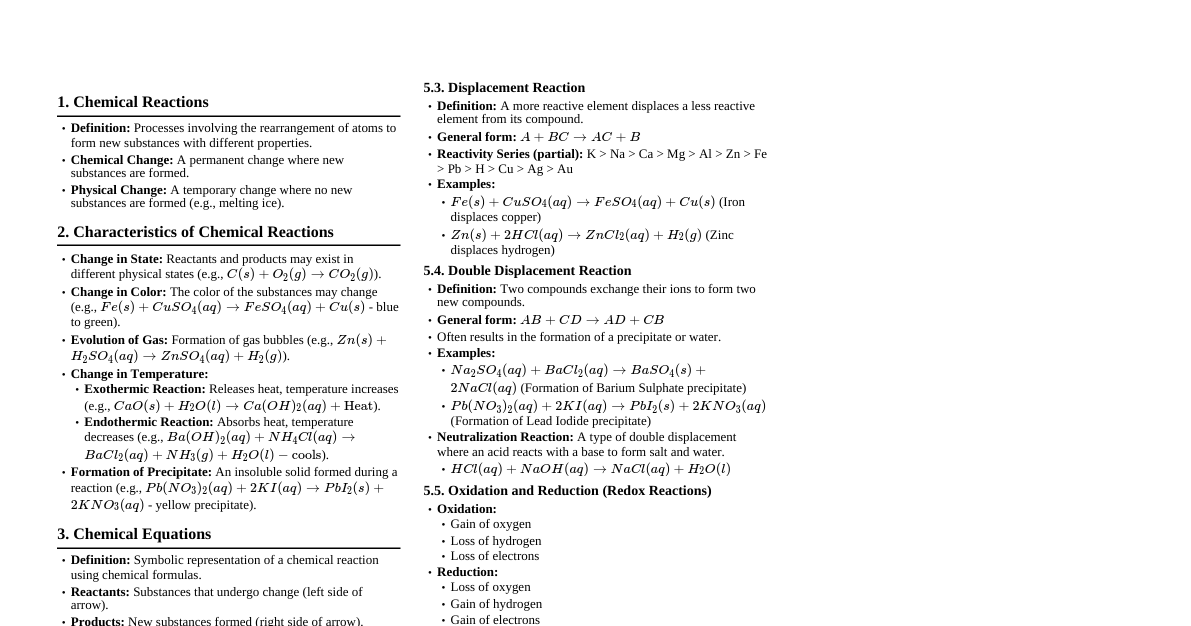
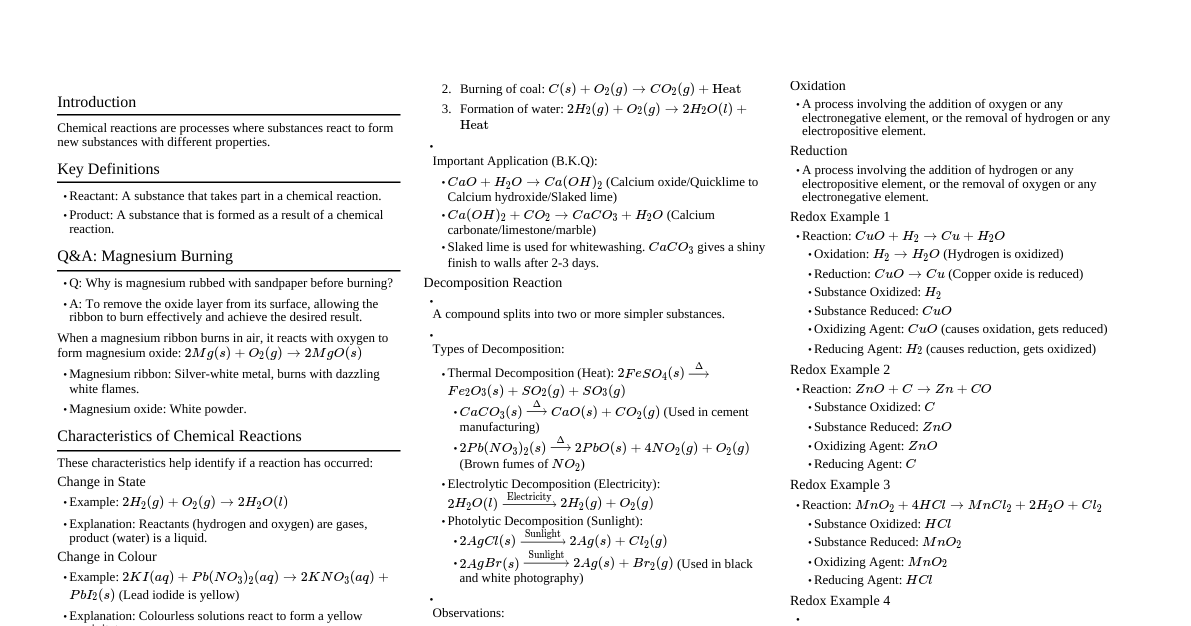
1. Introduction to Chemical Reactions A chemical reaction is a process where substances undergo chemical change to form new substances with different properties. This involves the breaking and making of chemical bonds. Reactants: Substances that take part in a chemical reaction. Products: New substances formed after a chemical reaction. Chemical Equation: A symbolic representation of a chemical reaction using chemical formulas. Reactants are on the left side, products on the right side, separated by an arrow ($\to$). 2. Characteristics of Chemical Reactions Any of these observations indicate a chemical change has occurred: Change in State: Reactants might be gas and products liquid. Change in Color: E.g., when iron rusts, its color changes from grey to reddish-brown. Evolution of a Gas: Bubbles are formed (e.g., zinc reacting with dilute sulfuric acid produces hydrogen gas). Formation of a Precipitate: An insoluble solid separates out from the solution (e.g., lead nitrate reacting with potassium iodide forms yellow lead iodide precipitate). Change in Temperature: Exothermic Reactions: Release heat, causing the temperature of the surroundings to rise (e.g., burning of natural gas, quicklime reacting with water). Endothermic Reactions: Absorb heat from the surroundings, causing the temperature to fall (e.g., dissolving ammonium chloride in water). 3. Writing and Balancing Chemical Equations According to the Law of Conservation of Mass , mass can neither be created nor destroyed in a chemical reaction. This means the total mass of reactants must equal the total mass of products. Therefore, the number of atoms of each element must be the same on both sides of a chemical equation. Steps for Balancing Chemical Equations (Hit and Trial Method): Write the word equation for the reaction. Convert the word equation into a skeletal chemical equation using chemical formulas. List the number of atoms of each element present in reactants and products. Start balancing with the compound containing the maximum number of atoms, preferably an element that is present in only one reactant and one product. Balance all the atoms by multiplying the formulas with suitable coefficients. Do NOT change the formulas themselves. Balance hydrogen and oxygen atoms last. Check the equation to ensure the number of atoms of each element is equal on both sides. Example: Reaction of Iron with Steam Skeletal equation: $Fe(s) + H_2O(g) \to Fe_3O_4(s) + H_2(g)$ Balancing Fe: $3Fe(s) + H_2O(g) \to Fe_3O_4(s) + H_2(g)$ Balancing O: $3Fe(s) + 4H_2O(g) \to Fe_3O_4(s) + H_2(g)$ Balancing H: $3Fe(s) + 4H_2O(g) \to Fe_3O_4(s) + 4H_2(g)$ Balanced equation: $3Fe(s) + 4H_2O(g) \to Fe_3O_4(s) + 4H_2(g)$ Including State Symbols: $(s)$ for solid $(l)$ for liquid $(g)$ for gas $(aq)$ for aqueous solution (dissolved in water) Reaction conditions like temperature, pressure, or catalyst can be indicated above/below the arrow (e.g., $\xrightarrow{Heat}$, $\xrightarrow{Pressure}$, $\xrightarrow{Catalyst}$). 4. Types of Chemical Reactions 4.1. Combination Reaction (Synthesis) Two or more reactants combine to form a single product. General Form: $A + B \to AB$ Examples: Burning of coal: $C(s) + O_2(g) \to CO_2(g)$ Formation of water: $2H_2(g) + O_2(g) \to 2H_2O(l)$ Formation of slaked lime: $CaO(s) + H_2O(l) \to Ca(OH)_2(aq) + \text{Heat}$ (Exothermic) 4.2. Decomposition Reaction A single reactant breaks down into two or more simpler products. These reactions often require energy (heat, light, electricity). General Form: $AB \to A + B$ Types: Thermal Decomposition: By heating. Example: $CaCO_3(s) \xrightarrow{Heat} CaO(s) + CO_2(g)$ (Limestone to quicklime) Electrolytic Decomposition (Electrolysis): By passing electricity. Example: $2H_2O(l) \xrightarrow{Electricity} 2H_2(g) + O_2(g)$ Photolytic Decomposition (Photolysis): By light energy. Example: $2AgCl(s) \xrightarrow{Sunlight} 2Ag(s) + Cl_2(g)$ (Used in black and white photography) 4.3. Displacement Reaction A more reactive element displaces a less reactive element from its compound. General Form: $A + BC \to AC + B$ Reactivity Series: A list of metals in order of decreasing reactivity (e.g., K > Na > Ca > Mg > Al > Zn > Fe > Pb > H > Cu > Ag > Au). A metal higher in the series can displace a metal lower in the series. Examples: Iron displacing copper: $Fe(s) + CuSO_4(aq) \to FeSO_4(aq) + Cu(s)$ (Iron nail turns brownish, blue copper sulfate solution fades) Zinc displacing hydrogen: $Zn(s) + 2HCl(aq) \to ZnCl_2(aq) + H_2(g)$ 4.4. Double Displacement Reaction Two compounds exchange their ions to form two new compounds. These reactions often result in the formation of a precipitate, water, or a gas. General Form: $AB + CD \to AD + CB$ Examples: Precipitation Reaction: Formation of an insoluble product (precipitate). $BaCl_2(aq) + Na_2SO_4(aq) \to BaSO_4(s) + 2NaCl(aq)$ (White precipitate of barium sulfate) Neutralization Reaction: Reaction between an acid and a base to form salt and water. $HCl(aq) + NaOH(aq) \to NaCl(aq) + H_2O(l)$ 4.5. Oxidation and Reduction (Redox Reactions) These reactions involve the transfer of oxygen or hydrogen, or electrons. Oxidation: Gain of oxygen. Loss of hydrogen. Loss of electrons (more advanced concept, not primary for Class 10). Reduction: Loss of oxygen. Gain of hydrogen. Gain of electrons (more advanced concept). Redox Reaction: A reaction where one substance is oxidized while another is reduced simultaneously. Oxidizing Agent: The substance that oxidizes another substance and gets reduced itself. Reducing Agent: The substance that reduces another substance and gets oxidized itself. Example: $CuO(s) + H_2(g) \xrightarrow{Heat} Cu(s) + H_2O(l)$ $CuO$ is reduced (loses oxygen). It is the oxidizing agent. $H_2$ is oxidized (gains oxygen). It is the reducing agent. 5. Effects of Oxidation in Everyday Life 5.1. Corrosion The process by which metals are slowly eaten up by the action of air, moisture, or a chemical on their surface. Rusting of Iron: Iron reacts with oxygen and moisture to form hydrated iron(III) oxide (rust). $4Fe(s) + 3O_2(g) + xH_2O(l) \to 2Fe_2O_3 \cdot xH_2O(s)$ Prevention: Painting, oiling, greasing, galvanizing (coating with zinc), chrome plating, anodizing, making alloys. 5.2. Rancidity The oxidation of fats and oils in food items when exposed to air for a long time, leading to an unpleasant smell and taste. Prevention: Adding antioxidants (substances that prevent oxidation, e.g., BHA, BHT). Packaging in nitrogen gas (e.g., potato chips). Refrigeration. Storing food in airtight containers. Storing food away from light.