CBSE Class 10: Chemical Reactions
Cheatsheet Content
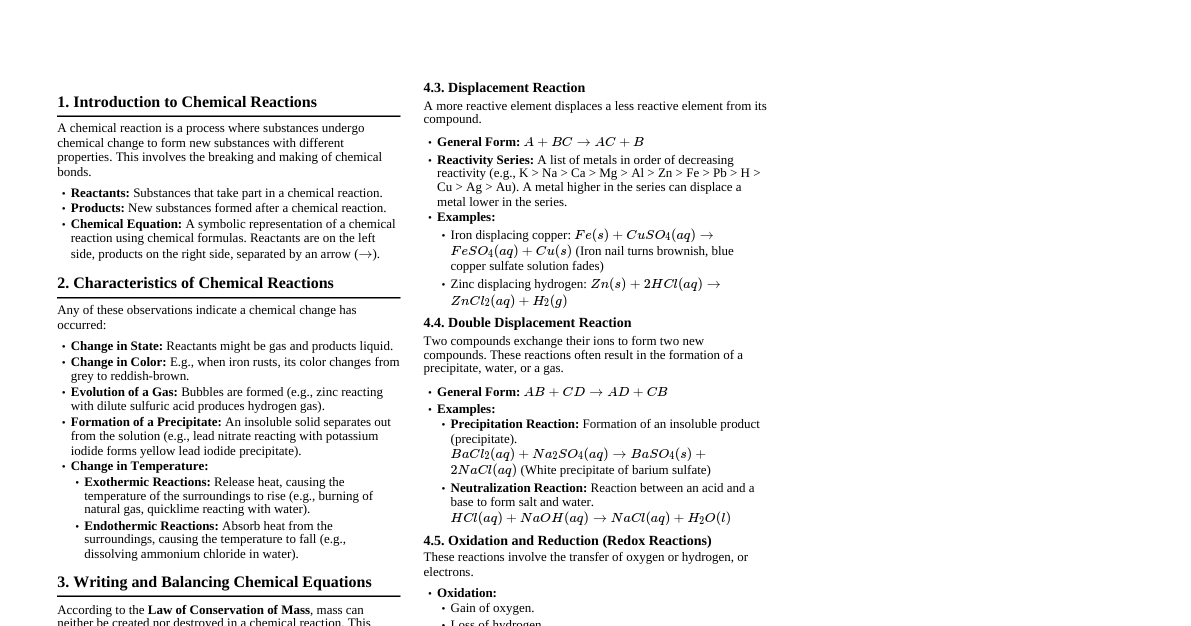
1. Chemical Reactions Definition: Processes involving the rearrangement of atoms to form new substances with different properties. Chemical Change: A permanent change where new substances are formed. Physical Change: A temporary change where no new substances are formed (e.g., melting ice). 2. Characteristics of Chemical Reactions Change in State: Reactants and products may exist in different physical states (e.g., $C(s) + O_2(g) \rightarrow CO_2(g)$). Change in Color: The color of the substances may change (e.g., $Fe(s) + CuSO_4(aq) \rightarrow FeSO_4(aq) + Cu(s)$ - blue to green). Evolution of Gas: Formation of gas bubbles (e.g., $Zn(s) + H_2SO_4(aq) \rightarrow ZnSO_4(aq) + H_2(g)$). Change in Temperature: Exothermic Reaction: Releases heat, temperature increases (e.g., $CaO(s) + H_2O(l) \rightarrow Ca(OH)_2(aq) + \text{Heat}$). Endothermic Reaction: Absorbs heat, temperature decreases (e.g., $Ba(OH)_2(aq) + NH_4Cl(aq) \rightarrow BaCl_2(aq) + NH_3(g) + H_2O(l) - \text{cools}$). Formation of Precipitate: An insoluble solid formed during a reaction (e.g., $Pb(NO_3)_2(aq) + 2KI(aq) \rightarrow PbI_2(s) + 2KNO_3(aq)$ - yellow precipitate). 3. Chemical Equations Definition: Symbolic representation of a chemical reaction using chemical formulas. Reactants: Substances that undergo change (left side of arrow). Products: New substances formed (right side of arrow). Arrow ($\rightarrow$): Indicates the direction of the reaction. State Symbols: $(s)$ for solid $(l)$ for liquid $(g)$ for gas $(aq)$ for aqueous solution (dissolved in water) Example: $2Mg(s) + O_2(g) \rightarrow 2MgO(s)$ 4. Balancing Chemical Equations Law of Conservation of Mass: Mass can neither be created nor destroyed in a chemical reaction. Total mass of reactants = Total mass of products. Number of atoms of each element must be equal on both sides. Hit and Trial Method: Write the unbalanced equation. Count atoms of each element on both sides. Start balancing with the compound containing the maximum number of atoms. Balance metal atoms first, then non-metal atoms (except H and O), then O, then H. Check if all atoms are balanced. Example: Balancing $Fe + H_2O \rightarrow Fe_3O_4 + H_2$ $Fe + H_2O \rightarrow Fe_3O_4 + H_2$ Fe: 1 (LHS), 3 (RHS); H: 2 (LHS), 2 (RHS); O: 1 (LHS), 4 (RHS) Balance O: $Fe + 4H_2O \rightarrow Fe_3O_4 + H_2$ Balance H: $Fe + 4H_2O \rightarrow Fe_3O_4 + 4H_2$ Balance Fe: $3Fe + 4H_2O \rightarrow Fe_3O_4 + 4H_2$ (Balanced) 5. Types of Chemical Reactions 5.1. Combination Reaction Definition: Two or more reactants combine to form a single product. General form: $A + B \rightarrow AB$ Examples: $C(s) + O_2(g) \rightarrow CO_2(g)$ (Burning of coal) $CaO(s) + H_2O(l) \rightarrow Ca(OH)_2(aq)$ (Quicklime with water) $2H_2(g) + O_2(g) \rightarrow 2H_2O(l)$ (Formation of water) 5.2. Decomposition Reaction Definition: A single reactant breaks down into two or more simpler products. General form: $AB \rightarrow A + B$ Requires energy (heat, light, or electricity) to break bonds. Types: Thermal Decomposition: By heat. $CaCO_3(s) \xrightarrow{\text{Heat}} CaO(s) + CO_2(g)$ (Limestone) $2FeSO_4(s) \xrightarrow{\text{Heat}} Fe_2O_3(s) + SO_2(g) + SO_3(g)$ Electrolytic Decomposition (Electrolysis): By electricity. $2H_2O(l) \xrightarrow{\text{Electricity}} 2H_2(g) + O_2(g)$ Photolytic Decomposition (Photolysis): By light. $2AgCl(s) \xrightarrow{\text{Sunlight}} 2Ag(s) + Cl_2(g)$ (Used in black and white photography) $2AgBr(s) \xrightarrow{\text{Sunlight}} 2Ag(s) + Br_2(g)$ 5.3. Displacement Reaction Definition: A more reactive element displaces a less reactive element from its compound. General form: $A + BC \rightarrow AC + B$ Reactivity Series (partial): K > Na > Ca > Mg > Al > Zn > Fe > Pb > H > Cu > Ag > Au Examples: $Fe(s) + CuSO_4(aq) \rightarrow FeSO_4(aq) + Cu(s)$ (Iron displaces copper) $Zn(s) + 2HCl(aq) \rightarrow ZnCl_2(aq) + H_2(g)$ (Zinc displaces hydrogen) 5.4. Double Displacement Reaction Definition: Two compounds exchange their ions to form two new compounds. General form: $AB + CD \rightarrow AD + CB$ Often results in the formation of a precipitate or water. Examples: $Na_2SO_4(aq) + BaCl_2(aq) \rightarrow BaSO_4(s) + 2NaCl(aq)$ (Formation of Barium Sulphate precipitate) $Pb(NO_3)_2(aq) + 2KI(aq) \rightarrow PbI_2(s) + 2KNO_3(aq)$ (Formation of Lead Iodide precipitate) Neutralization Reaction: A type of double displacement where an acid reacts with a base to form salt and water. $HCl(aq) + NaOH(aq) \rightarrow NaCl(aq) + H_2O(l)$ 5.5. Oxidation and Reduction (Redox Reactions) Oxidation: Gain of oxygen Loss of hydrogen Loss of electrons Reduction: Loss of oxygen Gain of hydrogen Gain of electrons Redox Reaction: A reaction where both oxidation and reduction occur simultaneously. Oxidizing Agent: Substance that oxidizes another substance and itself gets reduced. Reducing Agent: Substance that reduces another substance and itself gets oxidized. Example: $CuO(s) + H_2(g) \xrightarrow{\text{Heat}} Cu(s) + H_2O(l)$ $CuO$ is reduced (loss of oxygen) and acts as an oxidizing agent. $H_2$ is oxidized (gain of oxygen) and acts as a reducing agent. 6. Effects of Oxidation in Everyday Life 6.1. Corrosion Definition: The process of slow eating up of metals due to attack by atmospheric gases and moisture. Rusting of Iron: Iron reacts with oxygen and moisture to form hydrated iron(III) oxide (rust). $4Fe(s) + 3O_2(g) + 2xH_2O(l) \rightarrow 2Fe_2O_3 \cdot xH_2O(s)$ Corrosion of Copper: Forms a green layer of basic copper carbonate. Corrosion of Silver: Forms a black layer of silver sulphide. Prevention: Painting, oiling, greasing, galvanizing, chrome plating, anodizing, making alloys. 6.2. Rancidity Definition: The oxidation of fats and oils in food when exposed to air, leading to unpleasant smell and taste. Prevention: Adding antioxidants (e.g., BHA, BHT). Storing food in airtight containers. Flushing food packages with nitrogen gas (e.g., chips). Refrigeration.