Thermodynamics Essentials
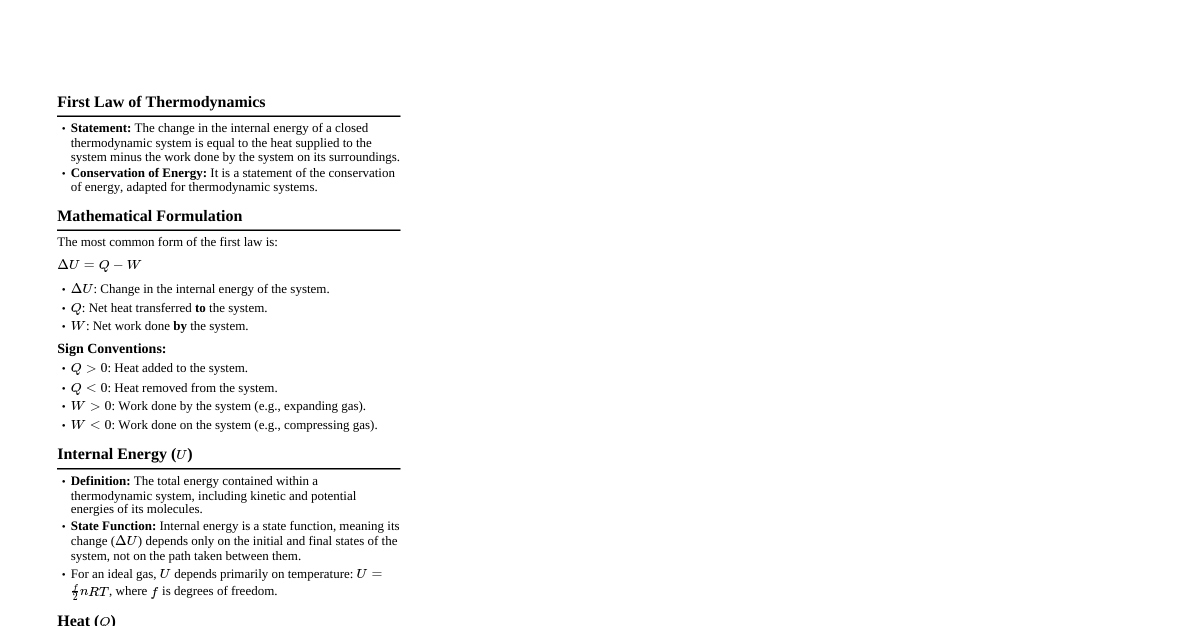
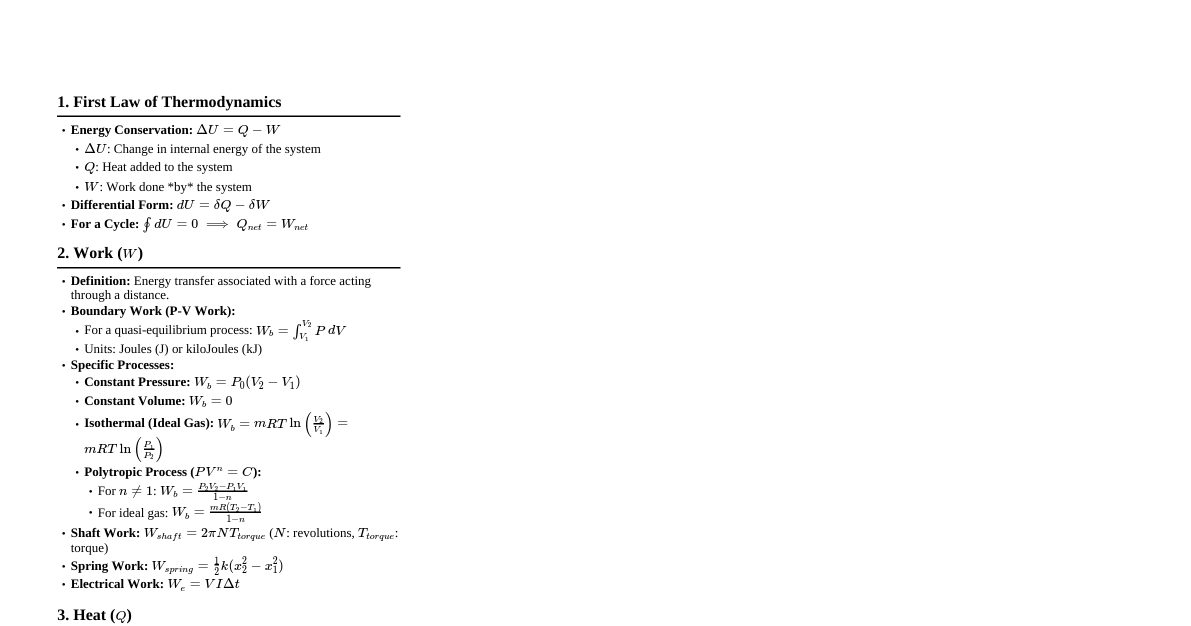
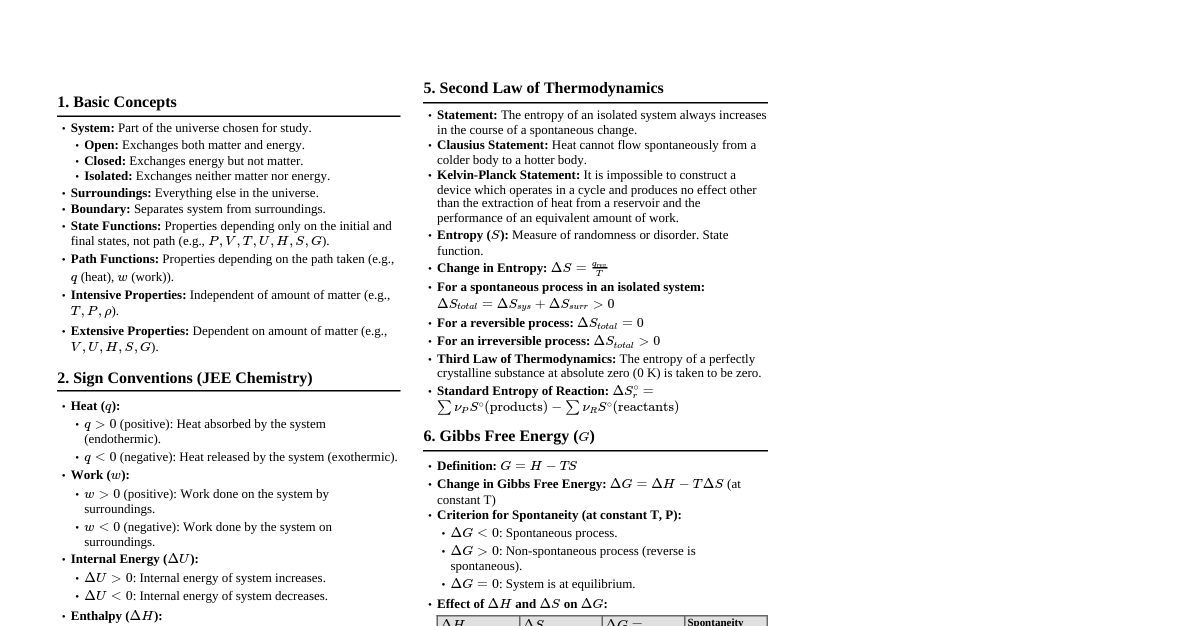
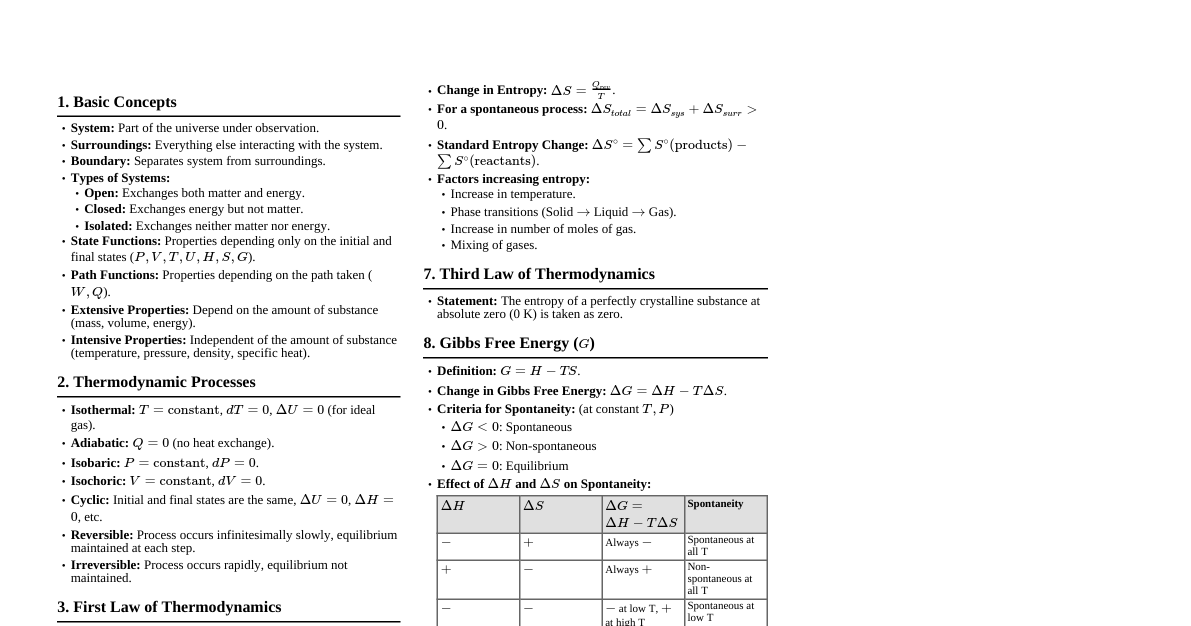
Cheatsheet Content
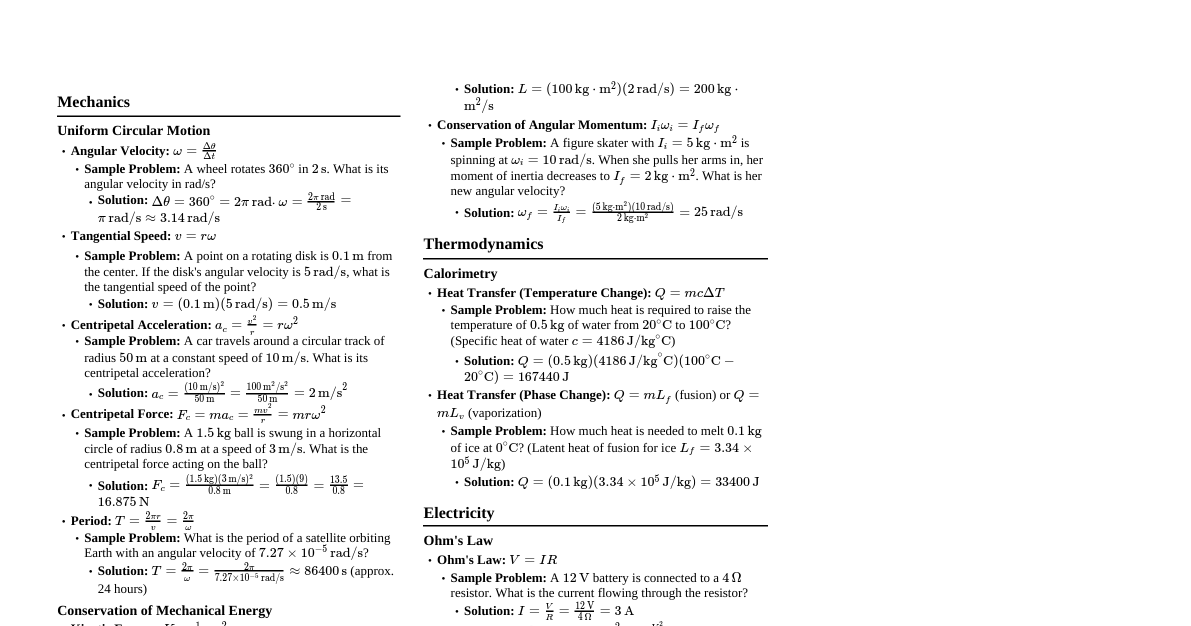
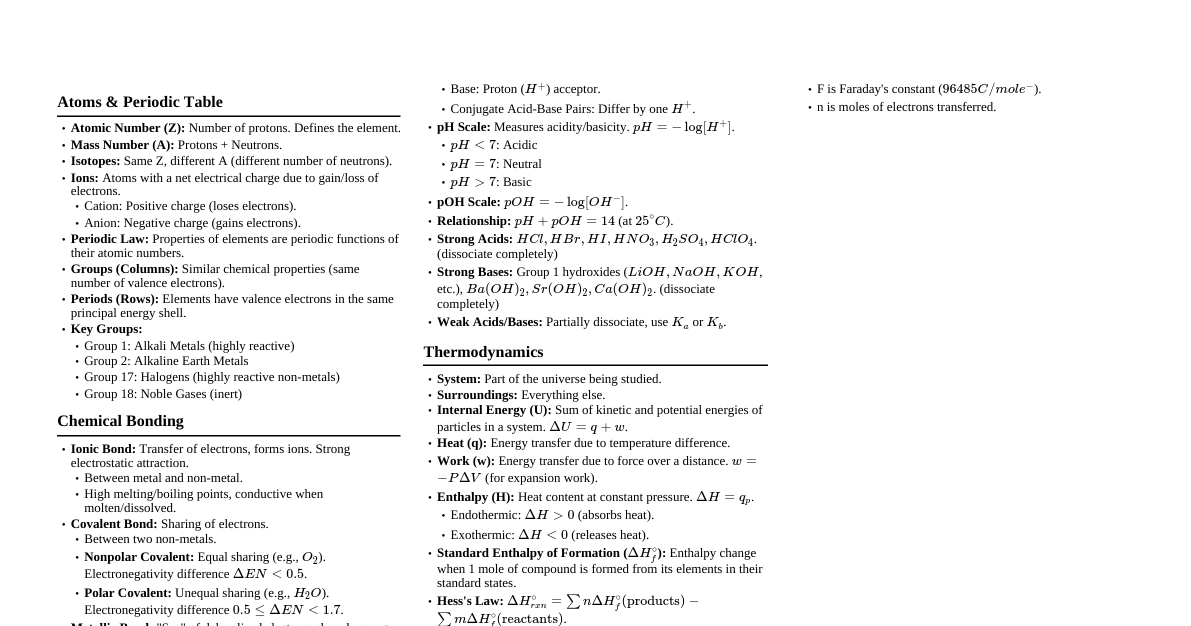
Fundamental Concepts System: Region of interest. Surroundings: Everything outside the system. Boundary: Separates system from surroundings. State: Condition described by properties ($P, V, T$). Process: Change of state. Cycle: Series of processes returning to initial state. Extensive Property: Depends on amount (e.g., $m, V, E$). Intensive Property: Independent of amount (e.g., $P, T, \rho$). Specific Property: Extensive property per unit mass (e.g., $v = V/m$). Zeroth Law of Thermodynamics If two systems are each in thermal equilibrium with a third system, then they are in thermal equilibrium with each other. Establishes temperature ($T$) as a measurable property. First Law of Thermodynamics (Conservation of Energy) Closed System (Fixed Mass) $\Delta E = Q - W$ $\Delta U + \Delta KE + \Delta PE = Q - W$ For stationary systems: $\Delta U = Q - W$ Differential form: $dU = \delta Q - \delta W$ Specific form: $\Delta u = q - w$ Open System (Control Volume) $\dot{E}_{in} - \dot{E}_{out} = dE_{CV}/dt$ For steady-state: $\dot{E}_{in} = \dot{E}_{out}$ $\dot{Q}_{CV} - \dot{W}_{CV} + \sum_{in} \dot{m}(h + \frac{V^2}{2} + gz) - \sum_{out} \dot{m}(h + \frac{V^2}{2} + gz) = 0$ Specific Enthalpy: $h = u + Pv$ Work ($W$) Boundary Work (Quasi-equilibrium): $W_{b} = \int P dV$ Shaft Work: $W_{shaft}$ Electrical Work: $W_{e}$ Total Work: $W = W_{b} + W_{shaft} + W_{e} + ...$ Work done BY the system is positive. Heat ($Q$) Heat transfer TO the system is positive. Conduction: $\dot{Q} = -kA \frac{dT}{dx}$ Convection: $\dot{Q} = hA(T_s - T_\infty)$ Radiation: $\dot{Q} = \epsilon \sigma A_s (T_s^4 - T_{surr}^4)$ Second Law of Thermodynamics Clausius Statement It is impossible to construct a device that operates in a cycle and produces no effect other than the transfer of heat from a cooler body to a hotter body. Kelvin-Planck Statement It is impossible for any device that operates on a cycle to receive heat from a single reservoir and produce a net amount of work. Entropy ($S$) A measure of molecular disorder or randomness. $\Delta S \ge 0$ for an isolated system (Principle of Increase of Entropy). Clausius Inequality: $\oint \frac{\delta Q}{T} \le 0$ Entropy Change: $dS = \frac{\delta Q_{rev}}{T}$ For an irreversible process: $dS > \frac{\delta Q}{T}$ Entropy balance for a closed system: $S_2 - S_1 = \int_1^2 \frac{\delta Q}{T} + S_{gen}$ ($S_{gen} \ge 0$) Entropy balance for a control volume (steady-state): $\sum_{out} \dot{m}s - \sum_{in} \dot{m}s - \sum_j \frac{\dot{Q}_j}{T_j} - \dot{S}_{gen} = 0$ Isentropic Process Reversible adiabatic process ($q=0, s_{gen}=0$). $\Delta s = 0 \implies s_2 = s_1$. For ideal gas: $T_2/T_1 = (P_2/P_1)^{(k-1)/k} = (v_1/v_2)^{(k-1)}$ Third Law of Thermodynamics The entropy of a pure crystalline substance at absolute zero temperature is zero. Establishes an absolute reference for entropy. Ideal Gas Relations Equation of State: $PV = mRT$ or $Pv = RT$ $R = R_u / M$ (Specific gas constant) $R_u = 8.314 \text{ kJ/(kmol}\cdot\text{K)}$ (Universal gas constant) Specific Heats: $c_v = (\partial u / \partial T)_v$ $c_p = (\partial h / \partial T)_p$ $c_p - c_v = R$ $k = c_p / c_v$ (Ratio of specific heats) Internal Energy: $\Delta u = c_v \Delta T$ (for ideal gas) Enthalpy: $\Delta h = c_p \Delta T$ (for ideal gas) Thermodynamic Cycles Heat Engines Convert heat to work. $\eta_{th} = W_{net}/Q_H = 1 - Q_L/Q_H$ Carnot Efficiency: $\eta_{Carnot} = 1 - T_L/T_H$ (Max efficiency) Refrigerators Transfer heat from low to high temperature. $COP_R = Q_L/W_{net} = Q_L/(Q_H - Q_L)$ Carnot COP: $COP_{R, Carnot} = T_L/(T_H - T_L)$ Heat Pumps Transfer heat from low to high temperature (heating). $COP_{HP} = Q_H/W_{net} = Q_H/(Q_H - Q_L)$ Carnot COP: $COP_{HP, Carnot} = T_H/(T_H - T_L)$ $COP_{HP} = COP_R + 1$ Exergy (Availability) Maximum useful work obtainable from a system as it comes to equilibrium with its surroundings. $X = (E - E_0) - T_0(S - S_0) + P_0(V - V_0)$ $\Delta X = X_2 - X_1$ Destruction of Exergy ($X_{dest}$): $X_{dest} = T_0 S_{gen} \ge 0$ Exergy is always destroyed in an irreversible process. Thermodynamic Potentials Internal Energy: $dU = TdS - PdV$ Enthalpy: $H = U + PV \implies dH = TdS + VdP$ Helmholtz Free Energy: $A = U - TS \implies dA = -PdV - SdT$ Gibbs Free Energy: $G = H - TS \implies dG = VdP - SdT$ Maxwell Relations $(\partial T / \partial V)_S = -(\partial P / \partial S)_V$ $(\partial T / \partial P)_S = (\partial V / \partial S)_P$ $(\partial P / \partial T)_V = (\partial S / \partial V)_T$ $(\partial V / \partial T)_P = -(\partial S / \partial P)_T$ Phase Change Saturated Liquid: Liquid at boiling temperature. Saturated Vapor: Vapor at condensation temperature. Superheated Vapor: Vapor above saturation temperature for given pressure. Subcooled Liquid: Liquid below saturation temperature for given pressure. Quality ($x$): Mass fraction of vapor in a saturated mixture. $x = m_g / (m_f + m_g)$ $y = y_f + x(y_g - y_f) = y_f + x y_{fg}$ (where $y$ is any intensive property like $v, u, h, s$) Psychrometrics Study of moist air properties. Relative Humidity ($\phi$): $\phi = P_v / P_g$ (where $P_g$ is saturation pressure at $T$) Specific Humidity ($\omega$): $\omega = m_v / m_a = 0.622 P_v / (P_{atm} - P_v)$ Dew-point Temperature ($T_{dp}$): Temperature at which condensation begins if air is cooled at constant pressure.