First Law of Thermodynamics
Cheatsheet Content
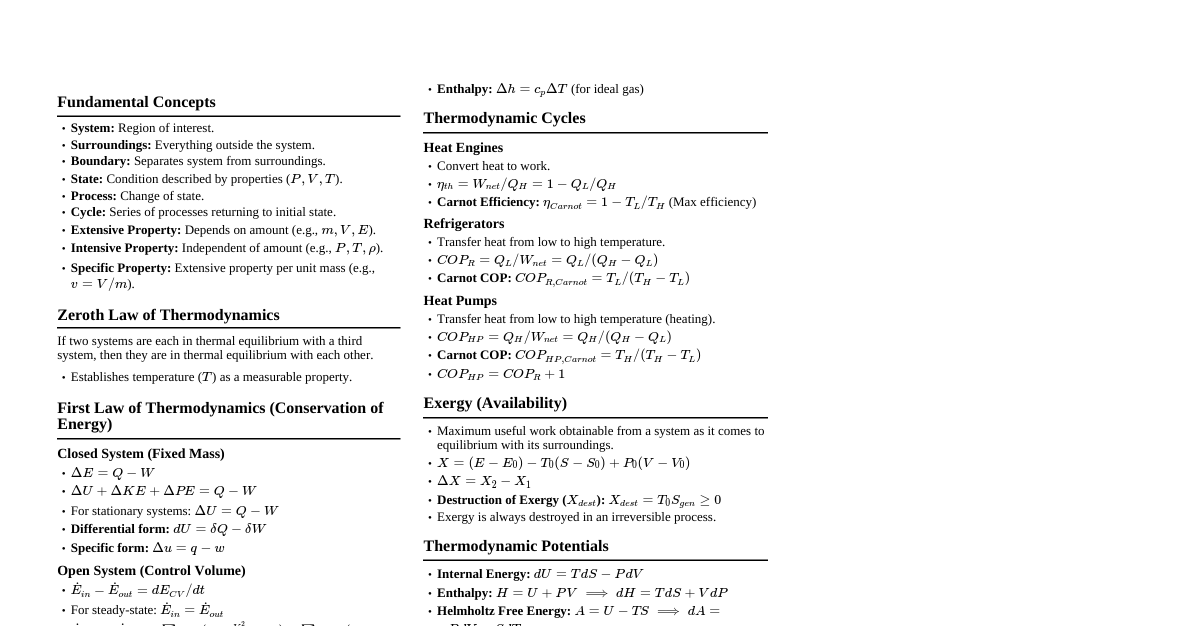
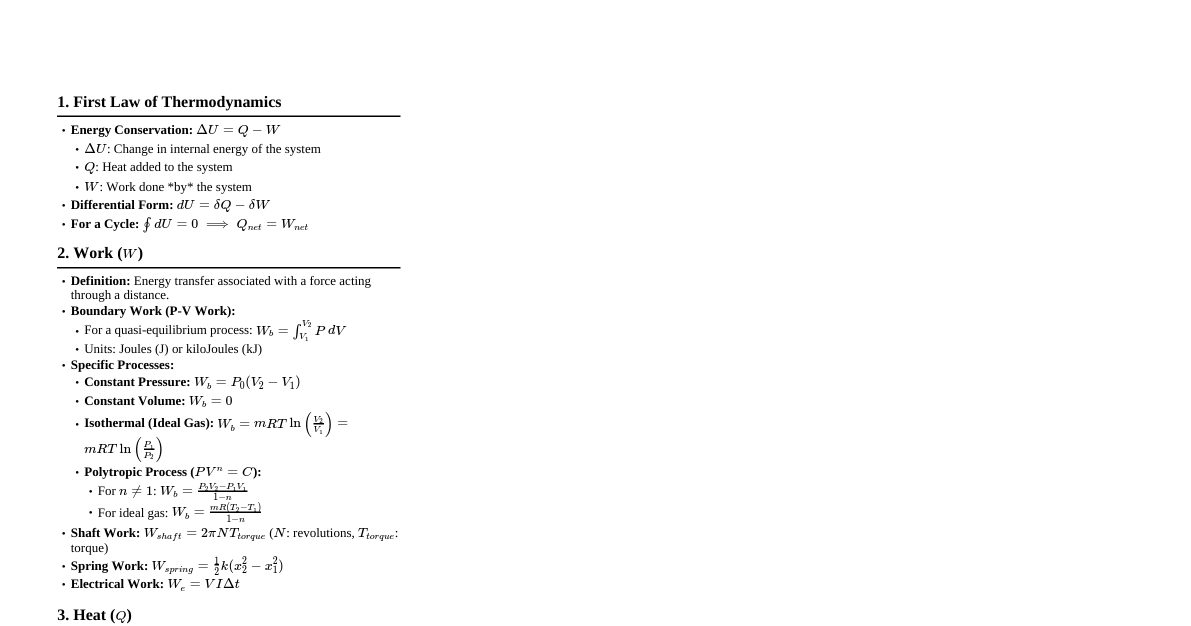
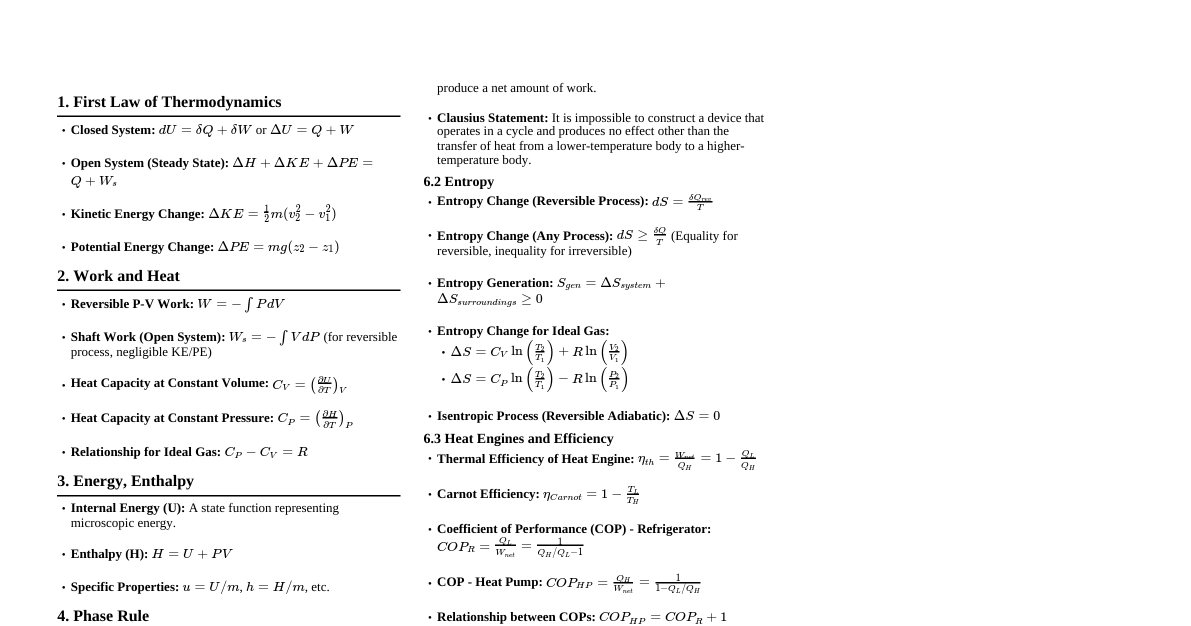
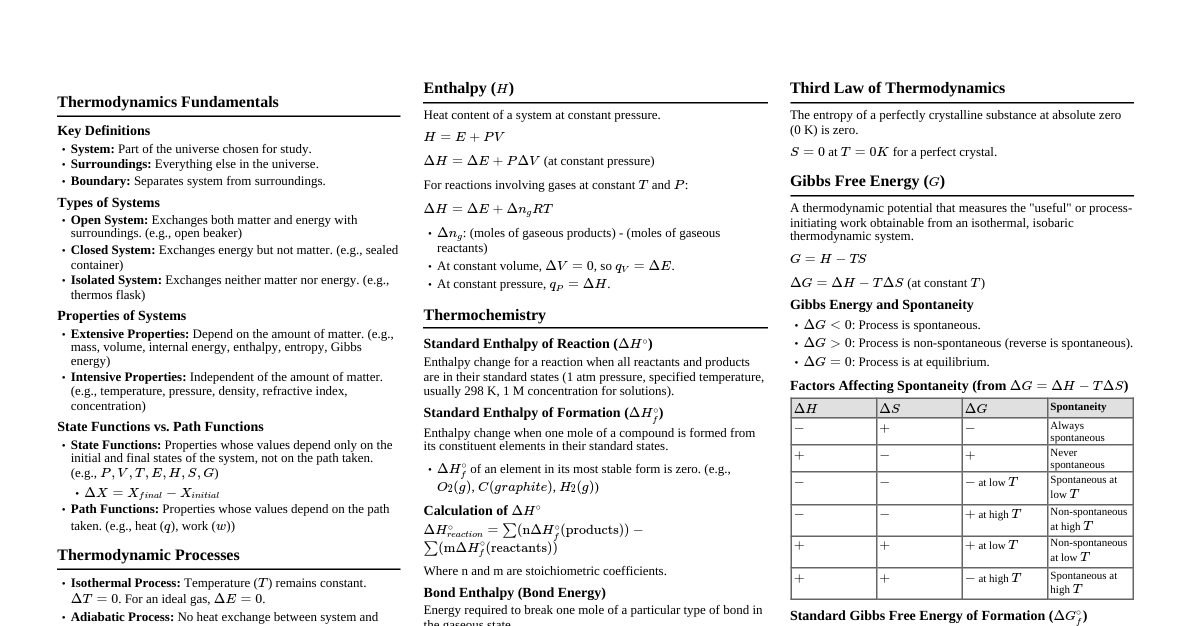
First Law of Thermodynamics Statement: The change in the internal energy of a closed thermodynamic system is equal to the heat supplied to the system minus the work done by the system on its surroundings. Conservation of Energy: It is a statement of the conservation of energy, adapted for thermodynamic systems. Mathematical Formulation The most common form of the first law is: $\Delta U = Q - W$ $\Delta U$: Change in the internal energy of the system. $Q$: Net heat transferred to the system. $W$: Net work done by the system. Sign Conventions: $Q > 0$: Heat added to the system. $Q $W > 0$: Work done by the system (e.g., expanding gas). $W Internal Energy ($U$) Definition: The total energy contained within a thermodynamic system, including kinetic and potential energies of its molecules. State Function: Internal energy is a state function, meaning its change ($\Delta U$) depends only on the initial and final states of the system, not on the path taken between them. For an ideal gas, $U$ depends primarily on temperature: $U = \frac{f}{2}nRT$, where $f$ is degrees of freedom. Heat ($Q$) Definition: Energy transferred between systems (or between a system and its surroundings) due to a temperature difference. Path-Dependent: Heat is not a state function; the amount of heat transferred depends on the process path. Specific Heat: $Q = mc\Delta T$ (for solids/liquids) or $Q = nC\Delta T$ (for gases), where $c$ is specific heat and $C$ is molar specific heat. Phase Changes: $Q = mL$ (where $L$ is latent heat). Work ($W$) Definition: Energy transferred between systems (or between a system and its surroundings) by means other than temperature difference, often involving a force acting over a distance. Path-Dependent: Work is not a state function; the amount of work done depends on the process path. Pressure-Volume Work: For a gas expanding or compressing, $W = \int P dV$. If pressure is constant, $W = P\Delta V$. Types of Thermodynamic Processes The first law can be applied to various processes: Process Description First Law ($\Delta U = Q - W$) Isobaric Constant pressure ($P$) $\Delta U = Q - P\Delta V$ Isochoric Constant volume ($V$) $W = 0 \implies \Delta U = Q$ Isothermal Constant temperature ($T$) For ideal gas, $\Delta U = 0 \implies Q = W$ Adiabatic No heat transfer ($Q = 0$) $\Delta U = -W$ Cyclic Process Returns to initial state $\Delta U = 0 \implies Q = W$ Applications and Implications Perpetual Motion Machines (Type I): The first law implies that it is impossible to create a machine that produces work without consuming an equivalent amount of energy (heat or internal energy). Energy cannot be created or destroyed. Energy Conversion: Explains how energy can be converted from one form to another (e.g., heat to work, chemical to thermal) while conserving the total amount. Heat Engines: The first law is fundamental to understanding the operation of heat engines, where heat is converted into mechanical work.