Physical Chemistry Essentials
Cheatsheet Content
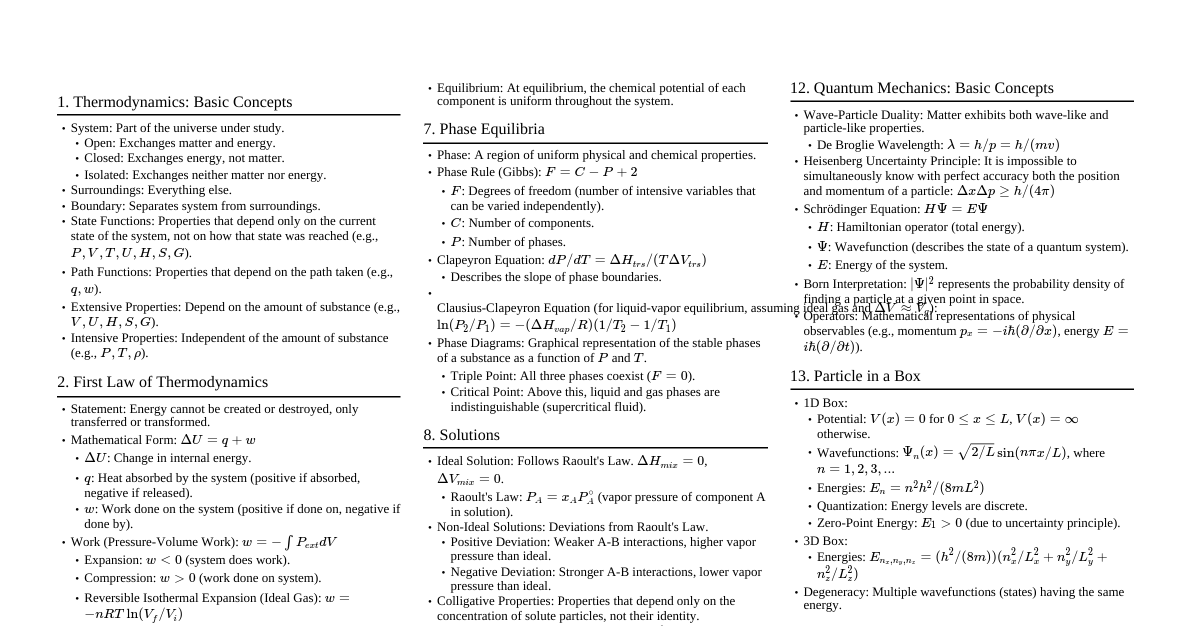
Unit 1: Quantum Chemistry & Atomic Structure de Broglie Equation States the wave-particle duality of matter. Every moving particle has a wave associated with it. $\lambda = \frac{h}{mv} = \frac{h}{p}$ $\lambda$: de Broglie wavelength $h$: Planck's constant ($6.626 \times 10^{-34} \text{ J s}$) $m$: mass of the particle $v$: velocity of the particle $p$: momentum of the particle Significance: Explains wave nature of electrons, crucial for understanding atomic structure and quantum mechanics. Heisenberg's Uncertainty Principle It is impossible to precisely determine, simultaneously, both the position and momentum of a particle. $\Delta x \cdot \Delta p_x \ge \frac{\hbar}{2}$ $\Delta E \cdot \Delta t \ge \frac{\hbar}{2}$ $\Delta x$: uncertainty in position $\Delta p_x$: uncertainty in momentum $\Delta E$: uncertainty in energy $\Delta t$: uncertainty in time $\hbar = \frac{h}{2\pi}$ (reduced Planck's constant) Significance: A fundamental principle of quantum mechanics, implying that measurement affects the system and there are inherent limits to knowledge at the quantum level. Significance of $\psi$ and $\psi^2$ $\psi$ (Wave Function): A mathematical function that describes the quantum state of an electron in an atom or molecule. It contains all the information about the system (energy, momentum, position). It has no direct physical meaning and can be a complex number. $\psi^2$ (Probability Density): The square of the absolute value of the wave function ($|\psi|^2$ for complex $\psi$). Represents the probability of finding an electron in a given region of space around the nucleus. It is always real and positive. Significance: Leads to the concept of atomic orbitals, which are regions of space where electrons are most likely to be found. Slater's Rules and Applications Empirical rules used to estimate the effective nuclear charge ($Z_{eff}$) experienced by an electron in a multi-electron atom. $Z_{eff} = Z - S$ $Z$: actual nuclear charge (atomic number) $S$: shielding constant (screening constant) Rules for Calculating $S$: Write electron configuration in groups: $(1s) (2s, 2p) (3s, 3p) (3d) (4s, 4p) (4d) (4f) \dots$ Electrons to the right of the electron of interest contribute $0$ to $S$. For $ns$ or $np$ valence electrons: Other electrons in the same $(ns, np)$ group contribute $0.35$. Electrons in the $(n-1)$ shell contribute $0.85$. Electrons in $(n-2)$ or deeper shells contribute $1.00$. For $nd$ or $nf$ valence electrons: Other electrons in the same $(nd)$ or $(nf)$ group contribute $0.35$. All electrons in shells to the left (inner shells) contribute $1.00$. Applications: Predicting atomic size trends. Explaining ionization energies. Understanding electronegativity variations. Estimating chemical properties related to valence electrons. Periodic Table Trends (s and p block) Atomic Radius: Decreases across a period (due to increasing $Z_{eff}$). Increases down a group (due to increasing number of electron shells). Ionization Energy (IE): Increases across a period (harder to remove electrons from a higher $Z_{eff}$). Decreases down a group (easier to remove electrons from larger atoms, further from nucleus). Electron Affinity (EA): Generally increases across a period (more attraction for electrons by higher $Z_{eff}$). Generally decreases down a group (less attraction for electrons by larger atoms). Electronegativity: Increases across a period (atoms become more non-metallic, tend to attract electrons). Decreases down a group (atoms become more metallic, tend to lose electrons). Metallic Character: Decreases across a period. Increases down a group. Electronegativity The tendency of an atom in a molecule to attract shared electrons towards itself. Pauling Scale: Based on bond dissociation energies of molecules. $\chi_A - \chi_B = 0.102 \sqrt{E_{AB} - \sqrt{E_{AA}E_{BB}}}$ (energies in kJ/mol) Fluorine is assigned $\chi_F = 3.98$ as the highest. Mulliken Scale: Based on ionization energy (IE) and electron affinity (EA). $\chi_M = \frac{IE + EA}{2}$ Represents the average of an atom's tendency to hold onto its electrons and attract new ones. Unit 2: Kinetic Theory of Gases Kinetic Theory of Gases (K.T.G.) Postulates Gases consist of a large number of identical, tiny particles (atoms/molecules) that are in constant, random motion. The volume occupied by the gas particles themselves is negligible compared to the total volume of the container. There are no intermolecular forces of attraction or repulsion between gas particles. Collisions between gas particles and with the container walls are perfectly elastic (no loss of kinetic energy). The average kinetic energy of gas particles is directly proportional to the absolute temperature. $\text{KE}_{avg} = \frac{3}{2}kT$. Derivations (Key Equations): Kinetic Gas Equation: $PV = \frac{1}{3}Nmv^2_{rms}$ $P$: pressure, $V$: volume, $N$: number of molecules, $m$: mass of one molecule, $v^2_{rms}$: mean square speed. Relation to Ideal Gas Law: $PV = nRT$ From K.T.G., $PV = \frac{2}{3}N(\frac{1}{2}mv^2_{rms}) = \frac{2}{3}N(\text{KE}_{avg})$ Since $\text{KE}_{avg} = \frac{3}{2}kT$, then $PV = \frac{2}{3}N(\frac{3}{2}kT) = NkT$ Since $N = nN_A$ and $R = kN_A$, then $PV = nN_A kT = nRT$. Root Mean Square Speed ($v_{rms}$): $v_{rms} = \sqrt{\frac{3RT}{M}} = \sqrt{\frac{3kT}{m}}$ $M$: molar mass, $R$: gas constant, $k$: Boltzmann constant. Average Speed ($v_{avg}$): $v_{avg} = \sqrt{\frac{8RT}{\pi M}}$ Most Probable Speed ($v_{mp}$): $v_{mp} = \sqrt{\frac{2RT}{M}}$ Collision Theory Collision Frequency ($Z$): Number of collisions per unit volume per unit time. $Z_{11} = \frac{1}{\sqrt{2}} \pi d^2 \bar{c} n^{*2}$ (for identical molecules) $Z_{12} = \pi \sigma_{12}^2 \sqrt{\frac{8kT}{\pi \mu}} n_1^* n_2^*$ (for different molecules) $d$: molecular diameter, $\bar{c}$: average speed, $n^*$: number density. Mean Free Path ($\lambda$): Average distance a molecule travels between successive collisions. $\lambda = \frac{1}{\sqrt{2}\pi d^2 n^*}$ Collision Diameter ($d$): The distance between the centers of two molecules at the point of closest approach during a collision. Van der Waals Forces Weak, short-range intermolecular forces that are responsible for the non-ideal behavior of real gases. These include: London Dispersion Forces (LDF): Present in all molecules, arising from temporary fluctuations in electron distribution creating instantaneous dipoles. Strength increases with molecular size and polarizability. Dipole-Dipole Forces: Occur between polar molecules due to the attraction between permanent dipoles. Dipole-Induced Dipole Forces: Occur when a polar molecule induces a temporary dipole in a nonpolar molecule. Van der Waals Equation of State (for Real Gases): $\left(P + \frac{an^2}{V^2}\right)(V - nb) = nRT$ $a$: accounts for intermolecular attractive forces. $b$: accounts for the finite volume occupied by gas molecules. Critical Phenomena The behavior of substances near their critical point, where the distinction between liquid and gas phases disappears. Critical Temperature ($T_c$): The temperature above which a gas cannot be liquefied, no matter how much pressure is applied. Critical Pressure ($P_c$): The minimum pressure required to liquefy a gas at its critical temperature. Critical Volume ($V_c$): The volume occupied by one mole of a substance at its critical temperature and critical pressure. Relationship with Van der Waals Constants: $T_c = \frac{8a}{27Rb}$ $P_c = \frac{a}{27b^2}$ $V_c = 3b$ Isotherms of Real Gases (e.g., CO$_2$): Above $T_c$, isotherms resemble ideal gas behavior. At $T_c$, there is a horizontal inflection point, indicating liquefaction. Below $T_c$, isotherms show distinct regions for gas, liquid-gas coexistence, and liquid. Unit 3: Organic Reaction Mechanisms Localized vs. Delocalized Electrons Localized Electrons: Electrons that are confined to a specific atom or a bond between two atoms. Found in sigma ($\sigma$) bonds and lone pairs not involved in resonance. Example: Electrons in a C-C single bond or a C-H bond. Delocalized Electrons: Electrons that are not confined to a single atom or bond but are spread over three or more atoms. Occur in systems with conjugated $\pi$ bonds (alternating single and double bonds) or with lone pairs adjacent to $\pi$ systems. Involves resonance structures. Example: $\pi$ electrons in benzene, carbonate ion, allyl cation. Significance: Increases stability, influences reactivity, and affects spectroscopic properties. Electromeric Effect (E-effect) A temporary effect in which a pair of $\pi$-electrons are completely transferred from one atom to another in a multiple bond, under the influence of an attacking reagent. It is a temporary effect, operating only in the presence of an attacking reagent. Represented by a curved arrow showing the electron shift. Example: In the presence of $H^+$, the $\pi$ electrons of an alkene shift towards one carbon, making it negatively charged and the other positively charged, facilitating electrophilic attack. Hyperconjugation (No-Bond Resonance) The delocalization of $\sigma$-electrons (typically C-H or C-C $\sigma$ bonds) of an alkyl group which is directly attached to an unsaturated system (e.g., double bond, benzene ring) or an atom with an unshared p-orbital (e.g., carbocation). Involves the overlap of a $\sigma$ orbital with an adjacent empty or partially filled p-orbital or $\pi$ orbital. Leads to stabilization of carbocations, free radicals, and alkenes. Example: In a carbocation, the C-H $\sigma$ bond adjacent to the carbocation's empty p-orbital donates electron density, stabilizing the positive charge. More $\alpha$-hydrogens (hydrogens on carbon adjacent to the unsaturated system/carbocation) lead to greater hyperconjugation and greater stability. Reagents: Electrophiles and Nucleophiles Electrophiles ("electron loving"): Electron-deficient species that seek electrons. Lewis acids (electron pair acceptors). Typically positively charged ions (e.g., $H^+$, $NO_2^+$), neutral molecules with incomplete octets (e.g., $BF_3$, $AlCl_3$), or molecules with polar multiple bonds (e.g., $C=O$ carbon). Attack electron-rich centers. Nucleophiles ("nucleus loving"): Electron-rich species that donate electrons. Lewis bases (electron pair donors). Typically negatively charged ions (e.g., $OH^-$, $CN^-$), neutral molecules with lone pairs (e.g., $H_2O$, $NH_3$, $R_2S$), or molecules with $\pi$ bonds (e.g., alkenes, alkynes, benzene). Attack electron-deficient centers. Types of Organic Reactions Substitution Reactions: An atom or group in a molecule is replaced by another atom or group. Nucleophilic Substitution (e.g., $S_N1$, $S_N2$) Electrophilic Substitution (e.g., electrophilic aromatic substitution) Free Radical Substitution (e.g., halogenation of alkanes) Addition Reactions: Two or more molecules combine to form a larger one, with the loss of a $\pi$ bond. Electrophilic Addition (e.g., $HBr$ to alkenes) Nucleophilic Addition (e.g., $HCN$ to aldehydes/ketones) Free Radical Addition Elimination Reactions: Two atoms or groups are removed from a molecule, typically forming a $\pi$ bond. $E1$, $E2$ reactions. Rearrangement Reactions: A molecule undergoes a reorganization of its atoms, often leading to a more stable isomer. e.g., Pinacol-Pinacolone rearrangement, Wagner-Meerwein rearrangement. Redox Reactions: Oxidation and reduction processes in organic molecules. Oxidation: gain of oxygen, loss of hydrogen, loss of electrons. Reduction: loss of oxygen, gain of hydrogen, gain of electrons. Carbocations, Carbanions, Carbenes Carbocations: Carbon atom with a positive charge and three bonds (sextet of electrons). Hybridization: $sp^2$, trigonal planar geometry. Electrophilic, highly reactive. Stability order: $3^\circ > 2^\circ > 1^\circ > \text{methyl}$ (due to hyperconjugation and inductive effect). Carbanions: Carbon atom with a negative charge and three bonds, plus a lone pair of electrons (octet). Hybridization: $sp^3$, pyramidal geometry (similar to ammonia). Nucleophilic, highly reactive. Stability order: $\text{methyl} > 1^\circ > 2^\circ > 3^\circ$ (opposite to carbocations, due to inductive effect of alkyl groups destabilizing negative charge). Carbenes: Neutral carbon atom with two bonds and two non-bonding electrons. Can be singlet (paired electrons, $sp^2$, bent) or triplet (unpaired electrons, $sp$, linear). Highly reactive, acts as both electrophile and nucleophile. Generated from diazomethane or ketene. Used in cyclopropanation reactions. Unit 4: States of Matter & Solid State Surface Tension ($\gamma$) The cohesive forces between liquid molecules cause the liquid surface to contract to the smallest possible area, creating a "skin" on the surface. Energy required to increase the surface area of a liquid by a unit amount. Units: $J/m^2$ or $N/m$. Influenced by intermolecular forces (stronger forces $\rightarrow$ higher surface tension). Decreases with increasing temperature. Applications: Capillary action, formation of drops and bubbles, detergency. Viscosity ($\eta$) A measure of a fluid's resistance to flow. It arises from the internal friction between adjacent layers of fluid moving at different velocities. Defined by Newton's Law of Viscosity: $F = \eta A \frac{dv}{dz}$ $F$: force, $A$: area, $\frac{dv}{dz}$: velocity gradient. Units: Pascal-second ($Pa \cdot s$) or Poise ($P$, $1P = 0.1 Pa \cdot s$). Influenced by intermolecular forces (stronger forces $\rightarrow$ higher viscosity). Decreases with increasing temperature for liquids; increases with increasing temperature for gases. Applications: Lubrication, flow in pipes, blood circulation. Law of Constancy of Interfacial Angles States that the angles between corresponding faces on crystals of the same substance are always the same, regardless of the size or shape of the crystal or the conditions of its growth. A fundamental law of crystallography, indicating the ordered internal atomic arrangement. Also known as Steno's Law. Law of Rational Indices States that the intercepts of the faces of a crystal on the crystallographic axes are either infinity or simple multiples of three fundamental lengths ($a, b, c$) along the axes. These intercepts can be expressed as ratios $na:mb:pc$, where $n, m, p$ are small integers or infinity. Forms the basis for Miller Indices. Miller Indices ($hkl$) A notation system used to describe crystallographic planes and directions in a crystal lattice. Steps to determine Miller Indices for a plane: Determine the intercepts of the plane with the crystallographic axes ($x, y, z$) in terms of lattice parameters ($a, b, c$). Take the reciprocals of these intercepts. Clear fractions to obtain the smallest set of integers ($h, k, l$). Enclose in parentheses: $(hkl)$. Example: A plane cutting at $1a, 1b, \infty c$ has intercepts $(1, 1, \infty)$. Reciprocals $(1, 1, 0)$. Miller index $(110)$. Bar over a number (e.g., $\bar{1}$) indicates a negative intercept. $\{hkl\}$ denotes a family of equivalent planes (e.g., $\{100\}$ includes $(100), (010), (001)$ etc.). $[uvw]$ denotes a crystallographic direction. Seven Crystal Systems and Fourteen Bravais Lattices Crystal Systems (based on unit cell geometry): Cubic: $a=b=c$, $\alpha=\beta=\gamma=90^\circ$ Tetragonal: $a=b \ne c$, $\alpha=\beta=\gamma=90^\circ$ Orthorhombic: $a \ne b \ne c$, $\alpha=\beta=\gamma=90^\circ$ Monoclinic: $a \ne b \ne c$, $\alpha=\gamma=90^\circ \ne \beta$ Triclinic: $a \ne b \ne c$, $\alpha \ne \beta \ne \gamma \ne 90^\circ$ Hexagonal: $a=b \ne c$, $\alpha=\beta=90^\circ, \gamma=120^\circ$ Rhombohedral (Trigonal): $a=b=c$, $\alpha=\beta=\gamma \ne 90^\circ$ Bravais Lattices: The 14 unique types of unit cells that can fill all space while maintaining the lattice points' identical surroundings. Cubic: Primitive (P), Body-Centered (I), Face-Centered (F) Tetragonal: P, I Orthorhombic: P, I, F, Base-Centered (C) Monoclinic: P, C Triclinic: P Hexagonal: P Rhombohedral: P Bragg's Law Describes the conditions for constructive interference of X-rays diffracted by crystal planes. $n\lambda = 2d \sin\theta$ $n$: order of diffraction (integer, $1, 2, 3, \dots$) $\lambda$: wavelength of X-rays $d$: interplanar spacing (distance between adjacent crystal planes) $\theta$: glancing angle (angle between the incident X-ray beam and the crystal plane) Significance: Allows determination of crystal structure (d-spacing values) from X-ray diffraction patterns. X-ray Diffraction Methods Laue Method: Uses a single crystal and a continuous spectrum of X-rays (white X-rays). The crystal is held stationary. Produces a pattern of spots on a photographic film, each spot corresponding to a particular set of crystal planes satisfying Bragg's law for a specific $\lambda$. Used for determining crystal symmetry and orientation. Rotating Crystal Method: Uses a single crystal and monochromatic X-rays ($\lambda$ is constant). The crystal is rotated about an axis. As the crystal rotates, different sets of planes come into position to satisfy Bragg's law, producing a series of spots arranged in layers. Used for determining unit cell dimensions. Powder Pattern Method (Debye-Scherrer Method): Uses a polycrystalline sample (powder) and monochromatic X-rays. The powder contains millions of tiny crystals oriented randomly. A cone of diffracted X-rays is produced for each set of planes, forming concentric rings on a film or detector. Used for identifying unknown crystalline substances, determining lattice parameters, and phase identification.