Metre Bridge (JEE)
Cheatsheet Content
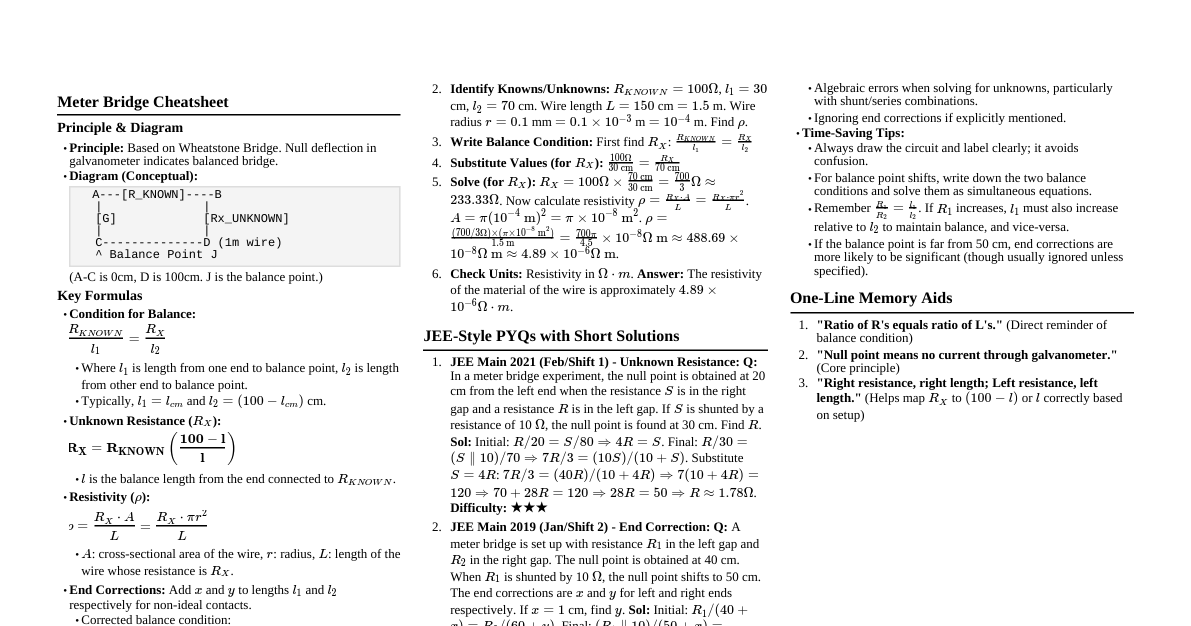
### Introduction to Metre Bridge - **Principle:** Based on Wheatstone Bridge. Used to find unknown resistance. - **Construction:** 1-meter long uniform wire (usually manganin or constantan) stretched along a scale, connected to two gaps via thick copper strips. - **Working:** A galvanometer (G) is connected between a jockey (J) and the central point (B). A known resistance (R) is in one gap, and the unknown resistance (X) is in the other. The jockey is moved along the wire until the galvanometer shows zero deflection (null point). ### Wheatstone Bridge Principle - For a balanced bridge, the ratio of resistances in the arms is equal: $$\frac{P}{Q} = \frac{R}{S}$$ - In a metre bridge, the wire acts as two resistances (P and Q) split at the null point. - Let $l$ be the length from one end to the null point. - The remaining length is $(100 - l)$. - If $\rho$ is resistance per unit length, then $P = \rho l$ and $Q = \rho (100 - l)$. - Thus, $\frac{R}{X} = \frac{\rho l}{\rho (100 - l)}$ - Simplified formula: $$\frac{R}{X} = \frac{l}{100 - l}$$ - **Unknown Resistance:** $$X = R \left(\frac{100 - l}{l}\right)$$ ### Important Considerations & Tricks 1. **Uniformity of Wire:** Assumed uniform. Non-uniformity leads to errors. 2. **End Corrections:** - Due to resistance of copper strips and contacts, the effective lengths are slightly different from measured lengths. - If end corrections are 'a' for the left end and 'b' for the right end: $$\frac{R}{X} = \frac{l + a}{100 - l + b}$$ - 'a' and 'b' can be found by interchanging R and X and taking another reading, or by using a known resistance for X. 3. **Sensitivity:** - Maximum when the null point is near the center of the wire (i.e., $l \approx 50$ cm). - This happens when $R \approx X$. - To achieve this, choose R such that it is of the same order as X. 4. **Heating Effect:** - Prolonged current flow heats the wire, changing its resistance. - Take readings quickly, and switch off current between readings. 5. **Reversing R & X:** - If you swap R and X, the null point shifts to $(100 - l)$. - Useful for verifying readings and finding end corrections. 6. **Galvanometer Connection:** - Always connect the galvanometer in series with the jockey. - Never slide the jockey on the wire; tap it gently to avoid scratching. 7. **Series/Parallel Combinations:** - If X is a combination of resistors, first calculate its equivalent resistance. - E.g., if two resistors $X_1, X_2$ are in series, $X = X_1 + X_2$. - If two resistors $X_1, X_2$ are in parallel, $X = \frac{X_1 X_2}{X_1 + X_2}$. 8. **Finding Resistance per Unit Length ($\rho$):** - If the total resistance of the wire (L = 100 cm) is $R_{wire}$, then $\rho = R_{wire}/100$. - This is rarely directly asked but helps in understanding. ### Common Errors & Mitigation (JEE Advanced) - **Zero Error in Scale:** Calibrate scale or take readings from both ends. - **Non-uniformity of Wire:** Use a high-quality uniform wire; take readings by interchanging R and X and average results. - **Contact Resistance:** Ensure tight connections; use thick copper strips to minimize their resistance. - **Thermal EMF:** If the null point shifts without moving the jockey, it might be due to thermal EMF. ### Sample Problem Approach 1. **Identify Given:** Known resistance (R), null point length ($l$). 2. **Identify Unknown:** Unknown resistance (X). 3. **Check for End Corrections:** If mentioned, use the modified formula. If not, assume ideal. 4. **Apply Formula:** $X = R \left(\frac{100 - l}{l}\right)$. 5. **Units:** Ensure consistency (usually Ohms for resistance, cm for length). #### Example: A resistance of $5 \Omega$ is connected in the left gap of a metre bridge. The null point is obtained at 40 cm from the left end. Find the unknown resistance. **Solution:** Given $R = 5 \Omega$, $l = 40$ cm. Using the formula: $X = R \left(\frac{100 - l}{l}\right) = 5 \left(\frac{100 - 40}{40}\right) = 5 \left(\frac{60}{40}\right) = 5 \times 1.5 = 7.5 \Omega$.