Work, Power, Energy Fundamentals
Cheatsheet Content
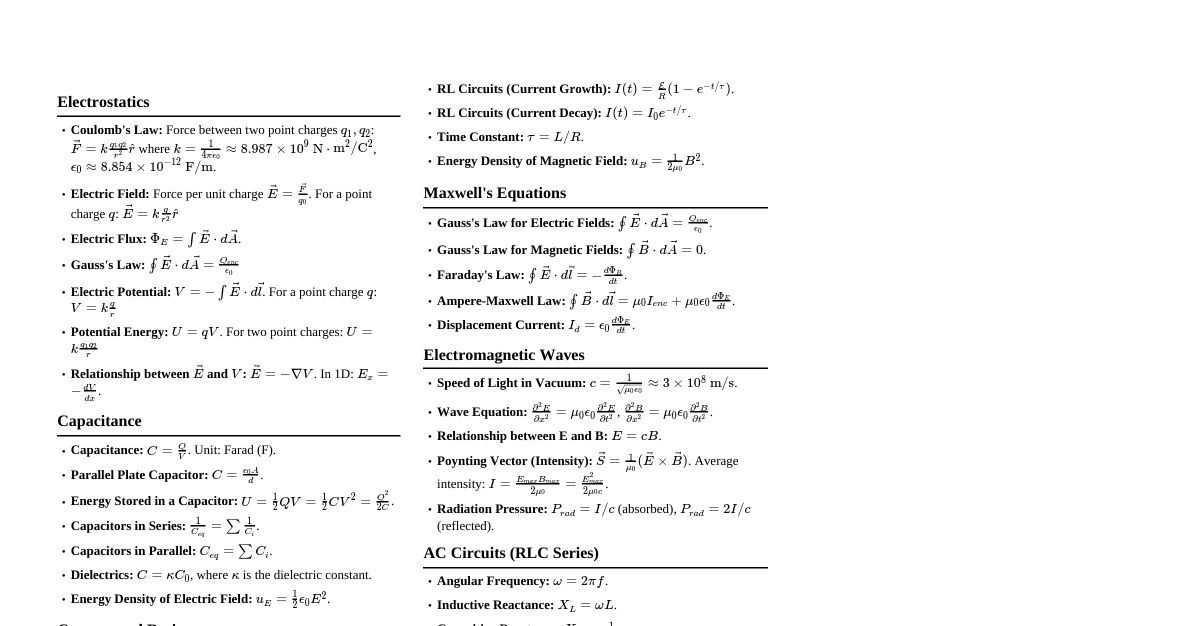
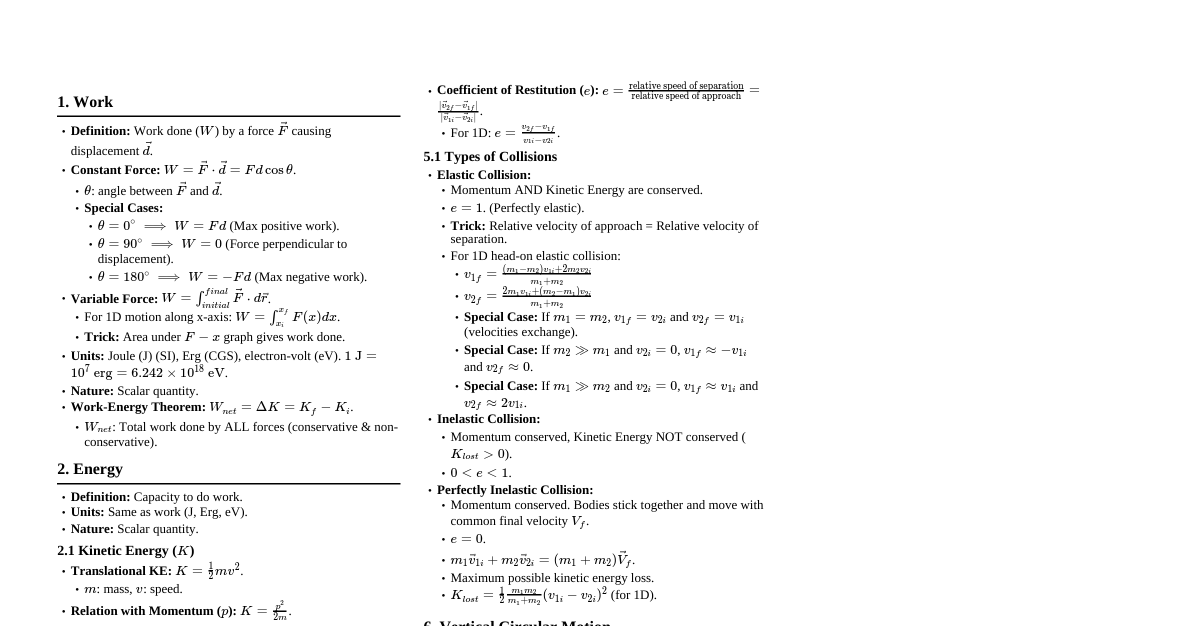
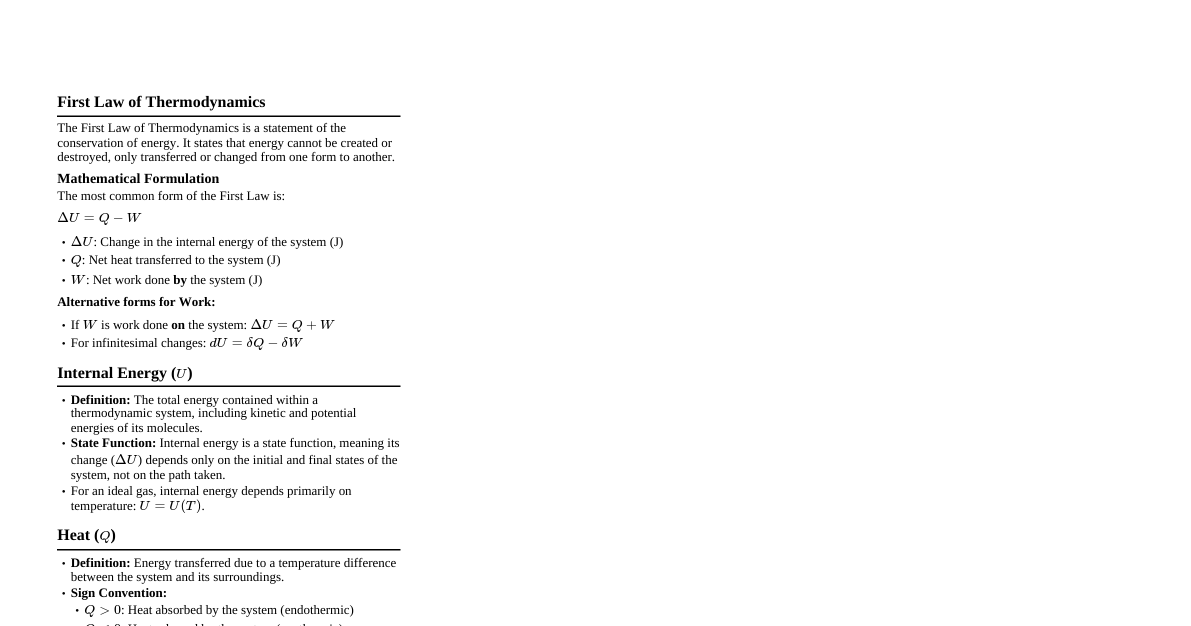
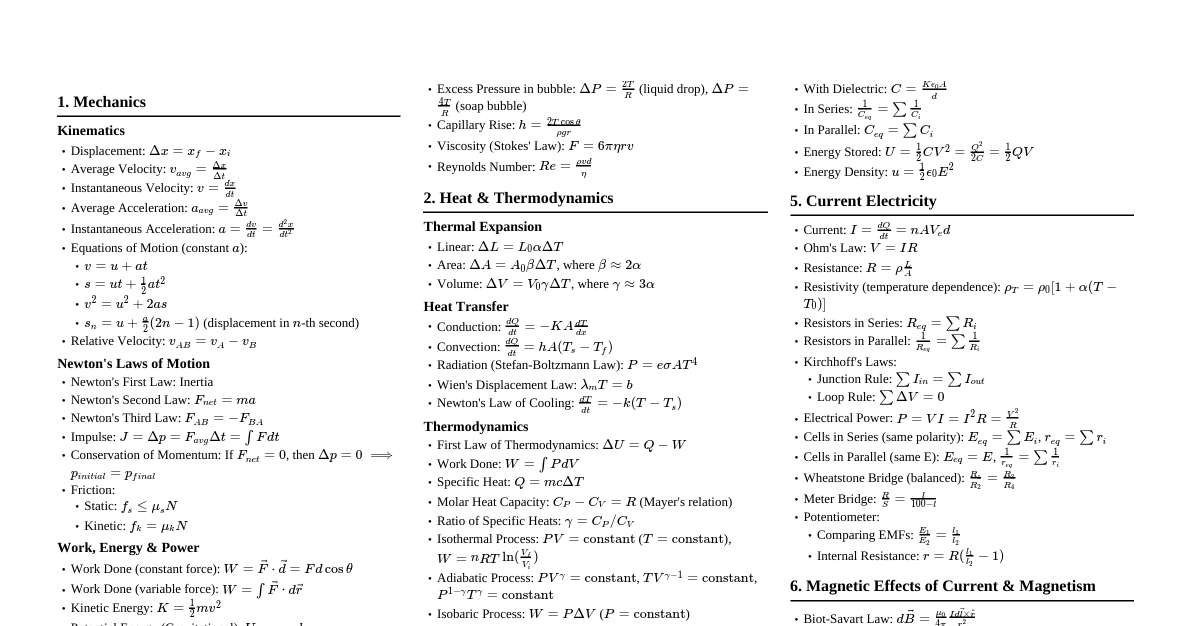
Work (W) Definition: Work done by a constant force $F$ over a displacement $d$ is $W = Fd \cos(\theta)$, where $\theta$ is the angle between $F$ and $d$. Units: Joules (J) = Newton-meter (N·m) Work by Variable Force: For a force $F(x)$ that varies with position, $W = \int_{x_1}^{x_2} F(x) dx$. Work-Energy Theorem: The net work done on an object equals its change in kinetic energy: $W_{net} = \Delta K = K_f - K_i = \frac{1}{2}mv_f^2 - \frac{1}{2}mv_i^2$. Positive Work: Force has a component in the direction of displacement. Negative Work: Force has a component opposite to the direction of displacement (e.g., friction). Zero Work: Force is perpendicular to displacement, or displacement is zero. Kinetic Energy (K) Definition: Energy an object possesses due to its motion. Formula: $K = \frac{1}{2}mv^2$, where $m$ is mass and $v$ is speed. Units: Joules (J) Relativistic Kinetic Energy (for speeds approaching $c$): $K = (\gamma - 1)mc^2$, where $\gamma = \frac{1}{\sqrt{1 - v^2/c^2}}$ is the Lorentz factor. Potential Energy (U) Definition: Energy an object possesses due to its position or configuration. Units: Joules (J) Gravitational Potential Energy (near Earth's surface): $U_g = mgh$, where $m$ is mass, $g$ is acceleration due to gravity, and $h$ is height. Elastic Potential Energy (Spring): $U_s = \frac{1}{2}kx^2$, where $k$ is the spring constant and $x$ is the displacement from equilibrium. General Gravitational Potential Energy: $U_g = -\frac{GMm}{r}$, where $G$ is the gravitational constant, $M$ and $m$ are masses, and $r$ is the distance between their centers. Conservative and Non-Conservative Forces Conservative Force: Work done is independent of the path taken. Work done in a closed loop is zero. Associated with potential energy forms (e.g., gravity, spring force). $W_c = -\Delta U$. Non-Conservative Force: Work done depends on the path taken. Work done in a closed loop is generally non-zero. Dissipates mechanical energy (e.g., friction, air resistance). $W_{nc} = \Delta E_{mech} = (K_f + U_f) - (K_i + U_i)$. Mechanical Energy (E) Definition: Sum of kinetic and potential energies. Formula: $E = K + U$. Units: Joules (J) Conservation of Mechanical Energy: If only conservative forces do work, then $E_i = E_f$ or $K_i + U_i = K_f + U_f$. Power (P) Definition: The rate at which work is done or energy is transferred. Average Power: $P_{avg} = \frac{\Delta W}{\Delta t} = \frac{\Delta E}{\Delta t}$. Instantaneous Power: $P = \frac{dW}{dt}$. Power for a Constant Force: $P = F \cdot v \cos(\theta)$ or $P = \vec{F} \cdot \vec{v}$ (dot product). Units: Watts (W) = Joules/second (J/s). Also horsepower (hp): $1 \text{ hp} \approx 746 \text{ W}$. Efficiency ($\eta$) Definition: The ratio of useful energy output to total energy input. Formula: $\eta = \frac{\text{Energy Output}}{\text{Energy Input}} = \frac{\text{Power Output}}{\text{Power Input}}$. Expressed as a decimal or percentage. Always less than 1 (or 100%) for real systems. Key Relationships and Theorems Work-Energy Theorem: $W_{net} = \Delta K$. Conservation of Energy (General): Energy cannot be created or destroyed, only transformed from one form to another. $E_{total, i} = E_{total, f}$. Including Non-Conservative Forces: $W_{nc} = \Delta E_{mech} = (K_f + U_f) - (K_i + U_i)$. Power from Work: $P = W/t$. Power from Force and Velocity: $P = \vec{F} \cdot \vec{v}$.