Electricity & Magnetism
Cheatsheet Content
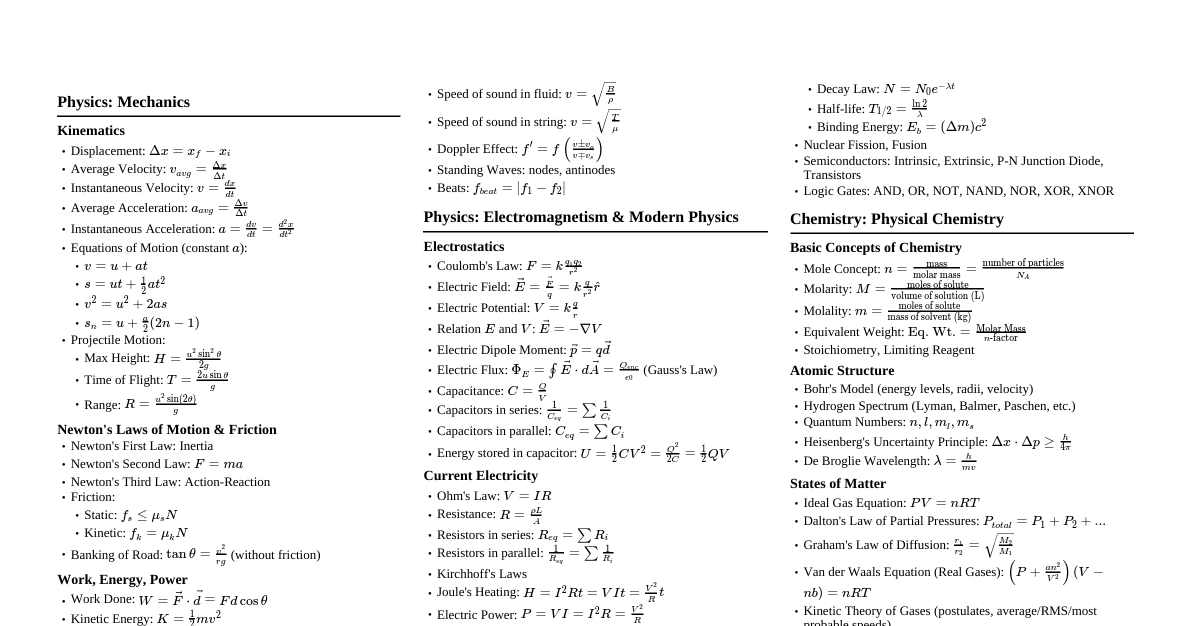
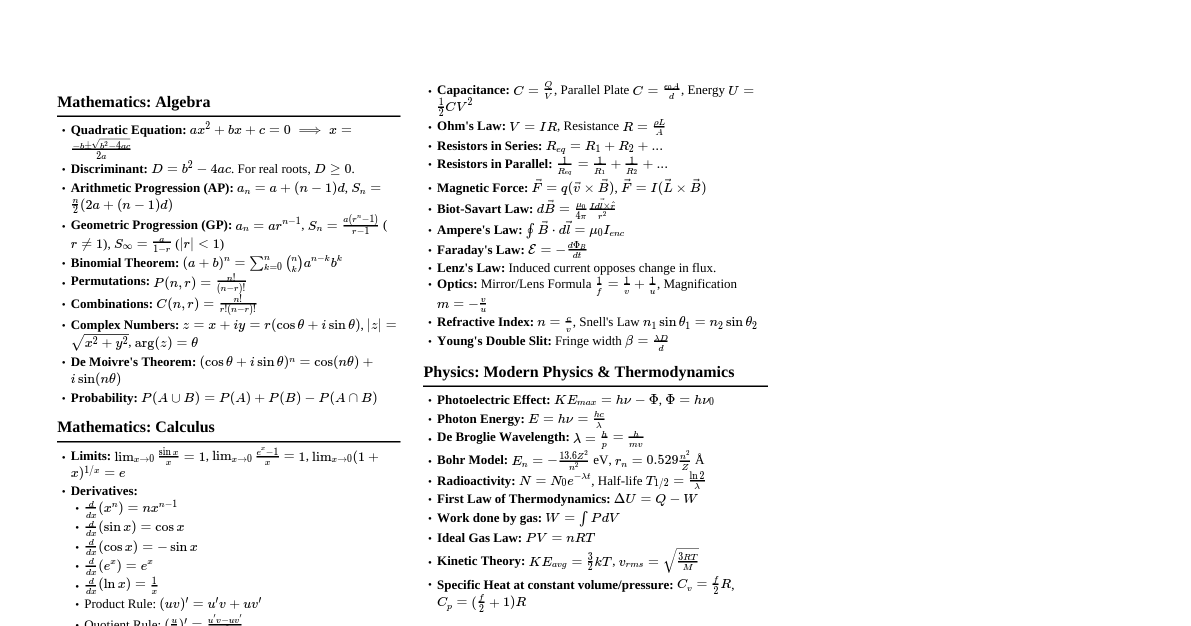
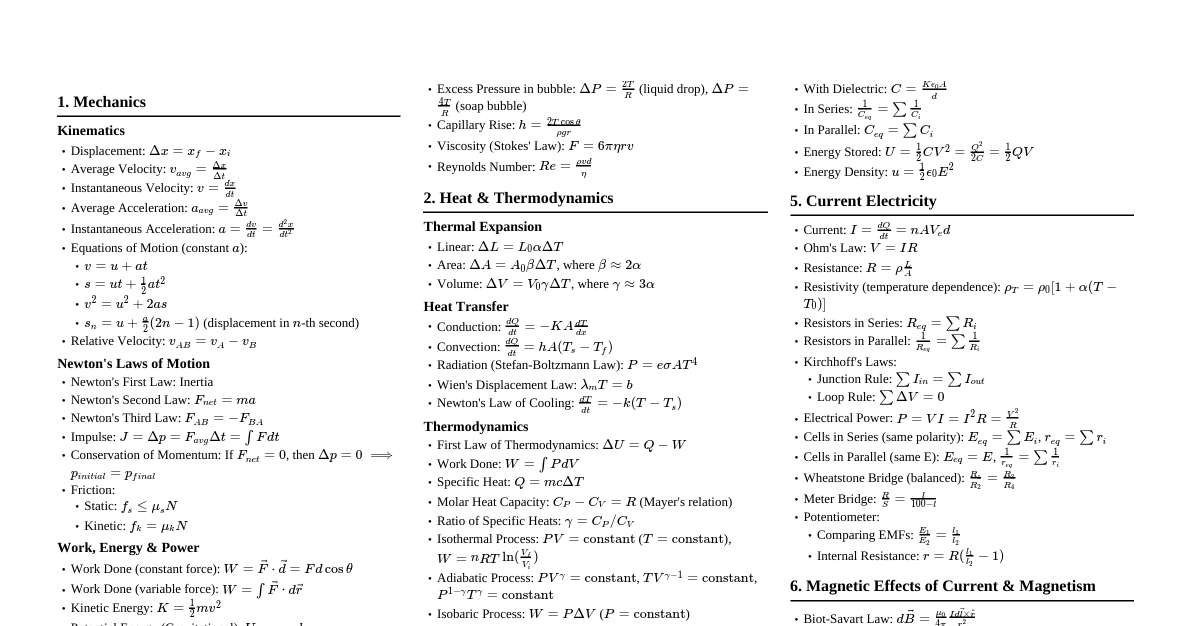
Electrostatics Coulomb's Law: Force between two point charges $q_1, q_2$: $$ \vec{F} = k \frac{q_1 q_2}{r^2} \hat{r} $$ where $k = \frac{1}{4\pi\epsilon_0} \approx 8.987 \times 10^9 \text{ N}\cdot\text{m}^2/\text{C}^2$, $\epsilon_0 \approx 8.854 \times 10^{-12} \text{ F/m}$. Electric Field: Force per unit charge $\vec{E} = \frac{\vec{F}}{q_0}$. For a point charge $q$: $$ \vec{E} = k \frac{q}{r^2} \hat{r} $$ Electric Flux: $\Phi_E = \int \vec{E} \cdot d\vec{A}$. Gauss's Law: $$ \oint \vec{E} \cdot d\vec{A} = \frac{Q_{enc}}{\epsilon_0} $$ Electric Potential: $V = -\int \vec{E} \cdot d\vec{l}$. For a point charge $q$: $$ V = k \frac{q}{r} $$ Potential Energy: $U = qV$. For two point charges: $$ U = k \frac{q_1 q_2}{r} $$ Relationship between $\vec{E}$ and $V$: $\vec{E} = -\nabla V$. In 1D: $E_x = -\frac{dV}{dx}$. Capacitance Capacitance: $C = \frac{Q}{V}$. Unit: Farad (F). Parallel Plate Capacitor: $C = \frac{\epsilon_0 A}{d}$. Energy Stored in a Capacitor: $U = \frac{1}{2}QV = \frac{1}{2}CV^2 = \frac{Q^2}{2C}$. Capacitors in Series: $\frac{1}{C_{eq}} = \sum \frac{1}{C_i}$. Capacitors in Parallel: $C_{eq} = \sum C_i$. Dielectrics: $C = \kappa C_0$, where $\kappa$ is the dielectric constant. Energy Density of Electric Field: $u_E = \frac{1}{2}\epsilon_0 E^2$. Current and Resistance Electric Current: $I = \frac{dQ}{dt}$. Unit: Ampere (A). Current Density: $\vec{J} = nq\vec{v}_d$. $I = \int \vec{J} \cdot d\vec{A}$. Ohm's Law: $V = IR$. Resistance: $R = \rho \frac{L}{A}$, where $\rho$ is resistivity. Unit: Ohm ($\Omega$). Resistivity Temperature Dependence: $\rho = \rho_0 [1 + \alpha(T-T_0)]$. Power Dissipated: $P = IV = I^2R = \frac{V^2}{R}$. Resistors in Series: $R_{eq} = \sum R_i$. Resistors in Parallel: $\frac{1}{R_{eq}} = \sum \frac{1}{R_i}$. DC Circuits (Kirchhoff's Rules) Junction Rule: $\sum I_{in} = \sum I_{out}$ (conservation of charge). Loop Rule: $\sum \Delta V = 0$ (conservation of energy). RC Circuits (Charging): $Q(t) = Q_{max}(1 - e^{-t/RC})$, $I(t) = I_{max}e^{-t/RC}$. RC Circuits (Discharging): $Q(t) = Q_0 e^{-t/RC}$, $I(t) = I_0 e^{-t/RC}$. Time Constant: $\tau = RC$. Magnetostatics Magnetic Force on a Charge: $\vec{F}_B = q(\vec{v} \times \vec{B})$. Magnetic Force on a Current Element: $d\vec{F}_B = I(d\vec{l} \times \vec{B})$. Magnetic Field of a Current (Biot-Savart Law): $$ d\vec{B} = \frac{\mu_0}{4\pi} \frac{I d\vec{l} \times \hat{r}}{r^2} $$ where $\mu_0 = 4\pi \times 10^{-7} \text{ T}\cdot\text{m/A}$ (permeability of free space). Magnetic Field of a Long Straight Wire: $B = \frac{\mu_0 I}{2\pi r}$. Magnetic Field at Center of a Loop: $B = \frac{\mu_0 I}{2R}$. Magnetic Field inside a Solenoid: $B = \mu_0 n I$, where $n$ is turns per unit length. Ampere's Law: $$ \oint \vec{B} \cdot d\vec{l} = \mu_0 I_{enc} $$ Magnetic Dipole Moment: $\vec{\mu} = NIA\hat{n}$. Torque on a Current Loop: $\vec{\tau} = \vec{\mu} \times \vec{B}$. Potential Energy of a Dipole: $U = -\vec{\mu} \cdot \vec{B}$. Electromagnetic Induction Magnetic Flux: $\Phi_B = \int \vec{B} \cdot d\vec{A}$. Unit: Weber (Wb). Faraday's Law of Induction: $$ \mathcal{E} = -\frac{d\Phi_B}{dt} $$ Lenz's Law: Induced current/EMF opposes the change in magnetic flux. Motional EMF: $\mathcal{E} = B L v$ (for a conductor moving perpendicular to B-field). Self-Inductance: $L = \frac{N\Phi_B}{I}$. Unit: Henry (H). Energy Stored in an Inductor: $U = \frac{1}{2}LI^2$. Inductors in Series: $L_{eq} = \sum L_i$. Inductors in Parallel: $\frac{1}{L_{eq}} = \sum \frac{1}{L_i}$. RL Circuits (Current Growth): $I(t) = \frac{\mathcal{E}}{R}(1 - e^{-t/\tau})$. RL Circuits (Current Decay): $I(t) = I_0 e^{-t/\tau}$. Time Constant: $\tau = L/R$. Energy Density of Magnetic Field: $u_B = \frac{1}{2\mu_0} B^2$. Maxwell's Equations Gauss's Law for Electric Fields: $\oint \vec{E} \cdot d\vec{A} = \frac{Q_{enc}}{\epsilon_0}$. Gauss's Law for Magnetic Fields: $\oint \vec{B} \cdot d\vec{A} = 0$. Faraday's Law: $\oint \vec{E} \cdot d\vec{l} = -\frac{d\Phi_B}{dt}$. Ampere-Maxwell Law: $\oint \vec{B} \cdot d\vec{l} = \mu_0 I_{enc} + \mu_0 \epsilon_0 \frac{d\Phi_E}{dt}$. Displacement Current: $I_d = \epsilon_0 \frac{d\Phi_E}{dt}$. Electromagnetic Waves Speed of Light in Vacuum: $c = \frac{1}{\sqrt{\mu_0 \epsilon_0}} \approx 3 \times 10^8 \text{ m/s}$. Wave Equation: $\frac{\partial^2 E}{\partial x^2} = \mu_0 \epsilon_0 \frac{\partial^2 E}{\partial t^2}$, $\frac{\partial^2 B}{\partial x^2} = \mu_0 \epsilon_0 \frac{\partial^2 B}{\partial t^2}$. Relationship between E and B: $E = cB$. Poynting Vector (Intensity): $\vec{S} = \frac{1}{\mu_0}(\vec{E} \times \vec{B})$. Average intensity: $I = \frac{E_{max}B_{max}}{2\mu_0} = \frac{E_{max}^2}{2\mu_0 c}$. Radiation Pressure: $P_{rad} = I/c$ (absorbed), $P_{rad} = 2I/c$ (reflected). AC Circuits (RLC Series) Angular Frequency: $\omega = 2\pi f$. Inductive Reactance: $X_L = \omega L$. Capacitive Reactance: $X_C = \frac{1}{\omega C}$. Impedance: $Z = \sqrt{R^2 + (X_L - X_C)^2}$. Ohm's Law for AC: $V_{rms} = I_{rms}Z$. Phase Angle: $\tan \phi = \frac{X_L - X_C}{R}$. Resonance Frequency: $\omega_0 = \frac{1}{\sqrt{LC}}$. At resonance, $X_L = X_C$, $Z=R$, $\phi=0$. Average Power: $P_{avg} = I_{rms}V_{rms} \cos\phi = I_{rms}^2 R$. ($\cos\phi$ is power factor). Quality Factor (Q-factor): $Q = \frac{\omega_0 L}{R} = \frac{1}{R}\sqrt{\frac{L}{C}}$.