Chemistry of Solutions Basics
Cheatsheet Content
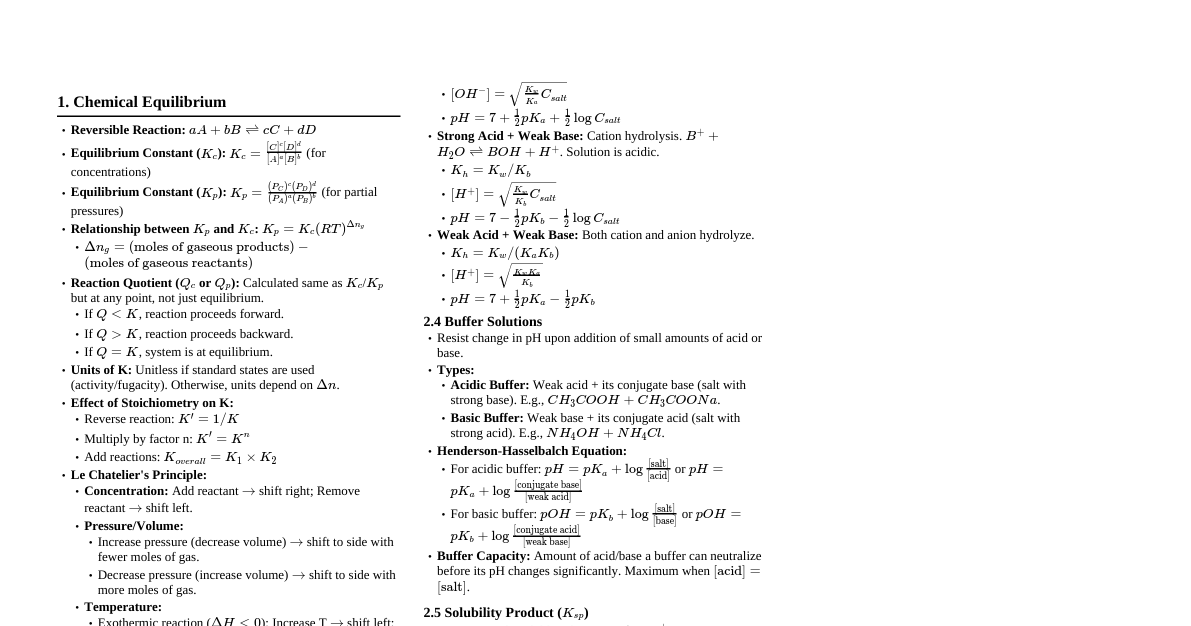
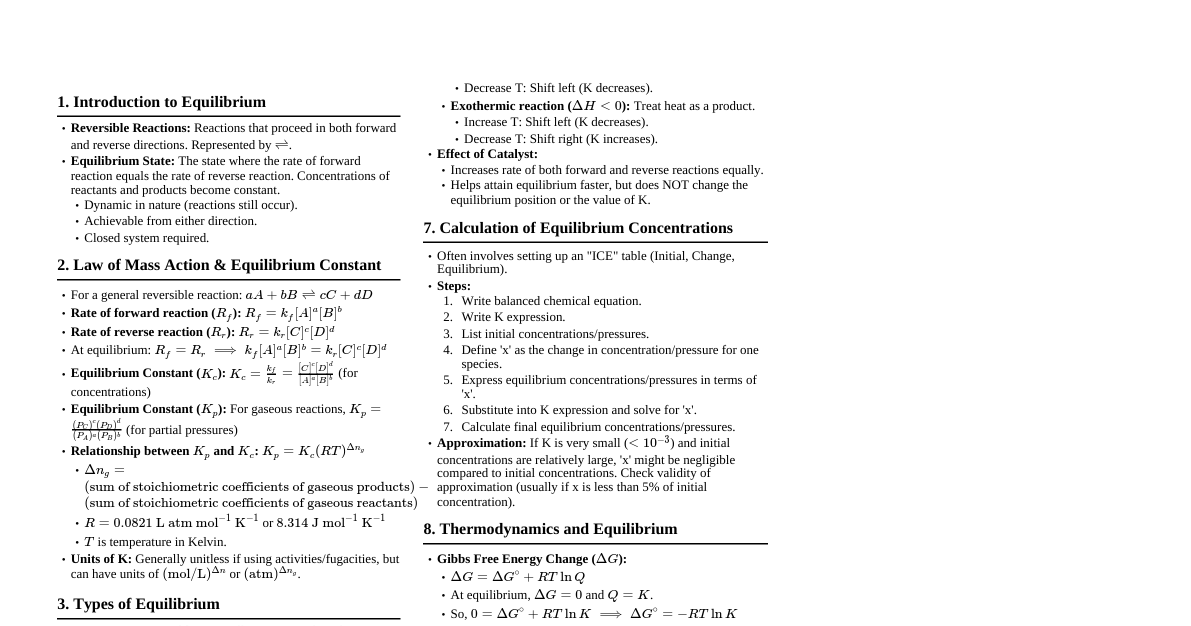
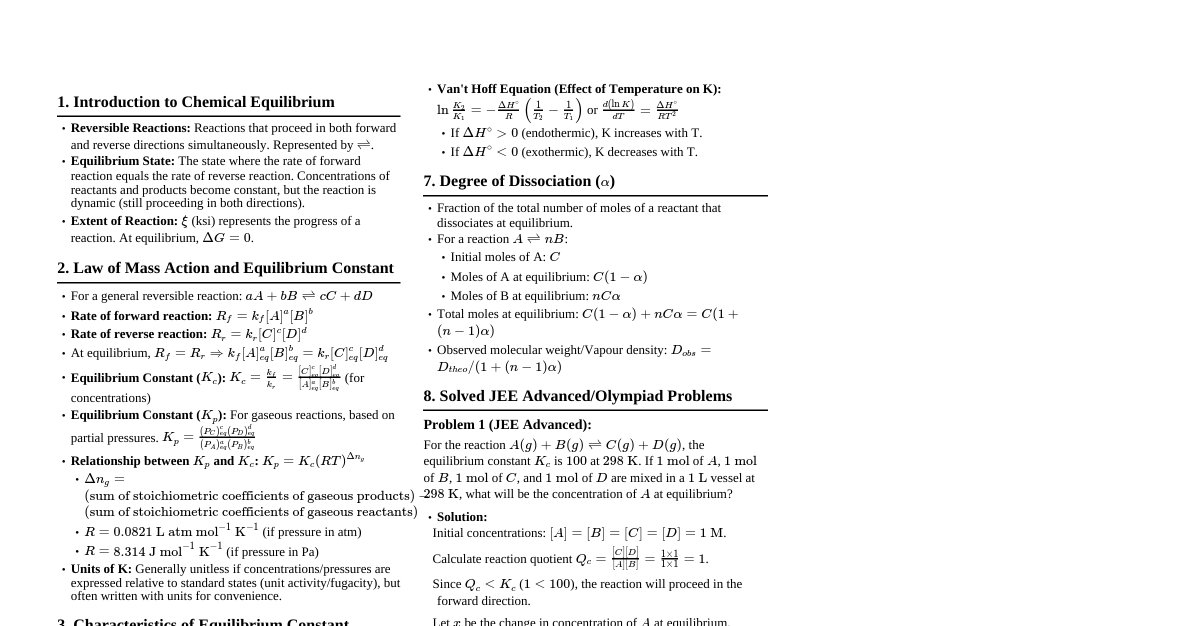
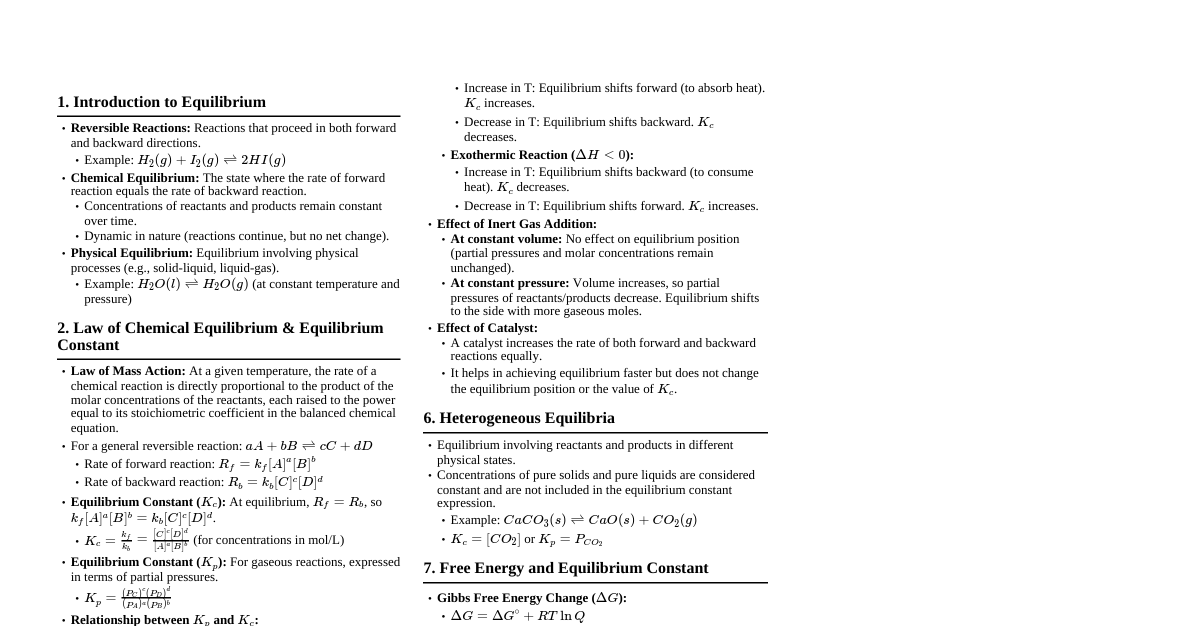
1. Properties of Liquids & Solutions Vapour Pressure: Pressure exerted by a vapor in thermodynamic equilibrium with its condensed phases (solid or liquid) at a given temperature in a closed system. Boiling Point: Temperature at which the vapor pressure of a liquid equals the pressure surrounding the liquid and the liquid changes into a vapor. Density: Mass per unit volume of a substance ($d = m/V$). Surface Tension: The cohesive forces between liquid molecules at the surface, creating a "skin-like" effect. Viscosity: A measure of a fluid's resistance to flow. Solutions: Homogeneous mixtures of two or more substances. Types of Solutions: Solid Solutions: Alloys (e.g., brass). Liquid Solutions: Sugar in water. Gaseous Solutions: Air (mixture of gases). 2. Concentration Units Percentage Concentration: Mass by Mass (% m/m): $( \text{mass of solute} / \text{mass of solution} ) \times 100$ Volume by Volume (% v/v): $( \text{volume of solute} / \text{volume of solution} ) \times 100$ Mass by Volume (% m/v): $( \text{mass of solute} / \text{volume of solution} ) \times 100$ Molarity (M): Moles of solute per liter of solution ($M = n/V$). 3. Colloids Definition: Heterogeneous mixtures in which one substance of microscopically dispersed insoluble particles is suspended throughout another substance. Examples: Milk, fog, paint, gels. 4. Solubility Definition: Maximum amount of solute that can dissolve in a given amount of solvent at a specific temperature. Factors Affecting Solubility: Temperature: Generally increases with temperature for solids, decreases for gases. Pressure: Significant for gases (Henry's Law). Nature of Solute/Solvent: "Like dissolves like." Saturated Solution: Contains the maximum amount of dissolved solute at a given temperature. Unsaturated Solution: Contains less than the maximum amount of dissolved solute. 5. Chemical Equilibrium Definition: A state where the rate of forward reaction equals the rate of reverse reaction, and the concentrations of reactants and products remain constant. Dynamic Nature: Reactions continue in both directions, but with no net change in concentrations. Characteristics: Closed system. Constant macroscopic properties (concentration, pressure, temperature). Reversible reactions. Equilibrium Constant (K): For $aA + bB \rightleftharpoons cC + dD$, $K_c = \frac{[C]^c[D]^d}{[A]^a[B]^b}$ $K_p = \frac{P_C^c P_D^d}{P_A^a P_B^b}$ Law of Mass Action: At a given temperature, the ratio of product concentrations to reactant concentrations, each raised to the power of its stoichiometric coefficient, is a constant (K). Le Chatelier's Principle: If a change of condition (temperature, pressure, concentration) is applied to a system in equilibrium, the system will shift in a direction that relieves the stress. 6. Acids, Bases & pH Lewis Concept of Acids and Bases: Lewis Acid: Electron pair acceptor. Lewis Base: Electron pair donor. Buffer Solutions: Solutions that resist changes in pH upon the addition of small amounts of acid or base. Typically consist of a weak acid and its conjugate base or a weak base and its conjugate acid. pH Value: A measure of the acidity or alkalinity of an aqueous solution. $pH = -\log[H^+]$ $pOH = -\log[OH^-]$ $pH + pOH = 14$ (at $25^\circ C$) Acidic Solutions: $pH Basic (Alkaline) Solutions: $pH > 7$ Neutral Solutions: $pH = 7$