Chemical & Ionic Equilibrium (JEE)
Cheatsheet Content
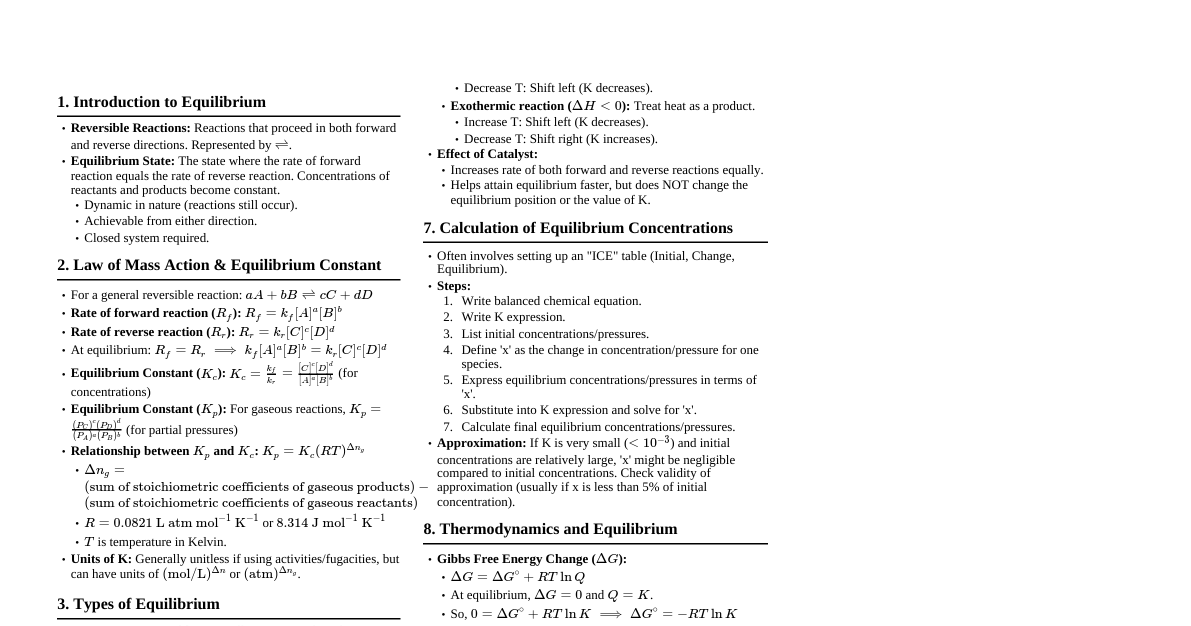
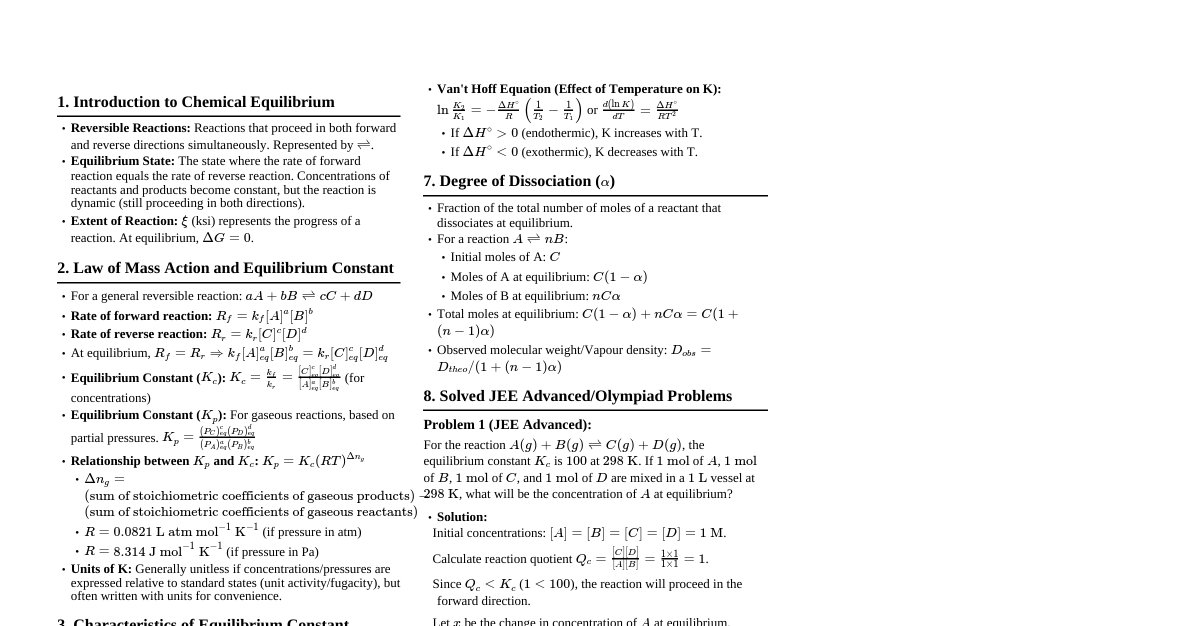
1. Chemical Equilibrium Reversible Reaction: $aA + bB \rightleftharpoons cC + dD$ Equilibrium Constant ($K_c$): $K_c = \frac{[C]^c[D]^d}{[A]^a[B]^b}$ (for concentrations) Equilibrium Constant ($K_p$): $K_p = \frac{(P_C)^c(P_D)^d}{(P_A)^a(P_B)^b}$ (for partial pressures) Relationship between $K_p$ and $K_c$: $K_p = K_c (RT)^{\Delta n_g}$ $\Delta n_g = (\text{moles of gaseous products}) - (\text{moles of gaseous reactants})$ Reaction Quotient ($Q_c$ or $Q_p$): Calculated same as $K_c$/$K_p$ but at any point, not just equilibrium. If $Q If $Q > K$, reaction proceeds backward. If $Q = K$, system is at equilibrium. Units of K: Unitless if standard states are used (activity/fugacity). Otherwise, units depend on $\Delta n$. Effect of Stoichiometry on K: Reverse reaction: $K' = 1/K$ Multiply by factor n: $K' = K^n$ Add reactions: $K_{overall} = K_1 \times K_2$ Le Chatelier's Principle: Concentration: Add reactant $\to$ shift right; Remove reactant $\to$ shift left. Pressure/Volume: Increase pressure (decrease volume) $\to$ shift to side with fewer moles of gas. Decrease pressure (increase volume) $\to$ shift to side with more moles of gas. Temperature: Exothermic reaction ($\Delta H Endothermic reaction ($\Delta H > 0$): Increase T $\to$ shift right; Decrease T $\to$ shift left. Inert Gas: Constant Volume: No effect. Constant Pressure: Shifts to side with more moles of gas. Catalyst: No effect on equilibrium position; only speeds up attainment of equilibrium. Gibbs Free Energy and Equilibrium: $\Delta G = \Delta G^\circ + RT \ln Q$ At equilibrium, $\Delta G = 0$ and $Q=K$, so $\Delta G^\circ = -RT \ln K$ $\ln K = -\frac{\Delta H^\circ}{RT} + \frac{\Delta S^\circ}{R}$ Van't Hoff Equation: $\ln \frac{K_2}{K_1} = -\frac{\Delta H^\circ}{R} \left( \frac{1}{T_2} - \frac{1}{T_1} \right)$ 2. Ionic Equilibrium 2.1 Acids and Bases Arrhenius: Acid ($H^+$ donor), Base ($OH^-$ donor). Brønsted-Lowry: Acid ($H^+$ donor), Base ($H^+$ acceptor). Conjugate Acid-Base pair: $HA \rightleftharpoons H^+ + A^-$. $HA$ (acid), $A^-$ (conjugate base). Lewis: Acid (electron pair acceptor), Base (electron pair donor). Ionization of Water: $H_2O \rightleftharpoons H^+ + OH^-$ $K_w = [H^+][OH^-] = 1.0 \times 10^{-14}$ at $25^\circ C$ $pK_w = -\log K_w = 14$ at $25^\circ C$ pH Scale: $pH = -\log[H^+]$ $pOH = -\log[OH^-]$ $pH + pOH = pK_w = 14$ (at $25^\circ C$) Acidic: $pH 7$. 2.2 Weak Acids and Bases Weak Acid ($HA$): $HA \rightleftharpoons H^+ + A^-$ Acid dissociation constant: $K_a = \frac{[H^+][A^-]}{[HA]}$ $[H^+] = \sqrt{K_a C_a}$ (for weak acid, $C_a$ = initial concentration) $pH = \frac{1}{2}(pK_a - \log C_a)$ Degree of dissociation ($\alpha$): $\alpha = \sqrt{K_a/C_a}$ Weak Base ($BOH$ or $B$): $BOH \rightleftharpoons B^+ + OH^-$ or $B + H_2O \rightleftharpoons BH^+ + OH^-$ Base dissociation constant: $K_b = \frac{[B^+][OH^-]}{[BOH]}$ or $K_b = \frac{[BH^+][OH^-]}{[B]}$ $[OH^-] = \sqrt{K_b C_b}$ (for weak base, $C_b$ = initial concentration) $pOH = \frac{1}{2}(pK_b - \log C_b)$ Degree of dissociation ($\alpha$): $\alpha = \sqrt{K_b/C_b}$ Relation between $K_a$ and $K_b$ for a conjugate pair: $K_a \cdot K_b = K_w$ $pK_a + pK_b = pK_w = 14$ (at $25^\circ C$) 2.3 Salt Hydrolysis Strong Acid + Strong Base: No hydrolysis, $pH = 7$. Example: $NaCl$. Weak Acid + Strong Base: Anion hydrolysis. $A^- + H_2O \rightleftharpoons HA + OH^-$. Solution is basic. $K_h = K_w/K_a$ $[OH^-] = \sqrt{\frac{K_w}{K_a} C_{salt}}$ $pH = 7 + \frac{1}{2}pK_a + \frac{1}{2}\log C_{salt}$ Strong Acid + Weak Base: Cation hydrolysis. $B^+ + H_2O \rightleftharpoons BOH + H^+$. Solution is acidic. $K_h = K_w/K_b$ $[H^+] = \sqrt{\frac{K_w}{K_b} C_{salt}}$ $pH = 7 - \frac{1}{2}pK_b - \frac{1}{2}\log C_{salt}$ Weak Acid + Weak Base: Both cation and anion hydrolyze. $K_h = K_w/(K_a K_b)$ $[H^+] = \sqrt{\frac{K_w K_a}{K_b}}$ $pH = 7 + \frac{1}{2}pK_a - \frac{1}{2}pK_b$ 2.4 Buffer Solutions Resist change in pH upon addition of small amounts of acid or base. Types: Acidic Buffer: Weak acid + its conjugate base (salt with strong base). E.g., $CH_3COOH + CH_3COONa$. Basic Buffer: Weak base + its conjugate acid (salt with strong acid). E.g., $NH_4OH + NH_4Cl$. Henderson-Hasselbalch Equation: For acidic buffer: $pH = pK_a + \log \frac{[\text{salt}]}{[\text{acid}]}$ or $pH = pK_a + \log \frac{[\text{conjugate base}]}{[\text{weak acid}]}$ For basic buffer: $pOH = pK_b + \log \frac{[\text{salt}]}{[\text{base}]}$ or $pOH = pK_b + \log \frac{[\text{conjugate acid}]}{[\text{weak base}]}$ Buffer Capacity: Amount of acid/base a buffer can neutralize before its pH changes significantly. Maximum when $[\text{acid}] = [\text{salt}]$. 2.5 Solubility Product ($K_{sp}$) For a sparingly soluble salt $A_xB_y \rightleftharpoons xA^{y+} + yB^{x-}$ $K_{sp} = [A^{y+}]^x[B^{x-}]^y$ (at equilibrium, saturated solution) Solubility ($s$): Moles of salt dissolved per liter. For $AB$: $K_{sp} = s^2 \implies s = \sqrt{K_{sp}}$ For $A_2B$ or $AB_2$: $K_{sp} = (2s)^2(s) = 4s^3 \implies s = \sqrt[3]{K_{sp}/4}$ For $A_xB_y$: $K_{sp} = (xs)^x (ys)^y = x^x y^y s^{x+y}$ Ionic Product ($Q_{sp}$): Calculated same as $K_{sp}$ but at any point, not just saturation. If $Q_{sp} If $Q_{sp} = K_{sp}$, solution is saturated, equilibrium. If $Q_{sp} > K_{sp}$, solution is supersaturated, precipitation occurs. Common Ion Effect: Solubility of a sparingly soluble salt decreases in the presence of a common ion. Effect of pH on Solubility: For salts with basic anions (e.g., $CaCO_3$, $Mg(OH)_2$), solubility increases with decreasing pH (increasing acidity).