IAL Edexcel Chemistry Semester 2
Cheatsheet Content
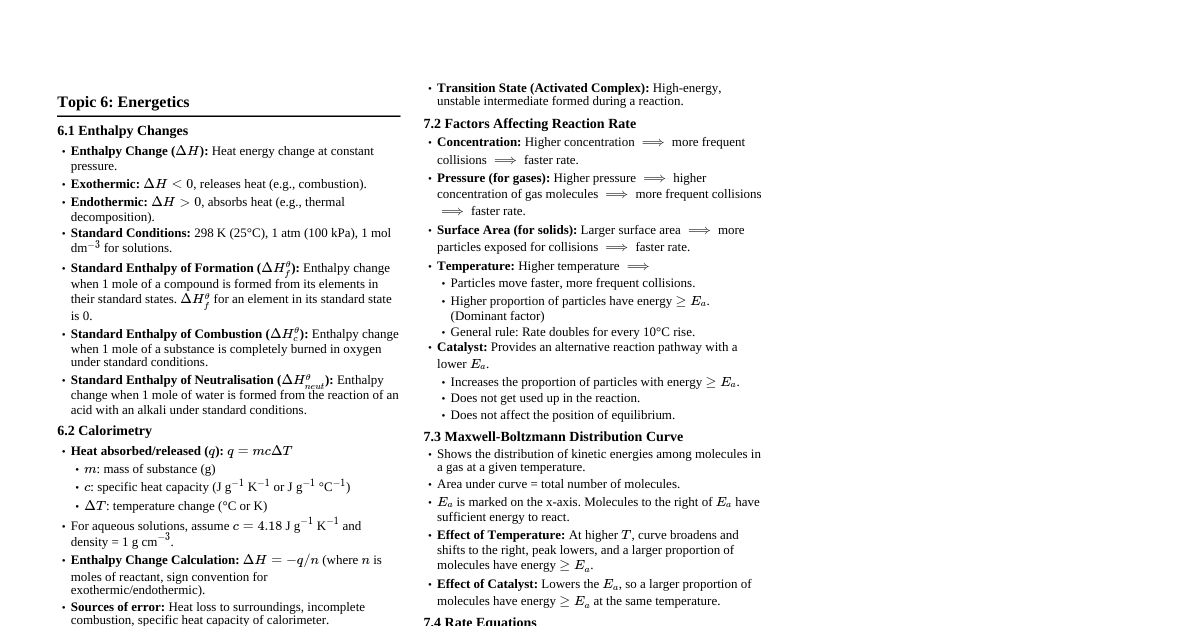
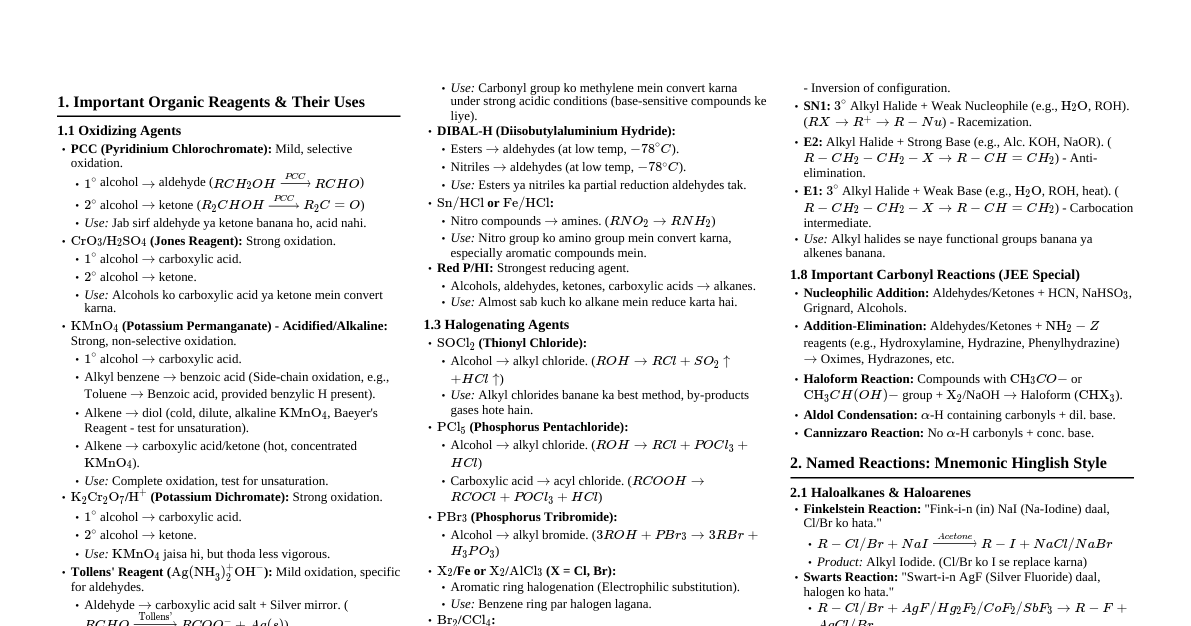
Topic 6: Energetics Enthalpy Changes Standard Enthalpy of Formation ($\Delta H_f^\circ$): Enthalpy change when 1 mole of a compound is formed from its elements in their standard states under standard conditions (298 K, 100 kPa). Standard Enthalpy of Combustion ($\Delta H_c^\circ$): Enthalpy change when 1 mole of a substance is completely burned in oxygen under standard conditions. Standard Enthalpy of Neutralisation ($\Delta H_{neut}^\circ$): Enthalpy change when 1 mole of water is formed from the reaction of an acid with an alkali under standard conditions. Hess's Law The total enthalpy change for a reaction is independent of the route taken, provided the initial and final conditions are the same. Calculations: Using $\Delta H_f^\circ$: $\Delta H_{reaction}^\circ = \sum \Delta H_f^\circ (\text{products}) - \sum \Delta H_f^\circ (\text{reactants})$ Using $\Delta H_c^\circ$: $\Delta H_{reaction}^\circ = \sum \Delta H_c^\circ (\text{reactants}) - \sum \Delta H_c^\circ (\text{products})$ Bond Enthalpies Average Bond Enthalpy: The average energy required to break 1 mole of a specific type of bond in the gaseous state. $\Delta H_{reaction}^\circ \approx \sum (\text{bond enthalpies of bonds broken}) - \sum (\text{bond enthalpies of bonds formed})$ Limitations: Average bond enthalpies are not exact for specific molecules. Calorimetry Heat energy change ($q$) = $mc\Delta T$, where $m$ is mass of substance heated/cooled (usually water), $c$ is specific heat capacity (of water, $4.18 \text{ J g}^{-1} \text{ K}^{-1}$), $\Delta T$ is temperature change. Enthalpy change ($\Delta H$) = $-q/n$, where $n$ is moles of limiting reactant. Topic 7: Rates of Reaction Collision Theory Particles must collide with sufficient energy (activation energy, $E_a$) and correct orientation for a reaction to occur. Factors Affecting Reaction Rate Concentration/Pressure: Higher concentration/pressure $\rightarrow$ more frequent collisions $\rightarrow$ faster rate. Temperature: Higher temperature $\rightarrow$ particles have more kinetic energy $\rightarrow$ more frequent and energetic collisions (more particles exceed $E_a$) $\rightarrow$ faster rate. Surface Area: Larger surface area (for solids) $\rightarrow$ more particles exposed for reaction $\rightarrow$ faster rate. Catalyst: Provides an alternative reaction pathway with a lower activation energy $\rightarrow$ faster rate (no change in yield). Maxwell-Boltzmann Distribution Shows the distribution of kinetic energies among gas particles at a given temperature. Area under curve = total number of particles. Increasing temperature shifts the curve to the right and flattens it, increasing the proportion of particles with energy $\ge E_a$. Rate Equations Rate expression: For $aA + bB \rightarrow \text{products}$, rate $= k[A]^m[B]^n$. Order of reaction: $m$ is the order with respect to A, $n$ is the order with respect to B. Overall order = $m+n$. Rate constant ($k$): Proportionality constant, depends on temperature and catalyst. Determining order: Experimentally from initial rates data. Units of $k$: Depend on overall order. E.g., for 1st order, $\text{s}^{-1}$; for 2nd order, $\text{mol}^{-1} \text{ dm}^3 \text{ s}^{-1}$. Half-Life ($t_{1/2}$) Time taken for the concentration of a reactant to fall to half its initial value. For a first-order reaction, $t_{1/2}$ is constant: $t_{1/2} = \ln(2)/k$. Activation Energy ($E_a$) Minimum energy required for a reaction to occur. Arrhenius equation: $k = A e^{-E_a/RT}$, where $A$ is the pre-exponential factor, $R$ is the gas constant, $T$ is temperature in Kelvin. Plot of $\ln k$ vs $1/T$ gives a straight line with gradient $-E_a/R$. Reaction Mechanisms Sequence of elementary steps by which a reaction occurs. Rate-determining step (RDS): The slowest step in the mechanism, its stoichiometry determines the rate equation. Topic 8: Chemical Equilibrium Reversible Reactions & Equilibrium Dynamic Equilibrium: Rate of forward reaction = rate of reverse reaction. Concentrations of reactants and products remain constant. Equilibrium Constant ($K_c$) For $aA + bB \rightleftharpoons cC + dD$, $K_c = \frac{[C]^c[D]^d}{[A]^a[B]^b}$ at equilibrium. Units of $K_c$ depend on the stoichiometry. Only aqueous and gaseous species are included in $K_c$ expression (pure solids/liquids have constant concentrations). Large $K_c$ ($>1$) means products are favoured. Small $K_c$ ($ Equilibrium Constant ($K_p$) For gaseous reactions, using partial pressures: $K_p = \frac{P_C^c P_D^d}{P_A^a P_B^b}$. $P_X = \text{mole fraction}_X \times \text{total pressure}$. Relationship between $K_c$ and $K_p$: $K_p = K_c(RT)^{\Delta n}$, where $\Delta n = (\text{moles of gaseous products}) - (\text{moles of gaseous reactants})$. Le Chatelier's Principle If a change in condition is applied to a system at equilibrium, the system will shift in a direction that counteracts the change. Concentration: Increase reactant $\rightarrow$ shift right. Increase product $\rightarrow$ shift left. Pressure (gases only): Increase pressure $\rightarrow$ shift to side with fewer moles of gas. Decrease pressure $\rightarrow$ shift to side with more moles of gas. Temperature: Increase temperature $\rightarrow$ shift in endothermic direction. Decrease temperature $\rightarrow$ shift in exothermic direction. Catalyst: No effect on equilibrium position or $K_c$/$K_p$. Only increases rate at which equilibrium is reached. Topic 9: Acid-Base Equilibria Brønsted-Lowry Theory Acid: Proton ($H^+$) donor. Base: Proton ($H^+$) acceptor. Conjugate acid-base pairs: differ by a single proton. E.g., $HCl/Cl^-$, $H_2O/OH^-$. Strong vs. Weak Acids/Bases Strong: Fully dissociate/ionise in solution (e.g., $HCl$, $NaOH$). Weak: Partially dissociate/ionise in solution (e.g., $CH_3COOH$, $NH_3$). pH Scale $pH = -\log_{10}[H^+]$. $[H^+] = 10^{-pH}$. Water dissociation constant: $K_w = [H^+][OH^-] = 1.0 \times 10^{-14} \text{ mol}^2 \text{ dm}^{-6}$ at 298 K. $pOH = -\log_{10}[OH^-]$. $pH + pOH = pK_w = 14$ at 298 K. Acid Dissociation Constant ($K_a$) For weak acid $HA \rightleftharpoons H^+ + A^-$, $K_a = \frac{[H^+][A^-]}{[HA]}$. $pK_a = -\log_{10}K_a$. Smaller $pK_a$ (larger $K_a$) means stronger weak acid. For weak acids: $[H^+] \approx \sqrt{K_a \times [HA]}$. Base Dissociation Constant ($K_b$) For weak base $B + H_2O \rightleftharpoons BH^+ + OH^-$, $K_b = \frac{[BH^+][OH^-]}{[B]}$. $pK_b = -\log_{10}K_b$. Relationship: $K_a \times K_b = K_w$ for a conjugate acid-base pair. Buffer Solutions Resist changes in pH upon addition of small amounts of acid or base. Composed of a weak acid and its conjugate base (e.g., $CH_3COOH/CH_3COO^-$) or a weak base and its conjugate acid. Henderson-Hasselbalch equation: $pH = pK_a + \log_{10}\frac{[\text{salt}]}{[\text{acid}]}$ or $pH = pK_a + \log_{10}\frac{[\text{conjugate base}]}{[\text{weak acid}]}$. Titration Curves & Indicators Strong acid + Strong base: Equivalence point at pH 7. Sharp change from pH 3 to 11. Weak acid + Strong base: Equivalence point $> $ pH 7. Sharp change from pH 7 to 11. Strong acid + Weak base: Equivalence point $ Weak acid + Weak base: No sharp change, not suitable for titration. Indicator: A weak acid/base that changes colour over a specific pH range. Its $pK_{In}$ should be close to the pH of the equivalence point. Topic 10: Organic Chemistry: Carbonyl Compounds, Carboxylic Acids & Derivatives Aldehydes and Ketones (Carbonyl Compounds) Structure: Contain the carbonyl group ($C=O$). Aldehyde: $R-CHO$, Ketone: $R-CO-R'$. Nomenclature: Aldehydes end in -al, Ketones in -one. Preparation: Primary alcohols $\rightarrow$ Aldehydes (partial oxidation with acidified $K_2Cr_2O_7$, immediate distillation). Secondary alcohols $\rightarrow$ Ketones (complete oxidation with acidified $K_2Cr_2O_7$, reflux). Reactions: Nucleophilic Addition: With $HCN/KCN$: Forms hydroxynitriles (e.g., $CH_3CHO + HCN \rightarrow CH_3CH(OH)CN$). With 2,4-dinitrophenylhydrazine (2,4-DNPH): Forms orange/yellow precipitate, used to test for $C=O$ and identify specific carbonyl compounds by melting point. Reduction: With $NaBH_4$ or $LiAlH_4$ to form alcohols. Aldehydes $\rightarrow$ primary alcohols, Ketones $\rightarrow$ secondary alcohols. Oxidation: Aldehydes are easily oxidised to carboxylic acids (e.g., by Tollens' reagent ($Ag(NH_3)_2^+$) or Fehling's solution ($Cu^{2+}$)). Ketones are resistant to oxidation. Tollens' reagent: Silver mirror formed (test for aldehydes). Fehling's solution: Brick-red precipitate formed (test for aldehydes). Iodoform reaction (Tri-iodomethane test): $CH_3CO-$ group or $CH_3CH(OH)-$ group. Forms yellow precipitate of $CHI_3$. (e.g., ethanal, propanone, ethanol, propan-2-ol). Carboxylic Acids Structure: Contain the carboxyl group ($-COOH$). Nomenclature: End in -oic acid. Acidity: Weak acids, dissociate partially in water. Stronger than alcohols due to resonance stabilisation of carboxylate ion. Reactions: With metals: Forms salt + hydrogen (e.g., $2CH_3COOH + Mg \rightarrow (CH_3COO)_2Mg + H_2$). With bases: Forms salt + water (neutralisation). With carbonates/hydrogencarbonates: Forms salt + water + carbon dioxide (effervescence, test for carboxylic acids). Esterification: With alcohols in presence of concentrated $H_2SO_4$ (catalyst) to form esters. Reversible. Reduction: With $LiAlH_4$ to form primary alcohols. Carboxylic Acid Derivatives Esters Structure: $R-COO-R'$. Nomenclature: Alkyl alkanoate (e.g., ethyl ethanoate). Preparation: Esterification of carboxylic acid with alcohol. Reactions: Hydrolysis: Acid hydrolysis: Reversible, forms carboxylic acid and alcohol. (e.g., $CH_3COOCH_2CH_3 + H_2O \rightleftharpoons CH_3COOH + CH_3CH_2OH$ with $H^+$). Base hydrolysis (saponification): Irreversible, forms carboxylate salt and alcohol. (e.g., $CH_3COOCH_2CH_3 + NaOH \rightarrow CH_3COONa + CH_3CH_2OH$). Acyl Chlorides (Acid Chlorides) Structure: $R-COCl$. Highly reactive. Nomenclature: Alkanoyl chloride (e.g., ethanoyl chloride). Preparation: Carboxylic acid + $SOCl_2$ (thionyl chloride). Reactions (Nucleophilic Acyl Substitution): With water: Vigorous reaction, forms carboxylic acid + $HCl$ (white fumes). With alcohols: Forms ester + $HCl$. With phenols: Forms phenyl ester + $HCl$. With concentrated ammonia: Forms primary amide + $NH_4Cl$. With primary amines: Forms secondary amide + $RNH_3Cl$. Acid Anhydrides Structure: $(RCO)_2O$. Less reactive than acyl chlorides. Nomenclature: Alkanoic anhydride (e.g., ethanoic anhydride). Preparation: Dehydration of carboxylic acids. Reactions (similar to acyl chlorides but less vigorous): With water: Slow reaction, forms carboxylic acid. With alcohols: Forms ester + carboxylic acid. With phenols: Forms phenyl ester + carboxylic acid. With concentrated ammonia: Forms primary amide + ammonium carboxylate. With primary amines: Forms secondary amide + alkylammonium carboxylate. Amides Structure: Primary ($RCONH_2$), Secondary ($RCONHR'$), Tertiary ($RCONR'_2$). Nomenclature: Alkanamide (e.g., ethanamide). Preparation: Acyl chloride/acid anhydride + ammonia/amine. Reactions: Hydrolysis: Acid hydrolysis: Forms carboxylic acid and ammonium salt. Base hydrolysis: Forms carboxylate salt and ammonia/amine. Dehydration (primary amides): With $P_4O_{10}$ to form nitriles.