IAL Chemistry Semester 2 (T6 & T7)
Cheatsheet Content
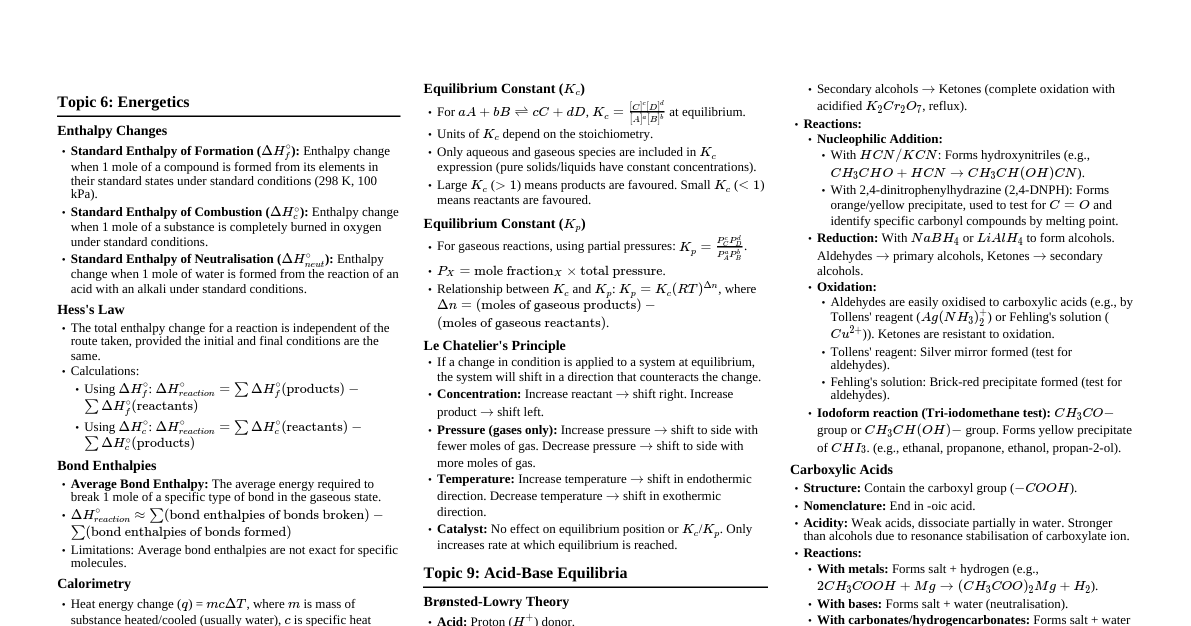
Topic 6: Energetics 6.1 Enthalpy Changes Enthalpy Change ($\Delta H$): Heat energy change at constant pressure. Exothermic: $\Delta H Endothermic: $\Delta H > 0$, absorbs heat (e.g., thermal decomposition). Standard Conditions: 298 K (25°C), 1 atm (100 kPa), 1 mol dm$^{-3}$ for solutions. Standard Enthalpy of Formation ($\Delta H_f^\theta$): Enthalpy change when 1 mole of a compound is formed from its elements in their standard states. $\Delta H_f^\theta$ for an element in its standard state is 0. Standard Enthalpy of Combustion ($\Delta H_c^\theta$): Enthalpy change when 1 mole of a substance is completely burned in oxygen under standard conditions. Standard Enthalpy of Neutralisation ($\Delta H_{neut}^\theta$): Enthalpy change when 1 mole of water is formed from the reaction of an acid with an alkali under standard conditions. 6.2 Calorimetry Heat absorbed/released ($q$): $q = mc\Delta T$ $m$: mass of substance (g) $c$: specific heat capacity (J g$^{-1}$ K$^{-1}$ or J g$^{-1}$ °C$^{-1}$) $\Delta T$: temperature change (°C or K) For aqueous solutions, assume $c = 4.18$ J g$^{-1}$ K$^{-1}$ and density = 1 g cm$^{-3}$. Enthalpy Change Calculation: $\Delta H = -q/n$ (where $n$ is moles of reactant, sign convention for exothermic/endothermic). Sources of error: Heat loss to surroundings, incomplete combustion, specific heat capacity of calorimeter. 6.3 Hess's Law The total enthalpy change for a reaction is independent of the route taken, provided the initial and final conditions are the same. Using Enthalpies of Formation: $\Delta H_{reaction}^\theta = \sum \Delta H_f^\theta (\text{products}) - \sum \Delta H_f^\theta (\text{reactants})$ Using Enthalpies of Combustion: $\Delta H_{reaction}^\theta = \sum \Delta H_c^\theta (\text{reactants}) - \sum \Delta H_c^\theta (\text{products})$ 6.4 Bond Enthalpies Mean Bond Enthalpy: Average energy required to break 1 mole of a specific type of bond in gaseous molecules. Always positive (bond breaking is endothermic). $\Delta H_{reaction}^\theta = \sum (\text{bond energies of bonds broken}) - \sum (\text{bond energies of bonds formed})$ Limitations: Bond enthalpies are average values, so calculations are estimates. 6.5 Lattice Energy Lattice Energy ($\Delta H_{LE}$): Enthalpy change when 1 mole of an ionic compound is formed from its gaseous ions. (Exothermic, e.g., $\text{Na}^+(g) + \text{Cl}^-(g) \to \text{NaCl}(s)$). Factors affecting lattice energy: Ionic Charge: Higher charge $\implies$ stronger attraction $\implies$ more exothermic lattice energy. Ionic Radius: Smaller radius $\implies$ stronger attraction $\implies$ more exothermic lattice energy. 6.6 Born-Haber Cycles An energy cycle used to calculate lattice energy or other unknown enthalpy changes indirectly. Includes: Standard enthalpy of formation ($\Delta H_f^\theta$) Enthalpy of atomisation ($\Delta H_{at}^\theta$): 1 mole of gaseous atoms from element. First/Second Ionisation energy (IE): Energy to remove 1st/2nd electron from gaseous atom. First/Second Electron affinity (EA): Energy change when 1st/2nd electron is added to gaseous atom. $\Delta H_f^\theta = \Delta H_{at}^\theta (\text{metal}) + \Delta H_{at}^\theta (\text{non-metal}) + \text{IE} + \text{EA} + \Delta H_{LE}$ (simplified for 1:1 ionic compound) 6.7 Enthalpy of Solution and Hydration Enthalpy of Solution ($\Delta H_{sol}^\theta$): Enthalpy change when 1 mole of an ionic solid dissolves in a large amount of water to form an infinitely dilute solution. Enthalpy of Hydration ($\Delta H_{hyd}^\theta$): Enthalpy change when 1 mole of gaseous ions dissolves in water to form 1 mole of hydrated ions. Always exothermic. Relationship: $\Delta H_{sol}^\theta = -\Delta H_{LE} + \sum \Delta H_{hyd}^\theta (\text{cations}) + \sum \Delta H_{hyd}^\theta (\text{anions})$ Factors affecting hydration enthalpy: Ionic charge and ionic radius (similar to lattice energy). Higher charge, smaller radius $\implies$ more exothermic hydration. Topic 7: Rates of Reaction 7.1 Collision Theory For a reaction to occur, reactant particles must: Collide with each other. Collide with sufficient activation energy ($E_a$). Collide with the correct orientation . Activation Energy ($E_a$): Minimum energy required for a reaction to occur. Transition State (Activated Complex): High-energy, unstable intermediate formed during a reaction. 7.2 Factors Affecting Reaction Rate Concentration: Higher concentration $\implies$ more frequent collisions $\implies$ faster rate. Pressure (for gases): Higher pressure $\implies$ higher concentration of gas molecules $\implies$ more frequent collisions $\implies$ faster rate. Surface Area (for solids): Larger surface area $\implies$ more particles exposed for collisions $\implies$ faster rate. Temperature: Higher temperature $\implies$ Particles move faster, more frequent collisions. Higher proportion of particles have energy $\ge E_a$. (Dominant factor) General rule: Rate doubles for every 10°C rise. Catalyst: Provides an alternative reaction pathway with a lower $E_a$. Increases the proportion of particles with energy $\ge E_a$. Does not get used up in the reaction. Does not affect the position of equilibrium. 7.3 Maxwell-Boltzmann Distribution Curve Shows the distribution of kinetic energies among molecules in a gas at a given temperature. Area under curve = total number of molecules. $E_a$ is marked on the x-axis. Molecules to the right of $E_a$ have sufficient energy to react. Effect of Temperature: At higher $T$, curve broadens and shifts to the right, peak lowers, and a larger proportion of molecules have energy $\ge E_a$. Effect of Catalyst: Lowers the $E_a$, so a larger proportion of molecules have energy $\ge E_a$ at the same temperature. 7.4 Rate Equations Rate = $k[\text{A}]^m[\text{B}]^n$ $k$: rate constant $[\text{A}], [\text{B}]$: concentrations of reactants $m$: order of reaction with respect to A $n$: order of reaction with respect to B Overall Order: $m+n$. Order of Reaction: Determined experimentally, not from stoichiometric coefficients. Zero Order: Rate is independent of reactant concentration ($[\text{A}]^0 = 1$). Rate = $k$ Units of $k$: mol dm$^{-3}$ s$^{-1}$ Concentration-time graph: straight line with negative gradient. First Order: Rate is directly proportional to reactant concentration. Rate = $k[\text{A}]$ Units of $k$: s$^{-1}$ Concentration-time graph: curve, constant half-life. Half-life ($t_{1/2}$): Time taken for concentration to halve. For first order, $t_{1/2} = \ln(2)/k$. Second Order: Rate is proportional to the square of reactant concentration. Rate = $k[\text{A}]^2$ Units of $k$: dm$^3$ mol$^{-1}$ s$^{-1}$ Concentration-time graph: steeper curve, half-life increases with time. 7.5 Determining Order of Reaction Initial Rates Method: Vary initial concentration of one reactant while keeping others constant, measure initial rate. If $[\text{A}]$ doubles and rate doubles $\implies$ 1st order in A. If $[\text{A}]$ doubles and rate quadruples $\implies$ 2nd order in A. If $[\text{A}]$ doubles and rate is unchanged $\implies$ 0th order in A. Concentration-Time Graphs: Plot $[\text{reactant}]$ vs time. Zero order: linear decrease. First order: exponential decrease, constant $t_{1/2}$. Half-life Method: If $t_{1/2}$ is constant, it's 1st order. 7.6 Rate Constant ($k$) $k$ is temperature-dependent. Arrhenius Equation: $k = Ae^{-E_a/RT}$ $A$: Arrhenius constant (pre-exponential factor) $E_a$: activation energy (J mol$^{-1}$) $R$: gas constant (8.314 J mol$^{-1}$ K$^{-1}$) $T$: absolute temperature (K) Logarithmic form: $\ln k = \ln A - E_a/RT$ Plot $\ln k$ vs $1/T$ gives a straight line. Gradient $= -E_a/R$ Y-intercept $= \ln A$ 7.7 Reaction Mechanisms A sequence of elementary steps by which a reaction occurs. Rate-Determining Step (RDS): The slowest step in the reaction mechanism. The order of reaction with respect to each reactant in the overall rate equation is determined by the stoichiometry of the reactants involved in the RDS. Intermediates are formed in one step and consumed in a subsequent step. They do not appear in the overall balanced equation or the rate equation.