Thermodynamics 2: Rankine Cycl
Cheatsheet Content
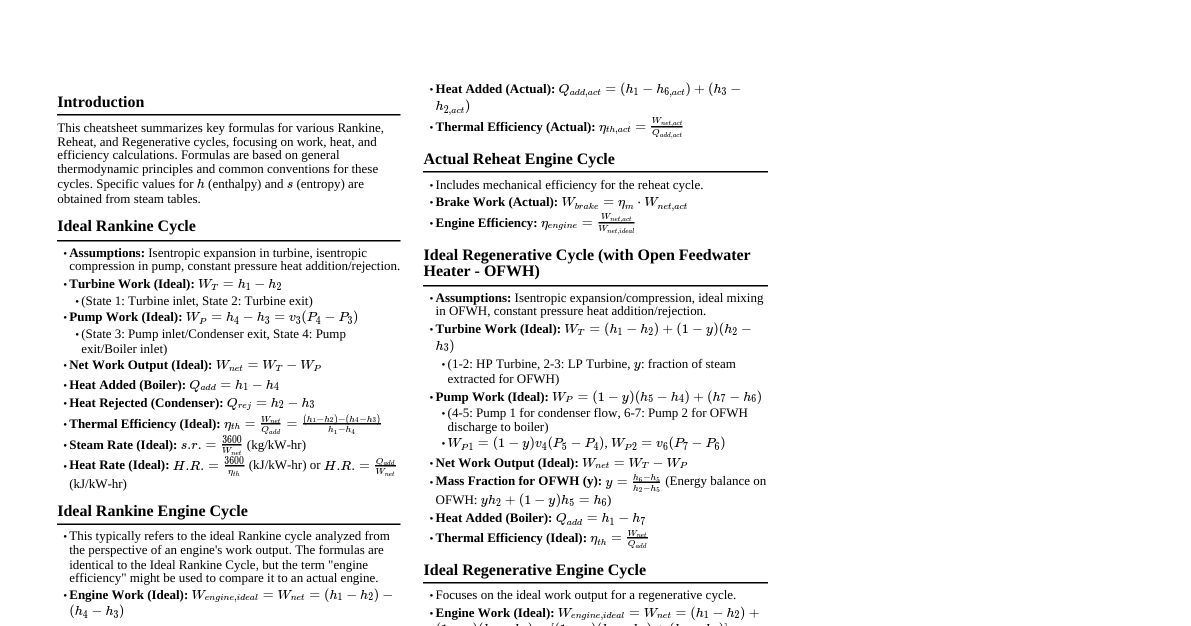
### General Notation & Definitions - $h$: Specific enthalpy (kJ/kg) - $s$: Specific entropy (kJ/kg·K) - $P$: Pressure - $v$: Specific volume (m$^3$/kg) - $W$: Work (kJ/kg) - $Q$: Heat (kJ/kg) - $\eta$: Efficiency - $SR$: Steam Rate (kg/kW·hr) - $HR$: Heat Rate (kJ/kW·hr) - Subscripts: - $t$: Turbine - $p$: Pump - $net$: Net - $A$: Heat Added - $R$: Heat Rejected - $th$: Thermal - $s$: Isentropic (ideal) - $actual$: Actual - $m$: Mechanical - $g$: Generator - $b$: Brake - $comb$: Combined - State points typically correspond to a T-s or h-s diagram. A diagram is essential for applying these formulas correctly. All specific quantities are per unit mass of steam flowing through the boiler, unless specified otherwise (e.g., mass fraction $y$). ### Ideal Rankine Cycle (Simple) - **Assumptions:** Isentropic turbine & pump, constant pressure heat addition & rejection. - **Heat Added ($Q_A$):** (Boiler) $$Q_A = h_1 - h_4$$ - **Heat Rejected ($Q_R$):** (Condenser) $$Q_R = h_2 - h_3$$ - **Ideal Turbine Work ($W_t$):** $$W_t = h_1 - h_2$$ - **Ideal Pump Work ($W_p$):** $$W_p = h_4 - h_3 = v_3(P_4 - P_3)$$ - **Ideal Net Work ($W_{net}$):** $$W_{net} = W_t - W_p = (h_1 - h_2) - (h_4 - h_3)$$ - **Thermal Efficiency ($\eta_{th}$):** $$\eta_{th} = \frac{W_{net}}{Q_A} = \frac{(h_1 - h_2) - (h_4 - h_3)}{h_1 - h_4}$$ $$\eta_{th} = 1 - \frac{Q_R}{Q_A} = 1 - \frac{h_2 - h_3}{h_1 - h_4}$$ - **Steam Rate ($SR$):** $$SR = \frac{3600}{W_{net}} \quad (\text{kg/kW}\cdot\text{hr, if } W_{net} \text{ in kJ/kg})$$ - **Heat Rate ($HR$):** $$HR = \frac{Q_A}{W_{net}} \times 3600 \quad (\text{kJ/kW}\cdot\text{hr, if } Q_A, W_{net} \text{ in kJ/kg})$$ ### Ideal Rankine Engine Cycle - **Note:** For an "Ideal Engine Cycle," the formulas are identical to the Ideal Rankine Cycle, as it represents the ideal thermodynamic performance of the engine/power plant. The "engine" aspect typically introduces mechanical efficiencies in actual cycles. - All formulas for $Q_A, Q_R, W_t, W_p, W_{net}, \eta_{th}, SR, HR$ are the same as for the **Ideal Rankine Cycle (Simple)**. ### Actual Rankine Cycle - **Assumptions:** Non-isentropic turbine & pump (efficiencies $\eta_t, \eta_p$), pressure drops in pipes, heat losses. - **Actual Turbine Work ($W_{t,actual}$):** $$W_{t,actual} = \eta_t (h_1 - h_{2s})$$ - $h_{2s}$ is the enthalpy after isentropic expansion from $P_1, T_1$ to $P_2$. - $h_{2,actual} = h_1 - W_{t,actual}$ - **Actual Pump Work ($W_{p,actual}$):** $$W_{p,actual} = \frac{h_{4s} - h_3}{\eta_p} = \frac{v_3(P_4 - P_3)}{\eta_p}$$ - $h_{4s}$ is the enthalpy after isentropic compression from $P_3, T_3$ to $P_4$. - $h_{4,actual} = h_3 + W_{p,actual}$ - **Heat Added ($Q_{A,actual}$):** $$Q_{A,actual} = h_1 - h_{4,actual}$$ - **Heat Rejected ($Q_{R,actual}$):** $$Q_{R,actual} = h_{2,actual} - h_3$$ - **Actual Net Work ($W_{net,actual}$):** $$W_{net,actual} = W_{t,actual} - W_{p,actual}$$ - **Actual Thermal Efficiency ($\eta_{th,actual}$):** $$\eta_{th,actual} = \frac{W_{net,actual}}{Q_{A,actual}} = \frac{W_{t,actual} - W_{p,actual}}{h_1 - h_{4,actual}}$$ - **Cycle Engine Efficiency (Relative Efficiency) ($\eta_{e,cycle}$):** $$\eta_{e,cycle} = \frac{\eta_{th,actual}}{\eta_{th,ideal}}$$ - **Actual Steam Rate ($SR_{actual}$):** $$SR_{actual} = \frac{3600}{W_{net,actual}}$$ - **Actual Heat Rate ($HR_{actual}$):** $$HR_{actual} = \frac{Q_{A,actual}}{W_{net,actual}} \times 3600$$ ### Actual Rankine Engine - **Note:** This often incorporates mechanical and generator efficiencies to determine the useful output. - **Brake Work ($W_b$):** The mechanical work delivered by the turbine shaft. $$W_b = \eta_m \cdot W_{t,actual}$$ - If pump work is also considered in the engine's mechanical output: $W_b = \eta_m \cdot W_{net,actual}$ - **Combined Work ($W_{comb}$):** The electrical work output from the generator. $$W_{comb} = \eta_g \cdot W_b = \eta_g \cdot \eta_m \cdot W_{t,actual}$$ - Or if pump work is considered in the net mechanical work: $W_{comb} = \eta_g \cdot \eta_m \cdot W_{net,actual}$$ - **Brake Engine Efficiency ($\eta_{e,brake}$):** $$\eta_{e,brake} = \frac{W_b}{W_{net,ideal}}$$ - **Combined Engine Efficiency ($\eta_{e,comb}$):** $$\eta_{e,comb} = \frac{W_{comb}}{W_{net,ideal}}$$ ### Ideal Reheat Cycle - **Assumptions:** Two turbines (HP, LP) with reheat, isentropic expansions & compressions. - $h_1$: Boiler exit, HP Turbine inlet - $h_2$: HP Turbine exit, Reheater inlet - $h_3$: Reheater exit, LP Turbine inlet - $h_4$: LP Turbine exit, Condenser inlet - $h_5$: Condenser exit, Pump inlet - $h_6$: Pump exit, Boiler inlet - **Heat Added ($Q_A$):** (Boiler + Reheater) $$Q_A = (h_1 - h_6) + (h_3 - h_2)$$ - **Heat Rejected ($Q_R$):** (Condenser) $$Q_R = h_4 - h_5$$ - **Ideal Turbine Work ($W_t$):** $$W_t = (h_1 - h_2) + (h_3 - h_4)$$ - **Ideal Pump Work ($W_p$):** $$W_p = h_6 - h_5 = v_5(P_6 - P_5)$$ - **Ideal Net Work ($W_{net}$):** $$W_{net} = W_t - W_p$$ - **Thermal Efficiency ($\eta_{th}$):** $$\eta_{th} = \frac{W_{net}}{Q_A}$$ - **Steam Rate ($SR$):** $$SR = \frac{3600}{W_{net}}$$ - **Heat Rate ($HR$):** $$HR = \frac{Q_A}{W_{net}} \times 3600$$ ### Ideal Reheat Engine Cycle - **Note:** Similar to the Ideal Rankine Engine Cycle, formulas are identical to the Ideal Reheat Cycle, representing ideal thermodynamic performance. - All formulas for $Q_A, Q_R, W_t, W_p, W_{net}, \eta_{th}, SR, HR$ are the same as for the **Ideal Reheat Cycle**. ### Actual Reheat Cycle - **Assumptions:** Non-isentropic HP & LP Turbines, non-isentropic pump. - **Actual HP Turbine Work ($W_{t,HP,actual}$):** $$W_{t,HP,actual} = \eta_{t,HP} (h_1 - h_{2s})$$ - $h_{2,actual} = h_1 - W_{t,HP,actual}$ - **Actual LP Turbine Work ($W_{t,LP,actual}$):** $$W_{t,LP,actual} = \eta_{t,LP} (h_3 - h_{4s})$$ - $h_{4,actual} = h_3 - W_{t,LP,actual}$ - **Total Actual Turbine Work ($W_{t,actual}$):** $$W_{t,actual} = W_{t,HP,actual} + W_{t,LP,actual}$$ - **Actual Pump Work ($W_{p,actual}$):** $$W_{p,actual} = \frac{h_{6s} - h_5}{\eta_p} = \frac{v_5(P_6 - P_5)}{\eta_p}$$ - $h_{6,actual} = h_5 + W_{p,actual}$ - **Heat Added ($Q_{A,actual}$):** $$Q_{A,actual} = (h_1 - h_{6,actual}) + (h_3 - h_{2,actual})$$ - **Heat Rejected ($Q_{R,actual}$):** $$Q_{R,actual} = h_{4,actual} - h_5$$ - **Actual Net Work ($W_{net,actual}$):** $$W_{net,actual} = W_{t,actual} - W_{p,actual}$$ - **Actual Thermal Efficiency ($\eta_{th,actual}$):** $$\eta_{th,actual} = \frac{W_{net,actual}}{Q_{A,actual}}$$ - **Cycle Engine Efficiency ($\eta_{e,cycle}$):** $$\eta_{e,cycle} = \frac{\eta_{th,actual}}{\eta_{th,ideal}}$$ - **Actual Steam Rate ($SR_{actual}$):** $$SR_{actual} = \frac{3600}{W_{net,actual}}$$ - **Actual Heat Rate ($HR_{actual}$):** $$HR_{actual} = \frac{Q_{A,actual}}{W_{net,actual}} \times 3600$$ ### Actual Reheat Engine Cycle - **Note:** Incorporates mechanical and generator efficiencies. - **Brake Work ($W_b$):** $$W_b = \eta_m \cdot W_{t,actual} \quad \text{or} \quad W_b = \eta_m \cdot W_{net,actual}$$ - **Combined Work ($W_{comb}$):** $$W_{comb} = \eta_g \cdot W_b = \eta_g \cdot \eta_m \cdot W_{t,actual} \quad \text{or} \quad W_{comb} = \eta_g \cdot \eta_m \cdot W_{net,actual}$$ - **Brake Engine Efficiency ($\eta_{e,brake}$):** $$\eta_{e,brake} = \frac{W_b}{W_{net,ideal}}$$ - **Combined Engine Efficiency ($\eta_{e,comb}$):** $$\eta_{e,comb} = \frac{W_{comb}}{W_{net,ideal}}$$ ### Ideal Regenerative Cycle (with one FWH) - **Assumptions:** Isentropic turbine & pumps, ideal FWH (no heat loss, outlet is saturated liquid at FWH pressure for open FWH, or condensate leaves at saturation temp for closed FWH), one extraction point. - Let $y$ be the fraction of steam extracted from the turbine for the FWH. - **Ideal Turbine Work ($W_t$):** $$W_t = (h_1 - h_2) + (1-y)(h_2 - h_3)$$ - $h_1$: Turbine inlet - $h_2$: Enthalpy at extraction point - $h_3$: Turbine exit to condenser - **Ideal Pump Work (Total $W_p$):** Sum of pump works. - For an **Open Feedwater Heater (FWH)** (states may vary by diagram): - $W_{p1} = (1-y)v_4(P_5 - P_4)$ (Condensate pump) - $W_{p2} = v_6(P_1 - P_6)$ (Boiler feed pump) - $W_{p,total} = W_{p1} + W_{p2}$ - FWH Energy Balance (to find $y$): $y h_2 + (1-y)h_5 = h_6$ (where $h_5$ is pump 1 exit, $h_6$ is pump 2 inlet/FWH exit, often $h_6 = h_f$ at FWH pressure) - For a **Closed Feedwater Heater (FWH)** (states may vary by diagram): - $W_{p1} = (1-y)v_4(P_5 - P_4)$ (Condensate pump) - $W_{p2} = v_7(P_1 - P_7)$ (Boiler feed pump) - $W_{p,total} = W_{p1} + W_{p2}$ - FWH Energy Balance (to find $y$): $y (h_2 - h_6) = (h_7 - h_5)$ (where $h_6$ is enthalpy of trapped condensate, $h_5$ is pump 1 exit, $h_7$ is pump 2 inlet/FWH exit) - **Heat Added ($Q_A$):** (Boiler) $$Q_A = h_1 - h_{boiler\_in}$$ - $h_{boiler\_in}$ is the enthalpy of water entering the boiler after all pumps/FWHs. - **Heat Rejected ($Q_R$):** (Condenser) $$Q_R = (1-y)(h_3 - h_4)$$ - $h_4$ is condenser exit enthalpy. - **Ideal Net Work ($W_{net}$):** $$W_{net} = W_t - W_{p,total}$$ - **Thermal Efficiency ($\eta_{th}$):** $$\eta_{th} = \frac{W_{net}}{Q_A}$$ - **Steam Rate ($SR$):** $$SR = \frac{3600}{W_{net}}$$ - **Heat Rate ($HR$):** $$HR = \frac{Q_A}{W_{net}} \times 3600$$ ### Ideal Regenerative Engine Cycle - **Note:** Identical to the Ideal Regenerative Cycle formulas. - All formulas for $Q_A, Q_R, W_t, W_p, W_{net}, \eta_{th}, SR, HR$ are the same as for the **Ideal Regenerative Cycle**. ### Actual Regenerative Cycle - **Assumptions:** Non-isentropic turbine sections, non-isentropic pumps, non-ideal FWH. - **Actual Turbine Work ($W_{t,actual}$):** (For a two-section turbine with one extraction, $y$ is mass fraction extracted) $$W_{t,actual} = \eta_{t,HP}(h_1 - h_{2s}) + (1-y)\eta_{t,LP}(h_{2,actual} - h_{3s})$$ - $h_{2,actual} = h_1 - W_{t,HP,actual}$ (Actual enthalpy at extraction point) - $h_{3,actual} = h_{2,actual} - W_{t,LP,actual}$ (Actual enthalpy at LP turbine exit) - **Actual Pump Work (Total $W_{p,actual}$):** Apply $\eta_p$ to each pump. $$W_{p,actual} = \sum \frac{\dot{m}_{pump} \cdot v_{in}(P_{out} - P_{in})}{\eta_p}$$ - **Heat Added ($Q_{A,actual}$):** $$Q_{A,actual} = h_1 - h_{boiler\_in,actual}$$ - **Heat Rejected ($Q_{R,actual}$):** $$Q_{R,actual} = (1-y)(h_{3,actual} - h_{4,actual})$$ - **Actual Net Work ($W_{net,actual}$):** $$W_{net,actual} = W_{t,actual} - W_{p,actual}$$ - **Actual Thermal Efficiency ($\eta_{th,actual}$):** $$\eta_{th,actual} = \frac{W_{net,actual}}{Q_{A,actual}}$$ - **Cycle Engine Efficiency ($\eta_{e,cycle}$):** $$\eta_{e,cycle} = \frac{\eta_{th,actual}}{\eta_{th,ideal}}$$ - **Actual Steam Rate ($SR_{actual}$):** $$SR_{actual} = \frac{3600}{W_{net,actual}}$$ - **Actual Heat Rate ($HR_{actual}$):** $$HR_{actual} = \frac{Q_{A,actual}}{W_{net,actual}} \times 3600$$ ### Reheat-Regenerative Cycle (General) - **Note:** This combines reheat and regenerative principles. The specific formulas depend heavily on the cycle diagram (number of FWHs, extraction points relative to reheat, open vs. closed FWH). A detailed T-s or h-s diagram with all state points and mass flow fractions is crucial. - **General Approach for Deriving Formulas:** 1. **Identify State Points:** Label all points on the T-s or h-s diagram (boiler inlet/outlet, turbine sections inlet/outlet, reheater inlet/outlet, FWHs, condenser, pumps). 2. **Mass Balance & Extraction Fractions:** Determine mass flow fractions ($y_i$) for each extraction point. The mass flow rate changes in the turbine after each extraction. 3. **Turbine Work ($W_t$):** Sum of work from all turbine sections, considering the specific mass flow through each section. - $W_t = (h_1 - h_2) + (1-y_1)(h_3 - h_4) + (1-y_1-y_2)(h_4 - h_5) + \dots$ - For **actual cycles**, apply turbine efficiencies to each section: $W_{t,actual} = \sum \eta_t (\dot{m} \Delta h_s)$ 4. **Pump Work ($W_p$):** Sum of work for all pumps, considering the specific mass flow through each pump. - $W_p = \sum \dot{m} v \Delta P$ - For **actual cycles**, apply pump efficiencies: $W_{p,actual} = \sum \frac{\dot{m} v \Delta P}{\eta_p}$ 5. **Net Work ($W_{net}$):** $$W_{net} = W_t - W_p$$ 6. **Heat Added ($Q_A$):** Sum of heat added in boiler and all reheaters. $$Q_A = (h_{boiler\_out} - h_{boiler\_in}) + \sum (h_{reheater\_out} - h_{reheater\_in}) \times (\text{mass fraction through reheater})$$ 7. **Heat Rejected ($Q_R$):** Heat rejected in condenser. $$Q_R = (1 - \sum y_i)(h_{condenser\_in} - h_{condenser\_out})$$ 8. **FWH Energy Balances:** For each FWH, perform an energy balance to determine unknown enthalpies or extraction fractions ($y_i$). - **Open FWH:** $\sum (\dot{m} h)_{in} = \sum (\dot{m} h)_{out}$ (mass in = mass out, energy in = energy out) - **Closed FWH:** $\dot{m}_{steam}(h_{steam} - h_{condensate}) = \dot{m}_{feedwater}(h_{feedwater,out} - h_{feedwater,in})$ 9. **Thermal Efficiency ($\eta_{th}$):** $$\eta_{th} = \frac{W_{net}}{Q_A}$$ 10. **Steam Rate ($SR$):** $$SR = \frac{3600}{W_{net}}$$ 11. **Heat Rate ($HR$):** $$HR = \frac{Q_A}{W_{net}} \times 3600$$ - **Engine Efficiencies (Brake/Combined):** Apply mechanical and generator efficiencies as described in the **Actual Rankine Engine** and **Actual Reheat Engine Cycle** sections.