Thermodynamics 2: Rankine Cycl
Cheatsheet Content
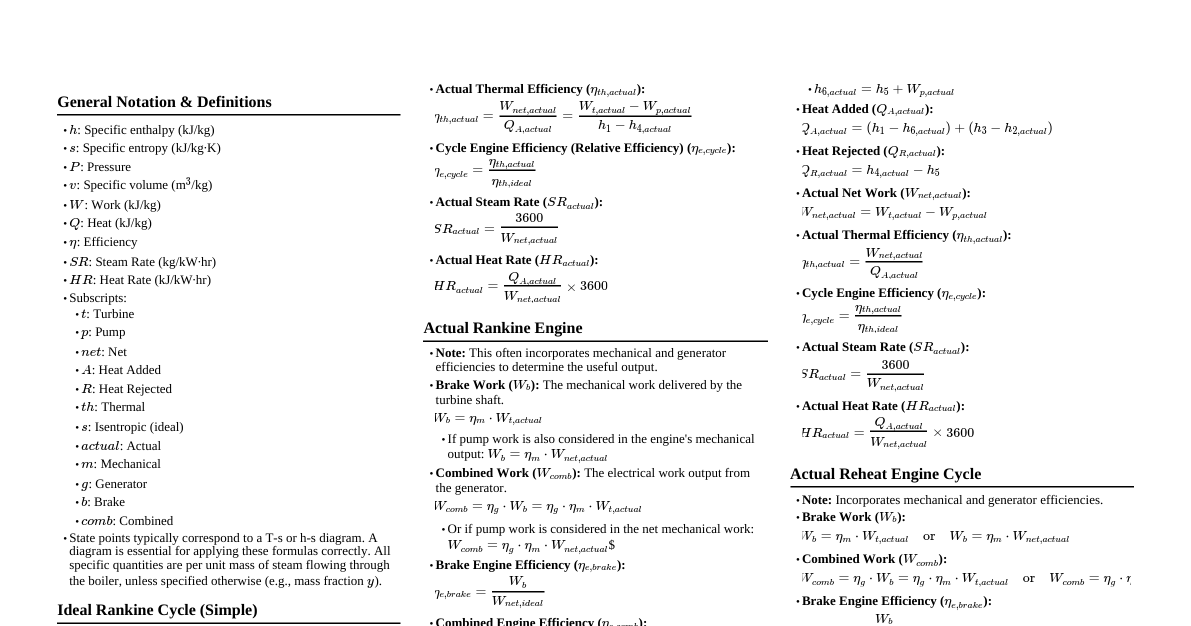
### Introduction This cheatsheet summarizes key formulas for various Rankine, Reheat, and Regenerative cycles, focusing on work, heat, and efficiency calculations. Formulas are based on general thermodynamic principles and common conventions for these cycles. Specific values for $h$ (enthalpy) and $s$ (entropy) are obtained from steam tables. ### Ideal Rankine Cycle * **Assumptions:** Isentropic expansion in turbine, isentropic compression in pump, constant pressure heat addition/rejection. * **Turbine Work (Ideal):** $W_T = h_1 - h_2$ * (State 1: Turbine inlet, State 2: Turbine exit) * **Pump Work (Ideal):** $W_P = h_4 - h_3 = v_3(P_4 - P_3)$ * (State 3: Pump inlet/Condenser exit, State 4: Pump exit/Boiler inlet) * **Net Work Output (Ideal):** $W_{net} = W_T - W_P$ * **Heat Added (Boiler):** $Q_{add} = h_1 - h_4$ * **Heat Rejected (Condenser):** $Q_{rej} = h_2 - h_3$ * **Thermal Efficiency (Ideal):** $\eta_{th} = \frac{W_{net}}{Q_{add}} = \frac{(h_1 - h_2) - (h_4 - h_3)}{h_1 - h_4}$ * **Steam Rate (Ideal):** $s.r. = \frac{3600}{W_{net}}$ (kg/kW-hr) * **Heat Rate (Ideal):** $H.R. = \frac{3600}{\eta_{th}}$ (kJ/kW-hr) or $H.R. = \frac{Q_{add}}{W_{net}}$ (kJ/kW-hr) ### Ideal Rankine Engine Cycle * This typically refers to the ideal Rankine cycle analyzed from the perspective of an engine's work output. The formulas are identical to the Ideal Rankine Cycle, but the term "engine efficiency" might be used to compare it to an actual engine. * **Engine Work (Ideal):** $W_{engine, ideal} = W_{net} = (h_1 - h_2) - (h_4 - h_3)$ ### Actual Rankine Cycle * **Assumptions:** Isentropic efficiencies for turbine and pump, pressure drops in pipes, heat losses. * **Turbine Work (Actual):** $W_{T,act} = \eta_T (h_1 - h_{2s})$ * ($h_{2s}$: Enthalpy at turbine exit if expansion were isentropic, $\eta_T$: Isentropic turbine efficiency) * **Pump Work (Actual):** $W_{P,act} = \frac{h_{4s} - h_3}{\eta_P}$ or $W_{P,act} = \frac{v_3(P_4 - P_3)}{\eta_P}$ * ($h_{4s}$: Enthalpy at pump exit if compression were isentropic, $\eta_P$: Isentropic pump efficiency) * **Net Work Output (Actual):** $W_{net,act} = W_{T,act} - W_{P,act}$ * **Heat Added (Boiler, Actual):** $Q_{add,act} = h_1 - h_{4,act}$ * **Thermal Efficiency (Actual):** $\eta_{th,act} = \frac{W_{net,act}}{Q_{add,act}}$ * **Steam Rate (Actual):** $s.r._{act} = \frac{3600}{W_{net,act}}$ (kg/kW-hr) * **Heat Rate (Actual):** $H.R._{act} = \frac{3600}{\eta_{th,act}}$ (kJ/kW-hr) ### Actual Rankine Engine Cycle * This cycle considers mechanical losses in the engine. * **Brake Work (Actual):** $W_{brake} = \eta_m \cdot W_{net,act}$ * ($\eta_m$: Mechanical efficiency) * **Combined Work (Actual):** If the plant produces both mechanical and electrical work, 'combined work' might refer to total useful work. Often $W_{combined} = W_{brake}$ if considering only mechanical output. In power plants, it might be the actual electrical output. * **Engine Efficiency:** $\eta_{engine} = \frac{W_{net,act}}{W_{net,ideal}}$ (Ratio of actual cycle efficiency to ideal cycle efficiency) * Or, if referring to mechanical efficiency, $\eta_m = \frac{W_{brake}}{W_{net,act}}$ ### Ideal Reheat Cycle * **Assumptions:** Isentropic expansion in both turbine stages, isentropic pump, constant pressure heat addition/rejection, reheat at constant pressure. * **Turbine Work (Ideal):** $W_T = (h_1 - h_2) + (h_3 - h_4)$ * (1-2: High-pressure turbine, 3-4: Low-pressure turbine) * **Pump Work (Ideal):** $W_P = h_6 - h_5 = v_5(P_6 - P_5)$ * **Net Work Output (Ideal):** $W_{net} = W_T - W_P$ * **Heat Added (Boiler & Reheater):** $Q_{add} = (h_1 - h_6) + (h_3 - h_2)$ * **Thermal Efficiency (Ideal):** $\eta_{th} = \frac{W_{net}}{Q_{add}}$ ### Ideal Reheat Engine Cycle * Similar to Ideal Rankine Engine Cycle, the formulas are for the ideal thermodynamic cycle with reheat. * **Engine Work (Ideal):** $W_{engine, ideal} = W_{net} = (h_1 - h_2) + (h_3 - h_4) - (h_6 - h_5)$ ### Actual Reheat Cycle * **Assumptions:** Isentropic efficiencies for both turbine stages and pump. * **Turbine Work (Actual):** $W_{T,act} = \eta_{T,HP}(h_1 - h_{2s}) + \eta_{T,LP}(h_3 - h_{4s})$ * **Pump Work (Actual):** $W_{P,act} = \frac{h_{6s} - h_5}{\eta_P}$ * **Net Work Output (Actual):** $W_{net,act} = W_{T,act} - W_{P,act}$ * **Heat Added (Actual):** $Q_{add,act} = (h_1 - h_{6,act}) + (h_3 - h_{2,act})$ * **Thermal Efficiency (Actual):** $\eta_{th,act} = \frac{W_{net,act}}{Q_{add,act}}$ ### Actual Reheat Engine Cycle * Includes mechanical efficiency for the reheat cycle. * **Brake Work (Actual):** $W_{brake} = \eta_m \cdot W_{net,act}$ * **Engine Efficiency:** $\eta_{engine} = \frac{W_{net,act}}{W_{net,ideal}}$ ### Ideal Regenerative Cycle (with Open Feedwater Heater - OFWH) * **Assumptions:** Isentropic expansion/compression, ideal mixing in OFWH, constant pressure heat addition/rejection. * **Turbine Work (Ideal):** $W_T = (h_1 - h_2) + (1-y)(h_2 - h_3)$ * (1-2: HP Turbine, 2-3: LP Turbine, $y$: fraction of steam extracted for OFWH) * **Pump Work (Ideal):** $W_P = (1-y)(h_5 - h_4) + (h_7 - h_6)$ * (4-5: Pump 1 for condenser flow, 6-7: Pump 2 for OFWH discharge to boiler) * $W_{P1} = (1-y)v_4(P_5 - P_4)$, $W_{P2} = v_6(P_7 - P_6)$ * **Net Work Output (Ideal):** $W_{net} = W_T - W_P$ * **Mass Fraction for OFWH (y):** $y = \frac{h_6 - h_5}{h_2 - h_5}$ (Energy balance on OFWH: $y h_2 + (1-y)h_5 = h_6$) * **Heat Added (Boiler):** $Q_{add} = h_1 - h_7$ * **Thermal Efficiency (Ideal):** $\eta_{th} = \frac{W_{net}}{Q_{add}}$ ### Ideal Regenerative Engine Cycle * Focuses on the ideal work output for a regenerative cycle. * **Engine Work (Ideal):** $W_{engine, ideal} = W_{net} = (h_1 - h_2) + (1-y)(h_2 - h_3) - [(1-y)(h_5 - h_4) + (h_7 - h_6)]$ ### Actual Regenerative Cycle * Includes isentropic efficiencies for turbines and pumps, pressure drops, and non-ideal mixing. * **Turbine Work (Actual):** $W_{T,act} = \eta_{T,HP}(h_1 - h_{2s}) + (1-y_{act})\eta_{T,LP}(h_{2,act} - h_{3s})$ * **Pump Work (Actual):** $W_{P,act} = \frac{(1-y_{act})(h_{5s} - h_{4,act})}{\eta_{P1}} + \frac{(h_{7s} - h_{6,act})}{\eta_{P2}}$ * **Net Work Output (Actual):** $W_{net,act} = W_{T,act} - W_{P,act}$ * **Mass Fraction for OFWH (Actual):** $y_{act} = \frac{h_{6,act} - h_{5,act}}{h_{2,act} - h_{5,act}}$ (enthalpies are actual values) * **Heat Added (Actual):** $Q_{add,act} = h_1 - h_{7,act}$ * **Thermal Efficiency (Actual):** $\eta_{th,act} = \frac{W_{net,act}}{Q_{add,act}}$ ### Reheat-Regenerative Cycle * Combines features of both reheat and regenerative cycles. * **General Approach:** Apply principles from both cycles. * Multiple turbine stages with reheat between them. * Steam extraction(s) for feedwater heating (OFWH or CFWH). * Work and heat calculations follow the same pattern: sum work/heat contributions from each component, accounting for mass flow rates. * **Net Work Output:** $W_{net} = \sum W_T - \sum W_P$ (each turbine/pump work must account for its respective mass flow) * **Heat Added:** $Q_{add} = (h_{boiler,out} - h_{feedwater,in}) + (h_{reheater,out} - h_{reheater,in})$ * **Thermal Efficiency:** $\eta_{th} = \frac{W_{net}}{Q_{add}}$ * **Mass Balances:** Crucial for determining mass flow rates through different sections (e.g., steam extracted for FWH). * Example for one extraction: $y_1 = \frac{h_{FWH,out} - h_{FWH,in\_low\_pressure}}{(h_{extraction\_point\_1}) - h_{FWH,in\_low\_pressure}}$ ### General Definitions & Efficiencies * **Isentropic Turbine Efficiency:** $\eta_T = \frac{W_{T,act}}{W_{T,ideal}} = \frac{h_{in} - h_{out,act}}{h_{in} - h_{out,s}}$ * **Isentropic Pump Efficiency:** $\eta_P = \frac{W_{P,ideal}}{W_{P,act}} = \frac{h_{out,s} - h_{in}}{h_{out,act} - h_{in}}$ * **Mechanical Efficiency:** $\eta_m = \frac{W_{brake}}{W_{shaft}} = \frac{W_{brake}}{W_{net,act}}$ (if $W_{net,act}$ is shaft work) * **Overall Plant Efficiency:** $\eta_{overall} = \eta_{th,act} \cdot \eta_g \cdot \eta_m$ * ($\eta_g$: Generator efficiency) * **Steam Rate (Specific Steam Consumption):** * $s.r. = \frac{\dot{m}_{steam}}{\dot{W}_{net}} = \frac{1}{W_{net}}$ (units: kg/kJ or lb/Btu, convert to kg/kW-hr or lb/hp-hr by multiplying by 3600 or 2545 respectively) * $s.r. = \frac{3600}{W_{net}}$ (kg/kW-hr if $W_{net}$ is in kJ/kg) * **Heat Rate:** * $H.R. = \frac{\dot{Q}_{add}}{\dot{W}_{net}} = \frac{Q_{add}}{W_{net}}$ (kJ/kJ or Btu/Btu) * $H.R. = \frac{3600}{\eta_{th}}$ (kJ/kW-hr if $\eta_{th}$ is dimensionless) * $H.R. = \frac{Q_{add}}{W_{net}}$ (kJ/kW-hr if $Q_{add}$ is kJ/kg and $W_{net}$ is kW-hr/kg)