New sheet - 11/16 22:14
Cheatsheet Content
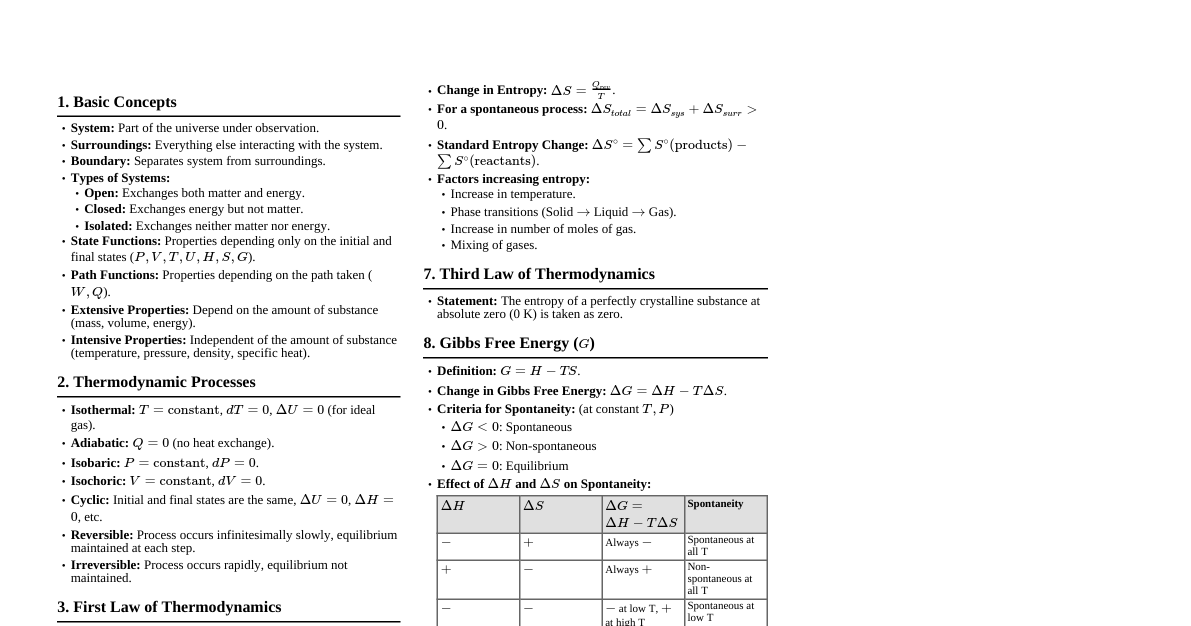
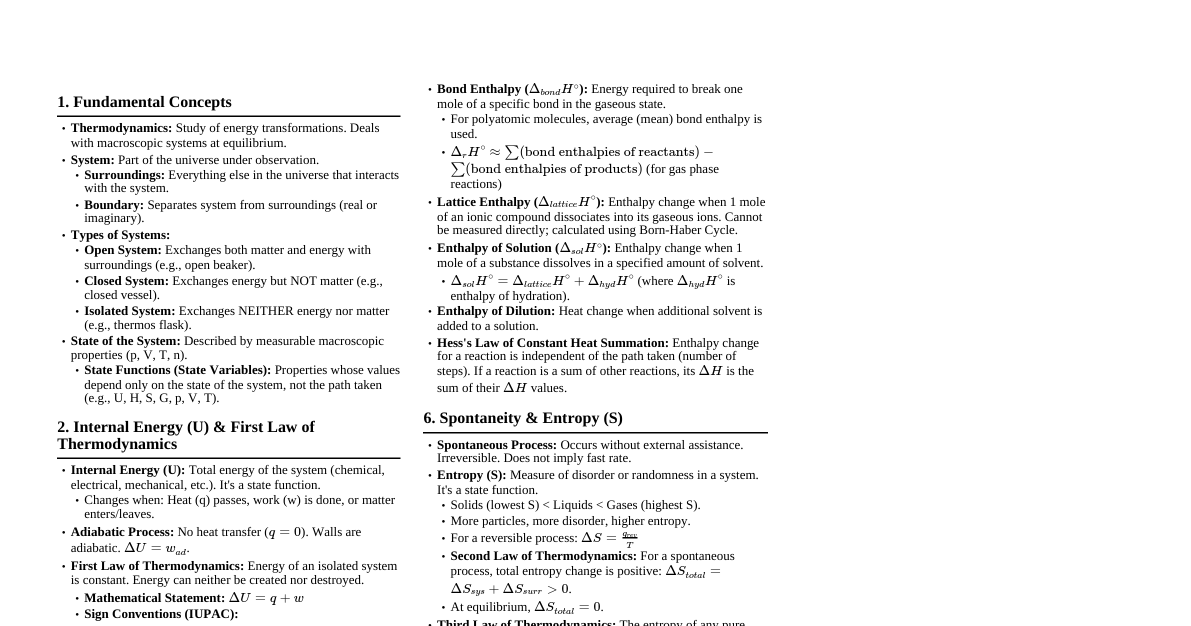
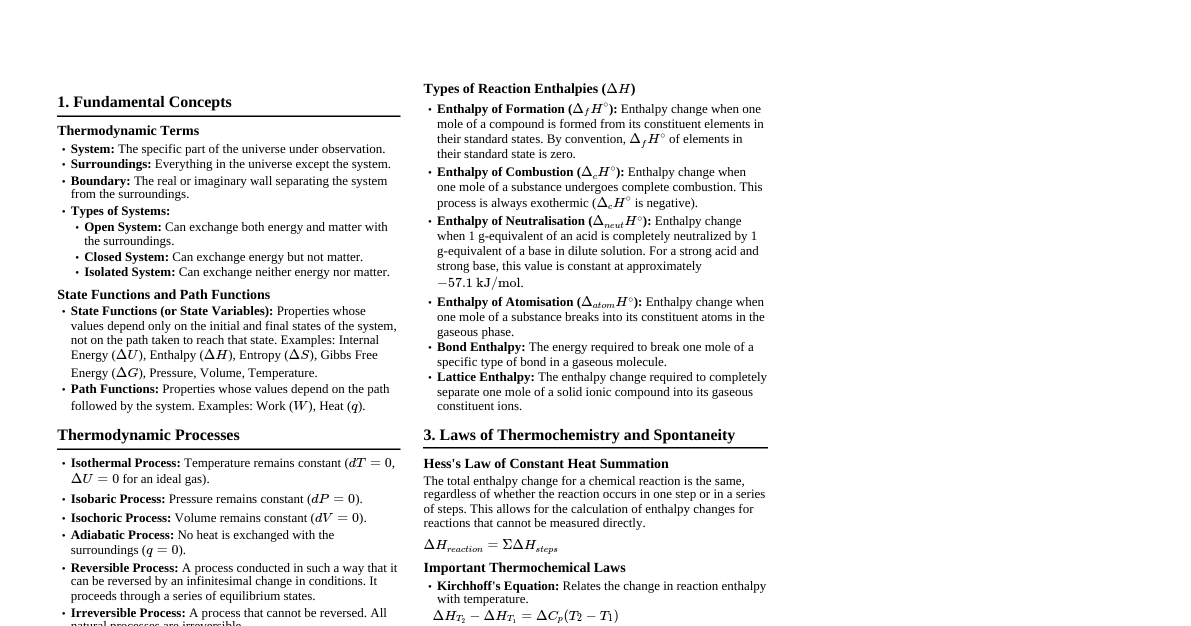
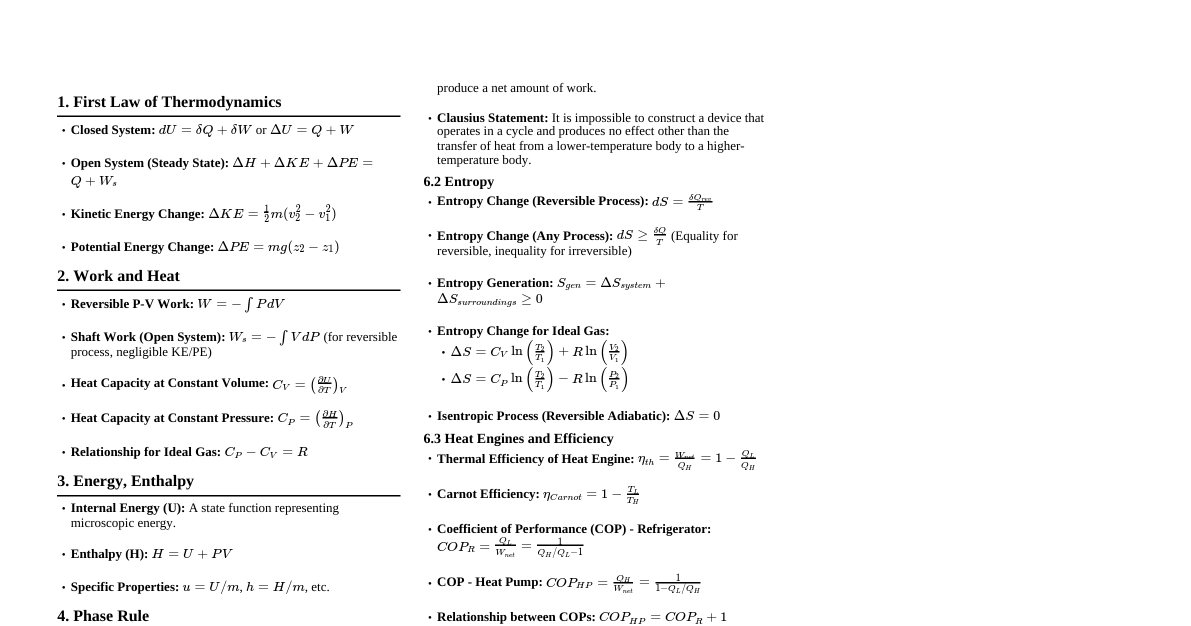
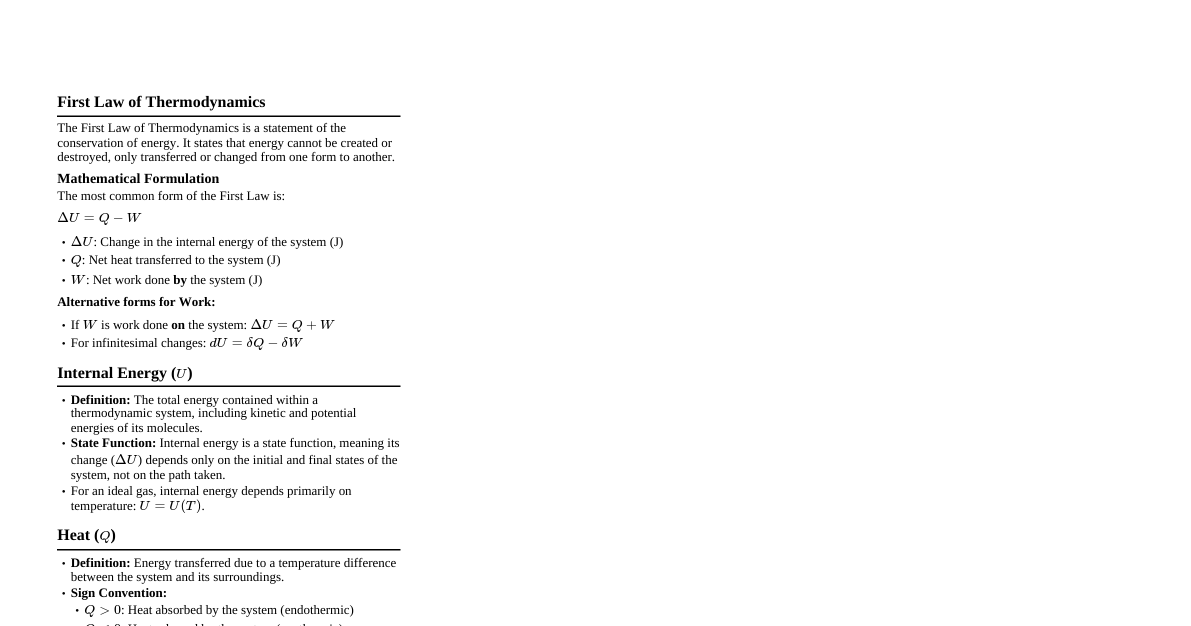
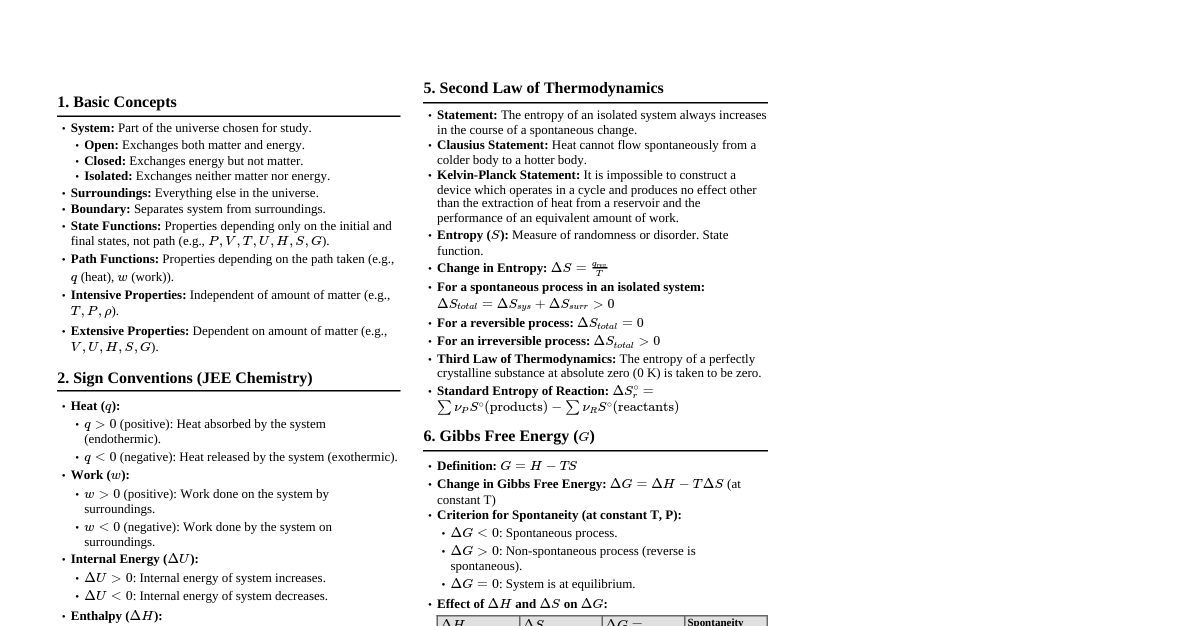
Thermodynamics Fundamentals Key Definitions System: Part of the universe chosen for study. Surroundings: Everything else in the universe. Boundary: Separates system from surroundings. Types of Systems Open System: Exchanges both matter and energy with surroundings. (e.g., open beaker) Closed System: Exchanges energy but not matter. (e.g., sealed container) Isolated System: Exchanges neither matter nor energy. (e.g., thermos flask) Properties of Systems Extensive Properties: Depend on the amount of matter. (e.g., mass, volume, internal energy, enthalpy, entropy, Gibbs energy) Intensive Properties: Independent of the amount of matter. (e.g., temperature, pressure, density, refractive index, concentration) State Functions vs. Path Functions State Functions: Properties whose values depend only on the initial and final states of the system, not on the path taken. (e.g., $P, V, T, E, H, S, G$) $\Delta X = X_{final} - X_{initial}$ Path Functions: Properties whose values depend on the path taken. (e.g., heat ($q$), work ($w$)) Thermodynamic Processes Isothermal Process: Temperature ($T$) remains constant. $\Delta T = 0$. For an ideal gas, $\Delta E = 0$. Adiabatic Process: No heat exchange between system and surroundings. $q = 0$. Isobaric Process: Pressure ($P$) remains constant. $\Delta P = 0$. Isochoric Process: Volume ($V$) remains constant. $\Delta V = 0$. Cyclic Process: System returns to its initial state. $\Delta X = 0$ for all state functions. Reversible Process: Can be reversed without leaving any change in the surroundings. Occurs infinitesimally slowly. Irreversible Process: Cannot be reversed without leaving a permanent change in the surroundings. Real processes are often irreversible. First Law of Thermodynamics Energy can neither be created nor destroyed, only converted from one form to another. $\Delta E = q + w$ $\Delta E$: Change in internal energy of the system. $q$: Heat supplied to the system. $q > 0$: Heat absorbed by the system (endothermic). $q $w$: Work done on the system. $w > 0$: Work done on the system. $w Work ($w$) Pressure-Volume Work (Expansion/Compression): $w = -P_{ext} \Delta V$ (for irreversible process) $w = -P_{ext} (V_f - V_i)$ For expansion, $V_f > V_i$, so $\Delta V > 0$, $w For compression, $V_f 0$ (work done on system). Work for Reversible Isothermal Expansion of an Ideal Gas: $w = -2.303 nRT \log \frac{V_f}{V_i}$ $w = -2.303 nRT \log \frac{P_i}{P_f}$ (since $P_iV_i = P_fV_f$ at constant T) Work for Isochoric Process: $\Delta V = 0 \implies w = 0$. Work for Free Expansion (in vacuum): $P_{ext} = 0 \implies w = 0$. Heat Capacity ($C$) Amount of heat required to raise the temperature of a substance by $1^\circ C$ or $1 K$. $q = C \Delta T$ Molar Heat Capacity ($C_m$): Heat capacity per mole. $q = n C_m \Delta T$. Specific Heat Capacity ($c$): Heat capacity per unit mass. $q = m c \Delta T$. Heat Capacity at Constant Volume ($C_V$): $C_V = (\frac{\partial E}{\partial T})_V$ For an ideal gas, $\Delta E = n C_V \Delta T$ Heat Capacity at Constant Pressure ($C_P$): $C_P = (\frac{\partial H}{\partial T})_P$ For an ideal gas, $\Delta H = n C_P \Delta T$ Relation between $C_P$ and $C_V$ for Ideal Gas (Mayer's Relation): $C_P - C_V = R$ (per mole) Enthalpy ($H$) Heat content of a system at constant pressure. $H = E + PV$ $\Delta H = \Delta E + P \Delta V$ (at constant pressure) For reactions involving gases at constant $T$ and $P$: $\Delta H = \Delta E + \Delta n_g RT$ $\Delta n_g$: (moles of gaseous products) - (moles of gaseous reactants) At constant volume, $\Delta V = 0$, so $q_V = \Delta E$. At constant pressure, $q_P = \Delta H$. Thermochemistry Standard Enthalpy of Reaction ($\Delta H^\circ$) Enthalpy change for a reaction when all reactants and products are in their standard states (1 atm pressure, specified temperature, usually 298 K, 1 M concentration for solutions). Standard Enthalpy of Formation ($\Delta H_f^\circ$) Enthalpy change when one mole of a compound is formed from its constituent elements in their standard states. $\Delta H_f^\circ$ of an element in its most stable form is zero. (e.g., $O_2(g)$, $C(graphite)$, $H_2(g)$) Calculation of $\Delta H^\circ$ $\Delta H_{reaction}^\circ = \sum (\text{n} \Delta H_f^\circ (\text{products})) - \sum (\text{m} \Delta H_f^\circ (\text{reactants}))$ Where n and m are stoichiometric coefficients. Bond Enthalpy (Bond Energy) Energy required to break one mole of a particular type of bond in the gaseous state. $\Delta H_{reaction}^\circ = \sum (\text{Bond energies of reactants}) - \sum (\text{Bond energies of products})$ (Note: This is an approximation and typically less accurate than using $\Delta H_f^\circ$) Hess's Law of Constant Heat Summation If a reaction takes place in several steps, then its standard enthalpy change is the sum of the standard enthalpy changes of the intermediate steps. A -> B $\Delta H_1$ B -> C $\Delta H_2$ ---------------- A -> C $\Delta H_{total} = \Delta H_1 + \Delta H_2$ Enthalpy of Combustion ($\Delta H_c^\circ$) Enthalpy change when one mole of a substance undergoes complete combustion with oxygen under standard conditions. Enthalpy of Neutralization ($\Delta H_{neut}^\circ$) Enthalpy change when one gram equivalent of an acid is completely neutralized by one gram equivalent of a base in dilute solution. For strong acid-strong base, it's approximately constant: $-57.3 \text{ kJ/mol}$. Enthalpy of Solution ($\Delta H_{sol}^\circ$) Enthalpy change when one mole of a substance dissolves in a specified amount of solvent to form a solution. Second Law of Thermodynamics The entropy of an isolated system tends to increase over time, or for a spontaneous process, the total entropy of the universe increases. $\Delta S_{total} = \Delta S_{system} + \Delta S_{surroundings} \ge 0$ For spontaneous processes: $\Delta S_{total} > 0$. For equilibrium processes: $\Delta S_{total} = 0$. Entropy ($S$) A measure of the randomness or disorder of a system. $\Delta S = \frac{q_{rev}}{T}$ (for a reversible process) Units: J K$^{-1}$ mol$^{-1}$ or J K$^{-1}$. Factors affecting entropy: Phase change: $S_{gas} > S_{liquid} > S_{solid}$ Temperature: $S$ increases with $T$. Volume: $S$ increases with $V$. Number of particles/moles: $S$ increases with more particles. Calculation of $\Delta S^\circ$ $\Delta S_{reaction}^\circ = \sum (\text{n} S^\circ (\text{products})) - \sum (\text{m} S^\circ (\text{reactants}))$ Entropy Change for Phase Transitions Melting: $\Delta S_{fus} = \frac{\Delta H_{fus}}{T_f}$ Vaporization: $\Delta S_{vap} = \frac{\Delta H_{vap}}{T_b}$ Entropy Change for Isothermal Reversible Expansion of Ideal Gas $\Delta S = 2.303 nR \log \frac{V_f}{V_i}$ $\Delta S = 2.303 nR \log \frac{P_i}{P_f}$ Third Law of Thermodynamics The entropy of a perfectly crystalline substance at absolute zero (0 K) is zero. $S = 0$ at $T = 0 K$ for a perfect crystal. Gibbs Free Energy ($G$) A thermodynamic potential that measures the "useful" or process-initiating work obtainable from an isothermal, isobaric thermodynamic system. $G = H - TS$ $\Delta G = \Delta H - T \Delta S$ (at constant $T$) Gibbs Energy and Spontaneity $\Delta G $\Delta G > 0$: Process is non-spontaneous (reverse is spontaneous). $\Delta G = 0$: Process is at equilibrium. Factors Affecting Spontaneity (from $\Delta G = \Delta H - T \Delta S$) $\Delta H$ $\Delta S$ $\Delta G$ Spontaneity $-$ $+$ $-$ Always spontaneous $+$ $-$ $+$ Never spontaneous $-$ $-$ $-$ at low $T$ Spontaneous at low $T$ $-$ $-$ $+$ at high $T$ Non-spontaneous at high $T$ $+$ $+$ $+$ at low $T$ Non-spontaneous at low $T$ $+$ $+$ $-$ at high $T$ Spontaneous at high $T$ Standard Gibbs Free Energy of Formation ($\Delta G_f^\circ$) Gibbs energy change when one mole of a compound is formed from its constituent elements in their standard states. $\Delta G_f^\circ$ of an element in its most stable form is zero. Calculation of $\Delta G^\circ$ $\Delta G_{reaction}^\circ = \sum (\text{n} \Delta G_f^\circ (\text{products})) - \sum (\text{m} \Delta G_f^\circ (\text{reactants}))$ Relationship between $\Delta G^\circ$ and Equilibrium Constant ($K$) $\Delta G^\circ = -RT \ln K$ $\Delta G^\circ = -2.303 RT \log K$ $R = 8.314 \text{ J mol}^{-1} \text{ K}^{-1}$ (Gas constant) If $K > 1$, $\Delta G^\circ If $K 0$ (reactants favored). If $K = 1$, $\Delta G^\circ = 0$ (equilibrium). Relationship between $\Delta G$ and $\Delta G^\circ$ $\Delta G = \Delta G^\circ + RT \ln Q$ $Q$: Reaction quotient. At equilibrium, $\Delta G = 0$ and $Q = K$, leading to $\Delta G^\circ = -RT \ln K$. Important Constants and Conversions Gas Constant ($R$): $8.314 \text{ J mol}^{-1} \text{ K}^{-1}$ $0.0821 \text{ L atm mol}^{-1} \text{ K}^{-1}$ $1 \text{ atm} = 101325 \text{ Pa} \approx 1.01 \times 10^5 \text{ Pa}$ $1 \text{ L atm} = 101.3 \text{ J}$ $1 \text{ cal} = 4.184 \text{ J}$ Absolute Zero: $0 \text{ K} = -273.15^\circ C$