Thermodynamics Formulas
Cheatsheet Content
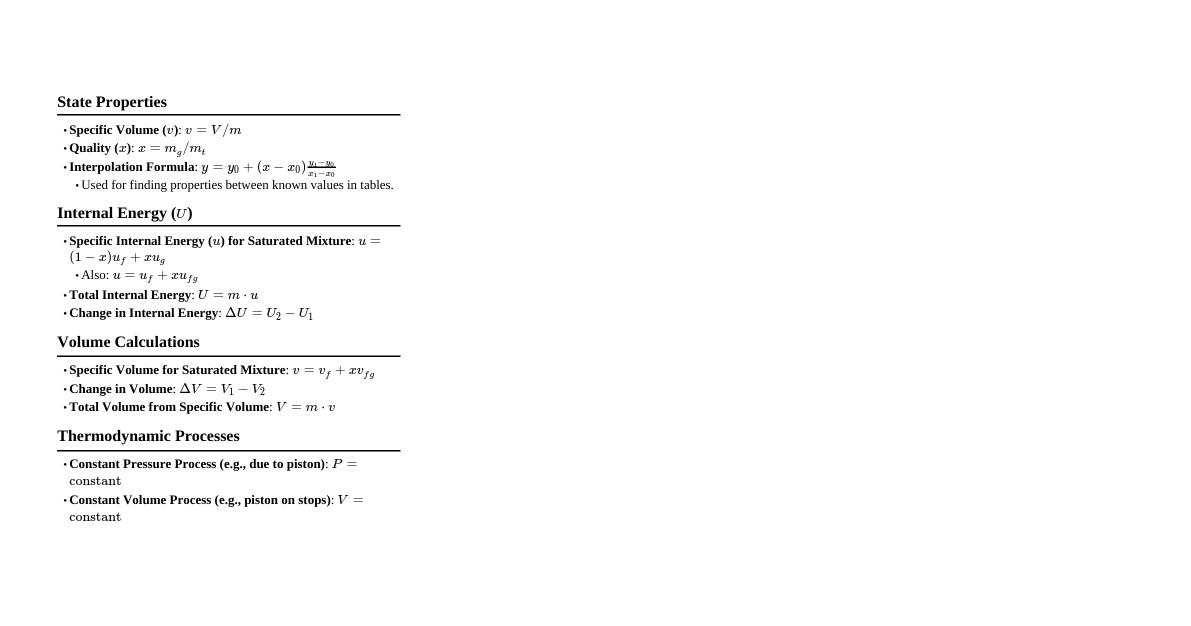
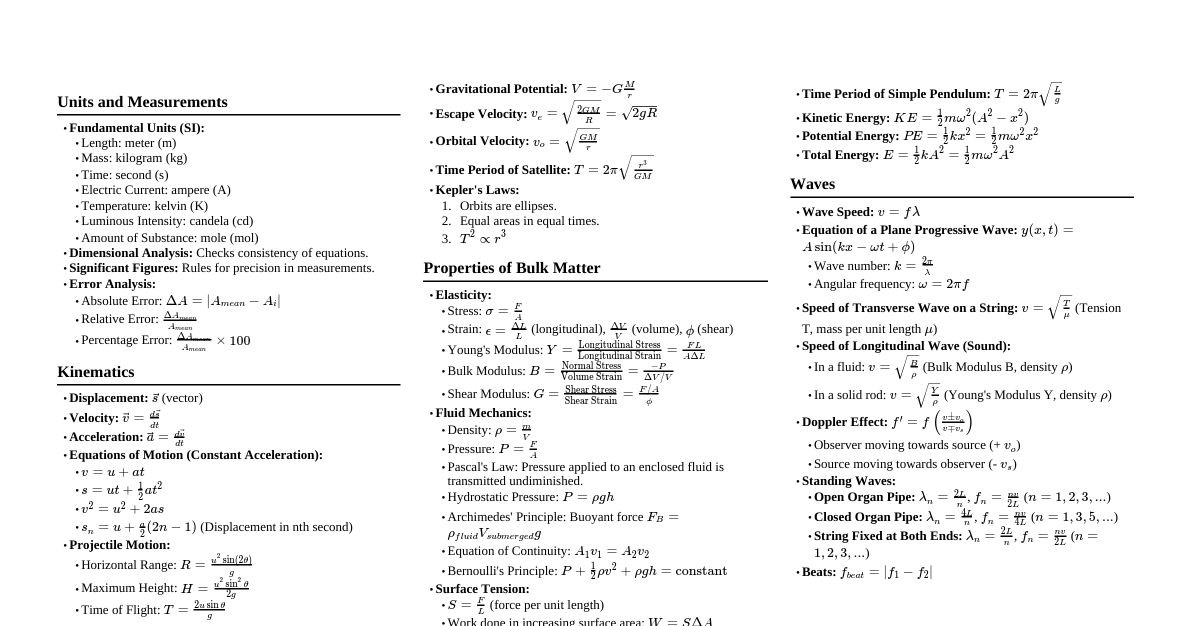
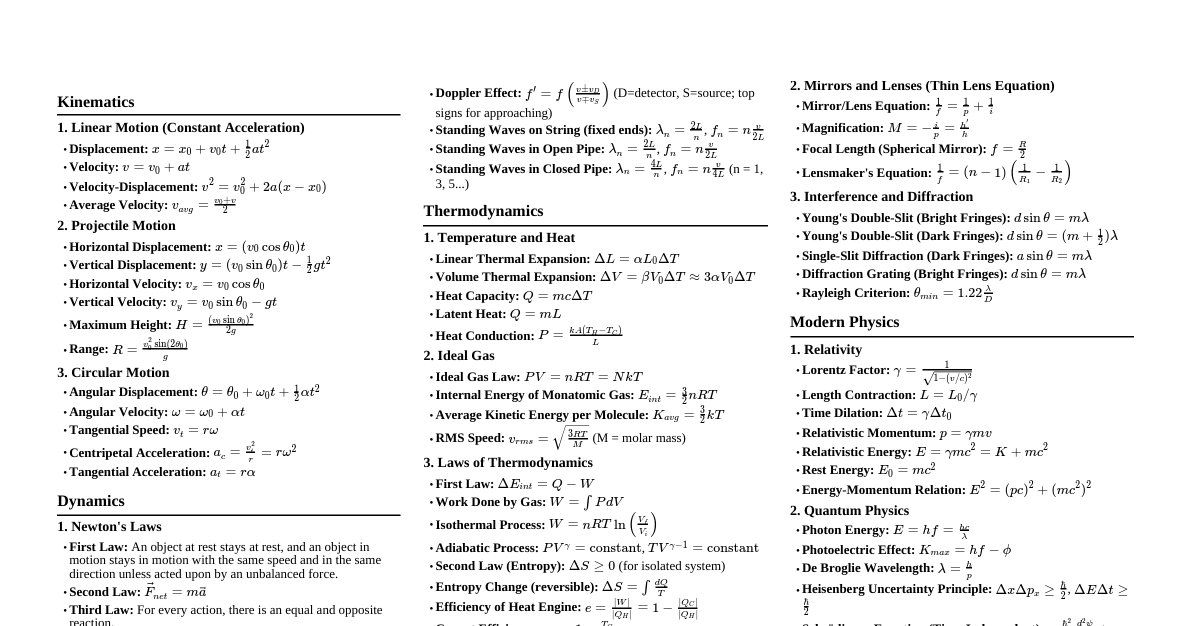
### Thermodynamic Systems - **System:** The part of the universe under consideration. - **Surroundings:** Everything outside the system. - **Boundary:** Separates system from surroundings. - **Types of Systems:** - **Open:** Exchanges both mass and energy. - **Closed:** Exchanges energy but not mass. - **Isolated:** Exchanges neither mass nor energy. ### Temperature and Heat - **Temperature Scales:** - Celsius to Kelvin: $T_K = T_C + 273.15$ - Fahrenheit to Celsius: $T_C = (T_F - 32) \times \frac{5}{9}$ - Celsius to Fahrenheit: $T_F = T_C \times \frac{9}{5} + 32$ - **Heat (Q):** Energy transferred due to temperature difference. - **Specific Heat Capacity:** $Q = mc\Delta T$ - **Latent Heat (Phase Change):** $Q = mL$ - $L_f$: Latent heat of fusion (melting/freezing) - $L_v$: Latent heat of vaporization (boiling/condensation) - **Heat Transfer Mechanisms:** - **Conduction:** $P = \frac{kA\Delta T}{L}$ (where $P$ is power, $k$ is thermal conductivity) - **Convection:** Heat transfer through fluid movement. - **Radiation:** $P = e\sigma AT^4$ (Stefan-Boltzmann Law, where $e$ is emissivity, $\sigma$ is Stefan-Boltzmann constant) ### First Law of Thermodynamics - **Conservation of Energy:** $\Delta U = Q - W$ - $\Delta U$: Change in internal energy - $Q$: Heat added to the system - $W$: Work done BY the system - **Work Done by a Gas:** - **Constant Pressure (Isobaric):** $W = P\Delta V$ - **Constant Volume (Isochoric):** $W = 0$ - **Constant Temperature (Isothermal):** $W = nRT \ln\left(\frac{V_f}{V_i}\right)$ (for ideal gas) - **Adiabatic Process:** $PV^\gamma = \text{constant}$ and $W = \frac{P_iV_i - P_fV_f}{\gamma - 1}$ (for ideal gas, $\gamma = C_p/C_v$) ### Internal Energy and Ideal Gases - **Internal Energy of Monatomic Ideal Gas:** $U = \frac{3}{2}nRT$ - **Internal Energy of Diatomic Ideal Gas:** $U = \frac{5}{2}nRT$ (at moderate temperatures) - **Molar Specific Heats of Ideal Gas:** - **Constant Volume ($C_v$):** - Monatomic: $C_v = \frac{3}{2}R$ - Diatomic: $C_v = \frac{5}{2}R$ - **Constant Pressure ($C_p$):** - $C_p = C_v + R$ (Mayer's Relation) - **Ratio of Specific Heats:** $\gamma = \frac{C_p}{C_v}$ - **Ideal Gas Law:** $PV = nRT = NkT$ - $R$: Universal gas constant ($8.314 \text{ J/(mol}\cdot\text{K)}$) - $k$: Boltzmann constant ($1.38 \times 10^{-23} \text{ J/K}$) ### Second Law of Thermodynamics - **Entropy (S):** Measure of disorder or randomness. - **Change in Entropy:** $\Delta S = \int \frac{dQ_{rev}}{T}$ - **For Reversible Isothermal Process:** $\Delta S = \frac{Q}{T}$ - **For Phase Change:** $\Delta S = \frac{mL}{T}$ - **Entropy of an Ideal Gas:** $\Delta S = nC_v \ln\left(\frac{T_f}{T_i}\right) + nR \ln\left(\frac{V_f}{V_i}\right)$ - **Statements of the Second Law:** - **Clausius Statement:** Heat cannot spontaneously flow from a colder body to a hotter body. - **Kelvin-Planck Statement:** It is impossible to construct a device that operates in a cycle and produces no effect other than the extraction of heat from a single thermal reservoir and the production of an equivalent amount of work. - **Entropy Statement:** The total entropy of an isolated system can only increase over time, or remain constant in ideal cases; it never decreases. ($\Delta S_{universe} \ge 0$) ### Heat Engines and Refrigerators - **Heat Engine:** Converts thermal energy into mechanical work. - **Efficiency:** $e = \frac{W}{Q_H} = 1 - \frac{Q_C}{Q_H}$ - $Q_H$: Heat absorbed from hot reservoir - $Q_C$: Heat expelled to cold reservoir - $W$: Work done by engine - **Carnot Engine (Ideal Engine):** - **Carnot Efficiency:** $e_C = 1 - \frac{T_C}{T_H}$ - $T_C$: Absolute temperature of cold reservoir - $T_H$: Absolute temperature of hot reservoir - **Refrigerator/Heat Pump:** Moves heat from colder to hotter region. - **Coefficient of Performance (COP) - Refrigerator:** $COP_{ref} = \frac{Q_C}{W} = \frac{Q_C}{Q_H - Q_C}$ - **Coefficient of Performance (COP) - Heat Pump:** $COP_{hp} = \frac{Q_H}{W} = \frac{Q_H}{Q_H - Q_C}$ - **Carnot COP - Refrigerator:** $COP_{ref,C} = \frac{T_C}{T_H - T_C}$ - **Carnot COP - Heat Pump:** $COP_{hp,C} = \frac{T_H}{T_H - T_C}$ ### Third Law of Thermodynamics - **Absolute Zero:** The entropy of a perfect crystal at absolute zero (0 K) is exactly zero. - It is impossible to reach absolute zero in a finite number of steps. ### Thermodynamic Potentials - **Enthalpy (H):** $H = U + PV$ - At constant pressure, $\Delta H = Q$ - **Helmholtz Free Energy (A):** $A = U - TS$ - At constant temperature and volume, $\Delta A \le 0$ for spontaneous processes - **Gibbs Free Energy (G):** $G = H - TS$ - At constant temperature and pressure, $\Delta G \le 0$ for spontaneous processes - $\Delta G = W_{non-PV}$ (maximum non-PV work) - **Maxwell Relations:** Derived from exact differentials of thermodynamic potentials (e.g., $\left(\frac{\partial T}{\partial V}\right)_S = -\left(\frac{\partial P}{\partial S}\right)_V$) ### Statistical Mechanics Basics - **Boltzmann's Entropy Formula:** $S = k \ln W$ - $W$: Number of microstates corresponding to a given macrostate - **Partition Function (Z):** Sum over all possible states of a system, weighted by their Boltzmann factors. - $Z = \sum_i e^{-\beta E_i}$ where $\beta = \frac{1}{kT}$ - **Average Energy:** $\langle E \rangle = -\frac{\partial \ln Z}{\partial \beta}$