HRK Physics Formulas
Cheatsheet Content
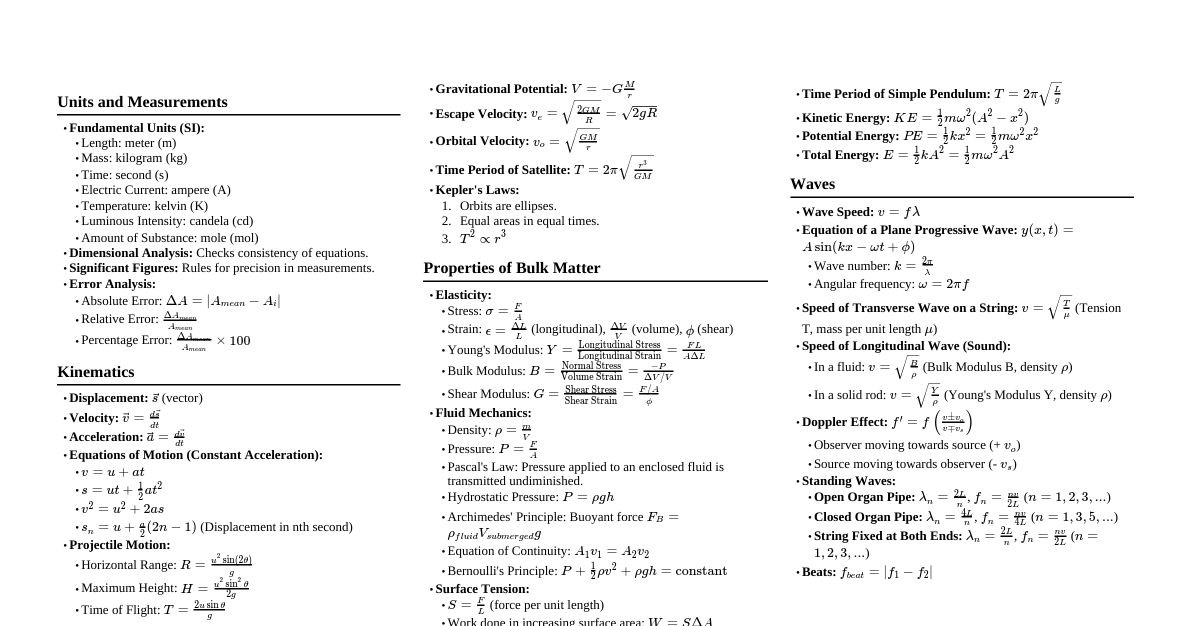
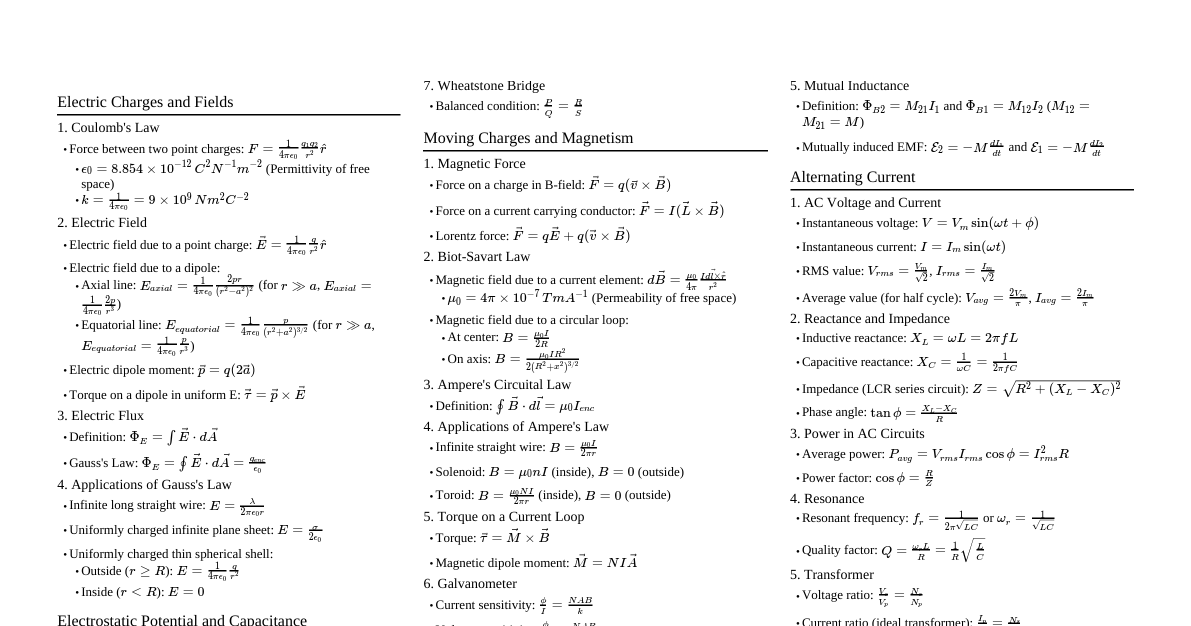
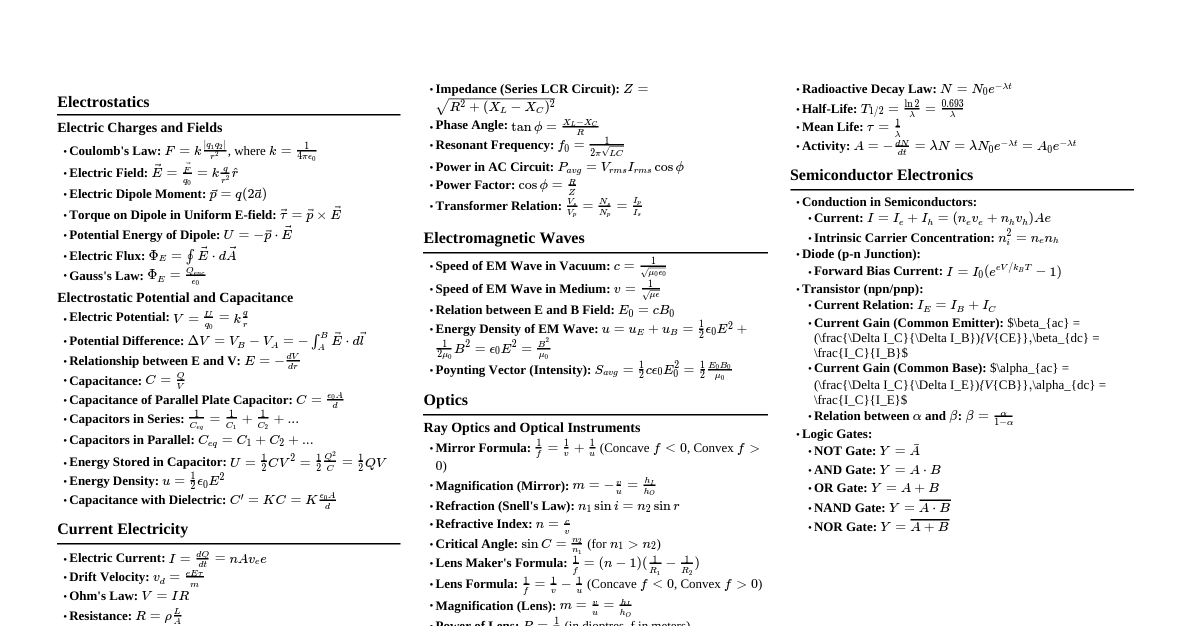
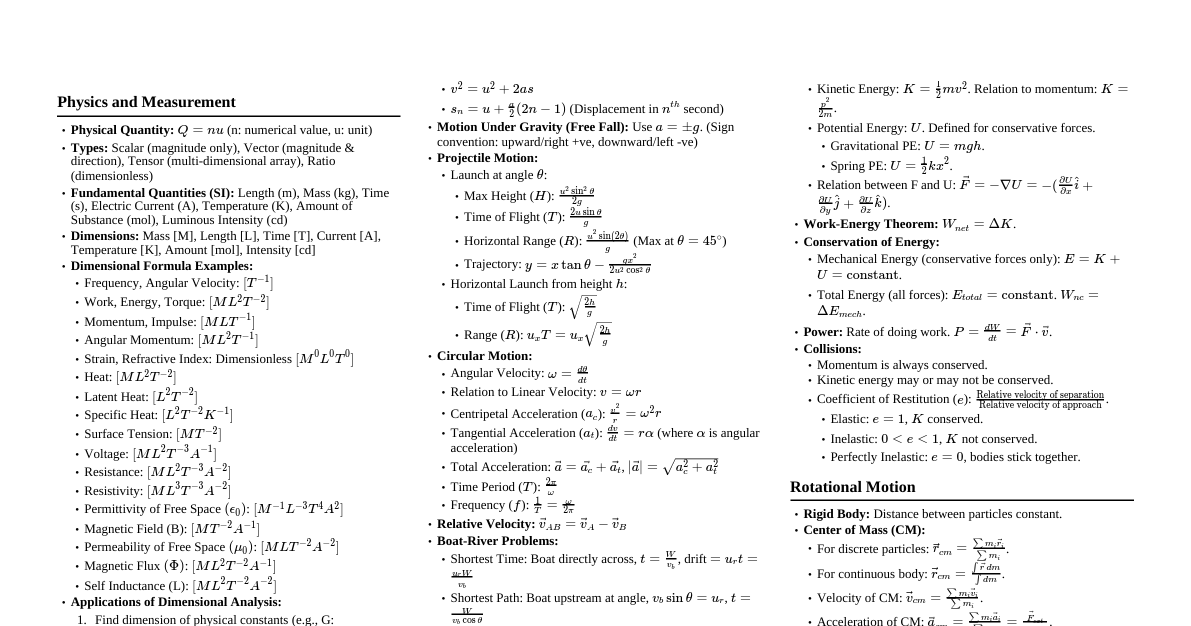
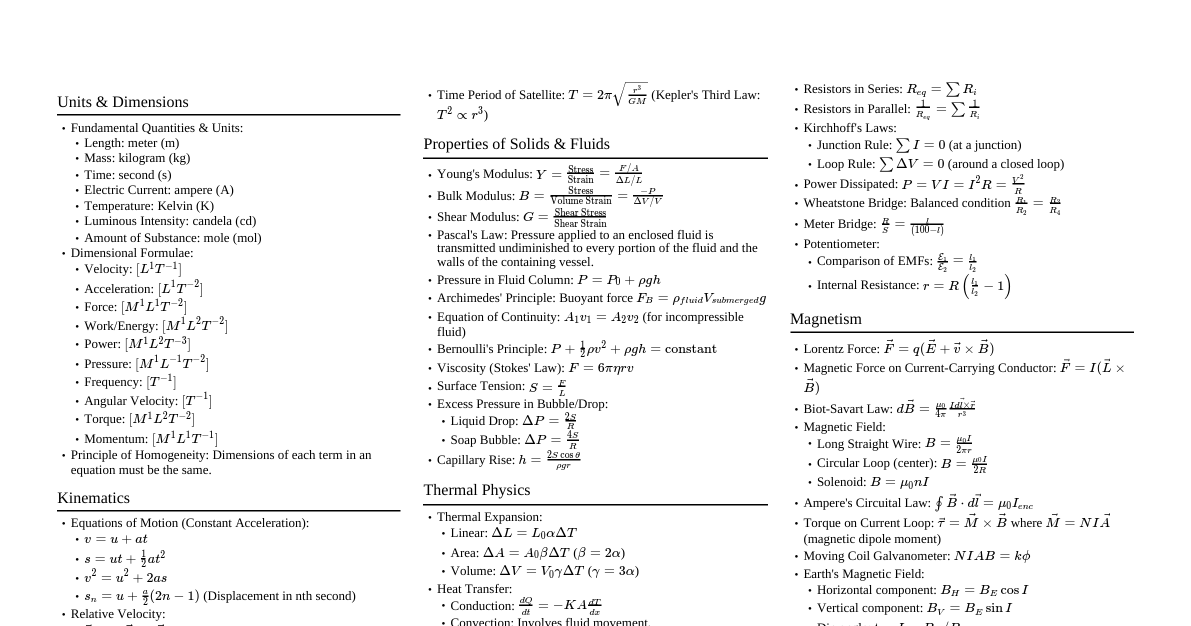
### Kinematics #### 1. Linear Motion (Constant Acceleration) - **Displacement:** $x = x_0 + v_0t + \frac{1}{2}at^2$ - **Velocity:** $v = v_0 + at$ - **Velocity-Displacement:** $v^2 = v_0^2 + 2a(x - x_0)$ - **Average Velocity:** $v_{avg} = \frac{v_0 + v}{2}$ #### 2. Projectile Motion - **Horizontal Displacement:** $x = (v_0 \cos\theta_0)t$ - **Vertical Displacement:** $y = (v_0 \sin\theta_0)t - \frac{1}{2}gt^2$ - **Horizontal Velocity:** $v_x = v_0 \cos\theta_0$ - **Vertical Velocity:** $v_y = v_0 \sin\theta_0 - gt$ - **Maximum Height:** $H = \frac{(v_0 \sin\theta_0)^2}{2g}$ - **Range:** $R = \frac{v_0^2 \sin(2\theta_0)}{g}$ #### 3. Circular Motion - **Angular Displacement:** $\theta = \theta_0 + \omega_0 t + \frac{1}{2}\alpha t^2$ - **Angular Velocity:** $\omega = \omega_0 + \alpha t$ - **Tangential Speed:** $v_t = r\omega$ - **Centripetal Acceleration:** $a_c = \frac{v_t^2}{r} = r\omega^2$ - **Tangential Acceleration:** $a_t = r\alpha$ ### Dynamics #### 1. Newton's Laws - **First Law:** An object at rest stays at rest, and an object in motion stays in motion with the same speed and in the same direction unless acted upon by an unbalanced force. - **Second Law:** $\vec{F}_{net} = m\vec{a}$ - **Third Law:** For every action, there is an equal and opposite reaction. #### 2. Forces - **Weight:** $W = mg$ - **Friction (Static):** $f_s \le \mu_s N$ - **Friction (Kinetic):** $f_k = \mu_k N$ - **Spring Force (Hooke's Law):** $F_s = -kx$ #### 3. Work, Energy, and Power - **Work Done by Constant Force:** $W = \vec{F} \cdot \vec{d} = Fd\cos\theta$ - **Work Done by Variable Force:** $W = \int \vec{F} \cdot d\vec{x}$ - **Kinetic Energy:** $K = \frac{1}{2}mv^2$ - **Gravitational Potential Energy:** $U_g = mgh$ - **Elastic Potential Energy:** $U_s = \frac{1}{2}kx^2$ - **Work-Energy Theorem:** $W_{net} = \Delta K$ - **Conservation of Mechanical Energy:** $E = K + U = \text{constant}$ (if only conservative forces) - **Power:** $P = \frac{dW}{dt} = \vec{F} \cdot \vec{v}$ #### 4. Momentum and Impulse - **Linear Momentum:** $\vec{p} = m\vec{v}$ - **Impulse:** $\vec{J} = \int \vec{F} dt = \Delta\vec{p}$ - **Conservation of Linear Momentum:** $\sum \vec{p}_i = \sum \vec{p}_f$ (for isolated system) - **Center of Mass:** $x_{CM} = \frac{\sum m_i x_i}{\sum m_i}$ ### Rotational Motion - **Moment of Inertia:** $I = \sum m_i r_i^2 = \int r^2 dm$ - **Torque:** $\vec{\tau} = \vec{r} \times \vec{F}$ or $\tau = I\alpha$ - **Rotational Kinetic Energy:** $K_{rot} = \frac{1}{2}I\omega^2$ - **Angular Momentum:** $\vec{L} = \vec{r} \times \vec{p} = I\vec{\omega}$ - **Conservation of Angular Momentum:** $\sum \vec{L}_i = \sum \vec{L}_f$ (if net external torque is zero) - **Work in Rotation:** $W = \int \tau d\theta$ - **Power in Rotation:** $P = \tau\omega$ ### Oscillations (SHM) - **Displacement:** $x(t) = A\cos(\omega t + \phi)$ - **Velocity:** $v(t) = -\omega A\sin(\omega t + \phi)$ - **Acceleration:** $a(t) = -\omega^2 A\cos(\omega t + \phi) = -\omega^2 x(t)$ - **Angular Frequency:** $\omega = \sqrt{\frac{k}{m}}$ (mass-spring) - **Period:** $T = \frac{2\pi}{\omega} = 2\pi\sqrt{\frac{m}{k}}$ - **Period of Simple Pendulum:** $T = 2\pi\sqrt{\frac{L}{g}}$ (for small angles) - **Period of Physical Pendulum:** $T = 2\pi\sqrt{\frac{I}{mgd}}$ ### Waves - **Wave Speed:** $v = \lambda f$ - **Speed on a String:** $v = \sqrt{\frac{T}{\mu}}$ (Tension $T$, linear density $\mu$) - **Sound Speed in Fluid:** $v = \sqrt{\frac{B}{\rho}}$ (Bulk modulus $B$, density $\rho$) - **Sound Speed in Solid Rod:** $v = \sqrt{\frac{Y}{\rho}}$ (Young's modulus $Y$, density $\rho$) - **Intensity:** $I = \frac{P}{A}$ - **Intensity Level (dB):** $\beta = 10 \log_{10}\left(\frac{I}{I_0}\right)$ - **Doppler Effect:** $f' = f \left(\frac{v \pm v_D}{v \mp v_S}\right)$ (D=detector, S=source; top signs for approaching) - **Standing Waves on String (fixed ends):** $\lambda_n = \frac{2L}{n}$, $f_n = n\frac{v}{2L}$ - **Standing Waves in Open Pipe:** $\lambda_n = \frac{2L}{n}$, $f_n = n\frac{v}{2L}$ - **Standing Waves in Closed Pipe:** $\lambda_n = \frac{4L}{n}$, $f_n = n\frac{v}{4L}$ (n = 1, 3, 5...) ### Thermodynamics #### 1. Temperature and Heat - **Linear Thermal Expansion:** $\Delta L = \alpha L_0 \Delta T$ - **Volume Thermal Expansion:** $\Delta V = \beta V_0 \Delta T \approx 3\alpha V_0 \Delta T$ - **Heat Capacity:** $Q = mc\Delta T$ - **Latent Heat:** $Q = mL$ - **Heat Conduction:** $P = \frac{kA(T_H - T_C)}{L}$ #### 2. Ideal Gas - **Ideal Gas Law:** $PV = nRT = NkT$ - **Internal Energy of Monatomic Gas:** $E_{int} = \frac{3}{2}nRT$ - **Average Kinetic Energy per Molecule:** $K_{avg} = \frac{3}{2}kT$ - **RMS Speed:** $v_{rms} = \sqrt{\frac{3RT}{M}}$ (M = molar mass) #### 3. Laws of Thermodynamics - **First Law:** $\Delta E_{int} = Q - W$ - **Work Done by Gas:** $W = \int P dV$ - **Isothermal Process:** $W = nRT \ln\left(\frac{V_f}{V_i}\right)$ - **Adiabatic Process:** $PV^\gamma = \text{constant}$, $TV^{\gamma-1} = \text{constant}$ - **Second Law (Entropy):** $\Delta S \ge 0$ (for isolated system) - **Entropy Change (reversible):** $\Delta S = \int \frac{dQ}{T}$ - **Efficiency of Heat Engine:** $e = \frac{|W|}{|Q_H|} = 1 - \frac{|Q_C|}{|Q_H|}$ - **Carnot Efficiency:** $e_C = 1 - \frac{T_C}{T_H}$ - **Coefficient of Performance (Refrigerator):** $K = \frac{|Q_C|}{|W|}$ ### Electromagnetism #### 1. Electrostatics - **Coulomb's Law:** $F = k\frac{|q_1q_2|}{r^2}$ - **Electric Field:** $\vec{E} = \frac{\vec{F}}{q_0}$ - **Electric Field (Point Charge):** $E = k\frac{|q|}{r^2}$ - **Electric Flux:** $\Phi_E = \int \vec{E} \cdot d\vec{A}$ - **Gauss's Law:** $\oint \vec{E} \cdot d\vec{A} = \frac{Q_{enc}}{\epsilon_0}$ - **Electric Potential Energy:** $U = k\frac{q_1q_2}{r}$ - **Electric Potential:** $V = \frac{U}{q_0} = k\frac{q}{r}$ - **Potential Difference:** $\Delta V = -\int \vec{E} \cdot d\vec{l}$ #### 2. Capacitance - **Capacitance:** $C = \frac{Q}{V}$ - **Parallel Plate Capacitor:** $C = \frac{\epsilon_0 A}{d}$ - **Energy Stored in Capacitor:** $U = \frac{1}{2}CV^2 = \frac{Q^2}{2C}$ - **Dielectric Constant:** $C = \kappa C_0$ #### 3. Current and Resistance - **Current:** $I = \frac{dQ}{dt}$ - **Ohm's Law:** $V = IR$ - **Resistance:** $R = \rho \frac{L}{A}$ - **Power in Circuit:** $P = IV = I^2R = \frac{V^2}{R}$ - **Resistors in Series:** $R_{eq} = R_1 + R_2 + ...$ - **Resistors in Parallel:** $\frac{1}{R_{eq}} = \frac{1}{R_1} + \frac{1}{R_2} + ...$ #### 4. Magnetism - **Magnetic Force on Moving Charge:** $\vec{F}_B = q\vec{v} \times \vec{B}$ - **Magnetic Force on Current-Carrying Wire:** $\vec{F}_B = I\vec{L} \times \vec{B}$ - **Biot-Savart Law:** $d\vec{B} = \frac{\mu_0}{4\pi} \frac{I d\vec{s} \times \hat{r}}{r^2}$ - **Magnetic Field (Long Straight Wire):** $B = \frac{\mu_0 I}{2\pi r}$ - **Magnetic Field (Solenoid):** $B = \mu_0 n I$ - **Ampere's Law:** $\oint \vec{B} \cdot d\vec{s} = \mu_0 I_{enc}$ - **Magnetic Flux:** $\Phi_B = \int \vec{B} \cdot d\vec{A}$ - **Faraday's Law of Induction:** $\mathcal{E} = -\frac{d\Phi_B}{dt}$ - **Lenz's Law:** Induced current/EMF opposes the change in magnetic flux. - **Inductance:** $L = \frac{N\Phi_B}{I}$ - **Energy Stored in Inductor:** $U_L = \frac{1}{2}LI^2$ #### 5. Electromagnetic Waves - **Speed of EM Waves:** $c = \frac{1}{\sqrt{\mu_0 \epsilon_0}}$ - **Speed of Light in Medium:** $v = \frac{c}{n}$ - **Energy Density (EM field):** $u = \frac{1}{2}\epsilon_0 E^2 + \frac{1}{2\mu_0} B^2$ - **Poynting Vector:** $\vec{S} = \frac{1}{\mu_0}(\vec{E} \times \vec{B})$ - **Intensity of EM Wave:** $I = S_{avg} = \frac{E_{max}B_{max}}{2\mu_0} = \frac{E_{max}^2}{2\mu_0 c}$ ### Optics #### 1. Reflection and Refraction - **Law of Reflection:** $\theta_i = \theta_r$ - **Snell's Law (Refraction):** $n_1 \sin\theta_1 = n_2 \sin\theta_2$ - **Critical Angle:** $\sin\theta_c = \frac{n_2}{n_1}$ (for $n_1 > n_2$) #### 2. Mirrors and Lenses (Thin Lens Equation) - **Mirror/Lens Equation:** $\frac{1}{f} = \frac{1}{p} + \frac{1}{i}$ - **Magnification:** $M = -\frac{i}{p} = \frac{h'}{h}$ - **Focal Length (Spherical Mirror):** $f = \frac{R}{2}$ - **Lensmaker's Equation:** $\frac{1}{f} = (n-1)\left(\frac{1}{R_1} - \frac{1}{R_2}\right)$ #### 3. Interference and Diffraction - **Young's Double-Slit (Bright Fringes):** $d \sin\theta = m\lambda$ - **Young's Double-Slit (Dark Fringes):** $d \sin\theta = (m + \frac{1}{2})\lambda$ - **Single-Slit Diffraction (Dark Fringes):** $a \sin\theta = m\lambda$ - **Diffraction Grating (Bright Fringes):** $d \sin\theta = m\lambda$ - **Rayleigh Criterion:** $\theta_{min} = 1.22 \frac{\lambda}{D}$ ### Modern Physics #### 1. Relativity - **Lorentz Factor:** $\gamma = \frac{1}{\sqrt{1 - (v/c)^2}}$ - **Length Contraction:** $L = L_0 / \gamma$ - **Time Dilation:** $\Delta t = \gamma \Delta t_0$ - **Relativistic Momentum:** $p = \gamma mv$ - **Relativistic Energy:** $E = \gamma mc^2 = K + mc^2$ - **Rest Energy:** $E_0 = mc^2$ - **Energy-Momentum Relation:** $E^2 = (pc)^2 + (mc^2)^2$ #### 2. Quantum Physics - **Photon Energy:** $E = hf = \frac{hc}{\lambda}$ - **Photoelectric Effect:** $K_{max} = hf - \phi$ - **De Broglie Wavelength:** $\lambda = \frac{h}{p}$ - **Heisenberg Uncertainty Principle:** $\Delta x \Delta p_x \ge \frac{\hbar}{2}$, $\Delta E \Delta t \ge \frac{\hbar}{2}$ - **Schrödinger Equation (Time-Independent):** $-\frac{\hbar^2}{2m}\frac{d^2\psi}{dx^2} + U(x)\psi = E\psi$ #### 3. Atomic Physics - **Bohr Model Energy Levels (Hydrogen):** $E_n = -\frac{13.6 \text{ eV}}{n^2}$ - **Photon Energy from Transition:** $\Delta E = E_f - E_i = hf$ - **Rydberg Formula:** $\frac{1}{\lambda} = R \left(\frac{1}{n_f^2} - \frac{1}{n_i^2}\right)$ #### 4. Nuclear Physics - **Mass-Energy Equivalence:** $E = mc^2$ - **Binding Energy:** $E_b = (\sum m_{nucleons} - m_{nucleus})c^2$ - **Radioactive Decay Law:** $N(t) = N_0 e^{-\lambda t}$ - **Half-life:** $T_{1/2} = \frac{\ln 2}{\lambda}$ ### Physical Constants - **Speed of Light ($c$):** $3.00 \times 10^8 \text{ m/s}$ - **Gravitational Constant ($G$):** $6.67 \times 10^{-11} \text{ N}\cdot\text{m}^2/\text{kg}^2$ - **Planck's Constant ($h$):** $6.63 \times 10^{-34} \text{ J}\cdot\text{s}$ - **Elementary Charge ($e$):** $1.60 \times 10^{-19} \text{ C}$ - **Electron Mass ($m_e$):** $9.11 \times 10^{-31} \text{ kg}$ - **Proton Mass ($m_p$):** $1.672 \times 10^{-27} \text{ kg}$ - **Neutron Mass ($m_n$):** $1.674 \times 10^{-27} \text{ kg}$ - **Boltzmann Constant ($k$):** $1.38 \times 10^{-23} \text{ J/K}$ - **Avogadro's Number ($N_A$):** $6.02 \times 10^{23} \text{ mol}^{-1}$ - **Universal Gas Constant ($R$):** $8.31 \text{ J/(mol}\cdot\text{K)}$ - **Permittivity of Free Space ($\epsilon_0$):** $8.85 \times 10^{-12} \text{ C}^2/(\text{N}\cdot\text{m}^2)$ - **Permeability of Free Space ($\mu_0$):** $4\pi \times 10^{-7} \text{ T}\cdot\text{m/A}$ - **Coulomb's Constant ($k_e = 1/(4\pi\epsilon_0)$):** $8.99 \times 10^9 \text{ N}\cdot\text{m}^2/\text{C}^2$ - **Atomic Mass Unit (u):** $1.66 \times 10^{-27} \text{ kg} = 931.5 \text{ MeV}/c^2$