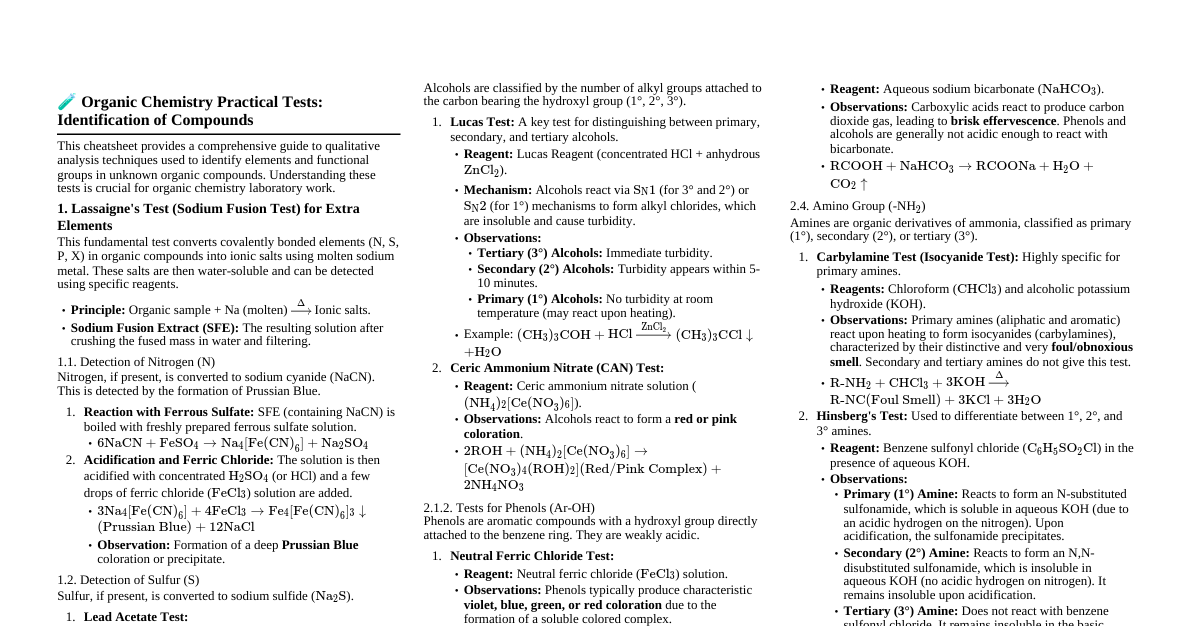
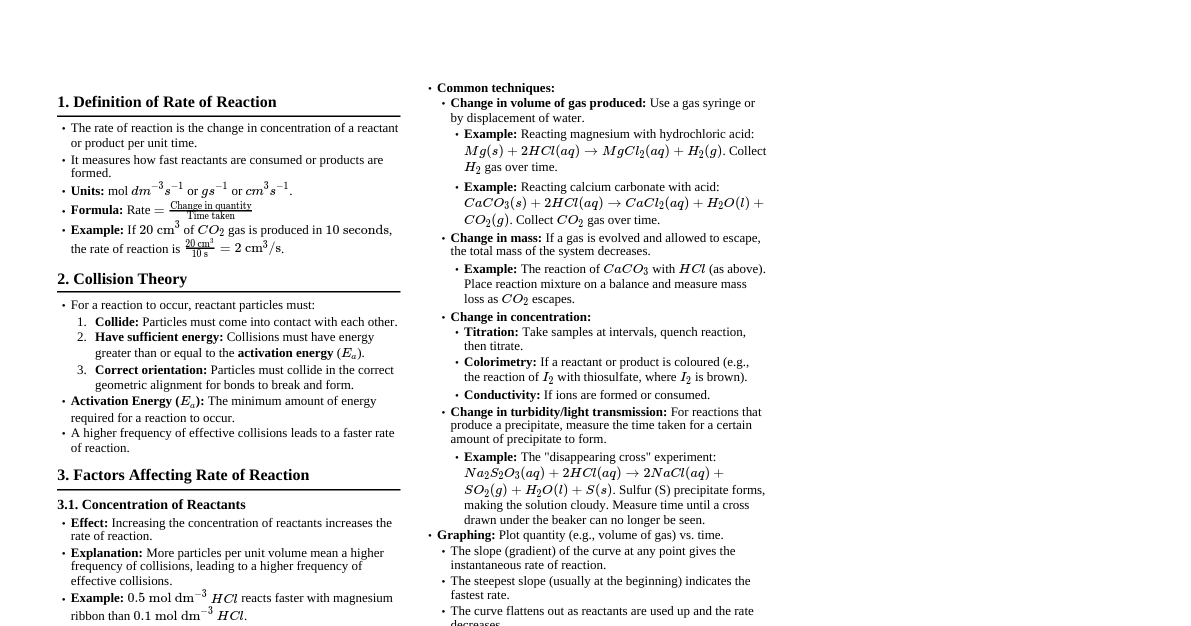
Chemistry MCQs & Concepts (RU Bank)
Cheatsheet Content
General Concepts & Theory 1. Atomic Models and Quantum Numbers Quantum Numbers: $n$ (Principal): Energy level, size of orbital. $l$ (Azimuthal/Angular Momentum): Shape of orbital ($s, p, d, f$), $l = 0, ..., n-1$. $m_l$ (Magnetic): Orientation of orbital in space, $m_l = -l, ..., +l$. $m_s$ (Spin): Electron spin direction, $+1/2$ or $-1/2$. Pauli Exclusion Principle: No two electrons in an atom can have the same set of four quantum numbers. Each orbital holds a maximum of two electrons with opposite spins. Aufbau Principle: Electrons fill lowest energy orbitals first. Hund's Rule: For degenerate orbitals, electrons fill singly before pairing up. Stability: Half-filled and fully-filled subshells (e.g., $d^5, d^{10}$) have extra stability. Orbit vs. Orbital: Orbit (Bohr model) is a fixed circular path; Orbital (Quantum mechanics) is a 3D region of space where an electron is likely to be found. Nodes: Regions of zero probability for finding an electron. 2. Chemical Bonding and Hybridization VSEPR Theory: Predicts molecular geometry based on minimizing electron pair repulsion (lone pair-lone pair > lone pair-bond pair > bond pair-bond pair). Hybridization: Mixing of atomic orbitals to form new hybrid orbitals (e.g., $sp^3$ for tetrahedral, $sp^2$ for trigonal planar, $sp$ for linear). Electronegativity: Tendency of an atom to attract electrons in a covalent bond (Pauling scale). Difference in electronegativity determines bond polarity. Bond Types: Ionic: Large electronegativity difference, electron transfer. Covalent: Electron sharing. Polar if unequal sharing, non-polar if equal sharing. Coordinate Covalent: One atom provides both electrons for the shared pair. Hydrogen Bond: Strongest intermolecular force involving H bonded to F, O, or N. Lattice Energy: Energy released when gaseous ions combine to form an ionic solid. Dipole Moment: Measure of net molecular polarity; zero for symmetrical molecules (e.g., $CCl_4$). 3. Le Chatelier’s Principle & Chemical Change Le Chatelier’s Principle: A system at equilibrium subjected to stress will shift in a direction that relieves the stress. Concentration: Increase reactant $\rightarrow$ shift right. Increase product $\rightarrow$ shift left. Temperature: Increase T for endothermic $\rightarrow$ shift right. Increase T for exothermic $\rightarrow$ shift left. Pressure (Gases): Increase P $\rightarrow$ shift to side with fewer moles of gas. No change if $\Delta n_{gas} = 0$. Catalyst: Increases reaction rate (forward and reverse equally), but does NOT shift equilibrium position. Reaction Rate: Affected by concentration, temperature, surface area, and catalyst. Higher T increases kinetic energy, leading to more effective collisions. Activation Energy ($E_a$): Minimum energy required for a reaction to occur. Catalyst lowers $E_a$. Equilibrium Constants ($K_c, K_p$): Ratio of products to reactants at equilibrium. $K_p = K_c(RT)^{\Delta n_{gas}}$. Acids & Bases: Arrhenius: Acid produces $H^+$, Base produces $OH^-$. Brønsted-Lowry: Acid is $H^+$ donor, Base is $H^+$ acceptor. Lewis: Acid is electron pair acceptor, Base is electron pair donor. pH: $-\log[H^+]$. $pH + pOH = 14$ at $25^\circ C$. Buffer Solution: Resists changes in pH upon addition of small amounts of acid or base (weak acid/conjugate base or weak base/conjugate acid). Entropy ($\Delta S$): Measure of disorder or randomness in a system. Enthalpy ($\Delta H$): Heat change at constant pressure. Exothermic ($\Delta H 0$). 4. Applied Chemistry Food Preservation: Methods like lowering pH (vinegar), increasing sugar/salt concentration (hypertonicity), canning, refrigeration. Vinegar: 6-10% acetic acid solution. Antioxidants: Inhibit oxidation reactions that cause food spoilage and free radical formation. Cleaning Agents: Soaps: Sodium/potassium salts of fatty acids. Form scum in hard water. Detergents: Synthetic cleaning agents, effective in hard water. Bleaching Powder: Calcium oxychloride ($CaOCl_2$). Colloids: Mixtures with particle sizes between solutions and suspensions (1 nm - 1000 nm). Emulsion: A colloid of two immiscible liquids (e.g., milk is fat in water). Saponification: Hydrolysis of an ester (fat/oil) with a strong base to form soap and glycerol. Part 1: 100 New Original Theoretical / Conceptual MCQs Chapter 2: Qualitative Chemistry Answer: Azimuthal (or angular momentum) quantum number ($l$). Concept: The azimuthal quantum number ($l$) defines the shape of an orbital (e.g., $l=0$ for $s$ (spherical), $l=1$ for $p$ (dumbbell), $l=2$ for $d$ (cloverleaf), $l=3$ for $f$ (complex)). Answer: They must have opposite spins ($m_s$). Concept: Pauli Exclusion Principle states that no two electrons in the same atom can have identical values for all four quantum numbers. If they are in the same orbital, $n, l, m_l$ are the same, so $m_s$ must be different ($+1/2$ and $-1/2$). Answer: $4s$ orbital has lower energy than $3d$ due to electron-electron repulsion and shielding effects (according to Aufbau principle). Concept: The Aufbau principle, combined with the $(n+l)$ rule, dictates the filling order. For $4s$, $n=4, l=0 \implies n+l=4$. For $3d$, $n=3, l=2 \implies n+l=5$. Lower $(n+l)$ means lower energy. Answer: The electron absorbs energy. Concept: When an electron moves from a lower energy level ($n=2$) to a higher energy level ($n=4$), it must absorb energy corresponding to the energy difference between the two levels. Answer: The nucleus must have a non-zero nuclear spin quantum number ($I \neq 0$). Concept: NMR (Nuclear Magnetic Resonance) spectroscopy relies on the magnetic properties of nuclei. Nuclei with an odd mass number or odd atomic number (and even mass number) have a non-zero spin and are NMR active (e.g., $^1H, ^{13}C, ^{31}P$). Answer: Gamma rays. Concept: The electromagnetic spectrum ranges from low frequency (radio waves) to high frequency (gamma rays). Higher frequency corresponds to higher energy. Answer: An orbit is a fixed, two-dimensional path (Bohr model), while an orbital is a three-dimensional region of space where an electron is most likely to be found (quantum mechanical model). Concept: Bohr's model described electrons orbiting the nucleus in fixed paths. Quantum mechanics replaced this with orbitals, which are probability distributions for electron location. Answer: 3 subshells ($s, p, d$). Concept: For a principal quantum number $n$, the number of possible subshells is equal to $n$. For the M shell, $n=3$, so there are 3 subshells ($l=0, 1, 2$ corresponding to $s, p, d$). Answer: Excitation of electrons to higher energy levels and subsequent emission of light upon returning to lower levels. Concept: Metal ions, when heated in a flame, absorb energy, causing their electrons to jump to higher energy states. When these excited electrons fall back to their ground states, they emit light of specific wavelengths characteristic of the element, producing distinct colors. Answer: Isobars are atoms of different elements that have the same mass number (total number of protons and neutrons) but different atomic numbers (number of protons). Concept: Example: $^{40}Ar$ (18 protons, 22 neutrons) and $^{40}Ca$ (20 protons, 20 neutrons). They have the same mass number (40) but are different elements. Answer: Hund's Rule of Maximum Multiplicity. Concept: Hund's Rule states that in degenerate orbitals (orbitals of the same energy), electrons will occupy each orbital singly with parallel spins before any orbital is doubly occupied. Answer: It is a region where the probability of finding an electron is zero. Concept: A node is a point, line, or surface where the wavefunction (and thus electron probability density) is zero. A $2s$ orbital has one radial node. Answer: It decreases the solubility of the weak electrolyte. Concept: The common ion effect states that the solubility of a sparingly soluble salt (weak electrolyte) decreases when a soluble salt containing a common ion is added to the solution, due to Le Chatelier's Principle. Answer: Balmer series. Concept: The Balmer series corresponds to electron transitions from higher energy levels ($n > 2$) to the $n=2$ energy level in the hydrogen atom, emitting light in the visible region of the spectrum. Answer: Zero (Gamma rays are electromagnetic radiation, not charged particles). Concept: Alpha particles ($+2$), Beta particles ($-1$), but Gamma rays are high-energy photons with no mass or charge. Answer: Alpha particle (composed of 2 protons and 2 neutrons, identical to a Helium nucleus). Concept: Protons and electrons are fundamental particles (or elementary particles). Alpha particles are composite because they are made of subatomic particles. Answer: The principal quantum number ($n$). Concept: The principal quantum number ($n$) determines the main energy level or shell in which an electron resides. Higher $n$ means higher energy and greater distance from the nucleus. Answer: They have the same number of electrons and thus the same electron configuration (valence electrons). Concept: Isotopes of an element have the same number of protons but different numbers of neutrons. Chemical properties are primarily determined by the number and arrangement of electrons, especially valence electrons, which are identical for isotopes. Answer: The minimum energy required to remove an electron from a gaseous atom in its ground state. Concept: Ionization potential (or ionization energy) is an endothermic process, reflecting the energy needed to overcome the attraction between the nucleus and the outermost electron. Answer: Wavelength ($\lambda$) and energy ($E$) are inversely proportional ($E = hc/\lambda$). Concept: Planck's equation ($E=h\nu$) and the wave equation ($c=\lambda\nu$) combine to show that higher energy photons have shorter wavelengths and higher frequencies. Answer: $s$-orbital. Concept: All $s$-orbitals (1s, 2s, 3s, etc.) have a spherical shape, though higher $s$-orbitals have radial nodes. Answer: It signifies the orientation of an orbital in space. Concept: The magnetic quantum number ($m_l$) describes the specific orbital within a subshell, distinguishing orbitals that have the same shape but different spatial orientations (e.g., $p_x, p_y, p_z$). Answer: 'sp' stands for Solubility Product. Concept: $K_{sp}$ is the equilibrium constant for the dissolution of a sparingly soluble ionic compound. It represents the product of the concentrations of the dissolved ions, each raised to the power of its stoichiometric coefficient. Answer: Because $3d^5 4s^1$ provides a more stable configuration (half-filled $d$-subshell) than $3d^4 4s^2$. Concept: Atoms tend to achieve greater stability by having half-filled or fully-filled subshells. In Chromium, an electron from $4s$ promotes to $3d$ to achieve a stable half-filled $3d^5$ configuration. Answer: A marker (or internal standard) is a substance with known absorption bands used to calibrate the spectrometer or identify unknown peaks by comparison. Concept: In spectroscopy, markers help in accurate wavelength/wavenumber assignments and quantification by providing reference points. Chapter 3: Periodic Properties and Chemical Bonding Answer: Noble gases (Group 18). Concept: Noble gases (He, Ne, Ar, Kr, Xe, Rn) have a full valence electron shell (an octet, except He with a duet), making them very stable and unreactive. Answer: As you move across a period, the number of protons (nuclear charge) increases, pulling the electrons closer to the nucleus, while the shielding effect remains relatively constant. Concept: Increased effective nuclear charge ($Z_{eff}$) across a period results in a stronger attraction for outer electrons, leading to a decrease in atomic size. Answer: Electronegativity is the power of an atom in a molecule to attract electrons to itself. Concept: Pauling's definition emphasizes the ability of an atom to attract shared electrons in a bond, leading to bond polarity. Answer: A significant difference in electronegativity between the bonded atoms. Concept: When two atoms with different electronegativities form a covalent bond, the electron pair is shared unequally, creating partial positive and negative charges, making the bond polar. Answer: $sp^3$. Concept: Each carbon atom in diamond is covalently bonded to four other carbon atoms in a tetrahedral arrangement, requiring $sp^3$ hybridization. Answer: Lone pair-lone pair repulsion is greater than bond pair-bond pair repulsion, compressing the bond angle from the ideal tetrahedral $109.5^\circ$ to approximately $104.5^\circ$. Concept: VSEPR theory explains that lone pairs occupy more space than bonding pairs, leading to increased repulsion and distortion of ideal geometries. Water has two lone pairs and two bonding pairs around the central oxygen. Answer: Pi ($\pi$) bonds. Concept: While sigma ($\sigma$) bonds can form from head-on overlap of $d$-orbitals, $\pi$ bonds are typically formed by the sideways overlap of parallel $p$ or $d$ orbitals, especially in coordination compounds or transition metal complexes. Answer: Nitrogen lacks vacant $d$-orbitals in its valence shell, preventing expansion of its octet to accommodate five bonds, unlike Phosphorus which has vacant $3d$ orbitals. Concept: Elements in the second period (like N) cannot exceed an octet because they only have $s$ and $p$ orbitals available for bonding. Third-period elements (like P) can utilize their vacant $d$-orbitals for expanded octets. Answer: Both covalent and coordinate covalent (dative) bonds, and ionic bonds. Concept: In $NH_4Cl$, the $NH_4^+$ ion contains three covalent $N-H$ bonds and one coordinate covalent $N \rightarrow H$ bond. The $NH_4^+$ cation then forms an ionic bond with the $Cl^-$ anion. Answer: A transition element is defined as an element that has a partially filled $d$-subshell in its elemental form or in any of its common ions. Concept: This definition excludes elements like Sc and Zn in Group 12, which have fully filled $d$-subshells in their common ions. Answer: Ionization energy and electron affinity. Concept: As atomic radius decreases across a period, electrons are held more tightly, so it requires more energy to remove an electron (higher ionization energy) and there is a stronger attraction for additional electrons (higher electron affinity). Answer: Octahedral. Concept: $sp^3d^2$ hybridization involves six hybrid orbitals, which arrange themselves in an octahedral geometry (e.g., $SF_6$). Answer: $H_2O$ molecules form strong intermolecular hydrogen bonds, which require more energy to overcome than the weaker dipole-dipole interactions and London dispersion forces in $H_2S$. Concept: The high electronegativity of oxygen and the presence of lone pairs allow water to form extensive hydrogen bonding, leading to its unusually high boiling point compared to hydrides of its group. Answer: Ionic bond. Concept: Generally, intramolecular forces (ionic and covalent bonds) are much stronger than intermolecular forces (hydrogen bonds, dipole-dipole, London dispersion). Among intramolecular bonds, ionic bonds are typically the strongest due to strong electrostatic attraction. Answer: Zero. Concept: Although the individual $C-Cl$ bonds are polar, the symmetrical tetrahedral geometry of $CCl_4$ causes the bond dipoles to cancel each other out, resulting in a net dipole moment of zero and thus a non-polar molecule. Answer: The energy released when an electron is added to a neutral gaseous atom to form an anion. Concept: Electron affinity is usually an exothermic process, indicating the stability gained when an atom accepts an electron. Answer: Group 16 elements (Oxygen family). Concept: Chalcogens include Oxygen (O), Sulfur (S), Selenium (Se), Tellurium (Te), and Polonium (Po). Answer: As cation size decreases, its polarizing power increases. Concept: Smaller, highly charged cations have a greater ability to distort the electron cloud of an anion (polarize it), leading to increased covalent character in an ionic bond (Fajan's Rules). Answer: A covalent bond formed when one atom contributes both electrons to the shared pair. Concept: Also known as a dative bond, it's a type of covalent bond where one atom (donor) provides the electron pair and the other atom (acceptor) provides an empty orbital (e.g., in $NH_4^+$ or complex ions). Answer: $d$-block. Concept: The $d$-block elements are also known as transition metals and constitute the largest group of metals in the periodic table. Answer: After the first electron is removed, the remaining ion is positively charged ($X^+$). Removing a second electron from a positively charged ion requires significantly more energy due to the increased electrostatic attraction between the nucleus and the remaining electrons. Concept: Successive ionization energies always increase because it becomes progressively harder to remove an electron from an increasingly positively charged species. Answer: Lithium (Li) and Magnesium (Mg). Concept: 'Bridge elements' (or diagonal relationship) refer to elements in period 2 and period 3 that exhibit similar properties despite being in different groups (e.g., Li resembles Mg, Be resembles Al, B resembles Si). Answer: Trigonal planar. Concept: $BF_3$ has a central boron atom bonded to three fluorine atoms with no lone pairs. Boron is $sp^2$ hybridized, resulting in a trigonal planar geometry with $120^\circ$ bond angles. Answer: The energy released when one mole of an ionic compound is formed from its gaseous ions. Concept: Lattice energy is a measure of the strength of the electrostatic forces between ions in a crystal lattice. It is a highly exothermic process. Answer: London Dispersion Forces (LDFs) or Van der Waals forces. Concept: Noble gases are nonpolar and only exhibit weak intermolecular London Dispersion Forces, which arise from temporary, induced dipoles due to instantaneous fluctuations in electron distribution. Chapter 4: Chemical Change Answer: The relationship between the rate of a chemical reaction and the concentrations of the reactants. Concept: The law of mass action states that the rate of a reaction is directly proportional to the product of the molar concentrations of the reactants, each raised to the power of its stoichiometric coefficient in the balanced equation. Answer: When the change in the number of moles of gaseous products and gaseous reactants is zero ($\Delta n_{gas} = 0$). Concept: The relationship is $K_p = K_c(RT)^{\Delta n_{gas}}$. If $\Delta n_{gas} = 0$, then $(RT)^0 = 1$, so $K_p = K_c$. Answer: The equilibrium shifts to the right (towards products). Concept: For an endothermic reaction, heat is a reactant. Increasing the temperature adds heat, so by Le Chatelier's Principle, the system shifts to consume the added heat, favoring the forward (endothermic) reaction. Answer: A buffer solution is a solution that resists changes in pH when small amounts of acid or base are added. Its primary function is to maintain a relatively constant pH. Concept: Buffers typically consist of a weak acid and its conjugate base or a weak base and its conjugate acid. Answer: $1.0 \times 10^{-14}$. Concept: $K_w = [H^+][OH^-]$. In pure water at $25^\circ C$, $[H^+] = [OH^-] = 1.0 \times 10^{-7} M$, so $K_w = (1.0 \times 10^{-7})^2 = 1.0 \times 10^{-14}$. Answer: The experimentally determined power to which the concentration of a reactant is raised in the rate law. Concept: The order of a reaction is an empirical value and indicates how the reaction rate depends on the concentration of each reactant. It is not necessarily related to the stoichiometric coefficients. Answer: The minimum amount of energy that reacting particles must possess in order to undergo a chemical reaction. Concept: Reactants must collide with sufficient energy (equal to or greater than $E_a$) and correct orientation to form products. Answer: A catalyst does not affect the enthalpy of a reaction ($\Delta H$). Concept: A catalyst speeds up a reaction by providing an alternative reaction pathway with a lower activation energy, but it does not change the initial and final energy states of reactants and products, thus $\Delta H$ remains unchanged. Answer: Entropy is a thermodynamic property that measures the degree of randomness or disorder in a system. Concept: Systems naturally tend towards states of higher entropy (greater disorder). For example, a gas has higher entropy than a liquid, which has higher entropy than a solid. Answer: pH values from 0 to less than 3. Concept: The pH scale typically ranges from 0 to 14. A pH of 7 is neutral. pH values less than 7 are acidic, and values greater than 7 are basic. Lower pH values indicate stronger acidity. Answer: It is the time required for the concentration of a reactant to decrease to half of its initial value, and for a first-order reaction, it is constant (independent of initial concentration). Concept: For a first-order reaction, $t_{1/2} = \frac{0.693}{k}$, where $k$ is the rate constant. This constant half-life is a characteristic feature of first-order kinetics. Answer: Increasing pressure shifts the equilibrium to the right, favoring the formation of ammonia (products). Concept: The Haber process $N_2(g) + 3H_2(g) \rightleftharpoons 2NH_3(g)$ involves 4 moles of gas on the reactant side and 2 moles of gas on the product side. By Le Chatelier's Principle, increasing pressure favors the side with fewer moles of gas. Answer: Enthalpy change ($\Delta H$) in an exothermic reaction is negative, indicating that heat is released to the surroundings. Concept: Exothermic reactions release energy, causing the temperature of the surroundings to increase. The products have lower enthalpy than the reactants. Answer: An inhibitor slows down or stops a chemical reaction. Concept: Inhibitors can act by various mechanisms, such as blocking active sites, denaturing enzymes, or removing free radicals, thereby decreasing the reaction rate. Answer: Molarity ($M$) is defined as the number of moles of solute per liter of solution. It is temperature-dependent because volume changes with temperature. Concept: As temperature increases, the volume of the solvent and solution generally increases, leading to a decrease in molarity. Answer: $CO_3^{2-}$. Concept: A conjugate base is formed when an acid loses a proton ($H^+$). $HCO_3^-$ (bicarbonate ion) can act as an acid by donating an $H^+$, leaving behind $CO_3^{2-}$ (carbonate ion). Answer: Lewis theory. Concept: Lewis acids are electron pair acceptors, and Lewis bases are electron pair donors. This is the broadest definition of acids and bases. Answer: The pH decreases (becomes more acidic). Concept: When $CO_2$ is bubbled into water, it forms carbonic acid ($H_2CO_3$), which then dissociates to produce $H^+$ ions, lowering the pH: $CO_2(g) + H_2O(l) \rightleftharpoons H_2CO_3(aq) \rightleftharpoons H^+(aq) + HCO_3^-(aq)$. Answer: The enthalpy change when one mole of a substance undergoes complete combustion with oxygen under standard conditions ($25^\circ C$, 1 atm pressure). Concept: Standard enthalpy of combustion ($\Delta H_c^\circ$) is always negative (exothermic) as combustion reactions release heat. Answer: An indicator that changes color in the acidic range (e.g., Methyl Orange or Methyl Red, with pH ranges typically below 7). Concept: In a strong acid-weak base titration, the equivalence point is acidic (pH Answer: The common ion effect suppresses the dissociation of weak acids, thereby decreasing the concentration of $H^+$ ions and increasing the pH. Concept: Adding a common ion (e.g., acetate to acetic acid) shifts the equilibrium of the weak acid dissociation to the left, reducing the amount of $H^+$ produced. Answer: Auto-catalysis is a reaction in which one of the products acts as a catalyst for the reaction itself. Example: The oxidation of oxalic acid by acidified potassium permanganate, where $Mn^{2+}$ (a product) catalyzes the reaction. Concept: The reaction starts slowly and then speeds up as the catalytic product accumulates. Answer: $pH + pOH = 14$ (at $25^\circ C$). Concept: This relationship stems from the ion product of water ($K_w = [H^+][OH^-] = 1.0 \times 10^{-14}$ at $25^\circ C$). Taking the negative logarithm of both sides gives $pK_w = pH + pOH = 14$. Answer: Higher temperatures increase the kinetic energy of reactant molecules, leading to a greater number of collisions with sufficient energy (above activation energy) and an increased frequency of effective collisions. Concept: The Arrhenius equation quantifies this relationship, showing that the rate constant increases exponentially with temperature. Answer: Chemical equilibrium is the state in a reversible chemical reaction where the rate of the forward reaction equals the rate of the reverse reaction, and the net concentrations of reactants and products remain constant in a closed system. Concept: It is a dynamic equilibrium, meaning reactions are still occurring, but there is no net change in concentrations. Chapter 5: Applied Chemistry Answer: 6-10%. Concept: Vinegar is a dilute aqueous solution of acetic acid, typically containing 5-20% acetic acid, with common household vinegar being 6-10%. Answer: Coagulation in milk refers to the process where milk proteins (caseins) clump together and solidify, often due to changes in pH (e.g., adding acid) or enzymatic action (e.g., rennet). Concept: This process is essential for making cheese and yogurt. The casein micelles lose their stability and aggregate. Answer: Agar is used as a gelling agent to solidify culture media, providing a solid surface for microbial growth. Concept: Agar is a polysaccharide derived from seaweed, commonly used in microbiology because it is resistant to microbial degradation and melts at a high temperature but solidifies at a lower temperature. Answer: Salt, sugar, vinegar, honey, spices. Concept: These substances preserve food by inhibiting microbial growth through various mechanisms like dehydration (salt, sugar), lowering pH (vinegar), or antimicrobial properties (spices, honey). Answer: Oxidation reactions. Concept: Free radicals are highly reactive molecules with unpaired electrons that are formed during oxidation. They can damage food components (lipids, proteins, vitamins), leading to spoilage. Answer: An emulsion is a heterogeneous mixture of two immiscible liquids, where one liquid is dispersed in the other in the form of tiny droplets. Milk is an oil-in-water emulsion, with fat globules dispersed in an aqueous phase. Concept: Emulsifiers are often added to stabilize emulsions, preventing the two phases from separating. Answer: Antioxidants protect food (and biological systems) from oxidative damage by scavenging free radicals or inhibiting oxidation reactions. Concept: They donate electrons to free radicals, stabilizing them and preventing a chain reaction of damage. Common examples include Vitamin C, Vitamin E, BHT, and BHA. Answer: Sodium benzoate. Concept: Sodium benzoate is a common food preservative, particularly effective in acidic foods, inhibiting the growth of bacteria, molds, and yeasts. Answer: Lactose is a disaccharide sugar found in milk, composed of one glucose molecule and one galactose molecule. Concept: It is also known as "milk sugar." Lactose intolerance results from a deficiency of the enzyme lactase, which breaks down lactose. Answer: The primary ingredients of talcum powder (e.g., talc, magnesium silicate) absorb moisture, reduce friction, and provide a smooth feel to the skin. Concept: Talc is a soft mineral used for its absorbent and lubricating properties. Answer: Zinc oxide acts as a physical sunblock, reflecting and scattering both UVA and UVB radiation, protecting the skin from sun damage. Concept: It is a broad-spectrum UV filter, forming a protective barrier on the skin. Answer: A colloid is a mixture in which one substance is dispersed evenly throughout another, with particles ranging in size from approximately 1 nanometer to 1000 nanometers. Concept: Colloidal particles are larger than those in a solution but smaller than those in a suspension, and they do not settle out. Answer: Hydrochloric acid (HCl) or other strong acids. Concept: Many commercial toilet bowl cleaners use strong acids to dissolve mineral deposits (like limescale, calcium carbonate) and organic stains. Answer: Saponification is the hydrolysis of an ester (typically a triglyceride, i.e., fat or oil) by an alkali (strong base) to produce soap (a fatty acid salt) and glycerol. Concept: This is the traditional method for making soap. Answer: Bleaching powder is chemically known as Calcium Oxychloride ($CaOCl_2$). Concept: It is used as a bleaching agent, disinfectant, and oxidizing agent, particularly in water treatment and sanitation. Answer: Formalin (a solution of formaldehyde) is highly toxic, carcinogenic, and can cause severe health problems, including kidney and liver damage, if consumed. Concept: It is used as a preservative for biological specimens but is strictly forbidden for food preservation due to its toxicity. Answer: Soaps react with hard water ions ($Ca^{2+}, Mg^{2+}$) to form insoluble scum, reducing their cleaning efficiency. Detergents, being synthetic, do not form scum with hard water and retain their cleaning power. Concept: Detergents contain sulfonate groups that remain soluble in the presence of hard water ions. Answer: Fatty fish (salmon, mackerel, tuna), flaxseeds, chia seeds, walnuts, and some plant oils. Concept: Omega-3 fatty acids are essential polyunsaturated fatty acids that are beneficial for heart and brain health. Answer: Hypertonicity in food preservation refers to the use of high concentrations of solutes (like sugar or salt) in food, which creates an osmotic pressure gradient that draws water out of microbial cells, inhibiting their growth. Concept: This principle is used in making jams, jellies, and salted meats. Answer: BOD (Biochemical Oxygen Demand) is the amount of dissolved oxygen needed by aerobic biological organisms to break down organic material present in a given water sample at a certain temperature over a specific time period. It is a key indicator of water quality; high BOD indicates high organic pollution. Concept: High BOD depletes oxygen in water, harming aquatic life. Answer: Ethylene acts as a plant hormone that promotes fruit ripening, senescence (aging), and abscission (shedding of leaves/fruits). Concept: It triggers biochemical changes like softening, color change, and flavor development in fruits. Answer: Glass is technically defined as an amorphous solid, specifically a supercooled liquid. Concept: It lacks the long-range ordered crystalline structure of true solids but is rigid and non-flowable at room temperature. Answer: Picric acid is 2,4,6-trinitrophenol. It is primarily used as an explosive, but also as a dye, an antiseptic, and a reagent in chemistry. Concept: Its strong oxidizing properties and explosive nature are due to the presence of three nitro groups on a phenolic ring. Answer: Dry ice is solid carbon dioxide ($CO_2$). Concept: It sublimes (changes directly from solid to gas) at $-78.5^\circ C$ ($-109.3^\circ F$) at atmospheric pressure, making it useful for refrigeration without leaving liquid residue. Answer: Canning is a food preservation method in which food is processed and sealed in an airtight container (can or jar) to prevent spoilage by microorganisms. Concept: The food is heated to kill bacteria and enzymes, and then sealed to prevent recontamination. Part 3: 50 High-Importance RU Exam Conceptual MCQs Answer: Any transition from $n > 1$ to $n=1$. Concept: The Lyman series in the hydrogen spectrum corresponds to electron transitions from higher energy levels ($n=2, 3, 4, ...$) down to the ground state ($n=1$), emitting ultraviolet radiation. Answer: $2(2l+1)$. Concept: For a given $l$ value, there are $(2l+1)$ orbitals (determined by $m_l$). Each orbital can hold 2 electrons. So, total electrons = $2 \times (2l+1)$. Answer: $N^{3-}$ has gained three electrons, increasing electron-electron repulsion and decreasing the effective nuclear charge felt by the outer electrons, leading to a larger size compared to $F^-$ which has gained only one electron. Both are isoelectronic with Neon, but Nitrogen has fewer protons. Concept: For isoelectronic species, the size decreases with increasing nuclear charge. N has 7 protons, F has 9 protons. $N^{3-}$ (7p, 10e) is larger than $F^-$ (9p, 10e). Answer: Werner Heisenberg. Concept: Heisenberg's Uncertainty Principle states that it is impossible to simultaneously know precisely both the position and momentum of a particle. Answer: Chlorine (Cl). Concept: Electron affinity generally increases across a period and decreases down a group. Halogens have high electron affinities. Fluorine's electron affinity is slightly lower than chlorine's due to its small size and strong electron-electron repulsion within its $2p$ subshell. Answer: Approximately $107^\circ$. Concept: In $NH_3$, the central nitrogen atom is $sp^3$ hybridized and has three bonding pairs and one lone pair. The lone pair-bond pair repulsion is stronger than bond pair-bond pair repulsion, compressing the ideal tetrahedral angle ($109.5^\circ$) to about $107^\circ$, giving it a trigonal pyramidal shape. Answer: $C_2H_4$ (ethene) or $BF_3$. Concept: $sp^2$ hybridization occurs when a central atom forms three sigma bonds and has no lone pairs, or forms two sigma bonds and one pi bond. This leads to a trigonal planar geometry with $120^\circ$ bond angles. Answer: Trigonal bipyramidal. Concept: In $PCl_5$, the central phosphorus atom is $sp^3d$ hybridized, forming five sigma bonds and having no lone pairs. This results in a trigonal bipyramidal geometry with two types of bond angles ($90^\circ$ and $120^\circ$). Answer: Atomic radius, metallic character, reactivity, and basicity of hydroxides. Concept: Down a group, the number of electron shells increases, leading to larger atomic size, weaker hold on valence electrons, and thus increased metallic character and reactivity. Answer: $AlCl_3$. Concept: A Lewis acid is an electron pair acceptor. $AlCl_3$ is electron-deficient (Al has only 6 valence electrons) and can accept an electron pair. $NH_3$ and $H_2O$ are Lewis bases (electron pair donors). Answer: The $H-F$ bond is stronger because Fluorine is smaller and more electronegative than Chlorine, leading to a shorter bond length and stronger electrostatic attraction between the nuclei and shared electrons. Concept: Bond strength is inversely related to bond length. Shorter bonds are generally stronger. Electronegativity difference also contributes to bond polarity and strength. Answer: A transition element is defined as an element that has a partially filled $d$-subshell in its elemental form or in any of its common ions. Concept: This definition excludes elements like Sc and Zn in Group 12, which have fully filled $d$-subshells in their common ions. Answer: $CCl_4$ (Carbon tetrachloride), $CO_2$ (Carbon dioxide), $BF_3$ (Boron trifluoride). Concept: These molecules have polar bonds, but their symmetrical geometry causes the individual bond dipoles to cancel out, resulting in a zero net dipole moment and a non-polar molecule. Answer: $s^{-1}$ (or $time^{-1}$). Concept: For a first-order reaction, the rate law is Rate $= k[A]$. The unit of rate is concentration/time (e.g., $M/s$). So, $M/s = k \times M \implies k = 1/s$. Answer: $K_p = K_c$. Concept: The relationship is $K_p = K_c(RT)^{\Delta n_{gas}}$. If $\Delta n_{gas} = 0$, then $(RT)^0 = 1$, so $K_p = K_c$. Answer: pH = 3. Concept: HCl is a strong acid, so it completely dissociates: $HCl \rightarrow H^+ + Cl^-$. Thus, $[H^+] = 0.001 M = 10^{-3} M$. $pH = -\log[H^+] = -\log(10^{-3}) = 3$. Answer: Speed up the rate at which equilibrium is reached, but does not change the position of the equilibrium or the value of $K_c$. Concept: Catalysts lower the activation energy for both the forward and reverse reactions equally, thus increasing both rates without altering the equilibrium concentrations. Answer: Salts of strong bases and weak acids (e.g., $CH_3COONa$). Concept: Anionic hydrolysis occurs when the anion of a salt (derived from a weak acid) reacts with water to produce $OH^-$ ions, making the solution basic. Example: $CH_3COO^- + H_2O \rightleftharpoons CH_3COOH + OH^-$. Answer: A weak acid and its conjugate base (e.g., $CH_3COOH/CH_3COONa$) or a weak base and its conjugate acid (e.g., $NH_3/NH_4Cl$). Concept: This combination allows the buffer solution to neutralize added acid or base, maintaining a relatively constant pH. Answer: To the left (towards reactants). Concept: For an exothermic reaction, heat is a product. Increasing the temperature adds heat, so by Le Chatelier's Principle, the system shifts to consume the added heat, favoring the reverse (endothermic) reaction. Answer: The product of the molar concentrations of hydrogen ions and hydroxide ions in water at a specific temperature, $K_w = [H^+][OH^-]$. (At $25^\circ C$, $K_w = 1.0 \times 10^{-14}$). Concept: This constant reflects the autoionization of water. Answer: Approximately 7.35-7.45. Concept: Human blood is a buffered system that maintains its pH within a very narrow, slightly alkaline range for proper physiological function. Answer: Carbon dioxide ($CO_2$). Concept: While several gases contribute, carbon dioxide is the most significant anthropogenic greenhouse gas due to its abundance and long atmospheric lifetime. Answer: 6-10% acetic acid. Concept: Vinegar is a dilute aqueous solution of acetic acid. Answer: Zymase. Concept: Zymase is a complex of enzymes found in yeast that catalyzes the fermentation of glucose (and other sugars) into ethanol and carbon dioxide. Answer: Talc (magnesium silicate) acts as an absorbent, anti-caking agent, and provides a smooth texture, helping to absorb excess oil and moisture on the skin. Concept: It is a finely ground mineral. Answer: Particles ranging in size from 1 to 100 nanometers. Concept: Nanoparticles are materials with at least one dimension in the nanoscale. Answer: Calcium Oxychloride ($CaOCl_2$). Concept: Bleaching powder is a common disinfectant and bleaching agent. Answer: Hydrated copper(II) sulfate ($CuSO_4 \cdot 5H_2O$). Concept: It is a blue crystalline solid used as a fungicide, algicide, and in electroplating. Answer: Acetoacetic ester (ethyl acetoacetate) or keto-enol tautomers. Concept: Tautomerism is a special type of structural isomerism where isomers exist in dynamic equilibrium, readily interconverting. Keto-enol tautomerism involves the migration of a proton and a double bond. Answer: $109.5^\circ$. Concept: Methane ($CH_4$) has a central carbon atom $sp^3$ hybridized, bonded to four hydrogen atoms with no lone pairs. This results in a perfect tetrahedral geometry with $109.5^\circ$ bond angles. Answer: Magnetic quantum number ($m_l$). Concept: The magnetic quantum number specifies the orientation of an orbital in space (e.g., $p_x, p_y, p_z$). Answer: $O_2$ is paramagnetic because it has two unpaired electrons in its molecular orbitals (according to Molecular Orbital Theory). Concept: Paramagnetic substances are attracted to a magnetic field due to the presence of unpaired electrons. Simple Lewis structures fail to explain oxygen's paramagnetism. Answer: Isoelectronic species are atoms or ions that have the same number of electrons and thus the same electron configuration. Concept: Example: $N^{3-}, O^{2-}, F^-, Ne, Na^+, Mg^{2+}, Al^{3+}$ are all isoelectronic with 10 electrons. Answer: 7. Concept: At $25^\circ C$, pure water is neutral, and $[H^+] = [OH^-] = 10^{-7} M$, so $pH = -\log(10^{-7}) = 7$. Answer: Temperature. Concept: The equilibrium constant ($K_c$ or $K_p$) is a constant for a given reaction at a specific temperature. Changes in concentration, pressure, or adding a catalyst do not change its value, only the position of equilibrium. Answer: An increase in temperature generally increases the rate of a gaseous reaction. Concept: Higher temperature leads to more frequent and more energetic collisions between gas molecules, increasing the proportion of molecules that possess energy greater than or equal to the activation energy. Answer: An amphoteric oxide is an oxide that can react with both acids and bases. Example: Aluminum oxide ($Al_2O_3$) or Zinc oxide ($ZnO$). Concept: $Al_2O_3 + 6HCl \rightarrow 2AlCl_3 + 3H_2O$ (reacts as a base) and $Al_2O_3 + 2NaOH \rightarrow 2NaAlO_2 + H_2O$ (reacts as an acid). Answer: Non-polar covalent bond. Concept: In $H_2$, two hydrogen atoms share electrons equally because they have identical electronegativity, forming a pure non-polar covalent bond. Answer: Silicon dioxide ($SiO_2$), also known as silica or sand. Concept: Silica is the primary component of most types of glass, along with fluxing agents (like soda ash) and stabilizers (like lime). Answer: Lactic acid. Concept: Lactic acid is produced when lactose (milk sugar) undergoes fermentation by lactic acid bacteria, which is why sour milk and yogurt have a tangy taste. Answer: Molar volume at STP (Standard Temperature and Pressure: $0^\circ C$ or $273.15 K$ and 1 atm) is 22.4 liters for one mole of any ideal gas. Concept: This is a consequence of Avogadro's law and the ideal gas law. Answer: Entropy decreases. Concept: Freezing water involves a transition from a more disordered liquid state to a more ordered solid (ice) state. Therefore, the randomness or disorder of the system decreases. Answer: A secondary standard is a substance whose concentration is determined by titration against a primary standard. Concept: Primary standards are highly pure, stable, and have a precisely known composition. Secondary standards are more commonly used in routine analyses after standardization. Example: NaOH solution is a secondary standard, standardized against primary standard KHP (potassium hydrogen phthalate). Answer: Graphite is a conductor because each carbon atom is $sp^2$ hybridized and bonded to three other carbon atoms in hexagonal layers. The remaining unhybridized $p$-orbital on each carbon atom overlaps to form a delocalized 'sea' of $\pi$ electrons above and below the layers, which are free to move and conduct electricity. Concept: Delocalized electrons are responsible for electrical conductivity. Diamond, with $sp^3$ hybridization and localized electrons, is an insulator. Answer: Spherical. Concept: All $s$-orbitals (1s, 2s, 3s, etc.) have a spherical shape, though higher $s$-orbitals have radial nodes. Answer: Francium (Fr) or Cesium (Cs). Concept: Ionization energy generally decreases down a group due to increasing atomic size and shielding, which reduces the attraction between the nucleus and the outermost electron. Alkali metals have the lowest ionization energies. Answer: The minimum amount of energy that reacting particles must possess in order to undergo a chemical reaction. Concept: This energy barrier must be overcome for reactants to transform into products. Answer: Green Chemistry focuses on designing chemical products and processes that reduce or eliminate the use and generation of hazardous substances. Concept: It promotes sustainability in chemistry and engineering, aiming for pollution prevention at the molecular level. Answer: The presence of partially filled $d$-orbitals, which allows for $d-d$ electronic transitions when light is absorbed. Concept: When white light passes through a transition metal complex, electrons are excited from lower energy $d$-orbitals to higher energy $d$-orbitals. The specific wavelengths absorbed correspond to the complementary color observed.