Mobile Computing - Unit 1
Shared 5/21/2026•2 views
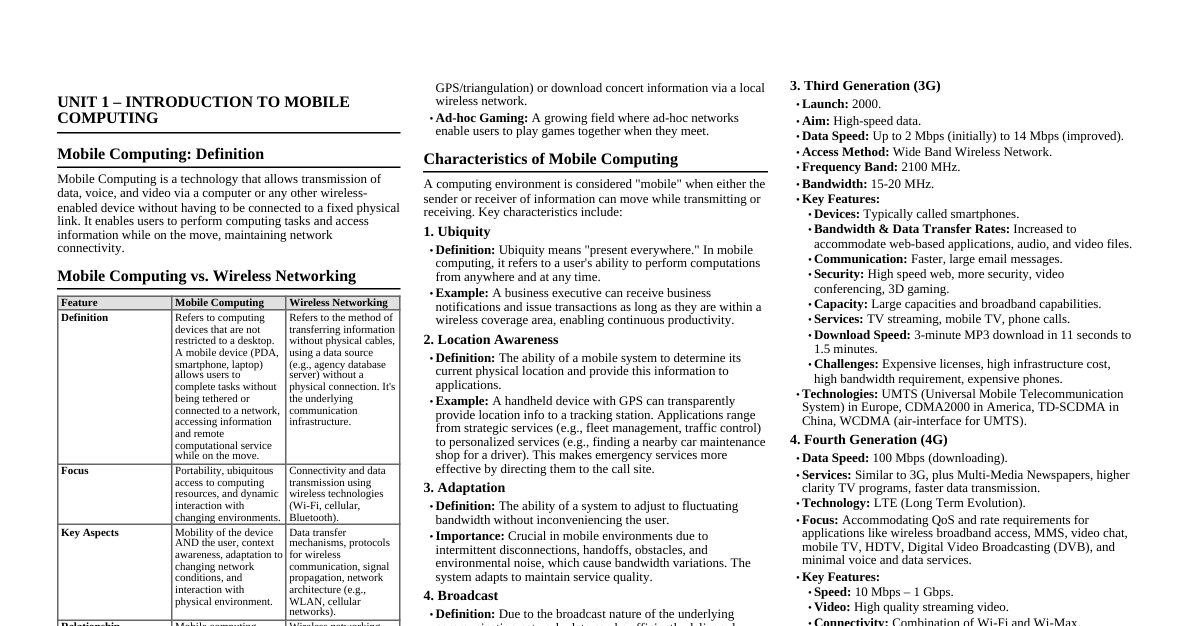
# UNIT 1 – INTRODUCTION TO MOBILE COMPUTING ## Most Expected Exam Questions ### 2-Mark Questions (Short Answers) - Define mobile computing. - Distinguish between mobile computing and wireless networking. - List any four applications of mobile computing. - What are the characteristics of mobile computing? - Differentiate between 1G, 2G, 3G, 4G, and 5G (data speed and key features). - What is multiplexing? List its types. - What is spread spectrum? Name its two types. - Differentiate DSSS and FHSS. - What is hidden terminal problem? What is exposed terminal problem? - What is FDMA? TDMA? CDMA? SDMA? - Explain MACA protocol. - List the advantages of spread spectrum. ### 13-Mark Questions (Medium Answers) - Explain the characteristics and applications of mobile computing in detail. - Describe the distinguishing features of various generations of mobile communication (1G to 5G) with a comparison table. - Explain spread spectrum techniques (DSSS and FHSS) with advantages and disadvantages. - Explain wireless MAC protocol issues (hidden and exposed terminal) and how MACA solves them. - Explain FDMA, TDMA, CDMA, and SDMA with working, advantages, disadvantages, and comparison table. - Explain CDMA with a numerical example (X and Y senders, Z receiver). ### 16-Mark Questions (Long Answers) - Discuss in detail the generations of mobile communication (1G to 5G) with complete comparison table, advantages, disadvantages, and applications. - Explain all types of multiplexing (FDM, TDM, CDM) and spread spectrum (DSSS, FHSS) with neat descriptions. - Describe the taxonomy of MAC protocols (fixed assignment, random assignment, reservation-based) with ALOHA, CSMA, and MACA in detail. ### Mobile Computing – Definition (2 Marks) - **Definition:** Mobile Computing is a technology that allows transmission of data, voice, and video via a computer or any other wireless-enabled device without having to be connected to a fixed physical link. - **Key Idea:** Unrestricted access to information and computational services while on the move. - **Exam Tip:** Focus on "mobility," "wireless," and "data/voice/video transmission." ### Mobile Computing vs. Wireless Networking (2 Marks) | Feature | Mobile Computing | Wireless Networking | | :------------------ | :------------------------------------------------- | :------------------------------------------------- | | **Primary Focus** | Mobility of the device and user | Method of data transfer (wireless medium) | | **Device Scope** | Computing devices (PDA, smartphone, laptop, etc.) | Any device using wireless transmission | | **Connectivity** | Not restricted to a desktop, untethered | Transfers data wirelessly to a data source | | **User State** | User is typically on the move | User may be stationary or mobile | | **Example** | Accessing email on a laptop while traveling | Connecting to Wi-Fi at home from a desktop | | **Core Concept** | Performing tasks without physical connection | Data transfer without cables | ### Applications of Mobile Computing (2/13 Marks) Mobile computing has revolutionized various sectors by enabling connectivity on the go. 1. **Vehicles:** * **Music/News:** Digital Audio Broadcasting (DAB) provides information at 1.5 Mbit/s. * **Communication:** Universal Mobile Telecommunications System (UMTS) phones offer voice and data connectivity (384 kbits/s). * **Navigation:** Global Positioning System (GPS) determines current car position. * **Safety:** Local ad-hoc networks for fast information exchange in emergencies, e.g., airbag deployment triggering emergency services. 2. **Emergencies:** * **Medical:** Ambulances with wireless connections send vital patient information to hospitals for early diagnosis and specialist consultation. * **Disaster Relief:** Wireless networks are crucial for communication during natural disasters (hurricanes, earthquakes), especially decentralized ad-hoc networks. 3. **Business:** * **Sales & Marketing:** Managers use mobile computers for presentations, accessing latest market share data, revising presentations, and communicating with the office. * **Field Work:** Traveling salesmen need instant access to company databases, update files, track activities, and maintain consistent data. 4. **Credit Card Verification:** * **Point of Sale (POS):** Terminals use cellular channels for quick and secure intercommunication with bank central computers for verifying credit card transactions, speeding up the process and reducing congestion. 5. **Replacement of Wired Networks:** * **Remote Sensors:** Used in challenging environments like weather forecasting, earthquake detection, or providing environmental information where wiring is difficult or uneconomical. * **Historic Buildings:** Wireless connections prevent damage to valuable walls or floors by eliminating the need for extensive cabling for sensors or information displays. 6. **Infotainment:** * **Location-based Information:** Travel guides provide historical information about a building (via GPS or local base station) and download concert information via local wireless networks. * **Gaming:** Enables ad-hoc gaming networks when people meet. ### Characteristics of Mobile Computing (2/13 Marks) These characteristics define the unique challenges and opportunities in mobile environments. 1. **Ubiquity:** * **Meaning:** Present everywhere. * **Description:** The ability of a user to perform computations from anywhere and at any time. * **Example:** A business executive receives notifications and issues transactions while in a wireless coverage area. * **Implication:** Continuous access to services regardless of location. 2. **Location Awareness:** * **Meaning:** Devices can transparently provide information about the user's current location. * **Description:** Applications use location data (e.g., from GPS) to offer personalized services. * **Example:** A car traveler finds a nearby maintenance shop via a mobile app, or traffic control dynamically monitors density and directs traffic. * **Implication:** Enables location-based services, emergency services, and smart city applications. 3. **Adaptation:** * **Meaning:** The system's ability to adjust to varying network conditions without user intervention. * **Description:** Crucial in mobile environments due to intermittent disconnections, bandwidth fluctuations, handoffs, obstacles, and environmental noise. * **Example:** A video streaming app might lower resolution during a period of low bandwidth to maintain playback continuity. * **Implication:** Ensures seamless user experience despite dynamic network conditions. 4. **Broadcast:** * **Meaning:** Efficient simultaneous delivery of data to multiple mobile users. * **Description:** Leverages the broadcast nature of the underlying communication network. * **Example:** All users near a railway station receive advertising information from a taxi service operator. * **Implication:** Effective for delivering common information to a group of users in a specific area. 5. **Personalization:** * **Meaning:** Services can be tailored to a user's profile and preferences. * **Description:** Allows users to easily access specific types of information from desired sources. * **Example:** A mobile user receives only news from preferred categories or updates from specific social media contacts. * **Implication:** Enhances user experience by providing relevant and filtered information. ### Generations of Mobile Communication Technologies (2/13/16 Marks) The evolution of mobile communication has seen significant advancements in speed, capacity, and services. #### 1. First Generation (1G) - **Year:** 1982-early 1990s - **Technology:** Advanced Mobile Phone System (AMPS) - **Key Features:** * **Speed:** 2.4 kbps * **Signal:** Analog * **Calls:** Voice calls only, limited to one country. * **Access:** Frequency Division Multiple Access (FDMA) * **Frequency Band:** 824-894 MHz (30 KHz channel capacity) - **Disadvantages:** Poor voice quality, poor battery life, large phone size, limited capacity, poor handoff reliability, poor security (calls susceptible to eavesdropping), very low spectrum efficiency. - **Example Systems:** Mobile Telephone System (MTS), Improved Mobile Telephone Service (IMTS), Push to Talk (PTT). - **BS Architecture:** MS (Mobile Station) -> BSC (Base Station Controller) -> MSC (Mobile Switching Center) -> PSTN (Public Switched Telephone Network) / Internet. #### 2. Second Generation (2G) - **Year:** Late 1980s onwards (emerged with GSM) - **Technology:** Global System for Mobile Communications (GSM) - **Key Features:** * **Signal:** Digital for voice transmission. * **Speed:** Up to 64 kbps (for data). * **Services:** Text messages (SMS), picture messages, MMS (Multimedia Messaging Service). * **Access:** TDMA (Time Division Multiple Access) for voice. * **Bandwidth:** 30 to 200 KHz. * **Quality:** Better voice quality and capacity than 1G. - **Disadvantages:** Unable to handle complex data like video, requires strong digital signals (network coverage dependent). #### 3. 2.5G (Intermediate Generation) - **Technology:** GPRS (General Packet Radio Service), EDGE (Enhanced Data rates for GSM Evolution), CDMA (Code Division Multiple Access) - **Key Features:** * **Speed:** 64-144 kbps. * **Domain:** Packet-switched and circuit-switched. * **Services:** Phone calls, email, web browsing, camera phones. * **Download Time:** 6-9 mins for a 3-min MP3 song. * **GSM Improvement:** Continuously improved to provide better services. #### 4. Third Generation (3G) - **Year:** Launched 2000 onwards - **Technology:** UMTS (Universal Mobile Telecommunication System) in Europe, CDMA2000 in America, WCDMA (air-interface technology). - **Key Features:** * **Speed:** 2 Mbps (initial) up to 14 Mbps (with packet switching improvements). * **Network:** Wide Band Wireless Network (improved clarity). * **Frequency:** 2100 MHz, 15-20 MHz bandwidth. * **Services:** High-speed internet, video calling/conferencing, 3D gaming, TV streaming, mobile TV, global roaming, large email messages. * **Download Time:** 11 sec - 1.5 mins for a 3-min MP3 song. * **Devices:** Smart phones, large cell phones. - **Disadvantages:** Expensive licenses, challenging infrastructure build-out, high bandwidth requirement, expensive phones. #### 5. Fourth Generation (4G) - **Year:** 2011 onwards - **Technology:** LTE (Long Term Evolution), WiMAX - **Key Features:** * **Speed:** 10 Mbps - 1 Gbps (download). * **Services:** Multi-Media Newspapers, HDTV content, Digital Video Broadcasting (DVB), video chat, mobile TV, high quality streaming video. * **Connectivity:** Combination of Wi-Fi and Wi-Max. * **Security:** High security. * **Access:** Any service, any time, anywhere based on user requirements. * **Multimedia:** Expanded multimedia services. #### 6. Fifth Generation (5G) - **Year:** Late 2010s onwards (expected around 2020) - **Technology:** World-Wireless World Wide Web (WWWW) - **Key Features:** * **Speed:** >1 Gbps (large broadcasting data in Gbps). * **Connectivity/Coverage:** Far better levels of connectivity and coverage. * **Clarity:** HD clarity for multi-media newspapers, TV programs. * **Memory/Speed:** Large phone memory, faster dialing speed, clarity in audio/video. * **Services:** Interactive multimedia, voice, streaming video, internet, etc. * **Efficiency:** More effective and attractive. * **Limitations:** Low cost per-bit, battery usage is more, hard to implement, complicated hardware, expensive equipment. #### Comparison of Mobile Communication Generations | Feature | 1G (1970-1980) | 2G (1990-2000) | 2.5G (2001-2004) | 3G (2004-2005) | 3.5G (2006-2010) | 4G (2011-Now) | 5G (Soon 2020) | | :------------------ | :---------------- | :------------------ | :------------------ | :------------------ | :---------------------- | :-------------------- | :---------------------- | | **Data Bandwidth** | 2 Kbps | 64 Kbps | 144 Kbps | 2 Mbps | More than 2 Mbps | 1 Gbps | More than 1 Gbps | | **Technology** | Analog Cellular | Digital Cellular | GPRS, EDGE, CDMA | CDMA2000, UMTS, EDGE | WiMax, LTE, Wi-Fi | WiMax, LTE, Wi-Fi | WWWW | | **Service** | Voice | Digital Voice, SMS, Higher Capacity | Packet Size, SMS, MMS | Integrated High Quality Audio, Video & Data | Integrated High Quality Audio, Video & Data | Dynamic Information access, Wearable Devices | Dynamic Information access, Wearable Devices with AI Capabilities | | **Multiplexing** | FDMA | TDMA, CDMA | CDMA | CDMA | CDMA | CDMA | CDMA | | **Switching** | Circuit | Circuit, Packet | Packet | Packet | All Packet | All Packet | All Packet | | **Core Network** | PSTN | PSTN | PSTN | Internet | Internet | Internet | Internet | | **Handoff** | Horizontal | Horizontal | Horizontal | Horizontal | Horizontal & Vertical | Horizontal & Vertical | Horizontal & Vertical | **Common Mistakes to Avoid:** Confusing data rates between generations, misattributing technologies (e.g., GPRS to 3G). Always mention the key distinguishing feature (analog/digital, packet/circuit switching, speed). ### Multiplexing (2/16 Marks) **Definition:** Multiplexing is a fundamental mechanism in communication systems that allows multiple users to share a single medium (channel) with minimum or no interference. **Goal:** Multiple use of a shared medium. **Important:** Guard spaces are needed to prevent interference. #### 1. Frequency Division Multiplexing (FDM) - **Idea:** Divides the total available bandwidth (frequency spectrum) into several narrower, non-overlapping frequency bands or channels. - **Working:** Each channel gets a dedicated frequency band for the entire duration of the communication. - **Advantages:** * No dynamic coordination needed. * Works well for analog signals. - **Disadvantages:** * Waste of bandwidth if traffic is unevenly distributed. * Requires guard bands between channels, reducing efficiency. * Inflexible. #### 2. Time Division Multiplexing (TDM) - **Idea:** Divides access to the entire frequency spectrum into fixed-sized time slots. - **Working:** Each user is allotted a specific time slot to transmit its data using the full bandwidth. Users take turns in a round-robin manner. - **Advantages:** * Only one carrier in the medium at any time. * High throughput for many users (if utilized efficiently). - **Disadvantages:** * Requires precise synchronization between sender and receiver. * Can lead to idle time slots if a user has no data to send, wasting capacity. * Inflexible. #### 3. Time and Frequency Multiplexing (e.g., GSM) - **Idea:** Combines both FDM and TDM. - **Working:** A frequency band is divided into multiple channels (FDM), and each channel is then further divided into time slots (TDM). - **Example:** GSM uses both FDMA (dividing into frequency channels) and TDMA (dividing each channel into time slots). - **Advantages:** * Better protection against tapping. * Better protection against frequency selective interference. * Higher data rates compared to pure FDM or TDM. - **Disadvantages:** Requires precise coordination and synchronization. #### 4. Code Division Multiplexing (CDM) / Code Division Multiple Access (CDMA) - **Idea:** All channels use the same spectrum at the same time, but each channel has a unique code. - **Working:** Each bit of user data is multiplied by a unique Pseudo-Noise (PN) coding sequence (chipping code). The receiver uses the same code to extract the original data. - **Advantages:** * Bandwidth efficient (all users share the same spectrum). * No coordination and synchronization necessary between users. * Good protection against interference and tapping (inherent security). - **Disadvantages:** * Lower user data rates per user. * More complex signal regeneration at the receiver. * Requires precise power control. - **Implementation:** Used in spread spectrum technology. ### Spread Spectrum (2/13/16 Marks) **Definition:** Spread Spectrum Modulation is a collective class of signaling techniques employed before transmitting a signal to provide secure communication and resistance to interference. These signals transmit at low power density over a wide spread of frequencies. **Purpose:** - **Anti-interference:** Prevents "interference" from other signals. - **Security:** Makes signals difficult to detect (Low Probability of Intercept - LPI) and jam (Anti-Jamming - AJ property). #### Pseudo-Noise (PN) Sequence - **Definition:** A coded sequence of 1s and 0s with certain auto-correlation properties. - **Type:** Maximum-length sequence, a type of cyclic code. - **Features:** * Band of signals occupy a narrow range of frequencies (relative to total spread). * Power density is high (locally). * Spread of energy is low and concentrated (overall). - **Result:** Highly resistant to interference or jamming. Multiple users can share the same spread spectrum bandwidth without interfering, making it a multiple access technique. - **Bandwidth:** Transmission bandwidth is significantly greater than the minimum required RF bandwidth. #### 1. Direct Sequence Spread Spectrum (DSSS) - **Working:** 1. Each bit of user data is multiplied (XOR-ed) by a secret, high-rate Pseudo-Noise (PN) sequence called a "chipping code." 2. This spreads the signal over a wider frequency band. 3. The receiver uses the *same* chipping code to "despread" and retrieve the original message. - **Advantages:** * Reduces frequency selective fading. * In cellular networks, base stations can use the same frequency range and several base stations can detect/recover the signal (soft handover). * Good protection against interference and tapping. - **Disadvantages:** * Requires precise power control. * Lower user data rates. * More complex signal regeneration. - **Implementation:** Used in CDMA. #### 2. Frequency Hopped Spread Spectrum (FHSS) - **Working:** 1. Users change their carrier frequency rapidly over a specified time interval (called "frequency hopping"). 2. A sender transmits on one frequency for a "dwell time," then hops to another frequency. 3. The sequence of frequency changes is determined by a pseudo-random number sequence. - **Frequency Reuse:** If sender 1 hops from frequency F1 to F2, another sender 2 can then use F1. - **Advantages:** * Frequency selective fading and interference are limited to short periods. * Simpler implementation than DSSS. * Uses only a small portion of the spectrum at any time. - **Disadvantages:** * Not as robust as DSSS against strong interference. * Simpler to detect (compared to DSSS). * Requires synchronization for hopping. #### Comparison: FHSS vs. DSSS | Feature | FHSS | DSSS / CDMA | | :------------------ | :---------------------------------------------- | :------------------------------------------------ | | **Frequencies Used**| Multiple frequencies are used (hopping) | Single frequency is used (spread by code) | | **User Discovery** | Hard to find user's frequency at any instant | User frequency is always the same (allocated code)| | **Frequency Reuse** | Allowed | Not allowed (in the sense of direct code reuse) | | **Sender Wait** | Sender need not wait (hops if busy) | Sender has to wait if spectrum is busy (for its code)| | **Power Strength** | Signal power strength is high (concentrated) | Signal power strength is low (spread) | | **Implementation** | Simpler | More complex | | **Robustness** | Less robust against strong interference | More robust against interference | #### Advantages of Spread Spectrum (General) - **Cross-talk elimination:** Reduces interference between channels. - **Better output with data integrity:** Improved reliability of data transmission. - **Reduced effect of multipath fading:** Spreading helps mitigate signal distortion caused by multiple paths. - **Better security:** Difficult to detect, intercept, or jam (LPI/AJ properties). - **Reduction in noise:** Signals are spread below the noise floor, making them less susceptible to noise. - **Co-existence with other systems:** Can share spectrum with narrow-band systems. - **Longer operative distances:** Can transmit over greater distances with lower power. - **Hard to detect:** Low power spectral density makes it difficult for unauthorized users to find the signal. - **Not easy to demodulate/decode:** Requires knowledge of the spreading code. - **Difficult to jam the signals:** Resilience against intentional interference. ### MAC Protocols – Introduction (2/13/16 Marks) **Definition:** Medium Access Control (MAC) protocol is the first protocol layer above the Physical Layer in Ad-hoc networks. It governs how multiple nodes share a common communication medium. #### Objectives of a MAC Protocol - **Discipline:** Enforce rules for accessing a shared channel when multiple nodes contend for it. - **Utilization:** Maximize channel utilization. - **Latency:** Minimize average transmission latency. - **Fairness:** Ensure no node waits unduly long for transmission. #### Properties Required for MAC Protocols - **Rule Enforcement:** Implement rules to manage contention on the shared channel. - **Maximizing Utilization:** Efficiently use the available channel capacity. - **Fair Channel Allocation:** Prevent discrimination, ensuring all nodes get a fair chance to transmit. - **Traffic Support:** Capable of supporting diverse traffic types with varying bit rates. - **Robustness:** Resilient to equipment failures and dynamic network changes. #### Issues in Wireless MAC ##### 1. Hidden Terminal Problem - **Scenario:** Two mobile stations (A and C) are out of range of each other but both are within range of a common base station (B). - **Problem:** If A transmits to B, C cannot hear A's transmission. If C then decides to transmit to B, it will sense the channel as idle and transmit, leading to a collision at B. - **Result:** A's and C's transmissions collide at B, causing data loss, even though A and C are "hidden" from each other. - **Impact:** Reduces network throughput significantly. ##### 2. Exposed Terminal Problem - **Scenario:** A mobile station B is transmitting to station A. Another station C is within range of B but out of range of A. C wants to transmit to station D (which is out of range of B). - **Problem:** C hears B's transmission to A. Since C senses the channel as busy, it refrains from transmitting to D, even though C's transmission to D would not interfere with B's transmission to A (because A is out of C's range). - **Result:** C is "exposed" to B's transmission and refrains from transmitting unnecessarily, leading to underutilization of the channel. - **Impact:** Decreases network efficiency and throughput. **Exam Tip:** Use simple diagrams to illustrate hidden and exposed terminal problems. Explain how both lead to inefficient channel usage. ### Taxonomy of MAC Protocols (16 Marks) MAC protocols are broadly categorized based on how they manage channel access. #### 1. Fixed Assignment Schemes - **Concept:** Resources (frequency bands, time slots, codes) are pre-allocated or assigned for the entire duration of a call/connection. - **Characteristics:** Circuit-switched. Once assigned, resources are dedicated. - **Types:** * **FDMA (Frequency Division Multiple Access):** Divides bandwidth into fixed frequency channels. Each user gets a channel. * **TDMA (Time Division Multiple Access):** Divides time into fixed slots within a frequency channel. Each user gets a slot. * **CDMA (Code Division Multiple Access):** Assigns unique codes to users, allowing them to share the same frequency and time simultaneously. #### 2. Random Assignment Schemes (Contention-based) - **Concept:** Nodes transmit whenever they have data, leading to potential collisions. Mechanisms are used to resolve these collisions. - **Characteristics:** Connection-less, packet-switching. No prior resource reservation. - **Types:** * **ALOHA:** * **Pure ALOHA:** Node transmits immediately when it has data. If collision, retransmits after random backoff. Simple, but high collision rate. * **Slotted ALOHA:** Time is divided into slots. Nodes can only transmit at the beginning of a slot. Reduces collision window, improving throughput. * **CSMA (Carrier Sense Multiple Access):** * **Concept:** "Listen before talk." Nodes sense the medium before transmitting. * **Non-persistent CSMA:** If channel busy, wait random time, then sense again. * **p-persistent CSMA:** If channel idle, transmit with probability 'p'. If busy, wait for next slot and re-sense. * **Persistent CSMA:** If channel idle, transmit immediately. If busy, continuously sense until idle. High collision rate if multiple nodes become ready when channel frees. * **CSMA/CD (Collision Detection):** * **Concept:** Transmit, and if collision detected, stop transmission and retransmit after backoff. * **Wired Networks:** Effective, as collision detection is easy (signal power changes). * **Wireless Networks:** Not suitable (very difficult) because: * Signal strength varies widely. * Transmitting node's own signal overwhelms faint collision signals. * Hidden terminal problem prevents detection of distant collisions. * **CSMA/CA (Collision Avoidance):** * **Concept:** Aims to *avoid* collisions rather than detect them. * **Wireless Networks:** Preferred over CSMA/CD. Uses mechanisms like RTS/CTS. #### 3. Reservation-based Schemes - **Concept:** Nodes explicitly reserve the channel for a call or a sequence of packets before transmitting. - **Characteristics:** Analogous to connection-based packet-switching. Suitable for varying traffic. - **Types:** * **RTS/CTS (Request To Send / Clear To Send):** * **Mechanism:** Sender transmits an RTS packet to the receiver. Receiver replies with a CTS packet. Actual data transfer begins only after CTS. * **Purpose:** Helps mitigate hidden terminal problem. All nodes hearing RTS or CTS defer their transmission. * **MACA (Multiple Access Collision Avoidance):** * **Concept:** An RTS/CTS-based protocol specifically designed for wireless. * **Working:** A sends RTS to B. B sends CTS to A. Nodes hearing RTS (e.g., C) defer. Nodes hearing CTS (e.g., C) defer. This prevents collisions at the receiver. * **Solves Hidden Terminal:** By having the receiver (B) respond with CTS, the hidden terminal (C) hears CTS and knows to defer. * **Solves Exposed Terminal:** A node (C) hearing RTS but not CTS can infer it's not the intended receiver and might be able to transmit to another node (D) if it doesn't hear B's CTS. * **MACAW (MACA for Wireless):** * **Revisions over MACA:** Adds ACKs, uses binary exponential backoff for retransmissions, attempts to solve starvation issues. ### SDMA (Spatial Division Multiple Access) (2/13 Marks) - **Definition:** SDMA is a channel access method that reuses the same set of cell phone frequencies in different geographical areas (cells/sectors). - **Idea:** Segments space into cells/sectors. Uses directional antennae. - **Working:** It utilizes directional antennas to create multiple spatial channels within the same frequency band, allowing concurrent transmissions to/from different users in different spatial locations. - **Key Concept:** Frequency reuse. By using sectorized antennas, the same frequency can be used in different sectors of a cell or in distant cells without interference. - **Terminals:** Only one terminal can be active in one cell/one sector at a time for a given frequency. - **Signal Preparation:** Cell structure directed antennas. - **Advantages:** * Very simple to implement. * Increases capacity per square kilometer significantly. - **Disadvantages:** * Inflexible. * Antenna configuration is typically fixed. - **Comment:** Most useful when combined with TDMA, FDMA, or CDMA. ### CDMA (Code Division Multiple Access) – Detailed Working and Numerical Example (2/13 Marks) **Definition:** CDMA is a channel access method where multiple users share the same frequency band and time simultaneously by assigning each user a unique orthogonal code (chipping code). **Working Principle:** 1. **Orthogonal Codes:** Each user is assigned a unique PN sequence (code) that is orthogonal to all other codes in the system. * **Orthogonality:** Two vectors (codes) are orthogonal if their inner product is zero. * **Example:** $\vec{p} = (2, 5, 0)$ and $\vec{q} = (0, 0, 17)$. Their inner product is $(2 \times 0) + (5 \times 0) + (0 \times 17) = 0$. 2. **Bipolar Notation:** For calculations, binary 0 is represented as -1 and binary 1 as +1. This simplifies multiplication and inner product calculations. 3. **Spreading:** A sender multiplies (XORs) its data bit (after converting to bipolar) with its assigned chipping code. This spreads the data across the wideband channel. 4. **Transmission:** All users transmit their spread signals simultaneously on the same frequency. The combined signal appears as random noise to an unauthorized receiver. 5. **Pseudo-Random Sequence Generator (PRSG):** * **Function:** Generates the unique chipping codes. * **Seed:** A starting point (seed) is required to generate a specific sequence. * **Frequency:** PRSG generates bits at a much higher frequency than actual user data. 6. **Despreading (Reception):** The receiver multiplies the incoming combined signal with the *specific code of the desired sender*. Due to orthogonality, only the desired signal is despread back to its original data, while other signals remain spread (appearing as noise) and are filtered out. * **Decision:** A positive result typically indicates a data bit of 1, and a negative result indicates 0. #### Numerical Example (from PDF pages 16-17) **Scenario:** Two senders, A and Y, transmit data to a receiver Z. - Sender X's data: 1 - Sender Y's data: 0 - Sender X's key (chipping code): $(0, 1, 0, 0, 1, 1)$ - Sender Y's key (chipping code): $(1, 1, 0, 1, 0, 1)$ **Step 1: Convert Data and Keys to Bipolar Notation** - Binary 0 → -1 - Binary 1 → +1 *For Sender X:* - Data: $1 \rightarrow +1$ - Key: $(0, 1, 0, 0, 1, 1) \rightarrow (-1, +1, -1, -1, +1, +1)$ *For Sender Y:* - Data: $0 \rightarrow -1$ - Key: $(1, 1, 0, 1, 0, 1) \rightarrow (+1, +1, -1, +1, -1, +1)$ **Step 2: Calculate Spread Signal for each Sender (Xs and Ys)** Each data bit is multiplied element-wise by its respective key. *Signal from X (Xs) = X_data * X_key:* $Xs = (+1) \times (-1, +1, -1, -1, +1, +1) = (-1, +1, -1, -1, +1, +1)$ *Signal from Y (Ys) = Y_data * Y_key:* $Ys = (-1) \times (+1, +1, -1, +1, -1, +1) = (-1, -1, +1, -1, +1, -1)$ **Step 3: Calculate the Combined Signal received at Z** The receiver Z receives the sum of all transmitted spread signals. *Signal at Z = Xs + Ys:* $Z = (-1, +1, -1, -1, +1, +1) + (-1, -1, +1, -1, +1, -1)$ $Z = (-1-1, +1-1, -1+1, -1-1, +1+1, +1-1)$ $Z = (-2, 0, 0, -2, +2, 0)$ **Step 4: Despread the Signal at Z to retrieve X's data** To get X's data, Z multiplies the received signal (Z) with X's key and sums the elements (inner product). *Z_despread_X = Z $\cdot$ X_key:* $Z_{despread\_X} = (-2, 0, 0, -2, +2, 0) \cdot (-1, +1, -1, -1, +1, +1)$ $Z_{despread\_X} = (-2 \times -1) + (0 \times +1) + (0 \times -1) + (-2 \times -1) + (+2 \times +1) + (0 \times +1)$ $Z_{despread\_X} = (2) + (0) + (0) + (2) + (2) + (0)$ $Z_{despread\_X} = 6$ **Step 5: Interpret X's data** - Since $Z_{despread\_X} = 6$ (a positive value), the original data bit from X is **1**. (This matches X's original data). **Step 6: Despread the Signal at Z to retrieve Y's data** To get Y's data, Z multiplies the received signal (Z) with Y's key and sums the elements. *Z_despread_Y = Z $\cdot$ Y_key:* $Z_{despread\_Y} = (-2, 0, 0, -2, +2, 0) \cdot (+1, +1, -1, +1, -1, +1)$ $Z_{despread\_Y} = (-2 \times +1) + (0 \times +1) + (0 \times -1) + (-2 \times +1) + (+2 \times -1) + (0 \times +1)$ $Z_{despread\_Y} = (-2) + (0) + (0) + (-2) + (-2) + (0)$ $Z_{despread\_Y} = -6$ **Step 7: Interpret Y's data** - Since $Z_{despread\_Y} = -6$ (a negative value), the original data bit from Y is **0**. (This matches Y's original data). **Exam Tips:** - Clearly state the bipolar conversion rule. - Show each step of the multiplication and summation. - Explain the interpretation of positive/negative results. - Emphasize that the orthogonality allows separation of signals. ### ALOHA and Slotted ALOHA (2/16 Marks) #### Pure ALOHA - **Working:** * A node transmits a frame immediately whenever it has data. * It does **not** check if the channel is busy before transmitting. * If a collision occurs (sender does not receive acknowledgment), the node waits for a random backoff time and retransmits. - **Advantages:** Extremely simple to implement. - **Disadvantages:** * High collision probability, especially under heavy load. * Low throughput (maximum theoretical throughput is 18.4% of channel capacity). - **Collision Window:** A frame is vulnerable to collision for twice its transmission time ($2T_f$). #### Slotted ALOHA - **Working:** * Time is divided into discrete, fixed-size slots. * Nodes can **only** begin transmission at the start of a slot. * If a node has data, it waits for the beginning of the next slot to transmit. * If collision, retransmits after a random number of slots. - **Advantages:** * Reduces the collision window to one frame transmission time ($T_f$). * Doubles the maximum theoretical throughput compared to Pure ALOHA (up to 36.8%). - **Disadvantages:** Requires global synchronization of slots. #### Comparison and Efficiency - Slotted ALOHA is more efficient than Pure ALOHA because it halves the collision probability. - Both are simple but have relatively low throughput compared to other MAC protocols. ### CSMA Variants (2/16 Marks) **CSMA (Carrier Sense Multiple Access):** "Listen before talk." Nodes sense the channel's carrier signal to determine if it's busy before transmitting. #### 1. Non-persistent CSMA - **Working:** * If the channel is idle, transmit immediately. * If the channel is busy, defer transmission, wait a random amount of time, then sense the channel again. - **Advantages:** Reduces collision probability compared to ALOHA by avoiding immediate transmission on a busy channel. - **Disadvantages:** Channel can remain idle even if a station has data to send, leading to lower utilization. #### 2. p-persistent CSMA - **Working:** (Applicable to slotted channels) * If the channel is idle, transmit with probability 'p'. * With probability (1-p), defer transmission to the next slot. * If the channel is busy, wait for the next slot, then sense again. - **Advantages:** Offers a balance between collision probability and channel utilization. - **Disadvantages:** Still prone to collisions if multiple stations transmit with probability 'p' in the same slot. #### 3. 1-persistent CSMA (or simply Persistent CSMA) - **Working:** * If the channel is idle, transmit immediately (with probability 1). * If the channel is busy, continuously sense the channel until it becomes idle, then transmit immediately. - **Advantages:** Maximizes channel utilization when it becomes idle. - **Disadvantages:** High collision probability if multiple stations are waiting and transmit simultaneously when the channel frees up. #### CSMA/CD (Collision Detection) - **Working:** * Sense channel. If idle, transmit. * While transmitting, continuously monitor the channel for collisions. * If a collision is detected, stop transmission, send a jam signal, and retransmit after a random backoff. - **Wired Networks:** Highly effective (e.g., Ethernet) because signal strength is stable, and collision detection is easy (transmitting node can detect power changes). - **Wireless Networks:** **NOT suitable** (difficult to implement) because: * **Signal Fading:** Signal strength varies greatly in wireless environments. * **Strong Local Signal:** A transmitting node's own signal is much stronger than any potential collision signal from another node, making detection difficult ("near-far problem"). * **Hidden Terminal:** A node cannot detect a collision if the colliding node is hidden from it. - **Conclusion:** In wireless, it's better to *avoid* collisions than to detect them. #### CSMA/CA (Collision Avoidance) - **Working:** * Sense channel. If idle, wait for a short interframe space (IFS), then transmit. * If busy, defer transmission. * Includes mechanisms like Request To Send (RTS) / Clear To Send (CTS) to reserve the medium and prevent collisions. - **Wireless Networks:** **Preferred** over CSMA/CD because it focuses on preventing collisions, which is more feasible in wireless environments. ### MACA (Multiple Access Collision Avoidance) and MACAW #### MACA Protocol (2/13/16 Marks) - **Concept:** A collision avoidance protocol designed for wireless networks, primarily to address the Hidden Terminal and Exposed Terminal problems using RTS/CTS handshaking. - **Working (RTS/CTS Handshake):** 1. **Sender (A) wants to transmit to Receiver (B):** A first sends a short **RTS (Request To Send)** packet to B. 2. **Receiver (B) receives RTS:** If B is ready, it replies with a short **CTS (Clear To Send)** packet to A. 3. **Data Transmission:** Upon receiving CTS, A starts transmitting the actual data packet to B. 4. **Medium Reservation:** * Any node that hears the **RTS** (e.g., C, located near A but far from B) knows that A wants to transmit and defers its own transmission for the duration specified in the RTS. * Any node that hears the **CTS** (e.g., C, located near B but far from A) knows that B is about to receive data and defers its own transmission for the duration specified in the CTS. - **How MACA Solves the Hidden Terminal Problem:** * **Scenario:** A and C are hidden from each other but both in range of B. A wants to send to B. C wants to send to B. * **MACA Solution:** A sends RTS to B. B replies with CTS. C, being in range of B, *hears the CTS from B*. Upon hearing CTS, C understands that B is busy and will defer its transmission, thus preventing a collision at B. * **Conclusion:** The CTS acts as a "silent" message to hidden terminals, informing them to back off. - **How MACA Solves the Exposed Terminal Problem:** * **Scenario:** B is transmitting to A. C is in range of B but not A. C wants to transmit to D (not in range of B). * **MACA Solution:** B sends RTS to A. A sends CTS to B. C *hears B's RTS* but *does not hear A's CTS* (as A is out of C's range). Since C doesn't hear A's CTS, it knows that the intended receiver A is not within its range. If C also does not hear any other CTS from B's vicinity, C can infer that its transmission to D would not interfere with B's reception from A. Thus, C can proceed with its transmission to D. * **Conclusion:** By distinguishing between hearing RTS and CTS, MACA allows exposed terminals to potentially transmit, improving channel utilization. #### MACAW (MACA for Wireless) - **Concept:** A revision of MACA that introduces additional mechanisms to improve performance and address some of MACA's limitations. - **Key Revisions/Features:** 1. **ACK (Acknowledgement):** After receiving a data frame, the receiver sends an ACK. This confirms successful reception and helps the sender know if retransmission is needed. 2. **Binary Exponential Backoff (BEB):** If a packet is lost (no ACK received), the sender uses BEB to back off for a random interval before retrying. This helps manage contention. 3. **Problem Solving:** MACAW aims to solve some starvation issues that could occur in MACA due to BEB. 4. **Collision Indication:** Senders know a collision occurred if they don't receive CTS or ACK. 5. **Neighbor Deferral:** Nodes hearing CTS keep quiet. Nodes hearing RTS but not CTS keep quiet until CTS is sent back to the sender. - **Overall:** MACAW makes the protocol more robust and efficient in handling packet losses and contention. ### Comparison Table: FDMA, TDMA, CDMA, SDMA (2/13 Marks) | Approach | SDMA | TDMA | FDMA | CDMA | | :--------------- | :---------------------------------------- | :------------------------------------------ | :------------------------------------------ | :----------------------------------------- | | **Idea** | Segment Space into cells/sectors | Segment Sending time into disjoint time-slots | Segment the frequency band into disjoint sub-bands | Spread the spectrum using orthogonal codes | | **Terminals** | Only one terminal active per sector/cell | All terminals active for short periods of time | Every terminal has its own frequency, uninterrupted | All terminals can be active at the same place, uninterrupted | | **Signal Prep.** | Cell structure directed antennas | Synchronization in the time domain | Filtering in the frequency domain | Code plus special receivers | | **Advantages** | Very simple, increase capacity per km² | Established, fully digital, very flexible | Simple, established, robust | Flexible, less planning needed, soft handover | | **Disadvantages**| Inflexible, antenna typically fixed | Guard space needed, Synchronization difficult | Inflexible, frequencies are a scarce resource | Complex receivers, needs more complicated power control for senders | | **Comments** | Useful in combination with TDMA/FDMA/CDMA | Standard in fixed networks, together with FDMA/SDMA | Typically combined with TDMA | Used in many 3G systems, higher complexity, integrated with TDMA/FDMA | ### Important Two-Mark Questions and Answers 1. **What is mobile computing? (May 17)** * Mobile Computing is a technology that allows transmission of data, voice, and video via a computer or any other wireless-enabled device without having to be connected to a fixed physical link. 2. **Distinguish between mobile computing and wireless networking. (May 17)** * **Mobile Computing:** Refers to computing devices not restricted to a desktop, allowing tasks without being tethered or physically connected to a network. Focuses on user mobility and remote access. * **Wireless Networking:** Refers to the method of transferring data wirelessly, without a physical connection, often between a device and a data source. Focuses on the communication medium. 3. **List the advantages of mobile computing. (May 16)** * Location flexibility and saves time. * Enhanced productivity. * Ease of research. * Entertainment. 4. **What are the limitations of Mobile Computing?** * Insufficient bandwidth. * Security standards. * Power Consumption. * Transmission Interferences. * Potential health hazards. * Human interface with device. 5. **List out the important applications of Mobile computing.** * Vehicles. * Emergencies. * Business. * Replacement of wired networks. * Infotainment. * Location dependent services. 6. **What is meant by SDMA?** * Spatial Division Multiple Access (SDMA) is a channel access method used in mobile communication systems which reuses the same set of cell phone frequencies in a given service area by using directional antennas. 7. **List out the characteristics of Mobile communications.** * Ubiquity. * Location Awareness. * Adaptation. * Broadcast. * Personalization. 8. **What are the different categories of mobile and wireless devices?** * Sensor, Pager, Mobile phones. * Embedded controllers, Pocket computer. * Personal digital assistant. * Notebook/laptop. 9. **What is meant by MAC Protocols?** * Medium Access Control (MAC) protocol is the first protocol layer above the Physical Layer in Adhoc networks. It defines rules for how multiple nodes share a common communication medium, aiming to maximize channel utilization and minimize latency. 10. **What is meant by multiplexing?** * Multiplexing is a fundamental mechanism that allows several users to share a communication medium (channel) simultaneously or concurrently with minimum or no interference. 11. **Write the three types of MAC protocol?** * Fixed Assignment Schemes (e.g., FDMA, TDMA, CDMA). * Random Assignment Schemes (e.g., ALOHA, CSMA). * Reservation-based Schemes (e.g., RTS/CTS, MACA). 12. **What are the categories of Fixed assignment MAC protocols? (Nov 13)** * Frequency Division Multiple Access (FDMA). * Time Division Multiple Access (TDMA). * Code Division Multiple Access (CDMA). 13. **What is meant by FDMA?** * Frequency Division Multiple Access (FDMA) is a channel access method where the available bandwidth is divided into many narrower frequency bands (channels), and each user is allocated one or several frequency bands for communication. 14. **What are the different features of MAC Protocols?** * Should enforce discipline for channel access. * Should maximize channel utilization. * Channel allocation needs to be fair. * Should support various types of traffic. 15. **What are the different Random assignment schemes in MAC? (May 17, Nov 16)** * ALOHA Scheme. * CSMA (Carrier Sense Multiple Access) Scheme. 16. **What is ALOHA?** * ALOHA is a simple communication scheme where a source transmits data whenever it has a frame to send. If the frame fails to be received (collision), it is retransmitted after a random backoff. 17. **Define TDMA.** * Time Division Multiple Access (TDMA) is a channel access method where multiple users share the same frequency channel by dividing the signal into different time slots. Users transmit in rapid succession, each using its own time slot. 18. **What is CDMA? (Nov 13)** * Code Division Multiple Access (CDMA) is a channel access method where various radio communication technologies allow several transmitters to send information simultaneously over a single communication channel by using unique orthogonal codes. 19. **What is the difference between Infrastructure and Ad-hoc Modes?** * **Infrastructure Mode:** Devices communicate through a central access point (e.g., wireless router). * **Ad-hoc Mode:** Devices connect directly to each other (peer-to-peer) without a central access point. 20. **What is reservation based scheme?** * It's a MAC protocol where a sender transmits a Request To Send (RTS) packet to the receiver before actual data transmission. The receiver replies with a Clear To Send (CTS) packet, reserving the channel for the data transfer. 21. **Spread spectrum is inherently secured than simple shift keying techniques. Justify this statement. (May 21)** * Spread spectrum signals have a Low Probability of Intercept (LPI), making them difficult for adversaries to detect. They also possess an Anti-Jamming (AJ) property, making them resilient to jamming signals, thus providing inherent security. 22. **Analyze the following scenarios in which mobile communication is involved and mobile communication is not involved. (May 21)** * **i) A person from a cell phone accesses a stationary server in his office that is in a wired network.** * **Involved:** Mobile communication (cell phone is mobile device, accessing server wirelessly implies mobile connection to network). * **ii) A person from one PC transfers a file to another person who is also working in a PC using wired connection.** * **Not Involved:** No mobility or wireless access is explicitly mentioned for the computing devices or connection. * **iii) A call is made from a land line phone to a mobile phone.** * **Involved:** Mobile communication (mobile phone is a mobile device). * **iv) Communication takes place between a pocket PC and a PDA.** * **Involved:** Mobile communication (pocket PC and PDA are mobile devices). ### Part-B / Long Answer Questions (Reference) 1. What is mobile computing? Mention the characteristics and applications of mobile computing. (May 17) 2. Explain the distinguishing features of various generations of Mobile Communication. 3. Describe in detail about Spread spectrum. 4. Explain in detail about Wireless MAC Issues. 5. What is FDMA? Briefly explain its working and its important applications. (May 17) 6. What is TDMA? Briefly explain its working and its important applications. 7. Define SDMA. Briefly explain its working and its important applications. 8. Explain the Mobile computing application. 9. Differentiate between FDMA, TDMA and CDMA. 10. What is MACA protocol? In which environment is it suitable? Briefly explain. 11. Apply mobile computing to design Taxi dispatcher and monitoring service. Explain the components in detail. (May 18) 12. i) Explain the various components of an FHSS based communication system. (May 21) ii) Assume that two senders A and B want to send the data. CDMA assigns 010011 as the key to A and 110101 as the key to B. A wants to send 1 and B wants to send 0. CDMA codes 0 as - 1 and 1 as + 1. Explain the steps involved in the process of sending and receiving. (May 21) 13. i) Explain how the slots are reserved by the base station based on the demand received from the mobile nodes using PRMA. (May 21) ii) Assume that three stations A, B and C are deployed as follows. B is within the transmission range of A and C and A and C are not within the transmission range. Explain how collisions are avoided using MACA protocol. (May 21) ### Final Rapid Revision Section #### Important Definitions to Memorize - **Mobile Computing:** Wireless access to info/services on the go. - **Ubiquity:** Present everywhere, computing anytime, anywhere. - **Location Awareness:** System knows user's location for tailored services. - **Adaptation:** System adjusts to changing network conditions (bandwidth, disconnections). - **Multiplexing:** Sharing a single medium among multiple users. - **Spread Spectrum:** Spreading signal over wide band for security/anti-interference. - **PN Sequence:** Orthogonal code for spreading/despreading in CDMA. - **Hidden Terminal:** Node A and C hidden from each other, but both visible to B, causing collision at B. - **Exposed Terminal:** Node B transmitting to A. C hears B, but C's transmission to D wouldn't interfere with A's reception. C is "exposed" and refrains unnecessarily. - **RTS/CTS:** Handshake to reserve medium and avoid collisions. #### Frequently Confused Concepts - **DSSS vs FHSS:** DSSS spreads signal with code on one frequency; FHSS hops frequencies. - **CDMA vs FDMA:** CDMA uses codes (all share spectrum); FDMA uses separate frequency bands. - **1G vs 2G vs 3G vs 4G vs 5G:** Key distinctions are analog/digital, circuit/packet switching, and data rates (Kbps -> Mbps -> Gbps). - **CSMA/CD vs CSMA/CA:** CD detects collisions (wired); CA avoids them (wireless via RTS/CTS). #### Rapid Revision Table: Key Data Rates & Acronyms | Generation | Peak Data Speed | Key Technology/Feature | | :--------- | :-------------------- | :---------------------------- | | 1G | 2.4 Kbps | Analog, Voice Only | | 2G | 64 Kbps | Digital, SMS | | 2.5G | 64-144 Kbps | GPRS, EDGE, Packet Data | | 3G | 2 Mbps (up to 14 Mbps)| UMTS, Video Calling, Mobile Internet | | 4G | 10 Mbps - 1 Gbps | LTE, WiMAX, HD Streaming | | 5G | >1 Gbps | WWWW, AI-enabled, IoT | | Acronym | Full Form | | :------ | :---------------------------- | | DAB | Digital Audio Broadcasting | | UMTS | Universal Mobile Telecommunication System | | GPS | Global Positioning System | | POS | Point of Sale | | AMPS | Advanced Mobile Phone System | | GSM | Global System for Mobile Communications | | GPRS | General Packet Radio Service | | EDGE | Enhanced Data rates for GSM Evolution | | LTE | Long Term Evolution | | WiMAX | Worldwide Interoperability for Microwave Access | | WWWW | World-Wireless World Wide Web | | FDM | Frequency Division Multiplexing | | TDM | Time Division Multiplexing | | CDM | Code Division Multiplexing | | PN | Pseudo-Noise | | DSSS | Direct Sequence Spread Spectrum | | FHSS | Frequency Hopped Spread Spectrum | | MAC | Medium Access Control | | CSMA | Carrier Sense Multiple Access | | CSMA/CD | CSMA with Collision Detection | | CSMA/CA | CSMA with Collision Avoidance | | RTS | Request To Send | | CTS | Clear To Send | | MACA | Multiple Access Collision Avoidance | | MACAW | MACA for Wireless | | SDMA | Spatial Division Multiple Access | | FDMA | Frequency Division Multiple Access | | TDMA | Time Division Multiple Access | | CDMA | Code Division Multiple Access | | PRSG | Pseudo-Random Sequence Generator | | LPI | Low Probability of Intercept | | AJ | Anti-Jamming | | BEB | Binary Exponential Backoff | #### Common Mistakes to Avoid - **Not explaining scenarios:** For hidden/exposed terminal, always draw a simple diagram and explain the interaction clearly. - **Confusing DSSS and FHSS:** Remember DSSS uses codes, FHSS uses frequency hopping. - **Skipping the CDMA numerical:** Practice the bipolar conversion and inner product calculation. - **Ignoring advantages/disadvantages:** These are easy marks, always include where relevant. - **Lack of structure:** Use headings, subheadings, and bullet points to make answers readable for examiners.