Math Essentials
Cheatsheet Content
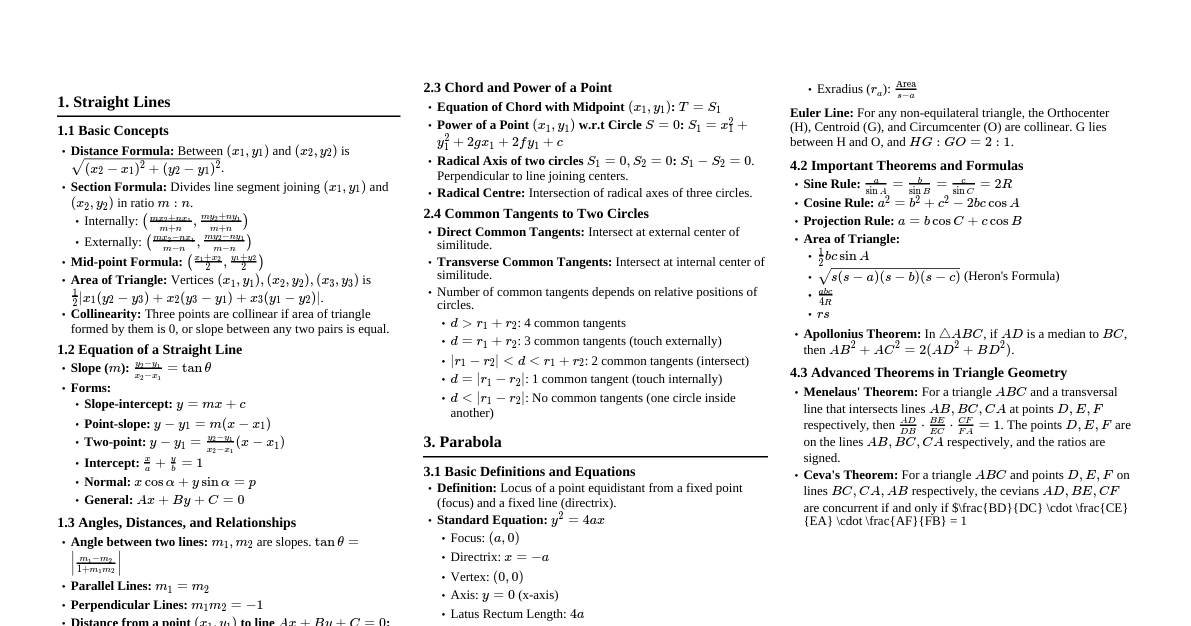
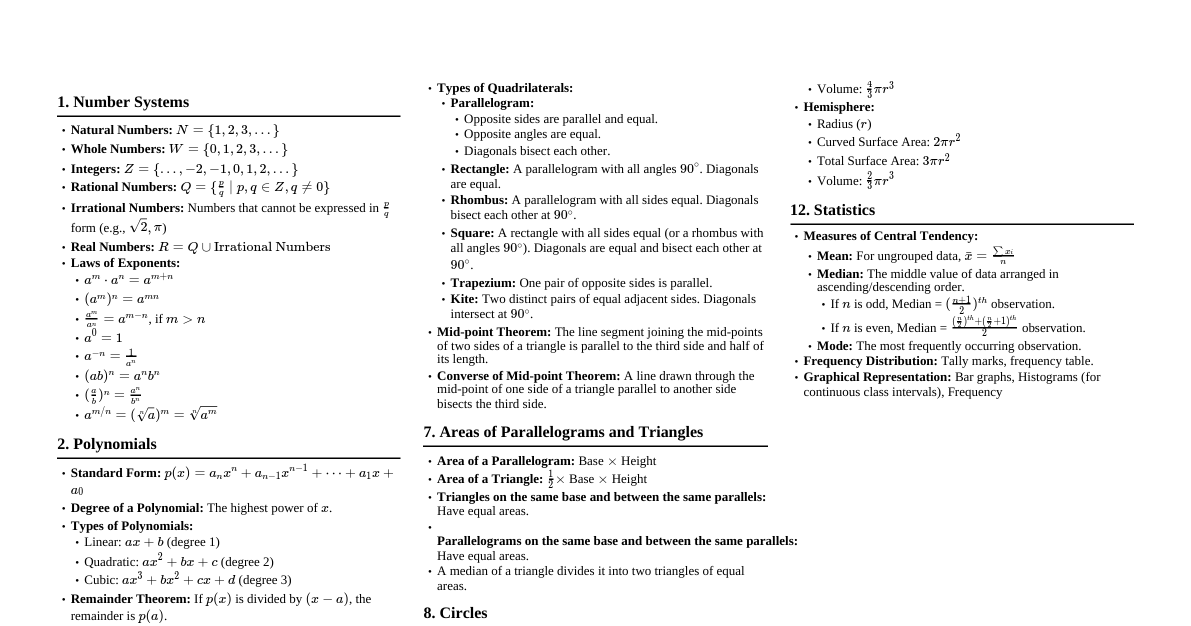
Set of Real Numbers Natural Numbers: $\mathbb{N} = \{1, 2, 3, ...\}$ Whole Numbers: $\mathbb{W} = \{0, 1, 2, 3, ...\}$ Integers: $\mathbb{Z} = \{..., -2, -1, 0, 1, 2, ...\}$ Rational Numbers: $\mathbb{Q} = \{ \frac{a}{b} \mid a, b \in \mathbb{Z}, b \neq 0 \}$ Irrational Numbers: Non-repeating, non-terminating decimals (e.g., $\pi, \sqrt{2}, e$) Real Numbers: $\mathbb{R} = \mathbb{Q} \cup \text{Irrational Numbers}$ Interval Notation: $[a, b]$: $a \le x \le b$ $(a, b)$: $a $[a, b)$: $a \le x $(a, b]$: $a Integer Exponents Definition: $a^n = a \cdot a \cdot ... \cdot a$ ($n$ times) Zero Exponent: $a^0 = 1$ (for $a \neq 0$) Negative Exponent: $a^{-n} = \frac{1}{a^n}$ Product Rule: $a^m \cdot a^n = a^{m+n}$ Quotient Rule: $\frac{a^m}{a^n} = a^{m-n}$ Power Rule: $(a^m)^n = a^{mn}$ Power of a Product: $(ab)^n = a^n b^n$ Power of a Quotient: $(\frac{a}{b})^n = \frac{a^n}{b^n}$ Operations of Polynomials General Form: $P(x) = a_n x^n + a_{n-1} x^{n-1} + ... + a_1 x + a_0$ Addition/Subtraction: Combine coefficients of like terms. $(ax^n + bx^n) = (a+b)x^n$ Multiplication (Distributive Property): $A(B+C) = AB+AC$ $(a+b)(c+d) = ac+ad+bc+bd$ (FOIL for binomials) Division: Using long division or synthetic division. Special Products Difference of Squares: $(a-b)(a+b) = a^2 - b^2$ Perfect Square Trinomials: $(a+b)^2 = a^2 + 2ab + b^2$ $(a-b)^2 = a^2 - 2ab + b^2$ Sum of Cubes: $(a+b)(a^2-ab+b^2) = a^3+b^3$ Difference of Cubes: $(a-b)(a^2+ab+b^2) = a^3-b^3$ Binomial Expansion (Pascal's Triangle or Binomial Theorem): $(x+y)^n = \sum_{k=0}^{n} \binom{n}{k} x^{n-k} y^k$ Factoring of Polynomials Greatest Common Factor (GCF): $ax+ay = a(x+y)$ Grouping: $ax+ay+bx+by = a(x+y)+b(x+y) = (a+b)(x+y)$ Difference of Squares: $a^2 - b^2 = (a-b)(a+b)$ Perfect Square Trinomials: $a^2 + 2ab + b^2 = (a+b)^2$ $a^2 - 2ab + b^2 = (a-b)^2$ Sum of Cubes: $a^3+b^3 = (a+b)(a^2-ab+b^2)$ Difference of Cubes: $a^3-b^3 = (a-b)(a^2+ab+b^2)$ Trinomials ($ax^2+bx+c$): Find two numbers $p, q$ such that $pq=ac$ and $p+q=b$. Then rewrite $bx$ as $px+qx$ and factor by grouping. Radical Expressions Definition: $\sqrt[n]{a} = a^{1/n}$ Rational Exponent: $a^{m/n} = (\sqrt[n]{a})^m = \sqrt[n]{a^m}$ Product Rule: $\sqrt[n]{ab} = \sqrt[n]{a} \cdot \sqrt[n]{b}$ Quotient Rule: $\sqrt[n]{\frac{a}{b}} = \frac{\sqrt[n]{a}}{\sqrt[n]{b}}$ Power Rule: $\sqrt[m]{\sqrt[n]{a}} = \sqrt[mn]{a}$ Simplifying Radicals: $\sqrt{a^2b} = a\sqrt{b}$ Rationalizing Denominators: $\frac{1}{\sqrt{a}} = \frac{\sqrt{a}}{a}$ $\frac{1}{a+\sqrt{b}} = \frac{a-\sqrt{b}}{a^2-b}$ Equations and Inequalities Equation A statement of equality between two expressions. Linear Equation Form: $ax+b=0$ (where $a \neq 0$) Solution: $x = -\frac{b}{a}$ Quadratic Equation Standard Form: $ax^2+bx+c=0$ (where $a \neq 0$) Quadratic Formula: $x = \frac{-b \pm \sqrt{b^2-4ac}}{2a}$ Discriminant ($\Delta$): $\Delta = b^2-4ac$ $\Delta > 0$: Two distinct real solutions $\Delta = 0$: One real solution (repeated root) $x = -\frac{b}{2a}$ $\Delta Factoring: If $ax^2+bx+c = (px+q)(rx+s)$, then $x = -q/p$ or $x = -s/r$. Completing the Square: $x^2+bx = (x+\frac{b}{2})^2 - (\frac{b}{2})^2$ One Variable in Terms of Others Algebraic manipulation to isolate a desired variable. Example: Solve $A = P(1+rt)$ for $r$: $r = \frac{A-P}{Pt}$ Inequalities Linear: $ax+b Quadratic: Solve $ax^2+bx+c > 0$ by finding roots and testing intervals. Properties: If $a If $a 0$, then $ac If $a bc$ Trigonometry Plane Angle Measure of rotation from an initial ray to a terminal ray. Measures of an Angle Degrees: $1^\circ = \frac{1}{360}$ of a full circle. Radians: Arc length $s = r\theta$. $\theta = \frac{s}{r}$. Conversion: $180^\circ = \pi$ radians, $1 \text{ rad} = \frac{180^\circ}{\pi}$, $1^\circ = \frac{\pi}{180} \text{ rad}$. Standard Position Vertex at origin $(0,0)$, initial side along positive x-axis. Positive angles: counter-clockwise. Negative angles: clockwise. Trigonometric Functions of an Angle (Unit Circle, $r=1$) For a point $(x,y)$ on the unit circle: $\sin \theta = y$ $\cos \theta = x$ $\tan \theta = \frac{y}{x}$ $\csc \theta = \frac{1}{y} = \frac{1}{\sin \theta}$ $\sec \theta = \frac{1}{x} = \frac{1}{\cos \theta}$ $\cot \theta = \frac{x}{y} = \frac{1}{\tan \theta}$ Trigonometric Function Values (Right Triangle) Let $\theta$ be an acute angle in a right triangle: $\sin \theta = \frac{\text{Opposite}}{\text{Hypotenuse}}$ $\cos \theta = \frac{\text{Adjacent}}{\text{Hypotenuse}}$ $\tan \theta = \frac{\text{Opposite}}{\text{Adjacent}}$ $\csc \theta = \frac{\text{Hypotenuse}}{\text{Opposite}}$ $\sec \theta = \frac{\text{Hypotenuse}}{\text{Adjacent}}$ $\cot \theta = \frac{\text{Adjacent}}{\text{Opposite}}$ Fundamental Identities Reciprocal Identities: $\csc \theta = \frac{1}{\sin \theta}$, $\sec \theta = \frac{1}{\cos \theta}$, $\cot \theta = \frac{1}{\tan \theta}$ Quotient Identities: $\tan \theta = \frac{\sin \theta}{\cos \theta}$, $\cot \theta = \frac{\cos \theta}{\sin \theta}$ Pythagorean Identities: $\sin^2 \theta + \cos^2 \theta = 1$ $1 + \tan^2 \theta = \sec^2 \theta$ $1 + \cot^2 \theta = \csc^2 \theta$ Inverse Trigonometric Functions $y = \arcsin x \iff \sin y = x$, for $-\frac{\pi}{2} \le y \le \frac{\pi}{2}$ $y = \arccos x \iff \cos y = x$, for $0 \le y \le \pi$ $y = \arctan x \iff \tan y = x$, for $-\frac{\pi}{2} Graph of Sine and Cosine General Form: $y = A \sin(Bx - C) + D$ or $y = A \cos(Bx - C) + D$ Amplitude: $|A|$ (max displacement from midline) Period: $T = \frac{2\pi}{|B|}$ (length of one cycle) Phase Shift: $\frac{C}{B}$ (horizontal shift; right if $C/B > 0$, left if $C/B Vertical Shift (Midline): $y=D$ (vertical displacement) Frequency: $f = \frac{1}{T} = \frac{|B|}{2\pi}$ Definition of Amplitude of Sine and Cosine Curves The amplitude is the absolute value of the coefficient $A$ in $y=A\sin(Bx-C)+D$ or $y=A\cos(Bx-C)+D$. It is half the difference between the maximum and minimum values of the function: $\text{Amplitude} = \frac{\text{max value} - \text{min value}}{2}$. Applications of Trigonometry Solution of Right Triangles Pythagorean Theorem: $a^2 + b^2 = c^2$ (for sides $a, b$ and hypotenuse $c$) Angle Sum: $A+B+C = 180^\circ$ (where $C=90^\circ$) Use $\sin, \cos, \tan$ ratios to find unknown sides/angles. Oblique Triangles Triangles without a right angle. Law of Sines $\frac{a}{\sin A} = \frac{b}{\sin B} = \frac{c}{\sin C}$ Used when given ASA, AAS, or SSA (ambiguous case). Area of a triangle: Area $= \frac{1}{2}bc \sin A = \frac{1}{2}ac \sin B = \frac{1}{2}ab \sin C$ Law of Cosines $c^2 = a^2 + b^2 - 2ab \cos C$ $a^2 = b^2 + c^2 - 2bc \cos A$ $b^2 = a^2 + c^2 - 2ac \cos B$ Used when given SAS or SSS. Heron's Formula for Area (SSS): Area $= \sqrt{s(s-a)(s-b)(s-c)}$, where $s = \frac{a+b+c}{2}$ (semi-perimeter). Analytic Geometry Cartesian Coordinate System Points $(x,y)$ in a 2D plane. Origin: $(0,0)$. Distance and Midpoint Formulas Distance ($d$) between $(x_1, y_1)$ and $(x_2, y_2)$): $d = \sqrt{(x_2-x_1)^2 + (y_2-y_1)^2}$ Midpoint ($M$) of segment between $(x_1, y_1)$ and $(x_2, y_2)$): $M = \left( \frac{x_1+x_2}{2}, \frac{y_1+y_2}{2} \right)$ Straight Lines Slope ($m$): $m = \frac{\Delta y}{\Delta x} = \frac{y_2-y_1}{x_2-x_1}$ Slope-Intercept Form: $y = mx+b$ (where $b$ is y-intercept) Point-Slope Form: $y-y_1 = m(x-x_1)$ Standard Form: $Ax+By=C$ General Form: $Ax+By+C=0$ Horizontal Line: $y=k$ (slope $m=0$) Vertical Line: $x=k$ (undefined slope) Properties of Lines Parallel Lines: $m_1 = m_2$ Perpendicular Lines: $m_1 m_2 = -1$ (or $m_2 = -\frac{1}{m_1}$) Angle $\theta$ between two lines: $\tan \theta = \left| \frac{m_2-m_1}{1+m_1 m_2} \right|$ Conic Sections General equation for a conic section: $Ax^2 + Bxy + Cy^2 + Dx + Ey + F = 0$ Determined by comparing coefficients or by eccentricity. Eccentricity ($e$) A ratio that defines the shape of a conic section relative to its focus and directrix. $e = \frac{\text{distance from point to focus}}{\text{distance from point to directrix}}$ Circle: $e=0$ Ellipse: $0 Parabola: $e=1$ Hyperbola: $e > 1$ Circle Standard Form: $(x-h)^2 + (y-k)^2 = r^2$ Center: $(h, k)$, Radius: $r$ General Form: $x^2+y^2+Dx+Ey+F=0$ (after completing the square) Parabola Vertical Axis (opens up/down): $(x-h)^2 = 4p(y-k)$ Vertex: $(h, k)$ Focus: $(h, k+p)$ Directrix: $y=k-p$ Axis of Symmetry: $x=h$ Horizontal Axis (opens left/right): $(y-k)^2 = 4p(x-h)$ Vertex: $(h, k)$ Focus: $(h+p, k)$ Directrix: $x=h-p$ Axis of Symmetry: $y=k$ Ellipse Horizontal Major Axis: $\frac{(x-h)^2}{a^2} + \frac{(y-k)^2}{b^2} = 1$ ($a>b>0$) Center: $(h, k)$ Vertices: $(h \pm a, k)$ Foci: $(h \pm c, k)$, where $c^2 = a^2 - b^2$ Co-vertices: $(h, k \pm b)$ Eccentricity: $e = c/a$ Vertical Major Axis: $\frac{(x-h)^2}{b^2} + \frac{(y-k)^2}{a^2} = 1$ ($a>b>0$) Center: $(h, k)$ Vertices: $(h, k \pm a)$ Foci: $(h, k \pm c)$, where $c^2 = a^2 - b^2$ Co-vertices: $(h \pm b, k)$ Eccentricity: $e = c/a$ Hyperbola Horizontal Transverse Axis: $\frac{(x-h)^2}{a^2} - \frac{(y-k)^2}{b^2} = 1$ Center: $(h, k)$ Vertices: $(h \pm a, k)$ Foci: $(h \pm c, k)$, where $c^2 = a^2 + b^2$ Asymptotes: $y-k = \pm \frac{b}{a}(x-h)$ Eccentricity: $e = c/a$ Vertical Transverse Axis: $\frac{(y-k)^2}{a^2} - \frac{(x-h)^2}{b^2} = 1$ Center: $(h, k)$ Vertices: $(h, k \pm a)$ Foci: $(h, k \pm c)$, where $c^2 = a^2 + b^2$ Asymptotes: $y-k = \pm \frac{a}{b}(x-h)$ Eccentricity: $e = c/a$