Vertical Projectile Motion
Shared 3/25/2026•80 views
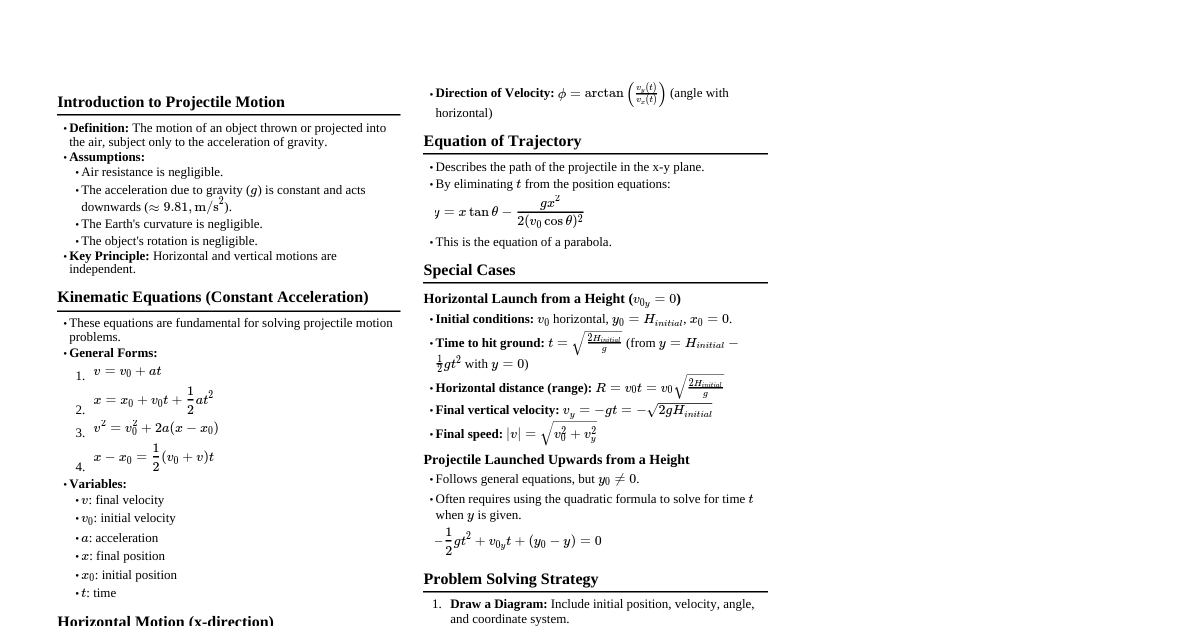
### Introduction to Vertical Projectile Motion Vertical projectile motion deals with objects moving purely up and down under the influence of gravity and other forces (like thrust or air resistance). This cheatsheet focuses on scenarios involving a rocket with mass, acceleration, and applied force. ### Key Variables - **m:** Mass of the object (kg) - **g:** Acceleration due to gravity (approx. $9.81 \, m/s^2$ downwards) - **a:** Net acceleration of the object ($m/s^2$) - **F_net:** Net force acting on the object (N) - **F_thrust:** Upward thrust force (N) - **F_gravity:** Force due to gravity (weight) (N) - **v_0:** Initial velocity (m/s) - **v:** Final velocity (m/s) - **y_0:** Initial vertical position (m) - **y:** Final vertical position (m) - **t:** Time (s) ### Forces and Newton's Second Law The fundamental principle governing motion is Newton's Second Law: $$F_{net} = ma$$ For vertical motion, we consider forces acting along the vertical axis. Let's assume upward is the positive direction. - **Force of Gravity ($F_{gravity}$):** This force always acts downwards. $$F_{gravity} = -mg$$ (The negative sign indicates it acts in the opposite direction to our assumed positive upward direction) - **Net Force ($F_{net}$):** If a rocket is experiencing an upward thrust ($F_{thrust}$) and gravity ($F_{gravity}$), the net force is: $$F_{net} = F_{thrust} + F_{gravity}$$ $$F_{net} = F_{thrust} - mg$$ - **Acceleration ($a$):** From Newton's Second Law: $$ma = F_{thrust} - mg$$ $$a = \frac{F_{thrust}}{m} - g$$ This 'a' is the net acceleration of the rocket. If $F_{thrust} = 0$, then $a = -g$, which is free fall. ### Kinematic Equations (Constant Acceleration) Once the net acceleration 'a' is determined (assuming it's constant), the following kinematic equations can be used: 1. **Velocity as a function of time:** $$v = v_0 + at$$ 2. **Position as a function of time:** $$y = y_0 + v_0t + \frac{1}{2}at^2$$ 3. **Velocity as a function of position (time-independent):** $$v^2 = v_0^2 + 2a(y - y_0)$$ #### Special Cases: - **Maximum Height:** At the peak of its trajectory, the instantaneous vertical velocity ($v$) is 0. - **Time to Max Height:** Use $v = 0$ in equation 1: $0 = v_0 + at_{peak} \implies t_{peak} = -\frac{v_0}{a}$ ### Problem-Solving Strategy 1. **Define Coordinate System:** Choose a positive direction (usually upward). 2. **Identify Knowns & Unknowns:** List all given values and what needs to be found. 3. **Draw Free-Body Diagram:** Show all forces acting on the object. 4. **Calculate Net Force:** Sum all forces in the vertical direction (e.g., $F_{net} = F_{thrust} - mg$). 5. **Calculate Net Acceleration:** Use $F_{net} = ma$ to find $a$. 6. **Apply Kinematic Equations:** Use the appropriate kinematic equation(s) to solve for unknowns (velocity, position, time). ### Example: Rocket Launch A rocket with a mass of $500 \, kg$ launches vertically. Its engine provides a constant upward thrust of $8000 \, N$. What is its acceleration and velocity after $10 \, s$? (Assume $g = 9.81 \, m/s^2$) 1. **Coordinate System:** Upward is positive. 2. **Knowns:** $m = 500 \, kg$, $F_{thrust} = 8000 \, N$, $g = 9.81 \, m/s^2$, $v_0 = 0 \, m/s$, $t = 10 \, s$. **Unknowns:** $a$, $v$. 3. **Free-Body Diagram:** $F_{thrust}$ (up), $F_{gravity}$ (down). 4. **Net Force:** $F_{net} = F_{thrust} - mg$ $F_{net} = 8000 \, N - (500 \, kg \times 9.81 \, m/s^2)$ $F_{net} = 8000 \, N - 4905 \, N$ $F_{net} = 3095 \, N$ (upward) 5. **Net Acceleration:** $a = \frac{F_{net}}{m} = \frac{3095 \, N}{500 \, kg}$ $a = 6.19 \, m/s^2$ (upward) 6. **Velocity after 10 s:** $v = v_0 + at$ $v = 0 + (6.19 \, m/s^2 \times 10 \, s)$ $v = 61.9 \, m/s$ (upward) Therefore, the rocket accelerates at $6.19 \, m/s^2$ and reaches a velocity of $61.9 \, m/s$ after $10$ seconds.