Simple Harmonic Motion
Cheatsheet Content
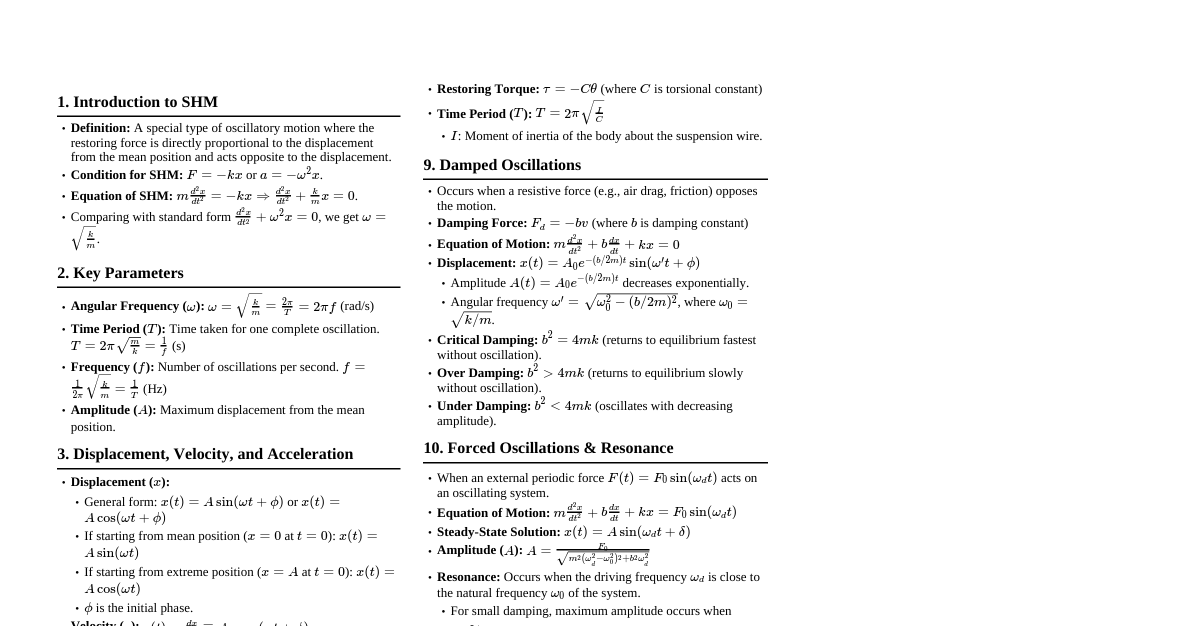
### Introduction to SHM - **Definition:** Simple Harmonic Motion (SHM) is a type of periodic motion where the restoring force is directly proportional to the displacement and acts in the direction opposite to the displacement. - **Key Characteristics:** - Periodic (repeats over time) - Oscillatory (moves back and forth around an equilibrium position) - Restoring force $F = -kx$ (Hooke's Law) - **Examples:** Mass-spring system, simple pendulum (for small angles), vibrating string. ### Basic Equations of SHM - **Displacement:** $x(t) = A \cos(\omega t + \phi)$ - $A$: Amplitude (maximum displacement from equilibrium) - $\omega$: Angular frequency (rad/s) - $t$: Time (s) - $\phi$: Phase constant (initial phase, rad) - **Velocity:** $v(t) = \frac{dx}{dt} = -A\omega \sin(\omega t + \phi)$ - Maximum velocity: $v_{max} = A\omega$ (occurs at equilibrium $x=0$) - **Acceleration:** $a(t) = \frac{dv}{dt} = -A\omega^2 \cos(\omega t + \phi) = -\omega^2 x(t)$ - Maximum acceleration: $a_{max} = A\omega^2$ (occurs at extreme positions $x=\pm A$) - **Angular Frequency:** $\omega = \sqrt{\frac{k}{m}}$ for mass-spring system - **Period (T):** Time for one complete oscillation. $T = \frac{2\pi}{\omega}$ - **Frequency (f):** Number of oscillations per second. $f = \frac{1}{T} = \frac{\omega}{2\pi}$ ### Energy in SHM - **Kinetic Energy (KE):** $KE = \frac{1}{2}mv^2 = \frac{1}{2}m A^2 \omega^2 \sin^2(\omega t + \phi)$ - **Potential Energy (PE):** $PE = \frac{1}{2}kx^2 = \frac{1}{2}k A^2 \cos^2(\omega t + \phi)$ - **Total Mechanical Energy (E):** $E = KE + PE = \frac{1}{2}k A^2 = \frac{1}{2}m A^2 \omega^2$ - Total energy is constant and proportional to the square of the amplitude. - Energy continuously transforms between kinetic and potential. ### Mass-Spring System - **Hooke's Law:** $F = -kx$ - **Equation of Motion:** $m\frac{d^2x}{dt^2} = -kx \Rightarrow \frac{d^2x}{dt^2} + \frac{k}{m}x = 0$ - **Angular Frequency:** $\omega = \sqrt{\frac{k}{m}}$ - **Period:** $T = 2\pi\sqrt{\frac{m}{k}}$ - **Horizontal System:** Frictionless surface. - **Vertical System:** Equilibrium position is shifted due to gravity. The effective restoring force is still proportional to displacement from this new equilibrium. ### Simple Pendulum - **Assumptions:** - Massless string of length $L$ - Point mass $m$ at the end - Small angular displacement ($\theta \le 10^\circ$) - **Restoring Torque:** $\tau = -mgL\sin\theta \approx -mgL\theta$ (for small $\theta$) - **Equation of Motion:** $I\frac{d^2\theta}{dt^2} = \tau \Rightarrow mL^2\frac{d^2\theta}{dt^2} = -mgL\theta \Rightarrow \frac{d^2\theta}{dt^2} + \frac{g}{L}\theta = 0$ - **Angular Frequency:** $\omega = \sqrt{\frac{g}{L}}$ - **Period:** $T = 2\pi\sqrt{\frac{L}{g}}$ - Note: Period is independent of mass and amplitude (for small angles). ### Physical Pendulum - **Definition:** Any rigid body allowed to oscillate about a fixed pivot point. - **Equation of Motion:** $I\frac{d^2\theta}{dt^2} = -mgd\sin\theta \approx -mgd\theta$ (for small $\theta$) - $I$: Moment of inertia about the pivot point - $d$: Distance from pivot to center of mass - **Angular Frequency:** $\omega = \sqrt{\frac{mgd}{I}}$ - **Period:** $T = 2\pi\sqrt{\frac{I}{mgd}}$ ### Damped Oscillations - **Definition:** Oscillations where the amplitude decreases over time due to dissipative forces (e.g., air resistance, friction). - **Damping Force:** $F_d = -bv$ (proportional to velocity, $b$ is damping constant) - **Equation of Motion:** $m\frac{d^2x}{dt^2} + b\frac{dx}{dt} + kx = 0$ - **Solutions (Underdamped):** $x(t) = A_0 e^{-\frac{bt}{2m}} \cos(\omega' t + \phi)$ - Amplitude decays exponentially: $A(t) = A_0 e^{-\frac{bt}{2m}}$ - Damped angular frequency: $\omega' = \sqrt{\frac{k}{m} - \left(\frac{b}{2m}\right)^2}$ - If $b^2 4mk$. System returns to equilibrium slowly without oscillating. ### Forced Oscillations & Resonance - **Forced Oscillation:** An oscillating system subjected to an external periodic driving force $F_d(t) = F_0 \cos(\omega_d t)$. - **Equation of Motion:** $m\frac{d^2x}{dt^2} + b\frac{dx}{dt} + kx = F_0 \cos(\omega_d t)$ - **Steady-State Solution:** The system eventually oscillates at the driving frequency $\omega_d$. - Amplitude: $A = \frac{F_0}{\sqrt{m^2(\omega_d^2 - \omega^2)^2 + b^2\omega_d^2}}$ - $\omega = \sqrt{k/m}$ is the natural frequency of the undamped oscillator. - **Resonance:** Occurs when the driving frequency $\omega_d$ is close to the natural frequency $\omega$ (or $\omega'$ for damped systems). - At resonance, the amplitude of oscillation becomes very large, especially for small damping ($b \approx 0$). - The resonance frequency is $\omega_{res} = \sqrt{\omega^2 - 2\left(\frac{b}{2m}\right)^2}$