Rotational, Gravitation, 2D Mo
Cheatsheet Content
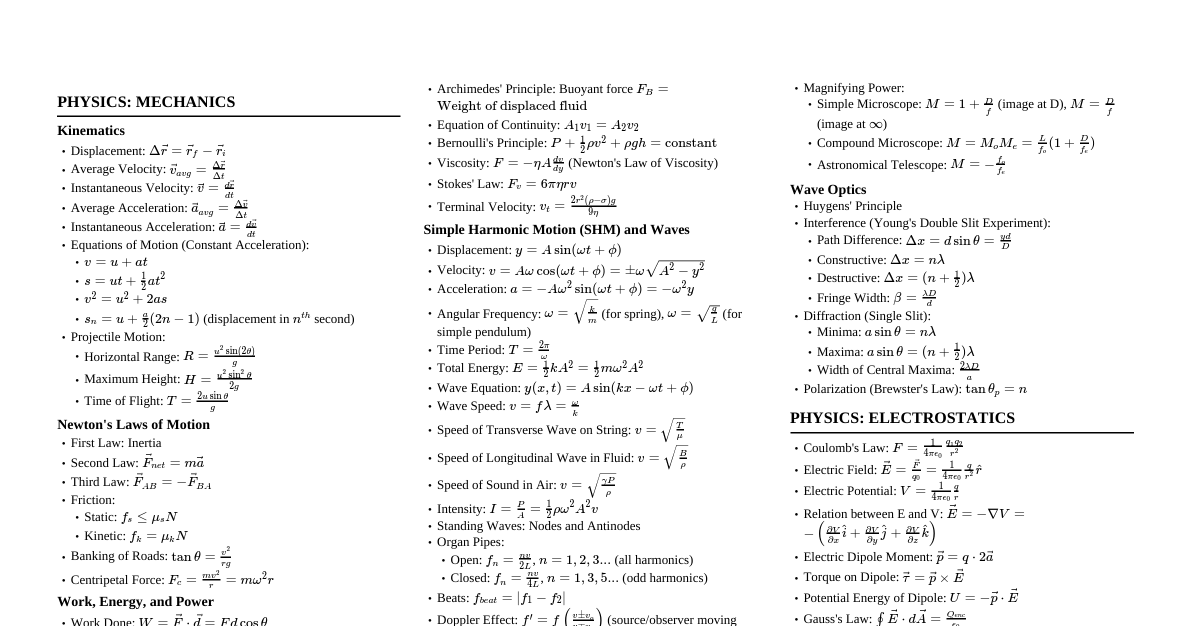
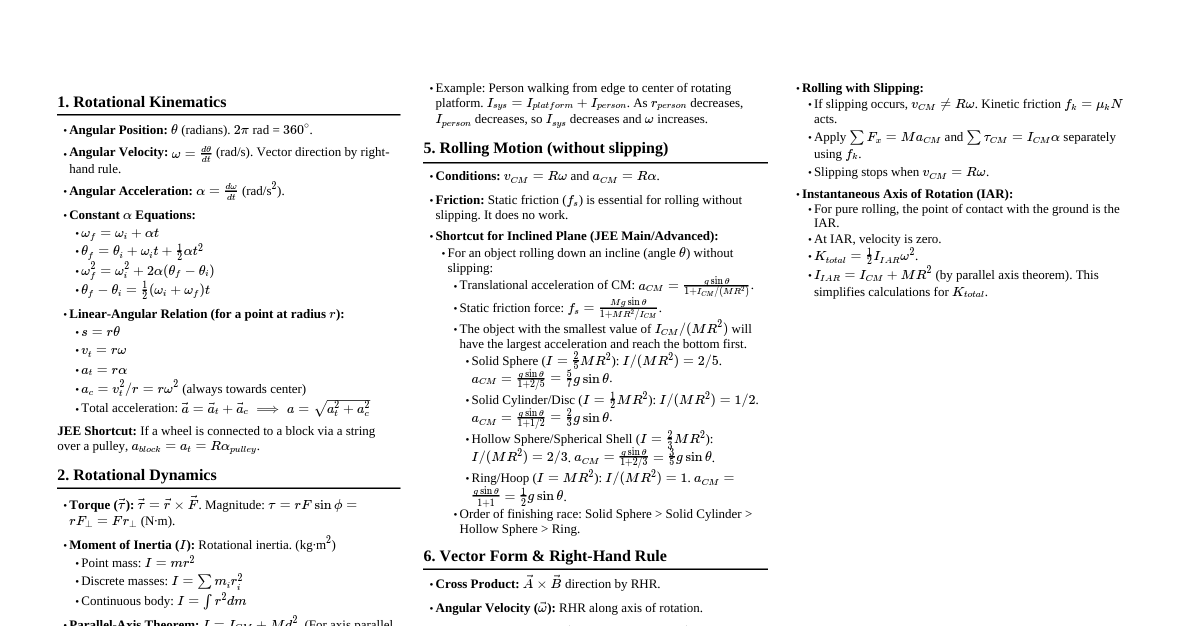
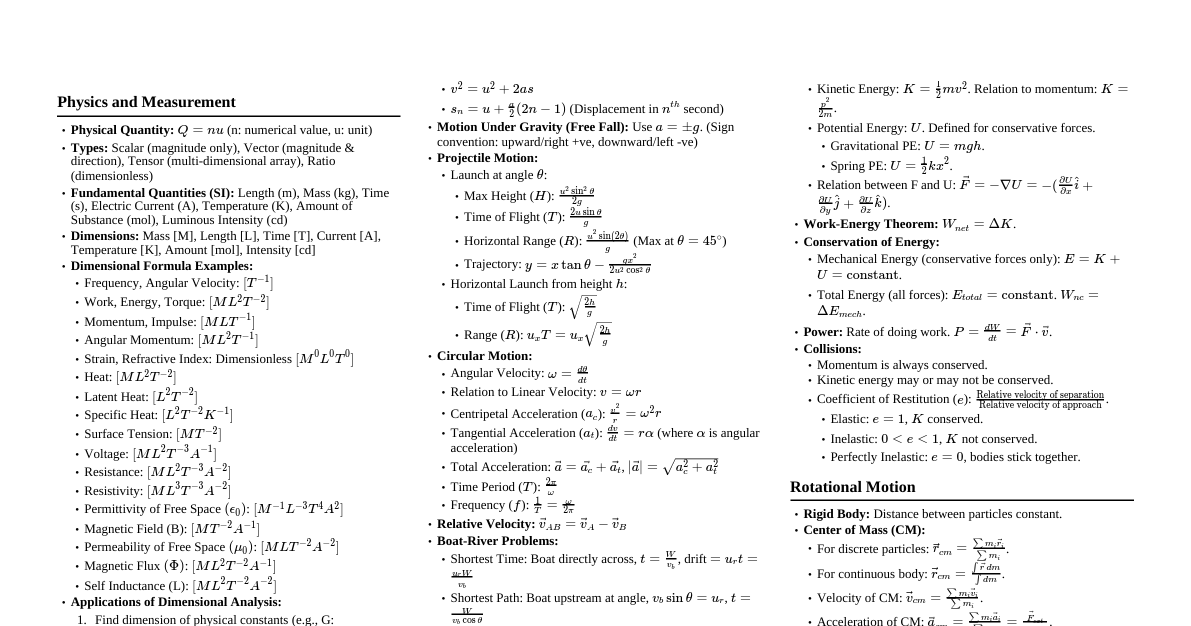
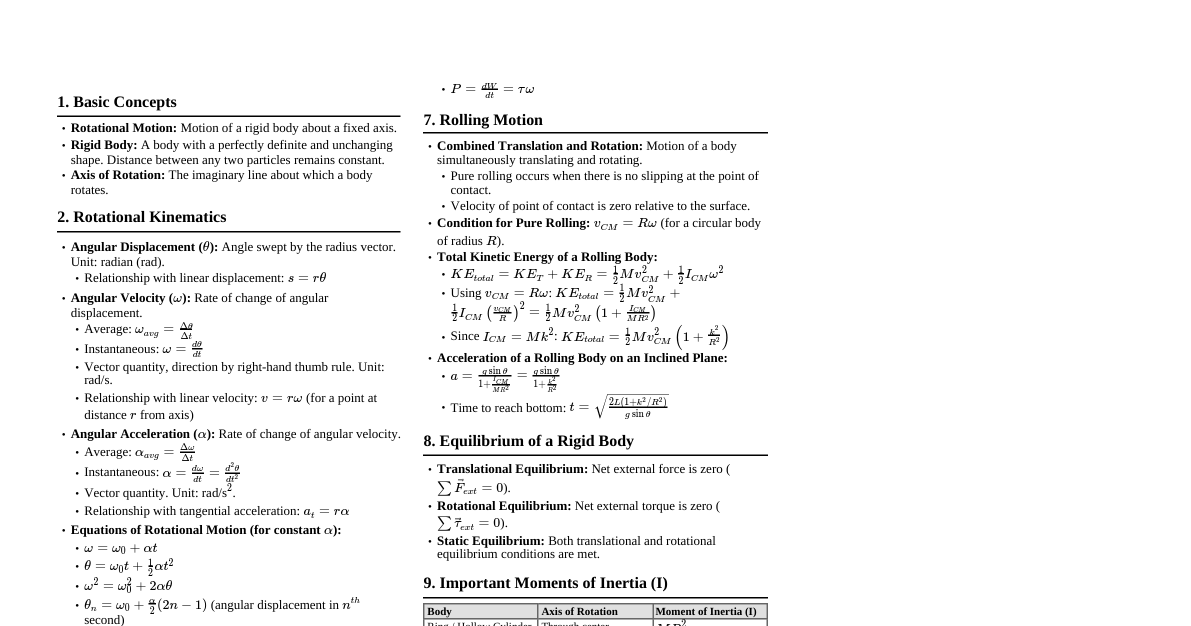
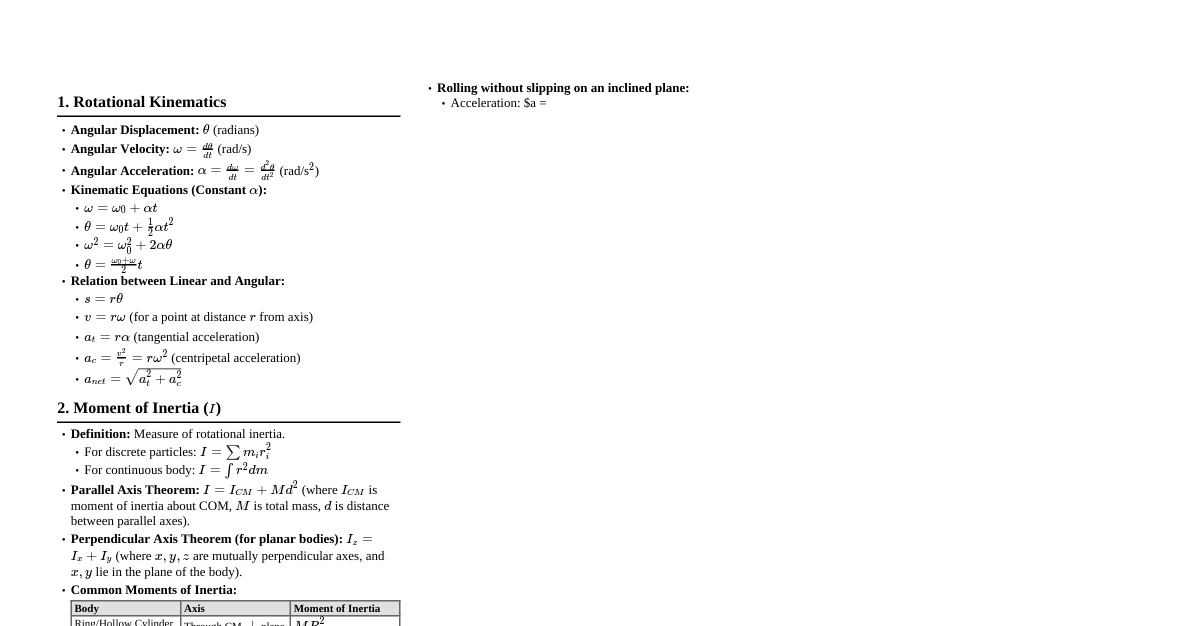
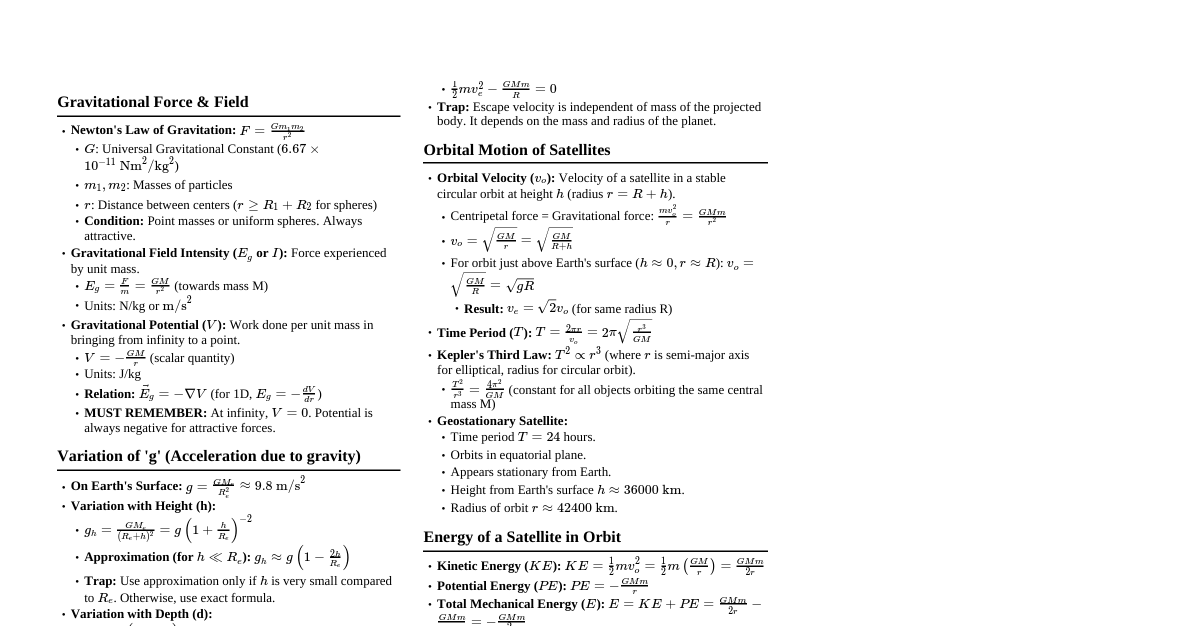
### Kinematics in 2D - **Displacement Vector:** $\vec{r} = x\hat{i} + y\hat{j}$ - **Velocity Vector:** $\vec{v} = \frac{d\vec{r}}{dt} = v_x\hat{i} + v_y\hat{j}$ - **Acceleration Vector:** $\vec{a} = \frac{d\vec{v}}{dt} = a_x\hat{i} + a_y\hat{j}$ #### Projectile Motion - **Horizontal Motion (constant velocity):** - $x = (v_0 \cos\theta) t$ - $v_x = v_0 \cos\theta$ - **Vertical Motion (constant acceleration $g$ downwards):** - $y = (v_0 \sin\theta) t - \frac{1}{2}gt^2$ - $v_y = v_0 \sin\theta - gt$ - **Time of Flight ($T$):** $T = \frac{2v_0 \sin\theta}{g}$ - **Maximum Height ($H$):** $H = \frac{v_0^2 \sin^2\theta}{2g}$ - **Horizontal Range ($R$):** $R = \frac{v_0^2 \sin(2\theta)}{g}$ - Max range at $\theta = 45^\circ$ - **Equation of Trajectory:** $y = x \tan\theta - \frac{gx^2}{2v_0^2 \cos^2\theta}$ #### Uniform Circular Motion - **Angular Displacement:** $\Delta\theta$ - **Angular Velocity:** $\omega = \frac{d\theta}{dt} = \frac{v}{r}$ - **Angular Acceleration:** $\alpha = \frac{d\omega}{dt}$ - **Centripetal Acceleration:** $a_c = \frac{v^2}{r} = \omega^2 r$ (always towards center) - **Tangential Acceleration:** $a_t = r\alpha$ (changes speed, tangential to path) - **Net Acceleration:** $\vec{a} = \vec{a_c} + \vec{a_t}$ ; $|\vec{a}| = \sqrt{a_c^2 + a_t^2}$ ### Rotational Dynamics - **Moment of Inertia ($I$):** Measure of rotational inertia. $I = \sum m_i r_i^2$ (for discrete particles) or $I = \int r^2 dm$ (for continuous bodies). - **Parallel Axis Theorem:** $I = I_{CM} + Md^2$ - **Perpendicular Axis Theorem (for planar bodies):** $I_z = I_x + I_y$ - **Torque ($\vec{\tau}$):** Rotational analogue of force. $\vec{\tau} = \vec{r} \times \vec{F}$ - Magnitude: $\tau = rF\sin\theta = r_{\perp}F = rF_{\perp}$ - **Angular Momentum ($\vec{L}$):** $\vec{L} = \vec{r} \times \vec{p} = I\vec{\omega}$ (for rigid body rotation) - **Newton's Second Law for Rotation:** $\tau_{net} = I\alpha$ - **Conservation of Angular Momentum:** If $\tau_{net} = 0$, then $L_{initial} = L_{final}$ ($I_1\omega_1 = I_2\omega_2$) - **Rotational Kinetic Energy:** $KE_{rot} = \frac{1}{2}I\omega^2$ - **Work Done by Torque:** $W = \int \tau d\theta$ - **Power in Rotational Motion:** $P = \tau\omega$ #### Rolling Motion - **Pure Rolling Condition:** $v_{CM} = R\omega$ - **Kinetic Energy of Rolling Body:** $KE_{total} = KE_{trans} + KE_{rot} = \frac{1}{2}Mv_{CM}^2 + \frac{1}{2}I_{CM}\omega^2$ - $KE_{total} = \frac{1}{2}Mv_{CM}^2 \left(1 + \frac{I_{CM}}{MR^2}\right)$ - **Acceleration of a body rolling down an incline:** $a = \frac{g\sin\theta}{1 + \frac{I_{CM}}{MR^2}}$ ### Gravitation - **Newton's Law of Universal Gravitation:** $F = \frac{Gm_1m_2}{r^2}$ - $G = 6.67 \times 10^{-11} \text{ Nm}^2/\text{kg}^2$ - **Acceleration due to Gravity ($g$):** - On Earth's surface: $g = \frac{GM}{R^2}$ - Variation with altitude ($h \ll R$): $g' = g\left(1 - \frac{2h}{R}\right)$ - Variation with depth ($d$ from surface): $g' = g\left(1 - \frac{d}{R}\right)$ - Variation with latitude ($\lambda$): $g' = g - R\omega^2 \cos^2\lambda$ - **Gravitational Potential Energy ($U$):** - For two masses: $U = -\frac{Gm_1m_2}{r}$ (always negative for attractive force) - Change in PE: $\Delta U = -W_{grav}$ - **Gravitational Potential ($V$):** $V = \frac{U}{m} = -\frac{GM}{r}$ - **Escape Velocity ($v_e$):** Minimum velocity required to escape Earth's gravitational field. - $v_e = \sqrt{\frac{2GM}{R}} = \sqrt{2gR}$ - **Orbital Velocity ($v_o$):** Velocity of a satellite in a circular orbit. - $v_o = \sqrt{\frac{GM}{r}}$ (where $r = R+h$) - For orbit close to Earth: $v_o = \sqrt{gR}$ - **Time Period of Satellite ($T$):** $T = \frac{2\pi r}{v_o} = 2\pi\sqrt{\frac{r^3}{GM}}$ - **Kepler's Laws:** 1. **Law of Orbits:** All planets move in elliptical orbits with the Sun at one focus. 2. **Law of Areas:** The line joining any planet to the Sun sweeps out equal areas in equal intervals of time (conservation of angular momentum). 3. **Law of Periods:** The square of the orbital period ($T$) of any planet is proportional to the cube of the semi-major axis ($a$) of its orbit. $T^2 \propto a^3$ or $\frac{T^2}{a^3} = \frac{4\pi^2}{GM_{sun}}$ ### Repeated JEE Topics & Formulas - **Moment of Inertia calculations:** Rings, Discs, Rods, Spheres (solid & hollow) about various axes using parallel and perpendicular axis theorems. - Ring (about axis through center $\perp$ to plane): $MR^2$ - Disc (about axis through center $\perp$ to plane): $\frac{1}{2}MR^2$ - Rod (about center $\perp$ to length): $\frac{1}{12}ML^2$ - Solid Sphere (about diameter): $\frac{2}{5}MR^2$ - **Conservation of Angular Momentum:** Especially problems involving change in configuration (e.g., person moving on a rotating platform, melting ice on a rotating disc). - **Rolling Motion problems:** Calculating acceleration, friction, kinetic energy for different shapes (sphere, cylinder, ring) on inclines or horizontal surfaces. - **Projectile Motion:** Max range, time of flight, height, velocity at any point, trajectory equation. - **Relative Velocity in 2D:** Finding minimum distance, time to meet. - **Gravitational Potential Energy:** Calculating work done to move a mass, escape velocity, orbital velocity. - **Kepler's Laws:** Especially $T^2 \propto r^3$ for satellite problems. - **Geostationary Satellite:** Orbital period = 24 hours, orbits in equatorial plane, appears stationary from Earth.