Straight Line - CET 11th
Cheatsheet Content
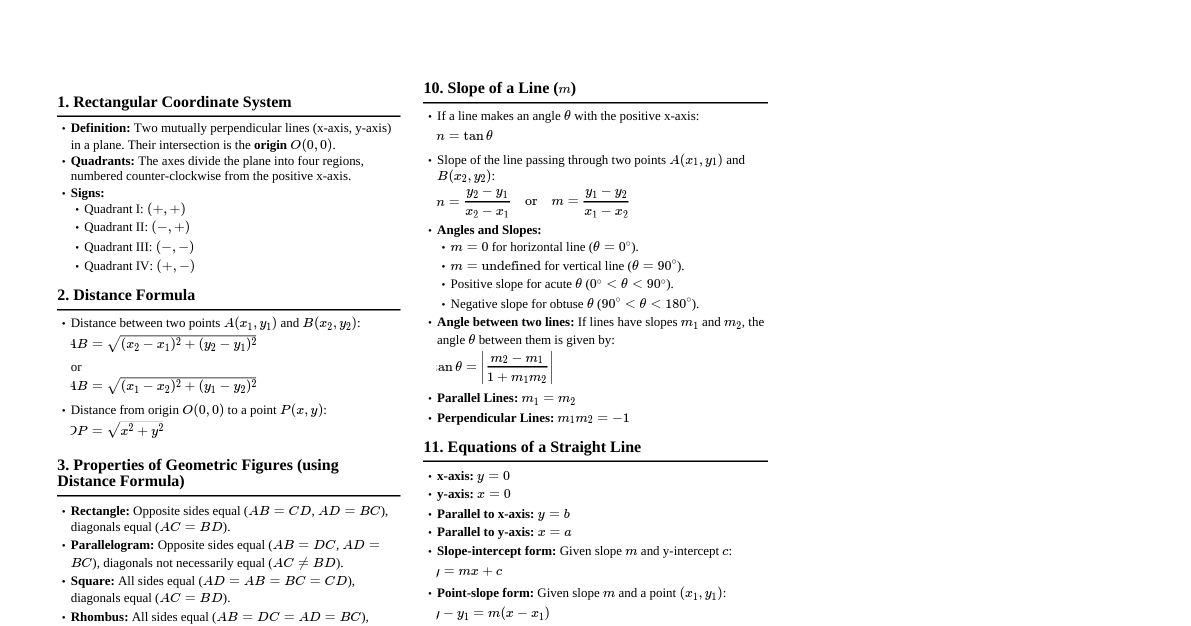
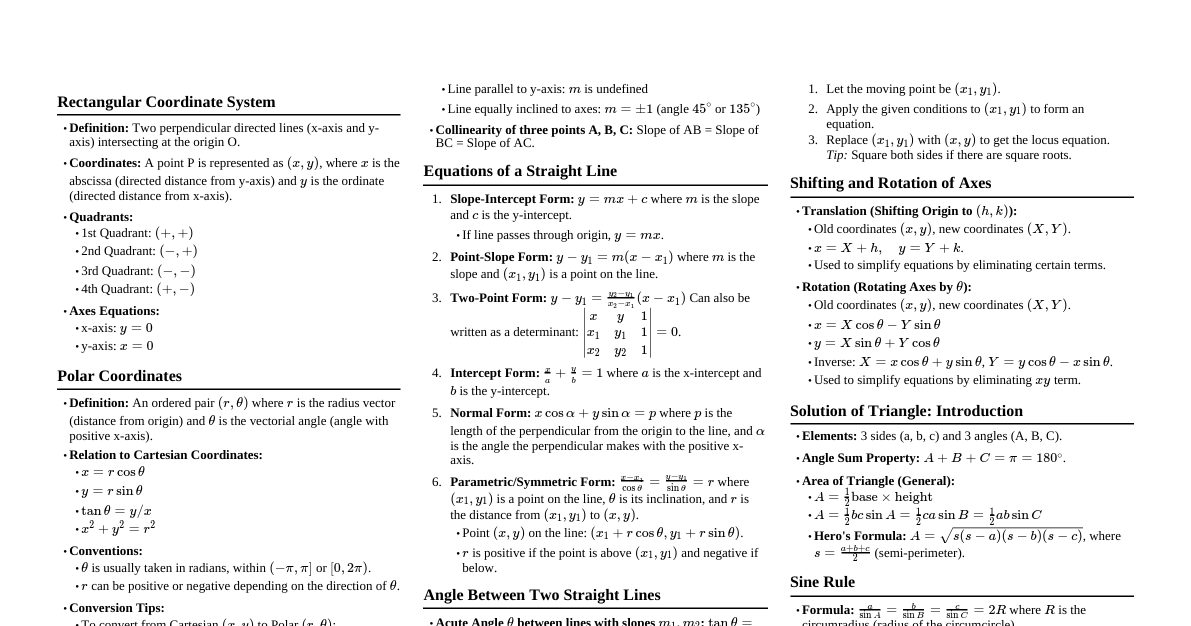
1. Introduction to Straight Lines A straight line is a curve with constant slope. General equation: $Ax + By + C = 0$, where $A, B, C$ are constants, and $A, B$ are not both zero. 2. Distance Formula Distance between two points $P(x_1, y_1)$ and $Q(x_2, y_2)$: $$ PQ = \sqrt{(x_2 - x_1)^2 + (y_2 - y_1)^2} $$ 3. Section Formula Internal Division Coordinates of a point $R(x, y)$ that divides the line segment joining $P(x_1, y_1)$ and $Q(x_2, y_2)$ internally in the ratio $m:n$: $$ x = \frac{mx_2 + nx_1}{m+n}, \quad y = \frac{my_2 + ny_1}{m+n} $$ External Division Coordinates of a point $R(x, y)$ that divides the line segment joining $P(x_1, y_1)$ and $Q(x_2, y_2)$ externally in the ratio $m:n$: $$ x = \frac{mx_2 - nx_1}{m-n}, \quad y = \frac{my_2 - ny_1}{m-n} $$ Midpoint Formula Coordinates of the midpoint of $PQ$: $$ x = \frac{x_1 + x_2}{2}, \quad y = \frac{y_1 + y_2}{2} $$ 4. Area of a Triangle Area of a triangle with vertices $(x_1, y_1)$, $(x_2, y_2)$, and $(x_3, y_3)$: $$ \text{Area} = \frac{1}{2} |x_1(y_2 - y_3) + x_2(y_3 - y_1) + x_3(y_1 - y_2)| $$ For collinear points, Area = 0. 5. Slope (Gradient) of a Line Slope $m$ of a line passing through $(x_1, y_1)$ and $(x_2, y_2)$: $$ m = \frac{y_2 - y_1}{x_2 - x_1} \quad (x_1 \neq x_2) $$ Slope $m$ of a line making an angle $\theta$ with the positive x-axis: $$ m = \tan \theta $$ Slope of a horizontal line (parallel to x-axis) is $0$. Slope of a vertical line (parallel to y-axis) is undefined. Slope of a line $Ax + By + C = 0$ is $m = -\frac{A}{B}$. 6. Conditions for Parallel and Perpendicular Lines Let $m_1$ and $m_2$ be the slopes of two lines $L_1$ and $L_2$ respectively. Parallel Lines: $m_1 = m_2$ Perpendicular Lines: $m_1 m_2 = -1$ (provided neither line is vertical) 7. Angle Between Two Lines The acute angle $\theta$ between two lines with slopes $m_1$ and $m_2$ is given by: $$ \tan \theta = \left| \frac{m_1 - m_2}{1 + m_1 m_2} \right| $$ 8. Different Forms of the Equation of a Straight Line a) Point-Slope Form Equation of a line passing through $(x_1, y_1)$ with slope $m$: $$ y - y_1 = m(x - x_1) $$ b) Two-Point Form Equation of a line passing through $(x_1, y_1)$ and $(x_2, y_2)$: $$ y - y_1 = \frac{y_2 - y_1}{x_2 - x_1}(x - x_1) $$ c) Slope-Intercept Form Equation of a line with slope $m$ and y-intercept $c$: $$ y = mx + c $$ d) Intercept Form Equation of a line with x-intercept $a$ and y-intercept $b$: $$ \frac{x}{a} + \frac{y}{b} = 1 $$ e) Normal Form (Perpendicular Form) Equation of a line where $p$ is the length of the perpendicular from the origin to the line and $\alpha$ is the angle this perpendicular makes with the positive x-axis: $$ x \cos \alpha + y \sin \alpha = p $$ f) General Form $$ Ax + By + C = 0 $$ To convert general form to normal form, divide by $\pm \sqrt{A^2 + B^2}$, choosing the sign to make the constant term positive. 9. Distance of a Point from a Line Distance of a point $(x_1, y_1)$ from the line $Ax + By + C = 0$: $$ d = \frac{|Ax_1 + By_1 + C|}{\sqrt{A^2 + B^2}} $$ Distance between two parallel lines $Ax + By + C_1 = 0$ and $Ax + By + C_2 = 0$: $$ d = \frac{|C_1 - C_2|}{\sqrt{A^2 + B^2}} $$ 10. Position of a Point Relative to a Line For a line $L: Ax + By + C = 0$ and a point $P(x_1, y_1)$: If $Ax_1 + By_1 + C > 0$, $P$ is on one side. If $Ax_1 + By_1 + C If $Ax_1 + By_1 + C = 0$, $P$ lies on the line. Two points $(x_1, y_1)$ and $(x_2, y_2)$ lie on the same side of the line $Ax + By + C = 0$ if $(Ax_1 + By_1 + C)$ and $(Ax_2 + By_2 + C)$ have the same sign. They lie on opposite sides if the signs are different. 11. Equation of a Line Passing Through the Intersection of Two Lines The equation of a line passing through the intersection of lines $L_1: A_1x + B_1y + C_1 = 0$ and $L_2: A_2x + B_2y + C_2 = 0$ is: $$ L_1 + \lambda L_2 = 0 $$ $$ (A_1x + B_1y + C_1) + \lambda (A_2x + B_2y + C_2) = 0 $$ where $\lambda$ is a constant determined by an additional condition. 12. Concurrency of Three Lines Three lines $L_1: A_1x + B_1y + C_1 = 0$, $L_2: A_2x + B_2y + C_2 = 0$, and $L_3: A_3x + B_3y + C_3 = 0$ are concurrent if: $$ \begin{vmatrix} A_1 & B_1 & C_1 \\ A_2 & B_2 & C_2 \\ A_3 & B_3 & C_3 \end{vmatrix} = 0 $$ 13. Family of Lines Lines parallel to $Ax + By + C = 0$: $Ax + By + k = 0$ Lines perpendicular to $Ax + By + C = 0$: $Bx - Ay + k = 0$ 14. Important Points of a Triangle For a triangle with vertices $A(x_1, y_1)$, $B(x_2, y_2)$, $C(x_3, y_3)$: Centroid: Intersection of medians. $$ G = \left( \frac{x_1+x_2+x_3}{3}, \frac{y_1+y_2+y_3}{3} \right) $$ Incenter: Intersection of angle bisectors. $$ I = \left( \frac{ax_1+bx_2+cx_3}{a+b+c}, \frac{ay_1+by_2+cy_3}{a+b+c} \right) $$ (where $a, b, c$ are side lengths opposite to vertices $A, B, C$) Circumcenter: Intersection of perpendicular bisectors of sides. Equidistant from vertices. Orthocenter: Intersection of altitudes. Note: Centroid, Circumcenter, and Orthocenter are collinear (Euler Line).