Straight Lines (Std 11)
Cheatsheet Content
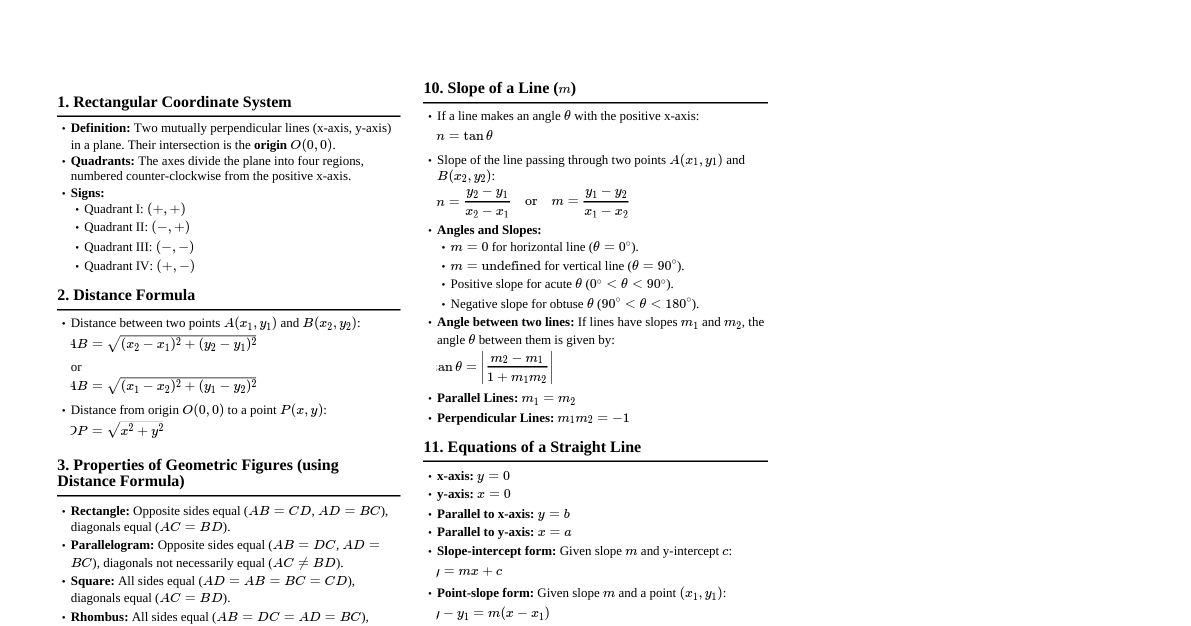
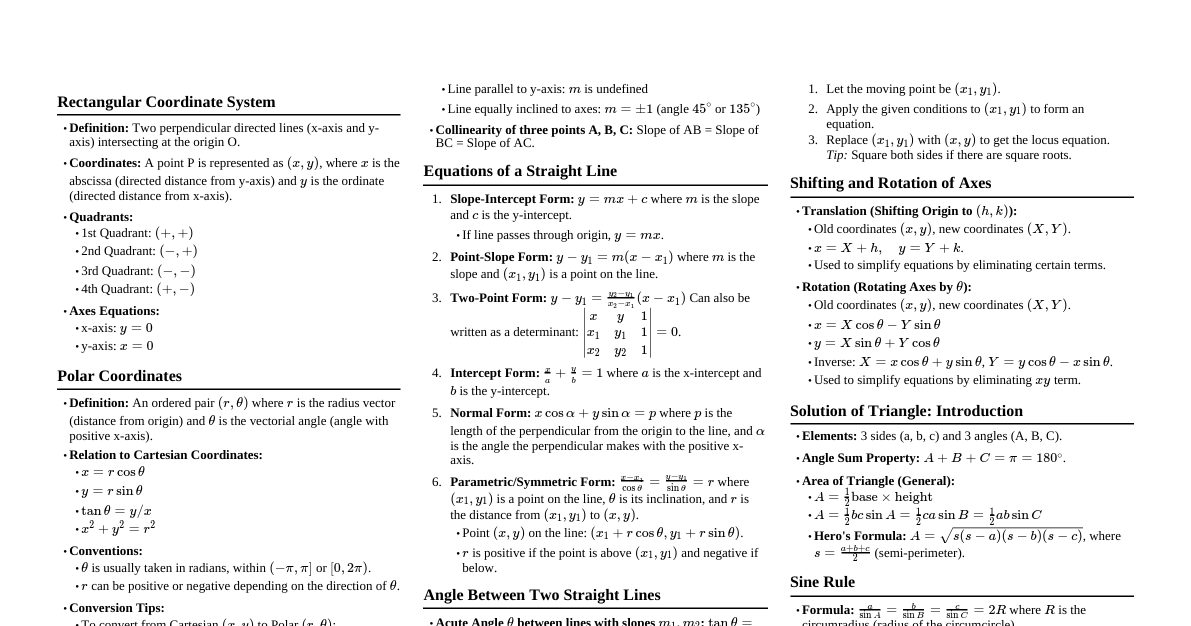
1. Introduction to Coordinate Geometry Coordinate Axes: Perpendicular lines (X-axis, Y-axis) intersecting at origin $O(0,0)$. Coordinates of a Point: $(x, y)$ where $x$ is abscissa and $y$ is ordinate. Distance Formula: Distance between $P(x_1, y_1)$ and $Q(x_2, y_2)$ is $PQ = \sqrt{(x_2-x_1)^2 + (y_2-y_1)^2}$. Section Formula: Internal Division: Point $P(x,y)$ dividing line segment joining $A(x_1, y_1)$ and $B(x_2, y_2)$ in ratio $m:n$ is $P\left(\frac{mx_2+nx_1}{m+n}, \frac{my_2+ny_1}{m+n}\right)$. External Division: $P\left(\frac{mx_2-nx_1}{m-n}, \frac{my_2-ny_1}{m-n}\right)$. Mid-point: $\left(\frac{x_1+x_2}{2}, \frac{y_1+y_2}{2}\right)$. Area of a Triangle: Vertices $(x_1, y_1)$, $(x_2, y_2)$, $(x_3, y_3)$ is $\frac{1}{2} |x_1(y_2-y_3) + x_2(y_3-y_1) + x_3(y_1-y_2)|$. Collinearity: Three points are collinear if the area of the triangle formed by them is zero. 2. Slope of a Line Definition: The tangent of the angle $\theta$ (inclination) that a line makes with the positive direction of the X-axis, $m = \tan \theta$. ($0 \le \theta Slope of X-axis: $m=0$. Slope of Y-axis: Undefined. Slope between two points: For $P(x_1, y_1)$ and $Q(x_2, y_2)$, $m = \frac{y_2-y_1}{x_2-x_1}$ (if $x_1 \ne x_2$). Conditions for Parallel/Perpendicular Lines: Parallel: $m_1 = m_2$. Perpendicular: $m_1 m_2 = -1$ (if neither is vertical). Angle between two lines: If $m_1$ and $m_2$ are slopes of two lines, the acute angle $\phi$ between them is given by $\tan \phi = \left|\frac{m_2-m_1}{1+m_1m_2}\right|$. 3. Forms of the Equation of a Line Horizontal Line: $y = k$ (parallel to X-axis, passing through $(0,k)$). Vertical Line: $x = c$ (parallel to Y-axis, passing through $(c,0)$). Point-Slope Form: $y - y_1 = m(x - x_1)$ (line passing through $(x_1, y_1)$ with slope $m$). Two-Point Form: $y - y_1 = \frac{y_2-y_1}{x_2-x_1}(x - x_1)$ (line passing through $(x_1, y_1)$ and $(x_2, y_2)$). Slope-Intercept Form: $y = mx + c$ (line with slope $m$ and Y-intercept $c$). Intercept Form: $\frac{x}{a} + \frac{y}{b} = 1$ (line with X-intercept $a$ and Y-intercept $b$). Normal Form: $x \cos \omega + y \sin \omega = p$ (where $p$ is perpendicular distance from origin to the line, and $\omega$ is the angle the normal makes with the positive X-axis). General Equation of a Line: $Ax + By + C = 0$ (where $A, B, C$ are real numbers and $A, B$ are not both zero). 4. General Equation of a Line: $Ax + By + C = 0$ Slope: $m = -\frac{A}{B}$ (if $B \ne 0$). X-intercept: $-\frac{C}{A}$ (if $A \ne 0$). Y-intercept: $-\frac{C}{B}$ (if $B \ne 0$). Conversion to Normal Form: Divide by $\pm\sqrt{A^2+B^2}$. Sign depends on $C$. 5. Distance of a Point from a Line Distance from origin $(0,0)$ to $Ax+By+C=0$: $d = \frac{|C|}{\sqrt{A^2+B^2}}$. Distance from a point $(x_1, y_1)$ to $Ax+By+C=0$: $d = \frac{|Ax_1+By_1+C|}{\sqrt{A^2+B^2}}$. 6. Distance between Two Parallel Lines For parallel lines $Ax+By+C_1=0$ and $Ax+By+C_2=0$: $d = \frac{|C_1-C_2|}{\sqrt{A^2+B^2}}$. 7. Equation of a Family of Lines Line passing through intersection of two lines: $L_1 + \lambda L_2 = 0$, where $L_1 = A_1x+B_1y+C_1=0$ and $L_2 = A_2x+B_2y+C_2=0$. $\lambda$ is any real number. 8. Important Concepts & Formulas Collinearity of three points: Area of triangle formed by them is zero. Slope of $AB$ = Slope of $BC$. Concurrency of three lines: Three lines $L_1, L_2, L_3$ are concurrent if they intersect at a single point. This can be checked by solving any two lines and substituting the point into the third. Perpendicular distance from point to line: Shortest distance. Image of a point with respect to a line: The reflection of a point across a line. If $P'(x',y')$ is the image of $P(x_1,y_1)$ with respect to the line $Ax+By+C=0$, then: $$\frac{x'-x_1}{A} = \frac{y'-y_1}{B} = -2\frac{Ax_1+By_1+C}{A^2+B^2}$$ Foot of the perpendicular: The point where the perpendicular from a point to a line meets the line. If $F(x_f,y_f)$ is the foot of the perpendicular from $P(x_1,y_1)$ to the line $Ax+By+C=0$, then: $$\frac{x_f-x_1}{A} = \frac{y_f-y_1}{B} = -\frac{Ax_1+By_1+C}{A^2+B^2}$$